Posts Tagged ‘Redistricting’

You Can’t Beat Something With Nothing

Wednesday, March 14th, 2012

Now that all the post-redistricting filings have been finalized, I thought I would take a look at Texas U.S. congressional races to see where either the Republican or the Democratic party has failed to field a candidate. While districts are usually drawn to protect incumbents and minimize the chances of the out-of-power party, it’s usually best to contest all possible races, for a variety of reasons:

  • You can’t beat something with nothing.
  • It helps tie down time, money and effort that could otherwise be shifted to other races.
  • It helps down-ballot races by drawing voters to the polls.
  • It offers a chance for Republicans to get their message of limited government, lower taxes and greater freedom out to people who might not otherwise hear it, and possibly make some converts in the process (the parable of the sower).
  • Stuff happens. Sudden, unexpected twists of fate can play out at any moment. Incumbents get caught stuffing bribe money into their freezer or consorting with prostitutes. Planes crash. And there’s always the possibility of someone being caught in bed with a dead woman or a live goat.
  • Unexpected opportunities arise, but you can’t take advantage of them if you don’t have a candidate in place.

    With that in mind, let’s see how well Republicans and Democrats have done in finding candidates for all 36 Texas congressional races:

    U.S. Congressional Races Where Democrats Failed to Field a Candidate

  • U.S. Representative District 2: Republican Incumbent Ted Poe
  • U.S. Representative District 3: Republican Incumbent Sam Johnson
  • U.S. Representative District 4: Republican Incumbent Ralph Hall
  • U.S. Representative District 13: Republican Incumbent Mac Thornberry
  • U.S. Representative District 17: Republican Incumbent Bill Flores (in a seat that was held by Democrat Chet Edwards until 2010!)
  • U.S. Representative District 19: Republican Incumbent Randy Neugebauer
  • U.S. Representative District 25: Open seat, formerly Lloyd Dogget’s until he moved to the newly created 35th District following redistricting. No less than 12 Republicans have filed for this seat (including former Senate candidates Michael Williams, Roger Williams, and Charles Holcomb). 56% of the newly reformulated 25th District’s residents voted for McCain in 2008; that’s solidly, but not overwhelmingly, Republican. But not one Democrat bothered to run…
  • So that’s seven U.S. Congressional races where Democratic National Committee Chair Debbie Wasserman Schultz, Democratic Congressional Campaign Committee National Chair for Recruiting and Candidate Services Allyson Schwartz, and, well, whoever the hell it is at The Texas Democratic Party in charge of recruiting candidates, were unable to find a single person out of approximately 688,488 citizens in each of those districts to run for the United States House of Representatives. Say what you want about Alvin Greene running for Senator in South Carolina, but at least he showed up, which Texas Democrats couldn’t even manage to do in almost one-fifth of U.S. Congressional races this year.

    By contrast, Republicans only fell down on the job in one congressional district:

    U.S. Congressional Race Where Republicans Failed to Field a Candidate

    U.S. Representative District 29: Democratic incumbent Gene Green gets a pass. In a district that went 62% for Obama, any Republican was going to have an uphill race. But given that there are five districts even more heavily Democratic (the 9th, 16th, 18th, 33rd, and 35th) where Republicans fielded a candidate, this seems like a lost opportunity, especially for a Republican Hispanic candidate in a Hispanic district headed by an old white guy. (Granted, this didn’t work for Roy Morales in 2010, but I would have preferred that Morales file again and run a token campaign over no one running at all.)

    All in all this is good news for Republicans. If I were a Democrat, I’d be mad at how thoroughly the state and national party fell down on the job of recruiting candidates.

    A suggestion: All six Republican incumbents who haven’t drawn an opponent should each hold a fundraiser for Republican Incumbent Francisco “Quico” Canseco, who figures to have the toughest race of any incumbent this time around.

    References

  • The Texas Congressional Delegation
  • List of 2012 Texas Republican Congressional Candidates
  • List of 2012 Texas Democratic Congressional Candidates
  • Daily Kos redistricting breakdown that includes numbers on how each District voted in the 2008 Presidential race.
  • More Redistricting Fallout

    Friday, March 2nd, 2012

    Now that redistricting is (mostly) settled (for this year), reverberations are still being felt around the state in various races. First a correction: Candidates have until March 9 to file, not the March 6 date I reported yesterday.

    Other tidbits:

  • Republicans have a list of newly filed candidates, including former winery owner John Yoggerst running against Lloyd Doggett in District 35.
  • The Democrats don’t have a separate page, but you can sort by date on the main candidate page. So far there are only a couple of new Sheriff filings.
  • Following yesterday’s roundup, Democrat Pete Gallego is warning fellow Democrat Ciro Rodriguez not to jump into the District 23 congressional race against Republican incumbent Francisco “Quico” Canseco (who unseated Rodriguez in 2010). Rodriguez is currently running against Lloyd Doggett in District 35.
  • For the second election in a row, Solomon Ortiz has been booted. Ortiz Sr. was defeated by Blake Farenthold in 2010, and now Solomon Ortiz, Jr. is calling it quitsfrom the Texas Houise because “District 33 has been eliminated.” I was going to make fun of him for exaggerating, but dang, he has a point: District 33 has gone from Corpus to NE of the Metroplex.
  • Finally, not Texas, but Dennis Kucinich’s district was eliminated in Ohio’s redistricting, forcing to run against fellow Democratic incumbent Marcy Kaptur. (Cue the nelson.jpg.) That primary is March 6. At least he’ll have someone to console him is he loses…
  • Texas Congressional Redistricting Breakdown

    Thursday, March 1st, 2012

    I’ve been reading up a bit more on the compromise redistricting lines released by the San Antonio district court. Texas Attorney General Greg Abbot was able to keep most of what the legislature passed, and the Governor signed, intact, but a few changes were made to satisfy Democratic demands to win in court what they couldn’t at the ballot box settle lawsuits by various minority interest groups under the provisions of the Voting Rights Act.

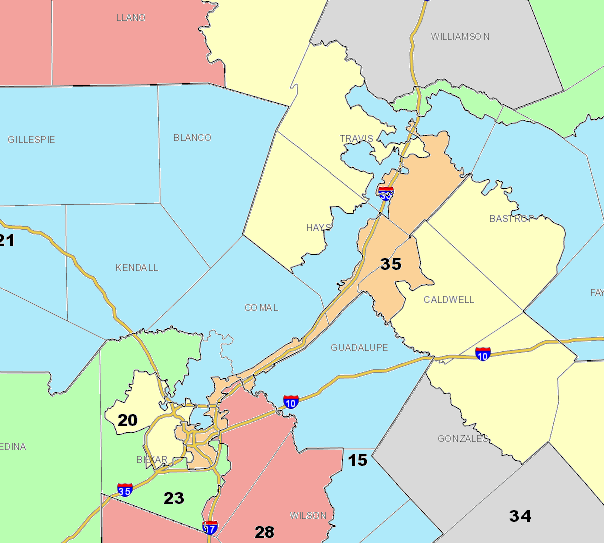
    Though U.S. Congressional Districts, State Senate Districts, and State House districts were all affected by the new maps, I want to focus on three U.S. Congressional Districts, including some shown in this map here:

  • District 35: Lloyd Doggett may not be gone, but District 35, the one Doggett plans to run in, is now 65% Hispanic and mostly based in San Antonio. And the recriminations have already started among Democrats: “If Lloyd Doggett would man up and spend that $3 million he’s been hoarding for the last decade, then we could have an extra Democratic seat.” Doggett dodged a bullet when District 20 incumbent Charlie Gonzalez (son of long-time Congressmen Henry B. Gonzalez, who held the office before him) announced he was retiring, letting up-and-comer Joaquin Castro run for that seat instead of 35, but there’s no shortage of San Antonio-based Democratic contenders, including Bexar County Tax Assessor-Collector Sylvia Romo. (There are two Republicans running for District 35, Susan Narvaiz and Rob Roark, both of San Marcos, but given that the new district went for Obaama by 63%, it’s going to be quite an uphill climb for any Republican.) One of the candidates currently running in District 35 is former Democratic Congressman Ciro D. Rodriguez (who is very pissy indeed about redistricting), who previously represented:
  • District 23: This seat is currently held by Republican Francisco “Quico” Canseco, who beat Rodriguez by a little over 7,000 votes in 2010. The redistricting map passed by the legislature made Canseco’s district more Republican, but the compromise district scales back Republican gains. It’s now slightly more Republican (50% of the new district voted for Obama in 2008, down slightly from 51% in the old district), but it’s still close enough that Democrats have to consider this a prime takeover target. Still, Canseco now has the power and name recognition of incumbency, and even if Obama wins (doubtful and frightful, but possible), I doubt his coattails will be particularly long in San Antonio. Texas State Rep. Peter Gallego is the likely Democratic candidate, but so far Canseco is beating him in the fundraising race over three to one. (Disclaimer: Canseco is one of two U.S. congressional candidates I donated to in the 2010 election cycle (three if you count attending a couple of John Carter’s picnics at $10 a pop).)
  • District 27: This is the district where Republican Black Farenthold narrowly edged Democratic incumbent Solomon Ortiz in 2010. (Despite the narrowness of the result, Ortiz announced he wouldn’t be trying to reclaim his old seat.) The interim map successfully makes Farenthold’s seat more safely Republican; Obama pulled 53% of the vote in the old district, but only 40% in the new. Farenthold also has a considerable fundraising advantage. The Democratic who raised the most for that race is Cameron County District Attorney Armando Villalobos. However, Cameron County is now in District 34.
  • All in all, Texas Republicans expect to pick up two to four U.S. Congressional seats thanks to redistricting, which looks extremely doable.

    And now we finally have election dates:

  • March 2: Filing for office reopens
  • March 6: Filing closes again
  • May 14: Early voting begins
  • May 26: Early voting ends
  • May 29: Primary Day
  • June 7-9: Republican and Democratic state conventions
  • July 31: Primary Runoff
  • References

  • Interactive Redistricting Map
  • The Texas Congressional Delegation
  • FEC Page for Texas Congressional and Senate Fundraising
  • List of 2012 Texas Republican Congressional Candidates
  • List of 2012 Texas Democratic Congressional Candidates
  • The Texas Redistricting Blog
  • Over on the left side of the Blogsphere, the Kos Kids have put up the a breakdown that includes numbers on how each District voted in the 2008 Presidential race.
  • The New Maps Are Here, The New Maps Are Here!

    Wednesday, February 29th, 2012

    The new redistricting maps, that is. Sounds like they haven’t been made final just yet, but most likely will be. If that happens this week, that might mean a late April (rather than May) primary.

    You can take a look at them here.

    (Hat tip: Blue Dot Blues, who, alas, hasn’t put me on her blogroll…)

    Voter Registration: Chill

    Friday, February 24th, 2012

    The Right Side of Austin offers up reassurance for those anxious over the fact they haven’t received their voter registration cards: Relax.

    Because Democrats and liberal special interest groups like LULAC and the NAACP want to achieve in courts what they couldn’t at the ballot box, voter registration cards can’t be sent out until the legal redistricting battle has been settled. But if you were a registered voter last year, your new voter registration card will automatically be mailed out once the redistricting fight is settled.

    So if you’ve been worrying, don’t. Once a date for the primary is set, everything should take care of itself…

    LinkSwarm For February 15, 2012

    Wednesday, February 15th, 2012

    Time for another roundup of this and that:

  • Media Matters is a paranoid interest group that works as an extension of the Democratic Party, and which many liberal journalists take their marching orders from. In other news, pro-wrestling is fake.
  • Mark Steyn on Obama as Henry VIII.
  • Harry Reid and the Democratic caucus totally support Obama’s war on Catholicism.
  • A goodly percentage of Notre Dame’s professors have rendered their judgment on Obama’s war on Catholicism: Unaccapetable.
  • Your tears, Rahm. Let me taste them.
  • Texas ranks top in exporting yet again, with exports bringing in more than $249.8 billion in 2011, up 20.7% from $206.9 billion in 2010.
  • Is the redistricting fight all about Lloyd Dogget? So black and Hispanic interest groups are fighting a long, drawn-out court battle to protect a single white incumbent.
  • I got that story from Must Read Texas, which seems like a veritable firehose of Texas news and links.
  • To support its welfare state, Denmark travels quite a way down the road to serfdom: “A suspected terrorist has more legal protection than the ordinary Danish taxpayer.”
  • Bin Laden gave up on jihad. Maybe.
  • Iowahawk takes aim at a certain Clint Eastwood commercial.
  • Clayton Cramer: A lot more people use guns to defend themselves than you think. (Hat tip: Say Uncle.)
  • Holly Hansen breaks radio silence to note skulduggery in Round Rock ISD. And here’s Part 2.
  • Some Marin County residents are fighting George Lucas’ plans to expand film-making facilities. Because California is just doing so well it can afford to alienate job creators.
  • Texas Republican Party on Redistricting Lawsuits State of Play

    Tuesday, January 31st, 2012

    A long but informative breakdown of where things stand. The bottom line: The cases are still up in the air, Texas GOP is not directly involved in talks, and February 6 is the last day the case can be resolved and still have an April 3 primary.

    Supreme Court to District Court: No, You Can’t Overturn the Democratic Process to Help Democrats. Not Yours.

    Friday, January 20th, 2012

    OK, they didn’t use quite that language (and I must prepend the usual I Am Not a Lawyer disclaimer). But in issuing the decision (they had previously blocked the District Courts’ maps), the Supremes did say the San Antonio District Court had exceeded its authority in drawing new redistricting maps for Texas for no clear reason, and ordered the District Court to go back to the drawing board and create maps closer to what the legislation passed in the first place:

    Because it is unclear whether the District Court for the Western District of Texas followed the appropriate standards in drawing interim maps for the 2012 Texas elections, the orders implementing those maps are vacated,and the cases are remanded for further proceedings consistent with this opinion.

    Time and time again in this decision, the Supreme Court criticizes the District Court for their approach:

  • “To the extent the District Court exceeded its mission to draw interim maps that do not violate the Constitution or the Voting Rights Act, and substituted its own concept of ‘the collective public good’ for the Texas Legislature’s determination of which policies serve ‘the interests of the citizens of Texas,’ the court erred.”
  • “Because the District Court here had the benefit of a recently enacted plan to assist it, the court had neither the need nor the license to cast aside that vital aid.”
  • “Some specific aspects of the District Court’s plans seem to pay adequate attention to the State’s policies, others do not, and the propriety of still others is unclear.”
  • “The District Court also erred in refusing to split voting precincts (called “voter tabulation districts” in Texas) in drawing the interim plans.”
  • “The District Court also appears to have unnecessarily ignored the State’s plans in drawing certain individual districts.”
  • “The court’s approach in drawing other districts was unclear.”
  • Time in time again, the Supreme Court said to the District Court: “You screwed up. The State government has the responsibility to perform redistricting, and you shouldn’t overturn their work without explicit Voting Rights Acts reason, and you went and did it anyway.”

    Justice Clarence Thomas concurred with the opinion, but went even further, declaring that Section 5 of the Voting Rights Act of 1965 (the section requiring judicial preclearance of voting districts) was unconstitutional:

    In my view, Texas’ failure to timely obtain §5 preclearance of its new plans is no obstacle to their implementation, because, as I have previously explained, §5 is unconstitutional…Although Texas’ new plans are being challenged on the grounds that they violate the Federal Constitution and §2 of the Voting Rights Act, they have not yet been found to violate any law. Accordingly, Texas’ duly enacted redistricting plans should govern the upcoming elections. I would therefore vacate the interim orders and remand for the United States District Court for the Western District of Texas to consider appellees’ constitutional and §2 challenges in the ordinary course.

    Presumably, a more chastised District Court will come back in short order with a map that more closely resembles what the legislature passed, and not one designed to give Democrats in the court room what they couldn’t achieve at the ballot box.

    Supreme Court to District Court on Texas Redistricting Plan: REJECTED!

    Saturday, December 10th, 2011

    The Supreme Court Friday night “blocked a redistricting plan for Texas drawn by a panel of federal judges.”

    I’ve got to run off, and the issue is far from settled, but this is good news for the rule of law, and bad news for liberals wanting to abuse the court system to get what they want despite voters rejecting them again and again.

    [Edited to add: Crappy, hastily written headline now rewritten to make it clear this was a U.S. Supreme Court stay, not the Texas Supreme Court, which is obviously holds no sway over a U.S. District Court. - LP]

    The Washington Post Discovers Ted Cruz

    Friday, June 17th, 2011

    Washington Post writer Aaron Blake pays serious attention to Ted Cruz, and his role as Tea Party favorite. It’s a decent write-up for an out-of-state MSM outlet playing catch-up, but there are several statements about which I have at least some minor quibbles.

    For example, take this sentence

    That’s because he’s emerging as a potential top-tier candidate in the Lone Star state race, posing a real tea party threat to better-funded candidates in what should be one of the most expensive primary races in the country.

    There’s two things wrong with that sentence:

    1. Cruz isn’t “a potential top-tier candidate,” he’s arguably already the frontrunner.

    2. Saying that he’s “posing a real tea party threat to better-funded candidates” suggests that there are, in fact, better-funded candidates. Leppert only has more money on hand thanks to a $1.6 million loan (discounting loans, in Q1 Leppert pulled in slightly over $1 million, and Cruz pulled in slightly under $1 million), and even then the rest of Leppert’s fundraising relied heavily on max contributions from a limited number of Dallas-area donors. So Cruz is about as well-funded as anyone in the race right now. (Would Lt. Governor David Dewhurst change that if he jumped into the race? If he really wanted to commit a substantial portion of his personal fortune (consistently rumored, without verifiable attribution, to be around $200 million), yes it would.)

    Likewise his suggestion that Leppert is one of the “big boys” (outside of Dallas, his profile is no bigger than Cruz’s) seems misguided.

    Then there’s this:

    Dewhurst is the prohibitive favorite if he gets in, and Leppert has made a big splash early with his fundraising. But many conservatives aren’t waiting for Dewhurst—choosing instead to rally around Cruz.

    I think “prohibitive favorite” overstates the case a bit (I would use “formidable”), but the idea that conservatives have ever “waited” on Dewhurst is off-base.

    As so many other Republican politicians do, Dewhurst occupies that vast gray area between a RINO (think Arlen Specter before he went The Full Benedict) and a real movement conservative. The phrase “a self-described ‘George Bush Republican’” appears, unsourced, in his Wikipedia entry (and thus is automatically suspect), and sums up the feelings of many conservatives towards Dewhurst. He ran as a conservative, and mostly governed as a conservative, but every now and then he would go off on Big Government tangents that would infuriate proponents of limited government. Despite this, outside the state, Dewhurst is regarded as something of an “arch-conservative” for shepherding through the (constitutionally-required) 2003 redistricting.

    I wouldn’t go so far as to compare him to Charlie Crist (as some have), but there’s been real dissatisfaction with Dewhurst among movement conservatives, and it came to the fore with this year’s legislative sessions, where, despite having controlling majorities in both House and Senate, conservative Republicans found their agenda being thwarted in many ways great and small by Dewhurst in the Senate and Speaker Joe Straus in the House. Hence state senator (and possible U.S. Senate candidate) Dan Patrick’s lashing out at Dewhurst for thwarting his anti-TSA goping bill. Dewhurst managed to get the big things done (i.e., getting a budget passed without a tax hike), but there’s a sense among conservatives that he could have gotten a lot more conservative bills passed if he really wanted to, and that he “left money on the table” in the game of legislative poker by compromising when he didn’t have to

    So it’s not at all surprising that Dewhurst is viewed as a stanch conservative when viewed from inside the Beltway; by Washington, D.C. standards he is. But there’s a widespread sense among Texas conservatives that they should be able to elect a full-bore movement conservative to replace Kay Bailey Hutchison, and that David Dewhurst isn’t that guy. There was a good deal of debate over whether Ted Cruz or Michael Williams was the preferred choice; with Williams getting out of the race to run for a House seat, the issue has been resolved in Cruz’s favor, as indicated by his impressive array of endorsements.

    Still, those quibbles aside, the WaPo piece is a pretty solid look at Cruz, and is well worth reading for those following the Texas Senate Race.

    (In the future, Brooks might want to run this sort of piece by Jennifer Rubin, who has a lot better grasp of the nuances of conservative politics than most MSM observers.)