Time for another look at how Texas’ Red State model stacks up against California’s Blue State model, with a roundup of relevant news from the past few weeks.
Archive for the ‘Economics’ Category
Texas vs. California: Summer of Bankruptcy Edition
Friday, August 10th, 2012IowaHawk Brings The Gospel of Barack
Monday, July 23rd, 2012And Lo, Iowahawk did step forth from the heavens, and deliver unto us the Book of Barack.
And it was good.
The Myth of “Bloated Greek Defense Spending”
Tuesday, July 17th, 2012In order to divert attention away from the economic, moral, and political bankruptcy of Europe’s cradle-to-grave welfare state, some liberals, relying on figures from the Out of Our Ass Institute of Statistics, are tying to claim that Greece’s excessive spending comes from a “bloated defense budget.”
Try again. Greece only spends 5.5% of it’s budget on defense:
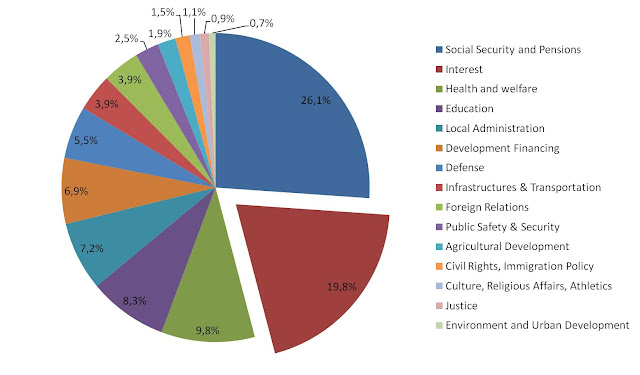
Either Europe (and the United States) must reform their runaway, bloated welfare states, or their welfare states will bankrupt their nations.
Texas vs. California: A Quick Roundup
Wednesday, July 11th, 2012Spent most of the day checking things off my list and web-surfing Creepy Pasta. So here’s a quick roundup of Texas vs. California tidbits:
⁄€#¢fifl‡•( ‹›fifl‡° °··‚‚
Austin Just Passed San Francisco (or California vs. Texas: Round 55)
Thursday, June 28th, 2012Today brings news that Austin just surpassed San Francisco in population to become the 13th largest city in the country. In fact, Texas had six of the top seven fastest growing cities over the past 14 months: Round Rock, Austin, Plano, McKinney, Frisco, and Denton placed 2-7, topped only by a post-Katrina New Orleans. And at only 7,000-odd residents behind Jacksonville and Indianapolis, expect Austin to be the 11th largest city in the country the next time this list is updated.
And that news gives me a great excuse to to another roundup of Texas vs. California!
Lest you think this is some kind of fluke, or that taxes are not the determining factor in this “escape from NY and California,” it isn’t just Texas that is gaining all these fleeing residents. The U.S. Census reported that all of the top 15 states for population growth during the past decade are no tax or low tax states like Nevada, Florida, Arizona, Utah, Georgia, North Carolina and South Carolina. It seems Americans are smarter than politicians give them credit for- they are voting with their feet for lower taxes, pro business attitude, and more economic freedom.
Because no state in the union has a better economy, let’s look “up close and personal” at the Texas miracle. Texas practices what I proudly call “Wild West Cowboy Capitalism.” And it works!
Texas has zero state income tax, zero capital gains taxes, and zero death taxes. It is a “right to work” state where employees may choose to join a union, but are never forced to. It is pro business and anti-lawyer (discouraging class action lawsuits and the first state to pass a “Loser Pays” law). Texas is also tight-fisted with welfare and entitlement benefits- unlike New York and California. The result of this limited government attitude is people with high incomes, assets, and ambition are moving into Texas, while those who lack work ethic, and feel entitled to handouts are moving out. Good riddance.
But the most important attribute of Texas is that its constitution limits the time that politicians can meet. The Texas Legislature is limited to meeting only 4 months every other year. That pretty much explains everything. Texas and my state of Nevada have no state income taxes and the fastest growing populations in America…not in spite of, but because the politicians aren’t allowed to sit in their seats all year long thinking of new ways to re-distribute income, impede business, and destroy jobs.
Greek Voting, Grexit, Spanic: Another EuroDebt Crises Roundup
Friday, June 15th, 2012So Greeks head off to the polls this weekend to (theoretically) choose whether to muddle along with a “right” (for Greece) government that will actually attempt to carry out something vaguely resembling austerity, or for Alexis Tsipras’ far-left Syriza party, who intends to re-enact Clevon Little’s scene from Blazing Saddles: “Drop the austerity demands, or I’ll drop out of the Euro and refuse to let Germany bail us out anymore!” “Do what he says, do what he says, that Greek’s crazy!” It’s anybody’s guess whether Greece will opt to keep the farce going for another few months, or finally set the whole house of cards tumbling down.
My guess is that there are still enough insiders who can benefits from dumping PIIGS bonds onto various sets of European taxpayers, so I expect that, one way or another, the Eurocrats will find a way to keep the charade up for another two or three months.
In light of that, here’s a roundup of Euro debt news:
Have a happy weekend!
While the Feiler Faster Thesis Won’t Save Obama’s Bacon
Sunday, June 3rd, 2012Micky Kaus, the Thinking Conservative’s Liberal, has been suggesting that the traditional thinking that the economy must be good at least six months before an election for the President to have a chance is wrong. His contention is that the Feiler Faster Thesis, the idea that the Internet has made it possible for much rapider media cycles to change people’s minds about things more quickly, will save Obama’s bacon even if we only see notable economy recovery, say, three or four months out.
I think the Feiler Faster Thesis is correct in general, but is mistaken in this particular instance. (And let’s temporarily ignore that I don’t think any economic recovery is in the offing at all this year.)
The problem is that this recession has been too long and deep for the Feiler Faster Thesis to save Obama even if the economy does pick up a few months before the election. People’s feelings about the economy are deeply tied to their personal experience. The people they know who are unemployed, the prices they pay at the grocery store, the foreclosures and lingering FOR SALE signs on their own street, the business and plants closings in their own city all trump the news cycle. While the Feiler Faster Thesis may explain rapid opinion changes about Iraq or Lady Gaga, it can’t override people’s own insecurity. Nobody cares about brightening economic indicators when they can’t pay their own bills
Which is not to say some people won’t pick up on economic news more rapidly. I’m sure that stock traders and hedge fund managers are working on faster cycles than ever before. But voters, especially independent and undecided voters, are still far more attuned to their own economic anxiety than to media narratives about a “recovery summer” they can’t see with their own eyes. Consumer confidence is considered a lagging economic indicator, which makes it precisely the sort of thing immune to the Feiler Faster Thesis.
The only people who think the Feiler Faster Theory might save Obama’s bacon are liberals who want it to.
EuroDoom for a Weekend in June
Friday, June 1st, 2012How about a nice slice of EuroDoom to ease you into the weekend?
With all the post-primary news, the European Debt Crises news has been chugging along for a while now. let’s look at some, shall we?
It’s a winner-take-all world. Countries that do well have to do a few things extremely well. Germany makes the world’s best machine tools, some of the best heavy engineering equipment, not to mention autos. German manufacturing dominates innumerable key niches. The Spanish don’t do anything well. They haven’t done anything well since the Spanish Empire outsourced its manufacturing to Flanders in the 16th century.
As a journalist told me yesterday, he worries whether the money in his pocket will be worth anything a year from now. Others worry about Germany’s increasingly negative image among recession-hit southern and eastern Europeans. Americans will understand this feeling well: you pay and pay to help others, only to have them turn on you in hatred and wrath, accusing you of horrible hidden motives and denouncing your selfishness.
EuroDoom #Grexit Update: Greeks Already Printing Drachmas?
Thursday, May 24th, 2012Are the Greeks already printing Drachmas? So says a completely unverified tweet from a random Twitter user. Really, what better source could you possibly ask for?
The Internet is alive with buzz on Greece exiting the Euro (see #grexit for a sip from the firehose). Sadly, there seems to be no buzz at all on reigning in the cradle-to-grave European welfare state that caused the crises in the first place.
More Grext/European debt crises news:
“Growth” to social democrats means growth in government’s size and reach, not growth in the real economy. This approach directly contributed to our current predicament; and more of the same will only exacerbate it.
Euro Update: The Euro is “An Unbridled Doomsday Machine”
Monday, May 21st, 2012Though markets have calmed a bit, the desperate search for a lever that will actually steer Europe away from the looming wall of a EuroCrash continues. Meanwhile, certain repeating motifs are detected:
Europe now has the lowest growth of any region in the world. We have already wasted years in trying to control this sickness in the euro, and we are saving the cancer and killing the patient. We have blighted countless lives and lost countless jobs by kidding ourselves that the answer to the crisis might be “more Europe”. And all for what? To salvage the prestige of the European Project, and to spare the egos of those who were wrong and muddle-headed enough to campaign for the euro.
Johnson is right about the cancer, but slightly wrong about the cause: The European cradle-to-grave welfare state is the cancer; the Euro just made it slightly more malignant.
But with two separate commentator’s calling the Euro a Doomsday Machine, I feel a new meme coming on:

Not to mention much better chances of being linked by Jonah Goldberg and James Lileks…
Greece, Spain, Ireland, Portugal and Italy (and California). In each case, the promise of more bailouts and a steady flow of cheap money only produced more reckless behavior, excessive levels of government spending and record levels of debt.
Johan Norberg, a senior fellow at the Cato Institute, summarizes the results: “From 1997 to 2007, government expenditures increased by around 6 percent annually in Spain, Portugal and Greece, while population remained mostly stable. Spending increased by 4 percent a year in Italy — even while the economy shrank.”
Consequently, “Between 2000 and 2010, Portugal increased its public debt as a share of GDP from 49 percent to 93 percent, France from 57 percent to 82 percent, Italy from 109 percent to 118 percent, and Greece from 103 percent to 145 percent,” reports Norberg.
The European crisis is as much a crisis of politics as economics. The current paralysis of the Greek political system demonstrates the point very clearly. EU policy has actively contributed to this crisis by effectively sealing off discussion of the political problems thrown up by austerity.
Budgetary policy is at the core of traditional democratic politics in Europe but the management of the euro zone is increasingly being effected not through democratic institutions but via a centralised and depoliticised form of technocratic fiat. The “stability” narrative has triumphed over the need for legitimacy as the crisis in Europe has deepened.
Ivan Krastev, the eminent political scientist, argues that we have now arrived at a point where national governments have politics but are no longer in control of policy, including budgetary policy, which is moving via the fiscal treaty and other measures to the EU level.
On the other side of this divide the European Union has policies but no politics, since decisions are increasingly being made by technocratic managers rather than directly elected representatives of the European public. The euro zone crisis has thus amplified an existing problem – the absence of both a European citizenry and a transparent European level political process.