George P. Bush, the current land commissioner of Texas, officially announced at a campaign kick-off event on Wednesday night that he would be running to be the top attorney for the Lone Star State.
“It’s time for a change,” said Bush at the event, held at a bar in Austin.
The move sets up what is sure to be a heated Republican primary race between Bush and current Attorney General Ken Paxton.
Bush, the grandson of former president George H. W. Bush and son of former Florida governor Jeb Bush, was considering a potential run for the position last October after several of Paxton’s top aides raised allegations of abuse of office and bribery against their boss.
“Enough is enough, Ken,” said Bush. “It’s time for you to go.”
Perhaps the most influential endorsement in the race will be from former president Donald Trump.
Last week, Bush tweeted, “Great to speak with President Trump to discuss the future of Texas and how we are keeping up the fight to put America first. I appreciate the words of encouragement and support. Big things coming soon!”
I can’t imagine that there’s a lot of love lost between Trump and the Bush clan, but stranger things have happened.
This decision is an indication that Bush has (probably correctly) identified Paxton as the weakest of the three top statewide office holders. Paxton’s low-grade scandals, clocking in at a mere 20 Milli-Hunters, are pretty weak as scandals go, but they have slightly tarnished what has generally been a very effective and conservative tenure as Attorney General.
But so too has the long-running Alamo redesign controversy sapped George P. Bush’s popularity. In 2014 he ran slightly ahead of Governor Greg Abbott in total votes. In 2018, he ran a couple of points behind.
Bush41 built a very effective fundraising machine, to the benefit of both 43 and George P. Bush, so I imagine Bush will be a moderate favorite in the race, but not a prohibitive one. Also expect Bush to get favorable media coverage right up until he clinches the nomination, at which point the MSM will turn on him in favor of whoever is the Democratic candidate. (Right now former Galveston mayor Joe Jaworksi is the only declared Democrat in the race.)
It also indicates that Bush thinks both Abbott and Lieutenant Governor Dan Patrick are too strong to take on. In this I think he’s correct as well. Abbott has a huge warchest to fend off any challenge. Dan Patrick has about half that, and strong conservative credentials that make it difficult for Bush to unseat him in a Republican primary.
If you’ve been following the Texas legislature for any appreciable length of time, then the close of the 87th Legislative Session must have felt eerily familiar to you: A whole bunch of conservative priority bills made it to the one yard line, only to be killed by various political maneuvers and the legislative schedule.
On Sunday night, with just hours left for the Texas House to give its final approval to legislation, Democrats left the chamber and busted the quorum.
By doing so, they were able to kill multiple bills in the process, including a high-profile omnibus election integrity bill and a bail reform bill.
Both bills were deemed priorities of Gov. Greg Abbott in February.
In order for the House to conduct business, a quorum of two-thirds of the chamber’s members (100 out of 150) are required to be present.
Despite being an emergency priority item that lawmakers have been allowed to address since February 1, Senate Bill 7—election integrity legislation that has been the target of Democrats nationwide—was scheduled to finally be passed on Sunday afternoon, just hours away from the midnight deadline.
As debate began, Democrat members started to leave the chamber, taking their voting keys with them.
When a vote was taken on whether to excuse one of the members, the tally revealed that only 86 members were present in the chamber.
The House then adjourned until 10 a.m. on Monday, without objection.
Abbott quickly took to Twitter to say election integrity, as well as bail reform, would be among the items added to a special session call.
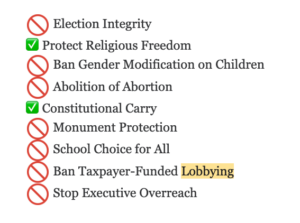
These were just many of the conservative priority bills that died in the session. Michael Quinn Sullivan provided the following scorecard via email:
Incompetence or sabotage? It seems like no matter who sits in the speaker’s chair, be it Dade Phelan, Dennis Bonnen or Joe Straus, conservative bills make it through the Senate only to die in the House at the last minute. It’s a pattern that repeats itself over and over again.
I’m not enough of an insider to tell you exact culprits behind killing conservative legislative priorities (though Speaker Phelan obviously deserves a considerable share of blame, as does Republican state representative Jeff Leach, who’s delaying tactics over a point of order helped doomed many of the above bills).
Governor Greg Abbott is threatening to veto legislative funding in retaliation for Democrats walking off the job, and threatening to hold a special session to get it done. I’m all in favor of calling a special session to pass those items, but it’s unclear whether it would be a special summer session or the already-planned redistricting session after census data is made available. It’s also unclear whether any legislator would be motivated by the threat of losing their $600 per month paycheck.
In any case, what is clear is that conservatives need a new gameplan for the next special session. If you have any ideas on what that should be (or have good candidates (besides Democrats) for who is really the power behind killing conservative bills), feel free to share them in the comments below.
When state Rep. Steve Toth (R-The Woodlands) introduced his bill to stem the teaching of critical race theory in Texas classrooms, he accepted almost two dozen amendments by Democrats that heaped a host of figures and documents onto the bill’s list of required reading to understand the nation’s founding.
After the bill passed the state House and then jumped to the Senate, the State Affairs Committee stripped these amendments away.
On Monday, Sen. Bryan Hughes (R-Mineola) introduced a committee substitute — a changed version of a bill — nearly identical to Toth’s original version, House Bill (HB) 3979. In fact, the text of the committee substitute is a carbon copy of Toth’s Senate companion bill, carried by Sen. Brandon Creighton (R-Conroe), which the Senate already passed.
This may seem like a lot of hugger mugger, but passing an amended version of the House’s bill makes it easier for the legislation to pass without a conference committee if the House accepts the senate changes.
While committee substitutes are a common stage in the life of bills, this bill’s committee substitute is notable for confirming a suspicion of some Democrats in the House, who asked Toth if the Senate would slough away their amendments. Toth said he bore no responsibility for the Senate’s actions. Ultimately, his acceptance of the amendments gained no Democratic support in the final House vote on the bill.
Snip.
As some critics noted in the State Affairs Committee hearing, the bill does not mention critical race theory explicitly. Rather, one part of the bill forbids teachers from pushing certain tenets of critical theory as it has been distilled and popularized. Examples include the notion that meritocracy is racist or prejudiced, or that certain racial groups bear collective guilt or responsibility.
Here are the eight concepts that teachers, administrators, and other school employees would not be able to require or make part of a course:
one race or sex is inherently superior to another race or sex;
an individual, by virtue of the individual’s race or sex, is inherently racist, sexist, or oppressive, whether consciously or unconsciously;
an individual should be discriminated against or receive adverse treatment solely or partly because of the individual’s race or sex;
members of one race or sex cannot and should not attempt to treat others without respect to race or sex;
an individual’s moral character is necessarily determined by the individual’s race or sex;
an individual, by virtue of the individual’s race or sex, bears responsibility for actions committed in the past by other members of the same race or sex;
an individual should feel discomfort, guilt, anguish, or any other form of psychological distress on account of the individual’s race or sex; or
meritocracy or traits such as a hard work ethic are racist or sexist or were created by members of a particular race to oppress members of another race.
Parents of all races, creeds and colors have come together to reject the radical racism of critical race theory, and now Texas is rejecting at the state level.
The Biden Recession blooms, Bibby bombs, Baltimore burns, inscrutable Flu Manchu somehow infects the vaccinated, and Canada’s institutional religious hostility inflicts its revenge on the pastor that defied them. It’s the Friday LinkSwarm!
If inflation wasn’t enough to remind you of Biden’s reboot of That 70’s Show, how about long gas lines? An east coast gas pipeline was shut down by ransomeware attack launched by a hacking group called DarkSide.
Rendered with the magic of dyslexia
We’re actually very fortunate that a for-profit gang carried out this hack, rather than a terrorist group or state actor.
Seeing some reports stating that Israeli ground forces entered Gaza, but seeing some Twitter commentary that, no, they haven’t entered, but that IDF artillery and tanks are pounding Hamas tunnels.
Two weeks ago Turkish forces launched a military assault in the Duhok region of Iraqi Kurdistan. Villagers were forced to ‘flee in terror’ from raining bombs. It was only the latest bombardment of the beleaguered Kurds by Turkey, NATO member and Western ally. It did not trend online. There were no noisy protests in London or New York. The Turks weren’t talked about in woke circles as crazed, bloodthirsty killers. Tweeters didn’t dream out loud about Turks burning in hell. The Onion didn’t do any close-to-the-bone satire about how Turkish soldiers just love killing children. No, the Duhok attack passed pretty much without comment.
But when Israel engages in military action, that’s a different story. Always. Every time. Anti-Israel fury in the West has intensified to an extraordinary degree following an escalation of violence in the Middle East in recent days. Protests were instant and inflammatory. Israeli flags were burned on the streets of London. Social media was awash with condemnation. ‘IDF Soldier Recounts Harrowing, Heroic War Story Of Killing 8-Month-Old Child’, tweeted The Onion, to tens of thousands of likes. Israel must be boycotted, isolated, cast out of the international community, leftists cried. Western politicians, including Keir Starmer, rushed to pass judgement. ‘What’s the difference?’, said a placard at a march in Washington, DC showing the Israeli flag next to the Nazi flag. The Jews are the Nazis now, you see. Ironic, isn’t it?
This is the question anti-Israel campaigners have never been able to answer: why do they treat Israel so differently to every other nation on Earth? Why is it child-killing bloodlust when Israel takes military action but not when Turkey or India do? Why must we rush to the streets to set light to the Israel flag but never the Saudi flag, despite Saudi Arabia’s unconscionable war on Yemen? Why is it only ‘wrong’ or at worst ‘horrific’ when Britain or America drop bombs in the Middle East but Nazism when Israel fires missiles into Gaza? Why do you merely oppose the military action of some states but you hate Israel, viscerally, publicly, loudly?
The judgement and treatment of Israel by a double standard is one of the most disturbing facets of global politics in the 21st century. That double standard has been glaringly evident over the past few days. Israel is now the only country on Earth that is expected to allow itself to be attacked. To sit back and do nothing as its citizens are pelted with rocks or rockets. How else do we explain so many people’s unwillingness to place the current events in any kind of context, including the context of an avowedly anti-Semitic Islamist movement – Hamas – firing hundreds of missiles into civilian areas in Israel? In this context, to rage solely against Israel, to curse its people and burn its flag because it has sent missiles to destroy Hamas’s firing positions in Gaza, is essentially to say: ‘Why won’t Israelis let themselves be killed?’
Last year, Iran’s Supreme Leader Ayatollah Ali Khamenei admitted for the first time that his country was supplying the Palestinian terrorist groups with weapons. “Iran realized Palestinian fighters’ only problem was lack of access to weapons,” Khamenei said in an online speech.
“With divine guidance and assistance, we planned, and the balance of power has been transformed in Palestine, and today the Gaza Strip can stand against the aggression of the Zionist enemy and defeat it.”
Khamenei went on to offer the reason why Iran was sending rockets, missiles and tons of explosives to the Gaza Strip: “The Zionist regime is a deadly, cancerous tumor in the region. It will undoubtedly be uprooted and destroyed.”
Khamenei’s admission shows how the mullahs in Tehran have been lying to the West for many years. In 2011, Mohammad Khazaee, the Permanent Representative of Iran to the United Nations, sent a letter to the President of the United Nations Security Council in which he vehemently denied that Iran was smuggling weapons into the Gaza Strip.
Baltimore was one of the first cities to try “de-policing.” How did that work out for it? Not so hot:
This experiment has been an abject failure. Since 2011, nearly 3,000 Baltimoreans have been murdered—one of every 200 city residents over that period. The annual homicide rate has climbed from 31 per 100,000 residents to 56—ten times the national rate. And 93 percent of the homicide victims of known race over this period were black.
Remarkably, Baltimore is reinforcing its de-policing strategy. State’s Attorney for Baltimore Marilyn Mosby no longer intends to prosecute various “low-level” crimes. Newly elected mayor Brandon Scott promises a five-year plan to cut the police budget. Both justify their policies by asserting that the bloodbath on city streets proves that policing itself “hasn’t worked”; they sell their acceleration of de-policing as a “fresh approach” and “re-imagining” of law enforcement.
The tried “broken windows” policing without understanding it:
The motivation for de-policing traces to the city’s botched response to an earlier crime epidemic in the 1990s, when it averaged 45 homicides per 100,000 population, up 55 percent from the previous decade. So in 1999 Baltimoreans elected a mayor, Martin O’Malley, who promised to apply New York’s successful crime-fighting approach, where homicides had plunged by two-thirds over the decade (to one-ninth Baltimore’s rate) thanks to an expanded police force and innovative, proactive policing strategies.
O’Malley’s first commissioner, NYPD veteran Ed Norris, initially showed promise. By 2002, Baltimore’s homicide rate was 20 percent below its 1999 level. As O’Malley pressed for more, however, relations soured, and Norris departed (and some financial shenanigans eventually earned him a stint in federal prison). His successor, Kevin Clark, another NYPD import, also became embroiled in personal and professional controversy; he was fired and succeeded by a Baltimore PD holdover. By the time O’Malley moved to the Maryland governor’s mansion in 2007, Baltimore’s homicide rate was back to its 1990s average.
The problem was not just turmoil among BPD leadership and meddling (or worse) by O’Malley, but a fatal misunderstanding of what had worked in New York. There, the broad spectrum of criminal activity was addressed efficiently and with community engagement. Detailed data helped guide resources to crime hot spots. Chief William J. Bratton implemented the Broken Windows theory-inspired community-policing methods pioneered by social scientists George Kelling and James Q. Wilson, who understood how small manifestations of disorder could grow to larger ones. Minor offenses that made residents feel unsafe or hinted at acceptance of violence were addressed in order to improve quality of life, strengthen communities, and prevent serious crime.
In Baltimore, however, Broken Windows was misunderstood and misapplied. It mutated into a malignant variant, “zero tolerance” policing—and BPD conduct became not just intolerant but unfocused and excessive. As David Simon, a veteran Baltimore crime reporter and creator of HBO’s The Wire, summed things up, O’Malley “tossed the Fourth Amendment out a window and began using the police department to sweep the corners and rowhouse stoops and [per Norris] ‘lock up damn near everyone.’” That sometimes even included Wire crew members on their way home from a long day of filming.
True Broken Windows policing, in Kelling’s words, creates “a negotiated sense of order in a community” and involves collaboration between cops and residents. As one BPD vet put it, “You go to a community—before we come in, [we should ask], ‘What are the main things you all can’t stand?’ Everybody playing music at 11:30 at night, kids sitting on the corner, the prostitutes using the little park over there to work their trade. Now, ‘What don’t you care about?’ See the old guys sitting down at the corner playing cards every night? They could stay there all they want. . . . Then the police come in and do what the neighborhood wants. You just don’t go out and lock everybody up.” But, he concluded, “we went overboard.”
Then they adjusted:
O’Malley’s successor, Sheila Dixon (the city’s first female and third black mayor), defied her staff’s recommendations and named as commissioner Frederick Bealefeld, a BPD lifer with no college pedigree. “It was something in my gut that felt he was the best person,” Dixon explained. “I could just feel his passion.”
Bealefeld understood community policing better than the New York imports, addressing disorder and crime efficiently. He attended community meetings tirelessly to find out what residents wanted done; got cops out of their cars and walking patrols more often; invested in better training; and supported cops’ work with kids. Partnering with a savvy federal prosecutor, Rod Rosenstein, he targeted known dealers and shooters, emphasizing quality arrests—including of cops on the take. It worked. Even as arrest totals fell (to 70,000 by 2010), so did the homicide rate, to a low of 31 per 100,000 residents by 2011.
And then the Social Justice started:
Dixon had embezzled gift cards meant for the poor—petty corruption is a Baltimore tradition—and in 2010 was succeeded by Stephanie Rawlings-Blake. The Oberlin-educated former public defender was more liberal than Dixon, personally lukewarm to Bealefeld, and sympathetic to those embittered by O’Malley’s “zero tolerance” policies. And she faced budget problems. De-policing, then, seemed to tick all the right boxes—and, with the homicide rate at a 23-year low (though still almost seven times the national average), there would be little outcry against it.
First came some defunding, with a 2 percent pay cut to help address a recession-related budget pinch; cops’ contributions to their pension funds also were raised to help address shortfalls there. The new mayor’s first proposed budget actually cut the BPD’s request by 10 percent, though the difference eventually was split. Demoralized, experienced cops started retiring in numbers.
Rawlings-Blake did not replace them, and she trimmed staffed aggressively. BPD budgets had consistently authorized about 3,900 positions through the O’Malley and Dixon years. Rawlings-Blake took that down by 5 percent in her 2012 budget and another 6 percent in 2013. Bealefeld called the cuts “unconscionable” and retired. As he’d told the head of the police union at one point, “you can only beat down your horses for so long before they give up.”
So even before Freddie Gray died in police custody in 2015 and Baltimoreans rioted, the BPD had 460 fewer budgeted “horses” than under Mayor Dixon—with 300 fewer on patrol, conducting investigations, or targeting violent criminals. Not surprisingly, the homicide rate surged 20 percent by 2013. And after the city’s newly elected prosecutor, Mosby, criminally charged six uniformed officers in Gray’s death—though she failed to convict any—proactive policing essentially ceased. The city’s annual body count jumped and has remained tragically high since.
Speaking of defunding the police, Minneapolis Mayor Jacob Frey admits that defunding the police was a huge mistake. If only the rest of the Minneapolis had realized this before all the deaths.
Just about everything they told us about transmission vectors for Mao Tze Lung was wrong:
Bars, gyms and restaurants. Those were just a few settings health experts warned could become hotbeds for COVID-19 spread as states began reopening in the spring and summer of 2020 following the first and second waves of the coronavirus pandemic in the United States.
Yet, public data analyzed by ABC News appears to tell a different story. The data from states across the country suggests specific outbreak settings (including bars, gyms, restaurants, nail salons, barbershops and stores — for the full list, see graphic below in story) only accounted for a small percentage, if any, of new outbreaks after the pandemic’s inital wave in 2020.
Snip.
Based on ABC News’ analysis of public data of all coronavirus cases in four states and D.C., the outbreak settings accounted for less than 5% of all COVID-19 cases in those states.
“World’s Most Vaccinated Nation Sees Active COVID Cases Double In Under A Week.” Mysterious uptick in the Seychelles.
Dave Hunt represented Clackamas County in the Oregon House of Representatives from 2003 through 2013. Hunt was the former Democratic Leader, Majority Leader, and Speaker of the House for the State of Oregon. As a legislator, Hunt the sponsor of a bill criminalizing sex trafficking in 2007. Hunt is currently a lobbyist working to influence the very chamber he left.
However, even more ironic in 2011, Dave Hunt use his position to support and vote for HB 2714. That bill created the crime of commercial sexual solicitation, the exact crime police used to charge Hunt when he was arrested and cited.
Sort of sounds like a garden variety prostitution solicitation charge. But if he’s one of the legislators to redefine that as “sex trafficking,” my sympathy is extremely limited.
NRA’s bankruptcy petition has been dismissed. Understandably, since it seemed a transparent ploy to begin with. It’s too bad Wayne LaPierre seems intent on dragging the NRA down with him…
Mark Sebu follows up on the Kentucky Ballistics explosion. Evidently it would haven taken 161,520 PI to shear the threads off the Sebu RN 50. Also, there were no pre-cuts on the sabot, suggesting it may indeed have been a counterfeit SLAP round that caused the explosion.
Not the Babylon Bee: O.J. Simpson backs Liz Cheney, accuses the Republican Party of “dishonesty.” I don’t feel I can adequately parody this real-life event, even though I should probably take a stab at it…
Top Gear/Grand Tour presenter James May found out that trickle charging a Tesla S’ main car battery didn’t charge the ordinary car battery, the one responsible for regular electric systems…like unlocking the hood latch to reach the same battery. Result: an hour of work just to reach the dead battery.
Speaking of impractical automotive accoutrements, here’s a Bugatti watch with a “working” W16 engine, yours for a mere $280,000…
Gov. Greg Abbott has gained another challenge from the right, with the addition of former State Sen. Don Huffines into the gubernatorial race on Monday.
“I’m a proud fifth-generation Texan,” said Huffines. “For too long, Texas has been let down by politicians who offer nothing but excuses and lies. Our border is still wide open. Property taxes keep going up. And our election laws continue to be ignored. Plain and simple, our politicians aren’t getting things done, and Texans have rightfully run out of patience.”
“I will fight and win on behalf of Texans. We will protect our great state and secure our freedoms. I am ready to take on the federal government and the entrenched elites of the Austin swamp. We will finally finish the wall and secure our border, and we’re not going to ask for permission to do it. We will put Texas on a path to eliminating property taxes. And we will enforce our sacred voting laws so that the voices of lawful voters are preserved and not diluted through corrupt election procedures,” he added.
Don Huffines was first elected to the Texas Senate in 2014, after defeating liberal Republican incumbent John Carona in the GOP primary.
Immediately, Huffines made his mark as one of the most conservative members of the chamber, on more than one occasion grinding the normally scripted Senate to a halt by offering amendments that attempted to improve Texas’ open carry law and completely phase-out the state’s margins tax.
Huffines also led the charge to take down “Dallas County Schools,” a corruption scheme that stole millions of dollars from Texas taxpayers and led to the imprisonment of six individuals.
Huffines was defeated in the Senate by Democrat Nathan Johnson in the 2018 Democrat sweep of Dallas County.
Since then, Huffines has continued to be a figure in the conservative movement, traveling the state to pull back the curtain on the true nature of the Texas Legislature, as well as being a sharp critic of the governor.
Is Huffines a serious threat to Abbott? Let’s just say he’s a more serious 2022 Texas Gubernatorial candidate than Chad Prather or Kurt Schwab. Or, for that matter, Barbara Krueger or Larry SECEDE Kilgore, the two nobodies Abbott wiped the floor with in the 2018 Republican primary. State senator is a pretty decent launching pad for statewide office, as Dan Patrick can attest. But no one has jumped straight from the state legislature to the Governor’s mansion since Dolph Briscoe did it in 1972, and that was after a previous gubernatorial run, plus the Sharpstown scandal. Mostly the the path to the governor’s mansion runs through a lower state-wide office (Attorney General and the Texas Supreme Court for Abbott, Lieutenant Governor and Agricultural Commissioner for Rick Perry, Treasurer for Ann Richards).
Up until last year, Abbott was considered a popular governor and a shoe-in for reelection. Then the 2020 lockdowns happened, then the disaster of the ice-storm. No one blames Mao Tse Lung on Abbott, and he clearly weathered the coronavirus crisis better than Andrew Cuomo, Gavin Newsom or Grethen Whitmer (to damn him with very faint praise indeed), but he waited far too long to lift the lockdown and mask mandate orders when it was obvious they had no effect on viral spread, especially compared to Ron DeSantis. Likewise, the ice storm was obviously not of Abbott’s making, but the years of lax oversight of ERCOT and a failure to push reliable fossil fuel over acquiescence to subsidies for trendy (and unreliable) renewables made the crisis far more severe than it had to be.
So Abbott probably is vulnerable, but I’m not sure Huffines is the candidate to take advantage of it. Abbott has at least $47 million in the bank, an extremely formidable warchest going into the primary season. (If Matthew McConaughey does jump into the race, he may need all of it.) Huffines has conservative bonafides, but losing your last race is seldom an indicator that you’re ready to step up a weight class (Richard Nixon not withstanding). Huffines, like Abbott, seems more like an artifact of the bygone pre-Trump political era, and thus very unlikely to defeat Abbott in the Republican primary.
For almost as long as I’ve been following politics, Democratic Party analysts like Ruy Teixeira have been confidently predicting a new, permanent Democratic majority based on the the demographic trend of rising numbers of minority voters, which explains why Democrats are so committed to keeping the spigot of illegal aliens flowing into America, as they viewed each as an Undocumented Democrat to be legalized via amnesty.
Strangely enough, things always seem to get in the way of this “natural” Democratic Party majority. First the white working class started defecting, then came the 2010 and 2014 Democrat off-year election wipeouts. Now the good ship “Demographics Favor Democrat Destiny” has run aground on the rocky outcropping known as “Donald Trump.”
There’s still lots of enthusiasm for Trump among Hispanics in Florida:
The South Florida-based Patriotas con Trump, or Patriots with Trump, has held multiple rallies outside Mar-a-Lago, members send messages all day in their WhatsApp group, and a smaller group of 10 meet regularly to brainstorm ways to recruit more members — and help get Republicans elected in 2022. They’re also looking ahead to 2024.
“We are Republican, but what we really like is what Trump promotes,” Laureano Chileuitt, the group’s leader, said. A physician, Chileuitt practiced neurosurgery in his native Colombia until he came to the U.S. in 2001.
“That’s why we consider him our caudillo,” Chileuitt said, using the Spanish word for strongman. While the term has a negative connotation in the U.S., it doesn’t for Chileuitt. “It just means he’s ‘the leader,’ like Uribe,” he said, referring to Álvaro Uribe, the right-wing former president of Colombia. “We are anti-globalization and anti-communism.”
Fueling such enthusiasm is the polarizing politics in Latin America, more options in conservative Spanish-language media, the presence of the Trump family in Florida and a state governor that remains a close ally of the former president.
Today, many in Miami still speak about Trump as often as they did when he was president. Like Patriotas con Trump, many small grassroots groups that sprung up during the election period are still active.
“Trump has not lost much support in this community,” Eduardo Gamarra, a Florida International University political scientist, said after conducting a poll for a private client.
Trump and Republicans made substantial gains among these groups in the 2020 election. The biggest shift toward Republicans was among non-Cuban and non-Puerto Rican Latinos, and that’s where a lot of the enthusiasm is concentrated now.
Venezuela’s ongoing crisis, Nicaragua’s human rights situation, Argentina’s return to leftist populism, and Peru’s runoff elections, with a socialist leading in the polls, all influence Latinos here and sharpen their focus on Trump.
While few Latinos cite U.S. foreign policy when polled about voting preferences, Gamarra finds communities in Florida are being influenced by politics in their home countries.
Trump is viewed by his international supporters, especially in Latin America, as a key ally in the anti-Communist fight. And in a state where Latinos have a strong connection to family and friends back home, the nexus between Trump and supporters of the Latin American right is strengthening.
Likewise, Republicans made big inroads among Hispanics in Texas:
The Democrats and the left try to make people believe they will flip Texas. They make gains in Houston, Dallas, and Austin, but not in the place most think would vote Democrat.
Props to The New York Times for casting a spotlight on the Hispanic Republicans in south Texas, who took everyone by surprise in November.
You would think the political leaders along the Rio Grande belonged to the Democrat Party. I wouldn’t blame you if you assumed they identified more with the far-left.
Author Jennifer Medina wrote that when you enter the Hidalgo County Republican Party’s office you see a bulletin board with the local leaders, including Hilda Garza DeShazo, Mayra Flores, and Adrienne Pena-Garza:
Hispanic Republicans, especially women, have become something of political rock stars in South Texas after voters in the Rio Grande Valley shocked leaders in both parties in November by swinging sharply toward the G.O.P. Here in McAllen, one of the region’s largest cities, Mr. Trump received nearly double the number of votes he did four years earlier; in the Rio Grande Valley over all, President Biden won by just 15 percentage points, a steep slide from Hillary Clinton’s 39-point margin in 2016.
That conservative surge — and the liberal decline — has buoyed the Republican Party’s hopes about its ability to draw Hispanic voters into what has long been an overwhelmingly white political coalition and to challenge Democrats in heavily Latino regions across the country. Now party officials, including Mr. Abbott, the governor, have flocked to the Rio Grande Valley in a kind of pilgrimage, eager to meet the people who helped Republicans rapidly gain ground in a longtime Democratic stronghold.
Pena-Garza chairs the Hidalgo County Republican Party, but “grew up the daughter of a Democratic state legislator.”
Her father switched parties in 2010:
But after her father switched parties in 2010, Ms. Pena-Garza soon followed, arguing that Democrats had veered too far to the left, particularly on issues like abortion and gun control.
“Politics down here did scare me because you didn’t go against the grain,” she said. “If someone’s going to tell you: ‘Oh, you’re brown, you have to be Democrat,’ or ‘Oh, you’re female, you have to be a Democrat’ — well, who are you to tell me who I should vote for and who I shouldn’t?”
Ms. Pena-Garza said she was called a coconut — brown on the outside, white on the inside — and a self-hating Latino, labels that have begun to recede only in recent years as she meets more Hispanic Republicans who, like her, embrace policies that they view as helping small business owners and supporting their religious beliefs.
Pena-Garza declared, “You can’t shame me or bully me into voting for a party just because that’s the way it’s always been.”
Females seemed to bolster the move to the Republican Party:
Women who staunchly oppose abortion voted for the first time; wives of Border Patrol agents felt convinced the Trump administration was firmly on their side; mothers picked up on the enthusiasm for Republicans from friends they knew through church or their children’s school.
Trump was certainly the catalyst. But it’s not just about Trump:
Democrats, and maybe Republicans, would think the enthusiasm was only with former President Donald Trump. But evidence shows the people also consider local and Congressional elections just as important.
Monica De La Cruz-Hernandez almost defeated Texas’s 15th Congressional District incumbent Vicente Gonzalez in November. She only lost by three points:
“That was just what you do,” she said. She added that while she could not recall ever having voted for a Democrat for president, she had hesitated to voice her political views publicly, fearing that it could hurt her insurance business. “But I never understood the Democratic values or message being one for me,” she said. “And I am convinced that people here have conservative values. That is really who the majority is.”
During her last campaign, Ms. De La Cruz-Hernandez relied heavily on local efforts, drawing little attention from the national Republican Party in a race she lost by just three points. Now she is focusing early on building support from donors in Washington. Already, the Democratic Congressional Campaign Committee has named Mr. Gonzalez a “Frontline” member, an indication that it views him as one of the most endangered House Democrats. And in March, the National Republican Congressional Committee put Mr. Gonzalez on its 2022 “Exit List” and began airing ads against him.
Hispanics are on average more religious than the average American, yet the hard-left victimhood identity politics leftwing ideologues currently steering the Democratic Party absolutely loath Christianity. Open borders are deeply unpopular with Hispanic Americans living along the border, and non-SJW Hispanics are heavily opposed to defunding the police. With a Democratic Party demonstrating new extremes in leftwing lunacy every day, is it any surprise that Hispanics are increasingly turning Republican?
The country had “done nothing about immigration in 30 years,” (most of them under Clinton and Obama), except that under Trump illegal immigration was reduced by 90 percent, and the principal problem was effectively solved until Biden stopped construction of the southern border wall and reopened the borders. He said it was time to do something about the ”dreamers” but that was not the policy of his party when Trump attempted to help them. Biden called for resources to deal with the “root cause of why people are fleeing” Central America as if it were the business of the United States to raise the welfare of those poor countries, and feed more graft into them, rather than to monitor its own border and apply a sane system of an admission of immigrants.
He revived the old Obama nonsense about combating employment with unionized green jobs, and leaped into the time warp of bygone days with the bunk that “the middle class built the country and the unions built the middle class, and we must promote the right to unionize.” Unions today are an almost wholly retrograde force redundant to market pressures for higher wages and better working conditions and largely confined to the stagnant backwater the public sector.
The former administration created huge numbers of “millionaires and billionaires who cheat on their taxes…adding $2 trillion of debt and extending the pay disparity between the chief executive and the lowest wage earner to 320 to 1.” Naturally ignored were the facts that under his predecessor the income taxes of 83 percent of taxpayers were reduced, the number of positions to be filled exceeded the number of unemployed by over 750,000 and the lowest 20 percent of income-earners was in percentage terms gaining income more swiftly than the top ten percent.
He taxed the former administration with “trickle-down” economics, though that charge was leveled at President Reagan’s massively popular and successful economic policies. Most outrageously, Biden took all credit for 220 million vaccinations with no hint that if it had not been for Trump’s direct intervention to accelerate the development of vaccines, none of it would have happened.
Almost as disingenuous was the claim that House of Representatives Bill Number 1, which would effectively eliminate any serious method of verifying the validity of individual votes, is really an attack on the Republican effort to attack “the sacred right to vote.“ That bill is almost certainly unconstitutional, would institutionalize and protect mass ballot harvesting, and it ignores the fact that 77 percent of Americans support photo-identification for voters.
The climate was again bandied as an “existential crisis” even though Biden acknowledged that the U.S. only provides 15 percent of the world’s carbon emissions. He also omitted to mention its splendid record in reducing those omissions even though there remains no convincing argument that they are relevant to the alleged crisis. Foreign affairs was an unrecognizable dreamworld: ”while leading with our allies” and “working closely“ with them to deal with Iran and North Korea, (principally by recommitting the West to acquiescing in Iranian nuclear militarization), he will ”stand up to (Chinese leader) Xi” whom he realizes is ”in deadly earnest” in his determination to supplant the United States as the world’s most important country.
After the usual reassertion that everyone is created equal, Biden slipped in the need to ”root out systemic racism that plagues America… White supremacy is terrorism” and has “surpassed Jihadism” as a menace. He gave no hint of what he thinks of organizations that are constantly threatening to burn America down if they’re not successful in extracting a full-body immersion in self-humiliation from the majority of Americans who despise all racism. Rarely in his rabidly bowdlerized summary of the nation’s affairs does the president allow the truth to intrude. This made the opposition response by Sen. Tim Scott of South Carolina particularly effective.
Biden tried to persuade his audience that gun violence has exploded due to the expiration of the ban on “assault weapons” in the early 2000s.
In fact, says [David] Harsanyi, “the rate of gun homicide continued falling for more than a decade after the ban ended, even though gun ownership exploded.” Indeed, “from 2006, overall homicides fell ten out of 14 years” and “twenty-one years after a gun violence peaked in 1993, and a decade after the assault-weapon ban ended, homicides by firearms hit a historic low.”
Another pro-President Joe Biden union just told its rank-and-file members: Sorry, guys, you are all fired.
Last week, the United Mine Workers of America union endorsed Biden’s energy policies. Yes, you read that right. The coal-mining union bosses have embraced a bill that outlaws coal mining.
This is about as dumb as the Pipefitters Union endorsing Biden for president. He repaid them with his first act as president — killing the Keystone pipeline. So now we have the Pipefitters Union against pipelines and the coal miners union against coal.
Did anyone bother to actually ask the rank-and-file members what they thought? Can they get their union dues back?
They should. The livelihoods of more than 50,000 coal miners just got sold down the river by their own union bosses.
State Reps. Steve Toth (R-The Woodlands) and James White (R-Hillister) are each carrying an identical duplicate of the bill, though the Public Education Committee of the Texas House only passed Toth’s. White’s twin never received a hearing.
The bill tackles a number of educational tactics feared by some Republicans to be nascent trends in the classroom, such as “action civics,” overly political curriculums, and a strain of sociological thought which organizes racism through structural rather than interpersonal terms, translated from academia to popular literacy by bestselling writers such as Ibram X. Kendi and commonly called “critical race theory.”
Specifically, the bill would adjust three key areas of education: the state curriculum, classroom education, and training for teachers and other employees.
It would require the State Board of Education to include an understanding of the country’s founding documents in the state curriculum standards, as well as an understanding of “the fundamental moral, political, and intellectual foundations of the American experiment in self-government.”
On top of barring teachers from asking students to engage in political activism, the bill would also forbid teachers from promoting racial preferences or concepts like inherent racism and racial guilt. It bans similar ways of teaching with regards to gender, such as fostering guilt on account of sex, teaching inherent or unconscious sexism, and encouraging worse treatment for one sex over another.
Lastly, it would forbid “training, orientation, or therapy that presents any form of race or sex stereotyping or blame on the basis of race or sex” for school employees.
Deeply embarrassing leaked audio has surfaced which has sparked a crisis in Iran and which may negatively impact ongoing nuclear talks in Vienna. Iranian Foreign Minister Javad Zarif was heard in audio confirmed by The New York Times as authentic saying that the Islamic Revolutionary Guard Corps (IRGC) overrules many government decisions, strongly suggesting it’s the military that’s actually fully in control of the country. While this may be to some degree stating the obvious, it’s hugely unexpected for Iran’s top civilian diplomat to actually candidly admit as much. One state media newspaper has already emphasized it’s a major “scandal” for the country.
Zarif is typically very guarded, but in the tapes that surfaced Sunday (it’s unclear at this point the origin of the leak) he’s heard discussing slain Guard Gen. Qassem Soleimani and how the elite commander undermined him in a variety of ways, noting he often went against Iran’s interests. The audio interview took place over two months ago, reports say, and was intended as a classified “oral history” project covering President Rouhani’s two terms in office from Zarif’s perspective.
“In the Islamic Republic the military field rules,” Zarif is heard telling a pro-government journalist.”I have sacrificed diplomacy for the military field rather than the field servicing diplomacy.” He goes so far as to say that Soleimani would often task himself as Iran’s top diplomat with “requirements”.
We know now that former secretary of state John Kerry isn’t merely a critic of Israel; he is an adversary. In leaked audiotapes obtained by the U.K.-based Iran International, as reported by the New York Times, Iranian foreign minister Mohammad Javad Zarif told a supporter that the former secretary of state had informed him about “at least” 200 covert Israeli actions against Iranian interests in Syria. Zarif listened to this information in “astonishment.”
Snip.
A high-ranking American official feels comfortable sharing this information with an autocratic adversary — a government that’s murdered hundreds of Americans, regularly kidnapped them, interfered with our elections, and propped up a regime that gasses its people — about the covert actions of a long-time American ally. What else did he tell Zarif? The Times doesn’t say.
It wouldn’t be surprising if Israel was more reluctant to share intel with the United States when Democrats such as Kerry show more fondness for those making genocidal threats against the Jewish people than they do for the state that protects them. It’s worth remembering that others like Senator Chris Murphy (who is now “requesting a classified briefing” on the Natanz incident, in which Israel likely sabotaged a nuclear facility) also secretly met with Zarif in Munich in a coordinated effort to undercut the Trump administration’s efforts to derail Iran’s ongoing nuclear-weapons program — an incident that comports far more closely with the definition of “collusion” than anything turned up against Trump officials. We have no idea what Murphy discussed with Zarif, either.
We do know that after the assassination of Qasem Soleimani — head of the Revolutionary Guard’s Quds Force and the terror group behind the death of over 600 American servicemen and thousands of others — Kerry and Murphy were among the many people scaremongering over a “massive regional war” that never materialized. In his leaked conversation, Zarif says of Soleimani that “by assassinating him in Iraq, the United States delivered a major blow to Iran, more damaging than if it had wiped out an entire city in an attack.”
“A citizen in the State of Illinois is not born with a Second Amendment right. Nor does that right insure when a citizen turns 18 or 21 years of age. It is a façade. They only gain that right if they pay a $10 fee, complete the proper application, and submit a photograph.
If the right to bear arms and self-defense are truly core rights, there should be no burden on the citizenry to enjoy those rights, especially within the confines and privacy of their own homes. A citizen’s Second Amendment rights should not be treated in the same manner as a driver’s license.”
“One Year After George Floyd, Minneapolis Is ‘Murderapolis‘ Again.”
It simply cannot be disputed that the prevalence of unjust killing and violence in the Twin Cities area has vastly increased since last summer’s protests and riots. Minneapolis recorded its second-most homicides ever in 2020 — after only 1995, when the city was ignobly dubbed “Murderapolis” in national media. And the trend has continued to escalate in 2021: between January 1 and April 25, the number of homicides increased by 92% compared to the same period in 2020. More than 80% of the shooting victims in 2020 were black.
“We’re gonna blow Murderopolis off the charts this year,” one Minneapolis cop told me. (Names in this post have been withheld or partially redacted. As you may be aware, there is often intense suspicion of journalists amongst both civilians and police.)
The situation is roughly the same in Saint Paul, which tied its all-time record for homicides in 2020. This year, it is on pace to break that record comfortably. The latest homicide was on Sunday night; a man was shot and killed outside a bar in an apparent carjacking. I visited the bar the following day and there was hardly any sign something was amiss — the manager only insisted that the killing had nothing to do with the bar. (Carjackings in the area have surged to an astronomical degree…)
“There’s way more people it seems like with guns now than there ever has been,” another Minneapolis cop told me, and “much less hesitation to use them.” These officers theorize that the explanation for the crime surge is related to the city’s political climate over the past year, which in their view has allowed perpetrators to wreak havoc without consequence. “They feel emboldened and they feel untouchable, in my opinion,” the cop said.
“Chinese Smart TV-Maker Accused of Spying on Owners’ Other Devices. “Smart TVs made by Skyworth were found to have an app — Gozen Data — installed on the Android-based operating system of the TV, according to a post on the V2EX website titled ‘My TV is monitoring all connected devices.’ According to the post, Gozen Data scanned for and collected the names of his computer, his network interface card, IP addresses, and the usernames of those connected to his and other local wifi networks.” Chinese electronic devices spying? Try to contain your shock…
“Faced with complaints from parents about the indoctrination of children, an official in Rockwood School District, Missouri, instructed teachers to create two sets of curriculum: a false one to share with parents, and then the real set of curriculum, focused on topics like activism and privilege, according to a memo obtained by The Daily Wire.” Fire everyone.
Eric S. Raymond thinks that since Microsoft makes most of its money off its Azure cloud services these days, and most of their cloud stuff is already on Linux, that their desktop future is actually running Windows on top of Linux via an emulation layer. Maybe. But if the history of tech teaches us anything, there will probably be some new, unforeseen technology that massively disrupts the entire market. (Hat tip: Borepatch.)
— Dudes Posting Their W’s (@DudespostingWs) April 27, 2021
Researchers remove offerings left in “Satanic” Icelanidc cave intended to help ward off the apocalypse. The rest of the script pretty much writes itself, doesn’t it? (Hat tip: Jack Posobiec.)
What sort of grade do you get if you don’t even show up for school for two years? In Baltimore, a D-. “Nearly half of students in one Baltimore high school have 0.99 GPA or lower.” (Hat tip: Nick Short.)
The Federal Drug Administration (FDA) is preparing to institute more measures to safeguard black lives by banning products they like. After it was announced that the Biden administration would prohibit the sale of menthol cigarettes, officials are looking at other ways the government can save the black community from itself.
Only days after the menthol ban was announced, the FDA declared that it was pushing full steam ahead with its effort to rescue the black community through what they refer to as “strategic race-based prohibition.” An FDA official explained that the fried fowl and grape-flavored cola – also known as “grape drank” – must be banned because “these hopeless negroes don’t know how to act.”
“Preventing black people from killing themselves by banning certain products is the least we can do given the level of oppression they have endured in this country,” said a high-ranking member of the Biden administration. “This is why fried chicken and grape soda have to go.”
He added: “How could they possibly survive if we don’t make these decisions for them?”
Florida and Texas gained House seats while California and New York lost one seat each as a result of population shifts, according to the 2020 census results announced on Monday.
Texas gained two House seats in the census apportionment for a new total of 38 congressional districts, while Florida gained one House seat, bringing its total number of districts to 28. California lost one House seat and will decline to 52 congressional districts, while New York also lost one House seat and will now have 26 congressional districts. Those four states are the nation’s most populous and together provide one-third of the House’s total seats.
A census official noted that if New York had counted 89 more people, the state would not have lost a House seat.
Too bad Andrew Cuomo killed off all those old people before they could be counted.
The population of California stopped growing several years before the coronavirus pandemic, and in 2020 the state lost more residents to outmigration than it gained. Residents have migrated to Texas as well as to neighboring states such as Arizona, Nevada, and Oregon.
Once again, blue states lost population and red states gained population. People flee Democratic governance and its symptomatic poverty, high taxes, crime and disorder. It’s also the first time California has lost a congressional seat ever.
With two new congressional seats to play with, how will Texas Republicans approach redistricting? I am very far indeed from a redistricting guru, but I have a few educated guesses about how they’ll approach things:
Obviously, they’ll try to carve out two more Republican districts, but that may prove difficult. Expect a new Metroplex-area suburban/exurban Republican majority district, but don’t be surprised if they have to create another Hispanic majority district for Democrats somewhere.
The next-highest priority has to be taking back the two seats lost in 2018, AKA The Year of Beto. Both the 7th (John Culberson losing to Lizzie Fletcher) and the 32nd (Pete Sessions losing to Collin Allred) were typical sleepwalking incumbents caught by end of election cycle demographic shifts, but there’s no reason those districts can’t be redrawn to make them Republican majority districts again. Republican challenger Wesley Hunt only lost by 3% in the 7th in 2020. (Sessions carpetbagged his way into the Waco-based 17th.)
Next up would be protecting Republican incumbents whose current districts are starting to get purple. To that end, I would guess that the 2nd District, with Dan Crenshaw, a rising national star regarded as a solid team player (as newly minted congressmen Beth Van Duyne and August Pfluger can attest) in a district that’s only R+5, would be the top candidate for shoring up. Van Duyne’s 24th (R+2) and Chip Roy’s 21st (R+5) would be next. John Carter’s 31st (R+6) is starting to get purple as well, but since he’s 79, he may not get as much consideration as other incumbents. Michael McCaul’s 10th (R+5) would be another candidate, but as one of the richest incumbents, there might be sentiment that he can stand fast without much additional help. Van Taylor’s 3rd (R+6) looks like a candidate on paper, but neither he nor previous Republican incumbent Sam Johnson ever won by less than 10 points.
A separate issue than the above, due to different dynamics, is what to do about the 23rd. The only true swing district in Texas over the last decade is currently held by Republican Tony Gonzalez, who defeated Democrat Gina Ortiz Jones by 4% in 2020. Despite having a giant target on his back every time, Republican Will Hurd held the seat for three cycles before retiring despite never breaking 50%. The fate of the 23rd is highly dependent on whether they decide to carve out another majority Hispanic Democratic district for San Antonio, or whether they want to…
Make a play for the Rio Grande Valley? One of the more surprising results of 2020 was that Republicans made significant inroads into the Valley, including President Donald Trump winning Democrat Henry Cueller’s 28th outright. Part of this is due to Trump’s increasing popularity among Hispanics, but the Texas Republican Party has been pouring significant resources into the Valley. Combined with Biden’s border crisis, all this adds up to an opportunity to pick up one or more seats through redistricting. Michael Cloud’s adjacent 27th is looking pretty safe, so the temptation will be to turn one or more of the 28th, Vicente Gonzalez’s 15th (D+3) and/or Filemon Vela Jr.’s 34th (D+5) into competitive swing districts.
Another issue will be what the hell to do with Austin, the blue tumor in the heart of red Texas. One driving rationale for the shape of the 35th district (running from Austin down I-35 to San Antonio) was trying to knock off Democratic incumbent Lloyd Doggett by forcing him to face off against a San Antonio-based Hispanic Democrat. That failed, and Doggett won handily. It’s going to be mighty tempting for Republicans to throw in the towel and fashion a liberal urban core district for Austin to free up redder suburban areas to shore up Republican incumbents.
I can see one approach solution that solves a lot of those problems: an urban Austin district, a new majority Hispanic district near San Antonio, and a new majority Hispanic district huddling the Rio Grande Valley, reinforcing the 23rd and turning two of the 15th, 28th and 34th into majority Republican districts. But the fact it is obvious means that it probably won’t come to pass, with the likely result a more sophisticated (i.e., gerrymandered) solution.
North Carolina Lieutenant Governor Mark Robinson appeared at the House Committee meeting on Voting Reform, and he’s noting having any of this “voter suppression” nonsense in relation to Georgia’s election reform law:
Am I to believe that black Americans, who have overcome the atrocities of slavery, who are victorious in the civil rights movement, and now sit in the highest levels of this government, could not figure out how to get a free ID to secure their votes?
Just a few days ago, the Vice President went to the very place that I mentioned, the Woolworth counter in Greensboro, but you know who wasn’t there you know who wasn’t invited? My good friend Clarence Henderson, who is a civil rights icon. He sat at that counter and endured the suffering and pain to make sure that black voices were heard. And why was he left out? Because he’s of a different political persuasion.
Then he gets down to what Democrats are actually trying to do:
The goal of some individuals in government is not to hear the voices of black Americans at all, it’s to hear the voices that fit their narratives and ultimately help keep power with one group. And that’s what this is all about, it’s about power. Just look at HR-1. It’s despicable. The entire thing is designed to keep one party in power and ensure they stay there indefinitely. They plan to do that by taking away the rights of states given by the constitution to govern their own elections. To mandate a partisan wish list that comes down from that federal government. Some of these items include using government dollars to fund campaigns in order to give an advantage to one party, mandating that felons are allowed to vote, including illegal immigrants on voter rolls, and of course trying to ban states from having voter ID.
On May 1st, voters in the Texas Sixth U.S. Congressional District, a suburban Metroplex district that runs from Arlington down to Corsicana, go to the polls to fill the seat vacated by late Republican Representative Ron Wright, who died February 7. It’s a Republican-leaning district that’s recently gotten more purple, and there are a bunch of candidates from both parties (plus a Libertarian and an Independent) running for the seat.
I haven’t paid close attention to the race, but one name has popped up a few times in my Twitter feed, that of Republican candidate “Big Dan” Rodimer, who’s running “More Texan Than Though” ad campaigns like this:
Wow, sure was impressive how that guy who’s face we never saw rode that bull! One tiny problem, though: Rodimer ran for a U.S. Congressional seat last year…in Nevada:
A Republican former professional wrestler is district-hopping in hopes of winning a U.S. House seat — and has apparently changed his personality as he tries to make those congressional dreams a reality.
Dan Rodimer won the GOP nomination in Nevada’s 3rd Congressional District in November 2020. He went on to lose to Democratic Rep. Susie Lee by a 3-point margin in the suburban Las Vegas-based seat.
A little more than four months later, he’s back, this time running in a special election in a Dallas-based seat more than 1,200 miles away — and he’s almost unrecognizable from his previously failed bid.
In his Nevada race, Rodimer ran ads painting himself as a clean-cut family man, wearing a collared shirt and seated on a couch with his wife and five children.
In the ad, he was defending himself from reports that he had been accused of assault three times between 2010 and 2013. According to a report from the Associated Press in October 2019, Rodimer was accused of punching men “at or outside of nightclubs.”
Now, Rodimer is back and running in a special election in Texas’ 6th Congressional District — a Dallas-based House seat left vacant after Rep. Ron Wright died following a COVID-19 diagnosis.
And Rodimer looks like a totally different person, donning a cowboy hat and positioning himself as a rodeo bull rider with a Texas accent.
American Independent is a lefty source, which explains the bad writing, repetition (can you tell me whether the district is Dallas-based?) and sloppy errors (Rodimer won his Nevada primary June 9, not in November), but the basic outline of facts is correct. Rodimer himself even mentions his Nevada run in his bio. “Dan Rodimer lived in Houston, Texas and worked as a home builder. He owned a house in Galveston and has always thought of Texas as his true home.” So the question is: Was his Nevada bid a carpetbagger bid, or is his Texas bid one now?
I asked Rodimer exactly when he moved to Texas on both his campaign email address and his Twitter account, and have not received a reply.
Issue-wise, I have have no problems with Rodimer, but I do have issue with his carpetbagger bid and how thickly he spackles on his Texas persona.
There are ten other Republican candidates running in the TX-06 field. I suspect more than one of them are acceptable conservative Republican candidates.