Archive for the ‘Budget’ Category
Thursday, June 18th, 2015
Stop me if you’ve heard this before, but Google News is once again filled with Greece on the Brink headlines and the Telegraph has started a live update page for the Greek debt crisis. Today’s Eurogroup meeting ended without any deal, Merkel says she won’t budge, and Greece admits they have no money to make their bundled payment to the IMF at the end of the month.
And the IMF has said there will be no grace period if Greece misses their June 30 deadline.
Also, tomorrow Greece owes €85 million to the European Central Bank. Since the ECB backstop is the only reason Greek banks aren’t already insolvent, I suspect Greece will find some way to make that payment, even if it means raiding the Emergency Transplants for Crippled Orphans fund.
Other than that, things are going swimmingly.
The sticking point, as always, is Greece’s insistence that the rest of Europe lend it more so as to allow Greece to continue spending insanely more money than it actually has on its bloated welfare state, and that it absolutely will not cut government pensions (the pensions it will be unable to pay without a loan anyway) at all. But “Greece still spends more than any other country in the European Union on pensions as a proportion to GDP – with the country shelling out a whopping 17.5 percent.”
British tourists are warned to take cash if they’re vacationing in Greece, since cash machines and credit cards may not work due to capital controls.
How much is Greece uncertainty weighing down stocks?
Eh, not so much…
Tags:Angela Merkel, Budget, European Central Bank, European Debt Crisis, Foreign Policy, Greece, Welfare State
Posted in Budget, Foreign Policy, Welfare State | No Comments »
Monday, June 15th, 2015
It looks like the rest of Europe has finally wised up to the fact that Alexis Tsipras has been playing them for chumps. It should be obvious to everyone now that Tsipras and his far-left Syriza party have no intention of reforming Greece’s bloated welfare state, they just wanted to pretend to as long as the rest of Europe was willing to underwrite it in exchange for pretending to reform. But lately even the pretense of reform has become intolerable. They want debt forgiveness and Europe to continue paying their bills, and they’re not going to budge until they get it, or until they totally destroy the Greek economy. You know, whichever.
Europe seems to finally have said “Enough!”
Other Greek links:
Might the European Central Bank impose capital controls on Greece (ala Cyprus) to force a change in the Greek government? Since the Greek banking system only exists at the mercy of ECB-backstopping, this could very well be the easiest way out of the crisis for everyone (even, weirdly, Tsipras and Syriza, who will still be able to claim they never gave in to Troika demands…)
“The latest Greek negotiating strategy is to demand a ransom to desist threatening suicide. Such blackmail might work for a suicide bomber. But Greece is just holding a gun to its own head — and Europe does not need to care very much if it pulls the trigger.”
“For the creditors, the test of whether Mr. Tsipras really wants Greece to remain in the eurozone comes down to a simple question: Is Syriza willing or able to reform Greece’s public sector?” Syriza wants to reform Greece’s public sector the way O. J. Simpson wants to find the real killers.
Gameplanning Greek outcomes. (Warning: Autoplaying video. Up yours, Bloomberg.)
Tags:Alexis Tsipras, Budget, Cyprus, European Central Bank, European Debt Crisis, Eurozone, Foreign Policy, Greece, Syriza, Welfare State
Posted in Budget, Foreign Policy, Waste and Fraud, Welfare State | No Comments »
Thursday, June 11th, 2015
The IMF just said to Greece “Screw you guys, I’m going home.” (Note: For the full effect, you have to say the preceding in the voice of Eric Cartman.)

The International Monetary Fund said it was halting bailout talks with Greece in a stark signal of its exasperation about a lack of progress toward a deal needed to avert a Greek default, as European leaders suggested the negotiations were nearing their endgame without an agreement in sight.
And keep in mind that these are transnational bureaucrats whose entire job description is long, drawn-out economic negotiations. And they’ve finally had enough of talking to Greece.
That’s not the fat lady warming up, that’s the fat lady striding boldly on stage and waiting for the cue to open her mouth.
The Greek debt crisis was always going to come to a bad end. The least bad alternative was introducing real austerity when the crisis hit, paring back their welfare state, reforming their economy, and living within their means for several years until their economy started growing again.
But by electing the far-left Syriza party, Greece has ended up opting for a far worse fate: They’re going to end up absolutely broke, absolutely in debt, and they won’t even be able to fund the day-to-day operations of their bloated welfare state. Unless the Greek parliament can somehow force a snap election and replace Alexis Tsipras’s lying, farcical government with one actually capable of recognizing reality, Greece is in for a level of economic pain that’s going to make the Great Depression look like a picnic…
(Hat tip: Zero Hedge.)
Tags:Budget, European Debt Crisis, Greece, IMF, Syriza, Welfare State
Posted in Budget, Welfare State | No Comments »
Wednesday, June 3rd, 2015
Looks like all of Greece’s creditors have finally decided it’s put up or shut up time for reform. “Greek Prime Minister Alexis Tsipras is expected to face demands for tough reforms of Greece’s pension system, labor laws and other areas, as well as creditors’ insistence on painful budget measures to ensure that Greece runs a fiscal surplus before interest.”
At this point Greece seems completely and utterly broke, unless there’s more upfront money in that still unsigned Russian pipeline deal than reports indicate (doubtful, given Russia’s own financial straits), or Tsipras finds yet another hidden money reserve to tap (“We can can pay pensions from the children’s bone marrow fund!”). So despite Tsipras’ insistence that they be allowed to keep spending other people’s money on their bankrupt welfare state, this time the jig may finally, finally, really, we mean it this time, for sure, be up.
Here’s a piece that explains in terms of game theory why Tsipras overplayed his weak hand:
Now, as long as the EU keeps Greece in the Eurozone then the Tsipras administration will find itself forced to either exit the Eurozone or apply the austerity it promised to end. Not only would such an outcome send a clear signal to other Eurozone nations that exiting was foolhardy, it would also indicate that radical, nationalist, anti-establishment and anti-austerity parties cannot deliver on their promises.
The EU won’t force Greece to exit the Eurozone but it won’t offer anything to keep Syriza in power, either. The EU simply needs to keep negotiating without offering anything but strict compliance with what was already agreed upon, which is continued austerity in return for loans. In effect, to use a sports analogy, the EU just needs to “run out the clock.” In the end, it appears that Tsipras will either be forced out of office or forced to break up his coalition and form a new government with the mainstream parties, the outcome that EU and Germany have been angling for all along.
(Though make no mistake: that “primary surplus” was always illusory.)
A few more Greek debt crisis links:
Now Greece is threatening not to pay this week’s debt payment to the IMF unless a deal is agreed on. Once again, Tsipras is playing chicken with a Yugo, while his opponents are driving a Tiger tank…
Tsipras needs to stop making empty promises and get a clue. “He cannot expect Germans to volunteer the money Greece needs, so he can spend it on the kind of leftist economic fantasy that was discredited all over Europe in the 1970s and 1980s. Just ask Argentina where default followed by populist economics leads.”
Germany has good reason to stop subsidizing Greece, namely their own crashing demographics: “Germany’s birth rate has collapsed to the lowest level in the world and its workforce will start plunging at a faster rate than Japan’s by the early 2020s, seriously threatening the long-term viability of Europe’s leading economy.” (Hat tip: Powerline.)
“A Greek exit is already priced into the euro.”
Tags:Alexis Tsipras, Budget, Euro, European Debt Crisis, Eurozone, Foreign Policy, Germany, Greece, PIIGS, Welfare State
Posted in Budget, Economics, Foreign Policy, Welfare State | No Comments »
Thursday, May 21st, 2015
Time for another Texas vs. California update:
“March marked a phenomenal run of 99 consecutive months when Texas’ unemployment rate was at or below the national average.” Also: “Texas employs an impressive two and a half times more people since December 2007 than the rest of the nation combined.”
The Texas state legislature is on the verge of passing an actual conservative budget.
Will Franklin looks at local bond debt in Texas. It’s creeping up, partially due to big government advocates scheduling off-year bond elections when fewer people are voting. Even so, voters seem willing to reject big-ticket bond items.
San Bernardino’s bankruptcy plan: CalPERS gets theirs, bondholders get screwed.
And San Bernardino is planning to outsource their firefighting operations, not least of which because the fire department sucks up $7 million worth of overtime a year. And the fact their union stopped participating in bankruptcy talks didn’t help… (Hat tip: Pension Tsunami.)
How a few wealthy California environmentalists give the illusion of a mass movement.
How retroactive pension increases destroyed California budgets. (Hat tip: Pension Tsunami.)
California is a victim of repeated short-sighted thinking.
Los Angeles joins the minimum wage hike bandwagon. Expect another wave of small business closure stories over the next few months…
Why public employee unions are the elephant in the room for California’s debt crisis. (Hat tip: Pension Tsunami.)
California’s majority Democrats shelve legislative transparency bill written by Republican. This is my shocked face.
Compton teachers get laid off, Do-Da, Do-Da…
“In another corporate exodus from Torrance, California, to North Texas, Kubota Tractor Corp. and Kubota Credit Corp. announced Thursday that they will move their headquarters to Grapevine from the Los Angeles area.”
“The number of young adults admitted to California hospital emergency rooms with heroin poisoning increased sixfold over the past decade.” (Hat tip: Cal WatchDog.)
The Weinstein Company hit with $130 million lawsuit. File under: Hollywood Accounting.
Tags:bankruptcy, California, CalPERs, Crime, Democrats, environmentalism, Grapevine, Regulation, San Bernardino, Texas, Texas 84th Legislative Session, Texas Public Policy Foundation, unions, Welfare State, WILLisms
Posted in Budget, Crime, Democrats, Regulation, Texas, unions, Welfare State | No Comments »
Thursday, May 14th, 2015
Greece managed to make its scheduled IMF loan repayment of around €750 million ($837 million) which “buys the country a few more weeks to reach a deal with creditors on fresh financing.”
Greek finance minister Yanis Varoufakis said “Greece must escape the ‘strictness trap’ of budget measures that might hurt the economy and so prevent the country from reducing its debt mountain to manageable levels.” In other words: “We absolutely refuse to stop spending other people’s money to prop up our welfare state.”
So the farce will continue on a little longer, at least.
In other Greek debt news:
Greece is “back” in recession. Assuming you believe it ever actually left it.
Europe wants €3 billion in budget cuts from Greece.
“The German Finance Ministry is supporting the idea of a vote by Greek citizens to either accept the economic reforms being sought by creditors to receive a payout from the country’s bailout program or ultimately opt to leave the euro.” Hmm, recognize economic reality or exit the Euro. Decisions…
And if you thought Greece had abandoned their stupid “German war reparations” idea, think again: “Archival video footage highlighting Nazi atrocities in Greece is being shown to commuters on the Athens subway as part of a campaign demanding war reparations from Germany.” I’m sure that will get them on Angela Merkel’s good side.
The Two Greeces: “Official Greece is dysfunctional; unofficial Greece works quite well. The official, theoretical Greece has checks and balances. The unofficial, reality-based Greece turns a blind eye when people break rules and dodge taxes.” I’m not nearly as positive as the author that the corrupt one can be swept away, or that Syriza wants to.
The Ghost Factories of Greece.
Tags:Angela Merkel, Budget, European Debt Crisis, fraud, Greece, IMF, Syriza, Welfare State, Yanis Varoufakis
Posted in Budget, Foreign Policy, Waste and Fraud, Welfare State | No Comments »
Friday, May 8th, 2015
And the Greece shell game over implementing reform (or, since it’s Greece, “reform”) continues.
Greece’s finance minister Yanis Varoufakis (who’s evidently still doing the negotiating, reports to the contrary notwithstanding) has handed the Eurocrats a proposal that doesn’t match what was discussed in negotiations. It’s like a cheap farce, or a con game to see how long they can keep string Europe along without actually agreeing to anything.
Greece Syriza government has said to their creditors: Economic reality? We don’t need your stinking economic reality! “Greece defied its international creditors on Thursday, refusing to cut pensions or ease layoffs to meet their demands, dimming prospects of progress next week towards securing desperately needed financial aid.”
Greece’s government also rehired public sector employees they previously laid off. What’s giving the engine a little more gas when you’re headed for the wall at full speed?
Other Greek debt crisis tidbits:
Greece introduces mandatory surcharges on tax withdrawals above €1,000 Euros.
Plus an 18% hotel and restaurant tax. Extra bonus: It will hit some tourists who have already prepaid for vacations. “It’s catastrophic.”
Living life under the threat of default. “I’ve got a bad feeling we’re not going to get a good ending.”
European “Commission President Jean Claude Juncker said that if Greece left the single currency area, the ‘Anglo-Saxon world’ would try everything to break it up.” Hey Jean Claude: Reality is doing a great job breaking up the Eurozone all by itself, between its unsustainable welfare state, its aging population, and the insistence of Euroelites on cutting those filthy commoners from having any say in the matter. And as for the “Anglo-Saxon world” trying to break up the Eurozone, have you seen whose in charge of things these days?
Greece’s Blazing Saddles act is wearing thin. (I seem to remember having made this exact comparison before…)
Tags:Budget, European Central Bank, European Debt Crisis, Eurozone, Foreign Policy, Greece, Jean Claude Juncker, Syriza, Welfare State, Yanis Varoufakis
Posted in Budget, Economics, Foreign Policy, Welfare State | No Comments »
Friday, April 24th, 2015
Time for another Texas vs. California roundup:
The Manhattan Institute has a new report out discussing how California’s pension spending is starting to crowd out essential services. (Hat tip: Pension Tsunami.)
Austin is the number one city in the country for technology job creation.
Texas unemployment is down to 4.2%.
That’s the lowest unemployment rate since March of 2007.
Marin County Grand Jury:
Unfunded pension liabilities are a concern for county and city governments throughout California. Reviewing this problem in Marin County, the Grand Jury examined four public employers that participate in the Marin County Employees’ Retirement Association (MCERA): County of Marin, City of San Rafael, Novato Fire Protection District, and the Southern Marin Fire Protection District, hereafter collectively referred to as “Employer(s)”
The Grand Jury interviewed representatives of the County of Marin, sponsors of MCERA administered retirement plans, representatives of MCERA, and members of the various Employer governing boards and staff. It also consulted with actuaries, various citizen groups, and the Grand Jury’s independent court-appointed lawyers.
In so doing, the Grand Jury found that those Employers granted no less than thirty-eight pension enhancements from 2001- 2006, each of which appears to have violated disclosure requirements and fiscal responsibility requirements of the California Government Code.
(Hat tip: Pension Tsunami.)
The Marin Country lawyer: Nothing to see in this Grand Jury Report! Critics: Hey, aren’t you pulling down a cool $434,000 by “triple dipping” the existing system? (Ditto.)
Why does the University of California system have to hike tuition 28%? Simple: Pensions.
As with other areas of state and local budgets, a big factor is pension costs, which for UC have grown from $44 million in 2009-10 to $957 million in 2014-15. And the number of employees making more than $200,000 almost doubled from 2007-13, from 3,018 to 5,933.
While total UC employees rose 11 percent from October 2007 to October 2014, the group labeled “Senior Management Group and Management and Senior Personnel” jumped 32 percent.
(Hat tip: Pension Tsunami.)
Los Angeles Teacher’s Union gets a 10% pay hike over two years.
Like everything else associated with ObamaCare, covered California is screwed up.
BART wants a tax increase. This is my shocked face. (Hat tip: Pension Tsunami.)
And by my count, there are 157 BART employees who make more than $200,000 a year in salary and benefits…
California state senate committee votes to raise California’s minimum wage to $13 by 2017. If I were Gov. Greg Abbott, I’d be ready to start sending Texas relocation information packets to large California employers the minute this gets signed into law.
California-based Frederick’s of Hollywood files for bankruptcy. The retail lingerie business just isn’t what it used to be…
Torrence, California newspaper wins Pulitzer Prize for reporting on local school district corruption.
Priorities: Carson, California approves $1.7 billion for an NFL stadium even though they don’t have an NFL team to put in it.
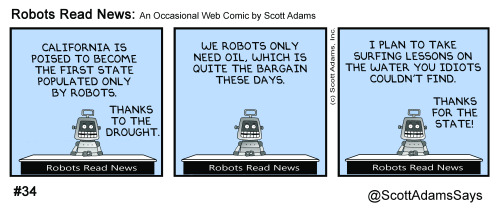
Dilbert’s Scott Adams weighs in on California’s drought:
Tags:Austin, California, Democrats, drought, Los Angeles, Los Angeles Unified School District, Marin County, ObamaCare, pension crisis, Texas, unemployment, unions, University of California, waste, Welfare State
Posted in Austin, Budget, Democrats, ObamaCare, unions, Waste and Fraud, Welfare State | No Comments »
Friday, April 17th, 2015
It’s appropriate that Zeno (the paradox Zeno) was Greek, since Greece appears to have entered Zeno’s Endgame. The country edges ever closer to default, without actually defaulting. Or without the Greek government actually ceasing to spend radically more money than it takes in, because the ruling left-wing Syriza Party would rather destroy the Greek economy than give up their bloated welfare state. Their latest plan is to raid pension funds to keep that welfare state going just a little longer. “This is the last bit of cash that the Greek state has.” “Honey, let’s cash in our 401K so we can buy some heroin!”
Sorry if this sounds like every other update on the Greek debt crisis over the last six years. It’s a vitally important story, which is why I keep covering it, but it’s also the story of a host of people making the same stupid, easily avoidable mistake again and again rather than making the hard choices necessary to deal with the problem.
A few other links of interest on the Greek debt endgame:
So Greece went hat-in-hand to the IMF: Can we put off making some debt repayments? IMF: (Laughs) Oh wait, you’re serious! Let me laugh harder!
Speaking of the IMF, this should be good for a laugh.
Greece’s phony baloney budget surplus disappears.
Looks like Greece’s creditors have finally reached the depression phase of the Kubler Ross grief cycle. “Greece’s international creditors signaled they are losing hope that Athens will do what is needed to unlock bailout funds before it runs out of money.” Do tell.
A timeline of Greece’s bills coming due. “Debt interest payments are piling up. It has to pay off an €80m interest bill to the European Central Bank (ECB) on 20 April and €200m to the International Monetary Fund (IMF) on 1 May. But the one that is stirring jitters around Europe is a €760m (£550m; $810m) interest payment to the IMF that is due on 12 May.”
Gameplanning a Grexit.
Tune in next week! Same bankrupt time! Same bankrupt channel!
Tags:Budget, Europe, European Debt Crisis, Foreign Policy, Greece, grexit, IMF, Syriza, Welfare State
Posted in Budget, Foreign Policy, Welfare State | No Comments »
Wednesday, April 15th, 2015
Hope you’ve finished your taxes already! Time for another Texas vs. California update:
Detroit and Stockton’s bankruptcies may signal further problems nationwide, says New York Fed President William Dudley. “While these particular bankruptcy filings have captured a considerable amount of attention, and rightly so, they may foreshadow more widespread problems than what might be implied by current bond ratings.”
The Texas senate approves a $211.4 billion biannual budget, which will need to be reconciled with the $209.8 billion House budget. Both budgets offer tax relief, but of different kinds.
The senate also zero funds two rogue agencies the Texas Racing Commission and the Travis County Public Integrity Unit. Expect Texas House Speaker Joe Straus, with deep ties to the gambling industry, to go to the mat to save the Racing Commission.
The Texas senate has also passed signifcant spending limit reform in Senate Bill 9.
CalPERS raises contribution rates by 6%.
California senate OKs yet another restrictive energy policy bill. Yet another in their continuing “Let’s send as much business to Texas as possible” acts…
Los Angeles Unified School District extends lavish employee benefits package another three years, despite existing underfunded liabilities. (Hat tip: Pension Tsunami.)
California sets aside $261 million for cost overruns on its already pricey high speed rail boondoggle.
California’s drought is something environmentalist liberal elites have brought on themselves: “Those who did the most to cancel water projects and divert reservoir water to pursue their reactionary nineteenth-century dreams of a scenic, depopulated, and fish-friendly environment enjoy lifestyles predicated entirely on the fragile early twentieth-century water projects of the sort they now condemn.”
More on the same theme.
San Diego builds a desalinization plant (Hat tip: Moe Lane.)
Central California is already starting to suffer water-related thefts.
In the wake of the Vergara ruling, California Republicans want to overhaul how teachers are hired and fired. Naturally teacher’s unions are opposed…
Judge rules that California must pay for sex change operations for prisoners on Eight Amendment grounds. “To contend that ‘forcing’ a prisoner to continue as a man violates the Constitution is absurd…It is nonsensical to grant imprisoned convicted felons health-care ‘entitlements’ that many law-abiding, hardworking taxpayers don’t enjoy.”
California prostitutes demand prostitution be legalized. You’d think they’d get a sympathetic hearing from California’s Democrat-controlled legislation, what with all they have in common… (Hat tip: Instapundit.)
Stanford student council candidate grilled over Colleging While Jewish. This could go in the regular LinkSwarm, but I noticed that both of these recent incidents took place in California.
Tags:Budget, California, drought, fraud, Joe Straus, Los Angeles Unified School District, Regulation, Texas, Texas Racing Commission, Travis County Public Integrity Unit, unions, Vergara vs. California, waste, water, Welfare State
Posted in Budget, Democrats, Regulation, Texas, unions, Waste and Fraud, Welfare State | No Comments »