Archive for the ‘Budget’ Category

Slow Motion EuroZone Trainwreck Continues

Monday, December 19th, 2011

It didn’t take long for cracks to start appearing among national politicians who are not nearly so sanguine over the prospect of Anschluss II as their counterparts in Brussels.

The French people are not wild about it either. But French politicians only pay slightly more attention to the French people than they do to the American government, which is to say: precious little.

The Portuguese threaten nuclear default.

Did the announcement calm markets elsewhere? Not so much:

Some of the world’s most powerful investment banks were downgraded by ratings agency Fitch as Germany’s cherished European fiscal compact appeared to be unraveling. The banks that were downgraded [Wednesday] night include US banks Bank of America and Goldman Sachs, Barclays and France’s BNP Paribas. Switzerland’s Credit Suisse and Germany’s Deutsche Bank were also cut.

Even France is in danger of a downgrade.

Of course, all this supposes that the new EuroPact will actually accomplish something. Fitch Ratings is not so sure. After warning of rating downgrades on “Belgium, Cyprus, Ireland, Italy, Slovenia and Spain,” they come to the bracing conclusion that “a ‘comprehensive solution’ to the eurozone crisis is technically and politically beyond reach.”

And now for the section of the roundup in which I quote whopping large chunks of Ambrose Evans-Pritchard on the whole thing.

First, the EU would like the UK to throw more money into the black hole. The UK is telling them to get stuffed:

Euro rage is reaching new heights over Britain’s latest outrage.

Our refusal to pony up a further €31bn we cannot afford, to prop up a monetary union that was created against our wishes and better judgment, and with the malevolent purpose of accelerating the great leap forward to a European state that is inherently undemocratic.

It is being presented as treachery, Anglo-Saxon perfidy, and the naked pursuit of national self-interest.

Let me just point out:

1) The UK never agreed to such a commitment in the first place. The line was written into the December 9 summit communiqué in an attempt to bounce Britain into handing over the money.

2) The UK does not consider the rescue machinery to be remotely credible as constructed.

3) The eurozone has the means to tackle its own debt crisis, if it is willing to use them. These include fiscal pooling and the mobilisation of the ECB.

As eurozone politicians never tire of reminding us, their aggregate debt levels are lower than those of the UK, US, or Japan. They are right. So get on with it and stop begging.

Euroland is of course entitled not to deploy eurobonds or the ECB if these mean a) a breach of the German constitution b) violate the ECB’s mandate. But that is entirely their choice. Both the Grundgesetz and the ECB mandate can be changed.

It was EMU members who created this dysfunctional currency. They are now trying to shift the consequences of their error onto others rather than taking the minimum steps necessary to fix the problem at root.

Second, his pointing out that the proposed treaty actually accomplishes very little:

The leaders of France and Germany have more or less bulldozed Britain out of the European Union for the sake of a treaty that offers absolutely no solution to the crisis at hand, or indeed any future crisis. It is EU institutional chair shuffling at its worst, with venom for good measure.

[snip]

And what for? All this upheaval for a mess of pottage, a flim-flam treaty? The deal is not a “lousy compromise”, said Angela Merkel. Well, actually that is exactly what it is for eurozone politicians searching for a breakthrough.

It tarts up the old Stability Pact without changing the substance (although there will be prior vetting of budgets). This “fiscal compact” is not going to make to make the slightest impression on global markets, and they are the judges who matter in this trial by fire.

Yes, there is more discipline for fiscal sinners, but without any transforming help. Even the old “Marshall Plan” of the July summit has bitten the dust.

There is no shared debt issuance, no fiscal transfers, no move to an EU Treasury, no banking licence for the ESM rescue fund, and no change in the mandate of the European Central Bank.

In short, there is no breakthrough of any kind that will convince Asian investors that this monetary union has viable governance or even a future.

Germany has kept the focus exclusively on fiscal deficits even though everybody must understand by now that this crisis was not caused by fiscal deficits (except in the case of Greece). Spain and Ireland were in surplus, and Italy had a primary surplus.

As Sir Mervyn King said last week, the disaster was caused by current account imbalances (Spain’s deficit, and Germany’s surplus), and by capital flows setting off private sector credit booms.

The Treaty proposals evade the core issue.

Ironically, the actual text of the new agreement has all sorts of things (like requiring a Balanced Budget Amendment to national constitutions) that, had it been in place and enforced 15 years ago might have prevented the situation in the first place. But if the nations of Europe had been capable of balancing their budgets, they wouldn’t have needed a Euro-fueled spending spree to keep their welfare states solvent in the first place.

For the PIIGS, growth is neither possible nor enough: “There is at this point no conceivable policy scenario which somehow makes Italy and Greece grow by as much as 2% a year for the next few years.”

Fed says no Euro bailout. But one might wonder at the firmness of their resolve. Especially since the head of the IMF says they need funds from outside the EU. Because who doesn’t love throwing good money after bad?

European bank walks are starting to turn into bank jogs.

Gold prices have plunged since the Euro treaty was announced. A sign the worst has passed? No, quite the opposite: Europe’s banks are selling their gold reserves in an attempt to stay solvent.

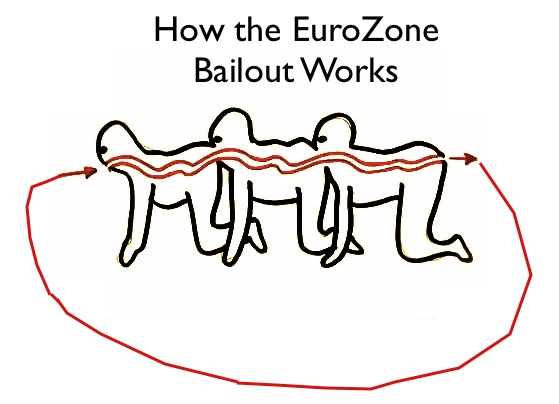
Let’s see if I’ve got this straight: EuroZone members, threatened by sovereign default on their bonds, are giving money backed by those same bonds to the IMF, which will use the money to prop up the EuroZone in order to prevent EuroZone countries from defaulting on their bonds. In order to help readers understand the genius of this maneuver, I have slightly altered a graphic from a recent movie to explain the concept:

(Hat tips: Insta, Ace, and The Corner, plus no doubt a few I’ve forgotten.)

European Union to Become SuperDuper European Union

Friday, December 9th, 2011

Let me see if I can get this straight:

UK Prime Minister David Cameron, objecting to the Deutschland Uber Alles renegotiation of the Maastricht Treaty, is now causing the creation of a new SuperDuper Europe, with Germany reoccupying the Rhineland taking leadership of the whole shebang, finally erasing the rest of the continent’s reluctance at receiving orders from Berlin?

I mean, when even the Europhillic New York Times says that “Twenty years after the Maastricht Treaty, which was designed not just to integrate Europe but to contain the might of a united Germany, Berlin had effectively united Europe under its control,” maybe the citizens of those stodgy old entities we used to call “countries” should consider the possibility that they might may be making a mistake. I am especially surprised that the non-Euro-using generalgouvernement Poland gave in so readily, as their previous experiences with rule from Berlin have been less than exemplary.

But what’s sacrificing the last of your country’s vestigially sovereignty compared to the glorious dream of saving the Euro?

Assuming, of course, that forging this Pact of Steel (including a 500 billion Euro bailout fund) actually saves the Euro, which is a dubious proposition at best. And at least one U.S. general says we should be prepared for civil unrest if Euro ends up exploding anyway.

The irony, of course, is that David Cameron, the wetest Tory Wet PM since Neville Chamberlain, refused to give in to another Eurotreaty British citizens wouldn’t get a chance to vote on less than two months after refusing to allow a vote on the previous EU treaty British citizens were not allowed to vote on. It would be ironic if Cameron actually ended up pulling the UK out of the EU because, in a moment of weakness, he actually exhibited rare and uncharacteristic streaks of firm principle and common sense.

Will the citizens of Europe actually get a chance to vote on this Reich closer European integration? Doubtful. Ireland’s Taoiseach is being “cagey” about a vote. (Translation: Fark no, you peasants won’t get a vote.) I doubt any of his brothers in Europe’s Permanent Ruling Class will feel any less “cagey.”

Through a thousand small steps, from committees and working groups and consultations and emergency decrees, Eurocrats have done their very best to remove power for all important decisions from the hands of the people and entrust it into their own well-greased palms. And also, not so coincidentally, to avoid taking the blame for the ruin their cradle-to-grave welfare states, and the huge and ever-growing debts necessary to pay for them, have made of Europe’s once free nations and productive economies.

Other Eurozone news, some possibly stale and out of date:

  • Jim DeMint says the best way for us to help Europe is not to help Europe.
  • Portugal’s economy is shrinking.
  • Moody’s downgrades French banks.
  • Problem: Possibility of sovereign debt default means bond downgrades. Solution: Create a bailout fund. problem: Downgrade of bailout fund. Solution: ?????
  • Europe’s Coming Inflation:

    For years, Europeans loved to lecture Americans on the both the safety and soundness of the continent’s banking system as opposed to our own, and how their economic system worked so much better than ours. Well, one lesson of the 2011 financial crisis is that many of their banks are probably in worse shape than the US banks were in 2008.

    At least our banks’ troubled investments were tied to real estate, which may rebound once our economy improves. Their banks are holding debt tied to some of the world’s least productive, no-growth countries.

    Why so underproductive? Most of the evidence points to the failure of the European welfare state.

    Europeans loved to lecture Americans on how government-run health-care and cradle-to-grave entitlements provided such safety and comfort for the masses. People supposedly didn’t mind paying higher taxes because it enhanced their standard of living.

    Until, of course, it didn’t enhance anything — and Greece, Italy, Spain and Portugal face the collapse of their safety nets because they can’t borrow to pay for them anymore, even as unemployment is rampant. (Meanwhile, France is not far behind.)

  • UT Law Dean Resigns Over Slush Fund Payouts

    Friday, December 9th, 2011

    Keep in mind that’s not what the headline says, which is a more neutral “UT law dean forced to step down.” But what else do you call “a $500,000 forgivable loan” to UT Dean Larry Sager “at a time when deans, vice presidents and other top university officials were under a salary freeze”? When you give people money they don’t have to pay back, that’s not a loan, that’s a gift. (I also wonder whether Dean Sager declared this money on his taxes. Or did he not have to, because it was a “loan”?) And slush fund seems to be the proper term for a fund from which sums can be doled out without administrative accountability.

    Or, to put it another way: If it were revealed that University of Texas head football coach Mack Brown had such a fund, to receive funds from or to dole out at his discretion, not only would we be calling it a slush fund, he would be fired, National Championship notwithstanding. Should the UT Law School be held to a lesser standard than the UT Athletics Department?

    No wonder the Texas Public Policy Foundation continues to advocate for lower administrative costs in higher education, among many other needed reforms. This most recent incident shows such reform is still badly needed.

    (Hat tip: Tax Prof Blog via Instapundit.)

    Ten Days to a EuroZone Collapse?

    Monday, November 28th, 2011

    So says a piece in the Financial Times, here excerpted from behind the paywall.

    Things are moving very fast indeed on the Euro front:

  • U.S. banks stop lending to European governments. While this is good news, the possibility that the Fed may rescue Europe is very, very bad news. Our own life raft is barely treading water, and now liberals want us to invite a dying elephant to climb aboard.
  • And not the Fed, then the IMF, which America also funds to a large extent.
  • This article from Der Spiegel is a good roundup on consensus wisdom, which boils down to the rest of Europe wondering why Angela Merkel won’t just give in and pay their bills.
  • There’s word she might even do it, but only if she can get France, Finland, the Netherlands, Luxembourg and Austria to join Germany in issuing “elite” Eurobonds. I mean, what’s another trillion in taxpayer equity flushed down the toilet in comparison to the beautiful dream of European integration?
  • Even Poland wants Germany to take a more active role, something that has not traditionally brought Poland tidings of comfort and joy.
  • Daniel Hannan at NRO provides a nice summary of the state of play:

    From the beginning, the Brussels elites made it clear that, to adapt Abraham Lincoln, their paramount object was to save the Union. Never mind if that meant imposing epochal poverty and emigration on the southern members, and unprecedented tax rises on the northern. Never mind if it meant toppling the elected prime ministers of Italy and Greece and replacing them with Eurocrats (respectively a former European Commissioner and a former vice president of the European Central Bank — two perfect specimens of the people who caused the crisis in the first place). They were prepared to pay any price to keep the euro together — or, more precisely, to expect their peoples to pay, since EU employees are generally exempt from national taxation.

  • How expensive will a Euro bank bailout be? Keep in mind that at one point during the 2008 meltdown, Morgan Stanley owed Uncle Sam $107 billion. With a B. For one bank.
  • In the mid-1990s, Bulgaria got a good look at a currency meltdown first-hand. They only recovered by adopting a currency board for the Lev (which is exactly what Steve H. Hanke and Kurt Schuler had suggested in 1991.)
  • The British Foreign office is already planning for a Euro collapse.
  • A general strike shuts down Portugal.
  • Finally, one Irish commentator puts things in purely mercenary terms:

    The only beneficiaries of the State’s assumption of [Anglo Irish Bank]’s liabilities are taxpayers in the countries whose banks were the reckless lenders to Anglo. Anglo, for all the guff at the time of the bank guarantee, had no systemic importance to the Irish economy. Irish taxpayers had no moral or other liability for its debts.

    The sole reason for saving it was the ECB’s insistence that no euro zone bank should fail. Had Anglo failed, the costs would have been borne primarily by European banks and consequently by European taxpayers.

    So the undertaking by the Irish State to stump up €47 billion to pay those private debts is an act of extreme (if extremely demented) euro-altruism. We are Europe’s ragged-trousered philanthropists, bailing out the euro with money we don’t have and that our European partners are kindly lending us at penal interest rates.

    And this single act of insane generosity wipes out every red cent we’ve got from Europe since 1973.

    [snip]

    And for what? For less than nothing. For a moment of panic, a daft notion, a stupid indulgence in bluster and bravado. Some bleary-eyed fools decided, in the middle of the night, that they could bluff the markets by throwing all the chips we might ever have on to the table. It didn’t take long for the markets to realise that their hand contained nothing better than a pair of deuces.

    But the gamble failed for Europe too. There might be some kind of (very expensive) pride in being able to say that little Ireland took the hit to save the euro zone, like the starry-eyed gal who takes a bullet for the outlaw in a corny western. But we saved nothing. All we managed to do was to buy the euro zone leaders more time in which to delude themselves that there was no real crisis.

  • Could All Of Europe Declare Bankruptcy?

    Tuesday, November 22nd, 2011

    That’s the option being openly talked about:

    Europe may need to pull a Chapter 11 – a US-style bankruptcy, which would permit a market shutdown and Euro Zone reorganization before reopening for business.

    The EU desperately needs a break from market pressures in order to allow the political apparatus to really gather its forces and finally move Europe and its debt crisis ahead of the curve. Here we are just a couple of weeks after the feeble attempt to apply an EFSF plaster on the problem and we’re already back to Square One: the EU debt crisis has reached the point at which none of the readily available tools or institutions are sufficient to match the magnitude of the crisis. This dictates the need for an out-of-the-box solution.

    EU policy makers played the extend and pretend game for as long as they could – but now the writing is on the wall: popular outrage is on the rise and putting increasing pressure on the political process – as we are seeing increased demonstrations and grass-root activity taking over both the political agenda and the media. And markets are now balking as empty promises and now a real lack of funds are seeing bond yields beginning to spike out of control. The self-reinforcing cycle of downgrades and austerity and recession are taking us to the very brink of a full scale Crisis 2.0.

    Or, alternately, the EU could just jetison all that inconvenient democracy to keep the Ponzi scheme going just a little bit longer, trying to hide the fact that Europe has run out of money.

    Says Walter Russell Mead: “Right now the world’s largest economic bloc is running around like a chicken with its head cut off.”

    So how could Europe possibly display the terminal bankruptcy of the high tax, high spending, highly unionized, cradle-to-grave welfare state, European/Blue State social model? How about if EU staffers went on strike?

    Dear Greek Citizens: I hope you weren’t so foolish as to believe that the Swiss bank accounts containing the money you earned actually belong to you, do you? You’re going to have to return them to Greek banks so we can steal them. Love, the EU.

    The Euro may have been great for Greek elites, but not necessarily great for average Greeks.

    How are things in the rest of Europe? In Spain, unemployment is 22.6%.

    The EU may crack before the Euro.

    China is not coming to the rescue, as China is suffering from the same demographic maladies afflicting Europe: “A population that is no longer growing very fast and is quickly aging. The proportion of the population that depends on the state for pensions and medical care is overwhelming the proportion that works and pays taxes to the state.”

    Plus, Chinese rating agencies just downgraded Greek debt.

    The IMF has quitely changed its rules to make it easier to bail out Europe. With your tax dollars.

    (Hat tips: Ace, Insta, and the usual suspects.)

    LinkSwarm for Friday, November 11, 2011 (11/11/11)

    Friday, November 11th, 2011

    I hope you’re celebrating both Veterans Day and Nigel Tufnel Day (11/11/11) today. A few bits of news:

  • Willisms debunks a lot of false claims about Texas jobs.
  • He also notes that Texas leads the nation in exports.
  • Care for a disabled child in Michigan? The SEIU can deduct union dues from your social security check. (Hat tip: Ace of Spades.)
  • I’ve not been keeping up with the situation in Killeen, but evidently City Council members voted to give the City Manager a $750,000 buyout, then refused to justify their actions to the taxpayers. The result? All five remaining City Council members were successfully recalled. Note to politicians across the state: Texas is not California. Try to get away with this sort of self-dealing here and we will boot your ass out of office. (Hat tip: Blue Dot Blues.)
  • Mexican cartel gunmen crossed into the small Texas town of Escobares in the Rio Grande Valley.
  • Speaking of cartel violence, the Mexican government evidently has the La Familia Michoacana drug gang on the ropes. La Familia was previously allied with the Gulf Cartel, but more recently worked with the Zeta cartel. I’d previously mentioned La Familia (and their activity in Austin) here.
  • Obama to tax Christmas trees in order to pay for a board to promote Christmas trees.
  • Democrats on the “SuperCommittee” propose…wait for it…wait for it…spending more money! Remember, any time a congressional Democrat says they want to cut spending, they’re lying. (If a Republican says they want to cut spending, there’s at least a possibility that they’re telling the truth.)
  • David Brooks praises Mitt Romney as “smart” and “sophisticated.” Yeah, like conservatives needed another reason to vote against Romney…
  • By contrast, George Will says that in Romney “Republicans may have found their Michael Dukakis.” (What’s the difference between David Brooks and George Will? One is a well-dressed, articulate, sophisticated, respected conservative columnist, and the other is David Brooks.)
  • Related.
  • Search and Rescue trailer stolen from NW Austin. Contact your local police if you spot the trailer shown in the picture.
  • I already mentioned this yesterday, but here’s the video of Sen. John Cornyn laying the smackdown on Eric Holder as to the difference between Wide Receiver and Fast and Furious.

  • I’ll try to do a Greek/Euro debt update just as soon as I figure out just what the hell Europe is actually doing…

    Election Results: Three Propositions Go Down In Defeat

    Wednesday, November 9th, 2011

    The results of yesterday’s election are up, and three of the ten propositions on the ballot went down in defeat. Since all statewide propositions usually pass, that’s an interesting (and welcome) result.

  • Proposition 4, which Texans for Fiscal Responsibility said “gives counties new authority for “Kelo”-style redevelopment takings” went down by the heftiest margin, 59.7% to 40.3%.
  • Proposition 7, which would have allowed El Paso County to use property taxes to build parks, went down 51.7% to 48.3%.
  • Proposition 8, a technical amendment which allow agricultural/ranching/ etc. land to be developed for water conservation without changing its tax status, lost 53% to 47%.
  • Propositions 2 and 6 each passed narrowly with less than 52% of the vote. Proposition 1, the only one I voted for and which provided homestead exemptions for the spouses of disabled veterans, passed by the largest margin, 82.9% to 17.1%.

    Taken together, the results seem to show that Texans are actually becoming more conservative, and more willing to oppose government spending and Kelo-style eminent domain abuses.

    About 675,000 voter participated in yesterdays election.

    As a side not, notice how information on the statewide election appears nowhere on the Houston Chronicle‘s main page, though it does provide a link to how Nancy Grace did on Dancing With the Stars. Just another sign of that once great (and conservative) newspaper’s decline into being just another irrelevant liberal MSM mouthpiece.

    Reminder: Election Tuesday!

    Sunday, November 6th, 2011

    Don’t forget that there’s a state constitutional amendment election Tuesday, November 8 (as well as various local elections, bond issues, etc.). A few roundups and recommendations from:

  • Texans for Fiscal Responsibility
  • Grassroots Texans
  • The Travis County Republican Party
  • As for myself, I’m currently leaning toward voting Yes on Proposition 1 and No on all the rest.

    Blue Dot Blues has a roundup of several additional sources you can go to, including some from the other side of the aisle. When in doubt, voting against whatever the Austin Chronicle endorses will seldom steer you wrong…

    Greeks Will Not be Allowed to Vote on Their Own Future

    Thursday, November 3rd, 2011

    The scheduled referendum on the bailout of Greece as been canceled.

    Once again, the glorious dream of European integration is far to important to let details like the consent of the governed interfere…

    Rick Perry’s Tax and Spending Reform Plan: Solid on Taxes, Timid and Unserious on Spending

    Wednesday, October 26th, 2011

    So Rick Perry unveiled his tax and spending reform plan. (His Wall Street Journal piece provides a brief overview.) It’s a serious compilation of a variety of solid conservative ideas for reforming the federal government. Serious, that is, in every area except spending.

    But before we get to the sour let’s look at the sweet. There is a great deal to like in Perry’s proposals:

  • Repealing ObamaCare (though this is pretty much a requirement for every Republican office-seeker these days)
  • Repealing Dodd-Frank (which has held down the economy in many ways great and small)
  • A 20% flat tax is a vast improvement over the labyrinth complexities of our special-interest-group-carve-out-ridden Swiss cheese of a tax code. Also, you have to admire this graphic, which should have liberal knees jerking:

  • Eliminating the tax on dividends and long term capital gains is a big win that will help revive the economy and restore global competitiveness.
  • As is eliminating the death tax (although if it were possible to entirely fund the government from an estate tax rather than an income tax, that would be preferable, but it isn’t).
  • Eliminating corporate loopholes and tax breaks is also a great idea, but at this point it’s just a vague notion. Just about any candidate of any party could say the same thing, and without a list of the actual loopholes to be eliminated it’s fairly meaningless. This is also an area where few proposals survive contact with congress.
  • Reducing the corporate tax rate to 20% is a great idea, and one long championed by many free market economists.
  • The Perry plan has a lot of good ideas for reducing the regulatory burden on American business. A moratorium on all pending legislation, automatic sunset provisions, and a full audit of all regulations enacted since 2008 should go a long way toward undoing the Obama regulatory burden and getting American business and hiring back on track.
  • So outside of the budget provisions, there is an awful lot for conservatives to like about the Perry plan.

    Even when it comes to the budget section, there’s a lot of conservative red meat: a non-tax hike balanced budget amendment, an end to baseline budgeting and concurrent resolutions (which bake bigger government into the process), and an end to earmarks. All solid initiatives, though the problem here is less presidential will than getting them through congress.

    So, given all that, what am I complaining about?

    What makes the Perry budget timid and unserious is his proposal to “balance the budget by 2020.” Given the way Washington works, a promise to balance the budget eight years from now is a promise to never balance the budget. It’s tea so weak it might as well be water. A balanced budget target that far out means that Congress can keep putting off difficult decisions by passing bills that place imaginary savings in out years where they will soon be rendered moot by the next congress. It’s once again a chance to sell out budget discipline for a handful of magic beans.

    It’s, yet again, kicking the can down the road.

    It’s also a big step back from the Ryan plan, which demanded a balanced budget in the 2015 timeframe. This was the plan seen by conservative Republicans and Tea Party activists as the minimum necessary for a serious reduction in the federal budget deficit. Given serious action wasn’t taken for it this year, it’s reasonable to push it that deadline out one more year to 2016, but pushing the target out beyond that amounts to preemptive surrender.

    While Perry’s $100 billion first year down-payment would be an improvement over the weak, phony-baloney deficit reduction enacted as part of the debt limit deal, it’s a ridiculously small cut for the $1 trillion+ Obama deficits being racked up each fiscal year.

    Bad as it is as policy, the Perry 2020 date is utterly disasterous as an opening position for negotiations with congress. Perry is going to have to set hard, early deficit targets to have any chance of taming the Leviathan, and then use his veto pen early and often if he doesn’t get them. The truth is that Democrats will scream bloody murder at any attempt at deficit reduction, so the next President might as well (to use the classic Ronald Reagan analogy) “throw long.” Every debt ceiling vote will have to come with both serious budget cuts and the other budget-taming proposals in the Perry plan. Democrats may still filibuster, but then they’ll have to deal with the crushing realities of living under a budget that actual matches spending to revenues. Even with a Republican House and Senate, to actually balance the budget the next President will need to push relentlessly to pass the most stringent budget that can muster 51 senator votes via reconciliation. Setting a 2020 date does nothing to prepare the media and ideological battlespaces for those difficult choices.

    Out-of-control federal spending is at the heart of almost all our economic problems, and the single biggest factor behind Tea Party discontent. Thus it has to be at the top of the next President’s agenda. Despite many other solid economic idea, the Perry plan doesn’t meet the test for serious deficit reduction. The shame is that Perry accomplished real spending reform in Texas. To impose such discipline on the out-of-control federal budge will be an order of magnitude more difficult. But to achieve real spending reform, you first have to campaign for it. Setting a goal for a balanced budget at the end of a theoretical Perry presidency’s second term rather than the first actually hampers that goal.