It’s Friday the 13th, spring is in the air, and SXSW crowds are flocking into downtown Austin. Here’s a LinkSwarm:
Archive for the ‘Austin’ Category
Kroll Report Vindicates Wallace Hall (Yet Again)
Wednesday, February 18th, 2015Every time new revelations come to light about the UT Admissions Scandal, they’ve always proven that UT regent Wallace Hall was right to launch his investigation, and that his critics were wrong to attempt to bury it (and him). The latest revelations are no exception:
University of Texas at Austin President Bill Powers used his authority to get “must have” applicants admitted to the state’s flagship school and misled internal lawyers looking into influence peddling in the admissions process in both the undergraduate college and UT’s top-ranked law school, an independent investigation obtained by The Dallas Morning News has found.
The wide-ranging investigation ordered by former Chancellor Francisco Cigarroa found that Powers overruled his admissions office and exercised broad control when it came to favored applicants – some of whom had the recommendation of powerful people in this state.
That report is the Kroll Report. What they found was what Wallace Hall alleged: That there was one admissions process for ordinary applicants, and another for the well-connected. “Applicants with special connections had a 72% acceptance rate compared to 40% overall.”
Let’s look at some details of the process from the Kroll report summary:
Review of Undergraduate Admissions Process
When an inquiry or recommendation concerning a candidate for admission is forwarded to the President’s Office from a “friend of the university” or other “person of influence” – which may include a public official, a member of the Board of Regents or UT-System official, an important alumnus or alumna, a major donor, a faculty member or other UT-Austin official – a long-standing practice has been to place a “hold” on that candidate’s application. The purpose of a hold is to indicate that a negative decision may not become final until the party which placed the hold is notified. Since 2009, certain hold designations have been entered on UT-Austin’s mainframe computer with the designation of “Q,” “L,” or “B.” A designation of “Q hold” indicates the application is being monitored by the President’s Office. An “L hold” indicates that the application is of interest to one of the college Deans. When both the President’s Office and a college Dean request a hold, the file is designated as a “B hold” applicant. (Several other types of holds exist for a variety of reasons; however, as explained later in this report, the only holds within the scope of Kroll’s investigation, and thus of interest for purposes of this report, are Q, L, and B holds.) Due in part to the increased competitiveness of undergraduate admissions at UT-Austin, and in part because recordkeeping is now computerized, Q-hold volumes have escalated considerably 13 over the past several years. Under President Powers, Q holds have totaled as many as 300 applicants of interest per year. The majority of holds appear to be based on requests from Texas legislators and members of the Board of Regents, while others are instigated by requests from the Chancellor’s Office, donors and alumni. The existence of holds combined with end-of-cycle meetings between the Admissions Office and the President’s Office, during which final decisions are made on all hold candidates not already admitted, has caused increasing levels of tension between the Admissions Office and the President’s Office. In recent years, President Powers, acting through his Chief of Staff, has at times made holistic determinations that differed from that of the Admissions Office. Consequently, it appears that a select handful of applicants each year are admitted over the objection of the Admissions Office. The President’s Office has acknowledged to Kroll that this has occurred, but insists that decisions are always made with the “best interests of the university” in mind. Based on our investigation, there is no evidence that any applicants have been admitted as a result of a quid pro quo or other inappropriate promise or exchange. There also is no evidence that efforts were made to “save spots” for certain applicants or that a dual system of admissions has been informally established. However, it is acknowledged that additional acceptances are sent out each year to accommodate special cases. With certain “must have” applicants, the President’s Office ordered applicants admitted over the objection of the Admissions Office. Because written records or notes of meetings and discussions between the President’s Office and Admissions are not maintained and are typically shredded, it is not known in particular cases why some applicants with sub-par academic credentials were placed on a hold list and eventually admitted. Rarely was it discussed why particular applicants needed to be admitted, or what, if any, connections the applicants had with persons of influence. But President Powers acknowledged to Kroll that “relational factors” do occasionally play an important role in determinations to admit some applicants who might not have otherwise been admitted. Over a six-year period, applicants on whom a hold of any type was placed were admitted 72% of the time, compared to an overall admission rate of approximately 40%. Texas residents accounted for 82% of all applicants placed on a hold list. Email correspondence reviewed by Kroll further confirmed that a relationship with university officials has on occasion provided applicants a competitive boost in the admissions process. The total number of arguably less-qualified applicants who have benefitted from the hold system and the President’s oversight of the hold candidates appears to be relatively small. Indeed, from 2009 to 2014, Kroll identified a total of only 73 enrolled applicants who were admitted with both a combined SAT score of less than 1100 and a high school GPA of less than 2.9. Kroll’s review of the available “outlier” files found that political connections may have influenced the admission decision in a small number of cases, while other cases suggested the possibility of alumni/legacy influence despite the prohibition under Texas law against legacy admissions. Several other cases, however, suggested a demonstrated commitment to ethnic and racial diversity and the consideration of other appropriate criteria. While it is often not clear why a particular applicant was placed on hold or received special consideration, the President’s Office acknowledged to Kroll that legislative letters and calls are typically accorded more weight than other letters and calls because legislative oversight impacts the university. In short, while it is impossible to conclude with absolute certainty from a review of the data and selected files alone that any one particular applicant benefitted from undue influence or pressure exerted on the admissions process, it is readily apparent that certain applicants are admitted at the instigation of the President over the assessment of the Admissions Office. The end-of-cycle meeting between the President’s Office and Admissions Office results each year in certain applicants receiving a competitive boost or special consideration in the admissions process. The data reviewed by Kroll confirms what President Powers and others have acknowledged, that relationships matter and are the deciding factor in admissions decisions for a select handful of applicants each year. Although the practice of holds and exercise of presidential discretion over Admissions may not violate any existing law, rule, or policy, it is an aspect of the admissions process that does not appear in UT-Austin’s public representations. Several other important constituents are at least partially complicit for this ad-hoc system of special admissions. For example, the Board of Regents sends approximately 50 to 70 names of applicants to the President’s Office each year. Similarly, many names are placed on a hold list as a result of requests from the Chancellor’s Office, the UT-System Office of Government Relations, major donors and alumni. In most years, there are certain legislators and Regents whose names are noted more than others. It would appear that these other bodies send inquiries concerning student applicants to the President’s Office with the expectation that such applicants be closely monitored by that office. Kroll notes that the existence of holds and watch lists, and the end-of-cycle meetings between the President’s Office and the Admissions Office, were not disclosed or specifically addressed by President Powers and his Chief of Staff during an internal Admissions Inquiry previously conducted by the UT-System. Although President Powers and his Chief of Staff appear to have answered the specific questions asked of them with technical precision, it appears that by their material omissions they misled the inquiry. At minimum, each failed to speak with the candor and forthrightness expected of people in their respective positions of trust and leadership. Review of Law School Admissions Process
By design and practice, UT Law School also utilizes a holistic admissions process. Although the law school requires no minimum LSAT score and only a 2.2 undergraduate GPA from an accredited institution, it is apparent that GPA and LSAT scores play a prominent role in admissions decisions. This fact, which is true of virtually all nationally ranked law schools, is driven in large part by the importance of GPA and LSAT in the perceived competitiveness of the law school and how it affects national rankings. Unlike many law schools, UT Law School does not rely on an Admissions Committee to review application files or to render individual admissions decisions. Instead, almost all individual admissions decisions are made by either the Assistant Dean for Admission and Financial Aid or by the Director of Admission Programs. Consequently, although Kroll found that the professionals in these positions perform their jobs with expertise and integrity, the system as designed insufficiently prevents final admissions decisions from potentially being influenced by external factors, including informal discussions with the Dean after receiving letters, phone calls or contacts from persons of influence. For example, members of the Texas legislature and other persons of influence frequently call or write in support of particular law school candidates outside of normal application procedures, and the Dean’s Office receives numerous calls from legislators urging the admission of certain applicants. Kroll found no evidence that the Dean or others at the law school acted improperly or in any way compromised the integrity of the admissions process. Nevertheless, the system as designed presents these well-intentioned professionals with potentially difficult balancing acts and ethical quandaries. When the Dean’s Office receives information about a law school applicant from a trusted source, the recent practice has been for the Dean to informally review the applicant’s credentials and determine whether a case for admission is plausible. If so, the Dean discusses the matter with the Assistant Dean for Admission and Financial Aid. As long as a final decision has not been made and communicated to the applicant, the Dean feels free to discuss any information received about an applicant with the Assistant Dean. In some instances, the resulting discussions have changed the mind of the Assistant Dean regarding a candidate for admission. The President of UT-Austin also receives calls and letters from persons of influence concerning law school applicants. When this occurs, the President’s Office advises the law school (usually the Dean) of these interests. From 2006 to 2012, former Dean Larry Sager received 10 to 20 calls a year from Nancy Brazzil about President Powers’ interest in certain law school applicants. Brazzil made clear she spoke for the President’s Office. Sager acknowledged that the intensity of Brazzil’s interest in a candidate may “have on occasion swayed my decision.”
There’s a good bit more, but those are some of the highlights.
Indeed, Cigarroa admitted that “Fairness has at times been compromised in the admission of students into the University of Texas at Austin.”
Over at Watchdog.org, Jon Cassidy puts the total admissions number of unqualified applicants as in the thousands.
He’s not the only one who thinks it’s a big deal. Over at The Dallas Observer, Jim Schutze says “To every single applicant who ever got turned down by UT, I say this: Your wildest most paranoid imagining of why you got screwed and how they really do admissions at UT was nowhere near wild or paranoid enough. We’re talking about admissions meetings where university officials shred all their notes before leaving the room.” He also notes, yet again, what a horrific whitewash job UT’s own internal investigation was.
Also this: “Kroll looked at a sample of 73 smelly admissions files tied to legislators. In that sample, four affluent high schools in Texas accounted for 45 percent of the sample. Among the four, Highland Park High School was way out ahead at No. 1 with a third of all the dicey admissions in the whole sample.”
Well, who could possibly object to rich, well-connected kids getting to cut into the admissions line ahead of mere commoners?
While UT defenders are quick to assert that “no criminal activity occurred,” Cassidy believes that the blatant favoritism for legacy admissions may have violated the state education code, which states “the university must continue its practice of not considering an applicant’s legacy status as a factor in the university’s decisions relating to admissions for that academic year.”
The Dallas Morning News piece notes:
Many of Powers’ current problems can be traced to the work of UT Regent Wallace Hall, a man who has been pilloried for personally examining the admissions process.
The Kroll report appears to vindicate Hall’s work and add weight to his concerns that political and financial influence dictated some admissions decisions.
Hall’s inquiries into the admissions process led to him being targeted by state legislators, including House Speaker Joe Straus and former Lt. Gov. David Dewhurst.
Dewhurst was forcibly retired by Dan Patrick. Straus, have course, has been one of Hall’s staunchest foes, and shows every sign of desiring to continue UT’s culture of admissions favors for the well-connected indefinitely…
LinkSwarm for January 30, 2015
Friday, January 30th, 2015Already the end of January? How did that happen?
Some links:
Andrew Sullivan retiring to spend more time with the Sarah Palin homunculus that lives inside his head http://t.co/Cu9yYZOPu6
— David Burge (@iowahawkblog) January 28, 2015
More than 2500 here in Austin rallying for #SchoolChoice #txlege #scw pic.twitter.com/m2RtVl3iHO
— Brendan Steinhauser (@bstein80) January 30, 2015
Did Megyn ask her for her lucky charms? RT @daveweigel: pic.twitter.com/0CFzMRY0bo
— Sonny Bunch (@SonnyBunch) January 28, 2015
Hsoi/John Daub Shooting Follow-Up
Tuesday, January 27th, 2015A bit more information on the Hsoi/John Daub self-defense shooting of autistic home invader Jared James has come to light that wasn’t in my original story.
The original news reports said things like James “forced his way onto the threshold of one of the homes.” What they actual meant was he battered at the door so hard he broke the frame:
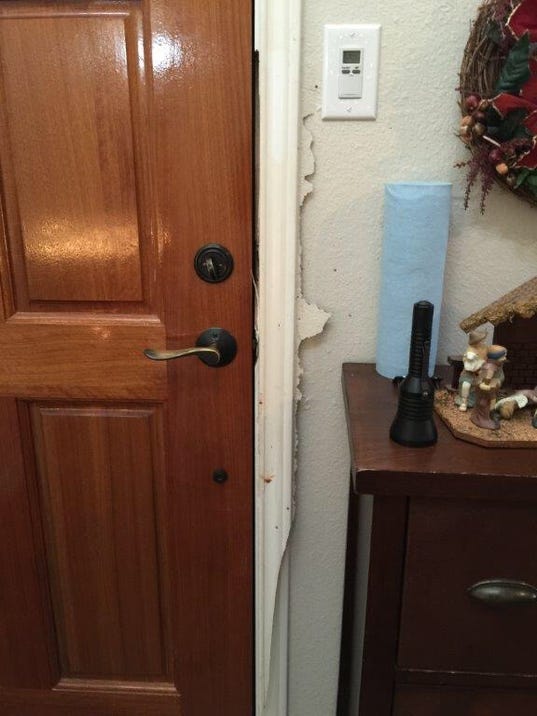
Also, new information shows that the late Mr. James was not quite the “gentle giant” some reports tried to paint:
This fall, for reasons that she [the mother] didn’t understand, [Catalina] Leverette [the mother] said her son had developed a tendency toward unpredictable outbursts, at times running through the house yelling. She knew the police had responded to calls about her son, and newly obtained police reports show two calls in 2014 for an “emotionally disturbed person” involving James.
Also this:
“On Dec. 11, [police] took James to a psychiatric hospital under court order.”
The James shooting was a tragedy, all right, but it was a tragedy of the health system not being able to get a mentally ill man the type help he obviously needed.
The UT Law Scandal: Bigger Than Previously Reported
Monday, January 26th, 2015Back when the University of Texas Law School “forgivable loan” scandal broke, I said it was for all intents and purposes a slush fund and a serious ethical problem for UT.
I didn’t know the half of it.
This piece by Jon Cassidy at Watchdog.org (based in part on documents he obtained from UT) paints ex-UT Law Dean Larry Sager as wetting his beak even more than previously suspected.
For years before a forgivable loan scandal forced him to resign as dean of the University of Texas Law School in 2011, Lawrence Sager was running up annual six-figure bills on a credit card paid for by the UT Law School Foundation.
From 2007 to 2010, Sager racked up $401,498.29 on that card, all of it paid by the foundation, apart from tens of thousands in other expenses for conferences, computers, club dues, food, travel, storage units and other items.
I can imagine numerous scenarios where a UT law school dean could rack up $400,000 in credit card expenses, but most of them involve words like “gambling,” “hookers” and “blow.”
More from Cassidy:
In all, the foundation has spent more than $1 million in compensating and reimbursing Sager. That’s just a fraction, however, of the $68 million the foundation has spread around UT during the past decade, most of it compensating the school’s faculty and administrators.
The question the attorney general’s report does not answer, or even ask, is whether the members of the Law School Foundation have received anything in return for their largesse. Reporting by Watchdog.org has established that many children of generous foundation members have been admitted into UT Law, although there is little evidence that would cast doubt on their qualifications.
More on that “forgiveable loan”:
The report says that “under Dean Sager’s leadership the Law School provided incorrect or incomplete responses to requests for salary information by both University management and the public pursuant to the Texas Public Information Act. To settle a lawsuit, both Foundation and public funds were expended in order to paper over a climate of non-disclosure.”
Scott also faulted Sager for concealing the $500,000 forgivable loan he procured for himself, reporting that “the Law School maintained two forgivable loan lists — one that contained Dean Sager’s $500,000 forgivable loan and one that excluded that particular loan.”
Keeping two sets of books is a classic indicator of financial fraud.
Thus far I have only skimmed the official Attorney General report on the loan issue (much less dug through all of the appendices), but there are several other questionable practices highlighted, like an unrecorded, $25,000 payment to one faculty member.
As Dallas Observer writer Jim Schutze notes, the state media continues to ignore the scandal regent Wallace Hall uncovered:
Cassidy’s and Williamson’s reporting was uniformly ignored by reporters and editorial pages of the state’s mainstream media. Most of the state’s major editorial pages joined the exposed members of the Legislature in denouncing Hall. An ad hoc committee of the Texas House of Representatives labored for months to find a way to remove Hall from the board of regents. When their own lawyers told them Hall hadn’t done anything for which he could be impeached and was in fact carrying out the duties of a regent, the committee slapped Hall instead with a gratuitous and toothless “censure,” an act with the legal meaning and gravitas of “fuck you anyway.”
And while he may no longer be Dean, Sager is still listed among UT law faculty.
The report goes to show, once again, that Wallace Hall was right about the need for tighter and deeper board oversight at UT. And that UT’s stables still haven’t been fully swept out…
Greg Abbott and Dan Patrick Sworn In
Tuesday, January 20th, 2015Greg Abbott has been sworn in as the 48th Governor of Texas, and Dan Patrick has been sworn in as Lt. Governor.
Annie’s List of Fail
Monday, January 12th, 2015Via PushJunction comes word that Amber Mostyn (wife of rich trial lawyer Steve Mostyn) is stepping down as chair of Annie’s List. What’s Annie’s List, you ask? Essentially an attempt to do Emily’s List for Texas, i.e. elect liberal female Democrats to office.
So how did Annie’s List do in 2014? By one measure they were quite successful: They raised 18th largest amount of money of any statewide political entity in 2014, raising $1,422,009.16 and spending $1,601,945.83.
But by another, more important measure, namely winning elections…not so hot. Let’s look at the results for the candidates they endorsed
So Annie’s List racked up a winning percentage of .111 for the races they publicly supported, which is pretty far below the Mendoza Line, and their lone win came for a seat Democrats already held. Going through Annie’s List campaign reports for 2013-2014 (more about which anon) shows two other campaigns they backed at some point in the cycle:
One wonders how long Annie’s pale, middle-aged, female leadership can keep raising money with such poor results.
For the sake of completeness, and providing a “one stop shop” for information about Annie’s List, here’s their official filing information via the Texas State Ethics Commission:
POLITICAL COMMITTEE INFORMATION
Annie’s List
Account: 00053715
Committee Type: General Purpose
Files Reports: Semi-Annually
8146-A Ceberry Drive
Austin, TX 78759TREASURER INFORMATION
Pinnelli, Janis W.
P.O. Box 50038
Austin, TX 78763
(512) 478-4487
And here are their electronic filings covering the 2013 to 2014 fundraising period:
Beyond Mostyn and Lisa Blue Baron, some of the names who gave significant amounts to Annie’s List include Obama bundler Naomi Aberly, Lee and Amy Fikes, and Serena Connelly, the daughter of late billionaire businessman Harold Simmons. So your usual batch of rich left-wing pro-abortion feminists. Fortunately for Texas, the state’s voters seem actively hostile to precisely the message they seek to push…
If You’re Wondering Why Stuff From Hsoi is Down…
Monday, January 5th, 2015…this news story should answer the question.
Short summary: John Daub, AKA Hsoi, had to fatally shoot a home invader who turned out to be autistic. It sounds like a justified shooting, but I’m sure one of the first things a defense attorney would say is “Take your gun blog down now.” Especially since he lives in Travis County.
(I don’t know Daub personally, but he’s on the blogroll, we follow each other on Twitter, and we both know the folks at KR Training.)
(Hat tip: Dwight via email.)
LinkSwarm for December 19, 2014
Friday, December 19th, 2014I trust everyone reading this has already heard about Sony Picture’s spinelessness in cancelling their release of The Interview, and Paramount’s even more-spineless refusal to allow theaters to show Team America: World Police in its place. This would be good reason to avoid paying for any Sony or Paramount products any time in the near future. And Cuba is a topic for another time. So here’s a quick look at the rest of what’s been happening the week before Christmas:
I am not exaggerating when I say it is the closest thing to Kafka’s The Trial I have ever witnessed, with editors and administrators giving conflicting and confusing advice, complaints getting “boomeranged” onto complainants who then face disciplinary action for complaining, and very little consistency in the standards applied. In my short time there, I repeatedly observed editors lawyering an issue with acronyms, only to turn around and declare “Ignore all rules!” when faced with the same rules used against them.
Texas vs. California Update for December 17, 2014
Wednesday, December 17th, 2014Time for another Texas vs. California update: