Posts Tagged ‘Germany’

Slow Motion EuroZone Trainwreck Continues

Monday, December 19th, 2011

It didn’t take long for cracks to start appearing among national politicians who are not nearly so sanguine over the prospect of Anschluss II as their counterparts in Brussels.

The French people are not wild about it either. But French politicians only pay slightly more attention to the French people than they do to the American government, which is to say: precious little.

The Portuguese threaten nuclear default.

Did the announcement calm markets elsewhere? Not so much:

Some of the world’s most powerful investment banks were downgraded by ratings agency Fitch as Germany’s cherished European fiscal compact appeared to be unraveling. The banks that were downgraded [Wednesday] night include US banks Bank of America and Goldman Sachs, Barclays and France’s BNP Paribas. Switzerland’s Credit Suisse and Germany’s Deutsche Bank were also cut.

Even France is in danger of a downgrade.

Of course, all this supposes that the new EuroPact will actually accomplish something. Fitch Ratings is not so sure. After warning of rating downgrades on “Belgium, Cyprus, Ireland, Italy, Slovenia and Spain,” they come to the bracing conclusion that “a ‘comprehensive solution’ to the eurozone crisis is technically and politically beyond reach.”

And now for the section of the roundup in which I quote whopping large chunks of Ambrose Evans-Pritchard on the whole thing.

First, the EU would like the UK to throw more money into the black hole. The UK is telling them to get stuffed:

Euro rage is reaching new heights over Britain’s latest outrage.

Our refusal to pony up a further €31bn we cannot afford, to prop up a monetary union that was created against our wishes and better judgment, and with the malevolent purpose of accelerating the great leap forward to a European state that is inherently undemocratic.

It is being presented as treachery, Anglo-Saxon perfidy, and the naked pursuit of national self-interest.

Let me just point out:

1) The UK never agreed to such a commitment in the first place. The line was written into the December 9 summit communiqué in an attempt to bounce Britain into handing over the money.

2) The UK does not consider the rescue machinery to be remotely credible as constructed.

3) The eurozone has the means to tackle its own debt crisis, if it is willing to use them. These include fiscal pooling and the mobilisation of the ECB.

As eurozone politicians never tire of reminding us, their aggregate debt levels are lower than those of the UK, US, or Japan. They are right. So get on with it and stop begging.

Euroland is of course entitled not to deploy eurobonds or the ECB if these mean a) a breach of the German constitution b) violate the ECB’s mandate. But that is entirely their choice. Both the Grundgesetz and the ECB mandate can be changed.

It was EMU members who created this dysfunctional currency. They are now trying to shift the consequences of their error onto others rather than taking the minimum steps necessary to fix the problem at root.

Second, his pointing out that the proposed treaty actually accomplishes very little:

The leaders of France and Germany have more or less bulldozed Britain out of the European Union for the sake of a treaty that offers absolutely no solution to the crisis at hand, or indeed any future crisis. It is EU institutional chair shuffling at its worst, with venom for good measure.

[snip]

And what for? All this upheaval for a mess of pottage, a flim-flam treaty? The deal is not a “lousy compromise”, said Angela Merkel. Well, actually that is exactly what it is for eurozone politicians searching for a breakthrough.

It tarts up the old Stability Pact without changing the substance (although there will be prior vetting of budgets). This “fiscal compact” is not going to make to make the slightest impression on global markets, and they are the judges who matter in this trial by fire.

Yes, there is more discipline for fiscal sinners, but without any transforming help. Even the old “Marshall Plan” of the July summit has bitten the dust.

There is no shared debt issuance, no fiscal transfers, no move to an EU Treasury, no banking licence for the ESM rescue fund, and no change in the mandate of the European Central Bank.

In short, there is no breakthrough of any kind that will convince Asian investors that this monetary union has viable governance or even a future.

Germany has kept the focus exclusively on fiscal deficits even though everybody must understand by now that this crisis was not caused by fiscal deficits (except in the case of Greece). Spain and Ireland were in surplus, and Italy had a primary surplus.

As Sir Mervyn King said last week, the disaster was caused by current account imbalances (Spain’s deficit, and Germany’s surplus), and by capital flows setting off private sector credit booms.

The Treaty proposals evade the core issue.

Ironically, the actual text of the new agreement has all sorts of things (like requiring a Balanced Budget Amendment to national constitutions) that, had it been in place and enforced 15 years ago might have prevented the situation in the first place. But if the nations of Europe had been capable of balancing their budgets, they wouldn’t have needed a Euro-fueled spending spree to keep their welfare states solvent in the first place.

For the PIIGS, growth is neither possible nor enough: “There is at this point no conceivable policy scenario which somehow makes Italy and Greece grow by as much as 2% a year for the next few years.”

Fed says no Euro bailout. But one might wonder at the firmness of their resolve. Especially since the head of the IMF says they need funds from outside the EU. Because who doesn’t love throwing good money after bad?

European bank walks are starting to turn into bank jogs.

Gold prices have plunged since the Euro treaty was announced. A sign the worst has passed? No, quite the opposite: Europe’s banks are selling their gold reserves in an attempt to stay solvent.

Let’s see if I’ve got this straight: EuroZone members, threatened by sovereign default on their bonds, are giving money backed by those same bonds to the IMF, which will use the money to prop up the EuroZone in order to prevent EuroZone countries from defaulting on their bonds. In order to help readers understand the genius of this maneuver, I have slightly altered a graphic from a recent movie to explain the concept:
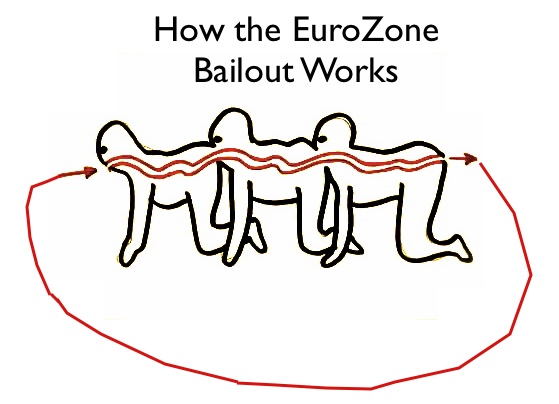
(Hat tips: Insta, Ace, and The Corner, plus no doubt a few I’ve forgotten.)

European Union to Become SuperDuper European Union

Friday, December 9th, 2011

Let me see if I can get this straight:

UK Prime Minister David Cameron, objecting to the Deutschland Uber Alles renegotiation of the Maastricht Treaty, is now causing the creation of a new SuperDuper Europe, with Germany reoccupying the Rhineland taking leadership of the whole shebang, finally erasing the rest of the continent’s reluctance at receiving orders from Berlin?

I mean, when even the Europhillic New York Times says that “Twenty years after the Maastricht Treaty, which was designed not just to integrate Europe but to contain the might of a united Germany, Berlin had effectively united Europe under its control,” maybe the citizens of those stodgy old entities we used to call “countries” should consider the possibility that they might may be making a mistake. I am especially surprised that the non-Euro-using generalgouvernement Poland gave in so readily, as their previous experiences with rule from Berlin have been less than exemplary.

But what’s sacrificing the last of your country’s vestigially sovereignty compared to the glorious dream of saving the Euro?

Assuming, of course, that forging this Pact of Steel (including a 500 billion Euro bailout fund) actually saves the Euro, which is a dubious proposition at best. And at least one U.S. general says we should be prepared for civil unrest if Euro ends up exploding anyway.

The irony, of course, is that David Cameron, the wetest Tory Wet PM since Neville Chamberlain, refused to give in to another Eurotreaty British citizens wouldn’t get a chance to vote on less than two months after refusing to allow a vote on the previous EU treaty British citizens were not allowed to vote on. It would be ironic if Cameron actually ended up pulling the UK out of the EU because, in a moment of weakness, he actually exhibited rare and uncharacteristic streaks of firm principle and common sense.

Will the citizens of Europe actually get a chance to vote on this Reich closer European integration? Doubtful. Ireland’s Taoiseach is being “cagey” about a vote. (Translation: Fark no, you peasants won’t get a vote.) I doubt any of his brothers in Europe’s Permanent Ruling Class will feel any less “cagey.”

Through a thousand small steps, from committees and working groups and consultations and emergency decrees, Eurocrats have done their very best to remove power for all important decisions from the hands of the people and entrust it into their own well-greased palms. And also, not so coincidentally, to avoid taking the blame for the ruin their cradle-to-grave welfare states, and the huge and ever-growing debts necessary to pay for them, have made of Europe’s once free nations and productive economies.

Other Eurozone news, some possibly stale and out of date:

  • Jim DeMint says the best way for us to help Europe is not to help Europe.
  • Portugal’s economy is shrinking.
  • Moody’s downgrades French banks.
  • Problem: Possibility of sovereign debt default means bond downgrades. Solution: Create a bailout fund. problem: Downgrade of bailout fund. Solution: ?????
  • Europe’s Coming Inflation:

    For years, Europeans loved to lecture Americans on the both the safety and soundness of the continent’s banking system as opposed to our own, and how their economic system worked so much better than ours. Well, one lesson of the 2011 financial crisis is that many of their banks are probably in worse shape than the US banks were in 2008.

    At least our banks’ troubled investments were tied to real estate, which may rebound once our economy improves. Their banks are holding debt tied to some of the world’s least productive, no-growth countries.

    Why so underproductive? Most of the evidence points to the failure of the European welfare state.

    Europeans loved to lecture Americans on how government-run health-care and cradle-to-grave entitlements provided such safety and comfort for the masses. People supposedly didn’t mind paying higher taxes because it enhanced their standard of living.

    Until, of course, it didn’t enhance anything — and Greece, Italy, Spain and Portugal face the collapse of their safety nets because they can’t borrow to pay for them anymore, even as unemployment is rampant. (Meanwhile, France is not far behind.)

  • Now Even German Bonds are Toxic

    Wednesday, November 23rd, 2011

    Now investors are even shying away from German sovereign debt:

    A “disastrous” sale of German benchmark bonds on Wednesday sparked fears the debt crisis was beginning to threaten even Europe’s biggest economy, with the Bundesbank forced to hold on to record amounts to ensure the auction did not fail.

    In one of the least successful debt sales by Europe’s powerhouse economy since the launch of the single currency, the low returns offered — just 2 percent annually over 10 years — deterred investors made uneasy by the escalating cost of the crisis to Germany.

    That meant the central bank had to pick up 39 percent of the 6 billion euros of debt Germany had hoped to sell after commercial banks bought just 3.644 billion euros of the issue.

    This isn’t Greece or Italy or Portugal. This is Germany, the strongest economy in the Eurozone, and the fourth largest economy in the world. There shouldn’t be any question about Germany’s ability to pay it’s debt, and there wouldn’t be if it weren’t for the fact that debt is denominated in Euros. If they were in Deutschmarks, Germany wouldn’t have any problem selling them.

    This just confirms what Euroskeptics have been noting for a while now: Once the defaults start, there’s no way to firewall the stronger Eurozone economies from the weaker ones while maintaining the same currency.

    Germany may soon be faced with the question of wrecking the Euro, or wrecking their own economy.

    Scenes from the EuroZone Summit

    Sunday, October 23rd, 2011

    There have been high level Euro rescue talks going on all weekend. How are they faring? Not well.

    Just when the eurozone governments thought it could not get worse for Europe’s single currency, it did.

    Shell-shocked EU finance ministers meeting in Brussels on Saturday were already reeling from the worst Franco-German rift for over 20 years and a fractious failure to resolve the problems that have brought Greece, and the euro, close to the brink.

    But then a new bombshell hit as a joint report by the EU and the International Monetary Fund (IMF) warned that, without a default, the Greek debt crisis alone could swallow the EuroZone’s entire €440 billion bailout fund – leaving nothing to spare to help the affected banks of Italy, Spain or France.

    Of course, the problem with following this story from abroad is how the news of the summit gets distorted like some intercontinental game of telephone, especially when filtered through the dulcet-toned hearing aids of welfare state boosters. Thus this overly enthusiastic piece in left-wing newspaper The Guardian, citing that a deal was near based on unnamed “EU diplomats” becomes this blipvert in the left-wing Daily Beast stating that a deal had been reached, becomes this Fark thread in which clueless liberals crow that no one should ever have doubted the soundness of either the Euro or the glorious European welfare state. And also that ratings agencies are evil.

    And yet, as of right now, this “done deal” to rescue the Euro has yet to materialize. How strange!

    Somehow, how France (a country running a a $90+ billion dollar budget deficit) and Germany (a country whose ruling party has lost every local election since it started shoveling money down the Greek bailout chute), were to magically comes up with some €1.6 trillion Euros (the difference between the current bailout fund and the super-sized fund required to backstop the Euro following the inevitable Greek default) is nowhere specified. After all, it was hard enough for Chancellor Angela Merkel to get Germany’s contribution to the fund boosted from €123 billion to €211 billion in the first place.

    As a result of all this happy, confident talk of how the Euro will never be allowed to falter? Moody’s downgraded Spain’s credit rating. They also threatened to do the same for France, especially if they decided to throw more taxpayer money into the Greek debt maw.

    The Good Ship Europe bears its load of bailout guarantees straight for the center of the Greek Debt crisis.

    And if you’re the EU, how do you prevent your debt from being downgraded? A.) Stop borrowing so much, B.) Increase your emergency reserves, or C.) Make it illegal for bond rating companies to downgrade your debt?

    Yeah, that will work.

    How badly awry has the Eruo project gone? The problem with this Hoover Institute piece on is what not to quote from it:

    The champions of the European Union once touted it as a “bold new experiment in living” and “the best hope in an insecure age.” But these days “fear is coursing through the corridors of Brussels,” as the B.B.C. reported in September. Such fear is justified, for the nations of Europe are struggling with fiscal problems that challenge the integrity of the whole E.U.-topian ideal. Greece teetering on the brink of default on its debts, E.U. nations squabbling about how to deal with the crisis, debt levels approaching 100 percent of GDP even in economic-powerhouse countries like Germany and France, and European banks exposed to depreciating government bonds are some of the signposts on the road to decline.

    A monetary union comprising independent states, each with its own peculiar economic and political interests, histories, cultural norms, laws, and fiscal systems, was bound to end up in the current crisis. All that borrowed money, however, was necessary for funding the lavish social welfare entitlements and employment benefits that once impressed champions of the “European Dream.” Yet, despite the greater fiscal integration created by the E.U., sluggish, over-regulated, over-taxed economies could not generate enough money to pay for such amenities. Now, the president of the European Council, Herman Van Rompuy, admits, “We can’t finance our social model.”

    This financial crisis means the government-financed dolce vita lifestyle once brandished as a reproach to work-obsessed America is facing cutbacks and austerity programs immensely unpopular among Europeans otherwise used to amenities like France’s 35-hour work week, or Greece’s two extra months of pay, or England’s generous housing subsidies that cost $34.4 billion a year. No surprise, then, that from Athens’ Syntagma Square to Madrid’s Puerta del Sol, austerity measures attempting to scale back government spending have been met with strikes, demonstrations, boycotts, and protests, some violent, on the part of citizens for whom such government entitlements have become human rights. In fact, such transfers of wealth have been formalized as rights in Articles 34 and 35 of the E.U.’s Charter of Fundamental Human Rights.

    The Euro crises will likely lead to another recession in the U.S. That is, if you think we ever came out of the Obama recession in the first place, which we didn’t.

    Europe’s private sector shrank for the first time in two years last month.

    Again: The question of a Eurozone collapse is not “if,” it is “when.” And how much of the losses European banks can put taxpayers on the hook for.

    This Week in Jihad for February 9, 2011

    Thursday, February 10th, 2011

    Things have been relatively quiet on the Jihad front this week, but there’s always something happening:

  • BBC Presenter: “Islam must not be offended at any price, although Christians are fair game because they do nothing about it if they are offended.”
  • Synagogue torched in Tunisia.
  • Reading the Bible? You know that’s a shooting.
  • Meet Yussuf al-Qaradawi, the Egyptian version of the Ayatollah Khomeini.
  • Over at JihadWatch, Roland Shirk offers up parallels between the modern Middle East and World War I.
  • Egyptian blogger Sandmonkey reveals identity.
  • Israeli PM Benjamin Netanyahu sees more parallels between the Iranian revolution and the situation in Egypt.
  • Geert Wilders: “All over Europe multicultural elites are waging total war against their populations. Their goal is to continue the strategy of mass-immigration, which will ultimately result in an Islamic Europe – a Europe without freedom: Eurabia.”
  • “Renegade ex-MILFs burn Christian village.” (Attention Farkers: This link is probably a lot less gratifying than you might believe…)
  • Pakistani suicide bomber kills 31 at army base.
  • Today’s latest American convert to Islam Jihadi comes to you from Baltimore.
  • Georgia is the latest state to ban Sharia.
  • German state Hesse bans face veils for public workers.
  • “Islam: The Religion of Sauron”. (No, really, that is the title. I’m going to go out on a limb and suggest that this comparison is a tad overwrought…)
  • (Hat tips: JihadWatch, Fark, Instapundit, Michael Totten, and the usual suspects.)

    Helen Thomas Fallout Roundup

    Tuesday, June 8th, 2010

    Lots of interesting fallout from Helen Thomas announcing her retirement following her amazingly stupid comments on sending Jews back to Germany and Poland:

    Still, despite all that, many liberals are still rushing to Thomas’ defense. (A quick Google blog search will turn many up.) It’s just more proof of that old liberal adage: “No enemies on the left.” Not even antisemitic ones.

    (Hat Tips: Instapundit, Real Clear Politics, Geoffrey Britain.)

    Updated: Iowahawk weighs in with The Golden Girls from Brazil.