Before we get into the British and U.S. tanks I saw at the Bovington Tank Museum, let’s look at one British prototype tank they had there, the Valiant, AKA “One of the Worst Tanks Ever Designed.”
Let’s look at the official Bovington description, shall we?
The Valiant appears to be one of the worst tanks ever designed in Britain. It is difficult to find any contemporary reports that say anything good about it!
The Valiant was originally designed by Vickers Armstrong to meet a War Office requirement for an Infantry Assault Tank for service in the Far East. During development the project was transferred first to the Birmingham Railway Carriage and Wagon Co. and then to Ruston and Hornsby Ltd. of Grantham.
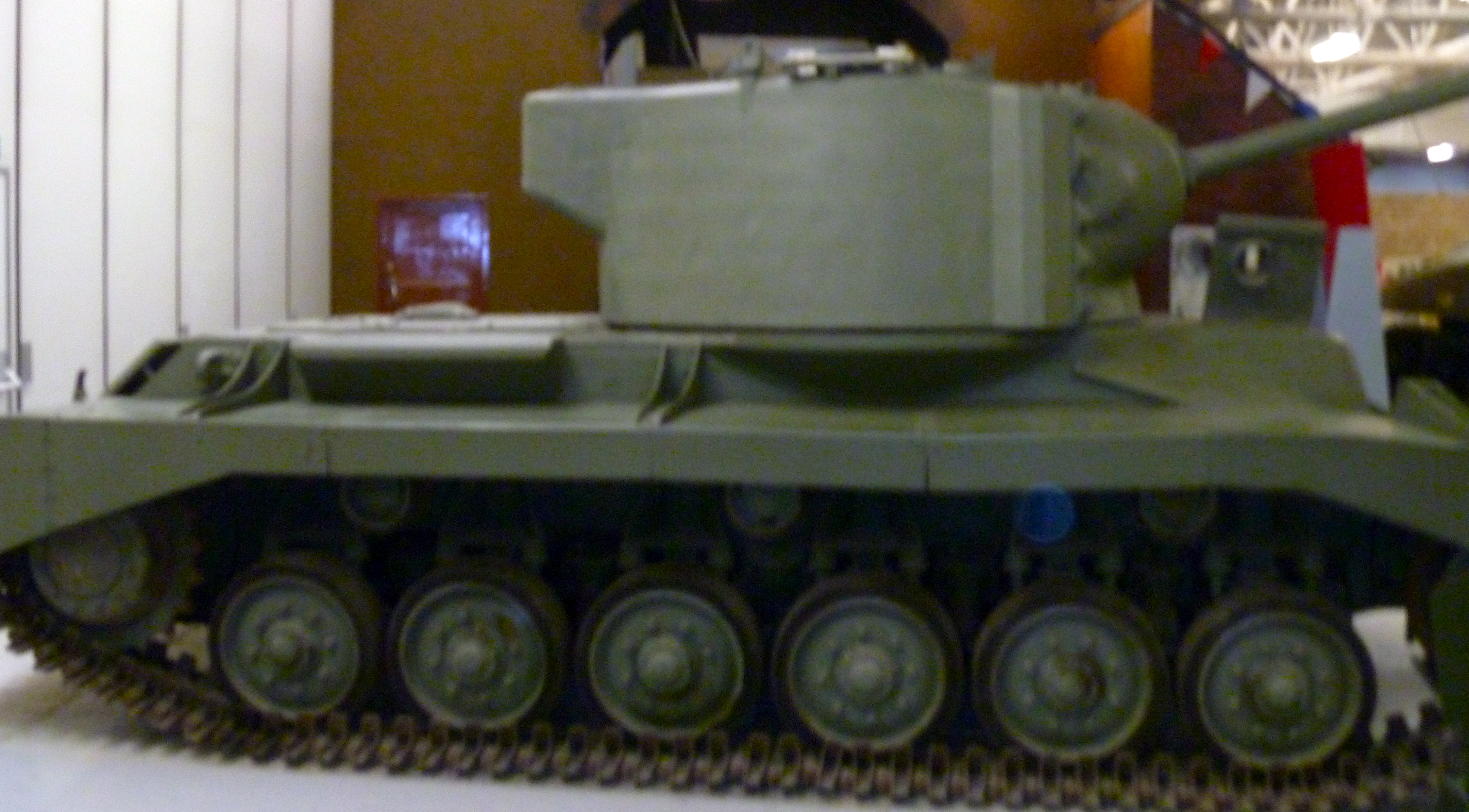
The designers were required to apply the thickest possible armour while keeping the weight as low as possible. Inevitably the hull was very small; the front hull casting was virtually moulded around the driver while the turret ring stuck out over the sides of the hull. In comparison the turret appeared to be enormous, as it had to accommodate a three man crew, (commander, gunner and loader/radio operator).
The Valiant used the same diesel engine as the Valentine, [although] it had little else in common with the earlier tank. Design documents exist for an improved version, the Valiant II, powered by a Rolls Royce Meteorite engine, converted to diesel operation.
Ruston and Hornsby built one prototype in 1944. Trials in 1944 – 45 revealed serious problems. With a power:weight ratio of 7.8hp per ton, the tank was slow. The ground clearance at the rear was found to be too low and the suspension, located partly under the hull, was easily damaged during cross-country driving. More seriously the driver was almost crippled by the cramped driving position and was in danger of being injured by the controls. Furthermore, the controls required inordinate strength to operate them. The tests were abandoned immediately.
Not surprisingly the Valiant did not enter production, officially because the war was likely to be over before the tank could be introduced into service.
My pics of the Valiant didn’t come out particularly well, but they do show what an odd looking tank it was:

And here’s a better pic from Wikipedia:
.jpg)
Wikipedia (citing David Fletcher’s book Universal Tank: British Armour in the Second World War), says “The sole Valiant was retained by the School of Tank Technology, where students were treated to an inspection of it at the end of their course and invited to find fault. David Fletcher wrote of this: ‘One hopes they started early in the morning.'”


