Posts Tagged ‘high speed rail’
Tuesday, August 30th, 2016
A new ranking of Freedom in the 50 states is out. Texas ranked 28th (too low, IMHO) while California ranked 49th:
- Texas:
Texas’s fiscal policy is very good. It is a fiscally decentralized state, with local taxes at about 4.5 percent of personal income, above the national average, and state taxes at about 3.6 percent of income, well below the national average. However, Texans don’t have much choice of local government, with only 0.36 jurisdictions per 100 square miles. State and local debt is above average (with the biggest problem being local debt burdens), at 23.1 percent of income, but it has come down slightly since FY 2011. Government subsidies are below average. Public employment has fallen significantly below average, at 11.8 percent of private employment.
Texas’s land-use freedom keeps housing prices down. It also has a regulatory taking compensation law, but it only applies to state government. The renewable portfolio standard has not been raised in years. Texas is our top state for labor-market freedom. Workers’ compensation coverage is optional for employers; most employees are covered, but not all. The state has a right-to-work law, no minimum wage, and a federally consistent anti-discrimination law. Cable and telecommunications have been liberalized. However, health insurance mandates were quite high as of 2010, the last available date. The extent of occupational licensing is high, but the state recently enacted a sunrise review requirement for new licensure proposals. Time will tell whether it is at all effective. Nurse practitioners enjoy no freedom of independent practice at all. Texas has few cronyist entry and price regulations, but it does have a price-gouging law, and Tesla’s direct sales model is still illegal. The civil liability system used to be terrible, but now it is merely below average. The state abolished joint and several liability in 2003, but it could do more to cap punitive damages and end parties’ role in judicial elections.
- California:
Although it has long been significantly freer on personal issues than the national average, California has also long been one of the lowest-scoring states on economic freedom.
Despite Proposition 13, California is one of the highest-taxed states in the country. Excluding severance and motor fuel taxes, California’s combined state and local tax collections were 10.8 percent of personal income. Moreover, because of the infamous Serrano decision on school funding, California is a fiscally centralized state. Local taxes are about average nationally, while state taxes are well above average. Government debt is high, at 22.8 percent of personal income. The state subsidizes business at a high rate (0.16 percent of the state economy). However, government employment is lower than the national average.
Regulatory policy is even more of a problem for the state than fiscal policy. California is one of the worst states on land-use freedom. Some cities have rent control, new housing supply is tightly restricted in the coastal areas, and eminent domain reform has been nugatory. Labor law is anti-employment, with no right-to-work law, high minimum wages, strict workers’ comp mandates, mandated short-term disability insurance, and a stricter-than-federal anti-discrimination law. Occupational licensing is extensive and strict, especially in construction trades. It is tied for worst in nursing practice freedom. The state’s mandatory cancer labeling law (Proposition 65) has significant economic costs. It is one of the worst states for consumer freedom of choice in homeowner’s and automobile insurance.
(Hat tip: Pension Tsunami.)
Texas tops yet another list as the best place to work and live.
“This notion of California as a land of outsiders is being turned on its head, our state’s dream repackaged – often with the approval of its ruling hegemons – as something more like a medieval city, expelling the poor and the young, while keeping the state’s blessings to the well-educated, well-heeled and generally older population”:
California has been bleeding people to other states for more than two decades. Even after the state’s “comeback,” net domestic out-migration since 2010 has exceeded 250,000. Moreover, the latest Internal Revenue Service migration data, for 2013-2014, does not support the view that those who leave are so dominated by the flight of younger and poorer people.
Of course, younger people tend to move more than older people, and people seeking better job opportunities are more likely to move than those who have made it. But, according to the IRS, nearly 60,000 more Californians left the state than moved in between 2013 and 2014. In each of the seven income categories and each of the five age categories, the IRS found that California lost net domestic migrants.
Nor, viewed over the long term, is California getting smarter than its rivals. Since 2000, California’s cache of 25- to 34-year-olds with college, postgraduate and professional degrees grew by 36 percent, below the national average of 42 percent, and Texas’ 47 percent. If we look at metropolitan regions, the growth of 25- to 34-year-olds with college degrees since 2000 has been more than 1.5 to nearly 3 times as fast in Houston and Austin as in Silicon Valley, Los Angeles, or San Francisco. Even New York, with its high costs, is doing better.
(Hat tip: Instapundit, who also notes “I remember talking to the Investor’s Business Daily folks a few years ago — they were headquartered in Marina Del Rey, a lovely place but one where they were constantly visited by inspectors, tax people, etc., all posing problems. When they opened an office in Texas, the state and local government people were all ‘tell us if we can help you.’ Very different experience.”)
“IRS Data: More Americans are relocating to Texas.” Though why an article datelined El Paso, and quoting only El Paso experts, uses a photo of Austin’s skyline to illustrate the story is a mystery…
The California Teacher’s Association: the worst union in America:
Seen as a national leader in the classroom during the 1950s and 1960s, the country’s largest state is today a laggard, competing with the likes of Mississippi and Washington, D.C., at the bottom of national rankings. The Golden State’s education tailspin has been blamed on everything from class sizes to the property-tax restrictions enforced by Proposition 13 to an influx of Spanish-speaking students. But no portrait of the system’s downfall would be complete without a depiction of the CTA, a political behemoth that blocks meaningful education reform, protects failing and even criminal educators, and inflates teacher pay and benefits to unsustainable levels.
Also this:
According to figures from the California Fair Political Practices Commission (a public institution) in 2010, the CTA had spent more than $210 million over the previous decade on political campaigning—more than any other donor in the state. In fact, the CTA outspent the pharmaceutical industry, the oil industry, and the tobacco industry combined.
California state appeals court rules unanimously that, yes, public employee pension benefits can indeed be reduced. (Hat tip: Pension Tsunami.)
The court giveth, the court taketh away, as the Vergara lawsuit ends with a whimper, meaning teachers unions can screw poor kids in California for the immediate future.
Meanwhile, California’s Democrat-controlled legislature passes a bill to get their fingers on private retirement funds create a plan to create a pension for private employee who don’t have one. (Hat tip: Pension Tsunami.)
No, it’s just to create more opportunities for graft through taxation. (Hat tip: Pension Tsunami.)
California’s cap-and-trade program is a colossal failure, and it may take the high speed rail boondoggle down with it:
California concluded its most recent cap-and-trade program auction last week. Out of 44,268,323 metric tons of carbon dioxide credits offered for sale by the state Air Resources Board, only 660,560 were sold, 1.5 percent of the total, raising a paltry $8.4 million out of a hoped-for $620 million. Last May’s auction was almost as bad, raising $10 million out of an anticipated $500 million.
California’s carbon dioxide cap-and-trade auction program was expected to bring in more than $2 billion in the current fiscal year that ends June 30, 2017, a quarter of which is earmarked for the high-speed rail project narrowly approved by voters in a 2008 ballot initiative. As a hedge against uncertainty, a $500 million reserve was built into the cap-and-trade budget. But, with the August auction falling 98.5 percent short, the entire reserve was consumed in the first of four auctions for the fiscal year.
It gets better:
In the meantime, the High-Speed Rail project, currently promised to cost “only” $68 billion to run from the Bay Area some 400 miles south to Los Angeles may be looking at $50 billion in overruns. To fund the costly train, which was sold to voters as not costing a dime in new taxes, the expected revenue stream from cap-and-trade has been securitized, putting the state on the hook to Wall Street for billions in construction money advanced on the promise of future cap-and-trade revenue.
California spends $1.5 billion for Chinook salmon.
The corrupt city of Maywood, California hired an engineering firm whose employees were so hard-working they put in 27 hour days.
The collapse of high-end California wine merchant Premier Cru, a $45 million wine Ponzi scheme.
Three skilled nursing facilities in Humboldt County, California to close because they can’t find enough nurses. Humboldt County is up on the Northern California coast.
The Inland Empire in Southern California, still reeling from its foreclosure crisis, saw the biggest jump in income inequality in the state at more than 40 percent. (Hat tip: Instapundit.)
Toastmasters International to move from Orange County, California to Colorado.
And least you think Texas is complete immune from pension worries, the Employees Retirement System of Texas is set to run out of money as well…in 2063. (Hat tip: Pension Tsunami.)
If California farmland overvalued?
California judge faces recall over being being too lenient to a sex offender. If the recall succeeds, liberals may very well regret setting this precedent…
California Governor Jerry Brown may push “green” initiatives, but he’s more than happy to take money for doing regulatory favors for Chevron and Occidental Petroleum. (Hat tip: Director Blue.)
From 2010: California’s abandoned wind farms.
Tags:California, California Teacher's Association, Colorado, corruption, Employees Retirement System of Texas, high speed rail, Maywood, Orange County, pension crisis, Texas, unions, Vergara vs. California, waste
Posted in Crime, Democrats, Texas, unions, Waste and Fraud | No Comments »
Monday, July 25th, 2016
Enjoy another Texas vs. California roundup:
June marked the 114th month that Texas was at or below the national unemployment average. Texas also created 246,600 jobs in the service sector.
Once again Texas ranks as the best state for business, and California ranks worst. (Hat tip: Fox and Hounds via Pension Tsunami.)
Elites watch while California crumbles:
The basket of California state taxes — sales, income, and gasoline — rates among the highest in the U.S. Yet California roads and K-12 education rank near the bottom.
California depends on a tiny elite class for about half of its income-tax revenue. Yet many of these wealthy taxpayers are fleeing the 40-million-person state, angry over paying 12 percent of their income for lousy public services.
Excessive state regulations and expanding government, massive illegal immigration from impoverished nations, and the rise of unimaginable wealth in the tech industry and coastal retirement communities created two antithetical Californias.
One is an elite, out-of-touch caste along the fashionable Pacific Ocean corridor that runs the state and has the money to escape the real-life consequences of its own unworkable agendas.
The other is a huge underclass in central, rural, and foothill California that cannot flee to the coast and suffers the bulk of the fallout from Byzantine state regulations, poor schools, and the failure to assimilate recent immigrants from some of the poorest areas in the world.
The result is Connecticut and Alabama combined in one state. A house in Menlo Park may sell for more than $1,000 a square foot. In Madera, three hours away, the cost is about one-tenth of that.
CalPERS suffers $30.8 billion annual loss. “CalPERS has notoriously minimized the annual pension contribution for its 3,007 government entities by fantasizing that its superior investments expertise will allow its investments to compound every year without loss for the next three decades at an annual rate of 7.5 percent.” (Hat tip: Pension Tsunami.)
CalSTRS isn’t doing much better: “The California State Teachers’ Retirement System [earned] 1.4% for the fiscal year ended June 30.” (Hat tip: Instapundit.)
Record tax revenues, yet somehow California is still broke:
California taxpayers are getting taken to the cleaners, but most of them are completely in the dark about how and why.
I will pose a quick question: Does it seem strange that California has recorded record revenue increases, yet we also see a record number of tax increases and bond issuances on the ballot?
In other words, the state’s tax system is collecting massive amounts of revenues, record amounts, yet politicians are still asking for a record number of new tax increases. For taxpayer advocates, it just doesn’t seem fair and seems very strange at first glance as to how this can even occur.
The truth of the matter is that California’s system of public finance is a complete train wreck and is set up such that no amount of tax revenues collected will ever be enough to satisfy “spending needs.” The so-called baseline expenditure increases are on autopilot and deficit projections are generated despite record revenue increases, a trend projected in the Governor’s May Revise.
(Hat tip: Pension Tsunami.)
“As we roll toward the November ballot, I’m reminded of H.L. Mencken’s quip that “Democracy is the theory that the common people know what they want, and deserve to get it good and hard.” We always get it “good and hard” in California given the ever-expanding one-party rule. The worse it gets, the more voters from the GOP high-tail it to Nevada and Texas — and the worse it gets as political competition evaporates. It’s the political equivalent of a death spiral.” (Hat tip: Pension Tsunami.)
Lots of tax hikes are on the California ballot this November, for a variety of different ostensible reasons, but actually for a single reason: Pensions. (Hat tip: Pension Tsunami.)
Beaumont, California: “Seven former officials were arrested and charged with stealing nearly $43 million during the city’s development boom. Now, residents are learning that the town’s problems go much deeper than the criminal case.” (Hat tip: Gregory Benford’s Facebook page.)
“California’s high-speed rail project increasingly looks like an expensive social science experiment to test just how long interest groups can keep money flowing to a doomed endeavor before elected officials finally decide to cancel it.” $68 billion and rising. (Hat tip: Ace of Spades HQ.)
“Teachers union writes a $10-million check for income tax ballot measure.”
“Oakland police officer Malcolm Miller more than quadrupled his $107,627 salary to $489,662 with overtime, benefits and other specialty pays last year — making him Oakland’s highest paid employee for the third year in a row.” (Hat tip: Pension Tsunami.)
“C.C. Myers Inc., one of California’s highest-profile freeway builders, has filed for bankruptcy.”
Also filing for bankruptcy: California-based developer Criswell-Radovan, which owns the Tahoe Cal Neva casino Frank Sinatra used to own.
One tiny bit of dubious good news for the Bankruptcy Court for the Central District of California: Now they’re only the second in bankruptcy filings in the nation at 45,000, having been overtaken by the Bankruptcy Court for the Northern District of Illinois at 47,535 filings.
Nissan and Toyota battle over Texas. “Both automakers are zeroing in on Texas as a key growth opportunity.”
California’s Democratic State Controller Betty Yee fined $2,082 for violations during her 2014 campaign.
Rent a security robot for $7 an hour. How many human security guards will be left at California’s $15 an hour?
Old and Busted: Participation trophies. The New Hotness: California’s Democratic officials giving awards to their own family members.
“Judge throws out ex-L.A. County Sheriff Lee Baca’s plea deal, saying six months in prison not enough.” (Hat tip: Dwight.)
Tags:bankruptcy, Beaumont (California), Betty Yee, Budget, California, CalPERs, CalSTARS, corruption, Crime, Criswell-Radovan, Democrats, Frank Sinatra, high speed rail, Illinois, minimum wage, Nissan, pension crisis, Tahoe, Texas, Toyota, unions
Posted in Budget, Crime, Democrats, Regulation, Texas, unions | No Comments »
Thursday, March 24th, 2016
Time for another Texas vs. California update:
California’s underfunded pension debts put it $175.1 billion in the red. “More than 51 percent ($89.9 billion) of the negative $175.1 billion consists of unfunded, employee-related, long-term liabilities.” (Hat tip: Pension Tsunami.)
A initiative to hike California’s minimum wage to $15 an hour has made the ballot. Also known as the “Send as much business as possible to Texas” act.
Speaking of which, Texas’ unemployment rate fell to 4.5% in January.
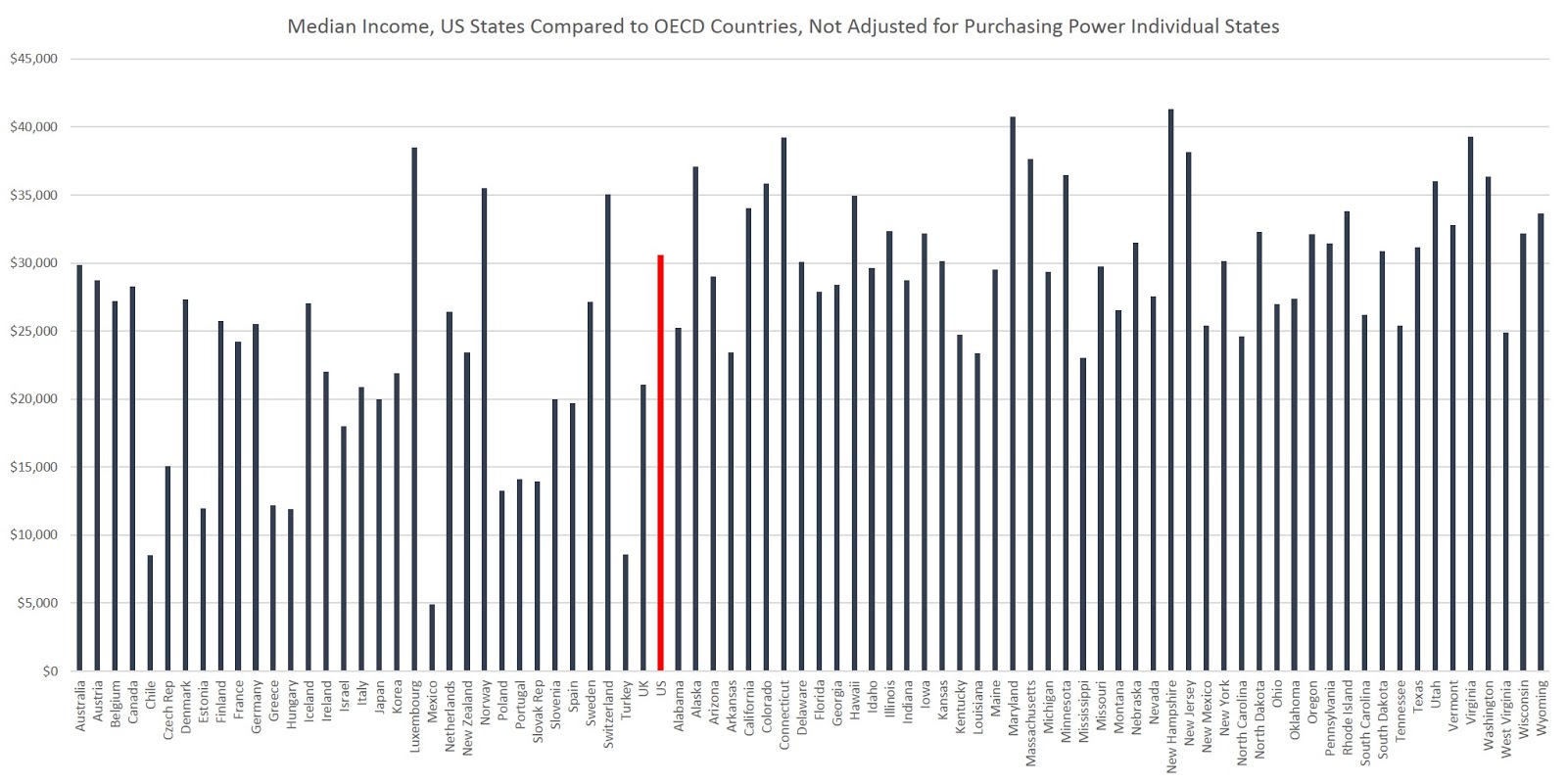
Germany and Sweden have lower median incomes than Texas. Indeed, were Germany and Sweden to join the union, they would instantly be among the poorest states.
Big Government advocates in California are fighting to renew a “temporary tax” on all those millionaires earning $250,000 or more a year. “The extension measure is again supported by the California Teachers Association and Service Employees International Union.”
California traffic fines have turned into a huge tax on the poor. “California is filled with people who are one traffic ticket away from losing their means of independent transportation. They get a ticket for a busted taillight or a small-change moving violation. On paper, the fine is $100, but with surcharges, it adds up to a lot more.” Which is why they’re having an amnesty to pay a reduced rate on outstanding tickets. But there’s a catch: “The practice of throwing in extra sources of revenue is so ingrained in Sacramento that there is a $50 amnesty program fee.” (Hat tip: Instapundit.)
Fresno’s pension system “is the only public pension program in California – and one of only a few in the United States – that has a surplus instead of unfunded pension liabilities.” (Hat tip: Pension Tsunami.)
“When unfunded pension, medical and other liabilities are formally included on its balance sheet, the [Orange County] Fire Authority’s debts exceeded its assets by $169 million for the fiscal year that ended in June,” the Register’s OC Watchdog wrote. “That’s a plunge of more than 680 percent in its ‘net position,’ or more than $420 million, over a single year.” (Hat tip: Pension Tsunami.)
California has a problem cutting pensions even when they’re going to convicted felons. (Hat tip: Pension Tsunami.)
Assisted suicide becomes legal in California June 9.
How long will California continue to consider itself part of the United States? (Hat tip: Ed Driscoll at Instapundit.)
Over 200 BART employees earned over $200,000 a year in total compensation.
California’s already long-delayed and already over-budget high speed rail fantasy is planning to put much of the initial segment underground due to community and environmental concerns. Problem: Digging those tunnels will probably cost $1 billion a mile.
California short-hauler Total Transportation Services Inc. files for bankruptcy.
“The parent company of Carl’s Jr., founded in Anaheim 60 years ago, is relocating its California headquarters to Nashville, Tenn.”
Kohl’s is closing nine stores in California, out of 18 total closing nationwide (none in Texas).
On the other hand, Sports Authority is closing slightly more stores in Texas (24) than California (19). Meh. I liked the stores more when they were Oshman’s…
California’s Quantum Fuel Systems Technologies Worldwide Inc., which manufactures and sells fuel systems and storage tanks for vehicles fitted for compressed natural gas, filed for bankruptcy. The fact the company has already gone through two reverse splits suggests long-running troubles…
Of course, being in Texas won’t prevent some municipalities of spending like they’re in California: San Antonio to spend almost $100,000 on a toilet.
Likewise, Houston’s credit rating been downgraded by both Moody’s and Standard & Poor’s due to “the city’s large unfunded pension liability.” Maybe former Houston Mayor Annise Parker should have spent more time on trimming expenses and fixing crummy surface streets than suing churches and tranny bathrooms…
Tags:California, Democrats, Fresno, high speed rail, Houston, Kohl's, Orange County, pension crisis, Quantum Fuel Systems, San Antonio, Sports Authority, Texas, unions, Welfare State
Posted in Democrats, Texas, unions, Welfare State | No Comments »
Thursday, February 25th, 2016
Been too long since I did a Texas vs. California roundup, so here it is:
Dark Age California:
There are large areas of Central California that resemble life in rural Mexico. Within a radius of five miles I can go to stores and restaurants where English is rarely spoken and there is no racial or cultural diversity—a far cry from Jeb Bush’s notion of an “act of love” landscape.
With unemployment at 10% or more in the interior of the state, with the public schools near the bottom in the nation, and with generous entitlements, it is no accident that one in six in the nation who receive public assistance now live in California, where about a fifth of the population lives below the poverty line.
One in four Californians also were not born in the United States; more than one in four who enter the hospital for any cause are found upon admittance to suffer from Type II diabetes. The unspoken responsibility of California state government is to bring state-sponsored parity to new arrivals from Oaxaca, and to do so in ideological fashion that ensures open borders and more government. It is the work of a sort of secular church, and questioning its premises is career-ending blasphemy.
“California has come a long way to dig itself out of budget deficits, but the state remains on shaky ground due to nearly $400 billion in unfunded liabilities and debt from public pensions, retiree health care and bonds.” More: “It’s California’s debt and liabilities that are concerning financial analysts, particularly the state’s rapidly growing unfunded retiree health care costs, which grew more than 80 percent over the past decade. California has promised $74 billion more in health and dental benefits to current and retired state workers than the state has put aside.” (Hat tip: CalWatchdog.)
And new accounting rules make those unfunded liabilities harder to ignore.
The problem might not be quite as bad as it is did not CalPERS and CalSTARS insist on politically correct investments. (Hat tip: Pension Tsunami.)
San Francisco political officials indicted:
A retired city employee and a former city commissioner who are at the center of bribery allegations involving Mayor Ed Lee were charged with multiple felonies including bribery and money laundering, San Francisco District Attorney George Gascon announced at a news conference Friday afternoon.
Also charged Friday was political consultant and former San Francisco Unified School District Board of Education President Keith Jackson, who pleaded guilty last year to racketeering charges.
The district attorney’s office charged recently retired Human Rights Commission employee Zula Jones, ex-HRC commissioner Nazly Mohajer and former political consultant Keith Jackson.
Remember that Zula Jones and Nazly Mohajer were fingered by Leeland Yee’s attorneys as being the go-betweens for bribing Lee. This brings up the question (yet again): Why hasn’t Lee himself been indicted?
And speaking of California government officials being indicted: “Retired Los Angeles County Sheriff Lee Baca pleaded guilty Wednesday to lying to federal investigators, a stunning reversal for the longtime law enforcement leader who for years insisted he played no role in the misconduct that tarnished his agency.” (Hat tip: Dwight.)
Jerry Brown vetoes kangaroo court minimums for college sexual assault cases.
“Brown pushed for the giant pension fund CalPERS to lower its assumed investment return from 7.5% to 6.5%. Given that the world is headed towards deflation and that CalPERS earned only 2.4% for the fiscal year ended June 30, 2015, Brown’s request seemed entirely reasonable. Instead, the board approved a staff proposal to move to the 6.5% target over 10 years.” (Hat tip: Pension Tsunami.)
CalPERS board President Rob Feckner, serving his twelfth term, casts deciding vote against proposal for term limits for board members. “Feckner was president of the California School Employees Association for four years and executive vice president of the California Labor Federation for five. Such a conflict of interest wouldn’t be tolerated with the president of other boards of directors. But with CalPERS, it’s par for the course.” (Hat tip: Pension Tsunami.)
San Diego voters: We want pension reform! Union-stacked Public Employment Relations Board (PERB): Get stuffed, peasants! Result: Lawsuit. (Hat tip: Pension Tsunami.)
The middle class is fleeing California. “In 2006, 38 percent of middle-class households in California used more than 30 percent of their income to cover rent. Today, that figure is over 53 percent.”
California tech industries continue their exodus to Texas:
The tech industry in the Bay Area has become a victim of its own success – and state policies. Like many other California businesses, tech firms are relocating or expanding operations in others states – particularly Texas – at an alarming rate.
Some companies spend significant amounts of time and money finding and training the right workers, only to see them poached by a flashy startup within a number of months. The need for a more stable workforce was one of the main reasons cloud-computing company LiveOps Cloud moved from Silicon Valley to a suburb of Austin, Texas, CEO Vasili Triant told the San Francisco Chronicle.
Other reasons to move or expand out-of-state are government-created: high taxes, burdensome regulations, unaffordable housing due to excessive development fees and restrictive land-use policies. California’s highly-educated workforce is not so unique anymore, and its quality of life has been tarnished by regulatory and affordability issues. Texas, by contrast, has no personal income tax and no corporate income tax (though it does have a less-onerous gross margins tax), and is universally hailed for having one of the friendliest business climates in the nation.
Google, Facebook, Apple, Dropbox, Oracle and nearly two dozen other Bay Area tech companies have all built or expanded facilities in Texas just since 2014, the Chronicle reported. There have been more than 1,500 publicly reported California “disinvestment events” across all industries over the past seven years, according to a November report from Spectrum Location Solutions, an Irvine-based business relocation consulting firm, although it estimated the actual tally at as high as 9,000. A California business “can save 20 percent to 32 percent of labor costs by relocating a facility out of state,” Spectrum president Joe Vranich told us last year.
More on the theme:
Between 1997 and 2000, during the peak of the dot-com boom, the Bay Area was a net importer of Texans: About 1,500 more households moved into the region from Texas than vice versa, bringing an additional $191 million (2015 dollars) in taxable income into the region, according to IRS data, which tracks the movement of taxpaying residents.
The trend changed in the early 2000s, and Texas has been a net importer of Bay Area households ever since. Between 2009 and 2012, as the recession was winding down and the second tech boom was revving up, the region lost about 1,430 households to Texas, and nearly $390 million in taxable income.
Snip.
I had a guy working for me (in the Bay Area) making $200,000 a year, struggling to pay his bills,” company CEO Triant said. “In lots of places in the country you’re living high on the hog on $200,000. … As far as work life balance and employee morale, we have absolutely seen a remarkable increase since moving here; it’s night and day.”
The firm still keeps a small Bay Area office, and Triant speaks fondly of his hometown of San Diego and California in general.
But when it comes to building a company and running a business, he has found a new home in Texas. “I want my employees to be able to have a good quality of life, live in a city with low crime rates, good schools,” he said. “And that’s what we’re doing here.”
“It’s no coincidence that Texas and Florida have thrived while New York and California have not. High levels of taxes, spending, and regulations make it more difficult for entrepreneurs to be successful. When entrepreneurs cannot expand their businesses and hire new workers, everyone is hurt, not just the rich.”
In the course of verifying a Rep. Joe Straus campaign ad, Polifact confirms that Texas has grown twice as fast as the rest of the country.
The University of California, Berkeley, is running a $150 million deficit this year. (Hat tip: Pension Tsunami.)
UC Academic Senate rejects task force’s proposed retirement benefits plan that, keeping with Jerry Brown’s modest pension reforms, would pay them a measly $117,020 pension benefit. (Hat tip: Pension Tsunami.)
“What’s more important: High-speed rail or water? Proponents of a proposed ballot measure would force voters to choose just that. The measure would redirect $8 billion in unsold high-speed rail bonds and $2.7 billion from the 2014 water bond to fund new water storage projects.”
Speaking of water restrictions, looks like Californians will get to enjoy them for another year.
Sure, Covered California (California’s ObamaCare) may be incompetent. But it’s also corrupt. The state auditor “criticized the exchange for not sufficiently justifying its decision to award a number of large contracts without subjecting the contractors to competitive bidding.”
California is releasing many felons as part of a “mass forgiveness” program. Including a murderer who tied up a husband and wife and beat them to death with a pipe.
California adds Aloe Vera to list of cancer-causing substances. “The problem is that the 800+ chemicals listed in Proposition 65 are not devised to protect consumers, but rather serve as a cash cow for private trial lawyers to sue small business and reap the hefty settlement payout. Since 1986, nearly 20,000 lawsuits have been filed, adding up to over half a billion dollars in settlement payments by business owners.” (Hat tip: Ed Driscoll at Instapundit.)
San Francisco’s planning process is designed for gridlock.
Bankrupt San Bernardino has reached a settlement with its firefighters union.
Heh. “The movement to emblazon state legislators with the logos of their donors has collected tens of thousands of signatures for its would-be ballot initiative.The measure, formally called the ‘Name All Sponsors California Accountability Reform (or NASCAR. Get it?) Initiative,’ would require all state legislators to wear the emblems or names of their 10 top donors every time they attend an official function.” The ballot initiative has already collected 40,000 signatures…
Huge soda pop collection is coming to the Dr Pepper museum in Waco.
Tags:Austin, Berkeley, California, CalPERs, CalSTARS, Crime, Democrats, Ed Lee, high speed rail, Keith Jackson, Lee Baca, LiveOps, Nazly Mohajer, pension crisis, Regulation, Rob Feckner, San Bernardino, San Diego, San Francisco, Social Justice Warriors, Texas, unions, Vance Ginn, Waco, waste, water, Welfare State, Zula Jones
Posted in Austin, Budget, Crime, Democrats, Regulation, Social Justice Warriors, Texas, unions, Waste and Fraud, Welfare State | 6 Comments »
Thursday, March 12th, 2015
Time for another Texas vs. California update:
In a worst-case scenario, CalSTARS and CalPERS might need an additional $50 billion a year between them to stay solvent.
If you haven’t taken a look at my piece on Stockton’s latest boondoggle, you probably should.
A new ballot initiative to cut California public employee pensions is due out in May, lead by former San Jose Mayor Chuck Reed, a Democrat.
Even Jerry Brown’s timid pension reforms are evidently too much for the Obama Administration, which is holding up funds over them.
A rare bit of good municipal news out of California, as Rancho Mirage declares that they’re debt free. (Hat tip: Pension Tunami.)
Prime Health Care pulls out of Daughters of Charity hospital acquisition. California Attorney general Kamala Harris may have just insured those hospitals will close instead.
Texas population to explode. (Hat tip: Push Junction.)
Land acquisition for California’s high speed rail boondoggle isn’t going swimmingly.
Malibu Golf Club files for Chapter 11. “An attorney for Malibu Associates said the company closed the golf club after defaulting on a $47-million loan from U.S. Bank, which has begun foreclosure proceedings.”
“In February, the Berkeley Health Center, a clinic that provided medical services to low-income patients, closed down in the wake of serious financial troubles, including allegations that it had mismanaged public funds.” They also left behind sensitive patient records…
Calfornia hikes water rates. Millions for the delta smelt, not one blue drop for you to drink…
Monolith Semiconductor relocates from Ithaca, New York to Round Rock.
Tags:California, CalPERs, CalSTARS, Chuck Reed, Democrats, fraud, high speed rail, Jerry Brown, Kamala Harris, Monolith Semiconductor, Rancho Mirage, Round Rock, Texas, Welfare State, Williamson County
Posted in Democrats, Texas, unions, Waste and Fraud, Welfare State | No Comments »
Thursday, February 19th, 2015
Time for another Texas vs. California roundup:
U.S. bankruptcy judge presiding over the Stockton case says pensions are not sacred and can be cut in bankruptcy. “CalPERS has bullied its way about in this case with an iron fist insisting that it and the municipal pensions it services are inviolable. The bully may have an iron fist, but it also turns out to have a glass jaw.”
Public employee pensions: Stealing from the young and poor to give to the old and rich. (Hat tip: Pension Tsunami.)
California’s entrepreneurs still think the business climate sucks. “In the 2014 survey, 63.5 percent called the small business climate poor, with just 10 saying it’s good. This year 60 percent still consider the business climate poor with 16.5 percent finding it good.”
By contrast, low oil prices won’t torpedo Texas’ economy. “Texas’ economy today is more resilient to oil price fluctuations thanks to industrial diversification and pro-growth policies.”
California’s combined capital gains tax rate is the third highest. Not third highest in the U.S., third highest in the world, lower only than Denmark and France.
How environmentalists made California’s drought worse.
Two unions are on different sides of a proposed sale of six struggling Catholic hospitals to a private company.
Defense contractor “Advantage SCI, LLC announced today that the company will relocate its headquarters to Alexandria, Virginia (Fairfax County in Old Town Alexandria) from El Segundo, California, after recognizing the high costs related to worker’s compensation, liability, and taxes that plague businesses in California.”
Coffee roaster Farmers Brothers is leaving California for either Oklahoma or Texas.
More on the Farmer Brothers relocation. “After surviving depressions, recessions, earthquakes and wars, Farmer Brothers is leaving California, finally driven out by high taxes and oppressive regulations.”
California Democrats file bills to force the state to get 50% of its energy from renewable energy by 2030. They’re basically putting up yet another big red sign to manufacturers: “We’ll make it impossibly expensive for you to do business here.”
Why health care in California is less affordable than elsewhere.
The mess that is California’s homeowner earthquake insurance.
California property owners aren’t wild about being forced to sell their land for the high speed rail boondoggle.
Arlene Wohlgemuth on why Texas should avoid the siren song of Medicare expansion. (Also, best wishes to her for a speedy recovery from her motorcycle accident.)
California’s top lifeguard pulls in a cool $236,859 in total compensation. (Hat tip: Pension Tsunami.)
“Lewd yoga dentist filed for bankruptcy.” A San Diego dentist, which is my pretext for including it here, but really, how could I not link a headline like that?
Tags:Arlene Wohlgemuth, California, CalPERs, Democrats, Energy Policy, environmentalism, health care, high speed rail, oil industry, pension crisis, Regulation, Texas, unions, Welfare State
Posted in Democrats, Regulation, Texas, unions, Waste and Fraud, Welfare State | 1 Comment »