Posts Tagged ‘unions’
LinkSwarm for February 3, 2012
Friday, February 3rd, 2012LinkSwarm for Friday, November 11, 2011 (11/11/11)
Friday, November 11th, 2011I hope you’re celebrating both Veterans Day and Nigel Tufnel Day (11/11/11) today. A few bits of news:
I’ll try to do a Greek/Euro debt update just as soon as I figure out just what the hell Europe is actually doing…
Red State, Blue State
Sunday, October 16th, 2011Tax revenues in Texas rose 11.8% in September compared to September a year ago.
Meanwhile, California took in 4 percent less than anticipated in September, falling $300 million short in September alone and $700 million short for the year.
These numbers offer me a chance to offer up my long-in-gestation comparison between Texas and California.
Both Texas and California share a number of similarities: They are the two most populous states in the Union, both are southern states with warm climates, both have long coastlines and important ports handling international trade, both share a border with Mexico, both have diverse populations and diversified economies, including extensive portions of the agriculture, energy, and high tech sectors.
The biggest difference between the two is their respective governments. Texas, of course, is the paragon of the red state model (low tax, low spending, limited government, non-union) whereas California is the classic example of the blue state model (high tax, high spending, expansive welfare state, closed shop). Texas kept government small, tightened its belt and lived within its means. California spent like there was no tomorrow, jacked tax rates into the stratosphere, and gave generous contracts to public employee unions. Now Texas is doing well and California is going broke.
So what example should America follow, that of deficit-slaughtering, budget-cutting, seriously limited government in Texas, which has added 730,000 jobs in the past decade, or that of regulation-happy, spend-mercilessly, owe-everything, flee-this-place-quickly California, which has lost 600,000 jobs during the same period?
Texas has some of the best cities for jobs in the country. California? It “boasted zero regions in the top 150.”
Chief Executive ranks Texas as the best state for business, and California as the worst.
High tech companies are fleeing California for low tax states. In fact, high earners inevitably flee high tax states for low tax states:
Examining IRS tax return data by state, E.J. McMahon, a fiscal expert at the Manhattan Institute, measured the impact of large income-tax rate increases on the rich ($200,000 income or more) in Connecticut, which raised its tax rate in 2003 to 5% from 4.5%; in New Jersey, which raised its rate in 2004 to 8.97% from 6.35%; and in New York, which raised its tax rate in 2003 to 7.7% from 6.85%. Over the period 2002-2005, in each of these states the “soak the rich” tax hike was followed by a significant reduction in the number of rich people paying taxes in these states relative to the national average. Amazingly, these three states ranked 46th, 49th and 50th among all states in the percentage increase in wealthy tax filers in the years after they tried to soak the rich.
Here’s a comparison between California and Texas that explains, in great detail, how and why Texas is kicking California’s ass. Remember those job creation numbers, so ably depicted by WILLisms?

Now compare Texas to California via this chart from Mark J. Perry’s Carpe Diem blog:
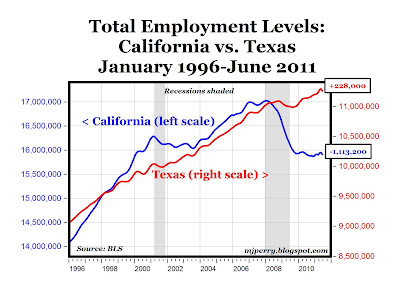
Another reason Texas is thriving is that it doesn’t have overpaid, all-powerful public sector unions.
High tech employees are fleeing California for Texas, because they can keep more of what they make, the government isn’t going bankrupt, and the roads and schools are now better in Texas. Despite all the money California spends on a a bloated public sector, the actual core services delivered are worse in California than they are in Texas:
“Today, you go to Texas, the roads are no worse, the public schools are not great but are better than or equal to ours, and their universities are good. The bargain between California’s government and the middle class is constantly being renegotiated to the disadvantage of the middle class.”
Just how broke California is became apparent in a recent Michael Lewis piece in Vanity Fair. It illustrates who irretrievably broken California’s politics and finances are, and just how little a dent Gov. Arnold Schwarzenegger made in fixing the problem:
David Crane, the former economic adviser—at that moment rapidly receding into the distance—could itemize the result: a long list of depressing government financial statistics. The pensions of state employees ate up twice as much of the budget when Schwarzenegger left office as they had when he arrived, for instance. The officially recognized gap between what the state would owe its workers and what it had on hand to pay them was roughly $105 billion, but that, thanks to accounting gimmicks, was probably only about half the real number. “This year the state will directly spend $32 billion on employee pay and benefits, up 65 percent over the past 10 years,” says Crane later. “Compare that to state spending on higher education [down 5 percent], health and human services [up just 5 percent], and parks and recreation [flat], all crowded out in large part by fast-rising employment costs.” Crane is a lifelong Democrat with no particular hostility to government. But the more he looked into the details, the more shocking he found them to be. In 2010, for instance, the state spent $6 billion on fewer than 30,000 guards and other prison-system employees. A prison guard who started his career at the age of 45 could retire after five years with a pension that very nearly equaled his former salary. The head parole psychiatrist for the California prison system was the state’s highest-paid public employee; in 2010 he’d made $838,706. The same fiscal year that the state spent $6 billion on prisons, it had invested just $4.7 billion in its higher education—that is, 33 campuses with 670,000 students. Over the past 30 years the state’s share of the budget for the University of California has fallen from 30 percent to 11 percent, and it is about to fall a lot more. In 1980 a Cal student paid $776 a year in tuition; in 2011 he pays $13,218. Everywhere you turn, the long-term future of the state is being sacrificed.
It’s even worse at the local level, where cities are going broke do to outrageous union pensions, such as in San Jose:
It shows that the city’s pension costs when he first became interested in the subject were projected to run $73 million a year. This year they would be $245 million: pension and health-care costs of retired workers now are more than half the budget. In three years’ time pension costs alone would come to $400 million, though “if you were to adjust for real life expectancy it is more like $650 million.” Legally obliged to meet these costs, the city can respond only by cutting elsewhere. As a result, San Jose, once run by 7,450 city workers, was now being run by 5,400 city workers.
What do the citizens of California get for some of the highest public sector wages in the country? Police and firefighters that stand around watching a man drown.
San Jose is far from the worst:
Back in 2008, unable to come to terms with its many creditors, Vallejo declared bankruptcy. Eighty percent of the city’s budget—and the lion’s share of the claims that had thrown it into bankruptcy—were wrapped up in the pay and benefits of public-safety workers.
You cannot tax your way to prosperity.
You cannot spend your way to prosperity.
Government can only create the conditions that allow the free market to create jobs.
The red state model works.
The blue state model doesn’t.
LinkSwarm for Wednesday, March 16, 2011
Wednesday, March 16th, 2011A few quick links:
Iowahawk Strikes Again!
Tuesday, March 8th, 2011Evidently I wasn’t the only one struck by Iowahawk’s masterfully takedown off Paul Krugman and The Economist on the middling (at best) performance of Wisconsin’s unionized education system. Now Iowahawk strikes again to confirm that, yes, he was right the first time. He also goes into more detail of the various dropout statistics, ACT/SAT scores, etc.
Also, Iowahawk reader Michael Pollard helpfully supplied statistics showing the comparison between Texas and Wisconsin also held generally when comparing the other maligned non-union states to Wisconsin. Sayeth Iowahawk: “Wisconsin is a (1) middling performer for white students; (2) below middling for Hispanic students, and (3) an absolute disaster for black students.”
Read the whole thing.
Iowahawk Defends Texas (And Slaps Paul Krugman and The Economist Into Next Sunday)
Monday, March 7th, 2011Iowahawk took time out from his busy schedule as the web’s premiere political satirist to evaluate some claims Paul Krugman and The Economist made about the educational achievements of Texas.
Wait, did I say “evaluate?” I meant “demolish like a bulldozer ripping through a condemned shantytown” (or an “Obamaville,” if you prefer). Kruggers and the EcoMen (which, I have to point out, would be a good name for a rock band) have been as thoroughly pwned as a hungover frat boy waking up after a late-night kegstand to find male genitalia Magic Markered across his face. It’s an epic take-down.
Let’s start with assertions that started the whole thing, and which exemplify a specific type of liberal desire to wish away Texas’ deeply inconvenient economic success. From Krugman:
And in low-tax, low-spending Texas, the kids are not all right. The high school graduation rate, at just 61.3 percent, puts Texas 43rd out of 50 in state rankings. Nationally, the state ranks fifth in child poverty; it leads in the percentage of children without health insurance. And only 78 percent of Texas children are in excellent or very good health, significantly below the national average.
Next comes the bit from The Economist:
Only 5 states do not have collective bargaining for educators and have deemed it illegal. Those states and their ranking on ACT/SAT scores are as follows:
South Carolina – 50th
North Carolina – 49th
Georgia – 48th
Texas – 47th
Virginia – 44thIf you are wondering, Wisconsin, with its collective bargaining for teachers, is ranked 2nd in the country.
With that background, you’re now ready for Iowahawk to demolish the subject like Charlie Sheen demolishes an ounce of cocaine. First, the necessary context:
A state’s “average ACT/SAT” is, for all intents and purposes, a proxy for the percent of white people who live there.
Actually this is not strictly true; it’s more accurate to say its a proxy for the percent of white and Asian people who live there. But close enough for government work.
Iowahawk goes on:
In fact, the lion’s share of state-to-state variance in test scores is accounted for by differences in ethnic composition. Minority students – regardless of state residence – tend to score lower than white students on standardized test, and the higher the proportion of minority students in a state the lower its overall test scores tend to be.
But don’t take his word for it. Take his facts for it, as he provides grade-by-grade comparisons of each of the two sates students broken down demographically (by white, black and Hispanic students). Go over and take a look at the data if you haven’t already. His conclusion:
To recap: white students in Texas perform better than white students in Wisconsin, black students in Texas perform better than black students in Wisconsin, Hispanic students in Texas perform better than Hispanic students in Wisconsin. In 18 separate ethnicity-controlled comparisons, the only one where Wisconsin students performed better than their peers in Texas was 4th grade science for Hispanic students (statistically insignificant), and this was reversed by 8th grade. Further, Texas students exceeded the national average for their ethnic cohort in all 18 comparisons; Wisconsinites were below the national average in 8, above average in 8.
Perhaps the most striking thing in these numbers is the within-state gap between white and minority students. Not only did white Texas students outperform white Wisconsin students, the gap between white students and minority students in Texas was much less than the gap between white and minority students in Wisconsin. In other words, students are better off in Texas schools than in Wisconsin schools – especially minority students.
He does the same job for Krugman’s dropout rates:
White and Hispanic Texas students indeed seem to dropout at a higher rate than their counterparts in Wisconsin, although in both cases (a) the difference is not statistically significant; and (b) in both cases, both states are significantly below the national average. Among black high school students, Texans have significantly lower dropout rates than their national cohort and Wisconsinites. Black high school students in Wisconsin have significantly higher dropout rates than national.
Your first question is probably, “why do the union teachers in Wisconsin hate black students?” Sorry, can’t help you there, I’m stumped too.
Ouch! You know that’s going to leave a scar…
LinkSwarm for Wednesday, March 2, 2011
Wednesday, March 2nd, 2011A few links to tide you over while I’m fighting the alligators:
Free Mickey Kaus (With Purchase)
Wednesday, February 23rd, 2011I haven’t been covering events in Wisconsin because plenty of other people have been doing a good job on that front. However, I was keenly interested in what Internet bon vivant and international man of mystery Mickey Kaus had to say.
Kaus is a Democrat (and an unsuccessful Senate candidate), but one fiercely critical of the Democratic Party’s reliance on corrupt public sector unions (and illegal alien amnesty), and thus I was quite interested to find out what he had to say on the subject.
While Kaus himself is Twittering up a storm about it, his Newsweek blog hasn’t been updated in more than three weeks…mainly because he’s no longer on that sinking shiphole, having been hired away by The Daily Caller. A good move for both Kaus and The Caller.
Or it would be, except I can’t find any mention of him there since the announcement of his hiring.
So what gives? Why aren’t we being regaled with Kaus’ pithy insights on the the battle in Wisconsin?
Free Mickey Kaus!*
*(Offer not valid in California, New York, Michigan, or Puerto Rico)
It’s Good to Be the King
Monday, October 18th, 2010The king of creating jobs, that is. “More than half of the net new jobs in the U.S. during the past 12 months were created in the Lone Star State.”
Funny what happens when you have:
- No state income tax
- Right to work laws
- No out-of-control public employee unions
- Conservative Republicans in charges of the Governor’s mansion, the House, and the Senate
- Which have actually constrained the growth of government during boom times
- A requirement by law to balance the budget
- Regulations that encourage private enterprise rather than punish it
- A healthy disdain for Political Correctness
- A thriving high tech sector
- Warm weather
- Natural ports
Some might think the last three are the most important factors, but California has all those as well, and their economy is biting the moose hard.
For a more detailed breakdown of of why Texas is kicking California’s ass (and not just at football), read this Arduin, Laffer & Moore report put out by the Texas Public Policy Foundation. Notice, for example, that Texas has lower taxes in every single category except sale tax (where the two are close to even)…and California is still broke! You can’t tax your way to prosperity.
Liberal policies don’t fail because of bad luck, or because of some sinister conservative conspiracy to make them fail. Liberal policies fail because the liberal ideas behind them are wrong.
Reality, it seems, has a free market bias.
LinkSwarm for Sunday, June 13
Sunday, June 13th, 2010A few random links to while away your day:
- It must be hard for the New York City teacher’s union, the United Federation of Teachers, to make ends meet, what with the $183,603 per year they have to pay for office space. That is to say, their office space in Boca Raton, Florida.
- “Environmentalists, like feminists, are just another arm of the Democratic establishment: ‘running dogs’ to be loosed or reined in as politics require. It is thus unnecessary to pay attention to what they say, since it’s just politics anyway.”
- “Europe’s Lehman Bros. is actually Europe.”
- Lifestyles of the rich and famous drug lords, including lots and lots of guns.
- When you’re Barack Obama, and Maureen Dowd (of all people) says that Joe Biden (of all people) has better relations with the press than you do, you may have a problem. Also this about Obama: “he is an elitist, too, as well as thin-skinned and controlling.” However, I’m not buying Dowd’s attempts to defuse the “media as Obama worshipers” problem: “The press traveling with Obama on the campaign never had a lovey-dovey relationship with him. He treated us with aloof correctness, and occasional spurts of irritation.” However, if that was the case, I don’t recall seeing a single report from the mainstream media in all of 2008 that mentioned it, which rather confirms the idea that the media buried any negative reporting during the campaign because of ideological solidarity and wanting him to win, doesn’t it?
- California’s Proposition 14 may have just insured that Green and Libertarian Party candidates never get on the general election ballot.
- Wednesday before Dutch election: Geert Wilders is irrelevant. Friday after Dutch election: Geert Wilders is a kingmaker.
- Am I just going to link to every damn Mark Steyn piece that comes down the pike? Why yes. Yes I am.
(Hat tips: Instapundit, Real Clear Politics, NRO’s The Corner)