Posts Tagged ‘Joe Straus’

About That Paxton Indictment

Monday, August 17th, 2015

Dwight covered the indictment of Texas Attorney General Ken Paxton on “three felony counts of securities law violations” a while back, but I wanted to touch on a few unusual aspects to the indictment.

Now I’m just a simple Hyper-Chicken from a backwoods asteroid blogger, so I won’t pretend to know the ins and outs of the security laws Paxton theoretically violated. But it does appear that something stinks about the Paxton indictment:

The two charges of fraud against Paxton don’t involve misrepresentation on Paxton’s part, or any other violation of a clear principle. Rather, the prosecutors think Paxton should have volunteered more information about his own investments in the course of selling stock in a company, and that his not doing so amounts to fraud.

Snip.

Paxton isn’t being accused of telling a lie, which is a factual question. He’s being accused of the much more subjective charge of misleading investors by failing to state a material fact. Actually, the indictments just allege the failure to state a fact; they don’t explain how anyone was misled.

Mateja told Texas Lawyer he had expected Paxton would be accused of making a fraudulent misrepresentation, and that he was surprised by the actual indictment.

“They are saying that it was unlawful for him to fail to mention that he had not personally invested (in a tech company called Servergy) and he would be receiving compensation,” Mateja said.

If that by itself were found to be a crime, securities traders across the state could be facing criminal exposure every time they make a sale, unless they take the unusual step of telling clients that they hadn’t purchased the stock for their own portfolios.

Paxton did have stock in Servergy, though: 100,000 shares that he’s been reporting on his annual disclosure forms since 2011.

The prosecutors are apparently unclear about whether Paxton already held those shares when he solicited investors, or whether he got them later, as they accuse him of failing to disclose to them that he “would be compensated, and had, in fact, received compensation from SERVERGY, INC., in the form of 100,000 shares.”

So either he would be or he had been. What the newspapers miss is that this isn’t an explicit violation of any law. It’s the special prosecutors’ opinion that Paxton should have volunteered this information.

The Paxton indictment becomes even more suspect when you see who’s really behind them, mainly Texas Speaker Joe Straus’ team.

There is now little doubt that the coalition government of liberal Republicans and Democrats who control the Texas House are responsible for the politically motivated indictments against Texas Attorney General Ken Paxton.

The leadership of that coalition, headed by Speaker Joe Straus, and Paxton have been political opponents for several years. In 2011, Paxton challenged Straus for the Speaker’s office and though he was unsuccessful, Paxton went on to win an open state senate seat in 2012. From there, he launched an underdog bid for Attorney General, defeating Straus’s boyhood friend, Rep. Dan Branch, in the process.

The indictments against Paxton were unsealed on Monday to reveal that the complainants were none other than Rep. Byron Cook (R–Corsicana) and a Florida businessman with connections to Cook, Joel Hochberg.

Cook is chairman of the powerful House Committee on State Affairs. It was at Cook’s Austin home that Straus was chosen to be speaker in 2009. As one of Straus’s most powerful lieutenants, Cook used his committee this session to stop a major ethics reform package, to bury pro-life legislation and legislation aimed at curbing illegal immigration, and to prevent a vote on legislation aimed at protecting paychecks from being raided by public employee unions.

Hochberg was not well known to Texans before Monday, but research reveals connections to Cook spanning decades. Cook earned his millions at the helm of a videogame publishing company named TradeWest that was founded by his father. Joel Hochberg was the creator of the popular video game “Battletoads” and other games that were published by TradeWest in the 1990s.

(I never played it, but Battletoads is widely described as the most difficult video game to beat of all time. )

On Saturday, just before the indictments were leaked to the New York Times by one of the special prosecutors involved in the case, we ran a piece examining, amongst other things, a series of open records requests filed with the offices of several members of House leadership. The requests, which were filed with the offices of House Speaker Joe Straus (R–San Antonio), Rep. Jim Keffer (R–Eastland), and Rep. Charlie Geren (R–Fort Worth), sought records of communications and meetings with the Travis County DA’s office about Paxton’s case. It is unclear what records specifically were being sought, but it is clear that the person who filed the requests, Democratic operative Matt Angle, thought there had been communications between those offices and the DA about Paxton.

Since then, a source has informed us that two other member’s of Straus’s leadership team, Rep. Drew Darby (R–San Angelo) and former Republican Rep. Harvey Hilderbran, were overheard discussing Paxton’s case at the 2014 Republican State Convention. According to the source, Darby and Hilderbran stated that they were waiting until after the 84th legislature commenced to renew their attacks on Paxton.

In short: The Paxton indictment, like the Perry indictment, appears to be more about politics than crime.

(Hat tip: Push Junction.)
UT Admissions Scandal 10X Worse Than Previously Admitted

Thursday, July 16th, 2015

We’ve known, from the drips and dabs that slipped out, that the UT admissions scandal was worse than the Kroll report actually let on. But we didn’t know it was ten times worse:

At least 764 applicants initially denied admission to the University of Texas were admitted thanks to a backdoor program for the wealthy and politically connected administered by former president Bill Powers.

More than 200 of those applicants were admitted despite having their applications cancelled by the Admissions Office.

The total is more than 10 times the 73 applicants widely reported from an investigation paid for by the university and conducted by Kroll Associates. Kroll withheld the full findings from its 107-page final report.

More:

The Kroll investigation confirmed what had been common knowledge in the wealthy Dallas-area community of Highland Park, which includes UT Regent Wallace Hall and House Education Committee chair Dan Branch: students were getting into UT at extraordinary rates, despite bad grades.

UT admitted seven Highland Park students with grade point averages below 2.0 and SAT scores below 800.

Also this:

The very worst of the students UT admitted, the investigation showed, were clustered in the districts of Branch, House Speaker Joe Straus (R-San Antonio), and Sen. Kirk Watson, (D-Austin).

Straus has gone to even greater lengths than UT to cover up the abuses. He authorized a special committee operating behind the scenes in an effort to impeach Hall for asking too many questions about the admissions process.

A very cynical part of me wonders if this is the root of Straus’ stranglehold on the Speaker’s office: his power as the go-to fixer for getting unqualified students into UT.

If you hadn’t heard, Wallace Hall, who uncovered the scandal, is suing UT chancellor William McRaven for access to the documents Texas attorney general Ken Paxton has already said he’s entitled to.

Indeed, UT’s dishonest coverup may be a big factor in the Supreme Court in agreeing to hear an appeal on Fisher vs. University of Texas, “a 2008 lawsuit brought by a white student claiming the university’s diversity-seeking admissions system had unfairly deprived her of admission.”

The Dallas Observer‘s Jim Schutze (who, unlike myself, favors affirmative action) explains:

The court did receive a blistering friend-of-the-court brief (see copy below) from the Cato Institute, a conservative think-tank, in support of Fisher’s request to be heard again. The Cato brief called the court’s attention to an investigation of admissions at UT that grew out of the Hall disclosures. Cato told SCOTUS the investigation proved that UT’s “claimed diversity rationale is a sham.”

That would be new evidence, maybe. But if it goes to the university’s core integrity – if the university has been lying to the courts about why it handles admissions the way it does – then maybe it’s not so new. Maybe it goes right to the heart of the existing case.

We have talked here often before about revelations brought forward by Hall showing that the former president of the university and some of the regents were handing out undergraduate admissions to sons and daughters of influential state legislators the way favors of love are distributed in a bawdy house. But does that kind of corruption go to the affirmative action question?

Nobody knows if the Cato amicus brief played any role at all in the high court’s eventual decision to rehear Fisher. But if it did, this would be why: When the Supreme Court ruled in 2013 to send Fisher back down to the 5th Circuit, the court said the lower court needed to take a tougher look at the university’s admissions policies. The Supreme Court told the lower court not to just take the university at its word but to examine the university’s admissions closely under a doctrine called “strict scrutiny.”

The 5th Circuit basically said yeah, yeah, OK, we strict scrutinied them, and we still trust them. So the 5th Circuit upheld the university. Fisher appealed back to the Supreme Court saying the 5th Circuit hadn’t really done the strict scrutiny strictly enough.

Then along comes the Wallace Hall evidence of an under-the-table secret admissions program the university forgot to tell the courts about. In fact, Hall’s investigation found evidence of lying, destruction of documents, coercion – enough story lines for an entire season of The Sopranos, all having to do with UT admissions.

A Supreme Court case is likely to bring national attention to a scandal the local mainstream media has tried to downplay or bury. And if it turns out UT actually lied to the courts, well, that sort of thing tends to make federal judges a mite testy…

(Hat tip: Push junction.)

Texas vs. California Update for April 15, 2015

Wednesday, April 15th, 2015

Hope you’ve finished your taxes already! Time for another Texas vs. California update:

  • Detroit and Stockton’s bankruptcies may signal further problems nationwide, says New York Fed President William Dudley. “While these particular bankruptcy filings have captured a considerable amount of attention, and rightly so, they may foreshadow more widespread problems than what might be implied by current bond ratings.”
  • The Texas senate approves a $211.4 billion biannual budget, which will need to be reconciled with the $209.8 billion House budget. Both budgets offer tax relief, but of different kinds.
  • The senate also zero funds two rogue agencies the Texas Racing Commission and the Travis County Public Integrity Unit. Expect Texas House Speaker Joe Straus, with deep ties to the gambling industry, to go to the mat to save the Racing Commission.
  • The Texas senate has also passed signifcant spending limit reform in Senate Bill 9.
  • CalPERS raises contribution rates by 6%.
  • California senate OKs yet another restrictive energy policy bill. Yet another in their continuing “Let’s send as much business to Texas as possible” acts…
  • Los Angeles Unified School District extends lavish employee benefits package another three years, despite existing underfunded liabilities. (Hat tip: Pension Tsunami.)
  • California sets aside $261 million for cost overruns on its already pricey high speed rail boondoggle.
  • California’s drought is something environmentalist liberal elites have brought on themselves: “Those who did the most to cancel water projects and divert reservoir water to pursue their reactionary nineteenth-century dreams of a scenic, depopulated, and fish-friendly environment enjoy lifestyles predicated entirely on the fragile early twentieth-century water projects of the sort they now condemn.”
  • More on the same theme.
  • San Diego builds a desalinization plant (Hat tip: Moe Lane.)
  • Central California is already starting to suffer water-related thefts.
  • In the wake of the Vergara ruling, California Republicans want to overhaul how teachers are hired and fired. Naturally teacher’s unions are opposed…
  • Judge rules that California must pay for sex change operations for prisoners on Eight Amendment grounds. “To contend that ‘forcing’ a prisoner to continue as a man violates the Constitution is absurd…It is nonsensical to grant imprisoned convicted felons health-care ‘entitlements’ that many law-abiding, hardworking taxpayers don’t enjoy.”
  • California prostitutes demand prostitution be legalized. You’d think they’d get a sympathetic hearing from California’s Democrat-controlled legislation, what with all they have in common… (Hat tip: Instapundit.)
  • Stanford student council candidate grilled over Colleging While Jewish. This could go in the regular LinkSwarm, but I noticed that both of these recent incidents took place in California.
  • Wallace Hall Fires Back at Straus

    Wednesday, April 1st, 2015

    After the grand jury failed to indict him, Wallace Hall fired back at Texas House Speaker Joe Straus:

    “The campaign by Speaker (Joe) Straus, Representative (Dan) Flynn and Senator (Kel) Seliger to criminalize my service as a Regent constitutes abuse of office,” Hall said in a statement. “Their use of the levers of political power to cover up wrongdoing by legislators should now be investigated, and those exposed for their abuses should be driven from office.”

    The piece also points out the numerous vested interests of people who have weighed in against Hall.

    LinkSwarm for February 20, 2015

    Friday, February 20th, 2015

    A Friday LinkSwarm for your edification:

  • Over on Ace of Spades, DrewM wonders just what we hope to achieve by intervening against ISIS.
  • Why doesn’t Obama include Egypt in the coalition against ISIS?
  • ISIS beheads cigarette smoker. Good thing Nurse Bloomberg is already out of office. Wouldn’t want to give him any ideas…
  • Sweden’s political establishment refuses to face its radical Muslim immigration problem. “In 1975, 421 rapes were reported to the police; in 2014, it was 6,620. That is an increase of 1,472%.”
  • Democrats are bracing for a backlash when the tax penalties in ObamaCare (the gift that keeps giving) start hitting unsuspecting tax filers.
  • And they just sent the wrong tax information to 800,000 ObamaCare enrollees.
  • Why did Governor SexPuppy resign? Because he tried to go all Lois Lerner on his emails. (Via AceOfSpadesHQ.)
  • DNC chair Debbie Wasserman Schultz offers to change her position on medical marijuana if a trial lawyer would just stop saying mean things about her. Way to look both corrupt and pathetic at the same time…
  • Old and Busted: Democrats attacking the Koch Brothers. The New Hotness: Democrats attacking Democrats attacking the Koch Brothers as the reason they lost in 2014.
  • Mike Rowe on education vs. a college degree.
  • First Amendment, Empower Texans and Michael Quinn Sullivan 1, Texas Trial Lawyers Association and Joe Straus’ Toadies 0.
  • Why progressives seem compelled to lie:

    Your standard progressive activist has really done nothing very interesting, so he or she needs to get proper credentials, to show that he or she knows what’s what, and that progressivism is what the world needs to deal with “problems”–after all, isn’t life just a series of problems calling for progressive intervention? They want to see what they believe.

    We, hence, have progressives making up the sort of stuff that puts them, the elite, in the center of the battle, on the ramparts, in the muddy trenches and downed helicopters with the common schlubs–the sort of worldly experience that allows progressives to tell us how to live our lives.

    Not to mention the fact that they doubt anyone will ever call them on their BS. (Hat tip: Instapundit.)

  • Swastikas and “F#ck Jews” painted on 30 houses in: A.) Paris, B.) Copenhagen, or C.) Madison, Wisconsin?
  • Related:

  • I hope to have time to put up a separate post on the ruling against Obama’s illegal amnesty Real Soon Now…

    Kroll Report Vindicates Wallace Hall (Yet Again)

    Wednesday, February 18th, 2015

    Every time new revelations come to light about the UT Admissions Scandal, they’ve always proven that UT regent Wallace Hall was right to launch his investigation, and that his critics were wrong to attempt to bury it (and him). The latest revelations are no exception:

    University of Texas at Austin President Bill Powers used his authority to get “must have” applicants admitted to the state’s flagship school and misled internal lawyers looking into influence peddling in the admissions process in both the undergraduate college and UT’s top-ranked law school, an independent investigation obtained by The Dallas Morning News has found.

    The wide-ranging investigation ordered by former Chancellor Francisco Cigarroa found that Powers overruled his admissions office and exercised broad control when it came to favored applicants – some of whom had the recommendation of powerful people in this state.

    That report is the Kroll Report. What they found was what Wallace Hall alleged: That there was one admissions process for ordinary applicants, and another for the well-connected. “Applicants with special connections had a 72% acceptance rate compared to 40% overall.”

    Let’s look at some details of the process from the Kroll report summary:

    Review of Undergraduate Admissions Process

  • When an inquiry or recommendation concerning a candidate for admission is forwarded to the President’s Office from a “friend of the university” or other “person of influence” – which may include a public official, a member of the Board of Regents or UT-System official, an important alumnus or alumna, a major donor, a faculty member or other UT-Austin official – a long-standing practice has been to place a “hold” on that candidate’s application. The purpose of a hold is to indicate that a negative decision may not become final until the party which placed the hold is notified.
  • Since 2009, certain hold designations have been entered on UT-Austin’s mainframe computer with the designation of “Q,” “L,” or “B.” A designation of “Q hold” indicates the application is being monitored by the President’s Office. An “L hold” indicates that the application is of interest to one of the college Deans. When both the President’s Office and a college Dean request a hold, the file is designated as a “B hold” applicant. (Several other types of holds exist for a variety of reasons; however, as explained later in this report, the only holds within the scope of Kroll’s investigation, and thus of interest for purposes of this report, are Q, L, and B holds.)
  • Due in part to the increased competitiveness of undergraduate admissions at UT-Austin, and in part because recordkeeping is now computerized, Q-hold volumes have escalated considerably 13 over the past several years. Under President Powers, Q holds have totaled as many as 300 applicants of interest per year. The majority of holds appear to be based on requests from Texas legislators and members of the Board of Regents, while others are instigated by requests from the Chancellor’s Office, donors and alumni.
  • The existence of holds combined with end-of-cycle meetings between the Admissions Office and the President’s Office, during which final decisions are made on all hold candidates not already admitted, has caused increasing levels of tension between the Admissions Office and the President’s Office. In recent years, President Powers, acting through his Chief of Staff, has at times made holistic determinations that differed from that of the Admissions Office. Consequently, it appears that a select handful of applicants each year are admitted over the objection of the Admissions Office. The President’s Office has acknowledged to Kroll that this has occurred, but insists that decisions are always made with the “best interests of the university” in mind.
  • Based on our investigation, there is no evidence that any applicants have been admitted as a result of a quid pro quo or other inappropriate promise or exchange. There also is no evidence that efforts were made to “save spots” for certain applicants or that a dual system of admissions has been informally established. However, it is acknowledged that additional acceptances are sent out each year to accommodate special cases. With certain “must have” applicants, the President’s Office ordered applicants admitted over the objection of the Admissions Office.
  • Because written records or notes of meetings and discussions between the President’s Office and Admissions are not maintained and are typically shredded, it is not known in particular cases why some applicants with sub-par academic credentials were placed on a hold list and eventually admitted. Rarely was it discussed why particular applicants needed to be admitted, or what, if any, connections the applicants had with persons of influence. But President Powers acknowledged to Kroll that “relational factors” do occasionally play an important role in determinations to admit some applicants who might not have otherwise been admitted.
  • Over a six-year period, applicants on whom a hold of any type was placed were admitted 72% of the time, compared to an overall admission rate of approximately 40%. Texas residents accounted for 82% of all applicants placed on a hold list. Email correspondence reviewed by Kroll further confirmed that a relationship with university officials has on occasion provided applicants a competitive boost in the admissions process.
  • The total number of arguably less-qualified applicants who have benefitted from the hold system and the President’s oversight of the hold candidates appears to be relatively small. Indeed, from 2009 to 2014, Kroll identified a total of only 73 enrolled applicants who were admitted with both a combined SAT score of less than 1100 and a high school GPA of less than 2.9. Kroll’s review of the available “outlier” files found that political connections may have influenced the admission decision in a small number of cases, while other cases suggested the possibility of alumni/legacy influence despite the prohibition under Texas law against legacy admissions. Several other cases, however, suggested a demonstrated commitment to ethnic and racial diversity and the consideration of other appropriate criteria.
  • While it is often not clear why a particular applicant was placed on hold or received special consideration, the President’s Office acknowledged to Kroll that legislative letters and calls are typically accorded more weight than other letters and calls because legislative oversight impacts the university.
  • In short, while it is impossible to conclude with absolute certainty from a review of the data and selected files alone that any one particular applicant benefitted from undue influence or pressure exerted on the admissions process, it is readily apparent that certain applicants are admitted at the instigation of the President over the assessment of the Admissions Office. The end-of-cycle meeting between the President’s Office and Admissions Office results each year in certain applicants receiving a competitive boost or special consideration in the admissions process. The data reviewed by Kroll confirms what President Powers and others have acknowledged, that relationships matter and are the deciding factor in admissions decisions for a select handful of applicants each year.
  • Although the practice of holds and exercise of presidential discretion over Admissions may not violate any existing law, rule, or policy, it is an aspect of the admissions process that does not appear in UT-Austin’s public representations.
  • Several other important constituents are at least partially complicit for this ad-hoc system of special admissions. For example, the Board of Regents sends approximately 50 to 70 names of applicants to the President’s Office each year. Similarly, many names are placed on a hold list as a result of requests from the Chancellor’s Office, the UT-System Office of Government Relations, major donors and alumni. In most years, there are certain legislators and Regents whose names are noted more than others. It would appear that these other bodies send inquiries concerning student applicants to the President’s Office with the expectation that such applicants be closely monitored by that office.
  • Kroll notes that the existence of holds and watch lists, and the end-of-cycle meetings between the President’s Office and the Admissions Office, were not disclosed or specifically addressed by President Powers and his Chief of Staff during an internal Admissions Inquiry previously conducted by the UT-System. Although President Powers and his Chief of Staff appear to have answered the specific questions asked of them with technical precision, it appears that by their material omissions they misled the inquiry. At minimum, each failed to speak with the candor and forthrightness expected of people in their respective positions of trust and leadership.
  • Review of Law School Admissions Process

  • By design and practice, UT Law School also utilizes a holistic admissions process. Although the law school requires no minimum LSAT score and only a 2.2 undergraduate GPA from an accredited institution, it is apparent that GPA and LSAT scores play a prominent role in admissions decisions. This fact, which is true of virtually all nationally ranked law schools, is driven in large part by the importance of GPA and LSAT in the perceived competitiveness of the law school and how it affects national rankings.
  • Unlike many law schools, UT Law School does not rely on an Admissions Committee to review application files or to render individual admissions decisions. Instead, almost all individual admissions decisions are made by either the Assistant Dean for Admission and Financial Aid or by the Director of Admission Programs. Consequently, although Kroll found that the professionals in these positions perform their jobs with expertise and integrity, the system as designed insufficiently prevents final admissions decisions from potentially being influenced by external factors, including informal discussions with the Dean after receiving letters, phone calls or contacts from persons of influence. For example, members of the Texas legislature and other persons of influence frequently call or write in support of particular law school candidates outside of normal application procedures, and the Dean’s Office receives numerous calls from legislators urging the admission of certain applicants.
  • Kroll found no evidence that the Dean or others at the law school acted improperly or in any way compromised the integrity of the admissions process. Nevertheless, the system as designed presents these well-intentioned professionals with potentially difficult balancing acts and ethical quandaries.  When the Dean’s Office receives information about a law school applicant from a trusted source, the recent practice has been for the Dean to informally review the applicant’s credentials and determine whether a case for admission is plausible. If so, the Dean discusses the matter with the Assistant Dean for Admission and Financial Aid. As long as a final decision has not been made and communicated to the applicant, the Dean feels free to discuss any information received about an applicant with the Assistant Dean. In some instances, the resulting discussions have changed the mind of the Assistant Dean regarding a candidate for admission.
  • The President of UT-Austin also receives calls and letters from persons of influence concerning law school applicants. When this occurs, the President’s Office advises the law school (usually the Dean) of these interests. From 2006 to 2012, former Dean Larry Sager received 10 to 20 calls a year from Nancy Brazzil about President Powers’ interest in certain law school applicants. Brazzil made clear she spoke for the President’s Office. Sager acknowledged that the intensity of Brazzil’s interest in a candidate may “have on occasion swayed my decision.”
  • There’s a good bit more, but those are some of the highlights.

    Indeed, Cigarroa admitted that “Fairness has at times been compromised in the admission of students into the University of Texas at Austin.”

    Over at Watchdog.org, Jon Cassidy puts the total admissions number of unqualified applicants as in the thousands.

    He’s not the only one who thinks it’s a big deal. Over at The Dallas Observer, Jim Schutze says “To every single applicant who ever got turned down by UT, I say this: Your wildest most paranoid imagining of why you got screwed and how they really do admissions at UT was nowhere near wild or paranoid enough. We’re talking about admissions meetings where university officials shred all their notes before leaving the room.” He also notes, yet again, what a horrific whitewash job UT’s own internal investigation was.

    Also this: “Kroll looked at a sample of 73 smelly admissions files tied to legislators. In that sample, four affluent high schools in Texas accounted for 45 percent of the sample. Among the four, Highland Park High School was way out ahead at No. 1 with a third of all the dicey admissions in the whole sample.”

    Well, who could possibly object to rich, well-connected kids getting to cut into the admissions line ahead of mere commoners?

    While UT defenders are quick to assert that “no criminal activity occurred,” Cassidy believes that the blatant favoritism for legacy admissions may have violated the state education code, which states “the university must continue its practice of not considering an applicant’s legacy status as a factor in the university’s decisions relating to admissions for that academic year.”

    The Dallas Morning News piece notes:

    Many of Powers’ current problems can be traced to the work of UT Regent Wallace Hall, a man who has been pilloried for personally examining the admissions process.

    The Kroll report appears to vindicate Hall’s work and add weight to his concerns that political and financial influence dictated some admissions decisions.

    Hall’s inquiries into the admissions process led to him being targeted by state legislators, including House Speaker Joe Straus and former Lt. Gov. David Dewhurst.

    Dewhurst was forcibly retired by Dan Patrick. Straus, have course, has been one of Hall’s staunchest foes, and shows every sign of desiring to continue UT’s culture of admissions favors for the well-connected indefinitely…

    Who Is Behind “Texas Citizens Coalition”?

    Monday, February 2nd, 2015

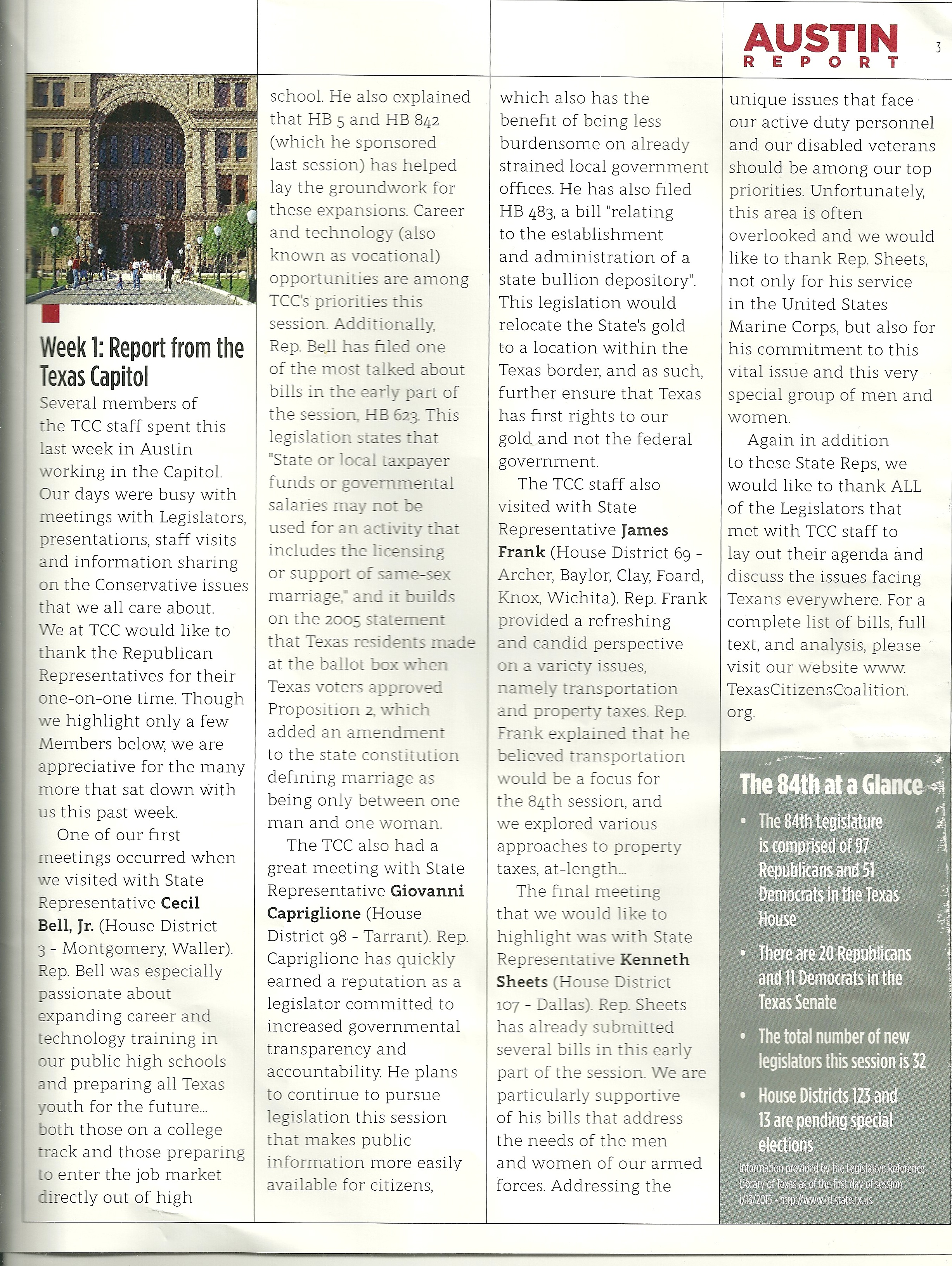
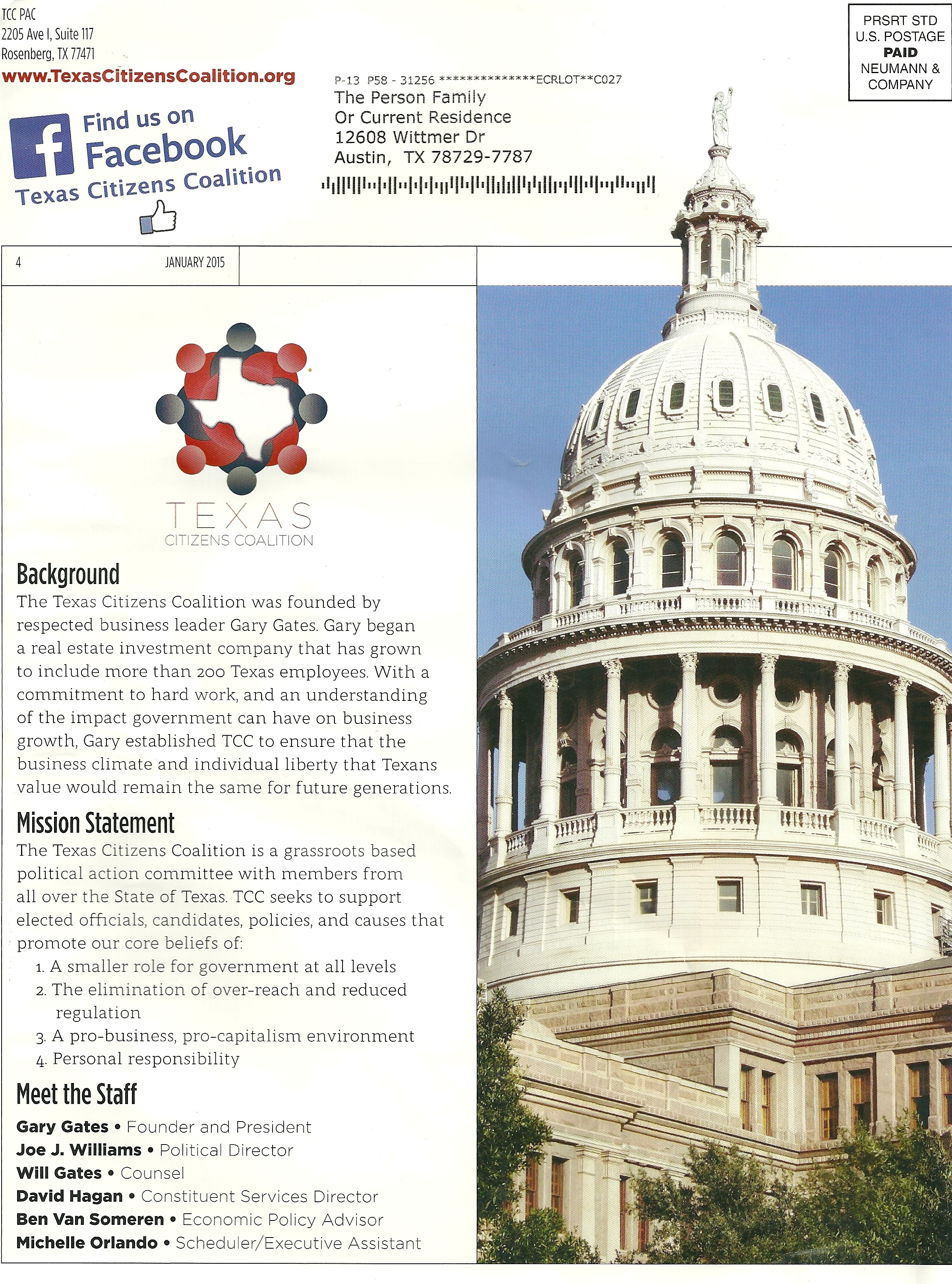
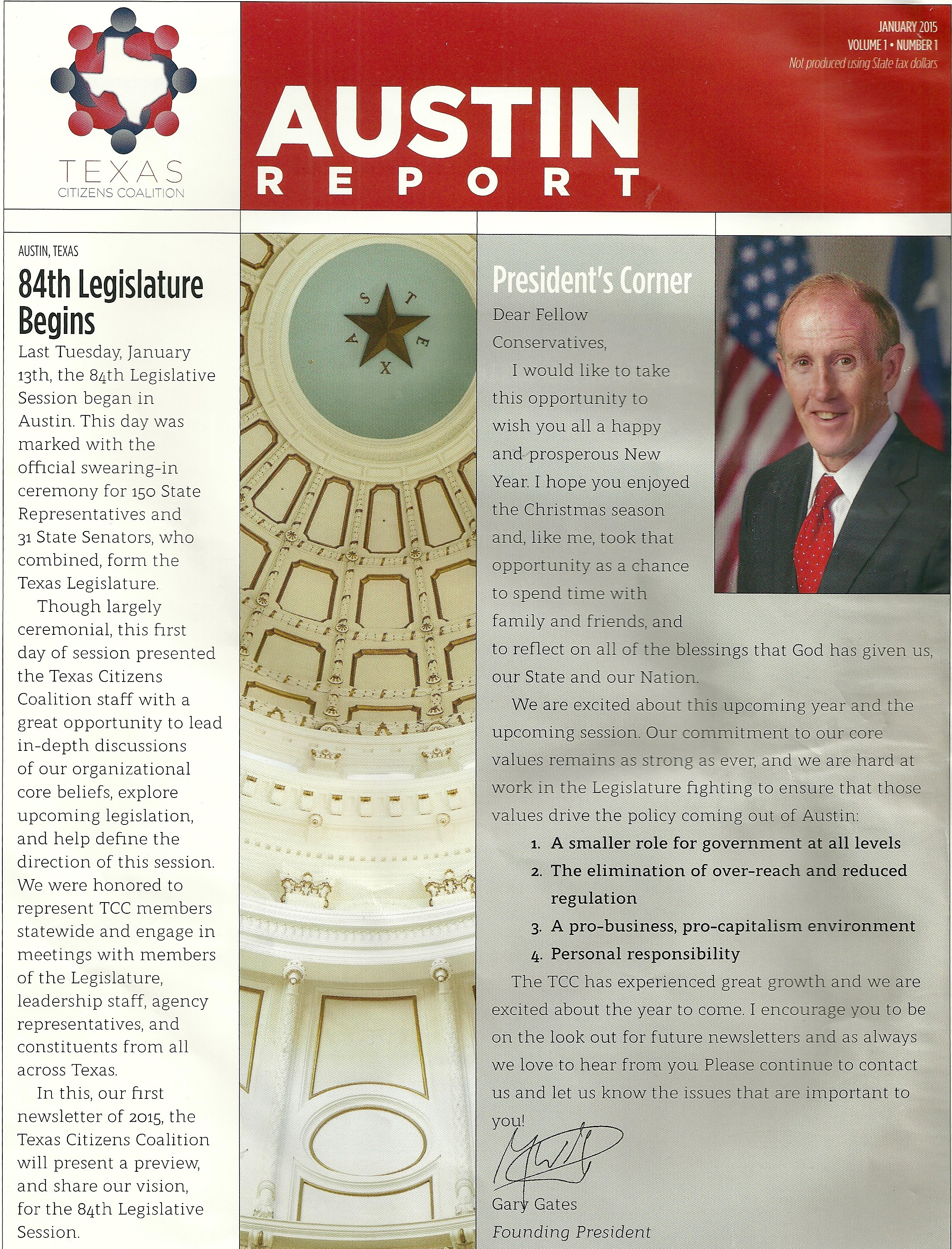
    Back in the middle of January I got a four-page flyer form an outfit calling itself the “Texas Citizens Coalition.” The group is headed up by Rosenberg realtor Gary Gates.

    Their ostensible goals sound conservative enough:

    1. A smaller role for government at all levels

    2. The elimination of over-reach and reduced regulation

    3. A pro-business, pro-capitalism environment

    4. Personal responsibility

    All well and good. But why drop a flyer two months after the election?

    My working theory is that Texas Citizens Coalition is another group created with the express purpose of supporting Speaker Joe Straus against his conservative critics.

    Supporting evidence for the theory:

  • One of their first news blurbs is from Straus himself. (The fact that the most recent bit of “Latest News” is from January ninth suggests lack of follow-through on TCC’s part…)
  • Note that every single legislator singled out for praise in page 2 of the flyer was not among those backing Scott Turner for Speaker.
  • Note that many of those praised legislators (Giovanni Capriglione, Tan Parker, Drew Springer and Jason Villalba) were all notable for declaring themselves Straus supporters in November.
  • The only groups that have been dropping flyers to my mailbox post-election have been pro-Straus groups.
  • Finally, I sent an email through their contact address asking if they were formed explicitly to support Straus, and received no reply.
  • If anyone has an alternate explanation, I’d be happy to hear it. Here’s the flyer itself:

    TCC1

    TCC2

    TCC3

    TCC4

    Straus Re-Elected Speaker. And It Wasn’t Close.

    Wednesday, January 14th, 2015

    Sadly, my previous analysis was right on the money. Straus maintained his hold on the Texas Speaker’s chair by a 127-19 margin over Scott Turner. For all the numerous Tea Party endorsements of House candidates (indeed, the North Texas Tea Party said that a vote for Straus for Speaker would preclude their endorsement), it seems that only a tiny minority of Tea Party-endorsed candidates are interested in challenging Straus’ iron grip.

    I would be most interested in hearing behind-the-scenes information on how Straus has managed to continue to procure the votes of so many conservative Republicans despite widespread grassroots opposition to Straus’ Speakership…

    A Real Texas Speaker’s Race? Don’t Count on It

    Wednesday, November 19th, 2014

    Despite a broad consensus that he’s too moderate and holding up important conservative legislation, conservatives in the Texas House failed to unseat Speaker Joe Straus in both 2010 and 2012. Since then, one Straus ally after another has fallen to more conservative challengers in the primaries. Will this session finally be the one where Straus is replaced?

    Well, conservative are certainly going to try to oust Straus from the speaker’s chair. “Scott Turner, the freshman state representative challenging Joe Straus for House speaker, affirmed on Tuesday that he will insist on a floor vote on Jan. 13, the first day of session, come what may.”

    Michael Quinn Sullivan makes the case for ousting Straus. (One would think that if Sullivan was as powerful as liberal reporters make him out to be, Straus would have been out of a job in 2011. But for all Sullivan’s considerable influence, Straus has managed to survive repeated attempts to kick him oust him.)

    And Texas Tea Party groups are threatening to hold Reps accountable if they vote for Straus as Speaker again. Indeed, the North Texas Tea Party said as much on their website. Unfortunately, they decided to do so in an overheated and poorly-formatted screed interspersed with ALL CAPITAL LETTERS FOR EMPHASIS. Guys, you’re not posting on a BBS in 1984. Things like this make it entirely too easy for the opposition (in this case Straus-backing RINOs and their media enablers) to dismiss you out of hand.

    However, as much as it pains me to report it, the more I read the tea leaves, the more I think Straus survives the challenge this time as well.

    Conservatives were less than thrilled when Rep. Giovanni Capriglione, who owes his seat in large measure to running against Straus and beating Straus ally Vicki Truitt in 2012, announced he was supporting Straus for speaker.

    Then Sarah Rumpf wrote that still more Republicans announced they were backing Straus:

    Joining Capriglione are Tan Parker (R-Flower Mound), Ron Simmons (R-Carrollton), Phil King (R-Weatherford), Myra Crownover (R-Lake Dallas), James Frank (R-Wichita Falls), and Drew Springer (R-Muenster), who emailed the release to Breitbart Texas with a short message that it was “from leading North Texas conservatives on our position on the 84th session.” Straus was first elected Speaker in 2009, largely on the votes of the Democrats and moderate Republicans in the House. Since first taking up the Speaker’s gavel, Straus has faced criticism from various conservative groups and grassroots activists who view him as more of a moderate.

    Now comes news that Straus theoretically has enough votes in the bag to stay speaker:

    The list of House Republicans who have publicly backed Straus in the past week include Trent Ashby of Lukfin, Cecil Bell of Magnolia, Giovanni Capriglione of Southlake, Travis Clardy of Nacogdoches, Myra Crownover of Denton, Tony Dale of Cedar Park, Marsha Farney of Georgetown, James Frank of Wichita Falls, Larry Gonzales of Round Rock, Jason Isaac of Dripping Springs, Kyle Kacal of Pearland, Phil King of Weatherford, Tim Kleinschmidt of Lexington, J.M. Lozano of Kingsville, Doug Miller of New Braunfels, Morrison, John Otto of Dayton, Chris Paddie of Marshall, Tan Parker of Flower Mound, John Raney of Bryan, Ron Simmons of Carrollton, Drew Springer of Muenster and Paul Workman of Austin. Three newly elected Republicans who will join the Legislature in January — Dade Phelan of Beaumont, Gary VanDeaver of Clarksville and Rick Galindo of San Antonio — have also pledged support to Straus.

    Et tu, Tony Dale? It’s disappointing that all three Williamson County Representatives (Dale, Larry Gonzalez and Marsha Farney) are backing Straus.

    At this point, it’s beginning to look like conservatives will need to knock off Straus in the 2016 Republican primary to get rid of him…

    Rich Liberal Trial Lawyer Steve Mostyn is the Bank Behind Texas Municipal Police Association PAC

    Tuesday, September 23rd, 2014

    It’s always interesting to find out where the money for innocuous sounding political committees is really coming from. Today the Dallas Morning news revealed that rich liberal trial lawyer Steve Mostyn provides the majority of money behind the Texas Municipal Police Association PAC.

    Houston trial lawyer and political mega donor Steve Mostyn, who usually helps Democratic candidates, bankrolled a police group that was mostly playing in GOP primaries last spring because he’s from Tyler and wanted to knock off tea party-backed freshman Republican Rep. Matt Schaefer, R-Tyler, a spokesman said Monday.

    Snip.

    Among the PAC’s targets were attorney general candidate Ken Paxton of McKinney, whom the law enforcement group’s president chided in this open letter for failing to register as an investment adviser. The omission drew Paxton, a freshman state senator, a fine from the Texas State Securities Board. Three months earlier, the police PAC endorsed Rep. Dan Branch, R-Dallas, Paxton’s chief rival for attorney general. In a May 27 runoff, Paxton crushed Branch.

    The association says it has more than 20,000 members who are law enforcement officers and first responders. Late last year, its PAC moved early to back Republican Speaker Joe Straus for re-election to his House seat in San Antonio. In this year’s GOP House primaries, the PAC generally supported Straus allies. For instance, it helped Rep. Jim Keffer, R-Eastland, who won; and Rep. Bennett Ratliff, R-Coppell, who narrowly lost.

    This confirms, yet again, another reason why it’s high time Straus was ousted from the Speaker’s chair.

    Of the $72,000 the municipal police association PAC has raised this year, 69 percent came from the Mostyn Law Firm, according to a Dallas Morning News review of campaign-finance reports to the Texas Ethics Commission. Of the $81,500 the PAC has spent on candidates in 2014, just over $52,000 — or 64 percent — went to buy radio ads, mailers and brochures for Schaefer’s GOP challenger, Tyler businessman Skip Ogle, the newspaper found.

    How did that work out?

    The effort failed as Schaefer, one of the House’s most conservative members, fended off Ogle in the initial March 4 balloting, 61 percent to 39 percent.

    In other words, it worked out pretty much the same way as just about all of Steve Mostyn’s political donations work out: Abject failure.

    So whatever happened to Mostyn’s plans to head up to New York City?

    (Hat tip: Michael Quinn Sullivan’s Twitter feed.)