Now that redistricting is (mostly) settled (for this year), reverberations are still being felt around the state in various races. First a correction: Candidates have until March 9 to file, not the March 6 date I reported yesterday.
Other tidbits:
Now that redistricting is (mostly) settled (for this year), reverberations are still being felt around the state in various races. First a correction: Candidates have until March 9 to file, not the March 6 date I reported yesterday.
Other tidbits:
I’ve been reading up a bit more on the compromise redistricting lines released by the San Antonio district court. Texas Attorney General Greg Abbot was able to keep most of what the legislature passed, and the Governor signed, intact, but a few changes were made to satisfy Democratic demands to win in court what they couldn’t at the ballot box settle lawsuits by various minority interest groups under the provisions of the Voting Rights Act.
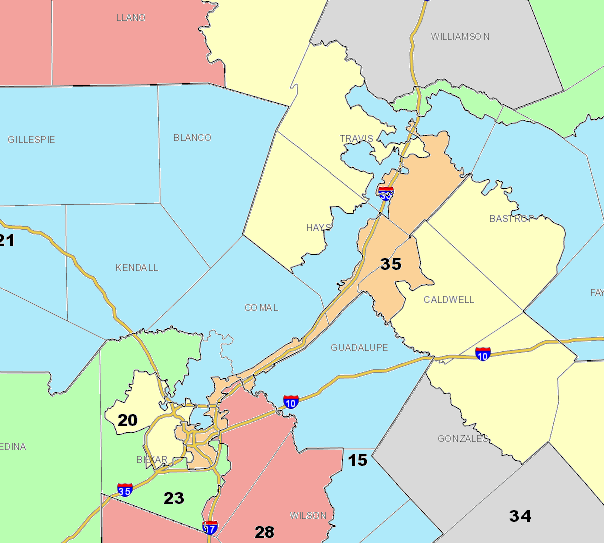
Though U.S. Congressional Districts, State Senate Districts, and State House districts were all affected by the new maps, I want to focus on three U.S. Congressional Districts, including some shown in this map here:
All in all, Texas Republicans expect to pick up two to four U.S. Congressional seats thanks to redistricting, which looks extremely doable.
And now we finally have election dates:
The new redistricting maps, that is. Sounds like they haven’t been made final just yet, but most likely will be. If that happens this week, that might mean a late April (rather than May) primary.
You can take a look at them here.
(Hat tip: Blue Dot Blues, who, alas, hasn’t put me on her blogroll…)
The Right Side of Austin offers up reassurance for those anxious over the fact they haven’t received their voter registration cards: Relax.
Because Democrats and liberal special interest groups like LULAC and the NAACP want to achieve in courts what they couldn’t at the ballot box, voter registration cards can’t be sent out until the legal redistricting battle has been settled. But if you were a registered voter last year, your new voter registration card will automatically be mailed out once the redistricting fight is settled.
So if you’ve been worrying, don’t. Once a date for the primary is set, everything should take care of itself…
Time for another roundup of this and that:
A long but informative breakdown of where things stand. The bottom line: The cases are still up in the air, Texas GOP is not directly involved in talks, and February 6 is the last day the case can be resolved and still have an April 3 primary.
OK, they didn’t use quite that language (and I must prepend the usual I Am Not a Lawyer disclaimer). But in issuing the decision (they had previously blocked the District Courts’ maps), the Supremes did say the San Antonio District Court had exceeded its authority in drawing new redistricting maps for Texas for no clear reason, and ordered the District Court to go back to the drawing board and create maps closer to what the legislation passed in the first place:
Because it is unclear whether the District Court for the Western District of Texas followed the appropriate standards in drawing interim maps for the 2012 Texas elections, the orders implementing those maps are vacated,and the cases are remanded for further proceedings consistent with this opinion.
Time and time again in this decision, the Supreme Court criticizes the District Court for their approach:
Time in time again, the Supreme Court said to the District Court: “You screwed up. The State government has the responsibility to perform redistricting, and you shouldn’t overturn their work without explicit Voting Rights Acts reason, and you went and did it anyway.”
Justice Clarence Thomas concurred with the opinion, but went even further, declaring that Section 5 of the Voting Rights Act of 1965 (the section requiring judicial preclearance of voting districts) was unconstitutional:
In my view, Texas’ failure to timely obtain §5 preclearance of its new plans is no obstacle to their implementation, because, as I have previously explained, §5 is unconstitutional…Although Texas’ new plans are being challenged on the grounds that they violate the Federal Constitution and §2 of the Voting Rights Act, they have not yet been found to violate any law. Accordingly, Texas’ duly enacted redistricting plans should govern the upcoming elections. I would therefore vacate the interim orders and remand for the United States District Court for the Western District of Texas to consider appellees’ constitutional and §2 challenges in the ordinary course.
Presumably, a more chastised District Court will come back in short order with a map that more closely resembles what the legislature passed, and not one designed to give Democrats in the court room what they couldn’t achieve at the ballot box.
The Supreme Court Friday night “blocked a redistricting plan for Texas drawn by a panel of federal judges.”
I’ve got to run off, and the issue is far from settled, but this is good news for the rule of law, and bad news for liberals wanting to abuse the court system to get what they want despite voters rejecting them again and again.
[Edited to add: Crappy, hastily written headline now rewritten to make it clear this was a U.S. Supreme Court stay, not the Texas Supreme Court, which is obviously holds no sway over a U.S. District Court. – LP]
Washington Post writer Aaron Blake pays serious attention to Ted Cruz, and his role as Tea Party favorite. It’s a decent write-up for an out-of-state MSM outlet playing catch-up, but there are several statements about which I have at least some minor quibbles.
For example, take this sentence
That’s because he’s emerging as a potential top-tier candidate in the Lone Star state race, posing a real tea party threat to better-funded candidates in what should be one of the most expensive primary races in the country.
There’s two things wrong with that sentence:
Likewise his suggestion that Leppert is one of the “big boys” (outside of Dallas, his profile is no bigger than Cruz’s) seems misguided.
Then there’s this:
Dewhurst is the prohibitive favorite if he gets in, and Leppert has made a big splash early with his fundraising. But many conservatives aren’t waiting for Dewhurst—choosing instead to rally around Cruz.
I think “prohibitive favorite” overstates the case a bit (I would use “formidable”), but the idea that conservatives have ever “waited” on Dewhurst is off-base.
As so many other Republican politicians do, Dewhurst occupies that vast gray area between a RINO (think Arlen Specter before he went The Full Benedict) and a real movement conservative. The phrase “a self-described ‘George Bush Republican'” appears, unsourced, in his Wikipedia entry (and thus is automatically suspect), and sums up the feelings of many conservatives towards Dewhurst. He ran as a conservative, and mostly governed as a conservative, but every now and then he would go off on Big Government tangents that would infuriate proponents of limited government. Despite this, outside the state, Dewhurst is regarded as something of an “arch-conservative” for shepherding through the (constitutionally-required) 2003 redistricting.
I wouldn’t go so far as to compare him to Charlie Crist (as some have), but there’s been real dissatisfaction with Dewhurst among movement conservatives, and it came to the fore with this year’s legislative sessions, where, despite having controlling majorities in both House and Senate, conservative Republicans found their agenda being thwarted in many ways great and small by Dewhurst in the Senate and Speaker Joe Straus in the House. Hence state senator (and possible U.S. Senate candidate) Dan Patrick’s lashing out at Dewhurst for thwarting his anti-TSA goping bill. Dewhurst managed to get the big things done (i.e., getting a budget passed without a tax hike), but there’s a sense among conservatives that he could have gotten a lot more conservative bills passed if he really wanted to, and that he “left money on the table” in the game of legislative poker by compromising when he didn’t have to
So it’s not at all surprising that Dewhurst is viewed as a stanch conservative when viewed from inside the Beltway; by Washington, D.C. standards he is. But there’s a widespread sense among Texas conservatives that they should be able to elect a full-bore movement conservative to replace Kay Bailey Hutchison, and that David Dewhurst isn’t that guy. There was a good deal of debate over whether Ted Cruz or Michael Williams was the preferred choice; with Williams getting out of the race to run for a House seat, the issue has been resolved in Cruz’s favor, as indicated by his impressive array of endorsements.
Still, those quibbles aside, the WaPo piece is a pretty solid look at Cruz, and is well worth reading for those following the Texas Senate Race.
(In the future, Brooks might want to run this sort of piece by Jennifer Rubin, who has a lot better grasp of the nuances of conservative politics than most MSM observers.)
Paul Burka has a post up in which he basically makes two arguments:
He is mistaken, to differing degrees, in both beliefs.
As for the first, Republicans are trying to Gerrymander as many Democrats as possible out of their congressional seats, white, black, Hispanic or purple, just as Democrats ruthlessly Gerrymandered Republicans out of congressional seats when they had control of redistricting. (Remember, Texas never had as many as three Republicans serving in the U.S. House of Representatives at the same time until James M. Collins joined George H. W. Bush and Bob Price in 1969, despite Texas voters preferring Republican Presidential candidates in 1928, 1952, and 1956.) It’s just that the Voting Rights Act makes it so much easier to do it against white Democrats than minority Democrats.
As for the second, anyone who has been reading this blog for any appreciable length of time should realize that I have no particular fondness for Rep. Doggett. However, laying the lion’s share of the Democratic Party’s precipitous decline in Texas at the feet of Doggett’s unsuccessful Senate campaign is both misguided and deeply ahistorical.
First of all, it was a lot less obvious in 1984 that Doggett was too liberal to win (though he was) than the fact that nobody was going to beat Phil Gramm. After Democrats threw him off the House Budget Committee for supporting the Kemp-Roth tax cuts and co-sponsoring the Gramm-Latta budget reconciliation bill, Gramm resigned from his House seat and ran for it again as a Republican, winning overwhelmingly and turning himself into a folk hero for doing so. In the Republican primary he creamed Robert Mosbacher, Jr. and Ron Paul, and then thumped Doggett by 900,000 votes. Nobody was going to beat Gramm that year, even if Kent Hance had managed to defeat Doggett. And remember that after losing to Doggett in the Democratic Primary, Hance switched to the Republican Party the very next year. Even back then, it was apparent that conservatives had no future in the Democratic Party.
Further, fingering Doggett as the cause of the Texas Democratic Party’s decline ignores the pronounced decline in the fortunes of the Democratic Party in every state south of the Mason-Dixon line over the last 32 years, as the so-called “Reagan Democrats” have fled the party in droves in both the South and Midwest thanks to its unwavering drive for bigger government and higher taxes. That can be laid at Doggett’s feet only insofar as he was one of several hundred Democratic elites pushing their party relentlessly left, no matter the electoral cost.
And as for Burka’s starting that “How could [Doggett] have had so little self-awareness as to not know that he had was too liberal to win a statewide race?”, two points:
There are numerous reasons why the Texas Democratic Party has gone from the overwhelming majority party in Texas to a rump minority party, the biggest one being that their misguided policies of big government liberalism are objectively wrong, financially ruinous and extremely unpopular. But Doggett is only an outstanding exemplar of the problem, not the cause of it.
(PS: Also remember that in 1992, Burka was blaming the Texas Democratic Party’s decline on Bill Clinton’s unwillingness to seriously contest the state against Bush41.)