Posts Tagged ‘Austin City Council’

Texas Energy Outage Postmortem

Wednesday, March 10th, 2021

I finally had time to finish this postmortem post on the Texas winter storm energy grid crisis. I’ve got a ton of pieces to get through, so let’s dig in.

  • How the energy grid fell apart:

    Here were two problems, one short term and one long term—which exacerbated the short-term one.

    The short-term failure came at about 1 a.m. Monday when ERCOT should have seen the loads soaring due to plummeting temperatures, and arranged for more generation.

    Texas came very close to having a system-wide outage for the whole state (in the ERCOT area, about 85% of the state) due to not arranging for more generation.

    This tripped the grid, knocking some reliable thermal plants (gas and coal) offline. This was a failure of the grid operator (ERCOT) not the power plants.

    In the last four to five years, Texas lost a net of 3,000 megawatts of thermal out of a total installed capacity 73,000 megawatts today.

    We lost the thermal power because operators couldn’t see a return on investment due to be undercut by wind and solar, which is cheap for two reasons—it’s subsidized and it doesn’t have to pay for the costs of grid reliability by purchasing battery farms or contracting with gas peaker plants to produce power when needed, not when they can.

    Meanwhile, Texas has seen a growth of 20,000 megawatts of wind and solar over the same period to a total of 34,000 megawatts of installed capacity statewide, though they rarely perform anywhere close to capacity.

    Wind and solar, with state and federal subsidies, have pushed reliable thermal operators out of business or prevented new generation from being built as operators can’t make money off of the market.

  • More:

    Equipment failure turned out to be a big part of the problem.

    “Beginning around 11:00 p.m. [Sunday night], multiple generating units began tripping off-line in rapid progression due to the severe cold weather,” said Dan Woodfin, senior director of system operations at ERCOT, the organization that manages the state’s electric grid.

    What does that mean? Equipment literally froze in the single digit temperatures and stopped working.

    Then, as reserves diminished, ERCOT asked transmission providers to turn off large industrial users that had previously agreed to be shut down. But the situation deteriorated quickly, requiring rotating outages that have lasted hours for many Texans.

    Electric generating plants did not properly winterize their equipment, said Dr. David Tuttle in the latest episode of the Y’all-itics political podcast. Tuttle is a research associate with the Energy Institute at the University of Texas at Austin.

    “There are things that can be done, but it will cost some money,” he added. “About every decade we have these long-sustained periods. And then, you know weatherization is supposed to happen, and then, it doesn’t because it costs money.”

  • “Yes, Green Energy Failures Helped Cause Texas Blackout Disaster.”

    As Texans reel from ongoing blackouts at the worst possible time, during a nationwide cold snap that has sent temperatures plummeting to single digits, the news has left people in other states wondering: How could this happen in Texas, the nation’s energy powerhouse?

    But policy experts have seen this moment coming for years. The only surprise is that the house of cards collapsed in the dead of winter, not the toasty Texas summers that usually shatter peak electricity demand records.

    The blackouts, which have left as many as 4 million Texans trapped in the cold, show the numerous chilling consequences of putting too many eggs in the renewable basket.

    Snip.

    On the whole, Texas is losing reliable generation and counting solely on wind and solar to keep up with its growing electricity demand. I wrote last summer about how ERCOT was failing to account for the increasing likelihood that an event combining record demand with low wind and solar generation would lead to blackouts. The only surprise was that such a situation occurred during a rare winter freeze and not during the predictable Texas summer heat waves.

    Yet ERCOT still should not have been surprised by this event, as its own long-term forecasts indicated it was possible, even in the winter. Although many wind turbines did freeze and total wind generation was at 2 percent of installed capacity Monday night, overall wind production at the time the blackouts began was roughly in line with ERCOT forecasts from the previous week.

    We knew solar would not produce anything during the night, when demand was peaking. Intermittency is not a technical problem but a fundamental reality when trying to generate electricity from wind and solar. This is a known and predictable problem, but Texas regulators fooled themselves into thinking that the risk of such low wind and solar production at the time it was needed most was not significant.

  • Could lawmakers have prevent the blackouts?

    “By Monday morning, half of Texas’ wind turbines were frozen solid, and wind generation bottomed out at 2 [percent] of installed capacity by Monday night,” said Jason Isaac, director of Life:Powered, a project of Texas Public Policy Foundation and a former state lawmaker.

    “Because of this massive gap in wind production and ERCOT’s delay, what should have been a series of brief rolling blackouts—inconvenient but manageable—instead turned into 4 million Texans left in the cold and without answers,” he continued. “To make matters worse, ERCOT shut down power at natural gas substations in the Permian, leading to further shortages.”

    Agricultural Commissioner Sid Miller has since said Texas should stop building wind turbines; focus on gas, coal, and oil; and called for the firing of Gov. Greg Abbott’s appointees to the Public Utility Commission—the government body that oversees ERCOT.

    But was this crisis foreseeable? Isaac says yes.

    “We’ve known for years that a weather event combining low wind and solar production and record demand could lead to blackouts,” he told Texas Scorecard. “This week, that event became a reality as new wind and solar generation failed to produce when it was needed the most, and it appears ERCOT fell asleep at the wheel.”

  • How the Texas outage started with bad policy:

    For years, Texas’ grid operator (ERCOT) has overestimated the ability to maintain a reliable grid without a sufficient supply buffer, known as a “reserve margin.” That margin is the difference between demand for electricity and what the grid can produce. When demand exceeds production, you get blackouts. That buffer has been shrinking because reliable sources of energy have been retired, few reliable plants have been constructed, and the grid is depending more and more on weather-dependent renewable energy that repeatedly fails to perform when we need it most.

    When wind and solar production predictably dropped as the winter storm hit, the buffer collapsed. ERCOT needed to execute a series of balancing measures that would have protected the grid. But it did not act soon enough, which caused many more gas and some coal power plants in the system to “trip.” (Think of it as a circuit breaker that triggers to prevent a fire or other emergency at your house when there is a system imbalance.) Other weather-related issues caused problems too but ERCOT’s failure to act sooner was a major factor.

    Usually, a system trip wouldn’t last long and we’d have power back in a few hours. But this time, many of the units that were tripped off the system had difficulty coming back online for a variety of reasons, including the fact that some were not designed to be taken off and put back on the system quickly, as well as other cold weather issues that exacerbated the problem.

    So when people blame ERCOT for not acting quickly, they’re right. And so are the people who say that both renewable energy and fossil energy plants are not generating what they should. But it doesn’t begin there. Our overdependence on unreliable energy that caused the razor thin reserve margins started the ball rolling years ago.

    Here’s the long story.

    Keeping the power on is a bit of a guessing game played out every day by the grid operator to make sure we have the right mix of energy getting on to the grid. There’s that buffer, the reserve margin, which ERCOT uses to give it some leeway in making moves. As with anything, the more reliable and predictable the source of energy, the better moves ERCOT can make.

    However, the race to add in renewables pushed out more reliable forms of energy and kept new reliable energy from being built. That resulted in the buffer in our electric grid being stripped out—going from more than a 20% surplus years ago to single digits in the last couple of years.

    Without that buffer, our system has become much more vulnerable to outages when we see extreme heat or extreme cold. The problem is made worse by the fact that renewables have grown to become a significant percentage of our fleet, making our power grid much more susceptible to weather-related shortages. That is because renewables do not show up when we need power the most (high heat, freezing cold, big storms, etc.)

  • Here’s an informative thread on how the Texas energy market is set up and how some of the system was offline when the worst hit:

    I think here he’s conflating a few different things; it’s unclear how much capacity was taken off line due to insufficient weatherization and how much was caused by ERCOT foolishly inducing blackouts in the gas-producing Permian Basin.

  • Chuck Devore:

  • More on how renewables helped create the crisis:

    Mitchell Rolling explains: “As you can see, the top three performing energy sources during the energy crisis in Texas were all fuel-based energy sources: nuclear, coal, and natural gas. On average, these three energy sources alone provided over 91 percent of all electricity generated throughout the energy emergency, as the graph below shows. Without these energy sources on the grid providing the bulk of electricity, the situation in Texas would have gone from bad to worse.”

  • More on the same theme:

    The massive blast of Siberia-like cold that is wreaking havoc across North America is proving that if we humans want to keep surviving frigid winters, we are going to have to keep burning natural gas — and lots of it — for decades to come.

    That cold reality contradicts the “electrify everything” scenario that’s being promoted by climate change activists, politicians, and academics. They claim that to avert the possibility of catastrophic climate change, we must stop burning hydrocarbons and convert all of our transportation, residential, commercial, and industrial systems so that they are powered solely on electricity, with most of that juice coming, of course, from forests of wind turbines and oceans of solar panels.

    But attempting to electrify everything would concentrate our energy risks on an electricity grid that is already breaking under the surge in demand caused by the crazy cold weather. Across America, countless people don’t have electricity. I’m one of them. Our power here in central Austin went out at about 3 am. I am writing this under a blanket, have multiple layers of clothes on, and am nervously watching my laptop’s battery indicator.

    This blizzard proves that attempting to electrify everything would be the opposite of anti-fragile. Rather than make our networks and critical systems more resilient and less vulnerable to disruptions caused by extreme weather, bad actors, falling trees, or simple negligence, electrifying everything would concentrate our dependence on a single network, the electric grid, and in doing so make nearly every aspect of our society prone to catastrophic failure if — or rather, when — a widespread or extended blackout occurs.

  • The truth about those frozen wind turbines:

    One of the most contested issues is the role wind generation has played. Prior to the onset of the storm last week, Texas led the nation in wind power generation and depended on the wind turbines in West-Central and Western Texas, along with a smaller number of turbines along the Gulf Coast, for about 25% of its electricity. As wind power has increased, coal-powered generation plants have been taken offline around the state. Texas has abundant coal, oil, and natural gas, and also has nuclear plants near Dallas and near Houston.

    Real-time data from the U.S. Energy Information Administration shows that wind power collapsed as the winter storm swept across the state.

    Snip.

    As the graph plainly shows, wind generation choked down but natural gas compensated. Coal and even nuclear power generation dipped. Solar generation has been negligible due to cloud cover and several inches of snow and ice.

    The cold has created extreme demand across the state. During most winter storms, the Panhandle, West Texas, and even North Texas around Dallas and above toward Paris may get cold but Central and South Texas could remain well above freezing. This has not happened during the current series of storms. The entire state is in a deep freeze, with snow appearing even on Galveston Island’s beach. Galveston averages lows of about 50 degrees and highs in the mid-60s during a typical February. It’s 37 degrees in Galveston as I write this, well below average. Austin has seen single-digit temperatures at night.

    To put all of this into some perspective, the storm that dumped more than six inches of ice and snow on Austin Sunday night would, by itself, have been a historic storm. It dropped more snow on the capital than any other storm since 1949. It was preceded by a major cold snap and has been followed by more extreme cold and then another ice and snow storm Tuesday night. Texas has not suffered a single historic winter storm over the past several days, but a series of them without any warming in between…

    Add to all of this, when Texas gets winter storms it usually doesn’t just get snow. Snow is fairly easy to deal with. Texas also gets ice, which can snap electric lines and break trees and tree branches, which also can fall on and break power lines. A tree in my yard is bent over by ice to the point that it looks like an invisible hand is holding it down. We can expect the ice to kill off millions of trees around the state. The ice layers also render most roads impassable. All of this is very unusual for Texas, but not unprecedented. The winter of 1836 was notably harsh; Santa Anna reportedly encountered deep snow as he marched his army toward San Antonio.

    Most winters, Austin will have a few cold days but no snow. Central Texas is known to go entire winters without anyone having to so much as scrape any frost off their car windshield. Austin has had two significant snowstorms in 2021, with the current one being historic by any measure.

    Piecing known information together, the wind turbines in Western Texas froze up starting Friday before the icy snowstorm hit, on Sunday night to Monday morning. This destabilized the Texas grid ahead of the worst of the storm. The storm produced the temperatures and precipitation the forecasts expected, but with weakened power generation and demand skyrocketing to heat millions of homes, homes which for the most part are not insulated against the current level of cold temperatures, the grid was set up to suffer mightily as it’s not hardened against extreme cold such as this once-in-a-century storm series is delivering.

  • In chart form:

  • What can clean energy advocates say when wind turbines freeze?

    Wind’s share has tripled to about 25% since 2010 and accounted for 42% of power last week before the freeze set in. About half of Texans rely on electric pumps for heating, which liberals want to mandate everywhere. But the pumps use a lot of power in frigid weather. So while wind turbines were freezing, demand for power was surging.

    California progressives long ago banished coal. But a heat wave last summer strained the state’s power grid as wind flagged and solar ebbed in the evenings. After imposing rolling blackouts, grid regulators resorted to importing coal power from Utah and running diesel emergency generators.

    Liberals claim that prices of renewables and fossil fuels are now comparable, which may be true due to subsidies, but they are no free lunch, as this week’s energy emergency shows. The Biden Administration’s plan to banish fossil fuels is a greater existential threat to Americans than climate change.

  • More on eliminating wind subsidies and the road forward:

    Decades of taxpayer-funded subsidies that favor unreliable wind power are crowding reliable energy sources out of the market, weakening the grid, and leading directly to the blackouts we experienced last week.

    It’s no surprise — in fact, Texas came close to seeing widespread blackouts in August 2019. Our reserve margin, the buffer of extra electricity between what Texans are using and what we can produce, has become steadily smaller in recent years. And without quick action by state leaders, it will only get worse.

    We should eliminate subsidies and tax breaks for energy companies — especially unreliable wind— to allow the free market to function smoothly. We must prioritize reliability and affordability in our electricity choices. Unfortunately, that’s not politically popular. But these are steps we can and must take for our state’s future.

  • Austin’s useless City Council being their usual useless selves: “Austin Energy’s biomass power plant in East Texas, which the city purchased in 2019 for $460 million, sat idle and produced no power during one of the worst winter energy crises in state history.” Well, at least it was providing Austinites jobs? Nope. It’s near Nacogdoches.
  • It did indeed suck to live without power for days on end.
  • A Texas Public Policy Foundation symposiums on the outage.
  • Heh:

  • Also, I got my electric bill for February and…it’s a totally normal February electric bill. It helps to have natural gas heat…

    Legislator Proposes Renaming Austin Overpass “Steve Adler Public Restroom Highway”

    Tuesday, March 2nd, 2021

    Ever since Mayor Steve Adler and the Austin City Council repealed the public camping ban in 2019, Austin overpasses (and significant parts of the rest of the city) have been filled with drug-addicted transients trashing the place. Rep. Bryan Slaton has filed a bill to memorialize the fact:

    A new bill filed in the Texas House would designate the stretch of I-35 in downtown Austin from 4th Street to 11th Street “Steve Adler Public Restroom Highway” — after the city’s incumbent mayor.

    Rep. Bryan Slaton (R-Royse City), the author of the bill, told The Texan, “Liberal legacies deserve to be recognized. Since the legislature has made it clear it intends to rename some highways and bridges this session, I think it’s imperative that we start with a highway that truly recognizes the contributions of Mayor Adler.”

    “Texans who don’t know history are doomed to repeat it, and with renaming the highway we will ensure that citizens of the Texas capital never forget the legacy of failed liberal policies.”

    Since its recission in July of 2019, Austin’s camping and laying policy has exacerbated its developing homeless problem. Tents and makeshift forts cropped up across the city, dotting its boulevards and crowding its underpasses.

    Months after the new policy’s establishment, Austin’s unsheltered homeless population grew by 45 percent while its sheltered population decreased by 11 percent.

    And shortly after its inception, the city faced a 14 percent violent crime increase involving homeless individuals whether as victims, suspects, or both.

    The policy came to a head last summer when a literal trash flood washed through a neighborhood, flooding back yards with garbage, needles, and feces.

    By and large, the city council and its mayor have maintained stubborn support for the policy that allows anyone to camp or lay on any public property — notably excepting Austin City Hall.

    Austin residents will get a chance to vote on reinstating the camping ban on May 1st.

    Immodest Proposal: Tax The Homeless

    Wednesday, February 10th, 2021

    Remember how Governor Greg Abbott said he was going to clear homeless camps out from under bridges and highway overpasses in Austin? TxDOT was supposed to enforce that edict for state highway underpasses, but I can tell you that every time I drive under the McNeil/183 underpass, that’s not being done.

    If highway underpasses are indeed state property, then I have an immodest proposal for solving the problem: The state of Texas should pass a law taxing homeless camping under state highway overpasses.

    After all, subsidize something (like the Austin City Council has done for homelessness) and you get more of it. Tax it, and you get less of it.

    Want to pitch a tent under a state overpass? Fine. then you can pay $10 a night for the privilege. That’s still cheaper than renting an apartment, but no longer free, and it helps to offset the considerable expense of cleaning up those homeless camps. But contrast, designated homeless areas like Camp RATT in East Austin would remain free, theoretically providing incentives for the homeless to take up legal residence elsewhere.

    Gov. Abott has once again been warning Austin that if they don’t reinstate the camping ban, he’ll take action:

    All well and good, but we’ve heard this before, and the problem continues to get worse:

    Something certainly needs to be done about the situation. Issuing press releases and throwing more money at the problem to be siphoned into the pockets of leftwing activists isn’t going to solve the problem.

    Austin to Vote on Wilco Homeless Hotel Today

    Wednesday, February 3rd, 2021

    In their ongoing attempt to inflict bumville on as much of Austin as possible, today the Austin City Council is scheduled to vote on buying a Williamson County hotel to use as a homeless shelter.

    The Williamson County Commissioners Court has asked the Austin City Council to delay a decision for six months on whether to buy a hotel to house homeless people. The hotel, the Candlewood Suites near Texas 45 and U.S. 183, is in part of Austin in Williamson County.

    Commissioners said Tuesday they did not learn about the city’s possible $9.5 million purchase until recently, and have not had time to assess the effects of the purchase.

    “I am asking the city of Austin to communicate with stakeholders,” said Commissioner Cynthia Long. The hotel is in her district.

    “As of last Friday, the city of Austin has not reached out to any government that might be impacted — not Williamson County, not Round Rock ISD, not Bluebonnet Trails (the local mental health authority), not Williamson County and Cities Health District,” Long said.

    The Austin City Council postponed a decision on whether to buy the hotel at 10811 Pecan Park Boulevard from Jan. 27 to Wednesday at the request of Council Member Mackenzie Kelly, who represents the district where the hotel is located.

    For those unfamiliar with Austin geography, that’s way out in suburbia near the intersection of 183 and 620:
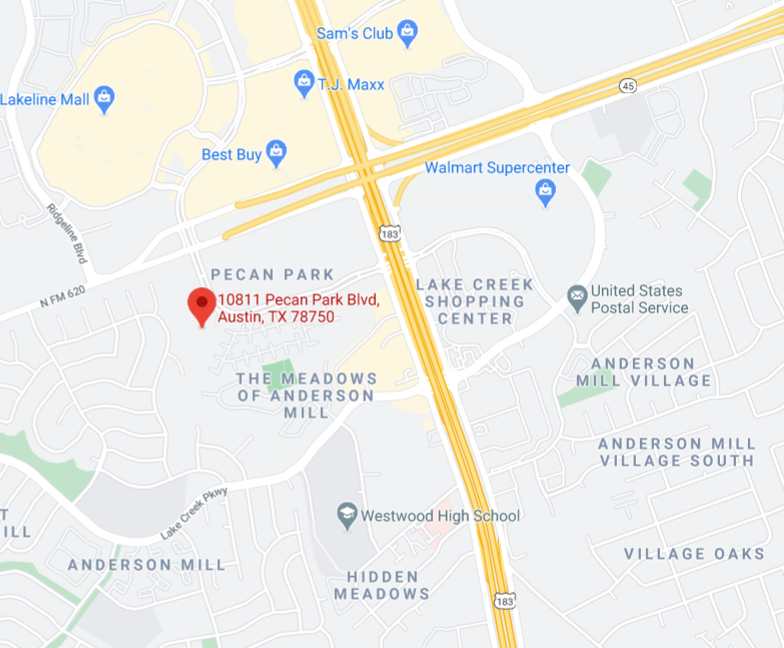
    Kelly is hosting a town hall meeting about the hotel from 6:30 to 7:30 p.m. on Wednesday at [zoom link].

    Austin officials notified Long about the hotel on Sunday, said Andy Hogue, a spokesman for Kelly, on Tuesday. Hogue declined further comment.

    Kelly, who was elected in November, campaigned heavily on a platform that many of the city’s policies regarding homelessness were not beneficial.

    On Sunday, residents of the Pecan Park and Anderson Mill neighborhoods held a protest about the plans for the hotel.

    Hotel owners and residents who own property near Candlewood Suites told commissioners on Tuesday that homeless people who camp in the area already were causing problems.

    “If the city buys Candlewood as a homeless shelter it would just zap our business,” said Marie Chaudhari, one of the owners of the Hampton Inn that shares a driveway with Candlewood Suites.

    “Ever since homeless camping was allowed on the streets,” Chaudhari said, “crime has increased so much we had to hire a security guard.”

    More:

    Candlewood Suites is located in the Williamson County portion of NW Austin. The city wants to buy it and transform the property into a homeless shelter and resource center.

    Tuesday, members of the Williamson County Commissioners Court made a formal request for the city to hold off for 180 days. It’s because they learned about this project a few days ago.

    The motion to hit the brakes was made by Commissioner Cynthia Long. “My hope is that the city of Austin will hear what we said and it’s an ask to work with your neighbors,” said Cynthia Long, Williamson County Commissioner for precinct 2

    Residence and business owners near the hotel say they were also blindsided by the city plan. “I think it would be important to have the public to have input to help out affect their neighborhoods,” said a woman who lives near the hotel.

    Those who attended Tuesday’s meeting asked county officials to step in and help. “As Williamson County judge I’m deeply disappointed and that someone did not communicate with this court prior to the decisions they made,” said Williamson County Judge Bill Gravell.

    The unanimous vote to make an official request for a 180-day pause was celebrated as a big step — but not a win.

    “Yes finally, it should’ve been City of Austin‘s job to listen to its constituents but apparently at least, I’m so thankful for Williamson County to be present for us out here,” said Rupal Chaudhari, who works next to Candlewood Suites

    The goal is to convince the city to do an economic impact study; similar to what the city requires private developers to do. Residents believe the study will show that property values will collapse and businesses will close.

    The continuing lockdown has proven that Mayor Steve Adler and the Austin City Council really don’t seem to care how many local businesses close.

    “Freda I think has about 50 employees we have about 20 at one hotel and the next hotel will have about 30 so that’s hundreds of jobs impacted just right there,” said Sanjay Chaudhari, the Hampton Inn & Suites General manager which is next door to Candlewood.

    Williamson County commissioners questioned why the city chose a northwest Austin site for its homeless hotel idea after a similar plan for a South Austin site failed last year. They also want to know more about how the city will address transportation issues, security, as well as what type of social programs will be provided; and where the funding for that will come from.

    “Actually it’s not weighing in on the proposal at all because quite frankly I don’t know enough about the proposal to be for or against it I’m simply asking and I think the commissioners’ court is asking to work with the county to work at the school district to work with the surrounding neighbors to talk about this,” said Long.

    If the city ignores the county request, commissioners sent another message. They’re willing to explore all options in order to have their concerns addressed.

    Hopefully that includes lawsuits.

    The repeal of the camping ban has created homeless encampments under virtually ever overpass along 183. My amazing psychic power predict that the new homeless hotel will have absolutely no effect on those existing Adlervilles, but will only draw more transients (and crime) to north Austin.

    It would be nice to think that the Austin City Council might listen to citizens for a change, but they seem hellbent on shoveling more money into the Homeless Industrial Complex.

    Abbott Receives Draft Proposal For APD Takeover

    Tuesday, December 22nd, 2020

    In the wake of the Austin City Council’s insane decision to partially defund the police, Governor Greg Abbott has received proposed legislation for the state to take over the Austin Police Department.

    More on the text of the proposal:

    Terry Keel, a former Travis County sheriff and state lawmaker, is one of the authors of the drafted language. Former State Rep. Ron Wilson is also behind the language.

    According to Quorum Report, the draft language states that “if the governor determines that the safety of a municipality’s residents is threatened because the municipality is providing insufficient municipal resources for public safety, the governor may issue a determination” that DPS should control the city’s police department. Keel previously told KVUE DPS and the city’s police department would work as a “special municipal police department division” that would answer to the DPS director.

    I looked but cannot currently find the actual text of the proposed bill in the LegiScan database.

    I’m of two minds about the proposal. Austin voters have made their bed by voting for the hard left, and both fairness and subsidiarity demand they be forced to lie in it. On the other hand, the protection of life, liberty and property is the very first duty of government. If the Austin City Council is unwilling to keep the city’s citizens safe, then the power and money necessary to do so should be removed from their hands.

    Jimmy Flannigan Goes Down In Flames

    Wednesday, December 16th, 2020

    A tiny glimmer of hope in Austin’s winter of discontent: Liberal city councilman Jimmy Flannigan was defeated by Mackenzie Kelly:

    Conservative challenger Mackenzie Kelly beat incumbent Jimmy Flannigan in the Austin City Council runoff election Tuesday, earning 677 more votes in District 6. Meanwhile, voters re-elected incumbent Alison Alter in District 10. She beat challenger Jennifer Virden by 587 votes.

    Kelly’s election will change the solidly progressive makeup the council has had the past two years. The positions she campaigned on are significantly more conservative than those of her fellow council members and she is the only council member to have an endorsement from the Travis County Republican Party.

    Snip.

    For the past two years, all eleven members of the Austin City Council — while they may have differed intensely on certain policy issues — have been generally progressive and unified in their ideals.

    This council approved a repeal of Austin’s ban on public camping in 2019 in an effort to decriminalize homelessness, an action that spurred heated debate in the community over how best to address homelessness. It has drawn statewide attention and criticism from the state’s Republican leaders, including Gov. Greg Abbott.

    This council also unanimously approved the city’s budget for the 2020-2021 fiscal year, which will ultimately move around $150 million dollars from the Austin Police Department.

    Snip.

    elly, who will be a newcomer to the council, ran on her experience as a volunteer firefighter and president of Take Back Austin, which is pushing to reinstate the ban on public camping in Austin.

    “From standing courageously behind our law enforcement community to demanding safer conditions for our homeless population to fighting for transparency at City Hall, the voice of Northwest Austin is has been heard,” Kelly’s campaign said in a statement. “Considering the stark differences between my campaign’s priorities and the platform of the incumbent, their united voice is resoundingly clear this evening!”

    Maybe with one sane voice on the Austin City Council, we can at least break up the groupthink. It’s a start.

    (Hat tip: Dwight.)

    Speaking of Austin’s homeless problem, Texas Scorecard made me aware of the SeeClickFix to report things like trash on property, graffiti, etc. Maybe we should start taking pictures of every trashed transient camp and report it on that tool, every day, until action is taken.

    Roundtable: Ten Questions About Austin Safety and Spending

    Tuesday, October 27th, 2020

    I’ve been meaning to do this roundtable on Austin’s future for a while, but the press of events (and fiddle-farting around on getting the right set of questions) delayed things until the headline rush toward election day finally made me send the questions out.

    Last week I submitted these questions to various Austin political observers, and here are their answers:

    1. What do you think drove the original lifting of the camping ban ordinance: An actual desire to help the homeless, virtue signaling, a desire to channel graft to their cronies (or leftwing causes), or something else?

      Terry Keel (Former Travis County Sheriff and State Rep): Decriminalizing petty crimes and protecting homelessness as a lifestyle choice is one of the new mandatory forms of virtue-signaling in the U.S. for liberal politicians like Austin’s mayor and council. It is a box they have to check, regardless of its obvious detrimental effects on surrounding property owners, businesses, and the homeless themselves. It just took a little longer for the political trend to reach us in Texas than it did in the large cities on the east and west coasts.

      Michael Quinn Sullivan (former CEO, Empower Texans): The Austin City Council seems perpetually vacillating between which virtues to signal. On the one hand, they are relentlessly handing out taxpayer dollars as corporate welfare to multinational corporations. On the other, they want to appeal to the leftist granola-crunching hippie culture that lives completely disconnected from the real world. The result are policies that have made Austin unaffordable and unlivable.

      Dennis Farris (retired APD): I think what drove them to Repeal the ordinance was a group of anti police activists who wanted to take some power away from APD. Its apparent it wasn’t well thought out because look at the outcome. You also have to look at who is profiting from the money the city is throwing at the homeless issue. 120 million plus in budgets 2019-2020 and 2020-2021.

      Adam Cahn (Cahnman’s Musings): The pre-camping ordinance repeal status quo wasn’t great. So it shouldn’t surprise anyone that there was a genuine reform effort. That effort was really easy for Casar et. al. to co-opt for purposes of graft.

      Basically, a bunch of well meaning people who should have known better turned out to be chumps who got played for suckers by Casar.

    2. Who is the primary driver of the homeless policy: Mayor Steve Adler or Councilman Greg Cesar?

      TK: It was inevitable that they’d both push for it, though from different perspectives. Adler takes his cues from the same progressive special interests/think tanks guiding other big-city liberal mayors. Adler actually spent Austin taxpayer dollars to travel to Los Angeles to learn how to emulate that city’s homeless policies – among the worst in the nation from any sane perspective. In that regard, he has succeeded in causing more harm to Austin than any Mayor in Austin’s history. I believe Greg Cesar’s motivation is more from deeply held extreme left-wing philosophical beliefs. He’s smart enough to know that the policy is detrimental to everyone, including the homeless. But it serves his purpose because it creates a stark picture of misery which he uses as fodder to support his assertion (a false one) that American society is failing – and capitalism in particular, is a failed system – and that local government needs to redirect more tax dollars to the issue.

      MQS: Steve Adler doesn’t appear to be the mayor; he seems to be Greg Cesar’s spokesman.

      DF: Greg Casar is the puppet master driving every decision made in city hall.

      AC: Greg Casar is the primary driver of everything that happens at City Hall.

    3. Why has the city council not responded to the huge outcry from city residents at the explosion of homeless camping all across Austin?

      TK: The Mayor and city council have shifted hard left and believe political changes in Austin leave them largely unaccountable to traditional middle-class values and the concerns of ordinary local business owners. For example, they really don’t care that Strait Music Company is now living a nightmare along Ben White Boulevard. Until ordinary voters in Austin – including democrat voters – hold them accountable, politicians like our current mayor and council will continue to tune them out. Unlike the old days, in recent years, most Austin citizens couldn’t even name their council member or mayor. That may be changing. You can be sure the mayor and council are watching nervously to see what happens to the incumbents in this current election and recall effort.

      MQS: Leftists thrive on chaos. What the citizens see as a problem with explosion of homeless “camping” is what the council members see as a feature. The worse the problem they created becomes, the bigger the government solution council members (think they) can impose.

      DF: They haven’t responded because they don’t know how to govern. When 10-1 was first announced former Mayor Leffingwell told me it was going to be a bad idea because they would elect a bunch of activists and not people who know how to govern and they will do something because of their activism and won’t be able to fix it even though they know its wrong because the activism rules how they think.

      AC: Denial and groupthink.

    4. Who has benefited the most financially from the explosion of homelessness?

      TK: The mayor and council’s policies have ballooned Austin’s homeless population, which is a windfall for social service providers who receive a portion of the record-setting spending of millions by Austin. This spending in turn draws more homeless to Austin and keeps the problem and spending growing.

      MQS: As always, government.

      DF: The cronies who are running ECHO [Ending Community Homelessness Coalition]

      AC: The social-services industrial complex and their assorted hangers-on are a good guess, but it wouldn’t surprise my if the honest answer is nobody.

    5. Why was the vote to partially defund the police unanimous?

      TK: The current mayor and council are all committed democrats or socialists, and they bow at the anti-police altar because they perceive their political survival as hinging on falling in line with that new political trend. The endorsement of the Austin Police Association used to be the most sought-after political endorsement of every candidate running for local office here. But recently there’s been a well-funded, nationwide progressive political trend in city politics and within the democrat party to demonize law enforcement. That caught Austin’s police union completely by surprise this election cycle.

      MQS: The Austin City Council is the least diverse group in Travis County, if not in Texas. They engage in GroupThink to a degree that would make even George Orwell’s characters blush.

      DF: Because Casar bullied them and if they even spoke out against the move they were threatened by the activists. I truly believe at least 5 council members do’t believe what they voted on but were afraid what would happen if they didn’t. See answer 4.

      AC: Groupthink.

    6. Do you approve of the Keel proposal to put Austin policing under control of the DPS?

      TK: If enacted properly – including withholding a portion of tax dollars from Austin’s city government to fund the new APD division of DPS, this proposal would prevent what is happening right now: (1) Austin’s council shifting local tax dollars away from public safety to fund controversial leftist social programs; and (2) burdening statewide taxpayers with supplementing Austin’s local law enforcement by making it necessary for the governor to assign state troopers to make up for APD’s depleted funding. The seat of state government is by express terms of the Texas Constitution a constituent issue for all Texans. Every city in Texas derives its power and authority from the State of Texas, via our state Constitution and statutes. Local governments are creatures of the state, which determines what powers they have, what their obligations are, what privileges they hold, and what restrictions are held to limit their power. It is not the prerogative of local Austin politicians to turn the capital city into a Portland-type of chaos. The legislature has not just the authority – but a duty – to step in and act.

      MQS: No; it is a bad idea. Austin voters – actively or through apathy – gave themselves this city council; they must live with the consequences. Why should taxpayers around the state be forced to subsidize Austin’s bad decisions? Letting DPS do APD’s job would reward the city council decisions. Mr. Keel’s proposal, while no doubt well intentioned, is an untenably dense bureaucratic solution, creating new functions and offices inside state agencies overlapping with the city offices… It’s the kind of “Republican” solution that empowers Democrats by duplicative and expanding government.

      Rather than look for a bailout from King Greg and the Legislature, concerned residents of Austin (like Mr. Keel) should spend time and energy convincing their neighbors of the need for better thinking… or even just the need for right-thinking people to participate. The city council did not emerge from a vacuum; they and their bad ideas were voted into office by a knowing and willing electorate.

      DF: Yes I fully support the proposal put forth by Terry Keel and Ron Wilson.

      AC: If it were up to me, the legislature would revoke the city council’s charter in its entirety, but the Keel proposal is a reasonably decent stopgap.

    7. Do you think Austin’s overburdened taxpayers might actually approve the rail bond?

      TK: Yes, Austin’s voters may actually vote for this ill-conceived proposal if history is any guide to voting in Austin. Whether things have gotten so bad here with the current mayor and council that there will be some sort of local political awakening by voters, one can only hope.

      MQS: One would hope not.

      DF: If the same groups that came out to vote in the run off and defeated 2 moderates for county and district attorney then the bond might pass. They don’t see it as raising their taxes if they rent but ultimately will increase the rent they pay.

      AC: My guess would be no, but Austin voters have disappointed me in the past.

    8. If it is approved, where do you think the money will actually end up going?

      TK: It will be largely wasted on legal, engineering and environmental special interests and studies.

      MQS: The pockets of multinational corporations selling the latest version of snake-oil.

      DF: Not to the intended projects. ATX has a history of mismanaging bond money. Look at the 90 million dollar main library that cost 120 million.

      AC: Details remain to be seen, but “down the rathole” is a good macro-category.

    9. How bad do you think crime in Austin will get if Jose Garza is elected DA?

      TK: Look to Philadelphia for your answer. What Philadelphia is experiencing with [DA Larry] Krasner is exactly what’s in store for Austin if Garza is elected. In short, crimes like narcotics and certain thefts will be decriminalized and there will be zero death penalty prosecutions for the most horrific crimes. Crime victims will be a secondary consideration, subordinate to criminal defendants. The relationship between the DA’s office and the police will be dysfunctional, with the DA’s new priority being to aggressively seek criminal charges against arresting officers for perceived use-of-force violations.

      MQS: Crime will be a lagging indicator, but the policies he is endorsing will no doubt have negative consequences. Let’s be clear here, though. The nice people in Terrytown and the tony neighborhoods that subsidize the Austin left might be inconvenienced, but they will be mostly sheltered. The brunt of the problems will be felt by Austin’s poorest and most vulnerable people – the one’s Garza and the rest of the virtue-signaling left claim to be helping. That’s the way it is with bad government policy, anyway. The poor are made poor, and the vulnerable become more so. Mr. Garza’s policies will simply continue that trend.

      DF: I think crime is already getting bad but once elected he’s promised to not prosecute drug offenses. Most of the property crime and many of the robberies and homicides are committed to feed a drug habit or over drugs. He seems more interested in going after the cops than the criminals. Forget ever seeing another death penalty case in TC.

      AC: Bad.

    10. Do you think things will get better or worse after the November election?

      TK: If President Trump is reelected, Texas holds or expands Republican rule in the statehouse, and the incumbent Austin city council members are all tossed, things could be looking up for Austin, Texas. Anything less than that, life in the city will be worse.

      MQS: That light you think you see at the end of the tunnel? It’s a train.

      DF: Either way it gets worse. If President Trump wins the left will riot in the street and if Joe Biden wins the far left socialists will influence him or figure a way under the 25th amendment to remove him and push this country more socialist where everything is free until they run out of our money. He’s definitely got something wrong with him.

      AC: Better. One way or another (lege override/May election), the camping ordinance probably gets reinstated in ’21. In addition, even if it’s only one or two seats, changing the ideological composition of council will at least break up the groupthink.

    Thanks to all of the above for taking time to participate.

    TPPF On Homelessness in Austin (And Elsewhere)

    Saturday, August 29th, 2020

    Here’s a Texas Public Policy Foundation roundtable on homelessness, with a focus on the problem in Austin.

    I’ve cut out five minutes of nothing-at-all at the beginning.

  • Filmmaker Chris Rufo has produced a documentary called America Lost, and he notes it’s not a housing shortage issue. “About three-quarters of those on the street have a substance abuse problem, and about three-quarters also have some sort of mental illness.”
  • Michele Steeb, who ran the St. John’s homeless shelter for women and children in Sacramento, said she saw about the same ration: 80% addicted, 75% with mental illness, and 50% lack a high school diploma or GED. Neither Austin nor Sacramento has put a dent in their homeless problem. Affordable housing doesn’t do it. “Around 70% of them need deep, individualized interventions.”
  • Texas Republican congressman Chip Roy. “if you have perspectives that don’t involve big government programs, you’re accused of ignoring the problem.” He says that when you get the federal government involved without policy innovation, you end up with problems. Says Austin Mayor Steve Adler’s policies have made the problem a whole lot worse. “We’ve seen a 45% increase [in homelessness] from 2019 to 2020. It’s a direct result of the policies the city council adopted”
  • Roy: “What doesn’t work is patting yourself on the back as the leftist mayor of Austin, Texas and saying ‘Look how important I am about focusing on the homeless,’ while you’re letting the homeless suffer in the streets.”
  • Rufo: “If you don’t have a local government that is willing to enforce the law, create rules, and maintain public order, you’re wasting your time.”
  • Homeless people say they can’t get access to the services Austin provides because they fear for their safety just walking four blocks.
  • (Hat tip: Cahnman’s Musings.)

    Austin Police Defunding/Homeless Update

    Thursday, August 20th, 2020

    In a follow-up to last week’s police defunding story, here are a few tidbits of Austin news related to police defunding, Adler’s bumsvilles, etc.

  • Texas Governor Greg Abbott says he will freeze property taxes for cities that defund the police.

    “[T]hey will lose the lifeblood of the revenues they receive from property taxes in Texas,” Abbott explained. “What this does, in English, is it is going to defund cities and cities’ ability to operate at all if they try to defund law enforcement.

    “We believe in law enforcement in Texas and we are not going to allow a replication of the types of policies we’ve seen destroying cities like Seattle and Portland and others.”

    Abbott accused such liberal precincts of “caving to the forces of socialism” even as crime increases, and added that some are allowing their municipalities to be “hijacked.”

    “So Texas is laying down a marker and that is, whether it be the city of Austin or another city, such actions are not going to be tolerated. In Texas, we embrace law enforcement, we will not accept turning power over to these socialistic forces that seek to abandon the rule of law and abandon the law enforcement officers who put their lives on the line to keep our communities safe.”

    However, unlike Abbott’s various Wuhan Coronavirus mandates, this will require the Texas legislature to enact, which won’t happen until next year. And Socialist Austin city councilman Greg Casar says it won’t deter his anti-police agenda.

  • Meanwhile, Williamson County Judge Bill Gravell blasted Austin’s defunding vote and asked Gov. Abbott to send more law enforcement. “In the correspondence, Gravell blasts Austin City Council members for cuts to the Austin Police Department valued at $150 million — including some $20 million in immediate budget cuts and a transfer of several departments away from police oversight to civilian functions, such as interacting with the homeless and dealing with mental health-related cuts.”

    It always seems to go back to the decision to make Austin bumsville, doesn’t it?

  • Brad Johnson of The Texan brings us news of what a trash heap Adler’s bums have made of the Windsor Park area of east Austin:

    “There were thousands of pounds of trash, human waste, and needles washing through our backyards and the creek bed.”

    Kevin Ludlow struck a nerve after posting his time-lapse video of the Windsor Park creek, which runs from Cameron Rd., into the neighborhood behind Ludlow’s house, and continues east. It even runs past a new community pool and water park.

    The video in question:

    The portion of creek bed which runs the length of the Heritage at Hillcrest apartment complex, behind his back yard, and down a couple of blocks further is prime real estate for the city’s growing homeless population because of its shade and relative seclusion.

    Since the beginning of 2020, Ludlow noted the population of homeless individuals living in the creek bed grew to a few hundred people until its apex a couple of weeks ago. A storm came on July 31, causing the creek to flood and wash the piles of debris further down the area.

    The issues that have arisen downtown and in the city’s business-heavy districts have been well-documented, but it has extended beyond these areas.

    Snip.

    In his video, Ludlow was able to record footage of campers smoking crack and shooting up heroin. Multiple times, campers became confrontational over his documentation.

    He added that because regular syringes can be hard to come by, campers turn to insulin needles — which are much smaller both in length and tip — of which he’s found numerous on the ground.

    He underscored, “I’m a pretty progressive-left guy, but [allowing homeless camping] has helped nobody, especially the homeless.”

    Snip.

    Back in October, Austin Police Department Chief Brian Manley reported statistics showing a 15 percent increase in violent crimes wherein both the victim and the suspect were homeless from July through September of 2019 compared with the same time frame the previous year.

    Austin’s homeless problem has been growing for decades, but a watershed moment occurred last year.

    In June of 2019, the Austin City Council approved the rescission of its public camping and lying ban. It went into effect in July and has led to a massive uptick in the unsheltered homeless population ever since, as more transients made camp on public property ranging anywhere from parks, sidewalks, underpasses, and more.

    The city’s stated intention was that the policy change would bring the homeless population into sheltered facilities wherein they could receive whatever aid they needed.

    In this year’s homeless population survey, the city recorded a 45 percent increase in its unsheltered population and an 11 percent decrease in those sheltered. There was an unmistakable incentive to leave shelters or the woods and live on the streets.

    The city eventually reinstated some of the restrictions in place before July 2019 but stopped well short of fully reinstating the ban. The issue has grown substantially and fractured the community and its elected council considerably.

    Read the whole thing.

  • Speaking of crime and the homeless:

  • Things that make you go “hmmmm”: “Austin council member Jimmy Flannigan has received more than $17,000 in contributions from members of a real estate development company that has worked on several city projects, as well as a lobbying firm that has many real estate, business and events clients, according to his latest campaign finance report.”
  • Speaking of Jimmy Flannigan:

    “Funding that upholds our dignity.” What bilious, gaseous nonsense. What he probably meant to say is “the graft that lines our pockets.”

  • Cahnman floats a radical solution: revoke the City of Austin’s charter, abolish the city council and have functions carried out by the county and state.
  • Austin City Council Steps Up War On Austin Citizens

    Saturday, August 15th, 2020

    The Austin City Council’s determination to destroy the city’s quality of life in an apparent effort to make Austin as dysfunctional a hellhole as San Francisco or Portland continues apace:

    After recent nationwide riots and lawlessness have left a trail of burned cities, destroyed livelihoods, and murdered citizens, Democrat local officials in Texas’ capital city are pushing further by slashing a third of the local police budget.

    On Thursday, the all-Democrat Austin City Council voted unanimously to take away $150 million from the Austin Police Department in next year’s city budget. The council decided to strip roughly $20 million immediately and spend it on other city projects, and the rest will be defunded and reallocated over the coming year.

    Among their cuts, the council removed 150 vacant police officer positions from the already understaffed department, canceled three upcoming cadet classes, and diminished APD’s overtime budget. Council members also proposed closing the police academy for a year and even demolishing the police headquarters building downtown.

    Ironically and tragically, the council is taking some of the police money and will instead spend it on killing children. Councilmember Greg Casar, a self-proclaimed socialist, said doing so will make Austin a “safer and better place to live.”

    “We did it!!” Casar tweeted after defunding the police, posting a picture proudly proclaiming, “We won.”

    Snip.

    “The council’s budget proposals continue to become more ridiculous and unsafe for Austinites,” tweeted the Austin Police Association. “They are going to ignore the majority who do not want the police defunded.”

    “The unwarranted attack by the Austin mayor and city council on their police department’s budget is no more than a political haymaker driven by the pressures of cancel culture,” said Texas Attorney General Ken Paxton in a press release. “The City of Austin already struggles to combat widespread crime, violence, and homelessness. … The mayor and the city council should immediately reconsider this ill-advised effort at virtue signaling, which will endanger lives and property in Austin.”

    “Data says your recommendations have made us less safe, not more,” tweeted tech analyst Patrick Moorhead to Councilmember Casar. “[Austin is] #1 in murder growth and #3 in robberies. Why should anyone trust your new, fairytale policies? Zero effectiveness. Anywhere, any city. #SocialistPlaybook”

    Chuck DeVore has more on the madness:

    Of Texas’ six most-populous cities, five plan to increase their law enforcement budgets: Dallas, El Paso, Fort Worth, Houston, and San Antonio. El Paso looked to increase its public safety budget 3%. Dallas Police Chief Hall emphasized countering violent crime while also “reimagining public safety.” Houston budgeted a 2% increase to its police department while San Antonio considered a 1.6% increase.

    But Austin just approved a $150 million cut to its police budget. Shifts in funding account for about $80 million, with the funds going to other departments, such as forensics and the 9-1-1 call center.

    As for the other $70 million in cuts to public safety in Austin, here’s where things get weird.

    More than $21 million in cuts come in the form of an amendment from Councilmember Greg Casar and include cancelling the three planned 2021 police cadet classes, reducing overtime by $2.8 million, and cutting supplies. Cutting overtime while reducing staffing will be especially difficult, as overtime typically results when an understaffed agency has to deploy existing personnel for more hours than anticipated.

    The remaining more than $49 million in cuts, also by Casar, comes under the rubric of “Reimagine Safety Fund.” It includes ongoing annual cuts of $3 million from overtime, $2.2 million from the mounted patrol, $1.3 million from the organized crime K-9 unit (drug interdiction), $279,086 from the police explorers program for youth ages 14 to 20, $18.5 million from traffic enforcement, $2 million from the regional intelligence center (focused on detecting, preventing, apprehending, and responding to criminal and terrorist activity), $10.7 million from training (which is odd, given the almost universal agreement that more police training is needed to avoid the potential for police abuse), $3.6 million from recruitment, and $7.3 million in reductions to the specialized units that patrol the lake and the parks.

    Of the cuts, $21.5 million is shifted in the form of “reinvestments” to programs such as $100,000 for abortion access and $6.5 million a year for the homeless under the “Housing First” policy of sheltering and feeding the homeless, with no expectation for them to seek treatment—essentially allowing them to live off taxpayer support until they die.

    So, “defund the police” looks like fewer cops and more abortions. Who knew?

    Meanwhile, downtown Austin has become like a ghost town due to COVID, as white-collar professionals do much of their work remotely, only making quick trips into the city for key meetings. This has left Austin’s burgeoning homeless population short on people to ask for money. The result is increasingly dystopian, as the homeless frequently outnumber office workers on the sidewalk—with the latter trying to find a place to eat that’s still open or quickly making their way to the parking garage, while the former call after them for drug and alcohol money.

    Snip.

    Austin’s preening politicians are playing politics with policing. The result is predictable: police morale will suffer, officers’ effectiveness will decline, crime will rise, and more people will be killed, injured, and robbed. Welcome to your brave new, post-logic world.

    This despite the fact that Austin is experiencing the largest increase in its homicide rate of any major U.S. city and that polls repeatedly show that Austinites don’t want the police defunded.

    Is it any surprise that the attrition rate in the Austin police department has more than doubled since 2017?

    The cherry on top: The just-cancelled cadet class would have been 51% minorities. (Hat tip: Matt Mackowiak.)

    This is what happens when you put the hard left in positions in power, when raking off the graft and waging cultural Marxism against “class enemies” like police and the middle class is more important than public safety.

    “Prepper Dad” and KR Training firearms instructor Paul Martin suggests two organizations Austinites worried about this decision might consider joining:

  • Save Austin Now
  • The Greater Austin Crime Commission