Posts Tagged ‘Los Angeles’
Monday, April 18th, 2016
Time for another Texas vs. California roundup, with the top news being California’s hastening their economic demise with a suicidal minimum wage hike:
Jerry Brown admits the minimum wage hike doesn’t make economic sense, then signs it anyway. (Hat tip: Ed Driscoll at Instapundit.)
Who is really behind the minimum wage hike? The SEIU:
California’s drive to hike the minimum wage has little to do with average workers and everything to do with the Golden State’s all-powerful government employee unions.
Nationally, the Service Employees International Union (SEIU) is known for representing lower skilled workers. But, of the SEIU’s 2.1 million dues-paying members, half work for the government. In California, that translates to clout with much of the $50 million SEIU spent in the U.S. on political activities and lobbying spent in California. In fact, out of the 12 “yes” votes for the minimum wage bill in the Assembly Committee on Appropriations on March 30, the SEIU had contributed almost $100,000 out of the three-quarters of a million contributed by public employee unions—yielding a far higher return on investment than anything Wall Street could produce.
Unions represent about 59 percent of all government workers in California. Many union contracts are tied to the minimum wage — boost the minimum wage and government union workers reap a huge windfall, courtesy of the overworked California taxpayer.
“The impacts of the increase in minimum wage on workers at the very bottom of the pay scales might be just the tip of the iceberg in terms of the ramifications of the minimum wage increase.” (Hat tip: Pension Tsunami.)
Indeed, that hike will push government employee wages up all up the ladder.
“California minimum wage hike hits L.A. apparel industry: ‘The exodus has begun.'” (Hat tip: Director Blue.)
“Texas’ job creation has helped keep the unemployment rate low at 4.3 percent, which has now been at or below the U.S. average rate for a remarkable 111 straight months.”
“Number of Californians Moving to Texas Hits Highest Level in Nearly a Decade”:
“California’s taxes and regulations are crushing businesses, and there are more opportunities in Texas for people to start new companies, get good jobs, and create better lives for their families,” said Nathan Nascimento, the director of state initiatives at Freedom Partners. “When tax and regulatory climates are bad, people will move to better economic environments—this phenomenon isn’t a mystery, it’s how marketplaces work. Not only should other state governments take note of this, but so should the federal government.”
According to Tom Gray of the Manhattan Institute, people may be leaving California for the employment opportunities, tax breaks, or less crowded living arrangements that other states offer.
“States with low unemployment rates, such as Texas, are drawing people from California, whose rate is above the national average,” Gray wrote. “Taxation also appears to be a factor, especially as it contributes to the business climate and, in turn, jobs.”
“Most of the destination states favored by Californians have lower taxes,” Gray wrote. “States that have gained the most at California’s expense are rated as having better business climates. The data suggest that may cost drivers—taxes, regulations, the high price of housing and commercial real estate, costly electricity, union power, and high labor costs—are prompting businesses to locate outside California, thus helping to drive the exodus.”
(Hat tip: Pension Tsunami.)
More on the same theme. (Hat tip: Pension Tsunami.)
It’s not just pensions: “The state paid $458 million in 2001 (0.6 percent of the general fund) for state worker retiree health care and is expected to pay $2 billion (1.7 percent of the general fund) next fiscal year — up 80 percent in just the last decade.” (Hat tip: Pension Tsunami.)
Texas border control succeeds where the Obama Administration fails. (Hat tip: Ace of Spades HQ.)
California and New York still lead Texas in billionaires. But for how long?
“The housing bubble may have collapsed, but the public-employee pension fund managers are still with us. If anything they’re bigger than ever, still insatiably seeking high returns just over the horizon line of another economic bubble.” (Hat tip: Pension Tsunami.)
How to fix San Francisco’s dysfunctional housing market. “Failed public policy and political leadership has resulted in a massive imbalance between how much the city’s population has grown this century versus how much housing has been built. The last thirteen years worth of new housing units built is approximately equal to the population growth of the last two years.” Also: “The city is forcing people out. Only the rich can live here because of the policies created by so-called progressives and so-called housing advocates.” (Hat tip: Ed Driscoll at Instapundit.)
UC Berkley to cut 500 jobs over two years.
What does BART do faced with a $400 million projected deficit over the next decade? Dig deeper. (Hat tip: Pension Tsunami.)
Stanton, California, is the latest California municipality facing bankruptcy. “One of the main reasons the city can’t pay its bills without the sales tax is that it gives outlandish salaries and benefits to its government workers.” (Hat tip: Pension Tsunami.)
Yesterday was Tax Freedom Day in Texas.
Politically correct investing has already cost CalPERS $3 billion. (Hat tip: Pension Tsunami.)
“A federal jury on Wednesday convicted former Los Angeles County Undersheriff Paul Tanaka of deliberately impeding an FBI investigation, capping a jail abuse and obstruction scandal that reached to the top echelons of the Sheriff’s Department.” (Hat tip: Dwight.)
Top California Democratic assemblyman Roger Hernandez accused of domestic violence.
Calls for UC Davis Chancellor Linda P.B. Katehi to resign, she of the supergenius “pay $175,000 to scrub the Internet of negative postings about the pepper-spraying of students in 2011” plan.
California beachwear retailer Pacific Sunwear files for Chapter 11 bankruptcy.
California retailer Sport Chalet is also shutting down.
75% of current Toyota employees are willing to move to Texas to work at Toyota’s new U.S. headquarters.
California isn’t the only place delusional politicians are pushing a “railroad to nowhere.” The Lone Star Rail District wants to keep getting and spending money despite the fact that Union Pacific said they couldn’t use their freight lines for a commuter train between Austin and San Antonio. The tiny little problem being that the Union Pacific line was the only one under consideration…
Tags:Austin, bankruptcy, BART, Berkeley, Border Controls, Budget, California, CalPERs, Chuck DeVore, Crime, Democrats, FBI, Jerry Brown, Linda P.B. Katehi, Los Angeles, Pacific Sunwear, Paul Tanaka, pension crisis, Roger Hernandez, San Antonio, San Francisco, SEIU, Sport Chalet, Stanton, Taxes, Texas, Toyota, UC Davis, unemployment, unions, Vance Ginn
Posted in Austin, Border Control, Budget, Crime, Democrats, Texas, unions | No Comments »
Monday, December 7th, 2015
Finally, some news from California that doesn’t involve radical islamic jihadis killing innocent people…
California lost 9,000 business HQs and expansions, mostly to Texas, 7-year study says. “It’s typical for companies leaving California to experience operating cost savings of 20 up to 35 percent.” (Hat tip: Pension Tsunami.)
Remember those “temporary taxes” that made California’s state income taxes the highest in the country? Well, to the all-devouring maw of a broke welfare state, no tax is temporary.
Los Angeles County: center of American poverty:
The Census Bureau’s 2012 decision to begin releasing an alternative measure of poverty that included cost of living has appeared to have far-reaching effects in California as politicians, community leaders and residents react to the new measure’s depiction of the Golden State as the most impoverished place in America.
The fact that about 23 percent of state residents are barely getting by has helped fuel the push for a much higher minimum wage and prompted renewed interest in affordable housing programs. It’s also put the focus on regional economic disparities, especially the fact that Silicon Valley and San Francisco are the primary engine of state prosperity.
While the tech boom and the vast increase in housing prices it has triggered in the Bay Area are national news, prompting think pieces and thoughtful analyses, the poverty picture in the state’s largest population center isn’t covered nearly as fully. Although the fact is plain in Census Bureau data, it’s not commonly understood that Los Angeles County is the capital of U.S. poverty. A 2013 study by the Public Policy Institute of California and the Stanford Center on Poverty and Inequality based on 2011 data found 27 percent of the county’s 10 million residents were impoverished, the highest figure in the state and the highest of any large metro area in the U.S.
Why California’s cities are in trouble: “The problems here, as the bankruptcies of San Bernardino and other cities have shown, are mismanagement and high costs incurred as a result of the state’s public-employee unions.” (Hat tip: Pension Tsunami.)
How CalPERS created a ticking time bomb. (Hat tip: Pension Tsunami.)
CalPERS also paid $3.4 billion in private equity firm fees since 1990, despite returns that were not that great. (Hat tip: Pension Tsunami.)
And CalPERS also has a huge problem with self-dealing and conflicts of interest. (Hat tip: Pension Tsunami.)
Texas’ largest employer is Wal-Mart. California’s largest employer is the University of California system.
But I doubt Wal-Mart has 35,065 employees who make more than $100,000 a year…
What good is California’s open meetings law if officials still feel free to ignore it? “Six decades after Brown Act passage, elected leaders still hold illegal meetings.” (Note: The Brown Act is named after Assemblyman Ralph M. Brown, D-Modesto, not either Jerry Brown.) (Hat tip: Pension Tsunami.)
Though Texas is doing much better at fiscal restraint than California, TPPF notes that Texas’ could still use additional spending restraint:
“Though Texas legislators did an excellent job by holding the total budget below population growth plus inflation during the last session, the state’s weak spending limit remains a primary cause of excessive budget growth during the last decade,” said Heflin. “Legislators can strengthen the limit by capping the total budget, basing the growth on the lowest of three metrics, and requiring a supermajority vote to exceed it. These reforms would have helped keep more money in Texans pockets where it belongs.”
“All segments of Texas housing market show strong gains in 2015.”
Mojave solar project operator files for bankruptcy.
“Fresh off of a major expansion, iconic San Francisco craft brewery Magnolia Brewing Co. filed voluntarily for Chapter 11 bankruptcy.” So a brewery that opened in 1997 is “iconic”?
“Fuhu Holdings Inc, a maker of kid-friendly computer tablets, has filed for Chapter 11 bankruptcy protection, according to a court filing on Monday.” Eh, included for completeness. That sounds like a bad business model for a startup no matter what state it was in…
Fresno Democratic assemblyman resigns to make more money in the private sector. Evidently a year to wait until his term expires was just too long to avoid climbing aboard the revolving door gravy train…
Tags:bankruptcy, California, CalPERs, Democrats, Fresno, Los Angeles, pension crisis, San Francisco, Texas, unions, waste, Welfare State
Posted in Democrats, Texas, unions, Waste and Fraud, Welfare State | No Comments »
Thursday, October 1st, 2015
Ah, that October chill…is not evident yet here in Austin. It’s supposed to hit 94° today.
Time for another Texas vs. California roundup:
The joys of working in Los Angeles: a $30,000 tax bill on $500 worth of freelance income.
California nears passage of another trial lawyer full employment act.
Texas had five of the ten fastest growing metropolitan areas in 2014. Austin isn’t on this list, but Midland and San Angelo are numbers one and two. (San Jose, California’s lone entry, checks in at eight.)
72% of Californians polled thinks the state has a pension crisis. Too bad this thinking doesn’t seem to influence their voting patterns yet… (Hat tip: Pension Tsunami.)
And yet a new bill would exempt some new hires from paying their fair share of pension costs. (Hat tip: Pension Tsunami.)
New pension accounting rules are about to show that a lot more California municipalities are insolvent.
“Instead of building freeways, expanding ports, restoring bridges and aqueducts, and constructing dams, desalination plants, and power stations, California’s taxpayers are pouring tens of billions each year into public sector pension funds.” (Hat tip: Pension Tsunami.)
Stockton’s bankruptcy didn’t solve it’s pension crisis.
Texas had a net gain of 103,465 people in 2014, the largest number of which came from California.
San Francisco wants to keep housing affordable…by restricting supply. Looks like somebody failed Economics 101…
Pension reform initiative to be refiled?
Unions are trying to undo San Diego’s voter-approved pension reforms. Because of course they are.
“Texas is like Australia with the handbrake off. There is no individual income tax and no corporate income tax, which explains the state’s rapid economic and population growth. A recent downturn has sparked some concern, however. Apparently Texas will only create another 150,000 jobs during 2015 – about the same number as Australia, from a population only a few million larger. In a good year, that number of jobs is easily generated by a single Texan city.” Also: IowaHawk’s illegal human organ trafficking!
Texas ranks 13th in budget transparency. California? Dead last.
Even some California Democrats balked at increasing the state’s already high gas prices.
As part of the bankruptcy of northwest supermarket chain Haggen (which bought a bunch of Albertson’s stores just six months ago), they’ll be closing all their California stores. And if you guessed that Haggen is unionized, you would be correct.
Jerry Brown revives the state’s redevelopment agency…and its potential for eminent domain abuse.
Reminder: Texas is enormous.
A scourge spreads out upon California. Crack gangs? Illegal aliens? Try “short term rentals.”
Historical note: 105 years ago today, three union guys bombed the Los Angeles Times, killing 21 people.
Tags:Albertson's, Australia, California, Crime, Democrats, Haggen, Jerry Brown, Los Angeles, Midland, pension crisis, San Angelo, San Jose, Stockton, Texas, unions, Welfare State
Posted in Crime, Democrats, Regulation, Uncategorized, unions, Waste and Fraud, Welfare State | No Comments »
Tuesday, September 8th, 2015
Time for another Texas vs. California roundup:
Why Texas is awesome:
First, there is no state income tax in Texas. Some people know this and some don’t—few really grasp what it means practically. It means that if you make decent money and decide to move here and rent something affordable, it’s essentially free to live in Texas. If you make $150,000 a year, your state income taxes in California are roughly $12,000 per year (in NYC it’s closer to $15,000). Or, you can put a thousand bucks a month toward your rent here. If you decide to buy, property taxes are high—but what you get for the money more than makes up for it. My editor at the Observer recently tried to cajole me into coming back to New York. Our house now—which has its own lake and is 29 minutes from the airport which never has lines—costs less than the rent we were paying for our lofted studio apartment in Midtown. Are you kidding?
Also note the mention of walk-in gun safes…
(Hat tip: Borepatch.)
600,000 Californians have moved to Texas since 2009.
Another take on that data: “5 Million People Left California Over the Past Decade. Many Went to Texas.”
Austin and Houston are the top two relocation destinations in the country.
$15 billion for a fish tunnel?
“The average full-career California teacher receives a pension benefit equal to 105% of their final earnings. CalSTRS CEO says the plan isn’t generous enough.”
In 2012, Los Angeles passed some modest pension reforms for newly hired employees. Surprise! A new union contract undoes those reforms. (Hat tip: Pension Tsunami.)
California, like Texas, has a homestead exemption built into their bankruptcy laws. Unlike Texas, California’s exemption doesn’t actually protect debtors.
The FBI raided Palm Springs’ city hall as part of a corruption probe.
Mining company suspends operations at California mine because rare earths aren’t.
Chief of tiny California fire district to have his $241,000 pension cut. (Hat tip: Pension Tsunami.)
Enviornmental idiocy and California’s drought.
Texas’ 2016 Fiscal Year started September 1st. “Several taxes that were eliminated on September 1 include the Inheritance Tax, Oil Regulation Tax, Sulphur Regulation Tax, Fireworks Tax, Controlled Substance Tax Certificates, and the Airline/Passenger Train Beverage Tax.”
Meanwhile, California’s legislature is trying to raise gas and tobacco taxes.
Elderly poverty in California.
Evidently California’s Democratic politicians stay up late at night devising ways they can make the state go broke even faster. The answer: Host the Olympics again.
Korean-owned businesses in LA consider relocating to El Paso. “Kim makes the case that El Paso, once home to plants for denim companies including Levi’s and Wrangler, has abundant skilled laborers, fewer regulations, much cheaper rent and direct flights from Los Angeles.”
A cartoon via IowaHawk’s twitter feed. That is all.
Tags:Austin, California, CalSTARS, Crime, Democrats, El Paso, environmentalism, Houston, Los Angeles, migration, Olympics, Palm Springs, Regulation, Texas, unions, Welfare State
Posted in Crime, Democrats, Regulation, Texas, unions, Welfare State | No Comments »
Friday, April 24th, 2015
Time for another Texas vs. California roundup:
The Manhattan Institute has a new report out discussing how California’s pension spending is starting to crowd out essential services. (Hat tip: Pension Tsunami.)
Austin is the number one city in the country for technology job creation.
Texas unemployment is down to 4.2%.
That’s the lowest unemployment rate since March of 2007.
Marin County Grand Jury:
Unfunded pension liabilities are a concern for county and city governments throughout California. Reviewing this problem in Marin County, the Grand Jury examined four public employers that participate in the Marin County Employees’ Retirement Association (MCERA): County of Marin, City of San Rafael, Novato Fire Protection District, and the Southern Marin Fire Protection District, hereafter collectively referred to as “Employer(s)”
The Grand Jury interviewed representatives of the County of Marin, sponsors of MCERA administered retirement plans, representatives of MCERA, and members of the various Employer governing boards and staff. It also consulted with actuaries, various citizen groups, and the Grand Jury’s independent court-appointed lawyers.
In so doing, the Grand Jury found that those Employers granted no less than thirty-eight pension enhancements from 2001- 2006, each of which appears to have violated disclosure requirements and fiscal responsibility requirements of the California Government Code.
(Hat tip: Pension Tsunami.)
The Marin Country lawyer: Nothing to see in this Grand Jury Report! Critics: Hey, aren’t you pulling down a cool $434,000 by “triple dipping” the existing system? (Ditto.)
Why does the University of California system have to hike tuition 28%? Simple: Pensions.
As with other areas of state and local budgets, a big factor is pension costs, which for UC have grown from $44 million in 2009-10 to $957 million in 2014-15. And the number of employees making more than $200,000 almost doubled from 2007-13, from 3,018 to 5,933.
While total UC employees rose 11 percent from October 2007 to October 2014, the group labeled “Senior Management Group and Management and Senior Personnel” jumped 32 percent.
(Hat tip: Pension Tsunami.)
Los Angeles Teacher’s Union gets a 10% pay hike over two years.
Like everything else associated with ObamaCare, covered California is screwed up.
BART wants a tax increase. This is my shocked face. (Hat tip: Pension Tsunami.)
And by my count, there are 157 BART employees who make more than $200,000 a year in salary and benefits…
California state senate committee votes to raise California’s minimum wage to $13 by 2017. If I were Gov. Greg Abbott, I’d be ready to start sending Texas relocation information packets to large California employers the minute this gets signed into law.
California-based Frederick’s of Hollywood files for bankruptcy. The retail lingerie business just isn’t what it used to be…
Torrence, California newspaper wins Pulitzer Prize for reporting on local school district corruption.
Priorities: Carson, California approves $1.7 billion for an NFL stadium even though they don’t have an NFL team to put in it.
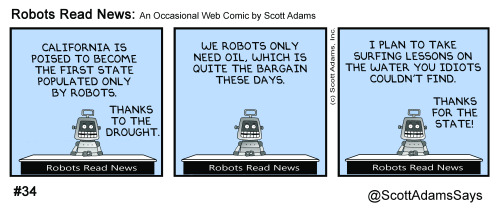
Dilbert’s Scott Adams weighs in on California’s drought:
Tags:Austin, California, Democrats, drought, Los Angeles, Los Angeles Unified School District, Marin County, ObamaCare, pension crisis, Texas, unemployment, unions, University of California, waste, Welfare State
Posted in Austin, Budget, Democrats, ObamaCare, unions, Waste and Fraud, Welfare State | No Comments »
Thursday, April 2nd, 2015
Time for another Texas vs. California roundup. The Texas House passed a budget, but I haven’t had a chance to look at it in any detail yet…
Unemployment rates in February: National average is 5.5%, Texas at 4.3%, California at 6.7%.
Even though hiring slowed to 7,100 new jobs in Texas in February, it was still the 53rd straight month of positive job creation, and Texas added 357,300 new jobs over the preceding 12 months.
A report from the Dallas Fed goes into more details.
California institutes mandatory water restrictions due to drought. California is indeed suffering a horrific drought, but it’s imposition of or acquiescence to idiotic environmental restrictions (see also: Delta Smelt) have made things much worse.
Some have proposed free market solutions to California’s water problems.
Workers comp abuse at LAPD/LAFD. (Hat tip: Pension Tsunami.)
Add Richmond, California to the list of cities that have radically underfunded their public employee retirement plans. “The shortfall of $446 million works out to about $4,150 for every city resident.” (Ditto.)
San Bernardino reveals its bankruptcy deal with CalPERS. (Hat tip: Pension Tsunami.)
Volokh the Younger examines the legal framework around the California rule (“not only that public employees are entitled to the pension they’ve accrued by their work so far, but also that they’re entitled to keep earning a pension (as long they continue in their job) according to rules that are at least as generous”), as well as its practical effects:
The California rule distorts what the salary/pension mix would otherwise be, given employer and employee preferences, and given the tax code as it is. Because underfunded pensions are a popular form of deficit spending, public employee compensation may already be too pension-heavy, and the rule makes it more so by freezing pensions in times of retrenchment. The incentive effects of the rule, given the political economy of government employment, may well exacerbate this tendency. And the possible theoretical reasons for preferring a pension-heavy mix don’t go very far in justifying this particular distortion.
California runs out of room on death row. Maybe they could subcontract to Texas…
Fresno’s deputy police chief busted on drug charges.
Tags:Alexander Volokh, California, Fresno, LAFD, LAPD, Los Angeles, pension crisis, Richmond (California), San Bernardino, Texas, unemployment, unions, Welfare State
Posted in Texas, unions, Welfare State | No Comments »
Thursday, March 26th, 2015
Time for another Texas vs. California roundup:
Forget all those snide liberal cracks about Texas’ public education system, since we have some of the highest graduation rates in the country.

“San Bernardino has defaulted on nearly $10 million in payments on its privately placed pension bond debt since it declared bankruptcy in 2012.”
The missed payments illustrate the trend among cities in bankruptcy to favor payments to pension funds over bondholder obligations, which has increased the hostility between creditors and municipalities.
San Bernardino declared last year that it intends under its bankruptcy exit plan to fully pay Calpers, its biggest creditor and America’s largest public pension fund with assets of $300 billion.
The city continues to pay its monthly dues to Calpers in full, but has paid nothing to its bondholders for nearly three years, according to the interest payment schedule on roughly $50 million of pension obligation bonds issued by San Bernardino in 2005.
If you’re a bank, a retirement fund, or a hedge fund, why on earth would you buy California municipal debt when there are safer alternatives? (Hat tip: Ace of Spades HQ Doom roundup.)
So how’s that San Francisco minimum wage law working out? Exactly like everyone who understands economics expected. “Some restaurants and grocery stores in Oakland’s Chinatown have closed after the city’s minimum wage was raised. Other small businesses there are not sure they are going to survive, since many depend on a thin profit margin and a high volume of sales.” Plus this: “Low-income minorities are often hardest hit by the unemployment that follows in the wake of minimum wage laws. The last year when the black unemployment rate was lower than the white unemployment rate was 1930, the last year before there was a federal minimum wage law.”
California’s Legislative Analyst’s Office suggests phasing out state health care for workers entirely.
California is dead last in spending transparency among the 50 states, with an F rating and a piddling score of 34. Texas ranks 13th with an A- and a score of 91. (Hat tip: Cal Watchdog.)
“North Texas gained an average of 360 net people per day from July 2013 to July 2014, a testament to the job-creating machine in the Lone Star state, according to the U.S. Census Bureau…North Texas and Houston were the only metropolitan areas to add more than 100,000 people during that one-year period.”
Just because California has some of the highest taxes in the nation doesn’t mean that the state’s Democratic legislature doesn’t want to add still more.
Meanwhile, the Texas Senate just passed a $4.6 billion tax cut.
California is rolling out more subsidies for Hollywood.
The Los Angeles Department of Water and Power not only has the highest employe costs in the country, it also ranks last in customer satisfaction. (Hat tip: Pension Tsunami.)
While Texas is certainly in much better shape than California on public employee pensions, things here are not entirely cloudless either. “The Texas Employee Retirement System is reporting unfunded liability of $14.5 billion in 2014, compared with liability of just $6.3 billion in 2013. By comparison, all of the state government’s general obligation debt as of 2013 was $15.3 billion. The Texas Law Enforcement and Custodial Officer Supplemental Retirement Plan is reporting unfunded liability of $673.1 million in 2014, compared with $306.7 million in 2013.”
Unlike California, Texas looks to get ahead of the curve on pension concerns with House Bill 2608, which restores control of pension funds to the local level by eliminating legislative approval for pension changes. I”nstead of locking up significant benefits in state statute, HB 2608 would allow city pension systems, like the Houston Firefighters’ Relief & Retirement Fund, to solve pension problems at the local level by changing benefit structures, if they so chose.”
“Support for the “bullet train” is ebbing across California, except, perhaps, in the Governor’s mansion.”
California raisin packer West Coast Growers files for Chapter 11.
American Spectrum Realty, a real estate investment management company that operates self-storage facilities under the 1st American Storage brand, has somehow managed to file for bankruptcy in both California and Texas. I think it’s safe to say that financial shenanigans are involved…
Lawsuit over misappropriated funds in a Napa Valley winery leads to a murder/suicide. It’s one of those stories that sounds too strange not to link to…
Tags:Budget, California, Crime, Economics, education, Los Angeles, minimum wage, Napa, Oakland, pension crisis, San Bernardino, San Francisco, Texas, unions, Welfare State
Posted in Budget, Crime, Democrats, Economics, Texas, unions, Welfare State | No Comments »
Wednesday, September 17th, 2014
Time for another Texas vs. California roundup:
The Texas economy continues to hum along:
During the second quarter, Texas employers added 148,200 net nonfarm jobs—an average of 49,400 per month. This amounts to an 18 percent share of all jobs created nationwide over this period in a state with only 8 percent of the country’s population and about 10 percent of total economic output. Over the last year, the addition of 382,200 net jobs in Texas was more new jobs than any other state. These employment gains increased the annual job growth rate to 3.4 percent, which is higher than those of the national average and other highly populated states.
The city of Los Angeles is at an impasse over police raises: the police union (naturally) wants raises, while the city says they can’t afford them. So what happens next? The issue goes before the Employee Relations Board, which just happens to be packed with union-approved appointees. In one-party Democratic cities and states, it’s always government together with unions against taxpayers. (Hat tip: Pension Tsunami.)
“The ugly reality is that so long as the boards of CalPERS and CalSTRS are controlled by public employee union loyalists, pension reforms enacted by state lawmakers and signed by governors will never live up to their billing.”
Jerry Brown lies about pension spiking.
Why San Antonio’s public-private partnerships are better at dealing with drought than Los Angeles.
A FAQ on Costa Mesa’s pension situation. Including answers to such questions as “How could the $228 million in unfunded pension liabilities affect the city budget?”
Watsonville, California passes a sales tax hike solely to pay for additional union pension payments.
A judge rules that bankrupt San Bernardino can cut firefighter pension benefits in order to exit bankruptcy.
A union-sponsored bill tries to increase liabilities for companies that hire contractors.
California is evidently cooking up a whole new batch of unconstitutional gun laws.
A look at phony baloney jobs numbers for California’s high speed rail boondoggle.
Firefly Space Systems is relocating from California to Burnet County, Texas. “King said Firefly was attracted to Texas partly because of its business and regulatory climate.” It doesn’t take a rocket scientist to figure out California offers a lousy climate for business. Or to put it another way: My days of underestimating California’s ability to improve its business climate are certainly coming to a middle…
Drone-maker Ashima is relocating to Reno, Nevada from California.
If you hadn’t heard, Tesla is building its battery factory in Nevada, not California.
An actual good law out of California: A law that prevents companies from suing customers for negative reviews.
North Carolina offered twice as much incentive money to Toyota but still lost out to Texas for relocating their HQ.
Your dedicated BART employee in action:
Tags:Ashima, Austin, BART, Budget, Burnet County, California, CalPERs, CalSTARS, Democrats, drought, Firefly Space Systems, Jerry Brown, Los Angeles, North Carolina, Regulation, San Antonio, San Bernardino, Tesla Motors, Texas, Texas Public Policy Foundation, unions, video, waste, Watsonville
Posted in Austin, Budget, Democrats, Regulation, Texas, unions, video, Waste and Fraud, Welfare State | 2 Comments »
Monday, August 25th, 2014
Another look at how Texas stacks up to the no-longer-so-Golden state:
Problem: Those lousy taxpayers get pension reform passed. Solution: CalPERS uses “99 categories of ‘special pay'” to go on a pension spiking orgy.
What are some of those 99 categories? “Clerks who type well. Cops who shoot straight. Librarians who are “assigned to provide direction or resources to library patrons.” I’m too scared to check if “Teachers who don’t rape their students” is an actual category or not…
Governor Jerry Brown is sending mixed signals on the pension spiking issue.
Who actually owns the CalPERS gap between actual funding and what they’ll need to pay out? “CalPERS can be risky (and it has been) with no consequences. The taxpayers have all the responsibility, but none of the control.”
So how much payroll and pension did Stockton trim in their bankruptcy? Zero.
There is no California comeback. “Personal income-tax revenues fell by 11 percent in the first quarter of this year and more than 6 percent through June.”
California cities are among the slowest to recover from the recession.
The only way California can get pensions under control is through a constitutional amendment.
Los Angeles Department of Water and Power is asking for more money. They’re also asking Angelinos to overlook their high salaries and lack of accountability.
City leaders are battling with DWP’s union, the International Brotherhood of Electrical Workers Local 18, to release financial records of a nonprofit trust, run jointly by labor- and management-appointed trustees, that has run through $40 million in ratepayer money. Brian D’Arcy, IBEW Local 18’s business manager, has refused to turn over the trust’s financial records, and DWP executives have said they don’t know how the money was spent.
California voters get to weigh in on a 7.5 billion water bill in November, which seems to have considerably less pork than a previously delayed $11 billion bill.
So how does bankrupt San Bernardino plan to climb into the black? Cutting back on outrageous pensions? Ha, you must be high! “Help us, weed, you’re our only hope!”
I know this is a shock, but California’s High Speed Rail Authority is behind schedule on buying land for it’s doomed boondoggle.
Los Angeles City Councilman Paul Koretz opposes ride share programs like Uber and Lyft. Strangely enough, he’s also received $11,000 in campaign contributions from the taxi industry. Quid pro, meet quo.
YTexas helps companies relocating to Texas connect with local businesses.
Tags:California, CalPERs, fraud, Jerry Brown, Los Angeles, marijuana, San Bernardino, Stockton, Texas, unions, Welfare State
Posted in Budget, Texas, unions, Waste and Fraud, Welfare State | No Comments »