Tom Leppert says he considers Dewhurst, not Ted Cruz, his main competition. Which is what you would expect him to say.
More details and reactions tomorrow.
Tom Leppert says he considers Dewhurst, not Ted Cruz, his main competition. Which is what you would expect him to say.
More details and reactions tomorrow.
Shawn McCoy of the Tom Leppert campaign clarifies Leppert’s Q2 fundraising numbers:
Yes, Tom invested more of his own money in the campaign. That was not part of the 750k.=
Not sure if you received our press release—it may help clarify further.
[Excerpt from attached press release]
DALLAS, Texas, July 15, 2011 – Republican U.S. Senate candidate Tom Leppert announced today that his campaign banked $1.25 million in the second quarter of 2011. Fueled by over $750,000 in second quarter contributions and another personal investment in the campaign, Leppert continues to lead the field of announced candidates in fundraising. Leppert now has $3.4 million in total cash on hand, with almost $3.2 million in all-important primary cash on hand to spend before voters go to the polls in March.
Thanks for the clarification. I was half-right in spotting the loan, and mostly wrong in my interpretation of its meaning.
Still waiting for Dewhurst to announce his candidacy. (It would be tempting to write a Waiting for Godot parody with Dewhurst in the Godot role, except I suspect the intersection between Texas political junkies and people who would appreciate a good Samuel Beckett parody would result in a fairly small set.) But there’s still plenty of news on the race:
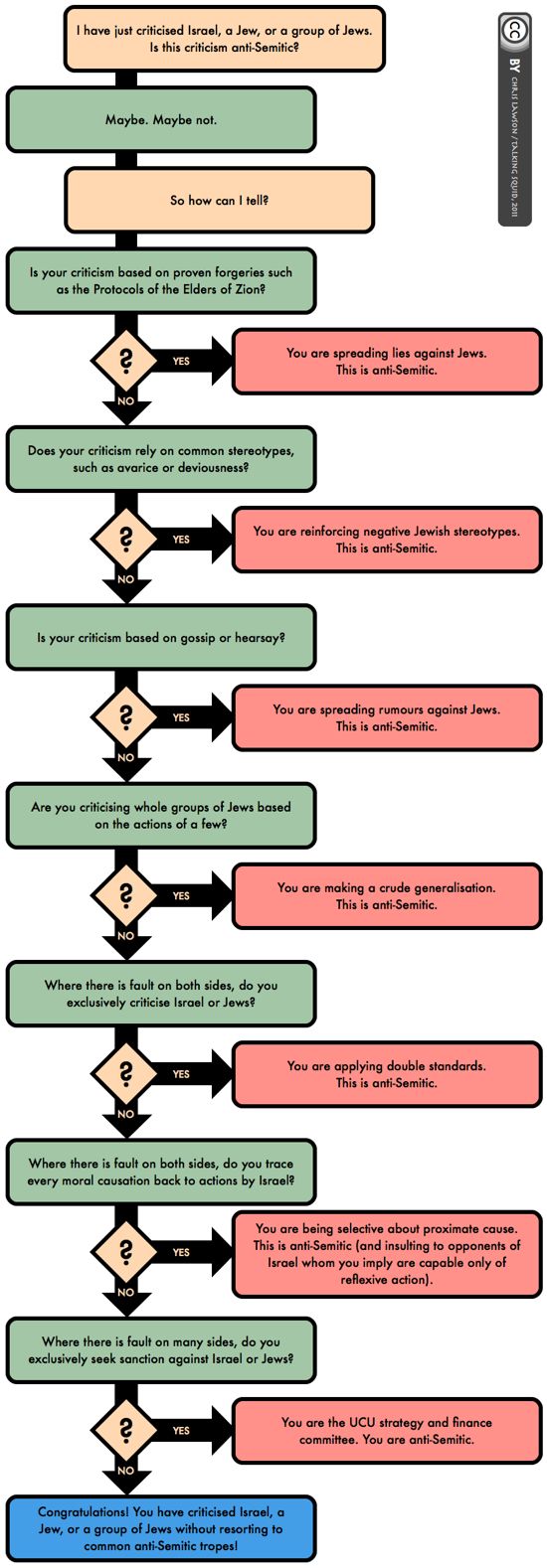
Over at Talking Squid, Chris Lawson has come up with a flow chart to determine whether criticism of Jews and/or Israel is anti-Semitic or not. Since its seems pretty useful, and since Lawson says “Anyone else is also free to use it as they please,” I’m including it here.
A few quick updates on the Texas Senate Race:
I went poking around the web to see if there were any signs that Ricardo Sanchez was actually assembling something resembling a serious campaign when I stumbled across some intriguing comments from one J. R. Behrman, a member of the State Democratic Executive Committee of the Texas Democratic Party. It’s always good to keep tabs on the other side, especially when there’s dissension in their ranks, and judging by these comments (pulled from down in the page), Mr. Behrman is not a happy camper:
The “Texas right of center electorate” is a construct of pimp-consultants simultaneously raising money while picking “winners” — meaning losers — namely, candidates, races, and — surprise — themselves as campaign consultants. With a few up and coming sycophants they can spend the money on “likely voter” campaigns featuring a decades-old mix of racially segmented media messages, “GOTV”, and proprietary technologies they get a portion of the license fee from.
These packaged candidate/campaign deals are peddled to the “Big Money Boys”. But, this has been so unsuccessful for so long, one wonders if it can be done any longer.
The AFL-CIO has been fleeced and given up on this.
There is, maybe, one rich, bored, living lawyer left dumping big bucks into a media campaign of his own design that does not appear to involve any actual candidates.
Meanwhile, the GOP has an actually proficient small-donor campaign fund-raising and mobilization machine based on a common technology — the same one Obama brought to Texas in 2008 but has since folded or withdrawn.
The GOP technology is nothing the same-old, same-old SDEC would even consider a competitive alternative to. They have a really great licensing deal on the VAN. The SDEC is an awards banquet for sycophants, not a strategic or technology forum.
So, Rick Sanchez can re-run the Wes Clark nomination campaign and defeat his likely opponent … nobody.
But, how does he win the general election Bill White just lost persuasively and expensively, …
If the party can not raise enough money to keep the doors open on the Little Office, …
If the Big Donors are tapped-out, dead, or, simply, looking at zero return on their “investments”, …
If the Obama campaign uses its operation in Texas to harvest volunteers and money for battleground states, and …
If the party establishment itself has nothing to stand on or run on but “ain’t it awful hand-wringing and grand-standing by districted incumbents with no race to run, and 70’s-vintage “celebrate diversity” identity politics masking zero-sum patronage among street-level race-hustlers?
And more, further down:
The SDEC has no plans or standards, just a mix of written and unwritten rules that are selectively enforced so as to perpetuate a patently failed party establishment in Austin — a Speaker’s Claque (with no Speaker).
This is how the State Legislature worked “back in the day” when we dominated bi-partisan concession-tending regime in Austin that the GOP has now hijacked. Clearly, that regime is no longer bi-partisan, but we still wallow in nostalgia for it, conduct our business habitually, and cling to the “center-right electorate” theory and “likely voter” corollary, consultants, and voter file. Those all used to work. But, the world changed in 1994 and 2000. The TDP and, for that matter, the DSCC/DCCC has not yet adjusted.
Delegate votes in the state convention — apart from ex-officio delegates — reflect the actual distribution of Democratic voters. Composition of the SDEC favors GOP voters and those in the lobby as administer the party’s McGovern-era racial quotas and patronage. This is a formula for rewarding sycophancy, not proficiency.
So, SDEC meetings are stuffed with non-voting members, honorific resolutions, and time-wasting ritual. There is simply no time to seriously or fairly consider questions, such as the employment of Ed Martin, that are sprung on the body by the staff and protected by the Palace Guard.
From cycle to cycle, the celebratory happy-talk results in catastrophic losses every eight years. In my tenure, the SDEC has become more defensive and apologetic rather than imaginative and critical.
I and others on the SDEC do come forward from Senate Districts outside of Austin with lots of both actual and potential Democratic voters or loyalists and small donors.
We bring constructive proposals that relate to increasing turnout of new and old, rural and urban, “base voters” using technologies and techniques that do not involve kick-backs and cross-subsidies to the Austin-based hangers-on and auxiliaries. But, these are quashed in committee by the Palace Guard and the hired help.
Statewide candidates, self-funded or pimped-out to their own bundler/consultants, just ignore the state party establishment which is, indeed, so negligent as to let the LaRouch cult get on the primary ballot steal votes and time from legitimate Democrats.
The likely-voter and center-right nonsense, is just the half-baked rationale for “keeping on, keeping on”, turning the state into a “red-state” bastion, keeping it there, but promising to “turn Texas blue” Real Soon Now without even discussing much less rectifying profound problems of party governance and finance.
While I would no doubt disagree with Mr. Behrman about most political issues, I find his comments quite interesting for two reasons:
Nor is this the first time Mr. Behrman has expressed these frustrations:
The Democratic Party establishment in Texas and Harris County are artifacts of a bi-partisan concession-tending regime that lasted statewide from 1824 to 1994 and persists on City Council to this day. This establishment lacks proficiency and purpose – now that tort reform is a done deal and they have no alternative to debt-driven fiscal austerity at every echelon of government.
So the prospects for winning statewide, countywide, and even citywide elections in 2011-12 are not good. There have been essentially no lessons learned from victories in 2008 or losses in 2010. “Wave Election!” is an excuse, not an analysis or a plan. The same consultants will be doing the same thing with the same tools but without the benefit of an Obama primary campaign here in Texas next year.
Apart from dismay at the effects of national, state, county, and city austerity, there will be little motivation and no money trickling down from national politics unless and until we turn things around here on the ground … dramatically. The patronage-oriented base vote will be no better than 2010 and the (2008-vintage) “new base vote” will be hard to motivate, locate, or mobilize. It is true that on the margin there is still some ‘bloc voting’ by various interest groups. But that is not the way the politics of age, ethnicity, class, and gender work in “majority-minority” counties like Harris, for one. So we are going to have to adopt Obama-type political methods and messages if we expect results like 2008.
He seems to be seeking a “mid-left progressive populist” position between toadying up to big business/big labor/big government interests (bailed-out banks, trial lawyers, etc.) and the party’s Identity Politics brigades and their race-hustling poverty-pimp enablers. This would theoretically enable the party to grow more middle class support for its redistributive policies. I rather doubt it.
But while I differ with Mr. Behrman’s prescribed course of treatment, I do think he has admirably identified a number of the symptoms.
How widely spread are Mr. Behrman’s sentiments? Being very far indeed away from the center of the Texas Democratic Party, I would not venture to estimate. My guess is that the sentiments themselves are fairly widely shared, but that few are inclined toward his suggestions…
You might have noticed that I have not been overly kind in my assessments of Paul Burka’s political observations. He comes across as a world-weary, old school, middle-of-the-road liberal reporter who can’t come to grips with the changing political landscape, yearning for the days when the two wings of the Democratic Party controlled Texas politics, Republicans were an exotic novelty, and big-government policies could safely be forged in smoky backrooms over rounds of whiskey without input from those butinski outsiders known as “taxpayers.” He doesn’t understand why the Tea Party won’t just go away and let him go back to a time when the people in power returned his phone calls. (More on Burka’s textbook liberalness in this Kevin D. Williamson piece over at NRO.)
All that said, he offers some very useful advice to his Yankee cohorts (i.e., fellow liberal journalists) on mistakes to avoid in covering Rick Perry. I doubt they’ll take that advice (Burka is, after all, a native Texan, and didn’t graduate from an Ivy League college (I’m sure the idea that Rice might be as good or better than many Ivy league schools is not the sort of thought likely to penetrate their mind) and is therefore automatically suspect), but it’s good advice none the less. The short essays next to Points 1 (Perry is not George Bush) and 5 (Perry is not a male hair model) are particularly good.
It is true that Perry has a much-remarked-upon coif, but don’t let this lead you to assume that he’s soft, or feckless, like that other recent walking shampoo ad, John Edwards. Perry is a hard man. He is the kind of politician who would rather be feared than loved—or respected. And he has gotten his wish.
Read the whole thing.
There’s two big senate race shoes waiting to drop over the rest of July: The announcement (whatever it is) Dewhurst is going to make on July 18, and FEC releasing Q2 fundraising results. In the meantime, here’s a smattering of senate race news
To concentrate on his 2012 Presidential run. After which, since he won’t be the GOP nominee, he will presumably retire from politics.
More about Paul’s somewhat-mixed legacy, and the nature of his supporters, at a later date…