The events of this week reveal the new standard. Like sharks to a whale carcass, our elites routinely feast upon precarious situations in other nations: The Podesta Group, Hunter Biden, and others were content to make a buck off the tensions in Ukraine along with Paul Manafort, just as the Clintons and others were happy to take tens of millions of dollars from Russian oligarchs. We all know that Manafort would be sitting in a house in Malibu right now with the same immunity deal the likes of Podesta, Biden, and the Clintons apparently possess if only he had never decided to work for Donald Trump.
Recall that the supposed original sin of the entire Russian-collusion gambit was that when approached (apparently mostly by agents of the United States government working for President Obama and friends) then-candidate Trump or his team were interested in recovering the emails that Hilary Clinton unwisely and illegally sent and then deleted from her private server so that no one could read them. There would be plenty of reasons for Americans and the U.S. government itself to seek out these emails, of course, if only to determine to what extent they threatened national security—never mind the power and wealth of the foundation engaged in international money collection that her husband ran while she was Secretary of State.
But while the supposed reasons for it change every week, the Ukraine fiasco reveals the real underlying cause of the Left’s outrageously hypocritical march towards impeachment. The ruling class is now effectively saying to President Trump: “We know that domestically we have nothing to fear from the media and the law—so how dare you ask other countries about us! You must be impeached for this crime and this crime alone—asking other countries about our wrongdoing! Only an insane or evil person would do this!”
“Atlantic City Mayor Frank Gilliam pleads guilty to stealing $87K from youth basketball nonprofit he founded.” Hey, which political party do you think Mr. Gilliam is a member of? Let’s start scanning the article and see if we can guess. Headline? No. First paragraph? No. Second paragraph? No. Look, I’ll save you the suspense: You have to go all the way down to the eleventh paragraph to learn what you already assumed: Mr. Gilliam is a Democrat.
The whole “white nationalist” charge against President Donald Trump and his supporters was always garbage.
Saying goodbye to the extremely consequential GOP class of 1994, the first Republican House majority in 40 years, the one that ran on the Contract With America and passed welfare reform.
A very malevolent incarnation of Florida Woman: Rich Democrat wife files police report over man using a meme on Facebook. “Beth Jaffe, who is the wife of city commissioner Bryon Jaffe, felt that the meme was threatening her life. Ms. Jaffe contacted the district office of the Broward County Sheriff’s Department and asked for them to investigate Van Antwerpen.” (Hat tip: Say Uncle.)
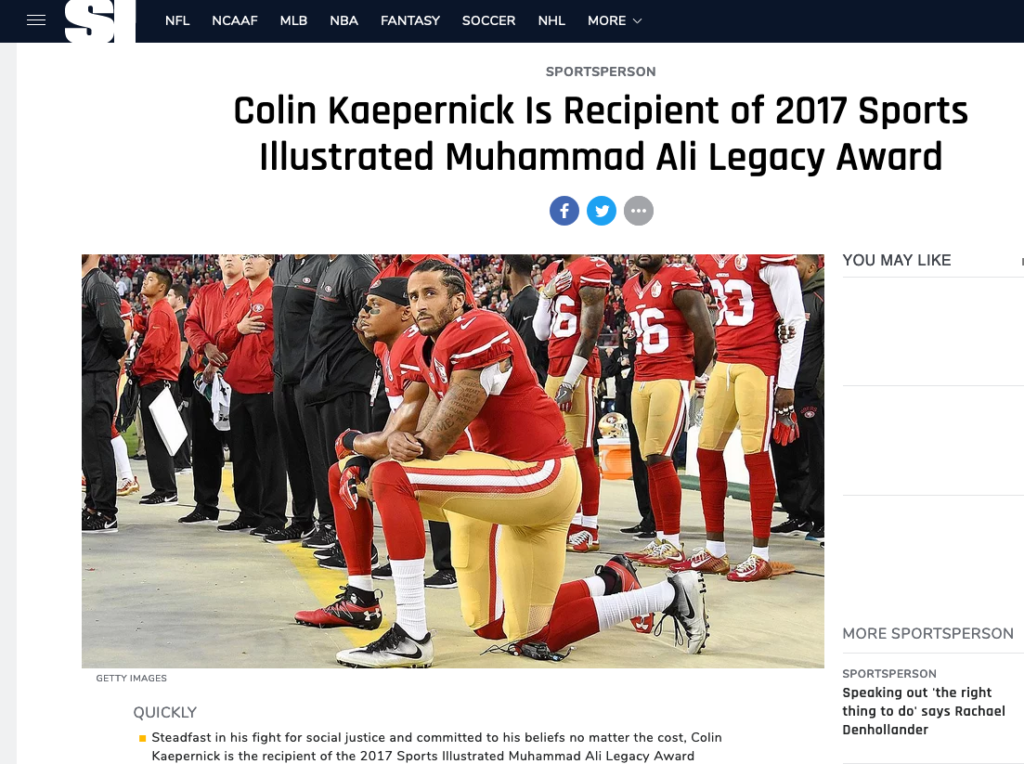
Ahem! I said I can’t possibly imagine how Sports Illustrated might have alienated their core—
The Guardian: “Women’s magazines are more progressive than ever – and they’re all closing down.” There’s this thing called “causality.” Maybe publishers should look into it while they still can… (Hat tip: Aceof Spades HQ.)
The real cause of these abuses is failure of university trustees to meet their fiduciary obligations, which in the case of public schools is to taxpayers. Weak boards allow university administrators to limit oversight of admissions. The administrators are allowed to see admissions criteria, but not the trustees who are supposed to be in charge. Board members who want admission favors for their own children or their friends go along, while others turn their heads to avoid the wrath of powerful alumni and politicians who benefit from the workarounds.
I witnessed this while serving as a member of the University of Texas System Board of Regents. My actions to expose the admissions scandal at UT-Austin, our flagship campus, resulted in impeachment hearings against me by the state legislature and even efforts to convince a grand jury to indict me. While neither worked, the university continues to hide all of the documents that would have exposed the scandal. Even the FBI knows only a fraction of the real corruption.
Details of the larger problem at the Austin campus were uncovered in a private investigation commissioned by our then-Chancellor and a minority of Board members. The problem is, our university president teamed up with a new Chancellor and the state’s most powerful elected officials to keep the findings sealed. The un-redacted report, which explains how hundreds of unqualified students manage to occupy spots in UT programs—including our law school—is locked in a courtroom after my lawsuit to make it public was challenged by the university. Every one of those students owes his or her presence on campus to a politician who controls state spending at the university, or to a well-connected donor or faculty member.
Following yesterday’s news that Socialist Vermont Senator and Democratic presidential candidate Bernie Sanders suffered a heart attack and had two stents installed, rumors have been rife that Sanders will drop out of the race.
Give the old commie his due: Bernie appears to be a tough old bird who keeps up a rigorous campaign schedule. And a stent procedure is far less taxing than a coronary bypass, and some people are up and walking about within a week after having a stent inserted.
That said, heart surgery of any kind is no joke. The people who are up and around in a few days after stent surgery are young people. Sanders is 78. And the next Democratic debate is thirteen days from now. It’s possible that Sanders will be recovered enough to participate, but I rather doubt it. At the very least I expect he’ll need a chair rather than standing for a couple of hours.
Also, anytime old people undergo general anesthetic, there’s the possibility they’ll suffer from postoperative cognitive dysfunction. Problems can include “impairments in attention, memory, concentration and/or executive function.” And even if he is all there, it’s a good bet that he won’t be as up physically for the grueling schedules of a serious presidential campaign.
If Sanders drops out, lots of people have calculated that will help Elizabeth Warren as the most viable leftward candidate, but that’s not necessarily the case. Morning Consult polls consistently show that slightly more Sanders voters prefer prefer Joe Biden as their second choice over Warren. I’m pretty sure Sanders voters won’t be wild about backing billionaire candidate Tom Steyer (an opinion they seem to share with the overwhelming voting age population).
If I had to pick a likely beneficiary of Sanders dropping out beyond Biden and Warren, the longshot that comes to mind is Andrew Yang. After all, both of their followers have a noted devotion to being promised free stuff…
The Biden clan gets rich, Klobuchar kills a duck, O’Rourke threatens a kitten and calls Journey punk rock, while Yang channels The Dead Kennedys and the Q3 fundraising deadline looms. It’s your Democratic Presidential clown car update!
Polls
Too damn many polls this time around…
CNN (Nevada): Biden 22, Sanders 22, Warren 18, Harris 5, Buttigieg 4, Steyer 4, Yang 3, Booker 2, Gabbard 1, Klobuchar 1, Ryan 1, Williamson 1. 4% is as high as we’ve seen Steyer in any poll. Is his airdropping money on his campaign finally moving the needle?
CNN (South Carolina): Biden 17, Warren 16, Sanders 11, Buttigieg 4, Harris 3, Steyer 3, Booker 2, O’Rourke 2, Gabbard 1, Klobuchar 1. These numbers are from the RealClearPolitics summary, as they’ve double-linked the Nevada poll on their source link.
Harvard/Harris: Biden 28, Warren 17, Sanders 16, Harris 6, O’Rourke 3, Buttigieg 3, Yang 3, Castro 2, Booker 2, Steyer 2, Klobuchar 1, Gabbard 1. be prepared to click the zoom button a lot…
Landmark Communications (Georgia): Biden 41.4, Warren 17.4, Sanders 8.1, Harris 5.6, Buttigieg 4.9, Booker 2.0, Yang 1.9, O’Rourke 1.4, Klobuchar 1.1, Gabbard 0.8, Bennett(sic) 0.1, Steyer 0.1, Castro 0.0. While I should theoretically appreciate the greater precision, I don’t understand how you get a 0.1 out of a sample of 500. Doesn’t that work out to half a person?
Emerson Biden 26, Warren 23, Sanders 22, Yang 8, Buttigieg 6, Harris 4, Booker 2, Castro 2, O’Rourke 1, Ryan 1, Gabbard 1, Sestak 1, Williamson 1. Small sample size of 462, but 8 is a new high for Yang. A couple more points and he’s in Ron Paul territory…
The other candidates have not yet started seriously spending on TV. To date, most candidates have been committed more resources to Facebook and Google ads than to television ads (Pete Buttigieg, for example, has spent $5.3 million on digital vs. just $302,200 on TV). After Steyer, the active candidate who has spent the most on TV is Joe Biden, who has aired 882 spots for an estimated $384,220, almost all of it in Iowa.
Evidently Saturday Night Live is still on, and they had a DNC Town Hall skit Saturday:
If you think this section is light this week, you’re right: I think the impeachment nothingburger has sucked a lot of the air out of the room for the 2020 race. One way or another, Trump always manages to do that…
Now on to the clown car itself:
Colorado Senator Michael Bennet: In. Twitter. Facebook. Says he’s staying in the race until New Hampshire. Gets a Politico interview, says he’s not on the impeachment train. Also says far left candidates hurt Democratic chances of beating Trump. He’s the third richest Democrat running, behind Steyer and Delaney. “Within days of the appointment [to the senate in 2009], Bennet sold off at least $2 million worth of stock, in companies like Philip Morris, Eli Lilly and Chevron, according to federal filings.”
Former Vice President Joe Biden: In. Twitter. Facebook. “Wherever Joe Biden went, son Hunter cashed in.”
Biden has been leading the Democratic field. The central case for his candidacy rests on the supposedly exemplary work he did as a senior member of Team Obama. Well, in 2016, acting as the Obama administration’s point man in Ukraine, the vice president — unlike Trump — openly threatened to withhold $1 billion in American loan guarantees if the embattled nation didn’t fire the country’s top prosecutor, Viktor Shokin.
As Biden later bragged, “I looked at them and said, ‘I’m leaving in six hours. If the prosecutor is not fired, you’re not getting the money.’ Well, son of a bitch. He got fired.’ ”
Most of the media assure us that, though by the Democrats’ new standards this kind of intimidation constitutes a flagrant abuse of power, Biden’s reasons for threatening Ukraine were chaste.
But simply repeating this talking point doesn’t make it true. Granted, Shokin was a shady character. Yet at some point he had been investigating Burisma, the largest gas company in Ukraine, which also happened to be paying Hunter Biden a $50,000 monthly salary as a board member.
By coincidence, Hunter had landed this cushy gig in a foreign country only a few months after the Obama administration began dispatching his father, Joe, to the very same foreign country on a regular basis.
There was, of course, absolutely nothing in Hunter’s résumé to indicate that he would be a valuable addition to foreign energy interest. He didn’t speak the language, and he had no particular expertise in the energy industry. Oh, he did have one thing, though: his last name.
I suppose, that isn’t entirely fair. Hunter once ran a hedge fund with his dad’s brother, James Biden, and associated with a notorious Ponzi schemer. James would go on to snag a job as executive vice president of a construction company in 2010, despite having virtually no experience in the field. And only a few months into his tenure, the company would win one of its biggest contracts in its history, a $1.5 billion deal to build affordable homes in Iraq.
By pure happenstance, Joe was also the Obama administration’s point man in Iraq at the time. Funny how these things work out.
Liberal reporters, who are framing Trump’s conversation with Zelensky as the most perilous threat in the republic’s history, have shown little curiosity about Biden’s dealings with the Ukrainian government. Many media personalities, in fact, have rallied to Biden’s defense, calling any intimation of wrongdoing a smear.
NBC’s Chuck Todd dismissed any Biden talk as a mere distraction. CNN called questions into the former vice president’s actions “baseless.” Other liberals now argue that the Biden firing of Shokin actually worked against the interests of Hunter.
We have no way of knowing if this is true, either. According to The New York Times, Hunter’s work for Burisma had “prompted concerns” among Obama administration State Department officials, because it undermined diplomacy in Ukraine. Was Biden really the only person available to pressure Ukrainian officials while his son was raking in the cash? Does anyone really believe Biden’s claims that he never once spoke to his 49-year-old son about business in the two years they spent working in the same country?
Late Summer 2006: Hunter Biden and his uncle, James Biden, purchase the hedge fund Paradigm Global Advisors. According to an unnamed executive quoted in Politico in August, James Biden declared to employees on his first day, “Don’t worry about investors. We’ve got people all around the world who want to invest in Joe Biden.” At this time, Joe Biden is months away from becoming chairman of the Senate Foreign Relations Committee and launching his second bid for president.
The unnamed executive who spoke to Politico charged that the purchase of the fund was designed to work around campaign-finance laws:
According to the executive, James Biden made it clear that he viewed the fund as a way to take money from rich foreigners who could not legally give money to his older brother or his campaign account. “We’ve got investors lined up in a line of 747s filled with cash ready to invest in this company,” the executive remembers James Biden saying.
Joe Biden’s brother told executives at a healthcare firm that the former vice president’s cancer initiative would promote their business, according to a participant in the conversation, who said the promise came as part of a pitch on behalf of potential investors in the firm.
The allegation is the latest of many times Biden’s relatives have invoked the former vice president and his political clout to further their private business dealings. It is the first that involves the Biden Cancer Initiative, a project Joe Biden made the centerpiece of his post-White House life following the death of his son Beau.
Biden’s brother, James, made the promise to executives at Florida-based Integrate Oral Care during a phone call on or around November 8, 2018, according to Michael Frey, CEO of Diverse Medical Management, a health-care firm that is suing James Biden. At the time, James Biden’s business partners were pursuing a potential investment in Integrate, according to Frey and court records. Frey, who had a business relationship with James Biden and his associates, had introduced the group to Integrate.
James Biden told the Integrate executives that he would get the Biden Cancer Initiative to promote an oral rinse made by the firm and used by cancer patients, Frey, who said he participated in the call, told POLITICO. He added that James Biden directly invoked the former vice president on the call. “He said his brother would be very excited about this product,” Frey said.
Make no mistake: This is a risky game the Democrats are playing. On the one hand, their most energetic voters practically demand Trump’s immediate removal. On the other hand, most voters are apathetic at best to the idea of impeachment, and will probably turn against it quite sharply if yet another investigation fails to reveal enough dirt on Trump. But as I wrote at Instapundit earlier today, maybe the only thing worse to the Democrats’ kamikaze wing than not going ahead with an impeachment inquiry would be an unsuccessful one.
But for some Democrats, that might be a risk worth taking. So let’s go back to our earlier thought, courtesy of GMU law prof David Bernstein.
My conspiracy theory of the day is opening an impeachment inquiry over Ukraine is less about Trump, and more about some very powerful Democrats wanting to get Biden out of the way early. https://t.co/3Mcg7Dpt3Z
The payoff here for “some very powerful Democrats” — and it wouldn’t be prudent to point fingers at anyone in particular — might be well worth the risk. Weaken Trump and force Biden out of the race, probably before Iowa? You can picture a particular presidential candidate or three saying “Deeeeeeliiiiiicious” in their best Dr. Evil voice.
In order to win the nomination in a crowded race, Biden needs to cultivate support across demographic groups, to at least feint at his ability to win back the Obama coalition in the general election. His bedrock of support is black voters. Black voters made up around one-quarter of the 2016 Democratic primary electorate and are a crucial demographic group for any candidate. According to Gallup, 63 percent of non-Hispanic black Democratic voters self-identify as moderate or conservative. This, even as the Democratic Party overall has gotten more liberal — 2018 was the first year that over half of Democrats (51 percent) identified as liberal (in 1994, that number was only 25 percent.)
But while black voters have remained more moderate or conservative, white voters have become increasingly likely to identify as liberal — 65 percent of non-Hispanic white Democrats called themselves liberal and have become rapidly more liberal on issues of race over the past 10 years. With white liberals comprising a key demographic not just in the first two primary states, Iowa and New Hampshire, but also in the media, it’s no wonder that Biden’s campaign has felt the pile-on of Twitter chatter.
Former San Antonio Mayor and Obama HUD Secretary Julian Castro: In. Twitter. Facebook. Swears he’s not going to run for the senate even if he drops the presidential run. Which is understandable, since (like O’Rourke) he would lose either. “Julián Castro’s campaign manager says fundraising email not ‘a threat to quit.'” Like I said last week about Booker, it’s the standard campaign solicitation shuck.
Former Maryland Representative John Delaney: In. Twitter. Facebook. His Iowa State Director Monica Biddix left the campaign to “pursue other opportunities,” which is hardly reassuring for Delaney’s longshot hopes. “His campaign announced later Friday that it had named Brent Roske the new Iowa state director. Roske earlier served as Democratic presidential candidate Marianne Williamson’s Iowa state director.” I’m guessing this is a step up in neither prestige nor likelihood of success, but probably a much stronger chance of receiving additional paychecks until the caucuses. BEEEEEFCAAAAKE!
Some big bank executives and hedge fund managers have been stunned by Warren’s ascent, and they are primed to resist her.
“They will not support her. It would be like shutting down their industry,” an executive at one of the nation’s largest banks told CNBC, also speaking on condition of anonymity. This person said Warren’s policies could be worse for Wall Street than those of President Barack Obama, who signed the Dodd-Frank bank regulation bill in the wake of the 2008 financial meltdown.
She’s all about leading the charge…except when it comes to fulfilling her actual senate voting duties:
$5 for anyone who can find a video of him doing a karaoke cover of “Holiday in Cambodia.” Gets a BBC profile. He proposed a VAT, which a New York Times writer says will raise more money than Warren’s wealth tax. In truth, both will earn exactly the same amount: zero, since neither has a hope in hell of passing.
Out of the Running
These are people who were formerly in the roundup who have announced they’re not running, for which I’ve seen no recent signs they’re running, or who declared then dropped out:
As for the running part, well, who knows? Lots no-hope candidates delude themselves into running for President every year, people with names like “Wayne Messam” and “Tom Steyer” and “Bill Weld” and “Joe Walsh” and “Kirstin Gillibrand” and “Even McMullin” and…
You get the idea.
As for the idea of Will Hurd securing the Republican nomination for President, well, that’s not happening.
In many ways Hurd was a perfect fit for TX-23, the only true swing district in Texas until 2018. A moderate Republican and squish on border enforcement, he probably did reflect the rough consensus of his majority Hispanic San Antonio-to-just-short-of-El Paso district. But the moderate views that were such a virtue in getting elected (and re-elected) would be a non-starter in the Republican primary. There are at least two other Texas Republican office holders (Rep. Dan Crenshaw and Sen. Ted Cruz) who would be much stronger first-tier contenders for a 2024 Presidential run, and several others who could do better than Hurd as well were they to run (and Rep. Mike McCaul could probably self-finance his run at least as well as John Delaney…er, never mind).
That said, I could see Hurd as a dark horse VP pick for a non-Texas nominee (pesky Twelfth Amendment). Which puts his overall chances of ever being President better than Beto O’Rourke’s…
On Tuesday, House Speaker Nancy Pelosi (D-Calif.) admitted her plans to put a resolution on the House floor Wednesday to investigate President Donald Trump’s Ukraine scandal, a process that will likely grow into an impeachment inquiry as Democrat demands for impeachment grow ever more insistent.
“Confirmed: House Speaker Nancy Pelosi planning to put a resolution on the House floor tomorrow to address the Ukraine issue as there are increasing calls by Democrats to start the impeachment process for President Trump,” PBS White House Correspondent Yamiche Alcindor tweeted.
In an interview with CNN Monday night, Pelosi declined to say whether or not she would fully endorse an impeachment inquiry, but she suggested a move toward impeachment proceedings was certain. “We will have no choice,” she said.
The renewed push for impeachment gained steam following reports that President Trump pressured Ukraine President Volodymyr Zelensky to investigate Joe Biden’s son Hunter in cooperation with the president’s personal lawyer, Rudy Giuliani. On Tuesday, Trump announced he would release the full transcript of the call, during which he reportedly pressured Zelensky to investigate Hunter Biden no fewer than eight times.
Hunter Biden was a board member of Ukrainian firm Burisma Group when Joe Biden served as secretary of State. During his tenure, Joe Biden pressured Ukraine to fire a prosecutor who was investigating Burisma.
Yes, a scandal where a sitting Democratic Vice President withheld aid from a foreign country unless they stopped investigating his crooked son’s crooked deals is somehow Trump’s fault. (Hat tip: Stephen Green at Instapundit.)
Democrat party is covering up a pattern of corruption involving high level members of the Obama cabinet. The multi-million and billion dollar pay-for-play is mind boggling. Biden Family sale of office to Ukraine was not the only one or the most egregious. Slimy Joe is not alone.
Let this sink in , The democrats want to impeach our President for exposing the crimes that they have committed . SMH Joe Biden needs to be impeached .#Trump2020LandslideVictory
Democrats want to impeach a president with a 53% approval rating based on a whistleblower with ZERO firsthand knowledge of the Trump-Ukraine phone call
It’s ironic that this so-called whistleblower scandal is going to be the thing that kicks off an actual impeachment inquiry, since it looks like just another nothingburger in a long line of nothingburgers:
The democrats in the House of Representatives are at it again. Is this their third or fourth call for impeachment of the president? Each week it seems media bring us a new sensational story of theft and intrigue, that then very quietly falls by the wayside once the facts emerge.
This time the controversy centers around business dealings that former Vice President Biden’s son had in the Ukraine. Allegedly, Biden’s son was on the board of a company that bribed Ukrainian officials to end a corruption investigation into it. Democrats now allege that the President threatened to withhold military aid to Ukraine should it not reopen the investigation into Biden’s son. The President denies this claim, and intends to release the transcript of the phone call in question. Currently Speaker Pelosi and her cohorts are planning impeachment, before any real evidence of misconduct has come to light.
The way the House is going about sounds less like an impeachment proceeding than a clown show:
BREAKING: Speaker Pelosi was shot down by her caucus in her bid to form one impeachment committee, similar to the Hyde Committee or the Rodino Committee, and capitulated to no fewer than 6 committee chairs to jointly "lead" the investigation, including volatile Rep. Maxine Waters
Perhaps because it’s obvious that the entire thing is politically motivated by Democrats’ irrational hatred of President Trump:
Nancy Pelosi suggests that Democrats have to impeach Trump because they desperately want to prevent him from getting re-elected: "He can't win, that is very serious" pic.twitter.com/JTS2mYIm1u
Democrats seem not to have noticed that Trump thrives in environments of opposition and chaos. There are a lot of people (not just among Republicans) who believe that actual impeachment is several bridges too far, that Br’er Trump is going to thrive in the impeachment brier patch, and that instead of derailing President Trump’s reelection, it’s going to ensure it.
So, you guys are just going to feed another roll of quarters into the dick punching machine on this impeachment thing, eh?
Lefties are tweeting about impeachment but have no idea what impeachment means. If they think that the 2/3 of the Senate would vote out Trump, they’re crazy. & if they do sincerely believe that, I hope they’re ready for President Pence, because we all know how much they love him
But it’s also possible that this is just a mime show for the hard left rubes, that Pelosi has no intention of allowing an actual a vote on impeachment:
Pelosi did not and has not promised a floor vote on impeachment. This is just the launch of an "inquiry." I'm told she deflected on the question of a floor vote in caucus today.
As I did in previous months, here’s an update on the number of Twitter followers of the Democratic presidential candidates, updated since last month’s update.
Last month I started using a tool that gives me precise Twitter follower counts.
I do this Twitter Primary update the last Tuesday of each month, following Monday’s Clown Car Update. Today’s falls on the 24th, while last month’s fell on the 27th, so feel free to adjust accordingly for the three day difference.
The following are all the declared Democratic Presidential candidates ranked in order of Twitter followers:
Removed from the last update: Kirsten Gillibrand, Bill de Blasio
For reference, President Donald Trump’s personal account has 64,699,182 followers, up 1,133,230 since the last roundup, so once again Trump has gained more Twitter followers this month than all the Democratic presidential contenders combined. The official presidential @POTUS account has 26,750,341, which I’m sure includes a great deal of overlap with Trump’s personal followers.
A few notes:
Twitter counts change all the time, so the numbers might be slightly different when you look at them. And if you’re not looking at the counts with a tool like Social Blade, Twitter does significant (and weird) rounding.
Andrew Yang gained the most of all the contenders, up almost 150,000 followers, passing Amy Klobuchar for ninth place. At that pace he’ll break the million follower mark next month.
Cory Booker gaining less than 15,000 followers since last month, despite starting with over 4 million, is a strong indication his campaign is dead in the water.
Marianne Williamson’s mere 4,000+ gain is even more pathetic. Clearly her magic ride is over.
Most pathetic of all is Tom Steyer, who has reportedly been throwing fistfuls of money into social media advertising…and gained 276 followers. That’s less than last-place Wayne Messam gained. Steyer could have gained more by posting cute puppy memes.
As predicted, Elizabeth Warren zoomed past Kamala Harris into third place, but her momentum has slowed, as she gained roughly half the followers in September she gained in August.
In fact all candidates seemed to slow the rate at which they acquired new followers. Maybe younger people stopped paying as much attention to politics after returning to school after summer vacation.
De Blasio quits, Warren rises, Sanders falls, Harris freefalls, Booker’s going broke, Klobuchar shows signs of life, Messam registers, and everyone is all-in on Iowa. It’s your Democratic Presidential clown car update!
Monmouth (New Jersey): Biden 26, Warren 20, Sanders 18, Booker 9, Buttigieg 6, Harris 6, Gabbard 2, de Blasio 1, Klobuchar 1, Yang 1. Booker’s best showing, but it’s for his home state, and if he got that percentage in the actual primary, it would be below the 15% threshold he needs to pick up delegates.
Iowa State University: Warren 24, Biden 16, Sanders 16, Buttigieg 13, Harris 5, Gabbard 4, Klobuchar 3, Yang 3, Steyer 2, Booker 2, O’Rourke 2, Williamson 1, Ryan 1. High as I’ve seen Buttigieg anywhere, much less Iowa. Sample size of 572.
Florida Atlantic University (Florida): Biden 24, Warren 24, Sanders 14, Buttigieg 5, Harris 4, Messam 3, Yang 2, O’Rourke 3, Bennet 1, Ryan 1, Bullock 1, Gabbard 1, de Blasio 1, Booker 1. Messam’s 3% in his home state is not only his highest anywhere, it may be the first time he’s actually registered as a choice.
Focus on Rural America (Iowa): Biden 25, Warren 23, Buttigieg 12, Sanders 9, Klobuchar 8, Harris 5, Steyer 3, Booker 2, yang 2, Bullock 1, Castro 1, Delaney 1. Gabbard 1, O’Rourke 1, Messam <1. Sample size of 500. Highest I've seen Klobuchar since she announced. Of all the longer-shot candidates, I'd give her the best chance of an "all in on Iowa" strategy getting results.
Former Vice President Joseph R. Biden Jr.’s campaign said it would have 110 staff members in the state by the end of this month. Senator Kamala Harris has promised to visit every week in October. Mayor Pete Buttigieg on Sunday kicked off a John McCain-like, everything-on-the-record bus tour and is advertising on local television and radio. Senator Amy Klobuchar is 49 counties into her tour of all 99 in the state. And on Monday, Senator Bernie Sanders will begin a “Bernie Beats Trump’’ tour of eastern Iowa to highlight what he says is his strength as a general election candidate.
As a new poll suggested a significant shift in the primary race’s top tier — with Senator Elizabeth Warren overtaking Mr. Biden for first place — candidates at the annual Polk County Steak Fry in Des Moines on Saturday tried to cut through the furor surrounding President Trump, Ukraine and Mr. Biden to deliver their message to voters still sifting through their preferences from one of the largest fields in history.
The candidates’ renewed sense of urgency has set the stage for a four-month sprint to a night of caucuses that remains the single biggest prize in American politics.
“We know that Iowa is where we can turn heads,’’ Mr. Buttigieg, of South Bend, Ind., said aboard his campaign bus on Sunday. “Even the other early states will be looking at what Iowa did.”
The increasing focus on Iowa, where voters must attend an hourslong midwinter evening gathering to participate in choosing their party’s nominee, has come at the expense of New Hampshire, where the nation’s first primary election comes eight days later.
None of the Democratic presidential candidates are betting their entire campaigns on a strong performance in New Hampshire, meaning it may be the first time since 1984 that there is not a candidate focused solely on the Granite State in a contested presidential race.
Naturally, this turn of events has supposedly given New Hampshire Democrats a case of the sads:
Overall, an analysis by The Hill shows that this cycle’s presidential candidates are actually visiting New Hampshire more frequently than 2016’s field of candidates.
Sen. Elizabeth Warren (D), who is from the neighboring state of Massachusetts, held 34 campaign stops between January and July of 2019, according to the NBC Boston candidate tracker.
Former Rep. John Delaney (D-Md.) held 79 campaign events in the same time frame, the most of any 2016 or 2020 candidate.
Former presidential candidate Sen. Kirsten Gillibrand (D-N.Y.) also held more campaign stops than any 2016 presidential candidate, with 53 campaign stops before the end of July. She dropped out of the race at the end of August.
Fat lot of good it did her.
“Even though there are dozens and dozens of candidate visits, they’re not as visible as they used to be,” said Andrew Cline, the president of the Josiah Bartlett Center for Public Policy.
In an interview with The Hill, Cline, who follows New Hampshire politics closely, said the sense the state is being overlooked by candidates is widely shared.
“It definitely feels like there isn’t much going on in New Hampshire week to week,” he said.
New Hampshire people can sound a bit miffed about the whole thing.
“Yes, it’s annoying,” Cline said about the feeling of an overshadowed first-in-the-nation primary.
The sentiment has been felt in the state throughout the summer.
For example, the famed Amherst, N.H., Fourth of July parade usually serves as a hotbed for presidential hopefuls, but none of the top-tier candidates showed up this year.
Most of the top-tier no-shows had supporters marching in their absence but were met with lukewarm enthusiasm compared to the low-polling candidates, such as Delaney and Rep. Tulsi Gabbard (D-Hawaii), who marched in the hot sun and shook hands with dozens of locals.
After most called for reducing meat consumption, and some for banning cheeseburgers, Democrats descended on Iowa to grill 10,000 steaks.
Are Harris, Buttigieg and Booker playing for second place? If so Harris is failing at that. Booker may well be running for veep. I get the impression that Buttigieg is the insider big money backup choice if Biden’s brain goes completely kablooey.
Lots of candidates aren’t even winning their home states. “The fact that so many Democratic candidates aren’t winning in their home states is not a good sign. These are the voters who know you best and should be the most behind you.”
Former Vice President Joe Biden: In. Twitter. Facebook. All that Hunter Biden/Ukraine dirt is finally getting dragged into the open. “Joe Biden, now the Democratic presidential frontrunner for 2020, faced scrutiny for months over accusations that he pressured Ukraine to fire its top prosecutor, who at that time was leading a corruption investigation into a natural gas company that had ties to Biden’s son.” Let’s go to the tape:
Here is Joe Biden bragging about using extortion to have a Ukrainian state prosecutor fired for investigating the shady business dealings of Biden’s son.
Those so-called experts on TV keep saying that Biden is old. Well, you’re not as young as you used to be, either, but you’re not ready to be shuffled off into the retirement home or the grave just yet. When they say Biden’s past his prime and no good anymore, those smug young punks are saying you’re past your prime and no good anymore. You hope to live long enough to see those guys deal with a bad back and arthritis and diabetes.
Then there are the kids are complaining about what Biden said and did in the ’70s. C’mon now, it was the ’70s. Everybody was listening to disco and wearing bell bottoms and taking drugs and growing their sideburns longer than your middle finger. Nobody’s the same now as they were in the ’70s. That nice-looking kid mayor who’s running was, what, in preschool then? You want to judge him based on what he was doing back then?
He gets dissed by Ilhan Omar, which will probably only help him with his base of mostly non-insane Democrats.
The next 10 days will be critical for Sen. Cory Booker, who warned his presidential run may come to an end if he isn’t able to raise nearly $2 million by the end of the month. “We have reached a critical moment, and time is running out,” campaign manager Addisu Demissie warned in a memo to staff and supporters. “It’s now or never: The next 10 days will determine whether Cory Booker can stay in this race and compete to win the nomination.”
Booker confirmed that was the case in a series of tweets, acknowledging it was unusual “for a campaign like ours to be this transparent” but he insisted that “there can be no courage without vulnerability.” Booker specified that his campaign doesn’t “see a legitimate long-term path forward” unless the campaign can raise $1.7 million by the end of September. The New Jersey senator insisted that “this isn’t an end-of-quarter stunt” but rather “a real, unvarnished look under the hood of our campaign.”
Possibly true, possibly just another version of the direct mail “Dear DONOR, we need $X amount of money for CANDIDATE campaign in Y days or we can’t go on! Could you give $Z to keep us going?” solicitation that everyone who’s ever donated to a political campaign gets. Were Booker and Harris in on the Jussie Smollett hate crime hoax? The Senator from Innsmouth.
Montana Governor Steve Bullock: In. Twitter. Facebook. “Why Steve Bullock Refuses to Drop Out. Members of the Clinton diaspora are pleading with the Montana governor to stay in the race, even if the rest of the country doesn’t know who he is.” Because if there’s anyone who has their pulse on the finger of America it’s Clinton cronies.
The Democratic Party, and America as a whole, have changed so much over the past 30 years that comparing candidates from different eras can seem moot. But there’s a distinctly Bill Clinton–esque sensibility to many Democratic Party veterans urging Bullock to stick with his presidential campaign, despite his failing to make the September debate stage and remaining, at best, in the margin of error of most polls. They see another popular, moderate governor of a small, conservative-leaning state who started his campaign late and is being written off, and they don’t just feel nostalgic—they feel a little déjà vu. They insist they are not being delusional.
Paul Begala, the former Clinton strategist and current CNN pundit, earlier this week went on Twitter to encourage people to donate to Bullock’s campaign. Minyon Moore, one of the top political aides in the Clinton White House and now one of the most respected African American female operatives in the party, told me she didn’t know Bullock before they recently had dinner, but she was impressed by both his understanding of public policy and his campaign’s outreach, and encouraged him to stay with it. “They’ve been doing a lot of quiet meetings,” Moore said. “Unfortunately, time is not waiting for anybody, but I think he has an important voice that probably hasn’t been heard as much as it should be heard.” Mickey Kantor, the former Clinton Commerce secretary, told me this week that Bullock is “a terrific talent,” with “a résumé we would have prayed for in a Democratic candidate for president.”
Just 10 candidates met the polling and donor thresholds to participate in last week’s Democratic debate in Houston. And de Blasio was not among them, nor did it seem possible for him to qualify for the next debate, in Ohio in October. As of July, only 6,700 people had donated to his campaign (debaters need 130,000), and he has only hit 2 percent support in a handful of polls all year long (none of which are counted by the Democratic National Committee for debate qualification). In short, it’s no mystery why de Blasio called it quits.
De Blasio was always an extreme long shot. He entered the race quite late, on May 16 — after more than 20 other major candidates had declared and the field was already drawing headlines for being historically saturated. In fact, only one successful presidential nominee since 1976 (Bill Clinton) kicked off his campaign later than de Blasio did. And although de Blasio was arguably one of the most progressive candidates in the field — having brought universal pre-K and other liberal reforms to the five boroughs — he was crowded out of the primary’s left lane by the likes of Sens. Bernie Sanders and Elizabeth Warren, who combined for 56 percent support among “very liberal” voters in the most recent Quinnipiac poll (de Blasio had less than 1 percent).
But probably de Blasio’s biggest problem was simply that Democratic voters did not like him,2 which is quite an unusual place to be among voters of one’s own party. In an average of national polls of 2020 candidates’ favorability from May, de Blasio was the only candidate at the time whom more voters viewed unfavorably than favorably (his net favorability rating — favorable rating minus unfavorable rating — was -1). That’s especially bad because de Blasio wasn’t some little-known candidate; 46 percent of Democrats were able to form an opinion of him. All other candidates who were at least as well-known had net favorability ratings of +21 or better!
That’s one way to put it. “Almost universally loathed” is another.
NY Post de Blasio presidential campaign obituary – “it died doing what it loved best – being as far away from nyc as possible” 😂 pic.twitter.com/il0X9vs4aW
Former Maryland Representative John Delaney: In. Twitter. Facebook. His daughter is getting married. Congrats! So now Delaney has at least one good thing that happened in his life this year…
Kamala Harris is putting her stumbling campaign on the line with a new Iowa-or-bust strategy: She’s shifting away from the closed-door fundraisers that dominated her summer calendar to focus on retail politicking in the crucial kickoff state.
Harris huddled with top campaign officials Tuesday in Baltimore to discuss the next steps as a series of polls show her plummeting into the mid-single digits. She’s not expected to significantly alter her message. Instead, Harris is planning to make weekly visits to the state and nearly double the size of her 65-person ground operation, sources familiar with the discussions told POLITICO.
The re-engagement in Iowa — where the California senator held a 17-stop bus tour in August but hasn’t returned since — is part of a broader acknowledgment inside the campaign that she hasn’t been in the early states enough. It’s designed to refocus her campaign and clarify her narrowing path to the nomination.
Harris has been backsliding since her summer confrontation with Joe Biden, dropping so far in recent surveys that her once-promising campaign appears in danger of becoming an afterthought.
An Iowa poll out Wednesday, conducted by her own pollster for another client, showed Harris well out of range of the frontrunners, Joe Biden and Elizabeth Warren, and behind Bernie Sanders, Pete Buttigieg and Amy Klobuchar.
By confiding (a little too loudly) to Senator Mazie Hirono of Hawaii that she’s “fucking moving to Iowa,” Harris inadvertently disclosed that her strategy now depends on getting a good result there. Another option would be to suggest to the nation that it’s not an optimal state for her, and thereby lower expectations. She could tell everyone that she’s putting her chips on New Hampshire. In truth, though, neither state is ideal for her.
Iowa and New Hampshire are among the least racially diverse states in the nation. At least in Iowa, Harris does not have to contend with two of the three frontrunners (Bernie Sanders of Vermont and Elizabeth Warren of Massachusetts) representing bordering states.
Harris’s decision looks logical even if it’s a bit forced. The third contest is the Nevada caucuses, but they have historically not had influence in the perceptions game. Harris’s best early state is likely South Carolina, where there is a huge African-American population that has tremendous influence in the Democratic primary. But Joe Biden is dominating in the polls there and that’s unlikely to change (or benefit Harris if it does) if she does poorly in the first three contests.
She needs a win before South Carolina, or at least a much-better-than-expected result that gives people a reason to see her as a real option. Iowa is probably her best bet for accomplishing that.
According to an Iowa poll by Harris’ chief pollster, David Binder, released by Focus on Rural America, Klobuchar has jumped ahead of Harris in the Hawkeye State, in fifth place behind Vermont Sen. Bernie Sanders after the third presidential debate in Houston.
Since the end of 2018, Klobuchar and Harris have jumped back and forth with one another in this particular poll. Harris had 10% support in September, while Klobuchar did not chart. By December, Klobuchar had 10% support and Harris dropped to 7%.
Harris jumped ahead of Klobuchar again in March by 3 points and following the California Democrat’s strong debate performance in Miami, after excoriating former Vice President Joe Biden, she received 18% support from Iowans in the poll, leap frogging into third place.
Klobuchar, on the other hand, spiraled downward at the time to the low single digits before rebounding to her current 8%.
Harris is an unlikable phony. Klobuchar, on the other hand, is just genuinely unlikable.
We’re swiftly marching into 2020, and as of right now, the Democrat party is in crisis with its 2020 candidates doing everything they can to appease the radical trend that has taken it over as Democrat leadership attempts to keep the party as centered as it possibly can.
It’s a war that is going to keep the left busy as the right continues to sail right through the election period with little to no difficulty. The great thing about O’Rourke’s comments is that, as Coons suggested, it will haunt Democrats going forward, specifically into 2020. O’Rourke essentially gave Democrats another problem to deal with, and so long as he’s is in the race, he’ll continue to make more problems for Democrats to deal with when it comes to gun control.
What’s more, it’s putting Democrat leadership in the position to tell demonstrable lies, and lies that will get other Democrats who do support that measure of gun control to turn on Democrat leadership.
So long as O’Rourke is around, the Democrats will continue to be forced to fight one another, and continue to give Republicans more momentum. It’s a house divided that will fall in 2020.
If I didn’t know any better, I’d say O’Rourke is a Republican plant.
Warren has begun to eclipse Sanders’s once-dominant standing among the Democratic Party’s most liberal voters and surpass him in some polls in the first two states in the nominating process: Iowa and New Hampshire.
They both support what would be a massive economic restructuring with ideas such as Medicare-for-all, but Sanders, 78, has carved out his brand as a democratic socialist while Warren, 70, has described herself as a capitalist who has operated more as part of the Democratic mainstream. While Sanders drew notice in 2016 for his avid fans and big crowds, it is Warren this time who is gaining traction that way.
These challenges have been compounded by volatility inside Sanders’s operations in Iowa and New Hampshire. The campaign quietly fired its Iowa political director in the late summer and has yet to name a replacement — a key vacancy as the race enters a crucial phase, with less than five months to go before the February caucuses.
Sanders’s difficulties in Iowa have come into sharper focus over the weekend. The most respected pollster in the state released a survey late Saturday showing Warren surging to 22 percent, two points ahead of former vice president Joe Biden, with Sanders at 11 percent. That places him third in the state where he fought Hillary Clinton to a near draw in 2016, launching an electrifying national movement.
Other Democratic presidentialcandidates have visited mosques on the campaign trail this year or spoken to Muslim groups. But Sanders has done it first and done it bigger, building on relationships with Muslim communities that took off during his previous presidential campaign, said Youssef Chouhoud, a political science professor at Christopher Newport University who studies the role of Muslims in politics.
“Historically, engaging with Muslims when you’re seeking federal office has been seen as politically dangerous,” Chouhoud said. “Bernie Sanders seems to be doing something different.”
Since February, Sanders has named a Muslim to be his campaign manager, tapped a prominent Muslim Palestinian American activist as a surrogate and visited a Los Angeles mosque to commemorate the victims of a New Zealand terrorist massacre at two Islamic houses of worship.
Last month, he headlined the Islamic Society of North America convention in Houston, where he got a standing ovation for his promise to overturn President Trump’s travel ban blocking most visitors from five predominantly Muslim countries from entering the U.S. It was the first time a presidential candidate addressed the largest and most prominent Muslim gathering in the country, and more than 7,000 people packed in to hear him.
Former Housing and Urban Development Secretary Julian Castro, the only other presidential candidate to speak at the event, followed Sanders, but many in the crowd left after hearing the senator.
Sanders’ campaign representatives said they hope Muslims will help him repeat his 2016 Michigan primary win and capture other states. The campaign credited outreach to Michigan’s large Arab American and Muslim communities — including Arabic campaign ads — as a factor in his win there.
Muslims and Islamic organizations, meanwhile, have sought out Sanders, inviting him to talk to their communities, praising his policy positions and offering endorsements. Many have taken to social media to show their support, using the hashtags #Muslims4Bernie and #InshallahBernie.
Over the summer, Latif, the Bay Area supporter, launched the website “Iftars with Bernie.” The name refers to the meals at sundown that end the daily fast during Ramadan, when extended families and friends take turns eating and praying together in each others’ homes. The website encourages Muslims to share literature about the senator at the dinners.
“Muslims appreciate how he is giving them opportunities to be part of his movement,” said Cynthia Ubaldo, a physical therapist in Columbus, Ohio, who hosted a similar event for Eid, a holiday at the end of Ramadan. She passed out homemade “Muslims for Bernie 2020” pins decorated with stars and crescent moons to her 30 guests.
Snip.
Linda Sarsour, a Palestinian American activist, is flying to Islamic conferences and mosques around the country to speak on Sanders’ behalf as a campaign surrogate. The co-founder of the Women’s March was among the leaders who left the group recently after infighting and accusations of anti-Semitism, which she has denied.
Sarsour says Sanders has attracted followers because of his response to Trump’s statements on Muslims and the conflict in Israel and the Palestinian territories.
Part of the challenge for Steyer, at this stage, is that his ideology does not especially distinguish him from many of his competitors. Were he a moderate, his late entry in the race might seem clearer—to rope the Party back toward centrist pragmatism. Instead, Steyer has cast himself as an outsider capable of realizing even the most progressive campaign promises. “My basic thesis is that we have a broken government,” he told me, adding that the top three candidates in the polls have served in Congress or the Senate for about seventy years. “We have to stop the corporations’ stranglehold on this government. So, if that is the issue, the question is who’s going to be credible in terms of making that happen.”
In his early visits to Iowa, though, his bid has felt somewhat abstract. When, at the diner, he roved from table to table, asking Iowans to name their top policy concerns, the impression was of a cheery executive crowdsourcing his own priorities. During another stump speech on his swing, Steyer outlined the five priorities central to his political identity—voting-rights protections, a clean environment, a complete education, a living wage, and good health—and pointed out that none of the candidates at the previous night’s debate had brought up the climate crisis. He later told me that the first debates, which he found uninspiring, had contributed to his decision to run. “I felt they weren’t really getting down to the nub of what’s going on in the United States,” he said, of the other candidates. “I am categorically, qualitatively different, and, in my opinion, what I am saying is much more realistic and much more significant than anything they’re saying. As far as I’m concerned, I have a very simple task—not an easy task, but simple—to try and see if I have something important to say to the American people.”
On Friday, a few dozen people, mostly seniors, convened in Maquoketa for a town hall hosted by Bob Osterhaus, a pharmacist who served in the Iowa state legislature until 2004. Osterhaus has seen a number of politicians pass through his home, including Bill Bradley, Chris Dodd, and John Dean, who told Osterhaus’s wife that her cinnamon rolls were the best he’d ever had. “It’s always interesting when a rich man decides to get in and try to act like a commoner,” Osterhaus said of Steyer before the event.
In her first Senate race in Massachusetts, in 2012, Warren won by just 7.4 percent, while Barack Obama was carrying the top of the ticket by more than 23 percent. (Warren might have been facing the unique obstacle of being seen as a carpetbagger, but it’s worth noting that Obama was running against a former Massachusetts governor.) Six years later, Warren won reelection against a barely known opponent in a Democratic wave election. She won by a more commanding 24.1 percent, but still fell short of the 27.2 percent margin Hillary Clinton had amassed in that state in the much-less-favorable 2016 election year.
Election results are indicative, but not dispositive. No two races are alike, and it’s possible Warren’s traits translate better to a presidential election than to the Senate (or to a campaign against Donald Trump in 2020 than to the Republicans she faced in 2012 and 2018). A somewhat more subjective measure of her political appeal is the degree to which Warren’s platform tracks with popular opinion.
When she began positioning her candidacy last year, Warren seemed to consciously aim for the broad mainstream of her own party. While she formally had endorsed the Bernie Sanders health-care plan, she was promising more limited measures, which seemed to insulate her from its unpopular aspects like higher middle-class taxes and forcing everybody off employer-based insurance. She was also distancing herself from Sanders by labeling herself “capitalist to my bones,” and even pitching her most radical proposal, the “Accountable Capitalism Act,” as good for business in the long run in a Wall Street Journal op-ed.
And Warren seemed also to understand the political appeal of policies that imposed their costs on corporations — both through taxes and through regulation — than on the public through general taxation. Her focus on corruption and corporate governance was substantively ambitious, but also presented a narrow target for attack — most voters are happy to stick costs on corporate America if they don’t worry about paying for new programs themselves. A year ago, I thought Warren had found the perfect sweet spot.
It didn’t work out that way. Despite an exhaustive Boston Globe report that her self-identification as Native American had never benefited her career, early media coverage fixated on the issue, and she drew scorn from left and right alike. To Democratic voters, she looked like another victim of Donald Trump’s bullying.
Months of dismal polling forced Warren to attract more attention from progressive activists and compete with Sanders for the energized left. She has thrust herself back into the conversation by releasing a blizzard of policy proposals, including a full-on embrace of Berniecare. Many of them poll quite well, though the totality of the programs — free college and debt forgiveness ($1.25 trillion over a decade), green energy investment ($2 trillion), universal child care ($700 billion), new housing subsidies ($500 billion), and Medicare for All (roughly $30 trillion) — would be impossible to fund entirely from the rich. Circa 2018, Warren had a strong case to make that she could avoid higher taxes on the middle class, but 2019 Warren couldn’t credibly make a promise like that without giving up most of her plans.
On top of all that, Warren has joined most of the field in embracing broadly unpopular stances that play well with progressive activists, like decriminalizing immigration enforcement, abolishing the death penalty, and providing health coverage to undocumented immigrants. Trump’s campaign clearly grasps that his only chance of success is to present the opposition as unacceptably radical, and the Democratic primary is giving him plenty of ammunition to make this case. (Trump has also stopped, for the moment, injecting his “Pocahontas” slur into the political news cycle, but that will return if she clinches the nomination.)
Ann Althouse has spotted the most embarrassing example of WaPo Warren sycophancy yet: “Frederick Douglass photos smashed stereotypes. Could Elizabeth Warren selfies do the same?” Sweet bleeding Jesus, do you have any idea how cringingly pathetic that makes you look? “Martin Luther King helped lift black Americans up to freedom. Could Wheaties do the same?” Matt drudge thinks it’s Warren’s nomination to lose. She and Biden joined UAW picket lines.
The more voters learned more about her, the less they seemed to like her. According to an analysis by my colleague Nathaniel Rakich, Williamson’s name recognition is up, but her net favorability ratings are down. She now actually has negative net favorability, a dubious honor she shares only with mayor of New York Bill de Blasio and former Rep. Joe Sestak. And her failure to resonate with an audience that might have been receptive to her message — “spiritual but not religious” Americans — also reflects the difficulty of reaching a group that’s defined largely by what it’s not.
According to the Pew Research Center, about one-third of Democrats identify as “spiritual but not religious” — an amorphous identity that has a lot in common with Williamson’s nondenominational spiritual practice. She identifies as Jewish and still attends High Holiday services, but she also practices transcendental meditation. She rose to prominence as a commentator and teacher of “A Course In Miracles,” a mystical book published in 1976 whose author claimed to be dictating revelations from Jesus.
“She’s really the definition of spiritual but not religious,” said Laura Olson, a political science professor at Clemson University, about Williamson. “In that sense, she represents — and you’d think might be able to reach — a very sizeable group of Americans.”
Depending on how you measure it, between one-fifth and one-third of Americans identify as “spiritual but not religious.” It’s a group whose numbers have grown in recent years, as more and more people draw away from institutional religion. And like Williamson, most of the “spiritual but not religious” maintain some kind of link to an organized faith tradition. In fact, according to Pew, they’re about as likely to identify as Protestant as they are to say they’re religiously unaffiliated. But perhaps unsurprisingly, the vast majority are not churchgoers, nor do they necessarily have a strong sense of communal identity or group cohesion. And here we run into the hurdle that makes outreach to the less-religious and the non-religious perennially tricky for Democrats: It’s hard to marshal a group that doesn’t think of itself as a group.
Williamson’s followers seem to be people who want meaning in their lives, and who reject the materialist vision of finite human life as a briefly flickering candle in a howling void of meaningless existential nothingness, but also don’t want to believe in something as unfashionable as Christianity. She wants mandatory national service to combat climate changes. Way to draw in that youth vote! Evidently she “didn’t challenge” a 9/11 truther in a 2012 interview. Meh, that’s a pretty limp gotcha.
These are people who were formerly in the roundup who have announced they’re not running, for which I’ve seen no recent signs they’re running, or who declared then dropped out:
Former Tallahassee Mayor and failed Florida Senate candidate Andrew Gillum
Former Vice President Al Gore
Former Alaska Senator Mike Gravel (Dropped out August 2, 2019)
Former Colorado Governor John Hickenlooper (Dropped out August 15, 2019; running for Senate instead) Things that make you go “Hmmm“: “John Hickenlooper’s exit from the presidential race came on the same day he would have had to file his financial disclosure forms with the Office of Government Ethics.”
Biden threatens a black man with a chain, Beto wants to take your guns, and Democrats don’t want to govern America, they want to punish it. It’s your Democratic Presidential clown car update!
The Hill/Harris X: Biden 27, Sanders 15, Warren 12, Harris 7, Yang 5, Buttigieg 4, Booker 3, O’Rourke 2. Large gap between this poll and YouGov for Warren; suspect the small sample (454) and methodology differences may be at play. But 5 points for Yang is his best showing, and means he gets to play Ted Cruz in basketball (see below).
Reuters/IPSOS: Biden 22, Sanders 16, Warren 11, Buttigieg 4, Harris 4, Yang 3, Booker 3, O’Rourke 2, Ryan 1, Steyer 1, Castro 1, Gabbard 1. No cross-tabs or sample size.
Quinnipac (Texas): Biden 28, Warren 18, Sanders 12, O’Rourke 12, Harris 5, Castro 3, Buttigieg 3, Klobuchar 2, Delaney 1, Yang 1. Sample size of 456 Democratic-leaning voters out of 1,410 registered voters.
“Democrats onstage in Houston aspire not so much to govern America as to punish it.”
Former Congressman Beto O’Rourke called racism not only “endemic” to America but “foundational.” He explained, “We can mark the creation of this country not at the Fourth of July, 1776, but August 20, 1619, when the first kidnapped African was brought to this country against his will and in bondage and as a slave built the greatness, and the success, and the wealth that neither he nor his descendants would ever be able to participate in or enjoy.”
The villains in the Democratic Party story of America do not remain hundreds of years beyond our reach. Cops, gun owners, factory farmers, employees of insurance and pharmaceutical companies, Wall Street speculators, the oil industry, Republicans, and so many others who, together, constitute the majority of the nation: our Houston Dems do not look to them as fellow countrymen but as impediments, evil impediments in some cases, to realizing their ideological vision. And if that message did not come across in English, several candidates speaking Spanish not comprehended by most viewers nevertheless did not get lost in translation.
That ideological vision includes a doubly unconstitutional confiscation of weapons through executive fiat endorsed by Sen. Kamala Harris and O’Rourke (“Hell, yes, we’re going to take your AR-15, your AK-47”), abolition of private health insurance in a bill sponsored by Sens. Sanders and Warren, former Vice President Joe Biden’s insistence that “nobody should be in jail for a nonviolent crime,” reparations for slavery supported by O’Rourke, a wealth tax proposed by Warren, Sen. Cory Booker’s call to “create an office in the White House to deal with the problem of white supremacy and hate crimes,” Harris demanding that government “de-incarcerate women and children” (even ones who murder?), Andrew Yang wanting to “give every American 100 democracy dollars that you only give to candidates and causes you like,” and the entire stage endorsing open borders, if in muted terms during this debate, and amnesty for illegal immigrants.
Here is a science-fiction scenario: Imagine a strange new virus that incapacitates everybody below the age of 75. The virus wipes out the entire political leadership, except one old man, who has survived on account of his age, but may also be too old to handle the awesome task before him.
Now suppose — and I am not certain this is the case, but just suppose — that this is happening to the Democratic presidential campaign. The virus is Twitter, and the old man is (duh) Joe Biden.
In the aftermath of the 2016 elections, an exotic political theory promoted by the party’s most left-wing flank suddenly gained wide circulation. The appeal of Bernie Sanders proved Democrats were ready to embrace socialism, or at least something close to it; and Donald Trump’s election proved a nominee with extreme positions could still win. These two conclusions, in combination, suggested the party would move as far left as activists preferred at no political cost.
Neither of these conclusions was actually correct. The Bernie Sanders vote encompassed voters who opposed Hillary Clinton for a wide array of reasons — including that she was too liberal — and were overall slightly to the right of Clinton voters. And political-science findings that general election voters tend to punish more ideologically extreme candidates remain very much intact. (Trump benefited greatly by distancing himself rhetorically from his party’s unpopular small-government positions, and voters saw him as more moderate than previous Republican nominees, even though he predictably reverted to partisan form once in office.)
And yet, this analysis seemed to race unchallenged through the Democratic Party from about 2016 — it seemed to influence Clinton, who declined the traditional lurch toward the center after vanquishing Sanders — through this year. Through sheer force of repetition, it achieved the status of a kind of self-evident truth.
2. Joe Biden did look old — especially when I switched from the downstairs TV to the newer upstairs TV. The sharper image of him is a little disturbing — I can see that his hair is a strange illusion — but the sharpness of his mind is what matters. He seemed ready to fight, and his idea was he identified with Barack Obama and he offers to make the country into where it would go if we still had Barack Obama. Make America Barack-Obama-Style Again. MABOSA!
3. Bernie was awful. His voice had acquired a new raspiness that made his angry, yelling style outright ugly. I couldn’t believe I needed to listen to him. I cried out in outrage and pain. The stabbing hand gestures — ugh! This is the Democrats second-most-popular candidate? I loved Bernie when he challenged Hillary 4 years ago. The anger was a fascinating mix of comedy and righteousness. But the act is old, and the socialism — did Joe call him a “socialist” more than once? — is scary. We can’t be having a raving crank throwing radical change in our face.
4. Elizabeth Warren was there on the other side of Biden. She and Bernie were double-teaming Joe, and that worked… for Joe. He linked Warren to Bernie: She’s for Bernie/I’m for Barack. I remember Warren reacting to every question with “Listen…” Like we’re the slow students in her class and we haven’t been paying attention and she’s getting tired of us. We should already know what she’s been saying on whatever the question happens to be. She was sunny and bright with enthusiasm when she talked about her early career as a school teacher and how when she was a child she lined up her “dollies” for a lesson. She was, she said, “tough but fair.” I love whatever love there is for tough but fair teachers. Maybe more of that, but we’re not in her class, and our responsibilities are to people and things in our own lives, not in keeping track of whatever her various policies and positions are. Warren seems to have the most potential, but she got yoked to Bernie, and the impression from a distance is: 2 radicals who want to make America unrecognizably different. MAUD!
Dozens of reporters and photographers descended on the Hawkeye Downs speedway, all waiting for one man to appear at a local Labor Day picnic.
That man was not Michael Bennet.
“We’re having a great Labor Day in Iowa,” said Mr. Bennet, the Colorado senator and still a presidential candidate, showing up suddenly to address the scrum that gathered 20 minutes earlier for the arrival of Joseph R. Biden Jr. “And here comes the vice president! So let me get out of his way.”
Life isn’t easy these days for bottom-tier Democratic presidential candidates. Not many people know who they are. Fewer come to their events. No reporters cover them regularly.
The indignities don’t stop there. On Saturday, an Iowa Democrat approached a Wall Street Journal reporter and asked if he was Gov. Steve Bullock of Montana. “I don’t even have cowboy boots on,” the reporter, John McCormick, wrote on Twitter about the encounter. Mr. Bullock’s campaign didn’t have yard signs for a house party on Sunday, so it borrowed signs used by Andy McGuire in Iowa’s 2018 primary for governor and taped “Bullock” placards on them. (Ms. McGuire, who placed fourth in the primary, has endorsed Senator Amy Klobuchar of Minnesota for president.)
The real problem with obscurity, though, is not securing enough donors, or high enough poll numbers, to make the debates. And it becomes something of a vicious cycle: Democratic voters and activists tend to see debate qualification as a litmus test of viability, but candidates can’t increase their viability unless they make the debate in the first place.
There were a lot of good politicians on the debate stage in Houston. But the night rang hollow as they clung to the old conventions — the overcoached performances, the canned lines, the pandering, the well-worn childhood anecdotes meant to project “relatability.”
Sign Up for Debatable
Agree to disagree, or disagree better? We’ll help you understand the sharpest arguments on the most pressing issues of the week, from new and familiar voices.
Tactics superseded passion and vision. Everyone seemed one tick off. Unlike with Barack Obama in 2008, none made you feel like you wanted to pump your fist in the air and march into the future behind them.
“Being a good politician doesn’t matter anymore,” lamented one freaked-out congressional Democrat afterward. “It’s like being a great used car salesman. We need a Holden Caulfield to call out all the phonies.”
It’s a paradox wrapped in an oxymoron about a moron: Trump’s faux-thenticity somehow makes the Democratic candidates seem more packaged, more stuck in politician-speak.
Unlike former “Apprentice” host Donald Trump’s exaggerations and narcissisms, Biden’s fantasies are not baked into an outsider candidacy that by intent offers as a radical change of policy, a tough presidential tone, and unconventional political tactics. Trump is a renegade. Biden remains what he always was—a deep state fixture. And his brand is mainstream Democrat left-liberal orthodoxy, which supposedly does not include weird and wild La La Land pronouncements.
Snip.
Biden’s fantasies, however, are quite different: 1) total memory losses and brain freezes—in which he has forgotten in what state he is, when he was vice president, or for whom he once served in that office; 2) mythography in which Joe Biden becomes an epic hero of every fiction he relates, as he stitches together half-true and quarter-true memories into mythical proportions, and 3) his race and gender hang-ups, in which he says something the Left would normally categorize as racist (e.g., “clean” and “articulate” blacks) or he breathes onto, touches, grabs, and hugs too long and too closely unsuspecting girls and women in the no margin-of-error #MeToo era, and 4) promises that he never intends to keep, such as embracing the suicidal Green New Deal.
As far as the diagnosis of the Biden gaffe machine, the only debate is whether Biden at 76 is addled and suffering early signs of dementia—that is, hardly the sharp and energetic septuagenarian that Bernie Sanders, Donald Trump, and Elizabeth Warren seem to be. Or, in fact, is he just now back in the spotlight and thus resuming his forty years of characteristic embarrassments, some of which blew up his prior two presidential bids.
Is Biden in fact not any more unhinged than he was at 40—the difference now being only that what was seen as eccentric and obnoxious then is now recalibrated as demented due to his advanced age?
After all, we remember a much younger Biden’s lies about his college résumé, his plagiarism in law school, his decades of creepy hugs and breathing into the ears and curls of prepubescent girls, his intellectual theft of British Labourite Neil Kinnock’s stump speech and padding it with family distortions, his trademark appropriation of the ideas and buzzwords of others, his racialist commentary (e.g., Barack Obama is our first “clean” and “articulate” major black presidential candidate, Delaware donut shops are all stuffed with Indian immigrants, Mitt Romney would put blacks “back in chains”) and on and on.
Whether one thinks that Biden is just continuing where he left off in 2008, or that his capacities have slipped considerably since that failed bid matters not. The key is the current prognosis: can the present Biden possibly survive the rigors of 14 more months of campaigning, some 10 or more primary debates, countless fundraisers and one-on-one televised interviews, nearly 50 state primaries, the convention melodramas, and likely three more debates with Donald Trump without every 24 hours sounding either crazy or incomprehensible or offering medical warning signals, in a fashion that confirms he is living in an alternate universe?
Biden’s positioning on racial issues has been problematic.
This issue exposed itself again Thursday during the presidential debate in Houston. Moderator Linsey Davis put a question to Biden:
“Mr. Vice President, I want to come to you and talk to you about inequality in schools and race. In a conversation about how to deal with segregation in schools back in 1975, you told a reporter, ‘I don’t feel responsible for the sins of my father and grandfather, I feel responsible for what the situation is today, for the sins of my own generation, and I’ll be damned if I feel responsible to pay for what happened 300 years ago.’
You said that some 40 years ago. But as you stand here tonight, what responsibility do you think that Americans need to take to repair the legacy of slavery in our country?”
Biden could have taken responsibility for his comments and addressed the question directly, but he didn’t. Instead, he gave a rambling, nonsensical answer that included a reference to a record player. But, the response ended in yet another racial offense in which he seemed to suggest that black people lack the natural capacity to be good parents:
We bring social workers into homes and parents to help them deal with how to raise their children. It’s not that they don’t want to help. They don’t — they don’t know quite what to do. Play the radio, make sure the television — excuse me, make sure you have the record player on at night, the — the — make sure that kids hear words. A kid coming from a very poor school — a very poor background will hear four million words fewer spoken by the time they get there.
His language belies a particular mind-set, one of a liberal of a particular vintage. On the issue of race, it is paternalistic and it pities, it sees deficiency in much the same way that the conservative does, but it responds as savior rather than with savagery. Better the former than the latter, surely, but the sensibility underlying the two positions is shockingly similar. It underscores that liberalism does not perfectly align with racial egalitarianism, regardless of rhetoric to the contrary.
The only surprising thing about the “not woke enough on race” attack is that we’re seeing it after Kamala Harris crashed and burned. So who does branding Biden as a racist benefit now? Liawatha? Michael Goodwin of the New York Post wants him to drop out. Fat chance. Grandpa Simpson is with the field until the bitter end.
Of all the Presidential hopefuls who have promised to oust Donald Trump in 2020, Steve Bullock, the governor of Montana, has perhaps the most compelling electoral record. In 2016, he was the only Democratic governor to be reëlected in a red state, winning by four points among Montanans, who had voted overwhelmingly for Trump. His bid is centered on a pledge to reform campaign finance, and, at stops in Iowa, he routinely touts his history of working with a Rebublican-led legislature in his home state to curb dark-money contributions. And yet, Bullock, the last governor left in the race, failed to secure the necessary number of individual donors to qualify for Thursday’s Democratic debate. Like a number of his fellow-candidates, he has criticized the Democratic National Committee’s qualification criteria, which, for at least a night, winnowed the Democratic field to ten. Last month, the billionaire philanthropist Tom Steyer, who has spent millions of dollars of his own money on advertisements, announced that he had received enough individual donations to qualify for the next round of Democratic debates, in October. A number of candidates expressed dismay, but the most vocal was Bullock, who appeared on television to criticize the lingering influence of money in politics. He conceded that the D.N.C.’s rule was well intentioned, but, he added, “what it really has done is allow a billionaire to buy a spot on the debate stage.”
On Thursday night, as his fellow-candidates stood behind their lecterns in Houston, Texas, Bullock sat at the corner of a glossy wooden bar at the Continental Lounge, a gastropub in Des Moines. The governor was in good spirits, hunched over a glass of Coke, with his right sleeve rolled up and his cowboy boots planted on the base of his stool. “I’d rather be on the debate stage,” he told me. “But I don’t think being on the debate stage is going to define what the first week of February looks like.” Earlier that day, in Clive, Bullock had attended a meet-and-greet hosted by the wife of Iowa’s former governor, Tom Vilsack. By his side at the Continental sat Tom Miller, the attorney general of Iowa and an old friend, who endorsed Bullock in May. (Miller, Bullock also noted, was one of the first state officials outside of Illinois to back Barack Obama in 2007.) They both ordered bacon cheeseburger flatbreads, which arrived, garnished with pickles, on marbled slabs of wood. Bullock, who had also ordered a refill of soda, looked surprised when the bartender arrived bearing tumblers of Bulleit bourbon.
“This is brought to you by the Gillibrand team,” the bartender said, gesturing to his left. A few former staffers of Senator Kirsten Gillibrand, of New York, who withdrew her candidacy last week, waved.
“I guess we have to drink, then,” Bullock said, raising his glass.
She’s out of the race, and we’re still hearing about Gillibrand and booze…
Former San Antonio Mayor and Obama HUD Secretary Julian Castro: In. Twitter. Facebook. Ouch: “Democratic presidential candidate Julián Castro lost one of his congressional endorsements Sunday, with Texas Rep. Vicente González switching to support former Vice President Joe Biden.” What does it tell you about the doomed nature of Castro’s campaign that even fellow Hispanic Texas democrats are abandoning it? On Fox, both Lisa Boothe and Juan Williams think Castro was Julian Castro the biggest debate loser for going after Biden.
California Senator Kamala Harris: In. Twitter. Facebook. Ann Althouse notes that New York Timesfinally mentions the fact that she was Willie Brown’s mistress: “”He appointed her to two well-compensated state posts. He gave her a BMW. He introduced her to people worth knowing…. Ms. Harris’s allies have bristled at any suggestion that Mr. Brown powered her ascent, dismissing the charge as sexist and making clear that she was plenty capable of impressing on her own.” Let ye who has never gifted a BMW to a political protege cast the first stone. Don’t distract me with details: “Kamala Harris Does Not Understand Why the Constitution Should Get in the Way of Her Gun Control Agenda.” Big money donors aren’t opening their pocketbooks to her campaign. That’s what happens when you become a falling star…
Miramar, Florida Mayor Wayne Messam: In. Twitter. Facebook. “While it’s still early in the presidential race, one thing is clear: Wayne Messam is no Pete Buttigieg.” It’s largely a rehash of last week’s Buzzfeed piece, but that’s the only Messam news this week…
At the Democratic-primary debate in Houston last night, Beto O’Rourke formally killed off one of the gun-control movement’s favorite taunts: The famous “Nobody is coming for your guns, wingnut.” Asked bluntly whether he was proposing confiscation, O’Rourke abandoned the disingenuous euphemisms that have hitherto marked his descent into extremism, and confirmed as plainly as can be that he was. “Hell yes,” he said, “we’re going to take your AR-15.”
O’Rourke’s plan has been endorsed in full by Cory Booker and Kamala Harris, and is now insinuating its way into the manifestos of gun-control groups nationwide. Presumably, this was O’Rourke’s intention. But he — and his party — would do well to remember that there is a vast gap between the one-upmanship and playacting that is de rigueur during primary season, and the harsh reality on the ground. Prohibition has never been well received in America, and guns have proven no exception to that rule. In New York, Connecticut, and New Jersey, attempts at the confiscation of “high capacity” magazines and the registration of “assault weapons” have both fallen embarrassingly flat — to the point that the police have simply refused to aid enforcement or to prosecute the dissenters. Does Beto, who must know this, expect the result to be different in Texas, Wyoming, or Florida? Earlier this week, the Democratic-controlled House of Representatives was unable to marshal enough votes to pass a ban on the sale of “assault weapons” — let alone to mount a confiscation drive. Sorry, Robert Francis. That dog ain’t gonna hunt.
And nor should it, for O’Rourke’s policy is spectacularly unconstitutional. The AR-15 is the most popular rifle in America by a considerable margin, and is therefore clearly protected by the “in common use” standard that was laid out in D.C. v. Heller. Put as baldly as possible, confiscation is not a program that the federal government is permitted to adopt.
Sen. Bernie Sanders has replaced the New Hampshire state director of his presidential campaign after growing indignation from his fiercest supporters that their concerns about losing the first-in-the-nation primary states were being ignored.
More than 50 members from Sanders’ state steering committee applauded on Sunday afternoon when they heard that Joe Caiazzo had been reassigned to Massachusetts, according to those in the room. The news was delivered by the new state director, Shannon Jackson, who ran Sanders’ Senate reelection in 2018.
“The people who helped Bernie win here last time knew and felt intimately that something was very different and not for the best,” said a steering committee member who was at the meeting. “We know our state, we know our counties and we see what other campaigns on the ground are doing. We weren’t happy with what we were seeing.”
Maybe Bernie could ask Trump’s advice on the best way to fire underperforming underlings. “Senator Bernie Sanders’s announced last week that Palestinian-American activist and Women’s March co-chair Linda Sarsour would be joining his presidential campaign as an official surrogate.” Just how big is the radical antisemitic faction in the Democratic Party these days? This is a move that could really blow up a synagogue in his face. Flashback: “Bernie Sanders Was Asked to Leave Hippie Commune for Shirking.” (Hat tip: Instapundit.)
Billionaire Tom Steyer: In. Twitter. Facebook. In the October debate. Which was mentioned last week, but if not for that, the only Steyer news appears to be from Salon, and there are things even I won’t do…
On the highest floor of the tallest building in Boston, Senator Elizabeth Warren was busy collecting big checks from some of the city’s politically connected insiders. It was April 2018 and Ms. Warren, up for re-election, was at a breakfast fund-raiser hosted for her by John M. Connors Jr., one of the old-guard power brokers of Massachusetts.
Soon after, Ms. Warren was in Manhattan doing the same. There would be trips to Hollywood and Silicon Valley, Martha’s Vineyard and Philadelphia — all with fund-raisers on the agenda. She collected campaign funds at the private home of at least one California megadonor, and was hosted by another in Florida. She held finance events until two weeks before her all-but-assured re-election last November.
Then, early this year, Ms. Warren made a bold bet that would delight the left: She announced she was quitting this big-money circuit in the 2020 presidential primary, vowing not to attend private fund-raisers or dial up rich donors anymore. Admirers and activists praised her stand — but few noted the fact that she had built a financial cushion by pocketing big checks the years before.
The open secret of Ms. Warren’s campaign is that her big-money fund-raising through 2018 helped lay the foundation for her anti-big-money run for the presidency. Last winter and spring, she transferred $10.4 million in leftover funds from her 2018 Senate campaign to underwrite her 2020 run, a portion of which was raised from the same donor class she is now running against.
As Ms. Warren has risen in the polls on her populist and anti-corruption message, some donors and, privately, opponents are chafing at her campaign’s purity claims of being “100 percent grass-roots funded.” Several donors now hosting events for her rivals organized fund-raisers for her last year.
“Can you spell hypocrite?” said former Gov. Ed Rendell of Pennsylvania, who contributed $4,000 to Ms. Warren in 2018 and is now supporting former Vice President Joseph R. Biden Jr.
Mr. Rendell said he had recruited donors to attend an intimate fund-raising dinner for Ms. Warren last year at Barclay Prime, a Philadelphia steakhouse where the famed cheesesteak goes for $120. (The dish includes Wagyu rib-eye, foie gras, truffled cheese whiz and a half-bottle of champagne.) He said he received a “glowing thank-you letter” from Ms. Warren afterward.
But when Mr. Rendell co-hosted Mr. Biden’s first fund-raiser this spring, Ms. Warren’s campaign sent brickbats, deriding the affair as “a swanky private fund-raiser for wealthy donors,” the likes of which she now shuns.
“She didn’t have any trouble taking our money the year before,” Mr. Rendell said. “All of a sudden, we were bad guys and power brokers and influence-peddlers. In 2018, we were wonderful.”
“While Warren won reelection easily in 2018, Biden’s backers point to her performance among independent and blue-collar voters as evidence she’ll fail to appeal to similar voters in the Rust Belt — just as Hillary Clinton did in 2016.” She wants to go after banks and big tech just as both are doing gangbusters. “Who would want to weaken America’s strong global leadership in technology? It would undoubtedly lead to mass layoffs and definitely destroy future investment and wreck the economy.”
These are people who were formerly in the roundup who have announced they’re not running, for which I’ve seen no recent signs they’re running, or who declared then dropped out:
Former Tallahassee Mayor and failed Florida Senate candidate Andrew Gillum
Former Vice President Al Gore
Former Alaska Senator Mike Gravel (Dropped out August 2, 2019)
Former Colorado Governor John Hickenlooper (Dropped out August 15, 2019; running for Senate instead) Things that make you go “Hmmm“: “John Hickenlooper’s exit from the presidential race came on the same day he would have had to file his financial disclosure forms with the Office of Government Ethics.”
Welcome to a Friday the 13th LinkSwarm! Try to avoid hockey-mask-wearing serial killers today.
Although I feel slightly dirty putting up a link to Vox, this piece on how Alaska’s Permanent Fund Dividend warps the politics of the state is worth reading, even if you have to factor in Vox’s anti-conservative bias. And I was unaware that Alaska now has the highest unemployment rate in the country…
Chicago, Los Angeles and New York are among the worst-run cities in the country, and residents are leaving. If only there was one single common (D)enominator to all those cities…
President Trump seeks a ban on flavored vaping. This is a very stupid approach to something that is largely a non-problem. It’s not the government’s purpose to protect people from themselves, even if it were vaping is several orders of magnitude less dangerous to your health than smoking, and this is appropriately handled at the state or local (not national) level. Plus there is a sufficient framework of laws to making sales to minors illegal anywhere they’re not already illegal. President Trump is simply wrong here.
Brexit is already changing the British economy. For the better.
The economy overall expanded by 0.3 per cent in July, significantly faster than the 0.1 per cent expected, and better than most of our main rivals. Next, we found out that the trade deficit narrowed slightly as imports fell. Finally, we learned that employment was at record highs and that wages were still growing at record rates. Add in a Chancellor who is about to start spending money with carefree abandon and there is no reason why it shouldn’t improve from here. It isn’t fantastic. But it is a decent performance from a mature economy facing what is meant to be its biggest economic challenge in a generation.
The best data we have suggest that the vast majority of Americans view political correctness as a problem, and that, contra the claim of many progressives, this is not a battlefield consisting of resentful ranting whites on one side and oppressed people on the other, the latter simply asking to be treated and spoken of with decency. In fact, the people most enthusiastic about intense forms of language-policing tend to be more privileged and more white, according to a national political-correctness survey conducted by the firm More in Common that made headlines last year. As Yascha Mounk wrote in his writeup in The Atlantic, “While 83 percent of respondents who make less than $50,000 dislike political correctness, just 70 percent of those who make more than $100,000 are skeptical about it. And while 87 percent who have never attended college think that political correctness has grown to be a problem, only 66 percent of those with a postgraduate degree share that sentiment.” Moreover, “Whites are ever so slightly less likely than average to believe that political correctness is a problem in the country: 79 percent of them share this sentiment. Instead, it is Asians (82 percent), Hispanics (87 percent), and American Indians (88 percent) who are most likely to oppose political correctness.”
Now, people have criticized that survey on the grounds that if you ask people whether “X is a problem,” where X is a culture-war buzzword, you’re likely to get a lot of positive responses. I think there’s something to this critique, but the numbers are too overwhelming to fully discount it. I also think that if you’re going to argue that PC is just a synonym for “being a decent person” you should then explain why so many Americans think that concept is a problem. Are Americans that invested in indecency?
Plus, it would be one thing if this survey were some sort of strange outlier, but if you look at the data we have on specific culture-war blowups of relevance to the PC and/or cancel-culture debates, you find the same pattern over and over. Almost always, the opinions most commonly represented in mainstream progressive outlets are not held by the masses, including by the groups seemingly with the most at stake. I’ve written about this before: On issues ranging from Ralph Northam’s blackface scandal to the Washington football team name to what term(s) should be used to refer to people of recent Latin American descent, woke-progressive opinion is often very out of line with that of the majority of members of the groups in question. Not only do the wokest progressives not speak for Americans; they don’t speak for the groups they’re claiming to want to protect. A 40-year-old American Indian from Oklahoma — that paragon of wealth and privilege and white resentment, of course — made this point pretty succinctly when he was interviewed for a focus group which accompanied the release of the More In Common survey: “It seems like everyday you wake up something has changed … Do you say Jew? Or Jewish? Is it a black guy? African-American? … You are on your toes because you never know what to say. So political correctness in that sense is scary.”
“It’s new,” Stone says of cancel culture, the term used to refer to boycotts started (usually via social media) when a person or group is offended by a star or brand. “I don’t want to say it’s the same as it’s always been. The kids are fucking different than us. There’s a generational thing going on.” Currently, Dave Chappelle is in the crosshairs for his latest Netflix stand-up special, Sticks and Stones. “I know some people have been canceled for genuinely, like, personal behavior, but Dave is not getting canceled anytime soon,” Stone says, joking that South Park and Chappelle are “grandfathered” out of the culture.
Stone also shared his theory as to why critics were so hard on the latest Chappelle special, while viewers seemed to enjoy it far more. “I feel bad for television critics and cultural critics,” he explains. “They may have laughed like hell at that, and then they went home and they know what they have to write to keep their job. So when I read TV reviews or cultural reviews, I think of someone in prison, writing. I think about somebody writing a hostage note. This is not what they think. This is what they have to do to keep their job in a social media world. So I don’t hold it against them.”
Also:
One of the most notable aspects from last season was the lack of any political dealings, specifically the nearly total absence of Donald Trump via the Mr. Garrison persona. “It was nice for us,” Parker says. “It was nice to not come in and talk about Donald Trump. And I think it was nice for people to watch and go, ‘Oh, yeah, there is still comedy outside of fucking Donald Trump. There is still funny shit as the world goes on.’ And you can get your Trump comedy on so many other shows.”
Every segment they air is selected because they think/hope it will damage President Trump and disenfranchise the tens of millions of Americans who voted for and support him. They don’t report news. They select only stories that they think will damage President Trump, and ignore or otherwise downplay and dilute the stories that don’t.
MyPayrollHR, a now defunct cloud-based payroll processing firm based in upstate New York, abruptly ceased operations this past week after stiffing employees at thousands of companies. The ongoing debacle, which allegedly involves malfeasance on the part of the payroll company’s CEO, resulted in countless people having money drained from their bank accounts and has left nearly $35 million worth of payroll and tax payments in legal limbo.
Snip.
Financial institutions are supposed to ignore or reject payment instructions that don’t comport with precise formatting required by the National Automated Clearinghouse Association (NACHA), the not-for-profit organization that provides the backbone for the electronic movement of money in the United States. But Slavkin said a number of financial institutions ended up processing both reversal requests, meaning a fair number of employees at companies that use MyPayrollHR suddenly saw a month’s worth of payroll payments withdrawn from their bank accounts.
Fake influencer exposed. Oh wait, let me rephrase that: More fake than usual influencer exposed. I’m not on Instagram, and I’m incredulous that “influencer” is even a thing. Maybe I could start an “anti-influencer” channel, with just videos of me reading a book while occasionally sipping from a can of off-brand diet root beer. Maybe I could get famous brands to me not to wear their clothing…
Permit me to list just a few of the more troubling accounts I was privy to during the committee’s meeting. Far more times than I would care to mention, the name “Indiana Jones” (the adopted title Dr. Jones insists on being called) has appeared in governmental reports linking him to the Nazi Party, black-market antiquities dealers, underground cults, human sacrifice, Indian child slave labor, and the Chinese mafia. There are a plethora of international criminal charges against Dr. Jones, which include but are not limited to: bringing unregistered weapons into and out of the country; property damage; desecration of national and historical landmarks; impersonating officials; arson; grand theft (automobiles, motorcycles, aircraft, and watercraft in just a one week span last year); excavating without a permit; countless antiquities violations; public endangerment; voluntary and involuntary manslaughter; and, allegedly, murder.
(Hat tip: Greg Benford on Facebook.)
Poland frowns on Greenpeace’s shenanigans:
No messing about 💪
Armed Polish border guards board Greenpeace 'Rainbow Warrior' ship blocking the delivery of coal to the port of Gdansk.
Greenpeace have accused Polish authorities of using excessive force.