Archive for the ‘Welfare State’ Category
Wednesday, July 11th, 2012
Spent most of the day checking things off my list and web-surfing Creepy Pasta. So here’s a quick roundup of Texas vs. California tidbits:
A ballot initiative could derail the union stranglehold over California.
Among all states, Texas has the most adequately funded pension plan.
Endemic corruption in California cities.
California tosses another $4.7 billion down the high speed rail rathole. Hell, even Mother Jones says that it’s a money-wasting boondoggle.
Texas has a market that works just fine for electricity when government lets it: “California pretended to have a deregulated electricity market, but it was really a poorly designed, government-controlled system that eventually collapsed under its own weight. Texas’ economy is outperforming the rest of the country because we put fewer burdens on markets. This is why Texas has the most competitive and successful electricity market in the United States, if not the world. If we let it work, the world-class Texas electricity market will power Texas’ future.”
You know, if I were looking to save money, eliminating the state’s open meeting law is about the last thing I would cut. California at every level government needs more transparency, not less. (That probably true for the other 56 49 states as well.)
Obama continues his efforts to harsh California’s buzz by shutting down the state’s largest marijuana dispensary.
Finally, I want to note that Dwight has created a tag to track all mentions of the No Longer Golden State on his blog, so you can read his roundups on police incompetence, municipal corruption, and bankrupt locales such as Vernon, Bell, San Bernardino, Cudahy, Maywood, and Zalgo.
⁄€#¢fifl‡•( ‹›fifl‡° °··‚‚
Tags:Blue State, Budget, California, Crime, Economics, fraud, Texas, unions, War on Drugs, waste, Welfare State
Posted in Budget, Crime, Democrats, Economics, Texas, unions, Waste and Fraud, Welfare State | No Comments »
Thursday, June 28th, 2012
Just got off a Texas Public Policy Foundation conference call with Chuck DeVore and Arlene Wohlgemuth on the effects of the Supreme Court ObamaCare decision. Just in case you hadn’t read anything on the Internet today, that ruling was 5-4 affirming ObamaCare as constitutional, majority opinion written by Chief Justice Roberts, not on Commerce Clause grounds, but on congress’ ability to tax:
The Affordable Care Act is constitutional in part and unconstitutional in part. The individual mandate cannot be upheld as an exercise of Congress’s power under the Commerce Clause. That Clause authorizes Congress to regulate interstate commerce, not to order individuals to engage in it. In this case, however, it is reasonable to construe what Congress has done as increasing taxes on those who have a certain amount of income, but choose to go without health insurance. Such legislation is within Congress’s power to tax.
Here some no-doubt random bits of information I gleaned from the conference call:
Of all the possible scenarios experts looked at in a possible ObamaCare ruling, this wasn’t one of them.
All the cost drivers and massive increase in bureaucracy is still there.
Texas was already looking at a $5 billion Medicaid shortfall for the next biennium; ObamaCare will likely make that a $15 shortfall.
No one knows if Texas will undertake Medicaid expansion or not.
ObamaCare was a consequence of Republican losses in 2006 and 2008, and a cause of Republican victories in 2010.
As a tax, ObamaCare can be repealed with 51 Senate votes (no filibuster).
Roberts’ decision “built a fence” around the Commerce Clause, possibly preventing further expansion of federal powers under that guise. (This has lead to some observers to suggest that Roberts is playing the “long game” of constraining the growth of the federal government.)
The court did invalidate (7-2) Medicare/Medicaid penalties for non-compliance, in that states cannot be “dragooned” into post-facto changes with the threat of withdrawn funding for established programs. DeVore: “This is a victory for the 10th Amendment and Federalism.”
That change might offer challenges to a whole lot of legislation.
The politicized way in which the Obama Administration has granted waivers to the politically connected might also offer avenues for equal protection challenges.
This TPPF policycast also covers some of the same topics discussed on the conference call.
So: That’s my brief recap of the conference call. I’m still digesting the ruling itself, and reactions to the ruling. I might be doing that for some time…
Tags:Arlene Wohlgemuth, Budget, Chuck DeVore, Medicaid, Medicare, ObamaCare, Supreme Court, Taxes, Texas, Texas Public Policy Foundation, Welfare State
Posted in Budget, ObamaCare, Supreme Court, Welfare State | No Comments »
Thursday, June 28th, 2012
Today brings news that Austin just surpassed San Francisco in population to become the 13th largest city in the country. In fact, Texas had six of the top seven fastest growing cities over the past 14 months: Round Rock, Austin, Plano, McKinney, Frisco, and Denton placed 2-7, topped only by a post-Katrina New Orleans. And at only 7,000-odd residents behind Jacksonville and Indianapolis, expect Austin to be the 11th largest city in the country the next time this list is updated.
And that news gives me a great excuse to to another roundup of Texas vs. California!
“Texas has been doing very well. If you draw a triangle whose points are Houston, Dallas and San Antonio, enclosing Austin, you’ve just drawn a map of the economic and jobs engine of North America.”
“California may be dreaming, but Texas is working. According to the U.S. Census Bureau, from 2000 to 2010, California lost a net of 519,600 jobs while Texas gained 1,093,600 jobs.” Lots of additional statistics here make the case for the measurable superiority of Texas’ Red State model over California’s Blue State model.
And they brought their incomes and assets with them. And there are plenty of reasons to move to Texas:
Lest you think this is some kind of fluke, or that taxes are not the determining factor in this “escape from NY and California,” it isn’t just Texas that is gaining all these fleeing residents. The U.S. Census reported that all of the top 15 states for population growth during the past decade are no tax or low tax states like Nevada, Florida, Arizona, Utah, Georgia, North Carolina and South Carolina. It seems Americans are smarter than politicians give them credit for- they are voting with their feet for lower taxes, pro business attitude, and more economic freedom.
Because no state in the union has a better economy, let’s look “up close and personal” at the Texas miracle. Texas practices what I proudly call “Wild West Cowboy Capitalism.” And it works!
Texas has zero state income tax, zero capital gains taxes, and zero death taxes. It is a “right to work” state where employees may choose to join a union, but are never forced to. It is pro business and anti-lawyer (discouraging class action lawsuits and the first state to pass a “Loser Pays” law). Texas is also tight-fisted with welfare and entitlement benefits- unlike New York and California. The result of this limited government attitude is people with high incomes, assets, and ambition are moving into Texas, while those who lack work ethic, and feel entitled to handouts are moving out. Good riddance.
But the most important attribute of Texas is that its constitution limits the time that politicians can meet. The Texas Legislature is limited to meeting only 4 months every other year. That pretty much explains everything. Texas and my state of Nevada have no state income taxes and the fastest growing populations in America…not in spite of, but because the politicians aren’t allowed to sit in their seats all year long thinking of new ways to re-distribute income, impede business, and destroy jobs.
How red tape strangles job creation in California.
Tort reform has resulted in a 44% increase in the number of doctor’s in Texas since 2003, or twice the population increase.
Texas factory orders up in May.
California’s pension crisis continues to fester, and Democrats appear to be unwilling to grapple with the issue. (And here’s more on the pension bomb from Walter Russell Mead.)
Gary Farmer, head of the Austin Economic Development Corp. tells California audience exactly how Austin lures business from their state. “The key reason for the state’s success in luring business from other locations is a better political and regulatory climate, he added. Texas has a corporate tax of 1 percent on adjusted gross receipts, while California’s is 8.84 percent of income. Texas has no personal income tax while California’s is 9.3 percent.”
Finally, speaking of California transplants, In-and-Out Burger is headed to Round Rock.
Tags:Blue State, Budget, California, Denton, Economics, Frisco, Gary Farmer, McKinney, Plano, Red State, Round Rock, Texas, tort reform, Welfare State
Posted in Budget, Economics, Texas, Welfare State | 1 Comment »
Sunday, June 17th, 2012
Feeling less suicidal than usual, Greek voters have opted for the conservative (for Greece) New Democracy party in parliamentary elections, beating out the radical-left Syriza, which insisted Europe keep shoveling money into the black hole that is the Greek budget, but rejected even the fake austerity the Eurocrats demanded. New Democracy leader Antonis Samaras has his work cut out for him, convincing the Eurocrats that yes, this time, they really are implementing austerity. This time for sure!
Look for this to help forestall the inevitable “grexit” for, oh, maybe three months. Which is when I bet Greece will find out it can’t pay it’s bills again after the latest infusion of cash, the money Europe kicked in will have strangely disappeared without seeming to have been spent on any fundamental government services, and insiders will have managed to transfer another few months of funds into their out-of-country banks accounts in advance of the next crisis…
Tags:2012 Election, Antonis Samaras, Budget, Elections, Euro, Europe, European Debt Crisis, Foreign Policy, Greece, grexit, Welfare State
Posted in Budget, Elections, Foreign Policy, Welfare State | No Comments »
Friday, June 15th, 2012
So Greeks head off to the polls this weekend to (theoretically) choose whether to muddle along with a “right” (for Greece) government that will actually attempt to carry out something vaguely resembling austerity, or for Alexis Tsipras’ far-left Syriza party, who intends to re-enact Clevon Little’s scene from Blazing Saddles: “Drop the austerity demands, or I’ll drop out of the Euro and refuse to let Germany bail us out anymore!” “Do what he says, do what he says, that Greek’s crazy!” It’s anybody’s guess whether Greece will opt to keep the farce going for another few months, or finally set the whole house of cards tumbling down.
My guess is that there are still enough insiders who can benefits from dumping PIIGS bonds onto various sets of European taxpayers, so I expect that, one way or another, the Eurocrats will find a way to keep the charade up for another two or three months.
In light of that, here’s a roundup of Euro debt news:
Forget grexit. The new hotness is Spexit and Spanic.
Which is why the EU just gave Spain a €100 billion life preserver. That should be good for, what, three months?
Which is why Fitch and Moody’s downgraded Spanish banks and debt.
Which is why Spanish borrowing costs have soared.
And Spain’s deal? Ireland wants some of that. And given the way Irish taxpayers were made to eat Anglo Irish Bank’s debts, I can’t say that I blame them.
And did I mention that Italy’s debt market might collapse?
Which explains why Italy is making noises about actual budget cuts and selling off state owned assets. Naturally, Italian unions are threaten to strike.
“By any objective criteria the Euro has failed, and in fact there is a looming, impending disaster.”
Tsipras has all but flipped Merkel off.
And Merkel fliped him off back.
Europe prepares for an influx of Greek refugees. And by “prepares,” I mean “prepares to keep them out.”
France and Spain want to dig faster.
Obama is boned because Europe is boned.
How the Euro will end: “Greece will simply run out of cash. Then Spain’s real-estate bubble will ruin an economy that really matters.”
Still not completely depressed about Europe’s prospects for escaping the trap created by their bankrupt cradle-to-grave welfare states? Well then, here’s some Mark Steyn to cruelly stomp on those last flickering embers of hope.
Have a happy weekend!
Tags:Alexis Tsipras, Angela Merkel, Budget, Euro, Europe, European Debt Crisis, Germany, Greece, Ireland, Mark Steyn, PIIGS, Spain, Syriza, Welfare State
Posted in Budget, Economics, Foreign Policy, Welfare State | 2 Comments »
Friday, June 1st, 2012
How about a nice slice of EuroDoom to ease you into the weekend?
With all the post-primary news, the European Debt Crises news has been chugging along for a while now. let’s look at some, shall we?
Heh. “The Euro cannot be destroyed by any craft that we here possess. It was made in the fires of Frankfurt. Only there can it be unmade. It must be taken deep into the heart of the European Central Bank, and cast back into the fiery chasm from whence it came!”
If the Leftists win the next round of voting in Greece, they promise to cancel the EU-sponsored bail-out and re-nationalize banks and companies. Way to calm the markets, dude! Not to mention reenacting Clevon Little’s famous scene from Blazing Saddles. “Experience is a dear teacher, but fools will learn from no other.”
“It is no longer a question of if, but how, Greece will leave the euro.”
The money flight from Greek banks continues.
And there’s this: “I can see only one mechanism that could force a collapse of the eurozone: a generalised bank run in several countries.”
In the showdown between Greece and the IMF, both sides deserve to lose.
NEIN! “Almost 80% of Germans reject eurobonds and 60% are against Greece remaining in the euro.”
Germany and Greece play chicken over the euro. That’s like a Mercedes playing chicken with a [ERROR: NO GREEK AUTOMAKER FOUND. ANALOGY ABORTED.]
Ireland votes yes on the Fiscal treaty, and then turns around with an implied “Now fork it over, Otto.”
Why Germany is great and Spain is totally screwed.
It’s a winner-take-all world. Countries that do well have to do a few things extremely well. Germany makes the world’s best machine tools, some of the best heavy engineering equipment, not to mention autos. German manufacturing dominates innumerable key niches. The Spanish don’t do anything well. They haven’t done anything well since the Spanish Empire outsourced its manufacturing to Flanders in the 16th century.
And Spain is really screwed.
Which is why the Germans seem inclined to let them have more rope.
Though at least one source says reports of Spanish bank runs are exaggerated.
But even Germans are getting nervous. Also this:
As a journalist told me yesterday, he worries whether the money in his pocket will be worth anything a year from now. Others worry about Germany’s increasingly negative image among recession-hit southern and eastern Europeans. Americans will understand this feeling well: you pay and pay to help others, only to have them turn on you in hatred and wrath, accusing you of horrible hidden motives and denouncing your selfishness.
Eurobills instead of Eurobonds?
Tags:Euro, Europe, European Debt Crisis, Germany, Greece, Ireland, Spain, Welfare State
Posted in Budget, Economics, Elections, Foreign Policy, Waste and Fraud, Welfare State | 1 Comment »
Thursday, May 24th, 2012
Are the Greeks already printing Drachmas? So says a completely unverified tweet from a random Twitter user. Really, what better source could you possibly ask for?
The Internet is alive with buzz on Greece exiting the Euro (see #grexit for a sip from the firehose). Sadly, there seems to be no buzz at all on reigning in the cradle-to-grave European welfare state that caused the crises in the first place.
More Grext/European debt crises news:
The Fraud of Austerity.
The European debt crises as the world’s longest root canal with the world’s dullest dental drill.
How lovely: diseases unknown to Europe are making a comeback thanks to the Greek government’s colossal mismanagement.
Problem: Greece’s government will seize their citizens’ Euros to forcibly convert them into Drachmas. Solution: Withdraw your cash in Euros. Problem: Burgler’s have figured this out too.
Spain’s Prime Minster: Screw the long term Euro plans, I need the European Central Bank’s sweet low rates right now.
Maybe because his government just pumped €9 billion into failing banks.
Who’s most exposed to the grexit? Italian and Spanish insurers.
There’s no conflict between real austerity and pro-growth polices. Too bad no one in Europe is willing to try them.
Wait, The Guardian actually printed an editorial by John Bolton? (“And the moon became as blood…”) It’s a good one, too:
“Growth” to social democrats means growth in government’s size and reach, not growth in the real economy. This approach directly contributed to our current predicament; and more of the same will only exacerbate it.
Tags:Euro, Europe, European Central Bank, European Debt Crisis, Greece, grexit, Italy, John Bolton, Spain, Welfare State
Posted in Budget, Economics, Foreign Policy, Waste and Fraud, Welfare State | No Comments »
Monday, May 21st, 2012
Though markets have calmed a bit, the desperate search for a lever that will actually steer Europe away from the looming wall of a EuroCrash continues. Meanwhile, certain repeating motifs are detected:
“Now that times are bad, the single currency has turned into an unbridled doomsday machine. Merkel continues to insist that she’ll do whatever it takes to save Europe’s “destiny”. The continued insistence on fiscal austerity and debt repayment tells a different story. Is Germany really prepared to bankroll a wider monetary union by putting its money where its mouth is, or is the game finally up?”
Boris Johnson also calls the Euro a Doomsday Machine:
Europe now has the lowest growth of any region in the world. We have already wasted years in trying to control this sickness in the euro, and we are saving the cancer and killing the patient. We have blighted countless lives and lost countless jobs by kidding ourselves that the answer to the crisis might be “more Europe”. And all for what? To salvage the prestige of the European Project, and to spare the egos of those who were wrong and muddle-headed enough to campaign for the euro.
Johnson is right about the cancer, but slightly wrong about the cause: The European cradle-to-grave welfare state is the cancer; the Euro just made it slightly more malignant.
But with two separate commentator’s calling the Euro a Doomsday Machine, I feel a new meme coming on:

Not to mention much better chances of being linked by Jonah Goldberg and James Lileks…
Europe is awakening from its Utopian dream.
Greece’s invisible bank run.
Greece is happy to stay in the Euro…as long as other countries are footing the bill. They want more subsidies and an end to even the #fakeausterity. Not only do they want to continue to dig their deficit spending grave, they insist on digging it as fast as possible. How to get Germany to agree to continue footing the bill is the one flaw in their otherwise cunning plan…
Why the Blue State model doesn’t work: Cheap money doesn’t mean welfare states balance their budgets, it just means they spend that much more:
Greece, Spain, Ireland, Portugal and Italy (and California). In each case, the promise of more bailouts and a steady flow of cheap money only produced more reckless behavior, excessive levels of government spending and record levels of debt.
Johan Norberg, a senior fellow at the Cato Institute, summarizes the results: “From 1997 to 2007, government expenditures increased by around 6 percent annually in Spain, Portugal and Greece, while population remained mostly stable. Spending increased by 4 percent a year in Italy — even while the economy shrank.”
Consequently, “Between 2000 and 2010, Portugal increased its public debt as a share of GDP from 49 percent to 93 percent, France from 57 percent to 82 percent, Italy from 109 percent to 118 percent, and Greece from 103 percent to 145 percent,” reports Norberg.
Greece and California are headed down the same path to disaster, and for the same reason.
In addition to budget deficits, the EU suffers from a deficit of democracy:
The European crisis is as much a crisis of politics as economics. The current paralysis of the Greek political system demonstrates the point very clearly. EU policy has actively contributed to this crisis by effectively sealing off discussion of the political problems thrown up by austerity.
Budgetary policy is at the core of traditional democratic politics in Europe but the management of the euro zone is increasingly being effected not through democratic institutions but via a centralised and depoliticised form of technocratic fiat. The “stability” narrative has triumphed over the need for legitimacy as the crisis in Europe has deepened.
Ivan Krastev, the eminent political scientist, argues that we have now arrived at a point where national governments have politics but are no longer in control of policy, including budgetary policy, which is moving via the fiscal treaty and other measures to the EU level.
On the other side of this divide the European Union has policies but no politics, since decisions are increasingly being made by technocratic managers rather than directly elected representatives of the European public. The euro zone crisis has thus amplified an existing problem – the absence of both a European citizenry and a transparent European level political process.
A long meditation on what a Greek exit would mean involving Frankenstein, Old Maid, and David Brin.
The EU sends inspectors to find out why Spain’s deficits are so high. Offhand I would say the solution to the mystery might be “because they’re spending more money than they’re taking in.” Obviously such thinking will never get you anywhere in the EU civil service…
Tags:California, Doomsday Machine, Euro, Europe, European Debt Crisis, Greece, pics, PIIGS, Spain, Star Trek
Posted in Budget, Economics, Foreign Policy, Waste and Fraud, Welfare State | 1 Comment »
Saturday, May 19th, 2012
Good evening. I’m not Chevy Chase, and you’re not either. (Unless the real Chevy Chase is reading this, in which case: 1. Loved you on the original SNL, and 2. Stop being such a total dick.)
The EuroZone crises has now reached the stage where European media is doing live updates.
Take a look at this update: “German Chancellor Angela Merkel has mooted the idea that Greece should hold a referendum on the euro alongside its second round of elections next month.” Well, no use even pretending that the Greeks have a say in their own future, is there?
The Zuckermutterobergroupenführer has spoken!
In other EuroDoom news:
Paul Krugman is hardly a fat lady, but when even he says the Euro may end “in months, not years,” then maybe maybe the Euro’s opera bouffe is finally nearing the curtain. And just think: This Nobel Prize-winning economist is only two years behind Mark Steyn (not to mention myself).
The G8 leaders are trying to be more generous with Germany’s money.
The Wall Street Journal staff cover endgame scenarios.
Bank runs continue in Greece…
…and in Spain.
While the European Central Bank has cut off loans to four (unnamed) Greek banks because they’re insolvent. The only wonder is that any Greek banks are considered solvent.
No wonder Moodys is downgrading Spanish banks.
How bad will the Euro-collapse be? “This type of shock could produce instability at least as extensive as the aftermath of the collapse of Lehman Brothers.”
Why the Euro is doomed to fall apart. Besides all the obvious reasons.
Der Spiegel goes all Amityville Horror on Greece: GET OUT.
Speaking of prominent German media outlets slamming Greece (insert your own Cartman’s Mother joke here), can anyone tell me why the Greek finance ministry offices look like an episode of Hoarders? My German is a bit rusty to watch a 45 minute documentary, but what are in the garbage bags? Tax returns?
Spain is going to miss its deficit targets Also, unemployment is going to top 25%.
The difference between America and Spain.
Spain’s housing bubble gets compared to Ireland’s housing bubble, including how it’s getting ready to drag down the banking sector. Actually, it also sounds an awful lot like Japan’s housing bubble. But Spain’s economy isn’t nearly as strong as Japan’s…
One of the many ways France screws growing businesses.
No matter what Greece does, “the country faces years of austerity after years of mismanagement, whatever the election result. Even at the height of the global financial crisis, it was obvious the museum-piece economies of Europe, weighed down by bulging public payrolls, entrenched welfare state systems and archaic work practices, faced greater upheavals and decades of poorer living standards than the US.”
Record shorting against the Euro.
Obama wants Europe to keep digging. After all, the longer they can keep up the charade, the brighter his already-dimming re-election chances…
And given how much America is spending under Obama, we’re in no position to cast stones.
Tags:Angela Merkel, Budget, Economics, Euro, Europe, European Central Bank, European Debt Crisis, Eurozone, Greece, Ireland, Japan, Paul Krugman, PIIGS, Spain, Welfare State
Posted in Budget, Economics, Waste and Fraud, Welfare State | No Comments »
Wednesday, May 9th, 2012
Over on Big Journalism, Joel Pollack makes a point I’ve been emphasizing in my EuroDoom roundups: Austerity hasn’t failed in Europe, it hasn’t even been tried:
The media insists on describing recent election results in Europe as a blow to “austerity,” when in fact Europe’s recent policies are anything but. Government spending has continued to rise across much of Europe, and even those countries that have made small cuts have not reduced government spending to pre-recession levels.
He in turn references this Veronique de Rugy piece at NRO (though the link is broken, so I had to go Googling) which also gives us this handy chart:
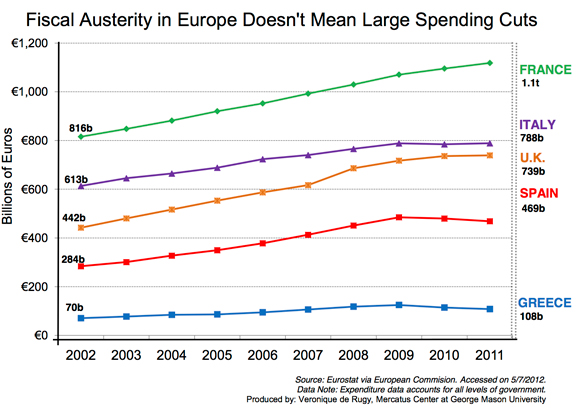
None of these “austerity” measures eliminated deficit spending, and none addressed the issue that’s driving all of Europe (and us) bankrupt, namely unwillingness to carry out structural reforms of the welfare state. The few tiny reforms that have been undertaken have been, as NRO’s Michael Tanner notes, ridiculously timid, and even those have been heavily weighted in future years. “So far, European governments haven’t even been willing to take a penknife to the welfare state, let alone an axe.” Plus a huge round of tax hikes:
It should come as no surprise that all those new taxes, combined with a lack of spending restraint, has threatened to throw Europe back into a double-dip recession. Is it any wonder that French, Greek, and British voters were anxious to “throw the bums out”?
Wait, this sounds familiar. Tax hikes on the rich accompanied by vague promises of future spending restraint, while refusing to restructure entitlement programs. That sounds a lot like . . . Barack Obama.
Actual austerity would mean (at a minimum) reducing spending to the amount of money actually taken in. As best I can tell, none of the PIIGS, or France, or the UK has undertaken such real austerity. That “severe” Greek austerity that just caused a change in government? It reduced Greece’s official deficit spending from 9.0% of GDP to 7.5% of GDP. They didn’t even want Greece to stop digging a hole, they just wanted them to dig more slowly.
I suspect that some 20-30 years hence, this mania for deficit spending will be seen as absolute madness, with future generations unable to fathom how politicians were so resolute in destroying their countries economies in order to maintain the welfare state, a folly for the ages. Hyperinflation is probably already baked into the Greek pie for its inevitable exit from the Eurozone, the only question is whether it will be Argentina 1999-2002 style hyperinflation, or Weimer Germany 1919-1923 style hyprinflation, and how much of Europe (and the rest of the world) will follow in their tracks.
Tags:austerity, Budget, Economics, Europe, European Debt Crisis, Eurozone, hyperinflation, Veronique de Rugy, Welfare State
Posted in Budget, Economics, Welfare State | 2 Comments »