Monty, the guy who does the Daily Doom over at Ace of Spades, is taking a break, which means that I have to do my own damn research step into the breach, so here a roundup of European Debt Crises news:
Archive for the ‘Welfare State’ Category
LinkSwarm For February 15, 2012
Wednesday, February 15th, 2012Time for another roundup of this and that:
Athens Burning
Monday, February 13th, 2012So the latest “final” bailout is agreed upon, the Greek parliament passes the austerity measured decreed by their German overlords like good little members of the Eurocratic elite, and for their troubles Greek citizens (whose input on the issue is neither required nor desired) responded to these events with widespread arson and looting.
Here are some protesters expressing their displeasure with austerity measures via the now-traditional medium of Molotov cocktails:
Who are we supposed to root for, the Eurocrats who turned a blind eye to Greece’s spendthrift ways when they let them join the Euro, the Greek bureaucrats who went on an orgy of unsustainable welfare state spending with Germany’s credit card, or the Greek citizens who happily sucked at the welfare state teat as long as Uncle Helmut was paying for it and are now throwing a hissy fit because mean Aunt Angela wants to ween them away? It’s like trying to decide between the pusher who stops giving away free heroin after ten years, or the junkie suddenly denied their fix: There are no heroes or sympathetic actors. Keep giving me my heroin or the Acropolis burns!
Other burning Euro issues:
As long as Germany wasn’t complaining, others could make free with Germany’s credit card. Once in the euro, Greece, Italy, Spain, and other countries that bankers used to consider reckless or unstable could borrow at the same rates. (The treaties that bound all these dissimilar countries together stipulated that there would be no bailouts for those who borrowed too much, but bankers obviously didn’t believe that.) A boom in lending pushed up wages and prices in those “peripheral” countries, rendering them uncompetitive. After the financial crisis of 2008, the countries that had overborrowed were saddled with more debt than they could comfortably repay. The eurozone’s Mediterranean members have come to think that Germany ought to rescue them. But the Germany to which they are addressing their petitions is not the penitent, diffident, and easily browbeaten land that they came to know over the last three generations. Germany has its own ideas about economics and morality, and it is ready to insist that its weaker neighbors adhere to them.
(snip)
The German public was dragged into the euro reluctantly and would never have consented to it had they been consulted. “The euro has always been the ‘Golden Calf,’ so to speak,” says Barclays’s economist Thorsten Polleit. “It was forced upon Germans.” There is still a lot of debate about how it was forced upon Germans. The most common explanation is that French president François Mitterrand insisted on the euro as a condition of Germany’s reunification. A number of Germany’s top politicians and economists assured citizens that the new currency would hold prices stable. That turned out to be right. They also promised that this would not mean sharing wealth and bailing out laggards. That turned out to be wrong—and perhaps catastrophically, apocalyptically wrong. In the late nineties, “many chief economists did a lot of client presentations where they told people the euro would be as stable as the German mark,” says Jörg Krämer, chief economist at Commerzbank. “I am quite happy I was young enough not to have had to do this.”
Read the whole thing.
Why the Tea Party Exists
Thursday, February 9th, 2012This piece by Dan McLaughlin encapsulates why the Tea Party exists, and why it has to fight a willfully heedless Republican establishment, so well that I’m going to quote whopping great chunks from it:
As anyone with a passing familiarity with Republican politics over the past four or five decades knows, conservative magazines and think tanks have been making detailed entitlement reform proposals for most of those years, and Republicans running for offices high and low have been running on platforms of reducing the size and cost of government for just as long. And then nothing happens.
That’s why Congress’ battles over the debt ceiling and related issues provide such a potent example. Basically all Republican Senators profess to be in favor of smaller government, and yet so few are willing to go to the barricades to make it a reality. Now, I’m a realist – there are limits to how much we could expect even a completely united GOP to bring home as long as Obama is the President and Harry Reid the Senate Majority Leader. But the repeated spectacle of leading pundits and Beltway Republicans tut-tutting Boehner and company for even trying to use their leverage to exact real concessions is a sign that the message Republican voters have been sending is not getting through to everyone.
(snip)
The related point here – and one that says much about why RedState has put so much energy into intra-party primary battles rather than the production of white papers – is that personnel is policy. The ideas are already there; what is lacking is the necessary corps of people with the will to fight for them.
(snip)
The point of my essay was not to denounce anyone, but to explain the history and depth of the current popular distrust on the Right of leaders who seem unwilling to lead. The battle to restrain runaway government spending is so much smoke and mirrors unless the people who profess to support it in word are dedicated to it in deed. No wealth of position papers, endorsements and Power Point presentations can demonstrate that. Voters and activists who have figured this out are rightly skeptical of those who don’t seem to “get it”. And they are more than willing to embrace flawed champions – even such a creature of the Beltway as Newt Gingrich – if they demonstrate the willingness to actually do something to stop the runaway train of federal spending. Every time some Beltway figure calls Newt or some Tea Party candidate crazy, voters think again, “he might actually be crazy enough to upset some applecarts to get things done.”
Read the whole thing.
(Hat tip: An American Housewife in London, more about which anon.)
EuroDoom Roundup: Waiting for the Inevitable Greek Default
Monday, January 30th, 2012You know the problem with doing one of these roundups on the European Debt Crises? I can search for “Euro” just about anytime of the day and night on Google News and come up with a dozen things I could potentially include. So just consider this a Whitman’s European Despair Sampler of possible bad news, as there’s a lot more where this came from:
LinkSwarm for January 26, 2012
Thursday, January 26th, 2012LinkSwarm, or EuroDoom? LinkSwarm, or EuroDoom? Well, the first link has some of each, but with Davos just starting up, I imagine their will be a nice helping of EuroDoom ready to serve tomorrow, so let’s put up a LinkSwarm today:
Hat tips: Ace, Insta, The Corner, and the usual suspects.
Going Down, Down, Down…
Friday, January 13th, 2012France’s credit rating, that is. “Standard & Poor’s has downgraded France’s credit rating, French TV reported Friday, while several euro zone countries face the same fate later in the day, according to reports.” Maybe because that “strict” 2012 budget France passed still had a budget deficit of 4.5% of GDP, despite the EU having a “limit” (in much the same way the Professional Wrestling has a “limit” on fouls) of 3.0%.
That would be the second largest economy in the Eurozone behind Germany, and the fifth largest in the world.
And the U.S. Federal Government’s 2012 budget deficit is running at about 6.9% of GDP…
EuroDoom Roundup for January 11, 2012
Wednesday, January 11th, 2012The race to a Euro-crackup seems to have slowed down to merely a jaunty saunter this week. Maybe once everyone made it to the New Year without a sovereign default, the Eurocrats might have breathed a sigh, confident that there’s still a few miles yet before they went over the falls…
Germany could create a parallel currency—a new D-Mark, pegged at 1.0 to the euro. The German government would guarantee that holders of German government bonds could convert euro securities to new-D-mark instruments on a one-to-one basis up to some designated date, perhaps two years in the future. Private German contracts expressed in euros would switch to new-D-mark claims over the same period. The transition would likely feature a period in which the euro and new D-mark circulate as parallel currencies.
Other countries could follow a path toward reintroduction of their own currencies over a two-year period. For example, Italy could have a new lira at 1.0 to the euro. If all the euro-zone countries followed this course, the vanishing of the euro currency in 2014 would come to resemble the disappearance of the 11 separate European moneys in 2001.
Of course, this would mean that any bonds from the PIIGS with a maturity date more than two years in the future would trade at a heavy discount, but that’s far preferable to the looming Euro crash. But a bigger problem to this proposal actually being implemented is that it reverses the drive to centralize European bureaucracy, and Eurocrats will never stand for that.
(Hat tips: Insta, Ace (most of the Greek stories), and Sundry.)
LinkSwarm for January 9, 2012
Monday, January 9th, 2012Like a squirrel hording nuts for winter, I’ve set aside a few tasty links for you to chew on:
Liberals have a rendezvous with regret. Their largest achievement is today’s redistributionist government. But such government is inherently regressive: It tends to distribute power and money to the strong, including itself.
Government becomes big by having big ambitions for supplanting markets as society’s primary allocator of wealth and opportunity. Therefore it becomes a magnet for factions muscular enough, in money or numbers or both, to bend government to their advantage.
[snip]
Not only does redistributionist government direct wealth upward; in asserting a right to do so, it siphons power into itself. A puzzling aspect of our politically contentious era is how little contention there is about the ethics of coercive redistribution by progressive taxation and other government “corrections” of social outcomes it considers unethical or unaesthetic.This reticence, in an age in which political reticence is rare, reflects the difficulty of articulating principled defenses of these practices. They go undefended because they are generally popular with a public that misunderstands their net effects and because the practices are the political class’s vocation today. The big winners from these practices are that class and the interests adept at collaborating with it.
Government uses redistribution to correct social outcomes that offend it. But government rarely explains, or perhaps even recognizes, the reasoning by which it decides why particular outcomes of consensual market activities are incorrect. When taxes are levied not to efficiently fund government but to impose this or that notion of distributive justice, remember: Taxes are always coerced contributions to government, which is always the first, and often the principal, beneficiary of them.
Call it The Dennis Moore Effect. “He steals from the poor, and gives to the rich…”
Hat tips: Real Clear Politics, Insta, Ace.
Slow Motion EuroZone Trainwreck Continues
Monday, December 19th, 2011It didn’t take long for cracks to start appearing among national politicians who are not nearly so sanguine over the prospect of Anschluss II as their counterparts in Brussels.
The French people are not wild about it either. But French politicians only pay slightly more attention to the French people than they do to the American government, which is to say: precious little.
The Portuguese threaten nuclear default.
Did the announcement calm markets elsewhere? Not so much:
Some of the world’s most powerful investment banks were downgraded by ratings agency Fitch as Germany’s cherished European fiscal compact appeared to be unraveling. The banks that were downgraded [Wednesday] night include US banks Bank of America and Goldman Sachs, Barclays and France’s BNP Paribas. Switzerland’s Credit Suisse and Germany’s Deutsche Bank were also cut.
Even France is in danger of a downgrade.
Of course, all this supposes that the new EuroPact will actually accomplish something. Fitch Ratings is not so sure. After warning of rating downgrades on “Belgium, Cyprus, Ireland, Italy, Slovenia and Spain,” they come to the bracing conclusion that “a ‘comprehensive solution’ to the eurozone crisis is technically and politically beyond reach.”
And now for the section of the roundup in which I quote whopping large chunks of Ambrose Evans-Pritchard on the whole thing.
First, the EU would like the UK to throw more money into the black hole. The UK is telling them to get stuffed:
Euro rage is reaching new heights over Britain’s latest outrage.
Our refusal to pony up a further €31bn we cannot afford, to prop up a monetary union that was created against our wishes and better judgment, and with the malevolent purpose of accelerating the great leap forward to a European state that is inherently undemocratic.
It is being presented as treachery, Anglo-Saxon perfidy, and the naked pursuit of national self-interest.
Let me just point out:
1) The UK never agreed to such a commitment in the first place. The line was written into the December 9 summit communiqué in an attempt to bounce Britain into handing over the money.
2) The UK does not consider the rescue machinery to be remotely credible as constructed.
3) The eurozone has the means to tackle its own debt crisis, if it is willing to use them. These include fiscal pooling and the mobilisation of the ECB.
As eurozone politicians never tire of reminding us, their aggregate debt levels are lower than those of the UK, US, or Japan. They are right. So get on with it and stop begging.
Euroland is of course entitled not to deploy eurobonds or the ECB if these mean a) a breach of the German constitution b) violate the ECB’s mandate. But that is entirely their choice. Both the Grundgesetz and the ECB mandate can be changed.
It was EMU members who created this dysfunctional currency. They are now trying to shift the consequences of their error onto others rather than taking the minimum steps necessary to fix the problem at root.
Second, his pointing out that the proposed treaty actually accomplishes very little:
The leaders of France and Germany have more or less bulldozed Britain out of the European Union for the sake of a treaty that offers absolutely no solution to the crisis at hand, or indeed any future crisis. It is EU institutional chair shuffling at its worst, with venom for good measure.
[snip]
And what for? All this upheaval for a mess of pottage, a flim-flam treaty? The deal is not a “lousy compromise”, said Angela Merkel. Well, actually that is exactly what it is for eurozone politicians searching for a breakthrough.
It tarts up the old Stability Pact without changing the substance (although there will be prior vetting of budgets). This “fiscal compact” is not going to make to make the slightest impression on global markets, and they are the judges who matter in this trial by fire.
Yes, there is more discipline for fiscal sinners, but without any transforming help. Even the old “Marshall Plan” of the July summit has bitten the dust.
There is no shared debt issuance, no fiscal transfers, no move to an EU Treasury, no banking licence for the ESM rescue fund, and no change in the mandate of the European Central Bank.
In short, there is no breakthrough of any kind that will convince Asian investors that this monetary union has viable governance or even a future.
Germany has kept the focus exclusively on fiscal deficits even though everybody must understand by now that this crisis was not caused by fiscal deficits (except in the case of Greece). Spain and Ireland were in surplus, and Italy had a primary surplus.
As Sir Mervyn King said last week, the disaster was caused by current account imbalances (Spain’s deficit, and Germany’s surplus), and by capital flows setting off private sector credit booms.
The Treaty proposals evade the core issue.
Ironically, the actual text of the new agreement has all sorts of things (like requiring a Balanced Budget Amendment to national constitutions) that, had it been in place and enforced 15 years ago might have prevented the situation in the first place. But if the nations of Europe had been capable of balancing their budgets, they wouldn’t have needed a Euro-fueled spending spree to keep their welfare states solvent in the first place.
For the PIIGS, growth is neither possible nor enough: “There is at this point no conceivable policy scenario which somehow makes Italy and Greece grow by as much as 2% a year for the next few years.”
Fed says no Euro bailout. But one might wonder at the firmness of their resolve. Especially since the head of the IMF says they need funds from outside the EU. Because who doesn’t love throwing good money after bad?
European bank walks are starting to turn into bank jogs.
Gold prices have plunged since the Euro treaty was announced. A sign the worst has passed? No, quite the opposite: Europe’s banks are selling their gold reserves in an attempt to stay solvent.
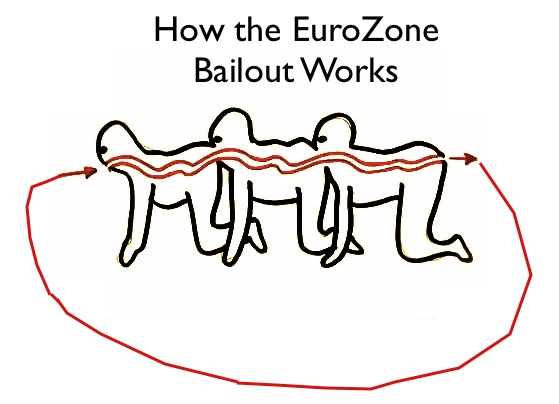
Let’s see if I’ve got this straight: EuroZone members, threatened by sovereign default on their bonds, are giving money backed by those same bonds to the IMF, which will use the money to prop up the EuroZone in order to prevent EuroZone countries from defaulting on their bonds. In order to help readers understand the genius of this maneuver, I have slightly altered a graphic from a recent movie to explain the concept:
(Hat tips: Insta, Ace, and The Corner, plus no doubt a few I’ve forgotten.)