Though markets have calmed a bit, the desperate search for a lever that will actually steer Europe away from the looming wall of a EuroCrash continues. Meanwhile, certain repeating motifs are detected:
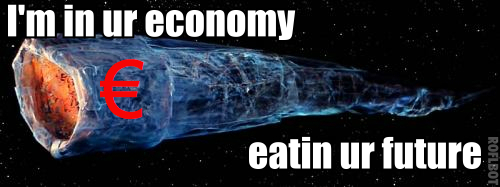
“Now that times are bad, the single currency has turned into an unbridled doomsday machine. Merkel continues to insist that she’ll do whatever it takes to save Europe’s “destiny”. The continued insistence on fiscal austerity and debt repayment tells a different story. Is Germany really prepared to bankroll a wider monetary union by putting its money where its mouth is, or is the game finally up?”
Europe now has the lowest growth of any region in the world. We have already wasted years in trying to control this sickness in the euro, and we are saving the cancer and killing the patient. We have blighted countless lives and lost countless jobs by kidding ourselves that the answer to the crisis might be “more Europe”. And all for what? To salvage the prestige of the European Project, and to spare the egos of those who were wrong and muddle-headed enough to campaign for the euro.
Johnson is right about the cancer, but slightly wrong about the cause: The European cradle-to-grave welfare state is the cancer; the Euro just made it slightly more malignant.
But with two separate commentator’s calling the Euro a Doomsday Machine, I feel a new meme coming on:
Not to mention much better chances of being linked by Jonah Goldberg and James Lileks…
Greece is happy to stay in the Euro…as long as other countries are footing the bill. They want more subsidies and an end to even the #fakeausterity. Not only do they want to continue to dig their deficit spending grave, they insist on digging it as fast as possible. How to get Germany to agree to continue footing the bill is the one flaw in their otherwise cunning plan…
Why the Blue State model doesn’t work: Cheap money doesn’t mean welfare states balance their budgets, it just means they spend that much more:
Greece, Spain, Ireland, Portugal and Italy (and California). In each case, the promise of more bailouts and a steady flow of cheap money only produced more reckless behavior, excessive levels of government spending and record levels of debt.
Johan Norberg, a senior fellow at the Cato Institute, summarizes the results: “From 1997 to 2007, government expenditures increased by around 6 percent annually in Spain, Portugal and Greece, while population remained mostly stable. Spending increased by 4 percent a year in Italy — even while the economy shrank.”
Consequently, “Between 2000 and 2010, Portugal increased its public debt as a share of GDP from 49 percent to 93 percent, France from 57 percent to 82 percent, Italy from 109 percent to 118 percent, and Greece from 103 percent to 145 percent,” reports Norberg.
The European crisis is as much a crisis of politics as economics. The current paralysis of the Greek political system demonstrates the point very clearly. EU policy has actively contributed to this crisis by effectively sealing off discussion of the political problems thrown up by austerity.
Budgetary policy is at the core of traditional democratic politics in Europe but the management of the euro zone is increasingly being effected not through democratic institutions but via a centralised and depoliticised form of technocratic fiat. The “stability” narrative has triumphed over the need for legitimacy as the crisis in Europe has deepened.
Ivan Krastev, the eminent political scientist, argues that we have now arrived at a point where national governments have politics but are no longer in control of policy, including budgetary policy, which is moving via the fiscal treaty and other measures to the EU level.
On the other side of this divide the European Union has policies but no politics, since decisions are increasingly being made by technocratic managers rather than directly elected representatives of the European public. The euro zone crisis has thus amplified an existing problem – the absence of both a European citizenry and a transparent European level political process.
A long meditation on what a Greek exit would mean involving Frankenstein, Old Maid, and David Brin.
The EU sends inspectors to find out why Spain’s deficits are so high. Offhand I would say the solution to the mystery might be “because they’re spending more money than they’re taking in.” Obviously such thinking will never get you anywhere in the EU civil service…
Chances are good that Europe’s interesting Eurozone times are about to get more interesting still with elections scheduled across the continent today, including those in France and Greece. So what does all this mean? Well, for one thing, the French socialist candidate (who has a good chance to kick Nicolas Sarkozy out of office) wants to renegotiate the fiscal discipline treaty. Perhaps even a socialist can tell a rotting fish when he smells one. And in Greece, the anti-bailout parties are expected to make dramatic gains at the expense of the “center-right” New Democracy (Tweedledee) and “center-left” Pasok (Tweedledum) parties who managed to bring Greece to this lovely pass in the first place.
Opposing Tweedledee and Tweedledum are a motley collection of small parties, including the Neo-Nazi Golden Dawn. Now in Europe, everyone to the right of the Christian Democrats seems to be labeled a “neo-Nazi,” be they libertarians, Geert Wilders, or the British National Party, but Golden Dawn appears to be the real thing. Take a look at their flag:
The overall color scheme seems vaguely familiar. Where have I seen that before? Let me think…
Of course, Golden Dawn is unlikely to gain enough votes to be a real player in the Greek parliament, so we may be denied the irony of seeing neo-Nazis oppose Greece’s German overlords.
There are also elections in Serbia and Armenia, lower level elections in Italy, and in Germany, regional elections in Schleswig-Holstein. While “regional elections in Schleswig-Holstein” must be almost as exciting a topic to American readers as enhanced rescission authority, it might go a long way toward determining whether Angela Merkel will continue in her role as Europe’s Sugar Momma Dominatrix.
Could the ruling parties lose everywhere? Well, since the ruing parties have collectively lost every single election since 2009, yeah. Now, whether the Eurocratic elite are will to let a little thing like “democracy” derail their dreams for an integrated Europe remains to be seen.
With government debt expected to hit 80% of GDP by the end of 2012, Spain has become like a family with a big mortgage where the primary breadwinner has lost his job. Unless they find a way to increase their income, they are going to go bankrupt. It is only a matter of time.
If people want to know what life looks like in the “Prohibitive Range” of the Laffer Curve, all they have to do is to visit Athens. Greece is literally falling apart. Unfortunately, by raising taxes, Spain is making exactly the same mistake that the Greeks made.
Of course, whatever the outcome of today’s elections are, we can be pretty sure they won’t do the one thing that might help get them out of the crises: rolling back the European welfare state.
The a persistent drumbeat among American liberals that in Europe austerity has failed. This is a myth. In fact, it’s never been tried.
I have a few major posts in various stages of gestation, so here’s a LinkSwarm to tide you over in the meantime:
Mark Steyn on our heroic Secret Service agents: “It’s not just the entitlements. Everywhere you look in the bloated federal Leviathan, all is waste, all is excess. But the absurd imperial presidency is a good place to start. The next citizen-executive of this republic would be sending a right message were he to halve the motorcade, halve the security detail, halve the hookers.”
Does Obama have an $8 billion slush fund to soften the impact of cuts to the Medicare Advantage program until after the election? (Hat tip: Alphecca.)
Pew Survey: GOP-sympathizers are better informed, more intellectually consistent, more open-minded, more empathetic and more receptive to criticism than their fellow Americans who support the Democratic Party.” (Hat tip: Alphecca.)
Borepatch reports on the Dallas Blogshoot. I was too busy and it was a bit too long of a drive for me to make. Which is a shame, since I would have liked to try some of the machine guns, and the .50 cal. Bonus: Ponies!
How the story of today’s media transformation is being written by the losers: “We should not expect anything like impartial analysis from people whose very livelihoods—and those of their close friends—are directly threatened by their subject matter.”
Want a glimpse of where health care is headed if ObamaCare isn’t repealed or overturned? In the UK, doctors told a woman to find another provider because her carbon footprint to visit them was too large. All two miles of driving worth. (Hat tip: Say Uncle.)
The word, in this case, is “moderate,” which seems to be particularly tricky to define. Especially when it comes to Middle Eastern political parties. Since you can support Hamas and promise to wipe Israel off the map and still be considered “moderate”…
A left-wing Irish documentary maker sets out to make a documentary about the plight of the Palestinians, but gets waylayed by those annoying facts, and instead decides to tell both sides of the story. Guess what? His friends aren’t interested. “The problem began when I resolved to come back with a film that showed both sides of the coin. Actually there are many more than two. Which is why my film is called Forty Shades of Grey. But only one side was wanted back in Dublin. My peers expected me to come back with an attack on Israel. No grey areas were acceptable.”
Israel and Hamas declare a ceasefire after four days of fighting. Honestly, maybe because I was traveling, or because I no longer feel the need to consult MSM news sources on a daily basis, I was actually unaware that there was slightly more violence than usual in the Middle East. The fact that Hamas cried uncle after a mere four days, despite the fact that Israel set it off by giving Hamas leader Zuhair al-Qaissi an express ticket to paradise, tells you that they must really have been getting their asses kicked by the IDF. Maybe Zuhair al-Qaissi really was important, or possibly Iran and Syria have had their hands too full to dole out the Qassam rockets with their customary generosity.
It turns out that Greece forcing haircuts on recalcitrant bond holders via the “Collective Action Clause” automatically triggers credit default swaps, the financial instruments that helped bestow such laughter and joy unto the world economy in 2008. There’s such a fine line between “bankrupt” and “solvent.”
But thanks to the rest of the EuroZone ponying up money to keep Greece solvent, Greece’s national debt will decline…from 120% of GDP, to a tiny, minuscule, almost-impossible to see 117% of GDP. In 2020. You know, the same year I’ll be enjoying a regular threesome with Olivia Wilde and Megan Fox.
But the bailout is accomplishing its primary goal: Keeping the whole thing from collapsing while Eurocratic insiders get to pretend everything is OK long enough to dump their losses onto taxpayers and continue to milk the rubes just a little bit longer.
And there’s already talk of another bailout being necessary before the ink on this latest batch of fiat Euros was even dry. A new record!
Monty, the guy who does the Daily Doom over at Ace of Spades, is taking a break, which means that I have to do my own damn research step into the breach, so here a roundup of European Debt Crises news:
And the Greeks, in turn, pass “tough spending cuts”. Presumably those “tough cuts” would be the ones reducing the annual budget deficit from 9% to 7.5% of GDP. They’re don’t even require Greece to stop digging, they just want them to dig slower. And even that assumes that such cuts will actually be implemented.
Among the austerity measures were a reduction in the minimum wage, including a 22% cut on the standard minimum monthly wage of 751 euros, and a 32% for those under 25. A good idea and necessary, but once again the sons are paying for the sins of the fathers.
Unions, realizing their role in helping bankrupt Greece, have meekly accepted the cuts. Ha, just kidding. They’re going on strike.
Following the downgrade, the European Central Bank announced that they would stop taking Greek debt as collateral, at least until the new Greek bailout package goes into effect.
Germany is thinking of sending German tax collectors to Athens. I’m sure it’s impossible that Greeks would take this in the wrong way.
Speaking of Germany, their high court has ruled yet again that a parliamentary panel set up to approve action by the euro zone bailout fund is unconstitutional.
Portugal is also digging more slowly, having cut its budget deficit from 5.9% of GDP last year to 4.5% this year. Meanwhile, it’s economy also contracted by 3.3%.
The Finns are in, supporting the Greek bailout to the tune of 2.3 billion Euros.
Ireland is actually allowing its citizens to vote on the European stability treaty. Of course, if they vote no, expect them to have to keep voting until they ratify the result the Eurocrats have already chosen for them.
Seeking Alpha makes the obvious point that you don’t want to hold any of the PIIGS sovereign debt. I would go further and suggest that you don’t want to hold any sovereign debt denominated in Euros…
So who, above all, wants to avoid a Euro default among the PIIGS? Would you believe Goldman Sachs? “At the end of 2011, Goldman Sachs had sold $142.4 billion of single-name swaps, contracts that pay out in the event of a default, on the five countries.” That’s an awful of of incentive to keep the game running until all the rubes taxpayers can be fleeced…
Even big-spending, welfare state cheerleader and all-around leftwing mouthpiece Paul Krugman thinks Greece will have to leave the Euro. So it only took two years for Krugman to come part of the way toward realizing what what Mark Steyn did two years ago. Of course, Krugman’s analysis is short term and technical, whereas Steyn saw the unsustainable nature of the welfare state a long time ago. Do you think Kurgman might want become a bit less of a cheerleader for big government? I wouldn’t hold your breath…
Spain balks at letting their government reduce spending by 4%of GDP. Problem: Their annual budget deficit is 8% of GDP. That’s the problem when you get that far down the hole to serfdom: Even slowing the digging becomes unacceptable, much less stopping…
“Decades of cradle-to-grave socialism, a short work week and long vacation periods for European Union workers have taken a toll on the treasuries of the nation states. The good life lived in Europe without a thought of tomorrow has brought on these days of reckoning. Greece is an example of the limits of a European welfare state.”
What would a real solution to Greece’s problems look like? “They must roll back bureaucracy, free up entrepreneurs and reduce the burden of the welfare state, so that the private sector can begin to grow….Regrettably, this is not the approach that has prevailed so far. Indeed, as things stand a whole host of European Union and European Central Bank policies are pushing things in precisely the opposite direction.”
American liberals love to talk about Northern Europe’s welfare states, but don’t like mentioning Southern Europe. “For all their fascination with Europe, southern Europe doesn’t loom large for the American Left. But France, Italy, Spain, Belgium, Portugal and Greece are more representative of European outcomes than Sweden, Denmark, and Finland, and have equally sized welfare states. Their failure should not be ignored in the American debate.”
Well, ain’t that a pisser. “‘European solidarity is not an end in itself and should not be a one-way street. Germany’s engagement has reached it limits,’ said the text, drafted by Chancellor Angela Merkel’s Christian Democrats and Free Democrat (FDP) allies.”
Has Germany’s willingness to throw bad money after good to bail out wastrel Greece’s unsustainable welfare state finally reached an end? Maybe. Or maybe Merkel is angling for more leverage over Greece to force them to cough up some more sovereignty, or even to (fat chance) actually implement austerity measures rather than just give them lip service. But without Germany, the IMF isn’t going to cough up, and without the two of them, there probably isn’t enough in the kitty to finance even the latest round of Greek bailout, much less the larger fund needed to staunch the contagion once the Greek default dominoes start tumbling.
The game of musical chairs may finally be reaching its end.
Greek bureaucrats in their Social Security office stage a walk-out. Now if all government employees went on strike and stayed there, they might just have a chance…
Want to know exactly how the Greek debt bond swaps will proceed? Me neither, but here it is anyway. Just part of full-service blogging, Ma’am….
Spain’s housing market makes ours look healthy by comparison. “Repossessed houses in Spain are valued at 43 percent less on average than the appraisals on the mortgages.”