Mexico has long suffered from drug cartel violence, at least since the demise of Colombian cartels in the 1990s. Various cartels seem to hold sway over different parts of Mexico, as tracked by this fairly up-to-date map from Wikipedia, the source of all vaguely accurate knowledge.
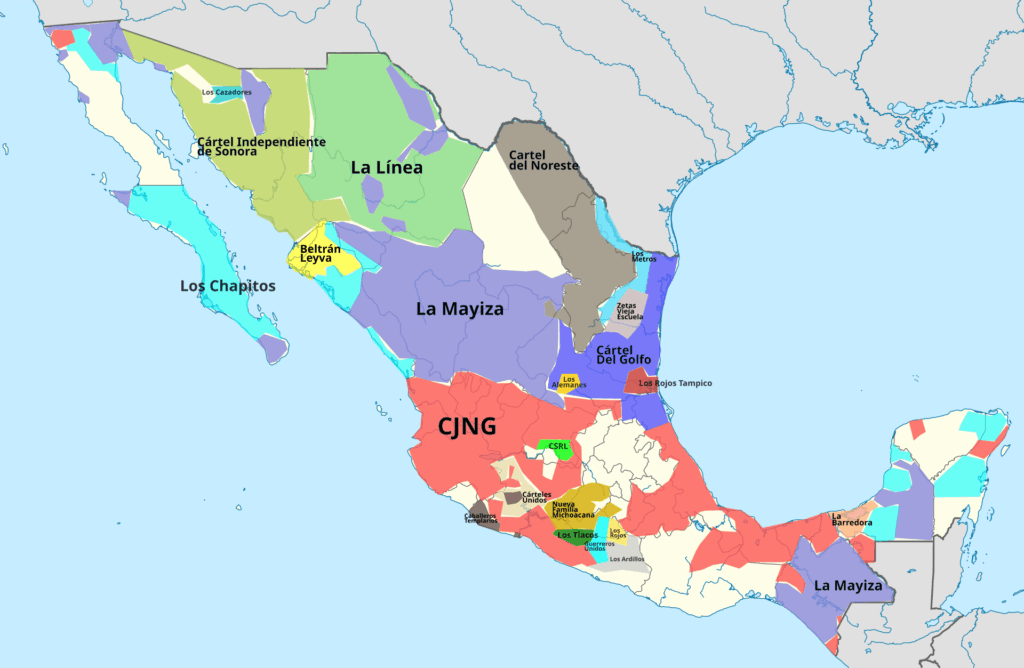
Half of those cartels I’ve never even heard of.
Ordinary Mexican citizens have regularly put up with levels of violence and government dysfunction that no American citizens (well, aside from those in deep blue cities who keep voting for that very thing) would put up, partially because of widespread belief that both Mexico’s government, and PRI and PAN, are in the pockets of the cartels. But that might finally be changing.
Thousands of demonstrators marched in the Mexican capital on Saturday to protest against violent crime and President Claudia Sheinbaum’s government.
I just want to observe how unlikely “Claudia Sheinbaum” is for the name of a Mexican president.
Sheinbaum said the marches, which also took place in other cities, had been funded by right-wing politicians who oppose her government.
The rally was organised by Gen Z youth groups, drawing support from citizens protesting against high-profile killings, including the assassination just weeks ago of Uruapan Mayor Carlos Manzo – who had called for tough action against cartels.
Demonstrators dismantled parts of a barrier protecting the National Palace, where Sheinbaum lives. Police protecting the compound used tear gas on the crowds.
Authorities have arrested 20 people for crimes including robbery and assault, Mexico City security chief Pablo Vazquez told reporters.
Protesters waved banners displaying messages including “We are all Carlos Manzo”, while others wore cowboy hats in tribute to him.
This isn’t the first protest against cartel violence, but it may be the first to reach the center of government.
Manzo was shot on 1 November while he attended a Day of the Dead festival.
He was known for speaking openly about drug-trafficking gangs in his town and cartel violence.
He had been demanding tough action against armed cartel members who terrorise the country.
The cartels are not shy about murdering their critics in Mexico, frequently with a considerable bit of torture first.
And of course, the whole point of the cartels is to export drugs into the lucrative market of the United States. Here’s a story from Houston today.
With the help of a vast network of local distributors in the United States and two of his trusted men, Nemesio Oseguera Cervantes, “El Mencho,” who has continuously led the Jalisco New Generation Cartel (CJNG), transformed Houston, Texas, into a drug distribution hub serving five U.S. states.
A court document obtained by MILENIO details how the network was established six years ago from the Jalisco cartel’s headquarters in Mexico, through an alliance with the Gulf cartel, which has dominated the drug corridor originating in Houston.
U.S. investigations reveal that since 2019, the CJNG has expanded into Houston to significantly increase the distribution of cocaine, methamphetamine, heroin, and fentanyl to other Texas cities, such as Galveston, and other locations like New Orleans, Louisiana; Pensacola, Florida; and Atlanta, Georgia. Nashville, Tennessee, and Chicago, Illinois.
El Mencho didn’t arrive alone. In addition to a vast network of local distributors, two of his most trusted men in Mexico built the prolific network that generates millions of dollars in profits and which, to this day, remains at the center of investigations initiated with Operation Rainmaker, by the Department of Justice (DOJ) and the Drug Enforcement Administration (DEA).
The case reviewed by MILENIO focuses on Gerardo Villarreal Martínez, a Mexican-American aligned with the CJNG, arrested last year. He came to the attention of Houston authorities in 2019 after becoming involved in El Mencho’s network, which included 40 other people, most of them based in Texas.
According to the indictment, the CJNG network operates through small distribution cells in the Houston area. Roque Zamudio Mendoza, another of the accused, was in charge of coordinating the distribution of drug shipments arriving from Mexico. Today he is a fugitive. He is presumed to be hiding in Mexico. Fifteen other defendants are also fugitives.
After hundreds of wiretaps of Villarreal’s phone calls, it was determined that he had contact with the highest levels of the cartel. His distributor in Mexico was Itiel Palacios García, alias El Compa Playa, who in turn coordinated directly with El Mencho and one of his main lieutenants, Audias Silva Flores, alias El Jardinero.
The DEA gathered enough evidence to request his arrest for drug trafficking on March 26, 2024.
On April 3 of that year, he appeared in court in Galveston, Texas, for his detention hearing. Agent Emerson testified that Villarreal should be held in pretrial detention pending trial on 12 counts of money laundering and drug trafficking.
And that’s just one story plucked today.
It would be great if the Mexican people were finally rising up against drug cartel tyranny, but I’m not holding my breath…
Tags: Carlos Manzo, Cartel Del Noreste, Claudia Sheinbaum, corruption, Crime, drug war, drugs, Foreign Policy, Gerardo Villarreal Martinez, Houston, Mexico, Mexico City, Nemesio Oseguera Cervantes AKA "El Mencho", New Generation drug cartel, Sinaloa Drug Cartel, Texas
“I just want to observe how unlikely ‘Claudia Sheinbaum’ is for the name of a Mexican president.”
She is no less “Latin” than Austrian Archduke Ferdinand Maximilian and seems to be equally popular.
Mexican drug cartels have the lion’s share of the US illicit drug trade–$150 billion, which is significantly larger than the $65 billion remitted to Mexico by “guest workers”.
The Mexican government opposes any US legislation that would impede these remittances. How enthusiastic could they possibly be about curbing the much more lucrative drug trade?
Mexicans labor in the US because too few good jobs exist in Mexico. The best paying jobs are created by the drug cartels. To solve both problems would require radically restructuring the economy by privatizing PEMEX, the state owned oil company and expanding from there.
However, this would lead to cries of “Yanqui Imperialism” when US oil companies buy up PEMEX shares.
So the problem seems to be ineradicable.
In the last two decades, there have been a half-million homicides In Mexico with as many as 50% of them attributed to cartel violence. This seems like a high price to pay for socialized industry but one the Mexicans seem willing to accept.
So yeah, the resistance to narco-tyrrany will be short lived.
If these anti-cartel/anti-government protests show any sign of being a real threat to the cartels and the government, you can expect violence against them, from both the government and the cartels (shudder). It’s hard to imagine what kind of popular movement could succeed in ousting both in Mexico.
I would have said the same thing about El Salvador before Bukele took over there, but I think Mexico will be a tougher nut.
Claudia Sheinbaum’s family and relatives will be murdered by the drug cartels if she decides to move against them.
Everybody knows this
This is why nothing will be done to bring the cartels to heal.
Also, of course, much (most?) members of the Mexican govt. are on the take from the cartels or realize that speaking against them is suicide . .
The drug cartels are not merely criminal organizations; they are organized, heavily armed, very well funded and very numerous insurrectionists .
For all intents and purposes they are in fact one side of civil war in Mexico.
And they are winning.
And they will keep winning because they are willing to use any and all means to stay in power.
For the legitimte “Mexico” to “win,” it will have to decide to use any and all means to kill or imprison the insurrectionist drug cartels. Mexico would have to impose martial law and treat the “enemy” as foreign military invaders.
And in doing so, take no prisoners.