Pretty much what you’d expect…
Posts Tagged ‘video’
Game of Thrones: Libertarian Edition
Saturday, August 5th, 2017Every TED Talk Ever
Saturday, July 29th, 2017Want to give a TED Talk? This video shows you how!
(Hat tip: Borepatch.)
LinkSwarm for July 28, 2017
Friday, July 28th, 2017Supposed to hit 104° in Austin today, and 106° tomorrow. Try to keep your cool…
In early March [Imran’s] wife, Hina Alvi, suddenly left the country for Lahore, by way of Doha, Qatar. Notwithstanding the return flight she booked for a date in September 2017, the FBI believes that she actually has no intention to return to the U.S. She had abruptly pulled the couple’s three daughters out of school without alerting the school’s staff, and brought them with her — along with lots of luggage and household goods — to Pakistan.
(Hat tip: Instapundit.)
Steyn also notes: Why worry whether Vladimir Putin gave the DNC emails to Wikileaks when Debbie Wasserman Schultz just gave Imran Awan her DNC iPad password? (Hat tip: Director Blue.)
Donald Trump, Jr. appears to be the latest figure in President Donald Trump’s inner circle to be caught in the giant web of the Great Kremlin Conspiracy. Trump the younger said he was promised dirt on Hillary Clinton, but that all he got in his June 2016 meeting with a Russian lawyer was an earful about dropping the Magnitsky Act, which sanctions Russian officials involved in the death of a Russian lawyer who was killed in detention.
If the Trump, Jr. meeting is just another chapter in the Beltway telenovela about Trump selling out America to the Russians through an ever-changing cast of supposed intermediaries—come back, Mike Flynn and Carter Page, we hardly knew ye—it sheds valuable light on the ways and means by which the news that fills our iPhone screens and Facebook feeds is now produced. You see, the Russian lawyer—often carelessly presented as a “Russian government lawyer” with “close ties to Putin”—Natalia Veselnitskaya, who met with Trump, also worked recently with a Washington, D.C. “commercial research and strategic intelligence firm” that is also believed to have lobbied against the Magnitsky Act. That firm, which also doubles as an opposition research shop, is called Fusion GPS—famous for producing the Russia dossier distributed under the byline of Christopher Steele, a former British intelligence agent for hire.
Steele’s report, a collection of anonymously-sourced allegations, many of which were said to come from “high-ranking former Russian government officials”—i.e. not exactly the kinds of people who seem likely to randomly shoot the shit with ex-British spooks—detailed Trump’s ties to Russian officials and strange sexual obsessions. Originally ordered up by one of Trump’s Republican challengers, the dossier circulated widely in D.C. in the months before the 2016 election, pushed by the Clinton campaign, but no credible press organization was able to verify its claims. After Clinton’s surprise loss, the dossier became public, and it’s claims—while still unverified—have shaped the American public sphere ever since.
Yet at the same time that Fusion GPS was fueling a campaign warning against a vast Russia-Trump conspiracy to destroy the integrity of American elections, the company was also working with Russia to influence American policy—by removing the same sanctions that Trump was supposedly going to remove as his quid pro quo for Putin’s help in defeating Hillary. Many observers, including the press, can’t quite figure out how the firm wound up on both sides of the fence. Sen. Chuck Grassley wants to know if Fusion GPS has violated the Foreign Agents Registration Act.
As the founders of Fusion GPS surely understand, flexibility is a key recipe for success—and the more room you can occupy in the news cycle, the bigger the brand. After all, they’re former journalists—and good ones. Fusion GPS is the story of a few journalists who decided to stop being suckers. They’re not buyers of information, they’re sellers.
Snip.
For the past seven years, I’ve reported on and written about American foreign policy and what I saw as troubling trends in how we describe and debate our relationship to the rest of the world. What I’ve concluded during that period is that the fractious nature of those arguments—over the Iran Deal, for instance, or the war in Syria, or Russia’s growing role in the Middle East and elsewhere—is a symptom of a problem here at home. The issue is not about this or that foreign policy. Rather, the problem is that the mediating institutions that enabled Americans to debate and decide our politics and policies, here and abroad, are deeply damaged, likely beyond repair.
The shape of the debate over the Joint Comprehensive Plan of Action illustrated this most clearly. The Obama White House turned the press into an instrument used not only to promote its initiatives, but also to drown out and threaten and shame critics and potential opponents, even within the president’s own party. Given the financial exigencies of a media whose business model had been broken by the internet, mismanagement, and the rise of social media as the dominant information platform, the prestige press sacrificed its independence for access to power. If for instance, your beat was national security, it was difficult at best to cross the very few sources of power in Washington that controlled access to information. Your job depended on it. And there are increasingly fewer jobs in the press.
Read the whole thing.
The Afghan Taliban has overrun three districts previously held by the Afghan government in the provinces of Paktia, Faryab and Ghor over the past several days. The Taliban is demonstrating that it can sustain operations in all theaters of Afghanistan. The three districts are located in three different regions of the country.
The district of Jani Khel in Paktia, a known stronghold of the Haqqani Network – the powerful Taliban subgroup that is based in eastern Afghanistan and in Pakistan’s tribal areas – fell to the Taliban earlier today after several days of heavy fighting, according to Afghan officials and the Taliban. Taliban spokesman Zabihullah Mujahid said that the district headquarters buildings, the police headquarters and all security checkpoints are under his group’s control. Fighting is underway at a nearby military base.
Jani Khel was effectively under Taliban control. At the end of March, the group claimed that all but six percent of the district, including the district center, was under Afghan government control.
The districts of Taywara in Ghor in central Afghanistan, and Kohistan (or Lolash) in Faryab in the northwest fell to the Taliban on July 23 after several days of fighting. TOLONews confirmed that the two districts are now Taliban controlled and “government forces have not yet launched military operations to re-capture these districts.”
The Taliban has also claimed it seized control of Pusht Koh in Farah province and Guzargah in Baghlan, however the reports cannot be independently confirmed. However Taliban reports on the takeover of districts have proven accurate in the pasts.
The loss of the three districts shows that the Taliban is capable of conducting operations in all regions of the country. Even as the three districts fell, the Taliban is on the offensive in all of the other regions. Afghan security forces, which are sustaining record highs in casualties and desertions, is largely on the defensive in most areas of the country.
(Hat tip: Stephen Green at Instapundit.)
Because the District’s good-reason law merits invalidation under Heller regardless of its precise benefits, we would be wasting judicial resources if we remanded for the [lower] court to develop the records in these cases. … We vacate both orders below and remand with instructions to render permanent injunctions against enforcement of the District’s good-reason law.
USS Gerald R. Ford Commissioned
Monday, July 24th, 2017On Saturday, President Donald Trump helped commission the USS Gerald R. Ford, a new aircraft carrier and the first of her class.
The Ford is the first complete carrier redesign since the launch of the Nimitz class in 1975. The Ford has a number of innovative features that distinguish it from Nimitz-class carriers:
Here’s a video of President Trump praising the ship’s namesake President and his naval career.
Here’s President Trump’s entire speech:
Here’s Captain Richard McCormack talking about the Ford’s shakedown cruise and the ship’s many innovations:
Here’s a video showing EMALS being tested:
The next Ford-class aircraft carrier, the USS John F. Kennedy (CVN-79, not to be confused with the previous, already decommissioned USS John F. Kennedy (CV-67) aircraft carrier, the US Navy’s last non-nuclear carrier) has already been laid down, and is scheduled to begin sea trials in 2018 and commissioned in 2020.
Note that in his speech, President Trump called for a 355-ship, 12-carrier navy, which has lead to some talk of bringing the non-nuclear USS Kitty Hawk out of retirement. I think that’s unlikely, though stranger things have happened…
Girls Und Panzer
Sunday, July 23rd, 2017Well, how on earth did I miss this?
Oh, Japan, don’t ever change…
The State of the War Against the Islamic State
Thursday, July 13th, 2017The coalition of forces fighting the Islamic State continue to make steady advances on a number of fronts:
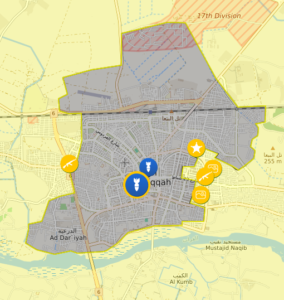
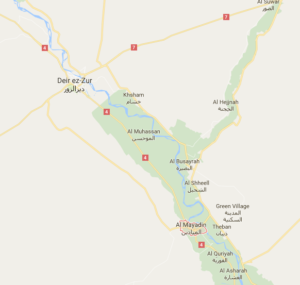
Under President Obama, U.S. Army Special Forces assigned to Syrian Democratic Forces needed special approval from Washington for virtually all tactical moves amid the politically complex theater of Americans, Arabs, Kurds, Turks and Syrians.
In Tabqa, where the city, its dam and its airfield were the objectives, the Green Berets decided they needed an airlift. Suddenly minus red tape, Arabs, Kurds and Americans were helicoptering into battle, and they quickly seized territory.
Under Mr. Obama, Islamic State terrorists could at times retreat from towns, immune from airstrikes if they used civilians as cover. The battle for Manbij in August became infamous when the SDF let 200 Islamic State fighters turn in their weapons and escape because they had threatened to kill town residents if they were not allowed to run away.
The new Trump strategy calls for surrounding towns, as opposed to pushing from one end or one side to another, in order to isolate Islamic State fighters and annihilate them.
Brett H. McGurk, special U.S. envoy to the coalition against the Islamic State who performed the same role for Mr. Obama, talked of “the delegations of authority which has made a difference in terms of the speed of execution. I think Tabqa was an example of that.”
“Our military people on the ground saw an opportunity to kind of surprise ISIS with a helicopter, moving them by helicopter, surprise them from behind and seize the airport, the dam and the town,” Mr. McGurk later told reporters at the Pentagon.
After Tabqa’s liberation, Mr. McGurk spoke to the city’s mayor, who gave a brief description of the war of annihilation.
“He also said he believes that most of these foreign fighters are now dead,” the diplomat said.
Mr. Mattis said: “No longer will we have slowed decision cycles because Washington, D.C., has to authorize tactical movements. I’ll leave that to the generals who know how to do those kind of things. We don’t direct that from here. They know our intent is the foreign fighters do not get out. I leave it to their skill, their cunning, to carry that out.”
House-by-house clearing in Raqqa:
The ruins of the Al Nuri Mosque in Mosul, from which al-Baghdadi declared his short-lived caliphate:
The Islamic State is by no means destroyed, but they’re definitely on the ropes. The defeat of the Islamic State won’t end transnational Islamic fundamentalism, but it will certainly take the wind out of their sails.
Not included in this roundup: Groups outside Islamic State territory that pledged allegiance to the Islamic State. I hope to have a separate roundup on them Real Soon Now.
Note: Post updated to remove embedded video on improvised weapons of the Battle for Mosul, as it’s been taken down for “violating YouTube’s Terms of Service,” possibly because it included Islamic State propaganda videos of weapon-making among the footage.
Mosul (Mostly) Liberated
Sunday, July 9th, 2017Iraqi forces have declared victory over the Islamic State in Mosul, although evidently a small pocket of resistance right up against the Tigris remains.
Iraqi PM Haider al-Abadi has visited Mosul to congratulate Iraqi forces for their victory over IS in the city.
Mr Abadi was there to announce the city’s full “liberation”, his office said in a statement.
Iraqi forces, backed by US-led air strikes, have been battling to retake Mosul since 17 October last year.
Islamic State militants seized it in June 2014 before taking much of Iraq’s Sunni Arab heartland and proclaiming a “caliphate” straddling Iraq and Syria.
Kurdish Peshmerga fighters, Sunni Arab tribesmen and Shia militiamen have also been involved in the gruelling battle.
This map from ISIS Livemap shows a slightly larger area of Islamic State control in Mosul, including a remaining section of the old city.
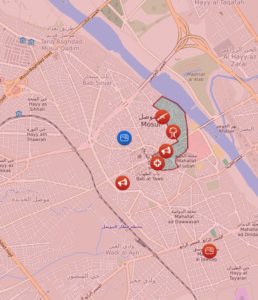
Some videos showing the fighting and destruction:
O’Keefe: You’re Going to Retract. Farhi: Never! Washington Post: Here, Have a Retraction
Saturday, July 8th, 2017Such a tiny little skirmish victory in the war against fake news, but since it fits into CNN Self-Immolation week, here’s James O’Keefe rubbing Paul Farhi’s nose in the fact that, yes, Farhi screwed up in his coverage of one of Project Veritas’ CNN videos, and the mistake was so obvious that yes, indeed, the Washington Post had to issue a retraction, just as O’Keefe said it would.
The question, of course, is why Farhi’s research was slipshod as to make an obviously erroneous assertion about such a short video, and why he was so stubborn and stiff-necked that he refused to offer a retraction when he was obviously in error…