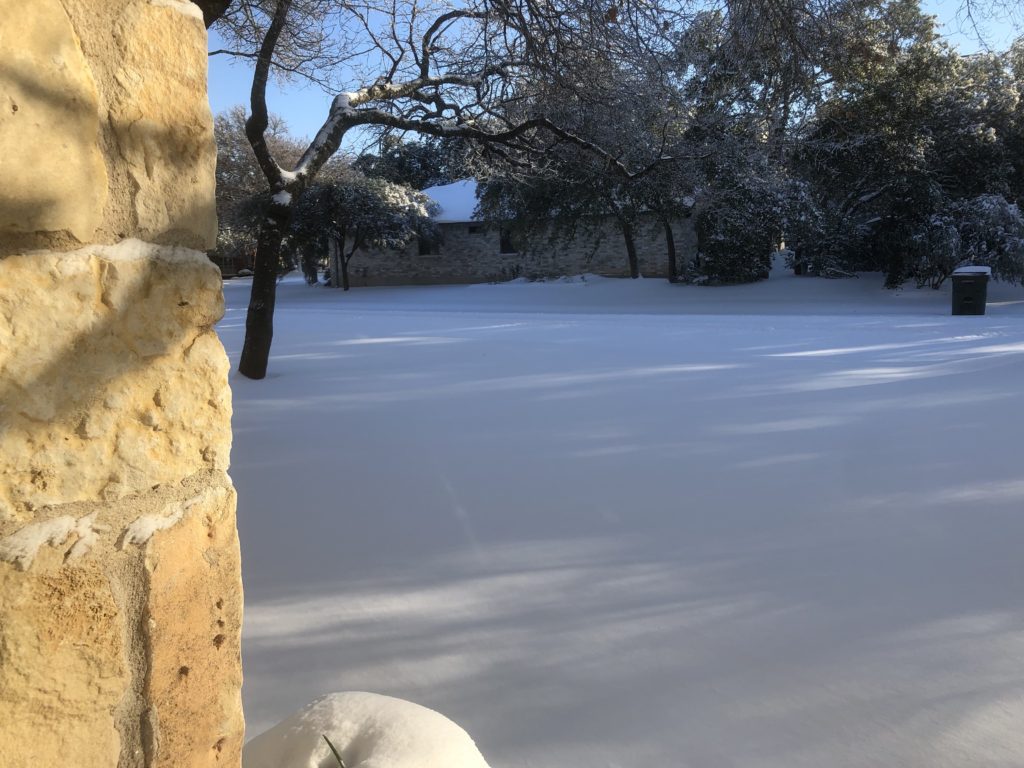
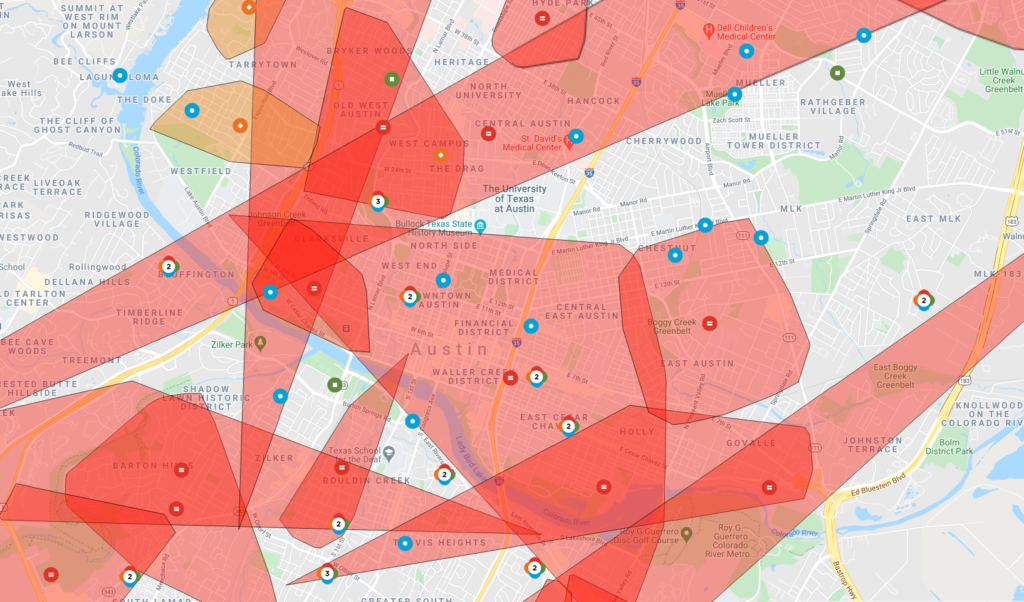
Since there’s not enough reporting of the negative case, I just wanted to report that power is not out in Austin right now.
A powerful cold front (that much talked-about “polar vortex”) rolled into the state over the weekend and dropped temperatures here in central Texas into the high teens. Anyone who remembers the ice storms of 2021 and 2023 knows that this is potentially a recipe for widespread power outages.
Likewise, the state outage map shows no widespread outages, with the biggest being some 8,000+ customers (among 2,000,000+) for Oncor (Dallas Metroplex).
Maybe ERCOT was better prepared this time. Or maybe it was the fact this system didn’t bring nearly the amount of freezing rain and snow we saw in 2021 and 2023. Or maybe it’s just the widespread arboreal destruction we saw in 2021 and 2023 means that the overwhelming majority of trees and limbs likely to take out power lines have already been cleared out.
In related news, HEB was supposedly picked clean of the usual emergency staples (bread, milk, etc.) this weekend, but in my trip today, the bread aisle was mostly full, with just a few empty shelf spots, and the rest of the store seemed similarly well-stocked. (Save the cheese and luncheon meat case, but a sign said that was a freezer issue.)
Here in Austin, it’s supposed to be in the teens until midweek, then fluctuate between just above to just below freezing through the weekend. here’s hoping the power stays on all through that.
And here, for prepping and filthy lucre purposes, is my most recent prepping supply list.
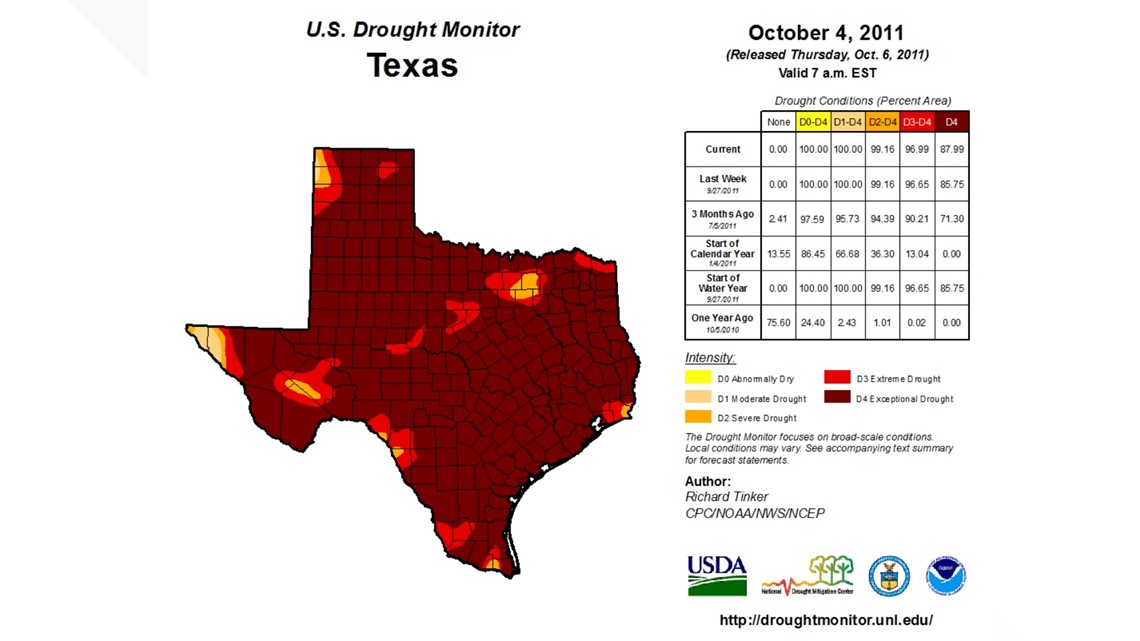
Austin usually has hot, dry summers with a high pressure system parked over us for months on end, but this year it’s been the worst since The Great Drought of 2011, where something like 98% of the state was in stage four drought conditions.
Thus far this year, the drought hasn’t been as bad (we had a decent amount of rain in spring), but the temperature has been more extreme, as this week saw a break from Austin suffering a record 45 days over 100°.
Remember that favoring trendy green energy sources like solar and wind over natural gas was a big contributing factor to the 2021 ice storm blackouts. Hopefully Texas lawmakers have learned their lesson, and more reliable baseload power has come online since.
As always, it’s best to be prepared with flashlights, batteries and maybe a portable power source to power fans and medical devices. (That’s the one that gets the best reviews on Amazon. I just got another power source, but since it came free as part of one of those “Redeem your company’s award points for merchandise from this catalog” type deals, I don’t have enough experience with it to recommend it yet.) You might also consider a home generator, like this one, but those are pricey, loud, and I have no direct experience with them, so you probably want to do some research if you’re going that route.
Public Utility Commission (PUC) Chairman Peter Lake and Electric Reliability Council of Texas (ERCOT) CEO Pablo Vegas sent a clear message to the Texas Legislature on Wednesday: tweak the electricity market so that natural gas generation can be supplemented, or continue to face problems in the summer heat.
I just have to pause here to note that “Pablo Vegas” sounds like an Anthony Weiner pseudonym.
“Operationally, the ERCOT grid is ready for this summer,” Lake said, unveiling the 2023 Seasonal Assessment of Resource Adequacy (SARA) report. “The reliability reforms that were put in place have been tested and continue to work. We’ve made the grid we’ve got as strong as possible using every tool available.”
The SARA report, as Lake stated, is an estimate of electricity demand and supply for certain scenarios based on past data, not a forecast of what is to come this summer.
It estimates peak demand to reach 82,739 megawatts (MW); for comparison, 1 MW can power about 200 homes during the peak demand hours of the late summer afternoon through evening. To cope with that demand, the state expects to have 97,000 MW of capacity available — two-thirds of which is thermal generation, combined with 13 percent from solar and 11 percent from wind.
However, Lake tinged the grid’s readiness with an omen.
“Data shows for the first time that peak demand this summer will exceed the amount we can generate from on-demand dispatchable power,” Lake warned. “There is no longer enough dispatchable generation to meet the demand of the ERCOT system. So, we will be relying on renewables to keep the lights on.”
The State of Texas is adding about 300,000 people per year, which means a larger and larger demand for electricity on the state’s largest power grid.
“In this new reality, our risk goes up as the sun goes down,” Lake added.
Vegas likened the situation to a car: the metaphorical vehicle — the physical grid itself — is up to par on maintenance, but it lacks the necessary fuel — the electricity supply — to power its full trip ahead.
Lake said that ERCOT’s dispatchable supply fleet only grew 1.5 percent from 2008 to 2022. During that time, its renewable footprint grew substantially with now more than 30,000 MW of wind power installed and more than 10,000 MW of solar.
The influx of renewables is driven primarily by the Production Tax Credit — a federal subsidy that pays renewable generators 2.6 cents per kilowatt-hour produced — which has given wind and now solar an advantage over thermal generation sources. ERCOT has 31,000 MW of solar generation in the queue along with 5,000 MW of wind.
In contrast, only 800 MW of dispatchable power has been added in the last year, according to Lake.
So thanks to renewables, blackouts may be in the future of Texans this summer.
The Biden administration is announcing a climate rule that would require most fossil fuel power plants to slash their greenhouse gas pollution 90 percent between 2035 and 2040 — or shut down.
The highly anticipated regulation being unveiled Thursday morning is just the latest step in President Joe Biden’s campaign to green the U.S. economy, an effort that has brought a counterattack from Republicans and coal-state Democratic Sen. Joe Manchin. That’s on top of efforts by Biden’s agencies to promote the use of electric cars, subsidize green energy sources like solar and wind and tighten regulations on products including gas stoves and dishwashers.
The draft power plant rule from the Environmental Protection Agency would break new ground by requiring steep pollution cuts from plants burning coal or natural gas, which together provide the lion’s share of the nation’s electricity. To justify the size of those cuts, the agency says fossil fuel plants could capture their greenhouse gas emissions before they hit the atmosphere — a long-debated technology that no power plant in the U.S. uses now.
As an alternative, utilities could hasten their decisions to shut down their aging coal plants, a trend that has already gathered speed in the past two decades. The rule allows plants that agree to close in the first half of the 2030s to avoid most or all of the pollution-reduction mandates.
Safe, reliable nuclear and fossil fuel powered energy is anathema to the Democratic Party because they can’t rake off enough graft from it. Unless you’re willing to let them shove their disasterous green energy programs down your throat, they want you deplorables sitting in the dark.
In recent days, Williamson County and the city of Taylor had seemed to emerge as the frontrunner to land a $17 billion chipmaking plant planned by Samsung.
Now, it seems the technology giant has indeed picked the small Central Texas city as the site for its next major operation, according to media reports.
Citing unnamed sources with knowledge of the decision, the Wall Street Journal reported Monday night that Samsung has picked Taylor over sites in Austin, Arizona and New York.
Samsung has not formally confirmed the decision, and a company spokesperson did not immediately respond to messages left by the American-Statesman on Monday evening. However, the announcement is expected to be made in a news conference with Gov. Greg Abbott at the Texas Capitol on Tuesday afternoon.
If Samsung does, in fact, build the facility at the Taylor site, it will be the latest in a stunning run of economic development wins for the Austin area, and for its technology sector in particular.
Tesla announced Oct. 7 that the automaker will move its corporate headquarters from California to Austin. That news came 15 months after Tesla chose an Austin-area site as the home for its $1.1 billion manufacturing facility. Software giant Oracle announced last December that it was moving its corporate headquarters from California to Austin, and a number of other technology giants — including Apple, Facebook, Google and Amazon — have recently expanded their operations in Central Texas.
Samsung recently overtook Intel as the largest semiconductor manufacturer in the world, and along with TSMC, those three are also the only real players in cutting-edge under-10nm processes. As I’ve mentioned before, new cutting edge fabs are hideously expensive to build. TSMC is a foundry (which means they fab other people’s chip designs), while both Samsung and Intel are integrated device manufacturers (IDMs), meaning they fab their own designs, though I think both dabble in foundry work as a sideline. (Samsung is also one of the largest flat panel screen manufacturers in the world; flat panel manufacturing uses semiconductor manufacturing techniques, but is fundamentally a different industry, and just about all flat panels are produced in Asia these days.)
The decision to eliminate New York from the list was probably quite easy. Back when IBM was running it’s state-of-the-art fabs in East Fishkill, there was considerable technological infrastructure in the state. Back In The Day IBM had some of the most respected process technology knowledge in the industry. But then they got out of the manufacturing business, and the East Fishkill fab got sold to Global Foundries, who later sold it to ON Semiconductor. But today New York constantly ranks among the worst states in the nation for business environment, due to high taxes, excessive regulation, and the gradual decay of infrastructure and institutions that comes with one-party Democrat control.
Arizona is a much stronger candidate. Intel has a huge complex of modern fabs in Chandler and TSMC is building a state of the art fab in Phoenix proper, which means there’s a lot of local talent and infrastructure to draw on. A purple state, Arizona usually ranks in the top ten for a business-friendly climate, but they do have a personal income tax.
Texas, by contrast, is constantly rated as the top or second best business climate the the country (occasionally losing to Florida), and has no state income tax. Samsung already has a fab in Austin, along with older legacy fabs from NxP (ex-Motorola) and Infineon, along with significant presence by the major semiconductor equipment manufacturing giants (Applied Materials, Tokyo Electron, etc.). Taylor is close enough to Austin to draw on the technical talent and infrastructure there, without having to worry about the crazy left-wing politics, as Williamson County, while having turned a bit more purple lately, is still safe Republican territory.
Another solid reason to locate in Taylor: ERCOT is headquartered there, which means the area will never be power-cycled in an emergency. The winter storm evidently cost Samsung $268 million in lost revenue from the outage, which I can well believe. When the power goes off, all the equipment needs to be requaled, which is a long, painful process for a single machine, much less the some 200+ needed in a modern fab.
America has lots of tech hubs: Silicon Valley, Seattle, the North Carolina triangle, greater Boston, etc. But nobody is building cutting edge fabs in those areas. Central Texas has rapidly expanding software, hardware and silicon industries.
Austin is primed to be one of the greatest global tech hubs of the 21st century, assuming Austin political leadership doesn’t screw it up…
Texas Public Policy Foundation’s Jason Isaac has a Prager U video analysis of the reasons behind the great Texas ice storm blackouts.
The analysis will be familiar to regular readers: Over-investment in unreliable, subsidized renewable energy meant under-investment in reliable fossil fuel and nuclear necessary for base load reliability.
The Republican National Committee (RNC) is invested in a comprehensive nationwide effort to make it easier to vote and harder to cheat. We’re fighting for election integrity because it’s absolutely vital to protect the sanctity of your ballot from Democrat schemes to undermine voting security. We are involved in 19 election integrity lawsuits nationwide, and we’re winning the fight.
Our investment is partially driven by polling that consistently shows the American people supporting our common-sense approach to securing elections. A recent poll commissioned by the RNC found that 78 percent of Americans support a proposed voting plan with five key principles: presenting voter ID, verifying voters’ signatures, controlling the ballot’s chain of custody, bipartisan poll observation, and cleaning up voter rolls. The poll also found that 80 percent of voters support voter ID requirements; this sentiment matches up with other polling, including a recent one from NPR which found 79 percent of voters in favor of voter ID. The measures we are pushing are not controversial or dramatic. They are common-sense and they are supported by American citizens.
Of course, that hasn’t stopped Democrats from trying to generate false outrage and controversy at every level of this conversation. The Democrat election playbook is simple: lie and seek attention until the mainstream media eagerly takes the baton and turns Democrat lies into a false national narrative. You saw this in Georgia, where Joe Biden and Stacey Abrams’ lies about the state’s election reforms pressured the MLB into moving its All-Star Game out of Atlanta. These lies cost the good people of Georgia an estimated $100 million. You’re seeing it now in Texas, where local Democrats have stormed out of legislative debates on election integrity not once, but twice. Their latest stunt saw them leave the floor of the Texas legislature and hop on private planes to fly to DC in a juvenile quest for media attention.
Unsurprisingly, the mainstream media lapped it up. This is their playbook. When it comes to election integrity, Americans need to pay attention to the relationship between Democrat lies and the mainstream media machine.
Back on June 24, the great Peggy Noonan hailed [Eric] Adams’s primary win as a victory of reality over progressive theory. “Adams was a cop for 22 years, left the New York City Police Department as a captain, and was the first and for a long time the only candidate to campaign on crime and the public’s right to safety. He was the first to admit we were in a crime wave.” Noonan observed, accurately, that African-American voters were not necessarily the most progressive voters in the electorate anymore, and that they represented a de facto force of, if not conservatism, then a realist wariness of the fringes of modern progressive thinking.
The notion of a centrist, tough-on-crime mayor replacing the notorious groundhog murderer and early pandemic denier sounds good, but we’ll see. Every elected official operates within a particular “Overton Window”: the range of policies that a politician can recommend without appearing too extreme to gain or keep public office given the climate of public opinion at that time. Adams did not win this primary by a landslide. While he received the most votes in the first round, he was the top choice of less than a third of the city’s Democrats. He has 51.1 percent out of the final two.
New York City desperately needs a dramatic improvement in its policing and prosecution of criminals, but Adams will have to take on a lot of deeply entrenched opponents and a city media and cultural environment that have evolved to reflexively demonize the NYPD. Way back in 2005, Fred Siegel described the New York City of the David Dinkins years as an era of “hysteria that led upstanding liberals to insist that they were more afraid of the NYPD than they were of criminals.” Whatever you think of Rudy Giuliani now, the young(er) mayor of the early 1990s was willing to be utterly hated as he enacted his reforms, convinced that the broader public would look past the controversy and appreciate the effects of lower crime rates. It remains to be seen whether Adams has that same courage to exchange short-term unpopularity for long-term improvement in the city’s streets — or whether he’ll bump up against the city’s Overton Window of what policy changes are acceptable and settle for a series of half measures.
The irony is that we see the same phenomenon in the opposite direction at the national level in Washington. Many progressives interpreted Biden’s presidential win, the 50–50 Senate, and the slightly shrunken House majority in the 2020 elections as a mandate to enact sweeping changes in the country — and they’re largely hitting brick walls. The national Overton Window isn’t wide enough to accommodate the wildest fantasies of progressives.
I’m not sure the feasibility of Overton Window possibilities matters to the Social Justice left. There’s is a holy revolutionary cause, and they need to seize control of the Party before they can seize control of the nation. To that end, I suspect many think that letting moderate Democrats lose elections is a small price to pay for continuing their unpopular march through America’s institutions…
The Texan brings back The War Room to track 2022 Texas election races.
“Texas House Democrats’ COVID-Spreading Publicity Stunt Is Backfiring.”
Outnumbered by Republicans in Austin 83 to 67, the Texas House Democratic Caucus decided to head to D.C. to publicize its opposition to election integrity bills, fundraise, and drum up support for federal legislation that would nationalize election law by imposing California law as a template on the nation — banning meaningful voter ID, expanding mail balloting while eliminating fraud safeguards, prohibiting proactive voter list maintenance, and mandating same-day voter registration with no checks for eligibility to vote.
But the Democrats’ trip hasn’t turned out as planned.
Soon after meeting with Vice President Kamala Harris and numerous White House staffers and members of the U.S. House and Senate, three Democrats were diagnosed with COVID-19, then another two, and now a total of six. An aide to Speaker Nancy Pelosi and a White House official tested positive soon after meeting with the Texas Democrats.
And the attention Democrats were hoping for soon turned sour, with Texas’s major newspapers, none of whom are friends of Republicans and have had little good to say about their election integrity bills, have nevertheless weighed in against the walkout. By two-to-one, Texas voters disapprove of the quorum-busting as well. Even national Republicans have piled on, with this tweet from Missouri Sen. Josh Hawley’s press secretary being emblematic.
Closer to home, Travis County GOP Chairman Matt Mackowiak said the quorum-breakers had “…engaged in performance theater for weeks claiming Gov. Abbott was putting lives at risk by reopening the state economy and waiving the statewide mask mandate, then they flew to DC on a private jet stocked with Miller Lite without masks, in violation of FAA rules, and now this farce turned into a super spreader event.”
But there are signs the Democratic solidarity is breaking down. With chairmanships, seniority, and even district boundaries on the line in a redistricting year, powerful Democrats are wavering while those seeking to move up sense an opportunity. A week ago, 80 House members were on the floor. As of Tuesday, 90, including several Democrats, were present. It’s a classic “prisoner’s dilemma” situation. If another 10 Democrats show up, the Texas House will have a quorum and can resume consideration of bills, leaving the other 50 holdouts with nothing for their efforts — except for perhaps being redrawn out of their districts by the Legislative Redistricting Board later this year.
When the Democrats do return, they will be asked to vote on bills that would bring mail-in balloting up to the standard for in-person voting by asking for ID in the form of writing a driver’s license number, or state ID number, or the last four of the Social Security number inside of a privacy flap in the ballot return envelope. The bill would also prohibit local elections officials from sending out unsolicited mail-in ballot applications, ban last-minute changes to election procedures, and clarify that properly appointed poll watchers must be able to see and hear election workers’ activities.
Asking for ID for mail-in ballots — one of the measures most vociferously opposed by Democrats — is supported by 81 percent of Texas voters, with voters from all demographic groups and both major parties approving of the safeguards.
With all due respect to Chuck DeVore, until the Texas election integrity bill is passed, their publicity stunt hasn’t backfired yet. There are few prices Democrats won’t pay for the ability to continue cheating.
Barely a year after the Minneapolis City Council voted to to defund the city’s police department after the death of George Floyd, a judge has ordered the city to hire more cops, thanks to a lawsuit filed by fed-up citizens.
“Minneapolis is in a crisis,” wrote the eight plaintiffs in their complaint, citing the rise in violent crimes, including shootings, sexual assault, murders, civil unrest, and riots, Fox News reports.
Progressive city council members couldn’t wait to gut the police department and allow a surge in crime, most of which would affect poor black neighborhoods. The tsunami of crime recently took the life of a popular coach who was shot attending a memorial for another victim of Minneapolis’ violent crime surge. He was the 42nd person murdered this year in Minneapolis. No word from Antifa and BLM if they are planning a mostly peaceful riot in his honor.
The cop-hating Minneapolis City Council and Mayor Jacob Frey were ordered to “immediately take any and all necessary action to ensure that they fund a police force,” according to Thursday’s court order by Judge Jamie L. Anderson. The crime-loving city council and mayor have until June 30, 2022, to establish a police force of 730 sworn officers. They currently have 669 cops. Minneapolis saw nearly 200 cops file paperwork to leave the Minneapolis Police Department in the first three months after the George Floyd riots. No idea how many more will resign or retire by the June 30, 2022, deadline, as the nation has seen a surge in cops walking away from departments nationwide.
NPR has not run a piece critical of Democrats since Christ was a boy. Moreover, much like the New York Times editorial page (but somehow worse), the public news leader’s monomaniacal focus on “race and sexuality issues” has become an industry in-joke. For at least a year especially, listening to NPR has been like being pinned in wrestling beyond the three-count. Everything is about race or gender, and you can’t make it stop.
Conservatives have always hated NPR, but in the last year I hear more and more politically progressive people, in the media, talking about the station as a kind of mass torture experiment, one that makes the most patient and sensible people want to drive off the road in anguish. A
Numerous examples snipped.
NPR sucks and is unlistenable, so people are going elsewhere. People like [Ben] Shapiro are running their strategy in reverse and making fortunes doing it. One of these professional analysts has to figure this one out eventually, right?
Evidently the primary mover behind the Gretchen Whitmer kidnapping “plot” was the FBI. It’s FBI “informants” all the way down. (Hat tip: Director Blue.)
Want to keep track of violence in Lori Lightfoot’s Chicago? Hey Jackass has the trending data plants policy wonks crave!
“In 25 major U.S. cities, officials have proposed cutting—or in 20 cases already cut—police budgets. However, what OpenTheBooks.com auditors found was that mayors and city officials still enjoy personal protection of a dedicated police detail costing taxpayers millions of dollars,” Adam Andrzejewski, CEO and founder of Open The Books (OTB), said in a statement announcing the new data.
Snip.
In San Francisco, for example, the costs of the security detail protecting Mayor London Breed and other city officials spiraled up from $1.7 million in 2015 to $2.6 million in 2020.
Breed has proposed shifting $120 million from the city’s police department to mental health and workforce training programs. City officials declined to say how many officers are assigned to the security details, according to OTB.
In Chicago, Mayor Lori Lightfoot claimed to be opposed to defunding the police, but OTB found that officials quietly abolished 400 police department positions last year.
Those positions were eliminated even as the city’s “security detail costs peaked in 2020—up $700,000 over five years: $2.7 million spent on 16 officers (2015); $2.9 million for 16 officers (2016); $2.7 million for 20 officers (2017); $2.8 million for 16 officers (2018); $2.8 million for 17 officers (2019); and $3.4 million for 22 officers (2020)—an all-time high,” OTB stated.
In New York, Mayor Bill de Blasio slashed $1 billion from the New York Police Department’s (NYPD) $6 billion annual budget, including $354 million transferred to mental health, homelessness, and education services.
But the mayor, who briefly sought the Democratic presidential nomination last year, continues to enjoy tax-paid police protection for himself, his wife, and his son.
“Serial Swatter Who Caused Death Gets Five Years in Prison.” “Shane Sonderman, of Lauderdale County, Tenn. admitted to conspiring with a group of criminals that’s been ‘swatting’ and harassing people for months in a bid to coerce targets into giving up their valuable Twitter and Instagram usernames.” So not only has he gotten people killed, he got them killed for really shitty reasons. (Hat tip: Ace of Spades HQ.)
“ERCOT Expands Power Grid Reserve Capacity in Preparation for Summer Heat.” “To prepare, ERCOT has dedicated 38 percent more in generation to reserve capacity from this July compared to last. And they plan to dedicate 56 percent more reserve capacity for August compared to August 2020.” 1.) That’s good, but 2.) Isn’t mid-July a wee bit late to be rolling out such plans? Let’s hope they’ve been working on this a while…
California court says that state laws requiring people to use crazy SJW pronouns violates freedom of speech.
Speaking of Harris: “Last month, the Supreme Court smacked down then-California Attorney General Kamala Harris’ attempt to force charitable nonprofits to turn over the names of their top donors, calling the power-grab ‘facially unconstitutional.'”
Gun sales decline slightly from record highs in 2020. Does this mean I might finally be able to pick up an AR-15 without it costing me an arm and a leg?
“Wayne LaPierre a Bigger Risk Than Fire and Brimstone.” “Lloyd’s of London is dropping all coverage for the NRA’s Board of Directors through their officers and directors insurance plan.”
More Soros-backed DA justice: “Accused murderer set free after St. Louis County prosecutors fail to show up, but found time for McCloskeys.”
Last week, Circuit Judge Jason Sengheiser dismissed charges of first-degree murder, armed criminal action, and unlawful gun possession against Brandon Campbell, 30, when prosecutors from the Circuit Attorney’s Office did not attend hearings for the case in May, June, and July, the St. Louis Post-Dispatch reported.
“The court does not take this action without significant consideration for the implications it may have for public safety,” Sengheiser wrote in kicking the case.
“Although presumed innocent, (Campbell) has been charged with the most serious of crimes. While the court has a role to play in protecting public safety, that role must be balanced with adherence to the law and the protection of the rights of the defendant,” the judge continued.
Sengheiser then took aim at Kim Gardner’s office.
“The Circuit Attorney’s Office is ultimately the party responsible for protecting public safety by charging and then prosecuting those it believes commit crimes,” he wrote.
“In a case like this where the Circuit Attorney’s office has essentially abandoned its duty to prosecute those it charges with crimes, the court must impartially enforce the law and any resultant threat to public safety is the responsibility of the Circuit Attorney’s Office.”
Thirty-eight-year-old Brandon Andrus’s criminal history is so lengthy he has more mug shots than some people have selfies.
But that didn’t stop 185th Criminal District Court Judge Jason Luong from allowing Andrus to be a free man by giving him three felony bonds, one for assaulting a family member last year.
On June 14, police say Andrus and another man murdered 35-year-old Rodrick Miller.
“Amazon’s New World Is Reportedly Frying High-End Graphics Cards.” Nothing like having your $2,000 Nvidia card bricked over a beta game…
Netflix to Wall Street: “Did I say we were going to gain two million new subscribers? Yeah, what I actually meant was we were going to lose 500,000 subscribers. Whoopsie! My bad!” Get woke, go broke.
James May launches his own gin. I don’t drink gin, but I bet that stuff sells out instantly, since the Top Gear/Grand Tour trio have one of the largest worldwide fan bases. I did not know that gin started out with neutral spirits before juniper berries were added.
I finally had time to finish this postmortem post on the Texas winter storm energy grid crisis. I’ve got a ton of pieces to get through, so let’s dig in.
Here were two problems, one short term and one long term—which exacerbated the short-term one.
The short-term failure came at about 1 a.m. Monday when ERCOT should have seen the loads soaring due to plummeting temperatures, and arranged for more generation.
Texas came very close to having a system-wide outage for the whole state (in the ERCOT area, about 85% of the state) due to not arranging for more generation.
This tripped the grid, knocking some reliable thermal plants (gas and coal) offline. This was a failure of the grid operator (ERCOT) not the power plants.
In the last four to five years, Texas lost a net of 3,000 megawatts of thermal out of a total installed capacity 73,000 megawatts today.
We lost the thermal power because operators couldn’t see a return on investment due to be undercut by wind and solar, which is cheap for two reasons—it’s subsidized and it doesn’t have to pay for the costs of grid reliability by purchasing battery farms or contracting with gas peaker plants to produce power when needed, not when they can.
Meanwhile, Texas has seen a growth of 20,000 megawatts of wind and solar over the same period to a total of 34,000 megawatts of installed capacity statewide, though they rarely perform anywhere close to capacity.
Wind and solar, with state and federal subsidies, have pushed reliable thermal operators out of business or prevented new generation from being built as operators can’t make money off of the market.
Equipment failure turned out to be a big part of the problem.
“Beginning around 11:00 p.m. [Sunday night], multiple generating units began tripping off-line in rapid progression due to the severe cold weather,” said Dan Woodfin, senior director of system operations at ERCOT, the organization that manages the state’s electric grid.
What does that mean? Equipment literally froze in the single digit temperatures and stopped working.
Then, as reserves diminished, ERCOT asked transmission providers to turn off large industrial users that had previously agreed to be shut down. But the situation deteriorated quickly, requiring rotating outages that have lasted hours for many Texans.
Electric generating plants did not properly winterize their equipment, said Dr. David Tuttle in the latest episode of the Y’all-itics political podcast. Tuttle is a research associate with the Energy Institute at the University of Texas at Austin.
“There are things that can be done, but it will cost some money,” he added. “About every decade we have these long-sustained periods. And then, you know weatherization is supposed to happen, and then, it doesn’t because it costs money.”
As Texans reel from ongoing blackouts at the worst possible time, during a nationwide cold snap that has sent temperatures plummeting to single digits, the news has left people in other states wondering: How could this happen in Texas, the nation’s energy powerhouse?
But policy experts have seen this moment coming for years. The only surprise is that the house of cards collapsed in the dead of winter, not the toasty Texas summers that usually shatter peak electricity demand records.
The blackouts, which have left as many as 4 million Texans trapped in the cold, show the numerous chilling consequences of putting too many eggs in the renewable basket.
Snip.
On the whole, Texas is losing reliable generation and counting solely on wind and solar to keep up with its growing electricity demand. I wrote last summer about how ERCOT was failing to account for the increasing likelihood that an event combining record demand with low wind and solar generation would lead to blackouts. The only surprise was that such a situation occurred during a rare winter freeze and not during the predictable Texas summer heat waves.
Yet ERCOT still should not have been surprised by this event, as its own long-term forecasts indicated it was possible, even in the winter. Although many wind turbines did freeze and total wind generation was at 2 percent of installed capacity Monday night, overall wind production at the time the blackouts began was roughly in line with ERCOT forecasts from the previous week.
We knew solar would not produce anything during the night, when demand was peaking. Intermittency is not a technical problem but a fundamental reality when trying to generate electricity from wind and solar. This is a known and predictable problem, but Texas regulators fooled themselves into thinking that the risk of such low wind and solar production at the time it was needed most was not significant.
“By Monday morning, half of Texas’ wind turbines were frozen solid, and wind generation bottomed out at 2 [percent] of installed capacity by Monday night,” said Jason Isaac, director of Life:Powered, a project of Texas Public Policy Foundation and a former state lawmaker.
“Because of this massive gap in wind production and ERCOT’s delay, what should have been a series of brief rolling blackouts—inconvenient but manageable—instead turned into 4 million Texans left in the cold and without answers,” he continued. “To make matters worse, ERCOT shut down power at natural gas substations in the Permian, leading to further shortages.”
Agricultural Commissioner Sid Miller has since said Texas should stop building wind turbines; focus on gas, coal, and oil; and called for the firing of Gov. Greg Abbott’s appointees to the Public Utility Commission—the government body that oversees ERCOT.
But was this crisis foreseeable? Isaac says yes.
“We’ve known for years that a weather event combining low wind and solar production and record demand could lead to blackouts,” he told Texas Scorecard. “This week, that event became a reality as new wind and solar generation failed to produce when it was needed the most, and it appears ERCOT fell asleep at the wheel.”
For years, Texas’ grid operator (ERCOT) has overestimated the ability to maintain a reliable grid without a sufficient supply buffer, known as a “reserve margin.” That margin is the difference between demand for electricity and what the grid can produce. When demand exceeds production, you get blackouts. That buffer has been shrinking because reliable sources of energy have been retired, few reliable plants have been constructed, and the grid is depending more and more on weather-dependent renewable energy that repeatedly fails to perform when we need it most.
When wind and solar production predictably dropped as the winter storm hit, the buffer collapsed. ERCOT needed to execute a series of balancing measures that would have protected the grid. But it did not act soon enough, which caused many more gas and some coal power plants in the system to “trip.” (Think of it as a circuit breaker that triggers to prevent a fire or other emergency at your house when there is a system imbalance.) Other weather-related issues caused problems too but ERCOT’s failure to act sooner was a major factor.
Usually, a system trip wouldn’t last long and we’d have power back in a few hours. But this time, many of the units that were tripped off the system had difficulty coming back online for a variety of reasons, including the fact that some were not designed to be taken off and put back on the system quickly, as well as other cold weather issues that exacerbated the problem.
So when people blame ERCOT for not acting quickly, they’re right. And so are the people who say that both renewable energy and fossil energy plants are not generating what they should. But it doesn’t begin there. Our overdependence on unreliable energy that caused the razor thin reserve margins started the ball rolling years ago.
Here’s the long story.
Keeping the power on is a bit of a guessing game played out every day by the grid operator to make sure we have the right mix of energy getting on to the grid. There’s that buffer, the reserve margin, which ERCOT uses to give it some leeway in making moves. As with anything, the more reliable and predictable the source of energy, the better moves ERCOT can make.
However, the race to add in renewables pushed out more reliable forms of energy and kept new reliable energy from being built. That resulted in the buffer in our electric grid being stripped out—going from more than a 20% surplus years ago to single digits in the last couple of years.
Without that buffer, our system has become much more vulnerable to outages when we see extreme heat or extreme cold. The problem is made worse by the fact that renewables have grown to become a significant percentage of our fleet, making our power grid much more susceptible to weather-related shortages. That is because renewables do not show up when we need power the most (high heat, freezing cold, big storms, etc.)
Here’s an informative thread on how the Texas energy market is set up and how some of the system was offline when the worst hit:
The ERCOT grid is a very complex beast. It can’t call on other grids for support (but that is a bit overrated as typically when you need power so does your adjacent region, but that’s later).
ERCOT is a 501c3 nonprofit that is charged with managing the market, but above all, reliability (keeping the lights on). In my experience some of the smartest people I’ve ever met work there. Wish I could name some of them because they’re absolutely brilliant.
Retail guys, municipalities, and cooperatives are the guys who buy power wholesale and sell it to the end user (residentials, commercials, industrials).
Retail outside of municipal or cooperative areas can shop for a retail provider. 8/
This year, ~20,000MW of (gas and coal) Power plants requested an outage. ERCOT runs an outage study looking at demand and other available resources, and then says yes. (They make sure all the plants in Houston aren’t out for example because that would jack up Houston rates). 12/
If those plants could be back up they would’ve because they want to make big money. So, Feb 11th, we go to bed, wake up to a coating of ice. This ice is thick and persistent. Next day, sun is out, roads are good. Maybe we’re through the worst?
On the night of the 15th, between midnight and 3 am, 8000MW of gas, 1200MW of Nukes, and 2000MW of coal trip off the grid. Culprits are frozen gas pipelines and water for steam. (Note the Big gas drops)
I think here he’s conflating a few different things; it’s unclear how much capacity was taken off line due to insufficient weatherization and how much was caused by ERCOT foolishly inducing blackouts in the gas-producing Permian Basin.
So no water through the pipe, no steam. No gas no gas to heat that water.
That trip caused a lot of the outages and most of the outrage.
So ERCOT’s only options in these situations is: 1) cut off a big chunk of the customers. 2) let the whole system trip and take months to get back to normal.
Last thing. In 2011. We had a bad winter but it was followed by a drought and the worst summer ever. Power plants didn’t have water in their lakes to run the plant. 100 days over 100°. The grid focused on that issue instead of the cold.
Nationally, retail electric sales generated $117 billion in 3Q2022, $10.9 billion in Texas (of which $6.3 billion was residential) and $14.5 billion in California. 2/12
If Texans paid what Californians did for electricity, Texans would have paid $13.2 billion more, or about $508 more per person in the state for those three months in 2020. 4/12
One aspect of Texas’ failure has been the rapid grown of unreliables (wind and solar) subsidized by federal and state policy concurrent with the shedding of reliable power (coal and natural gas). 6/12
We suggest making all electricity producers guarantee dispatchable power for Texas’ grid—this means that the unreliables would have to secure agreements… 8/12
Mitchell Rolling explains: “As you can see, the top three performing energy sources during the energy crisis in Texas were all fuel-based energy sources: nuclear, coal, and natural gas. On average, these three energy sources alone provided over 91 percent of all electricity generated throughout the energy emergency, as the graph below shows. Without these energy sources on the grid providing the bulk of electricity, the situation in Texas would have gone from bad to worse.”
The massive blast of Siberia-like cold that is wreaking havoc across North America is proving that if we humans want to keep surviving frigid winters, we are going to have to keep burning natural gas — and lots of it — for decades to come.
That cold reality contradicts the “electrify everything” scenario that’s being promoted by climate change activists, politicians, and academics. They claim that to avert the possibility of catastrophic climate change, we must stop burning hydrocarbons and convert all of our transportation, residential, commercial, and industrial systems so that they are powered solely on electricity, with most of that juice coming, of course, from forests of wind turbines and oceans of solar panels.
But attempting to electrify everything would concentrate our energy risks on an electricity grid that is already breaking under the surge in demand caused by the crazy cold weather. Across America, countless people don’t have electricity. I’m one of them. Our power here in central Austin went out at about 3 am. I am writing this under a blanket, have multiple layers of clothes on, and am nervously watching my laptop’s battery indicator.
This blizzard proves that attempting to electrify everything would be the opposite of anti-fragile. Rather than make our networks and critical systems more resilient and less vulnerable to disruptions caused by extreme weather, bad actors, falling trees, or simple negligence, electrifying everything would concentrate our dependence on a single network, the electric grid, and in doing so make nearly every aspect of our society prone to catastrophic failure if — or rather, when — a widespread or extended blackout occurs.
One of the most contested issues is the role wind generation has played. Prior to the onset of the storm last week, Texas led the nation in wind power generation and depended on the wind turbines in West-Central and Western Texas, along with a smaller number of turbines along the Gulf Coast, for about 25% of its electricity. As wind power has increased, coal-powered generation plants have been taken offline around the state. Texas has abundant coal, oil, and natural gas, and also has nuclear plants near Dallas and near Houston.
Real-time data from the U.S. Energy Information Administration shows that wind power collapsed as the winter storm swept across the state.
Snip.
As the graph plainly shows, wind generation choked down but natural gas compensated. Coal and even nuclear power generation dipped. Solar generation has been negligible due to cloud cover and several inches of snow and ice.
The cold has created extreme demand across the state. During most winter storms, the Panhandle, West Texas, and even North Texas around Dallas and above toward Paris may get cold but Central and South Texas could remain well above freezing. This has not happened during the current series of storms. The entire state is in a deep freeze, with snow appearing even on Galveston Island’s beach. Galveston averages lows of about 50 degrees and highs in the mid-60s during a typical February. It’s 37 degrees in Galveston as I write this, well below average. Austin has seen single-digit temperatures at night.
To put all of this into some perspective, the storm that dumped more than six inches of ice and snow on Austin Sunday night would, by itself, have been a historic storm. It dropped more snow on the capital than any other storm since 1949. It was preceded by a major cold snap and has been followed by more extreme cold and then another ice and snow storm Tuesday night. Texas has not suffered a single historic winter storm over the past several days, but a series of them without any warming in between…
Add to all of this, when Texas gets winter storms it usually doesn’t just get snow. Snow is fairly easy to deal with. Texas also gets ice, which can snap electric lines and break trees and tree branches, which also can fall on and break power lines. A tree in my yard is bent over by ice to the point that it looks like an invisible hand is holding it down. We can expect the ice to kill off millions of trees around the state. The ice layers also render most roads impassable. All of this is very unusual for Texas, but not unprecedented. The winter of 1836 was notably harsh; Santa Anna reportedly encountered deep snow as he marched his army toward San Antonio.
Most winters, Austin will have a few cold days but no snow. Central Texas is known to go entire winters without anyone having to so much as scrape any frost off their car windshield. Austin has had two significant snowstorms in 2021, with the current one being historic by any measure.
Piecing known information together, the wind turbines in Western Texas froze up starting Friday before the icy snowstorm hit, on Sunday night to Monday morning. This destabilized the Texas grid ahead of the worst of the storm. The storm produced the temperatures and precipitation the forecasts expected, but with weakened power generation and demand skyrocketing to heat millions of homes, homes which for the most part are not insulated against the current level of cold temperatures, the grid was set up to suffer mightily as it’s not hardened against extreme cold such as this once-in-a-century storm series is delivering.
In chart form:
This sums up what you want to know about power shortages in #Texas! Timeline matters. Researchers must start from Feb 9. Have solar & wind failed? YES, starting Feb 9.
Have backup #natgas plants failed? Yes, starting Feb 14. Yet, Natgas generation still way higher than before pic.twitter.com/AKa6M0neZw
Wind’s share has tripled to about 25% since 2010 and accounted for 42% of power last week before the freeze set in. About half of Texans rely on electric pumps for heating, which liberals want to mandate everywhere. But the pumps use a lot of power in frigid weather. So while wind turbines were freezing, demand for power was surging.
California progressives long ago banished coal. But a heat wave last summer strained the state’s power grid as wind flagged and solar ebbed in the evenings. After imposing rolling blackouts, grid regulators resorted to importing coal power from Utah and running diesel emergency generators.
Liberals claim that prices of renewables and fossil fuels are now comparable, which may be true due to subsidies, but they are no free lunch, as this week’s energy emergency shows. The Biden Administration’s plan to banish fossil fuels is a greater existential threat to Americans than climate change.
Decades of taxpayer-funded subsidies that favor unreliable wind power are crowding reliable energy sources out of the market, weakening the grid, and leading directly to the blackouts we experienced last week.
It’s no surprise — in fact, Texas came close to seeing widespread blackouts in August 2019. Our reserve margin, the buffer of extra electricity between what Texans are using and what we can produce, has become steadily smaller in recent years. And without quick action by state leaders, it will only get worse.
We should eliminate subsidies and tax breaks for energy companies — especially unreliable wind— to allow the free market to function smoothly. We must prioritize reliability and affordability in our electricity choices. Unfortunately, that’s not politically popular. But these are steps we can and must take for our state’s future.
Austin’s useless City Council being their usual useless selves: “Austin Energy’s biomass power plant in East Texas, which the city purchased in 2019 for $460 million, sat idle and produced no power during one of the worst winter energy crises in state history.” Well, at least it was providing Austinites jobs? Nope. It’s near Nacogdoches.
Regular readers know that Austin has been climbing out of a once in a century winter storm that froze our roads and wrecked our power grid. Right now it’s still 19°F, but it’s supposed to warm up to a balmy 39°F this afternoon…
Could be worse: ERCOT says that their quick thinking to impose rotating blackouts prevented the physical destruction of the Texas Interconnect Grid. That may even be true, but it’s sort of like a teenager saying “Thanks to my quick thinking, I only managed to burn down the garage and not the entire house!”
Passage of this bill this year would lead to job losses and higher use of labor-reducing equipment and technology,” said Sean Kennedy, executive vice president for public affairs for the National Restaurant Association. “Nearly all restaurant operators say they will increase menu prices. But what is clear is that raising prices for consumers will not be enough for restaurants to absorb higher labor costs.”
But for the fact that he’s president — given his track record of having been wrong on every defense and foreign policy issue for almost five decades — it would be easy to ignore his assessment of China. This is a man who said in 2019, “China is going to eat our lunch? Come on, man.” He added, “I mean, you know, they’re not bad folks, folks. But guess what? They’re not competition for us.” Despite the difficulty of being wrong on both occasions Biden managed it.
Focus for a moment on what he said about the conversation with Xi. It is natural that China would be spending billions on transportation given the size of the country and the billions who inhabit it. Whether it is true that China is spending billions on climate change is another matter. It has, for decades, been spending billions on coal-fired electricity generation plants and has only recently made noises about reducing pollution.
But “climate change” is probably the last priority for China while it is spending far greater sums on its military and cyberwar capabilities. Xi was clearly trying to gull Biden into some sort of race to reduce greenhouse gas emissions so that we could strangle our economy while China doesn’t do the same to its own. China may well be trying to reduce pollution — Beijing is infamous for its barely breathable brown air — but how much it is really doing remains to be seen.
Biden apparently wants to be known as the “climate change president.” If Xi can increase Biden’s desire to make climate change his top priority for legislation and regulation (which seems altogether likely in any event) China will be greatly advantaged by Biden’s concomitant reductions in spending on the U.S. military and intelligence communities.
To say that Biden is soft on China only proves the speaker’s command of the obvious.
What Tenev did not say, or explain, is why his company – which is merely a client-facing front of Citadel, which buys the bulk of Robinhood’s orderflow to use it perfectly legally in any way it sees fit – was so massively undercapitalized that the DTCC required several billion more in collateral to protect Robinhood’s own investors against the company’s predatory ways of seeking to capitalize on the gamification of investing making it nothing more (or less) than a trivial pursuit to millions of GenZ and millennial investors, a point which Michael Burry made so vividly.
The #mainstreetrevolution is a myth. Zero commissions and gamified apps were designed to feed flows to the two most influential WS trading houses. A few HFs got hurt, but if retail is moving toward more trading and away from fundamentals, WS owns that game. #Stonks by design. https://t.co/Y4raF0jiM3
— Cassandra (@michaeljburry) February 9, 2021
Incidentally we know why Tenev did not mention it: it’s because Robinhood’s back office is a shambles of a shoestring operation, one which never anticipated either such a surge in trading not a multi-billion collateral requirement; had Robinhood been a true brokerage instead of pretending to be one, and run merely to open as many retail accounts as it could in the shortest amount of time, thus generating the most profit in the quickest amount of time to allow its sponsors a quick and profitable exit, it would actually have been on top of this.
SpaceX wants to bring fast satellite broadband internet to the world — and in particular, to internet users in far-flung, rural locations, where download speeds are low and prices are high.
One of the first places in America to get SpaceX Starlink service was Alaska, the state with the lowest population density in the country — just one person per square mile. The company next extended service into Canada (population density: three people per square mile), followed last month by service in the UK — a big jump in concentration, with 650 people per square mile. (Even in the UK, there are plenty of isolated locations where internet service is expensive, slow — or both).
SpaceX’s globe-spanning satellite constellation should be capable of providing 100 megabit-per-second internet service to anywhere by the end of this year. You can expect that a lot of countries, no matter how urbanized they are (or not), will be lining up to sign up for Starlink service. And the more countries Starlink signs up as customers, the better the prospects for the SpaceX subsidiary’s promised IPO.
One country that most definitely does not want Starlink, however, is Russia.
Snip.
As Ars points out, “Russia is planning its own satellite Internet constellation, known as ‘Sphere.'” And in contrast to SpaceX’s Starlink, which is a privately funded and privately built communications system, the 600-satellite Sphere constellation will be a project built and run by the Russian state under the aegis of its Roscosmos space agency. And that could be a problem.
Sphere, you see, is rumored to cost $20 billion to build, may not begin launching until 2024, and won’t be completed before 2030.
Those numbers alone tell you Sphere will never be built, Starlink or no Starlink. Russia is a profoundly broke and profoundly broken country. Sphere is just the sort of prestige project Putin loves to announce to much fanfare, national greatness vaporware that either never gets built or else creeps out into the real world years (or even decades) late and in much-reduced form, like only ordering 100 T-14 Armata tanks.
Iranian fuel tanker convoy to Afghanistan goes boom.
The media want you to know that it’s Trump’s fault they couldn’t investigate such trivial scandals as Lincoln Project pedophiles, because how would they have time when Orange Man Bad?
Speaking of the Lincoln Project, founder Rick Wilson managed to pay off his mortgage early just as the John Weaver pedophilia scandal was breaking. How fortuitous!
Back in The Before Time, The Long Long Ago, newspapers actually defended free speech.
Back in 1977, the New York Times maintained that as long as Nazis did not engage in any illegality, they were “entitled” to the protection of the law, and then put the onus of maintaining peace on the Skokie residents:
The argument that they will provoke violence simply by appearing on the streets of Skokie only emphasizes the obligation of the police to keep the peace—and gives an opportunity the people of Skokie to demonstrate their respect for the law.
These days, the Times board will chase you out of the building for allowing anyone to voice an opinion that chafes against the brittle sensitivities of its writers. The paper employs full-time speech monitors to vet wrongthink.
The cancel mob comes for Baen Books. Book editors and writers kindly tell them to get stuffed.
Special for Black History Month:
Here are the names of the 200+ slaves owned by Kamala Harris’ ancestor Hamilton Brown in Jamaica in 1817. One of the largest planters in Jamaica, Brown now has a town named after him, Brown’s Town pic.twitter.com/6QnBpEQyez
Facebook head Mark Zuckerberg told employees they need to “inflict pain” on Apple because Apple won’t let Facebook steal every single bit of personal data from Apple devices.
“Bill Gates Bankrolling Educational Organization That Says Math is Racist.” “A conglomerate of 25 educational organizations called A Pathway to Equitable Math Instruction asserts that asking students to find the correct answer is an ‘inherently racist practice.’ The organization’s website lists the Bill & Melinda Gates Foundation as its only donor.” How many fingers, Winston?
A helicopter running on fossil fuel spraying a chemical made from fossil fuels onto a wind turbine made with fossils fuels during an ice storm is awesome. pic.twitter.com/3HInc2qKb9
“Man Asks That You Respect His Preferred Adjectives.” “‘Here are the adjectives I identify with,’ Becker put on social media. ‘Cool, witty, handsome, innovative, fun.’ Please use one of these adjectives when describing me. It distresses me when people use adjectives I don’t identify as,’ Becker later explained. ‘Like “creepy,” “weird,” or “off-putting.” That’s basically denying my existence and trying to genocide me.'”
I reached out to the Texas Public Policy Foundation’s energy expert Katie Tahuahua about the dire energy problems brought about by the huge winter storm, here are her answers:
1. The Texas Interconnect Grid is a separate grid from the U.S. Eastern and Western Interconnect grids. What advantages and disadvantages does this provide for Texas energy consumers?
KT: The advantage of Texas having its own electric grid is that our communities aren’t affected by poor policy choices in other states we have no control or accountability over. However, it also means we must bear the full costs of our choices and feel the full brunt of crises like the blackouts across the state this week.
2. What role does ERCOT serve in managing the Texas Interconnect grid?
KT: The Electric Reliability Council of Texas (ERCOT) manages the Texas Interconnection Grid — although, unfortunately, the “Reliability” in its name has now been called into question.
3. The current wave of extreme cold was forecast in advance. Why were so many electricity-producing entities caught off-guard?
KT: There are two problems here. The first is that ERCOT waited too long to initiate conservation measures to meet increased demand as the weather turned colder. However, this delay wouldn’t have been a problem at all had Texas not put so many eggs in the renewable basket. Instead of adding more reliable fossil fuel generation to the grid over the last few years to keep up with our growing population and electricity demand, we’ve closed over 3,000MW in natural gas and clean coal and instead added 20,000MW of unreliable wind and solar to the grid. Unfortunately, all that wind and solar was barely generating when Texans needed it most. By Monday morning, half of Texas’ wind turbines were frozen solid and total wind generation bottomed out at 2% capacity by Monday night. Because of this massive gap in wind production and ERCOT’s delay, what should have been a series of brief rolling blackouts — inconvenient but manageable — instead turned into millions of Texans left in the cold and without answers.
4. What, if any, role has ERCOT’s demand pricing policies played in helping create the current crisis?
KT: ERCOT does not currently have demand pricing policies. While voluntary demand pricing programs could help prevent situations like this, any regulatory solution should place the cost of ensuring reliable electricity on the generators where it belongs, not on the customers.
5. A great number of Austin households are without power right now. Has Austin energy performed notably worse than other government power entities, and what policies have contributed to making the situation worse?
KT: Anecdotally, we know that there are communities in several areas of the state still without power. It does not appear that the blackouts are worse in Austin than anywhere else. However, Austin’s boisterous promotion of unreliable renewable energy — and their expensive failed efforts to use it — have reduced reliability for their customers and for the broader Texas grid. Unfortunately, San Antonio and CPS Energy are going down the same path that will put their ratepayers on the hook for $1 billion and further jeopardize the security of our grid.
6. How much, if any, has the push for “renewable” energy courses like wind and solar contributed to the current energy difficulties in Texas?
KT: It’s clear that policy decisions favoring unreliable wind and solar energy made blackouts such as this inevitable at some point. The severity of this blackout could have been reduced had ERCOT acted more swiftly — but it never would have been an issue had our grid not been so deeply penetrated by unreliable energy sources that contribute the least when they are needed the most, yet are propped up by billions in taxpayer-funded subsidies every year.
The Texas Legislature should end these subsidies and require all electric generators to guarantee a certain amount of “dispatchable,” or readily available, power to the grid at all times. The Texas Public Policy Foundation and our Life:Powered initiative will be working closely with the legislature to preserve Texans’ access to affordable, reliable electricity no matter the weather.
Thanks to Katie Tahuahua for taking the time to answer these questions.
Today is the first time in almost a week that the temperature is going to get above freezing…
The University of Texas at Austin is closed through 8 a.m. Wednesday.
Austin Energy is performing rolling blackouts to conserve power. The electricity provider, which has more than 500,000 customers, instituted the measure as a “last resort to preserve the reliability of the electric system as a whole,” the city said in a statement. The outages typically last 10 to 40 minutes but were lasting longer than expected as of early morning Dec. 15, Austin Energy tweeted. The Electric Reliability Council of Texas has asked utilities around the state to use rotating outages to lessen the strain on the state’s power grid.
Many flights are canceled. Austin-Bergstrom International Airport officials urged travelers to confirm their flight status if flying in the next 48 hours. The airport also announced that Security Checkpoint 1 is closed and all passengers will be screened through Security Checkpoint 2. According to FlightAware, 138 flights into or out of ABIA had been canceled as of 8 a.m. Feb. 15. In addition, many roads around the airport have been closed because of ice.
The Electric Reliability Council of Texas (ERCOT), which manages the Texas Interconnect Grid, reports that the grid is near capacity and rolling blackouts may last some time. My power hasn’t gone out here since it was restored Friday morning.
You don’t even need to tell Austin drivers to stay out of this stuff. If you look at the traffic cams, the roads are empty.
Yesterday HEB reported that it was running out of items and closing early, and even if it’s open today, it’s on a reduced schedule. The local HEB phone number just rings, so I wouldn’t count on any of them being open.
I imagine that almost all restaurants are closed (here’s an outdated list). No answer at the Jim’s and Denny’s locations I called. I even tried calling all three local Waffle Houses to see if any were open, and all three calls went to voicemail.
Truly the end times are upon us.
I’ll give you more first hand info when I walk the dogs later.
Stay warm…
Update: There are reportedly almost 2 million people without power across Texas this morning.
Update 8: Pflugerville is under a boil water notice:
Due to a prolonged power outage at the water treatment plant, Pflugerville is under a boil water notice. We are working with Oncor to restore power, but until further notice, all city water customers must boil their water prior to consumption. (1/3) pic.twitter.com/alhpeSfyaN