Posts Tagged ‘Democrats’

Ricardo Sanchez’s House Burns Down

Friday, November 18th, 2011

Democratic Senate frontrunner Ricardo Sanchez had pretty horrible Veteran’s Day, as a fire destroyed his San Antonio home.

The article linked above states that arson investigators (pace the video) have ruled out foul play.

I would like to formally extend my condolences to Sanchez and his family for the tragic loss, and relief that everyone got out of the house safely.

I actually had an inkling of this early in the week, since I had some Google search hits on “Ricardo Sanchez fire,” but was unable to find anything in the news when I searched then, just a tweet linking to a dead Facebook page. In fact, there doesn’t seem to have been anything findable by Google News until yesterday. Either major San Antonio news sources were unbelievably slow in covering an important story about a major public figure, or Google isn’t picking them up for some reason.

Texas Senate Race Update for Friday, November 11, 2011

Friday, November 11th, 2011

Elizabeth Ames Jones is out, but the other contenders soldier on. Here’s another Texas Senate Race update:

  • David Dewhurst is endorsed by the The Texas Farm Bureau Friends of Agriculture Fund. Given my opposition to agribusiness subsidies, this is not a plus in my book.
  • Dewhurst also campaigned in Midland.
  • Tom Leppert picked up the endorsements of the mayors of Corpus Christi, Arlington, Sugar Land, Richardson, Denton, and several other Texas cities. Though some of those are from his Metroplex base, those are good pickups for him, and it is interesting that he picked up the support of mayors of high-growth, suburban “ring” cities.
  • Robert T. Garrett of The Dallas Morning News calls Ted Cruz a “social conservative spearchucker.” (I can just picture Garrett using this phrase about Michael William or Herman Cain, and then Having a Little Talk with his editor.) Potentially offensive phrasing aside, “social conservative” is not quite accurate, since Cruz is a classic “fusionist” conservative Republican candidate, as both a social and economic conservative. In this race, Glenn Addison and Curt Cleaver fit the mold of social conservatives more fully than Cruz. And it does make one wonder, yet again, why Garrett insists on pushing the “Cruz sucks/Dewhurst is invincible” angle that has become his recent stock-in-trade…
  • The Houston Chronicle has a poll for which Senate candidate you support.
  • USA Today deigns to notice Sean Hubbard. That’s probably the political highlight of his week, although last week he attended Occupy Dallas, which seems appropriate, since both will be entirely forgotten by this time next year. Judging from the pictures, I’ve thrown parties that had more attendees than Occupy Dallas…
  • Many candidates have offered up thanks to veterans today, but it took Ricardo Sanchez to turn it into an election pitch. I have no problem with Sanchez running on his military record, or if he had mentioned it in passing in a post appreciating veterans, but to turn a Veterans Day message into a pitch of Democratic talking points while hustling for votes seems…unseemly.
  • LinkSwarm for Friday, November 11, 2011 (11/11/11)

    Friday, November 11th, 2011

    I hope you’re celebrating both Veterans Day and Nigel Tufnel Day (11/11/11) today. A few bits of news:

  • Willisms debunks a lot of false claims about Texas jobs.
  • He also notes that Texas leads the nation in exports.
  • Care for a disabled child in Michigan? The SEIU can deduct union dues from your social security check. (Hat tip: Ace of Spades.)
  • I’ve not been keeping up with the situation in Killeen, but evidently City Council members voted to give the City Manager a $750,000 buyout, then refused to justify their actions to the taxpayers. The result? All five remaining City Council members were successfully recalled. Note to politicians across the state: Texas is not California. Try to get away with this sort of self-dealing here and we will boot your ass out of office. (Hat tip: Blue Dot Blues.)
  • Mexican cartel gunmen crossed into the small Texas town of Escobares in the Rio Grande Valley.
  • Speaking of cartel violence, the Mexican government evidently has the La Familia Michoacana drug gang on the ropes. La Familia was previously allied with the Gulf Cartel, but more recently worked with the Zeta cartel. I’d previously mentioned La Familia (and their activity in Austin) here.
  • Obama to tax Christmas trees in order to pay for a board to promote Christmas trees.
  • Democrats on the “SuperCommittee” propose…wait for it…wait for it…spending more money! Remember, any time a congressional Democrat says they want to cut spending, they’re lying. (If a Republican says they want to cut spending, there’s at least a possibility that they’re telling the truth.)
  • David Brooks praises Mitt Romney as “smart” and “sophisticated.” Yeah, like conservatives needed another reason to vote against Romney…
  • By contrast, George Will says that in Romney “Republicans may have found their Michael Dukakis.” (What’s the difference between David Brooks and George Will? One is a well-dressed, articulate, sophisticated, respected conservative columnist, and the other is David Brooks.)
  • Related.
  • Search and Rescue trailer stolen from NW Austin. Contact your local police if you spot the trailer shown in the picture.
  • I already mentioned this yesterday, but here’s the video of Sen. John Cornyn laying the smackdown on Eric Holder as to the difference between Wide Receiver and Fast and Furious.

  • I’ll try to do a Greek/Euro debt update just as soon as I figure out just what the hell Europe is actually doing…

    Texas Senate Race Updates for October 19, 2011

    Wednesday, October 19th, 2011
  • Ted Cruz appeared on the Mike Berry radio show:

    Great line: “Where is it written that Republicans have to be spineless jellyfish?”

  • Cruz will also be (is?) appearing on the Mark Levin show at 7:30 PM.
  • According to an email from the New Revolution Now folks, Cruz won the straw poll for the Tyler candidate forum, with 39%, Glenn Addison came in second with 30%, Lela Pettinger took third with 18%, and Tom Leppert took fourth with 10% (which is, I think, an improvement from his previous straw poll performances). David Dewhurst, Elizabeth Ames Jones, and Ricardo Sanchez all polled less than 1%. And Jones was scheduled to be at the forum…
  • Leppert’s Q3 FEC report is up.
  • Addison raised $35,059 for the Q3 fundraising quarter. This brings his total fundraising up to $60,486, and he has $35,557 on hand. While that amount will not cause Dewhurst or Cruz to lose sleep, it’s still impressive for a longshot candidate. It’s also more than a third what ostensibly “serious” candidate Ricardo Sanchez raised this quarter, and Addison did it without (as far as I can tell) a professional campaign staff or professional fundraisers. If someone with Addison’s intelligence and drive were competing in the Democratic primary, Sanchez would be in serious trouble…
  • David Dewhurst has reorganized his Senate campaign staff. That’s seldom a sign of overwhelming confidence.
  • A minor Ft. Worth Star-Telegram piece on the Cruz-Dewhurst battle.
  • The Wall Street Journal does a piece on the Tom Leppert-occupy Wall Street story, clarifying that Washington Mutual, upon whose board Leppert sat, didn’t receive a bailout, but that J.P. Morgan Chase, which absorbed WaMu assets at a deep discount after WaMu melted down, did.
  • Pettinger is appearing at a campaign event with Republican presidential candidate Herman Cain on October 25. Though sponsored by the Clear Lake Tea Party, the even is actually in La Marque.
  • An Andrew Castanuela sighting in Lubbock.
  • Curt Cleaver…hasn’t update his Facebook or Twitter feeds since September 15, preventing me from completing the Republican Senate Candidate Longshot News Perfecta.
  • Still, that’s more recently than Ricardo Sanchez updated his news page.
  • Both Sanchez and Sean Hubbard (according to his Facebook page) will be speaking at the Dallas County Democratic Party’s Annual Fish Fry Friday, October 21. Strangely enough, however, Sanchez’s name is the only one on the flyer.
  • Sorry, absolutely no Stanley Garza news to be had. Believe me, I looked.
  • Finally, according to his Facebook and Twitter feeds, Glenn Addison became a grandfather today. Congratulations!
  • Whatever Ricardo Sanchez Was Doing in Q3, It Wasn’t Fundraising

    Wednesday, October 19th, 2011

    National Journal is reporting that Ricardo Sanchez raised a disasterous $83,000 in Q3. He also spent over $112,000 for the quarter and finished with $119,000 in the bank.

    Digging into his Q3 FEC report makes his quarter seem, if anything, even worse. I get a total of 108 individual donations for the period, or an average of only slightly more than one a day. You should be able to get more than that by having a guy with a sandwich board standing next to a campaign table down in Hemisfair Park. I count only $25,249.26 in out-of-state donations, which is pretty sad for the DNC’s hand-picked candidate. And only four of those were max donations; a serious Democratic candidate should be able to get twice that many just from a single luncheon with trial lawyers. And a Melanie Gray of Houston sent in $4,600, which is over the FEC $2,500 limit.

    Let’s look at some of his largest disbursements:

  • $51,625.30 to D.C.-based Hilltop Public Solutions for campaign management. As an outside observer, I have to ask: What campaign? Some of the principals seem to have worked on John Edwards 2004 Presidential campaign, which is not one I would chose for a model.
  • $27,265.19 to Taylor Collective Solutions, which I’ve mentioned before, for fundraising. Judging from the evidence, I don’t think he’s getting good value for his money.
  • $16,000 for “fundraising” to a Joe Livoti, who lists his position on LinkedIn as “Finance Director Gen. Ricardo Sanchez for Senate.” Oddly for a Texas senate candidate, Mr. Livoti works out of New York. Mr. Livoti does not seem to have been overly successful at his fundraising duties.
  • Lots of airfare and hotel charges; a puzzling amount, given how few public appearances he made during the period. Given how little he’s taking in, maybe he should consider driving rather than flying, at least for in-state fundraisers, and staying with supporters rather than sleeping in hotels.
  • $1,000 to Sparkpoint Strategies. From their website: “Sparkpoint is an online community mobilization tool that allows you to easily organize, inform and engage your supporters by offering them a private-branded platform to voice their opinions, stay informed and take immediate action to further your progressive cause.” Given that today the Sanchez campaign has 681 Facebook friends, 96 Twitter followers (for one tweet), and 9 followers for an empty YouTube page, his expenditures in the social media arena have not resulted in any notable gains in the social media venues we can actually track.
  • There are an awful lot of checks to First Bank San Antonio for “Merchant Services.” I get a total of $4,586.95. Unless his bank charges some steep credit card fees, it’s hard to figure out what those charges were for. Unless those were for cashier’s checks, in which case they’re probably not properly accounted for expenses under FEC rules.
  • So we have a candidate picked by the Democratic establishment, a campaign run out of D.C. and New York, that none the less doesn’t seem to be pulling in Democratic establishment money.

    Just what has the Ricardo Sanchez campaign been doing the last three months? (Besides scrubbing any mention of tax cuts from his campaign website.) He hasn’t been raising money. He hasn’t been making campaign appearances. He hasn’t been tweeting. He hasn’t been generating any notable buzz.

    All this is good news for whoever wins the Republican nomination, but if I were a Texas Democrat, I’d feel insulted. The DNC has foisted a Potemkin Candidate on you, one who shows no signs of being willing to run a serious, energetic campaign. More than ever, Sanchez looks vulnerable to a serious challenge from the left. But so far it doesn’t look like there’s a single Democrat in the state of Texas up to that challenge.

    Holder Goes With The “I’m Incompetent and Let My Subordinates Handle All Memos” Defense

    Friday, October 7th, 2011

    CBS lets Sharyl Attkisson decloak long enough to print Eric Holder’s “I didn’t lie, I swear, I was just incompetent” defense for the Fast and Furious scandal:

    Holder says that his testimony to Congress, stating he first heard of Fast and Furious earlier this year, “was truthful and accurate… I have no recollection of knowing about Fast and Furious prior to the public controversy about it.”

    In other words: I’m so out-of-the-loop that I didn’t know my underlings were involved in a massive, illegal, and deadly plot to break the law resulting in over 200 deaths. Way to be on top of things, Mr. AG!

    Holder maintains he didn’t know about the controversial gunwalking tactics used in the case.

    The Sgt. Schultz defense.

    The Attorney General says that while he was sent received memos on Fast and Furious, they are “actually provided to and reviewed by members of my staff and the staff of the Office of the Deputy Attorney General.”

    The Richard Nixon “I was out of the loop” defense. Didn’t work so well for him either.

    As CBS News has reported, the Deputy Attorney General during Fast and Furious, Gary Grindler is now Holder’s Chief of Staff. Documents provided to Congress indicate Grindler received a detailed briefing on Fast and Furious in March of 2010 and made handwritten notes on briefing materials.

    However, in the letter, Holder says Grindler “was not told of the unacceptable tactics employed in the operation in his regular monthly meetings with ATF…”

    “I now understand some senior officials within the Department were aware at the time there was an operation called Fast and Furious although they were not advised of the unacceptable operational tactics being used in it,” says Holder’s letter.

    There’s a word for this sort of denial: it’s called bullshit. Bureaucracies are good at one thing: Following the rules. Even as stupid as some of the cowboys in ATF are, there’s no way some field-level supervisor got the bright idea: “Hey, let’s directly violate the federal laws we’re supposed to enforce! Plus I won’t tell anyone higher up! What’s the worst that could happen?” Doesn’t pass the smell test. You don’t isolate top officials from this sort of info, you make sure they’re in the loop to cover your own ass. Fast and Furious is so far off the reservation that the order for it had to come from way up high. Not necessarily Holder (though that’s a distinct possibility), but someone far enough up the food chain to make such an outrageous order stick. Like Obama.

    Plus this:

    In his letter, Holder also criticized the House Committee investigating Fast and Furious, saying he cannot sit idly by “as law enforcement and government employees who devote their lives to protecting our citizens be considered ‘accessories to murder’.”

    Well then, maybe you should have, oh, I don’t know, provided enough oversight to make sure they weren’t accessories to murder. Shouldn’t be that hard.

    There are two possibilities:

    A. If Holder knew about Fast and Furious, he’s an accessory to murder, and shouldn’t be Attorney General.
    B. If Holder didn’t know about Fast and Furious, then he’s manifestly incompetent, and shouldn’t be Attorney General.

    There is no option C.

    Some Analysis of the Republican Victory in the New York Ninth Congressional District Special Election

    Thursday, September 15th, 2011

    I’m a sucker for wonkish political analysis of voting results, so here are some of the more notable results-scrying for Bob Turner’s win over David Weprin in New York’s Ninth Congressional District after Rep. Anthony “look at my bulge” Weiner resigned in disgrace. A race Weprin lost despite $485,000 of DCCC ad buys and having Bill Clinton and New York Governor Andrew Coumo campaign for him. I’m going to ignore the usual “weak candidate, ran a bad race” blather liberals always trot out when a Democrat loses, because it’s become a tautology that doesn’t explain anything. He lost? Bad candidate that ran a bad campaign. He won? A good candidate who ran a good campaign.

    Speaking of incompetence, let’s also dismiss DNC chair Debbie Wasserman Schultz laughable assertion that a district where registered Democrats outnumber registered Republicans 3-1 “is difficult for Democrats.” Even more risible is Wasserman Schultz’s claim that Obama has an “incredibly strong record on Israel.” She truly is the gift that keeps giving to Republicans.

    So why did Weprin lose? Some theories:

  • Much has been made of former Democratic Mayor Ed Koch’s support for Turner and Obama’s abysmal record on Israel turning off the districts heavy Jewish population.
  • Over at Real Clear Politics, Sean Trende suggests that the win might be seen in light of Obamas slipping popularity with white voters.
  • Over at National Review Online, Kathryn Jean Lopez thinks Weprin’s support of gay marriage may have done him in. Her theory gets support from, of all places, The Village Voice.
  • Finally, there’s the theory that Obama is so unpopular that he’s dragging down all Democratic candidates with him, no matter where they run. And who’s floating this particular theory? That would be Weprin himself.
  • Democratic strategist James Carville says it’s time for Obama to panic, but his advice is on the lines of firing people, find some scapegoats, and return to Ye Olde Big Government Religion. (He also seems to regard a $1.25 trillion budget deficit as “austerity.”) Walter Russell Mead isn’t impressed with the advice: “This President doesn’t do ‘tough’ very well….he isn’t convincing as a Chuck Norris impersonator. Often when he tries to sound tough he comes out tinny. Also, teleprompters don’t work when the goal is to project spontaneous, righteous and passionate rage.”

    If NY9 is indeed a bellwether for 2012 (a big if), Democrats are in for some pretty rough storms over the next 14 months…

    85% of a Lucid Essay, or Why Walter Russell Mead Should Have Quit While He Was Ahead

    Thursday, August 4th, 2011

    Everyone and their blogging dog have linked to this Walter Russell Mead essay on “The Progressive Crisis”, mainly because it’s a really good essay, at least until the last few paragraphs. (It is, in turn, partially a critique of Democratic pollster Stanley Greenberg’s piece on the puzzle of just why voters don’t think liberal policies are totally awesome.) After critiquing Greenberg’s suggestion that campaign finance reform is just the tonic to cure progressive ills, we get to the real meat of Mead’s juicy argument:

    Greenberg has not yet come to grips with the deepest and most difficult aspect of the crisis of liberal legitimacy. He roots the dangerous and corrupting special interests outside the state: with their money and their lobbying the corporations and the fat cats influence and pervert the state. But the state and its servants do not, in Greenberg’s story, constitute a special interest of their own.

    This is not how voters see it. For large numbers of voters the professional classes who staff the bureaucracies, foundations and policy institutes in and around government are themselves a special interest. It is not that evil plutocrats control innocent bureaucrats; many voters believe that the progressive administrative class is a social order that has its own special interests. Bureaucrats, think these voters, are like oil companies and Enron executives: they act only to protect their turf and fatten their purses.

    At this point Your Humble Blogger will now make the universal gesture of tapping his pointer finger to his nose, thus.

    It gets better:

    The problem goes even deeper than hostility toward perceived featherbedding and life tenure for government workers. The professionals and administrators who make up the progressive state are seen as a hostile power with an agenda of their own that they seek to impose on the nation.

    This perception, also, is rooted in truth. The progressive state has never seen its job as simply to check the excesses of the rich. It has also sought to correct the vices of the poor and to uplift the masses. From the Prohibition and eugenics movements of the early twentieth century to various improvement and uplift projects in our own day, well educated people have seen it as their simple duty to use the powers of government to make the people do what is right: to express the correct racial ideas, to eschew bad child rearing technique like corporal punishment, to eat nutritionally appropriate foods, to quit smoking, to use the right light bulbs and so on and so on.

    Progressives want and need to believe that the voters are tuning them out because they aren’t progressive enough. But it’s impossible to grasp the crisis of the progressive enterprise unless one grasps the degree to which voters resent the condescension and arrogance of know-it-all progressive intellectuals and administrators. They don’t just distrust and fear the bureaucratic state because of its failure to live up to progressive ideals (thanks to the power of corporate special interests); they fear and resent upper middle class ideology. Progressives scare off many voters most precisely when they are least restrained by special interests. Many voters feel that special interests can be a healthy restraint on the idealism and will to power of the upper middle class.

    The progressive ideal of administrative cadres leading the masses toward the light has its roots in a time when many Americans had an eighth grade education or less. It always had its down side, and the arrogance and tin-eared obtuseness of self assured American liberal progressives has infuriated generations of Americans and foreigners who for one reason or another have the misfortune to fall under the power of a class still in the grip of a secularized version of the Puritan ideal. But in the conditions of late nineteenth and twentieth century America, the progressive vanguard fulfilled a vital and necessary social role.

    The deep crisis of the progressive ideal today is that it is no longer clear that the American clerisy is wanted or needed in that role.

    At bottom, that is what the populist revolt against establishments of all kinds is about. A growing section of the American population wants to think and act for itself, without the guidance of the graduates of ivy league colleges and blue chip graduate programs.

    The fight for limited government that animates so many Americans today isn’t a reaction against the abuses and failures of government. It is a fight to break the power of a credentialed elite that believe themselves entitled by talent and hard work to a greater say in the nation’s affairs than people who scored lower on standardized tests and studied business administration in cheap colleges rather than political science in expensive ones.

    There are a few things to quibble with in those paragraphs. Saying that people “fear and resent upper middle class ideology” muddles two separate issues, namely the imposition of politically correct, anti-religious, environmentalist etc. ideology on the unwilling through government coercion favored by liberal coastal urban atheist elites vs. the inspirational upper middle class values of working for a living, getting (and staying) married, raising children, owning a house etc., which cannot be imposed. Also, a large portion of the Tea Party is indeed animated by the failures and abuses of Big Government, not to mention the corruption and self-dealing of Democratic elites who funnel taxpayer money to liberal constituencies (ACORN, unions, etc.), who then turn around and give it back to those same Democratic elite in the form of campaign contributions and cushy post-electoral sinecures. But those are relatively minor points.

    But the next paragraph in Mead’s essay is where the whole thing goes careening off the rails, thanks to his trotting out that most hoary and unwise cliche, comparing national politics to high school cliques. This is almost always a bad idea, and best left to the Maureen Dowds of the world. It’s a simplistic, reductio ad absurdum argument that will make it all too easy for liberals to dismiss the entire essay in toto rather than grappling with the real problems the American public has with them and their policies.

    As a commenter on the blog notes, “It is unfortunate that an article that is so insightful ends in an utter train-wreck of stupidity.”

    Dissension in the Ranks of the SDEC

    Monday, July 18th, 2011

    I went poking around the web to see if there were any signs that Ricardo Sanchez was actually assembling something resembling a serious campaign when I stumbled across some intriguing comments from one J. R. Behrman, a member of the State Democratic Executive Committee of the Texas Democratic Party. It’s always good to keep tabs on the other side, especially when there’s dissension in their ranks, and judging by these comments (pulled from down in the page), Mr. Behrman is not a happy camper:

    The “Texas right of center electorate” is a construct of pimp-consultants simultaneously raising money while picking “winners” — meaning losers — namely, candidates, races, and — surprise — themselves as campaign consultants. With a few up and coming sycophants they can spend the money on “likely voter” campaigns featuring a decades-old mix of racially segmented media messages, “GOTV”, and proprietary technologies they get a portion of the license fee from.

    These packaged candidate/campaign deals are peddled to the “Big Money Boys”. But, this has been so unsuccessful for so long, one wonders if it can be done any longer.

    The AFL-CIO has been fleeced and given up on this.

    There is, maybe, one rich, bored, living lawyer left dumping big bucks into a media campaign of his own design that does not appear to involve any actual candidates.

    Meanwhile, the GOP has an actually proficient small-donor campaign fund-raising and mobilization machine based on a common technology — the same one Obama brought to Texas in 2008 but has since folded or withdrawn.

    The GOP technology is nothing the same-old, same-old SDEC would even consider a competitive alternative to. They have a really great licensing deal on the VAN. The SDEC is an awards banquet for sycophants, not a strategic or technology forum.

    So, Rick Sanchez can re-run the Wes Clark nomination campaign and defeat his likely opponent … nobody.

    But, how does he win the general election Bill White just lost persuasively and expensively, …

    If the party can not raise enough money to keep the doors open on the Little Office, …

    If the Big Donors are tapped-out, dead, or, simply, looking at zero return on their “investments”, …

    If the Obama campaign uses its operation in Texas to harvest volunteers and money for battleground states, and …

    If the party establishment itself has nothing to stand on or run on but “ain’t it awful hand-wringing and grand-standing by districted incumbents with no race to run, and 70’s-vintage “celebrate diversity” identity politics masking zero-sum patronage among street-level race-hustlers?

    And more, further down:

    The SDEC has no plans or standards, just a mix of written and unwritten rules that are selectively enforced so as to perpetuate a patently failed party establishment in Austin — a Speaker’s Claque (with no Speaker).

    This is how the State Legislature worked “back in the day” when we dominated bi-partisan concession-tending regime in Austin that the GOP has now hijacked. Clearly, that regime is no longer bi-partisan, but we still wallow in nostalgia for it, conduct our business habitually, and cling to the “center-right electorate” theory and “likely voter” corollary, consultants, and voter file. Those all used to work. But, the world changed in 1994 and 2000. The TDP and, for that matter, the DSCC/DCCC has not yet adjusted.

    Delegate votes in the state convention — apart from ex-officio delegates — reflect the actual distribution of Democratic voters. Composition of the SDEC favors GOP voters and those in the lobby as administer the party’s McGovern-era racial quotas and patronage. This is a formula for rewarding sycophancy, not proficiency.

    So, SDEC meetings are stuffed with non-voting members, honorific resolutions, and time-wasting ritual. There is simply no time to seriously or fairly consider questions, such as the employment of Ed Martin, that are sprung on the body by the staff and protected by the Palace Guard.

    From cycle to cycle, the celebratory happy-talk results in catastrophic losses every eight years. In my tenure, the SDEC has become more defensive and apologetic rather than imaginative and critical.

    I and others on the SDEC do come forward from Senate Districts outside of Austin with lots of both actual and potential Democratic voters or loyalists and small donors.

    We bring constructive proposals that relate to increasing turnout of new and old, rural and urban, “base voters” using technologies and techniques that do not involve kick-backs and cross-subsidies to the Austin-based hangers-on and auxiliaries. But, these are quashed in committee by the Palace Guard and the hired help.

    Statewide candidates, self-funded or pimped-out to their own bundler/consultants, just ignore the state party establishment which is, indeed, so negligent as to let the LaRouch cult get on the primary ballot steal votes and time from legitimate Democrats.

    The likely-voter and center-right nonsense, is just the half-baked rationale for “keeping on, keeping on”, turning the state into a “red-state” bastion, keeping it there, but promising to “turn Texas blue” Real Soon Now without even discussing much less rectifying profound problems of party governance and finance.

    While I would no doubt disagree with Mr. Behrman about most political issues, I find his comments quite interesting for two reasons:

    1. He attacks both the corrupt (pimp-consultants, Big Donors) and insane (“70’s-vintage ‘celebrate diversity’ identity politics masking zero-sum patronage among street-level race-hustlers”) wings of the Democratic Party with equal vigor.
    2. Some quibbles aside (I think the center-right status of the Texas electorate is an objective fact), most of his criticisms strike me as dead-on. The state Democratic Party has been largely ineffectual, and its reliance on corrupt street-level hustlers to get out the vote (and commit vote fraud in the process) certainly haven’t helped it’s reputation.

    Nor is this the first time Mr. Behrman has expressed these frustrations:

    The Democratic Party establishment in Texas and Harris County are artifacts of a bi-partisan concession-tending regime that lasted statewide from 1824 to 1994 and persists on City Council to this day. This establishment lacks proficiency and purpose – now that tort reform is a done deal and they have no alternative to debt-driven fiscal austerity at every echelon of government.

    So the prospects for winning statewide, countywide, and even citywide elections in 2011-12 are not good. There have been essentially no lessons learned from victories in 2008 or losses in 2010. “Wave Election!” is an excuse, not an analysis or a plan. The same consultants will be doing the same thing with the same tools but without the benefit of an Obama primary campaign here in Texas next year.

    Apart from dismay at the effects of national, state, county, and city austerity, there will be little motivation and no money trickling down from national politics unless and until we turn things around here on the ground … dramatically. The patronage-oriented base vote will be no better than 2010 and the (2008-vintage) “new base vote” will be hard to motivate, locate, or mobilize. It is true that on the margin there is still some ‘bloc voting’ by various interest groups. But that is not the way the politics of age, ethnicity, class, and gender work in “majority-minority” counties like Harris, for one. So we are going to have to adopt Obama-type political methods and messages if we expect results like 2008.

    He seems to be seeking a “mid-left progressive populist” position between toadying up to big business/big labor/big government interests (bailed-out banks, trial lawyers, etc.) and the party’s Identity Politics brigades and their race-hustling poverty-pimp enablers. This would theoretically enable the party to grow more middle class support for its redistributive policies. I rather doubt it.

    But while I differ with Mr. Behrman’s prescribed course of treatment, I do think he has admirably identified a number of the symptoms.

    How widely spread are Mr. Behrman’s sentiments? Being very far indeed away from the center of the Texas Democratic Party, I would not venture to estimate. My guess is that the sentiments themselves are fairly widely shared, but that few are inclined toward his suggestions…
    Democratic Senate Candidate Ricardo Sanchez Comes Out for Illegal Alien Amnesty, Teachers Unions, and…Tax Cuts???

    Saturday, June 11th, 2011

    Ricardo Sanchez finally has a website up, though Google still can’t find it, and it was only announced on his Facebook page yesterday. I wonder why it took so long, since he announced back on May 11; it doesn’t take a month to put up a website.

    Also, he’s apparently going to be running as “Ric Sanchez,” though most of the media (save the Dallas Morning News) don’t appear to have gotten the memo.

    The website actually contains some policy substance, though you have to wade through lots of vague, boilerplate, focus-group tested blather to get to it:

  • Sanchez, after some hemming, hawing, and hand-wringing, supports the Dream Act illegal alien amnesty. Despite some vague comments on “enforcement of our existing immigration laws” and a nod to the drain illegal aliens put on state and federal budgets, there’s absolutely no mention of completing the border fence, and no mention of the narco-terrorist war raging in Mexico.
  • He also supports teachers unions. He mentions vouchers (but not school choice or charter schools), but in the sort of highly-qualified way that makes you think he only wants them for public schools. And he slams the No Child Left Behind Act, critics of which are not exclusive to the left.
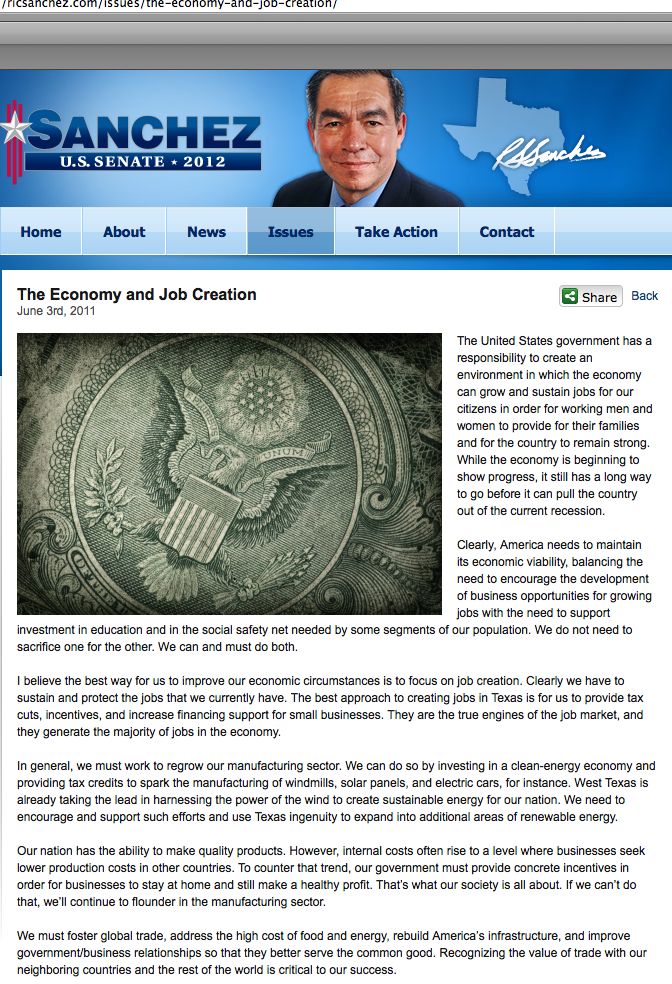
  • So far, so standard for liberal Democrats. However, in “The Economy and Job Creation” section, in addition to the usual “green jobs,” “social safety net” and “infrastructure” blather all Obama-era Democrats parrot, there’s this: “The best approach to creating jobs in Texas is for us to provide tax cuts, incentives, and increase financing support for small businesses.” Never mind that the entire page is vague to the point of distraction, never mind that the words “budget deficit” and “national debt” are nowhere to be found; the frontrunner for the Democratic nomination for the Texas Senate seat actually came out for tax cuts. Even more shocking is that there’s no mention of that holiest of Democratic talking points, “tax hikes on the rich.” Indeed, a Democratic candidate calling for tax cuts is so out of character that I feel compelled to take a screen shot in case the Nutroots read him the riot act and force him to scrub it, so here it is:

  • It’s in the third paragraph. Click to embiggen.

    Granted, anyone can say anything on their website; it doesn’t mean they believe in it, and it doesn’t mean they won’t jettison it ten minutes after they’ve won election. But for a major Democratic candidate to call for tax cuts not before the general election, but even before the Democratic primary, suggests that either Texas is even more conservative a state than even we on the right realize, or (and I mention this only as a possibility) Ricardo Sanchez actually believes in tax cuts as a way to create economic growth. That would put him in agreement with the all the major Republican candidates, but it’s pretty close to heresy in today’s Democratic Party.

    We’ll see what sort of reaction his positions get, assuming people can actually find his website…