Not quite as down as I was last night. There’s lots of the commentary this morning on how Donald Trump under-performed vs. expectations.
Here are some random primary results and links:
“So far, Trump wins open primaries and Cruz wins closed…and the calendar is starting to change toward more closed primaries.” Also: “So here’s where it potentially gets interesting. Although the media are looking forward to March 15, this Saturday (March 5) there are four Republican primaries/caucuses: Kansas, Kentucky, Louisiana and Maine. All are closed.” If Cruz can take three of those four, it’s a whole new race. (Hat tip: Instapundit.)
It was generally a bad night on the anti-Joe Straus front. Straus won his primary, as did Jason Villalba, and Straus-backed Lance Gooden took out conservative Stuart Sptizer in the Texas 4th Congressional District, while Hugh B. Shine took out conservative (and bit of a loose cannon) Molly White. For a while it looked like Straus crony Byron Cook might lose, but he eked out a win over Thomas McNutt with 50.4%.
The chairman of the Licensing Committee, Wayne Smith, and the chairman of Special Purpose Districts, Doug Miller, are now facing tough run-offs against conservative challengers Briscoe Cain and Kyle Biedermann.
State Rep. Debbie Riddle, a Straus loyalist on the powerful Calendars Committee, was defeated outright by Valoree Swanson in a four-way race.
Meanwhile, decorated veteran Terry Wilson defeated liberal State Rep. Marsha Farney, who was rumored to have been tapped by Straus to helm the Public Education Committee in 2017.
On the other hand, conservative fighters Jonathan Stickland, Tony Tinderholt, and Matt Rinaldi won big re-election fights. Stickland, Tinderholt, and Rinaldi were top targets of the establishment, with the opponents slinging copious amounts of mud to no avail.
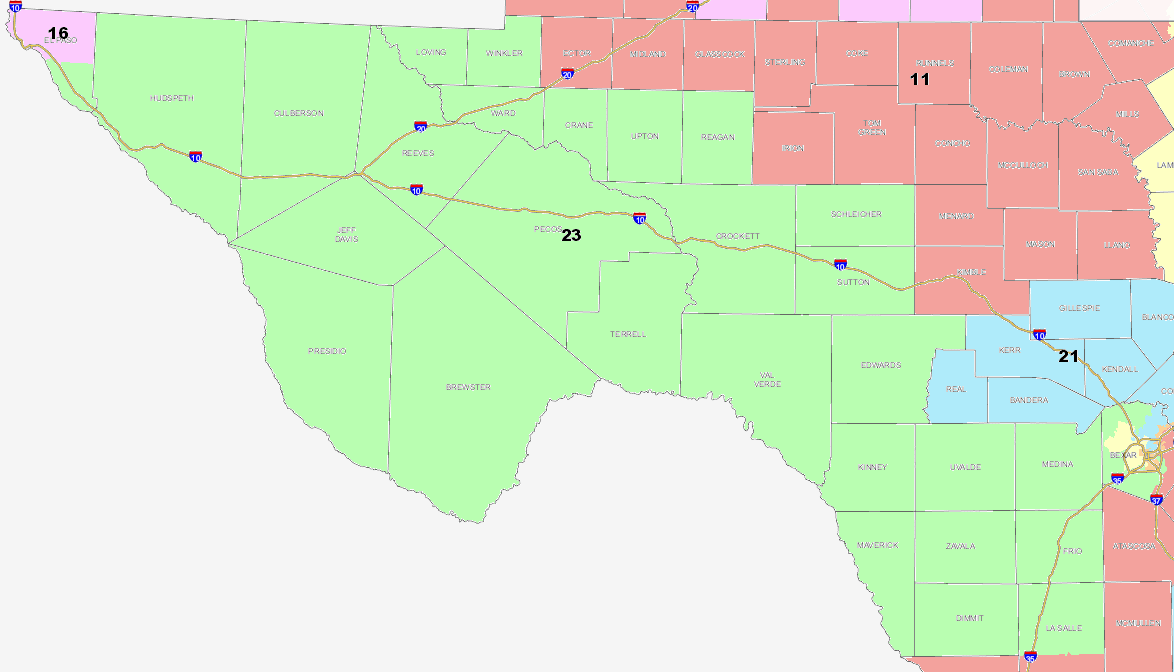
Another Will Hurd (R) vs. Pete Gallego (D) matchup in the 23rd Congressional District. This is the only true swing U.S. House seat left in Texas, and it will probably come down to turnout. Gallego took the seat from Francisco “Quico” Canseco in 2012 and Hurd took the seat back for Republicans in 2014.
Other Williamson County races: Robert Chody wins the Sheriff race over four challengers, Donna Parker and Landy Warren are going to a runoff for County Commissioner Precinct 1, and Laura Baker and Warren Oliver Waterman are going to a runoff for Williamson Court-at-Law No. 2 Judge.
Francisco “Quico” Canseco is gearing up to take U.S. Congressional District 23 back from Democrat Pete Gallego. Canseco lost the by just over 9,000 votes in 2012, having beaten Ciro Rodriguez for the seat by just over 7,000 votes in 2010. CD23 is the biggest “swing” district in Texas, and Canseco probably has a good chance to take back the seat as Gallego will have to win in 2014 without a boost from the Obama campaign.
I was going to have an insightful, data-filed post on the Texas 23rd Congressional district race, but then I realized that the Los Angeles Times data I was relying on flipped at least one bit of information (NRA-ILA is doing independent expenditures against Pete Gallego, not against Rep. Francisco “Quico” Canseco), which means I can’t trust the rest. Super executive summary: Canseco has a huge cash on-hand advantage, $785,623 to $23,250, but assuming the other LA Times numbers are right, the independent expenditure race is a lot closer to even.
Now on to a LinkSwarm a week before the election:
Obama is clearly winning the race for military endorsements, having 6 endorsements to Romney’s paltry 359.
Given that Miklosi has raised about half of what his Republican opponent incumbent Mike Coffman has for the Colorado Sixth Congressional District race, but only has about one-fifth the cash on hand, Livoti seems to have retained his magic touch.
As previously reported, the Texas 23rd Congressional District is one of the most closely watched races in the country. As such, it’s no surprise that the Democratic Congressional Campaign Committee is rolling out attack ads against incumbent Republican Rep. Francisco “Quico” Canseco on behalf of Democratic challenger Pete Gallego.
And, much like the national Democratic attack ads, it’s filled with lies.
But don’t take my word for it. WOAI in San Antonio has done the heavy lifting in debunking team Gallego’s claims:
The most important Texas political race is obviously the Texas Senate race. Barring any unforeseen catastrophe, I fully expect Ted Cruz to soundly thump Paul Sadler in November.
The second most important Texas race is for the 23rd Congressional District, where Republican Francisco “Quico” Canseco eked out the second closest win over a Democratic congressional incumbent in 2010, beating Ciro Rodriguez by a little over 7,000 votes. Rep. Blake Farenthold’s win over Solomon Ortiz in the 27th congressional district was the closest Texas CD race that year, decided by a mere 799 votes, but the 27th was made considerably more Republican in redistricting, going from voting for Obama by 53% of the vote to a mere 40% of the vote under the new district lines.
The legislature was not able to reenforce Canseco’s sprawling district to nearly the same extent, and it was only made slightly more Republican, going from a 51% Obama district to a 50% Obama district. That, plus the power of incumbency and $1 million cash on hand (as of June 30) give Canseco a real fighting chance to hold the seat. His Democratic opponent, Pete Gallego, spent all his money to beat Rodriguez in the runoff, but this is still the only decent shot Texas Democrats have to defeat a incumbent Republican congressman this year, so expect the usual big Democratic donors (unions and trial lawyers) to come to his rescue.
Heritage ranks Canseco a solid (if not exceptional) conservative at 72%, higher than the (lamentably low) Republican House average of 65%, but 50 points better than even the best Texas Democratic representative (Henry Cuellar).
If you were looking for a Texas congressional race where your donations might help Republicans hold a tough seat, this is the one.
In the game of District 35 Chicken, Ciro Rodriguez decided that no, he didn’t want to face off against Lloyd Doggett’s 18-wheeler full of money and swerved aside. Instead he’s going to run against Republican incumbent Francisco “Quico” Canseco for the 23rd Congressional District seat Rodriguez lost to him in 2010. But before that, he has to get past State Rep. Pete Gallego, who has been running for the 23rd for months and tried (unsuccessfully) to warn Rodriguez off what is now likely to be a very bruising Democratic primary fight. (John Bustamante, son of yet another former Democratic congressmen, is also running, but with only $3,000 in his campaign coffers, I see no sign that he has gotten any traction, whereas both Rodriguez and Gallego have broken the $100,000 mark.)
I’ve been reading up a bit more on the compromise redistricting lines released by the San Antonio district court. Texas Attorney General Greg Abbot was able to keep most of what the legislature passed, and the Governor signed, intact, but a few changes were made to satisfy Democratic demands to win in court what they couldn’t at the ballot box settle lawsuits by various minority interest groups under the provisions of the Voting Rights Act.
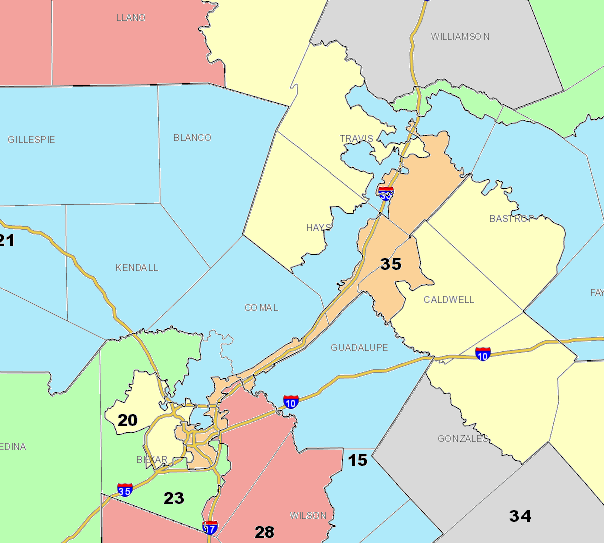
Though U.S. Congressional Districts, State Senate Districts, and State House districts were all affected by the new maps, I want to focus on three U.S. Congressional Districts, including some shown in this map here:
District 35: Lloyd Doggett may not be gone, but District 35, the one Doggett plans to run in, is now 65% Hispanic and mostly based in San Antonio. And the recriminations have already started among Democrats: “If Lloyd Doggett would man up and spend that $3 million he’s been hoarding for the last decade, then we could have an extra Democratic seat.” Doggett dodged a bullet when District 20 incumbent Charlie Gonzalez (son of long-time Congressmen Henry B. Gonzalez, who held the office before him) announced he was retiring, letting up-and-comer Joaquin Castro run for that seat instead of 35, but there’s no shortage of San Antonio-based Democratic contenders, including Bexar County Tax Assessor-Collector Sylvia Romo. (There are two Republicans running for District 35, Susan Narvaiz and Rob Roark, both of San Marcos, but given that the new district went for Obaama by 63%, it’s going to be quite an uphill climb for any Republican.) One of the candidates currently running in District 35 is former Democratic Congressman Ciro D. Rodriguez (who is very pissy indeed about redistricting), who previously represented:
District 23: This seat is currently held by Republican Francisco “Quico” Canseco, who beat Rodriguez by a little over 7,000 votes in 2010. The redistricting map passed by the legislature made Canseco’s district more Republican, but the compromise district scales back Republican gains. It’s now slightly more Republican (50% of the new district voted for Obama in 2008, down slightly from 51% in the old district), but it’s still close enough that Democrats have to consider this a prime takeover target. Still, Canseco now has the power and name recognition of incumbency, and even if Obama wins (doubtful and frightful, but possible), I doubt his coattails will be particularly long in San Antonio. Texas State Rep. Peter Gallego is the likely Democratic candidate, but so far Canseco is beating him in the fundraising race over three to one. (Disclaimer: Canseco is one of two U.S. congressional candidates I donated to in the 2010 election cycle (three if you count attending a couple of John Carter’s picnics at $10 a pop).)
Over on the left side of the Blogsphere, the Kos Kids have put up the a breakdown that includes numbers on how each District voted in the 2008 Presidential race.