She seems nice: “Nikole Hannah-Jones, the lead essayist on New York Times Magazine’s 1619 Project, wrote a letter to the editor in Notre Dame’s The Observer stating that ‘the white race is the biggest murderer, rapist, pillager, and thief of the modern world.'” (Hat tip: Sean Davis.)
Theoretical phsyicist Dr. Stephen Hsu forced to resign VP position after bogus accusations of sexism and racism:
“The attacks attempt to depict me as a racist and sexist, using short video clips out of context, and also by misrepresenting the content of some of my blog posts. A cursory inspection reveals bad faith in their presentation,” Hsu posted on June 12. “The accusations are entirely false — I am neither racist or sexist.”
“The Twitter mobs want to suppress scientific work that they find objectionable. What is really at stake: academic freedom, open discussion of important ideas, scientific inquiry. All are imperiled and all must be defended.”
Robert Johnson, founder of Black Entertainment Television (BET) and the first black billionaire, mocked Cancel Culture and the “borderline anarchists” who topple statues and monuments, claiming that black people “laugh” at the white people engaging in such violence. Even when white liberals topple a Confederate statue, Johnson insisted, “black people don’t give a damn.”
“Look, the people who are basically tearing down statues, trying to make a statement are basically borderline anarchists, the way I look at it,” Johnson told Fox News on Wednesday. “They really have no agenda other than the idea we’re going to topple a statue.”
The first black billionaire, who has called for $14 trillion in reparations payments to descendants of slavery, argued that vandalism and attacks on statues do not help the black community.
“It’s not going to give a kid whose parents can’t afford college money to go to college. It’s not going to close the labor gap between what white workers are paid and what black workers are paid. And it’s not going to take people off welfare or food stamps,” Johnson insisted.
He insisted that the rioters tearing down statues “have the mistaken assumption that black people are sitting around cheering for them saying, ‘Oh, my God, look at these white people. They’re doing something so important to us. They’re taking down the statue of a Civil War general who fought for the South.’”
“You know, black people, in my opinion, black people laugh at white people who do this the same way we laugh at white people who say we got to take off the TV shows,” Johnson added. He said these attempts to purge American culture of supposedly offensive monuments and media are “tantamount to rearranging the deck chairs on a racial Titanic.”
“It absolutely means nothing,” the BET founder insisted.
“White Americans seem to think that if they just do sort of emotionally or drastic things that black people are going to say, ‘Oh my God, white people love us because they took down a statue of Stonewall Jackson.’ Frankly, black people don’t give a damn,” he quipped.
Know who else isn’t impressed with Social Justice Warriors? Muhammad Ali’s son.
“Don’t bust up s**t, don’t trash the place,” Ali Jr. told the Post. “You can peacefully protest. My father would have said, ‘They ain’t nothing but devils.’ My father said, ‘all lives matter.'”
With regard to the Black Lives Matter movement specifically, Ali Jr. said he believes BLM is “racist” — and his father would have, too.
“I think it’s racist,” he said. “It’s not just black lives matter, white lives matter, Chinese lives matter, all lives matter, everybody’s life matters. God loves everyone — he never singled anyone out. Killing is wrong no matter who it is.”
“It’s pitting black people against everyone else. It starts racial things to happen; I hate that,” he added of the BLM movement.
Communist China has decided it must crush Hong Kong because it knows the city presents an information-streaming ethnic, geographic, political and ideological alternative to the Chinese Communist Party’s authoritarian police state.
The CCP police state promises China’s citizens prosperity’s material goodies — cellphones, electric cars — in exchange for silently accepting communist dictates no matter how harsh and malign. Hong Kong, however, is not a promise. It is an existing democratic example of 21st-century Chinese prosperity.
Why add “information streaming”? Despite the best efforts of the CCP’s censors, cyberbullies, digital surveillance brigades and police threats, what happens in Hong Kong doesn’t stay in Hong Kong. Information about Hong Kong’s political, economic, social and cultural vitality manages to spread throughout mainland China.
The Chinese people also know Beijing lied about the COVID-19/Wuhan virus. The virus originated in China. Only former Obama administration media flacks argue otherwise. The CCP may have tried, but it failed to control human-to-human stories of mourning families. In February and March, the Chinese people knew why demand for funeral urns had spiked in the Hubei province.
The preceding four paragraphs sketch the domestic political threat the CCP confronts. Tiananmen Square proves the CCP sees this threat as a war.
The CCP cannot answer this question: How long can the prosperous tyranny continue to survive trading smartphones and quality American pork for political subservience by the roughly 400 million people in China’s quasi-middle class?
Snip.
Recent economic news suggests China is teetering. A China-EU investment and trade deal has snagged. Bloomberg reported defaults “in all sectors” of China’s offshore bond market have exceeded $4 billion, double that during the same period of 2019. First-quarter 2020 percentage profits, capital expenditures and retail sales may be the lowest since the 1990s.
Big Picture: The goodie-producing economic engine that braces the CCP’s domestic political strategy needs international markets. China’s domestic economy can’t sustain it.
CCP international aggression magnifies the vulnerabilities. Recent vile aggression abounds.
States with the least restrictions on their citizens’ movements and businesses due to the CCP Virus pandemic have the lowest death rates on average from the disease that prompted a national lockdown beginning in mid-March, according to a new study.
Conversely, the most restrictive states show higher death rates on average from the disease known as COVID-19 caused by the CCP virus and originating in late 2019 in China.
You know all that “Wuhan Coronavirus is overwhelming Houston hospitals!” panic? Yeah, not so much. (Hat tip: Aaron Glenn.)
More on the subject:
Here's what's going on with plenty of availability of general beds, too.#Texas has 2nd most recoveries in nation & 2nd lowest case fatality rate. @DavidBalatHC#Texas is responsibly phasing out shutdown, but some are spreading fear & wanting people locked down. #txlegepic.twitter.com/VeuSm3fM3W
Tesla is said to be in negotiation with Travis County, Texas, home to the state capital, Austin, for property tax abatements on what is said to be up to a $25 billion investment bringing up to 30,000 jobs to the region. Since Texas collects most of its taxes through property taxes, abatements are often offered as an incentive for industry to locate in the state and can be worth millions.
The proposed Tesla gigafactory in Austin would build the company’s new Cybertruck electric pickup and serve as a second site to build the Model Y SUV.
I’d never heard of Wirecard before last week, but evidently CEO Markus Braun resigned over some massive financial shenanigans that involved missing billions.
A few writers you’ve never heard of: “How dare J. K. Rowling question the sacred trans movement by saying there are two sexes! You must drop her immediately and send your staff for ‘reeducation!'” Literary agency: “Ah-ha-ha-ha-ha! That’s funny! There’s the door!”
A three hour interview. Yeah, I know I’m not making things any easier on you.
Still, I suggest watching it, even though I think Rogan and Weinstein are wrong on some fundamentals (see my notes below) because Weinstein, having lived through the Evergreen State College nightmare, has a far better (and scarier) understanding of what outlandish ideas animate the unholy Social Justice Warrior alliance that has set America’s cities aflame.
Some of the money quotes:
“We were in a faculty meeting [at Evergreen], and I said that the proposals that were moving through were a threat to the Enlightenment values that were the basis of the institution. And what I got back was something I had never heard before, which was an attack not only on the Enlightenment but on the idea of enlightenment. I was just so stunned. I was a college professor amongst faculty and somebody was actually saying out loud that Enlightenment was a problem and nobody in the room said anything.”
“If you end up in Critical Theory, any one of these fields, Women’s Studies, Queer Studies, whatever, it is you have already foregone this option [of studying STEM]. You don’t end up in Critical Theory if you have the chops to do science. So in effect you have people who don’t stand to personally benefit from opening those doors wider, because they wouldn’t go through them, arguing that nobody should go through those doors.”
“An excellent student, one of the best ones we ever had, was a young woman named Odette. Odette is half black her mom is Afro-Caribbean, she was known to be my student and Heather [Haying, Weinstein’s wife and also a teacher at Evergreen]’s student during the riots. And she was actually confronted and physically bullied by the rioters who accused her of being a race traitor for studying science. This actually happened.”
“If #BlackLivesMatter just simply meant what those words imply, I’d be on board with it. It doesn’t. It means a great deal more than that, and we’re beginning to see that in the last couple of weeks.”
“There’s something in us that thinks that the Great Leap Forward in China cannot happen here. That what happened in Cambodia cannot happen here. That Nazi Germany cannot happen, and that the Soviet Union couldn’t happen here. I don’t know what characteristic it is that people think makes it impossible. I don’t think it’s impossible. I think if there is a characteristic that makes it unlikely, it is the structure it is the Constitution.” (I would contend that widespread gun-ownership and ingrained American individualism make it very unlikely. I also wonder if he means the Cultural Revolution rather than the Great Leap Forward.)
“The proposals that are coming out of this movement are quite foolish. The strategy is incredibly smart.”
“If there’s one most important lesson out of the whole Evergreen fiasco, it’s that the police can be withdrawn from a situation and chaos takes a matter of hours to emerge, which we are also seeing in Seattle.”
“The idea that you could withdraw the police first is absolutely insane.”
“Joe Biden is an influence peddler. He is not an idea guy. He’s the same idea as Hillary Clinton in a different morphology. Who cares? This is not an answer to any known question. This is stay the course at a moment when we could not afford to stay the course less right. How dare the Democratic Party do this to us again at this moment?”
“Hillary Clinton advanced Trump’s candidacy because she wanted to run against him. So if you if you have Trump Derangement Syndrome, you still have to be angry at the Democratic Party for putting us in this predicament.”
The biggest thing Weinstein and Rogan get wrong: The lack of opportunity in inner cities isn’t an effect of mass incarceration, but of the breakdown in the black nuclear family brought about by the perverse incentive structures of Johnson’s Great Society welfare programs, which preceded rising black crime rates and increased incarceration. Widespread black economic progress was proceeding and converging toward white norms before the Great Society. Once again, read Charles Murray’s Losing Ground, which goes into great statistical detail to prove the case.
Also, Occupy Wall Street was in no way, shape or form an “organic” movement, it started out battlespace preparation by the Obama team to face Mitt Romney in 2012, but quickly became the prototype for the organizational insurrection we saw first in Ferguson and which has now been rolled out nationwide.
His argument for a “radical centrist duo” to run for President and Vice President outside the two-party system just isn’t going to work, for political, cultural and (most important) Constitutional issues. And it can’t work this year for calendar/ballot access issues. (And the idea that former Admiral William McRaven is even remotely possible as a center-right white horse savior is laughable. Weirdly, Andrew Yang strikes me as much more plausible candidate, even if Universal Basic Income is wrong, but he’s neither rich nor famous enough to pull it off.) When he starts talking about that, feel free to skip to 1 hour and 44 minutes in for Rogan to start talking about Biden’s cognitive decline.
To be honest, I made it about an hour and fifty minutes in, only because I need to post this do other stuff. I fully intend to watch the rest this weekend.
So what did it take to turn spineless lefty Portland Mayor Ted Wheeler into a law-and-order guy? Trying to create an “autonomous zone” on his own street. “By 1 a.m., elaborate barricades had been erected. But in the early hours of Thursday morning, police moved into the area, declaring it an unlawful assembly. Portland Police estimated about 50 people were in the area when they dispersed the autonomous zone.”
It’s certainly frustrating to watch a pack of reeking leftist scumbags declare a portion of an American city an “autonomous zone” – what is it with Democrats and their secession fetish? – but do not get frustrated because Donald Trump has not sent the 101st Airborne in to powerwash the human grunge from Seattle’s feces-bedecked streets.
That’s what the Democrats want. And Trump – a better strategic thinker than all the media geniuses, hack politicians, and Afghan War-losing generals who cry about him – is not only not going to give them the victory they crave. He’s going to jam their cheesy plan down their throats.
The libs’ plan to win in November corresponds to Trump’s plan to crush them yet again. Skeptical? Consider this. In the five years since he rode down that escalator bringin’ hell with him, how many times have they come at Trump and won? Zero. He’s spent half a decade on the edge of doom and he’s still here. Why would you think that the walls are suddenly closing in now? You shouldn’t.
Let’s understand the strategic scenario. The long-term strategic objective of the leftists is to turn the United States into Venezuela, and they want to be Maduro. The major strategic objective that will put them in position to do so is victory in the November elections. Everything happening right now is part of their overall strategy to achieve that objective. But what kind of operation are they using to achieve that objective? There are two types of operations relevant here – kinetic and information. A kinetic operation is actual warfare. It’s violence designed to defeat the enemy and cause his surrender by either physically destroying him or occupying his territory and compelling surrender. An information operation is designed to affect the perceptions, and thereby the actions, of the target. Kinetic ops tend to do something to the enemy; and info op tends to get the target to do something to himself.
Elections are usually information operations. They attempt to build a narrative and play on perceptions and cause the target to take the action that will lead to victory. That is, get the target (the electorate) vote for the candidate the info operator wants elected.
Okay, so what is the 2020 elections, with the rioting, vandalism, violence and occupations?
This still an information operation, not a kinetic one.
They want to convince us we are powerless, that everyone else supports their commie agenda, that we cannot win. Their tactics are designed to create that impression and crush our morale. These include the 24/7 media hype, the outright media lies, the movie stars with their dumb PSAs, the staged statue attacks, the corporate solidarity proclamations, the social media cancellations, and the craven kneeling by people who are supposed to stand up for us. But another tactic, familiar to any student of insurgencies, is to provoke an overreaction by those in power in order to undermine its moral authority. They want is to make us (including the president) think this is a kinetic operation, and get our side to make fundamental strategic errors by failing to recognize the true nature of the threat. They hope that such a mismatch between perception and reality will then lead to gravely damaging blunders. One of those would be Trump succumbing to his legit frustration and sending in a bunch of federal troops to crack skulls in Seattle.
Defining this insurgency as a kinetic operation supports the leftists’ information operation goal of making Americans perceive the situation as out of control, of there being chaos, and of making the election of Grandpa Badfinger being the only thing that will resolve the situation. But there is no kinetic situation to resolve – at least none that is strategically significant in a kinetic sense. Despite the hype, the protests may have involved a peak of 2 million people across the country – out of 330 million. That’s nothing kinetically; it’s significant informationally because it is pushed by so many cultural influencers. The scurvy scumbags of Antifa hold essentially no ground except the turf they are physically standing on at the moment, and that is minuscule. Even the hilarious Road Warrior Republic of Seattle is not even a rounding error of a rounding error in terms of US territory. It’s significant only in the context of an information operation.
Many of us cons are furious that Trump is “doing nothing.” This is the wrong thing to think. Trump is only doing nothing if this is a kinetic operation; because this is an information operation, not going kinetic (sending in the troops) is doing something. And in fact, Trump is employing the law enforcement component of his kinetic assets by having the feds wait and arrest Antifa types after the protests end, and hitting them with hardcore federal rioting-related charges. Previously, they would get ticketed and released; now, looking at a five-to-ten stretch, the lawyers their daddies hired to get these sunshine anarchists out of their beefs are going to be advising them to roll over so they can start back up at Cornell in September and not at Leavenworth.
Who benefits then from our national nervous breakdown that never seems to end?
It is the globalist elites who still govern most of our society today, despite the invasion of Donald Trump.
And those elites wish to continue that rule through what they fervently hope will come as the outcome of these demonstrations—more government control, particularly government control that helps them.
They have seen it done elsewhere with results they might want to emulate, at least until recently.
Call it China Envy.
The Chinese Communist Party has, over the years, found a way to regulate their society to an extraordinary degree via a form of communism that maximizes profits and power for those (party) elites while holding the masses largely at bay.
No wonder our elites are jealous.
People call ours “globalists” but they’re not really global. They’re selectively global, but actually just greedy and power-hungry, like the ChiComs.
Whether planned or not, or partially planned, the current confluence of catastrophes has offered them an opportunity to advance their cause against their natural adversary, Mr. Trump.
In macro, that is the landscape of election 2020—the globalist elites represented, for the moment anyway, by Joe Biden versus the American people, represented by Donald Trump.
Many of those American people, heavily influenced by the media and repelled by the president’s rhetoric, do not realize that he is representing them, but he is. Ignorant, often willfully, they oppose him tooth and nail.
An equal number, or possibly larger, as the one million plus requesting tickets to his Tulsa rally indicates, supports Mr. Trump.
We are in the midst of a Battle Royale for the soul of our nation, whether it remains more or less the democratic republic the Founders envisioned or becomes an Americanized version of what has been evolved by the CCP.
If the latter, ironically, then such groups as Black Lives Matter (BLM) and Antifa will be kicked to the curb once victory has been achieved and secured.
It’s always the same thing: Our newspapers are full of intense interest in Harvard’s admissions standards but have very little to say about New York City’s dropout rate. People can’t help being fascinated with themselves and their peers. If you want to know what is on the minds of the leaders of the American ruling class, it’s no secret. They’ll tell you, if you ask — and if you don’t.
George Floyd is still dead. Jacob Frey is still mayor of Minneapolis. Medaria Arradondo is still the chief of police. More than a third of black students will drop out of high school in Milwaukee. But Forbes has announced a change in its in-house stylebook and will henceforth honor the woke convention of uppercase Black vs. lowercase white. And George Floyd is still dead. Jacob Frey is still mayor of Minneapolis. Medaria Arradondo is still the chief of police.
Oh, but they got James Bennet, the opinion editor at the New York Times. And surely that is something? It is, indeed, a very useful illustration of the E-Class vs. S-Class divide. Bennet was fired after purportedly endangering the lives of black Times staffers — a charge no mentally normal adult actually takes seriously — by publishing a guest column about the riots and the Insurrection Act by Senator Tom Cotton. The campaign to end Bennet did not come from America’s poor black communities as the workers of the world looked up, stunned, from page A24 of the New York Times — the venom came straight and undiluted from 620 Eighth Avenue, New York, N.Y., with Bennet’s underlings and juniors more or less putting him on an ice floe and pushing him out to sea.
Bennet was pushed out on behalf of marginalized black Americans, which necessitated that Bennet immediately be replaced by . . . a well-off white woman who went to Georgetown and Columbia and won a Pulitzer Prize for writing about that great loathsome theater of American middle-class anxiety: restaurants. (“The real price of inexpensive menu items,” the Pulitzer people summarized.) Well-off white women from elite colleges run the diversity-and-sensitivity racket like the 17th-century Dutch ran the tulip racket, like the De Beers cartel used to run diamonds. Big Caitlyn is getting paid. Affluent white women are the main E-Class beneficiaries of the current headhunting project to clear a little room at the top, just as they have historically been the primary beneficiaries of affirmative-action programs, contracting set-asides, and other programs to help out the poor disenfranchised Georgetown alumni out there in the cold and dark.
“Police, Fire Reportedly Refused to Respond to Crime in Progress in Seattle’s Breakaway CHOP.” “This is where ‘defund the police’ will lead not just in Seattle, but wherever it’s thoughtlessly implemented. Probably not all the way to the segregationist, secessionist CHOP, but to crime-ridden streets into which police and fire are more circumspect about intervening.”
these riots and their associated melodrama might most accurately be called the Nov. 3 riots. It’s the prospect of the election, especially the possibility that President Donald Trump will be reelected, which provides the fuel for the current hysteria.
But Simon is right. A solid majority of voters are disgusted by what they see. There is a large overdraft on the country’s budget of white guilt. Expect a foreclosure on the account Nov. 3. Yes, yes, the situation is fluid and a week, as Harold Wilson once observed, is a long time in politics. But a biopsy of the body politic in mid-June 2020 doesn’t bode well for the old man in the basement or scriptwriters Nancy Pelosi and Chuck Schumer.
The longer this madness continues, the more likely it is that the president will enjoy a victory of historic proportions.
Another caveat about all those “Oh my God, Wuhan coronavirus cases are spiking in Florida,” etc. stories, take a look at these statistics. Assuming they’re accurate (a big assumption), new cases are going up (not spiking per se), but deaths are going down. It really looks like cases aren’t spiking, we’re just detecting milder and milder cases of it thanks to widespread testing.
Instead of #BlackLivesMatters, how about actually defending black lives? “National African American Gun Association (NAAGA) Membership Grows as Members Purchase Ammo in Record Numbers.” Good. (Hat tip: Say Uncle.)
Good news in a sea of bad: Austin Police Chief Brian Manley is not getting the axe. Finally, a scalp the radical left didn’t take.
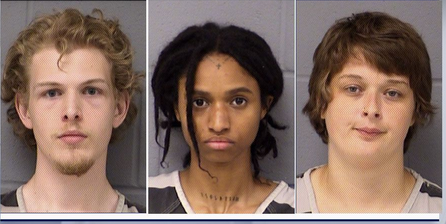
Antifa members arrested in Austin for looting. “Lisa Hogan, Samuel Miller, and Skye Elder were arrested last week and charged with various state jail felonies after they smashed into a boarded-up Target, destroyed and ripped out surveillance cameras, and looted the store, stealing and damaging over $20,000 in property.” The mugshot:
Exactly the sort of Antifa winners you would expect to loot a Target
Chuck-E-Cheese files for bankruptcy. When they had to make it on the quality of their food, they were doomed…
Also filing for bankruptcy: 24 Hour Fitness. Hard to make a living when the government outlaws your business model. (Hat tip: Instapundit.)
Rocket fuel storage facility explosion in #China, the air catches fire before the explosion, the orange smoke is a clear indication of rocket fuel. The Shockwave shatters the glass of the nearby textile mill. You will not find this story on Chinese "news"
Biden comes out of his basement and sees his shadow, more questions about China and Ukraine, more veepstakes, and questioning just how much of that #BlackLivesMatter money ActBlue is raking in goes to Biden. It’s this week’s BidenWatch!
After reaching the BLM homepage, which features a “Defund The Police” petition front and center, if a user chooses to donate, they’re rerouted to a site hosted by ActBlue and prompted with the message: “We appreciate your support of the movement and our ongoing fight to end state-sanctioned violence, liberate Black people, and end white supremacy forever.”
Joe Biden is the top beneficiary of the ActBlue’s fundraising efforts.
Is there any evidence that BLM funds donated through ActBlue aren’t going to Biden? If so, who are the recipients?
Reminder: Biden once had a very different view of street disorder and black lives:
I’m not sure that highlighting the 1994 crime bill will actually cost Biden votes, but showing videos like this does provide a stark contrast of the Joe Biden of today and the Joe Biden of the past who obviously had a far more functional brain…
Creepy Joe Biden is beginning to emerge from the basement again, and the results have not been auspicious thus far.
Cut to Philadelphia, Wednesday. He was sporting the de rigueur mask, but it was dangling loosely from his left ear, as if he’d forgotten it. That made his statement attacking President Trump (I think) all the more bizarre.
All dialogue guaranteed verbatim:
“You know, the rapidly rising uh, um, uh, in with the — with the — I don’t know, uh uh,” he said, finally looking up in utter confusion from his notes.
“His, his just inability to focus on any federal responsibility,” Biden mumbled, and I don’t believe he’s been seen outside the basement since.
That latest stumble got a good leaving alone from approximately 99% of the media’s Democrat stenographers. So the next day the Trump campaign manager put out an email demanding that the press’s Democrat rump swabs “stop protecting Biden.”
“The failure to expose the American people to these rambling displays of incoherence, ineptitude and forgetfulness is depriving voters of a clear picture of Biden’s inability to execute the duties of the office he seeks.”
Which is exactly why Biden’s comrades in the media are doing their damnedest to keep him under wraps.
Staying out of the limelight is good for Biden because the election is not about him. It’s about Trump and his missteps, and Biden is the generic Democratic alternative to another four years of the current administration.
Biden’s campaign is explicitly trying to define the election based on whether or not to give Trump four more years in office. A slide in a Biden campaign strategy briefing last month said, “This election is a referendum on Trump.”
“If the country is asked to have an up or down vote on whether or not Donald Trump should receive four more years, the country would say no, and [the Trump campaign] themselves admit it,” Biden campaign strategist Mike Donilon said during the presentation.
Former Virginia Gov. Terry McAuliffe plainly explained why Biden does not need to be out in the open during a video call with a local Democratic group over the weekend.
“People say all the time, ‘Oh, we got to get the vice president out of the basement,’ He’s fine in the basement,” McAuliffe said. “Two people see him a day: his two body people. That’s it.”
Will a Joe Biden presidency derail housing reform and the “recap and release” of mortgage giants Fannie Mae and Freddie Mac?
The answer is a resounding “yes,” according to housing analysts who have ties to Biden’s economic advisers and their thinking on what might happen to the housing giants, if as current polls suggest, the former vice president unseats Donald Trump and becomes president in November….affordable housing is a significant issue to Biden and he would like to expand Fannie and Freddie’s mandate and likely keep them under government control.
Of course they do. How else are Democrats supposed to rake off the graft?
We all agreed that Trump has been too tepid lately and not using the instincts that blew up the political world in 2016.
We are all aware that Joe Biden has benefited greatly from his pandemic-induced basement quarantine. He’s such a train wreck that his handlers are no doubt working overtime to come up with excuses to keep him away from the campaign trail and — more importantly — from sharing a debate stage with President Trump.
The three of us agreed that President Trump needs to seize the initiative now and start goading Biden to get back in the public eye and into a debate. One of Trump’s greatest gifts is the thing that drives old guard Republicans crazy — his ability to drive a narrative on social media. Now is the time for him to use that bully pulpit and relentlessly bait Biden and force his hand.
Biden can’t win a Twitter throwdown with Trump. His handlers are tweeting for him and they are not the most inventive lot. His Twitter feed reads like something that came from a book titled “Democrat-y Stuff Candidates Should Say.” It would be very easy for the president to make Crazy Joe the Wonder Veep look awful all day, every day. The end game is to get Biden back in public, of course, but there is an immediate return on investment in a Twitter flame war.
In my five years of watching Donald Trump in the political arena, the only thing I’ve learned is that Trump probably isn’t going to do what I expect him to do, or think he should, and that what he ends up doing will probably be more effective than what I suggested. (Hat tip: Stephen Green at Instapundit.)
Biden spent over three decades opening American markets to Chinese goods, ignoring China’s abhorrent human rights record, and dismissing the challenge posed by our greatest rival for global leadership. The “made in China” era coincided with the closure of tens of thousands of American factories, stagnant working-class wages, and the loss of America’s ability to produce essential goods domestically — a vulnerability that took on incredible significance when we learned that we were dependent upon China to produce the medical equipment needed to combat the coronavirus pandemic.
This disaster was facilitated by politicians of both parties, and no one was more gung ho than Joe Biden, the poster child for the globalism that reigned supreme until the 2016 presidential election, which Donald J. Trump won by campaigning on a platform diametrically opposed to the “open markets and open borders” philosophy of the D.C. establishment. In the White House, President Trump became the first American leader in decades to take a firm stand against China’s malfeasance and demand a genuinely fair and reciprocal trade deal for American workers.
While Joe Biden was the vice president of the United States, conversely, he was downplaying the consequences of China’s rise — even as his own family tried to get rich through deals with Chinese state-owned companies.
Biden leading in swing states, yadda yadda yadda. Consider this your periodic reminder that polls are pretty much meaningless this election season. The one poll I dug into, for Texas, undersampled Republicans by about seven points, so expect widespread media falsification of just about every media to help drag Biden over the line.
Another reason not to believe those polls: When you ask people who they think will win, a majority agree that President Trump will beat Biden, 51%-37%. (Hat tip: Instapundit.)
As data show recent riots and the months-long COVID-19 economic shutdown hurt black-owned businesses more than any other racial group, the Trump campaign slammed rival presidential candidate Joe Biden for a “weak” response to these challenges.
Democratic governors generally have been more hesitant to reopen their states’ economies than Republicans, leading to criticism from President Trump and his campaign, which argues that delays hurt black-owned enterprises.
The Trump campaign pointed to a new study from the National Bureau of Economic Research showing there has been a a 41% decline in the number of black business owners from February to April of this year, driven by the COVID-19 shutdown.
“President Trump’s background as an entrepreneur and builder shapes his passion for protecting, supporting and empowering American black-owned business owners, especially right now,” Paris Dennard, Black Voices for Trump Advisory Board member told Just the News. “Every day Joe Biden fails to strongly call an end to the looting, and rioting in urban cities, more black-owned businesses are destroyed. Every day Joe Biden fails to support efforts to safely and expeditiously re-open the economy, more black businesses are destroyed. The data shows a prolonged economic shutdown hurts black American entrepreneurs, so Joe Biden’s opposition is standing in the way of black generational wealth, growth and opportunities.”
More veepstakes pandering. “Among the candidates who have progressed to the point of more comprehensive vetting or have the potential to do so are Sen. Kamala D. Harris (D-Calif.), Rep. Val Demings (D-Fla.), former national security adviser Susan E. Rice and Atlanta Mayor Keisha Lance Bottoms, all of whom are black. Sen. Elizabeth Warren (D-Mass.), who is white, is also in that group, as is New Mexico Gov. Michelle Lujan Grisham, who is Latina.”
The search committee has been in touch with roughly a dozen women, and some eight or nine are already being vetted more intensively.
Among that group are two contenders who have recently grown in prominence, Representative Val Demings of Florida and Mayor Keisha Lance Bottoms of Atlanta. One well-known candidate, Senator Amy Klobuchar of Minnesota, has lost her perch as a front-runner. And some lower-profile candidates, like Senator Tammy Baldwin of Wisconsin, are advancing steadily in the search process.
Some of the contenders who have advanced furthest in the process are well known, including Senators Kamala Harris of California and Elizabeth Warren of Massachusetts. But The Times confirmed that several other women — whose names have been repeatedly floated but who have not publicly confirmed that they agreed to be vetted for the job — are under active consideration as well.
Ms. Harris and Ms. Warren have been interviewed at length by Mr. Biden’s team, as has Ms. Baldwin, who was the first openly gay candidate ever elected to the Senate.
Two women with distinctive national-defense credentials have also been interviewed and asked for documents: Senator Tammy Duckworth of Illinois, an Iraq war combat veteran who is Asian-American, and Susan Rice, the former national security adviser to President Barack Obama and the first black woman to serve as ambassador to the United Nations.
As the vetting process advances to a newly intense phase, the political currents of the last few weeks are also leaving a mark on the Biden team’s deliberations. The wave of demonstrations touched off by the killing in Minneapolis of George Floyd, a black man, at the hands of a white police officer there, has elevated a pair of black women long regarded as intriguing long-shot candidates: Ms. Demings and Ms. Bottoms.
Though Ms. Demings and Ms. Bottoms are far less known to the national electorate than other figures on Mr. Biden’s list, they have played crucial roles in a cascading civil rights crisis: Ms. Demings, a former police chief in Orlando, Fla., has become a major figure in the law-enforcement debate, while Ms. Bottoms’s handling of chaotic demonstrations in her city earned her national acclaim.
For “national acclaim” read “less incompetent than other Democratic mayors.
This has been a long time coming. At least a generation, maybe two. The left methodically has taken control of key institutions to implement an anti-American, anti-Capitalist agenda.
You send your kids to public schools and college, where they are taught from their earliest years that America and capitalism are the sources of evil in the world, that we are a systemically racist society that consumes ‘black and brown bodies,’ while socialist and communist systems are more equal and fair. It’s all a lie, but it’s a lie told by the teachers, professors, and administrators with power. The real racists are the people who obsess about race, and who judge people based on the color of their skin.
When your kids emerge from the social justice warfare meat grinder, you don’t recognize them anymore. Oh well, you shrug.
There is a concerted effort funded by leftist billionaires and high tech companies to control what you can say, and to silence you through mob action or social media throttling if you get out of line. The large corporate media, with only a couple of exceptions, is thoroughly corrupt and works every day to elect their preferred candidates, always Democrats.
The law enforcement system is being undermined by district attorneys funded by George Soros whose agenda is to prevent enforcement of laws, and politicians whose goal is to see those arrested released immediately without bail. We’re seeing that right now with rioters and looters almost immediately released. The next push is to defund the police.
Hollywood, The music industry. Television. Gone.
We still have the vote and can win elections, despite the disadvantage. But it’s not a guarantee. Which is why the left wants to subvert voting integrity.
All this time, you have seen bits and pieces, and figured that while you might not agree, it wasn’t a threat to our existence.
The wilding and looting should be your wake up call. When seconds counted, the police were pulled back by the policitians.
Reminder: The #BlackLivesMatter chant “Hands Up Don’t Shoot” is founded on a lie.
Let us know Biden and his party by what they have done for black people in all the decades Dems have enjoyed a firm hold on their vote.
If they really cared about black lives, they would have tried to address the real reasons for black disadvantage. They would worry about fatherlessness, the 70 percent of black children born to single mothers, the illiteracy that holds down black achievement, and drugs that blight black lives.
They would champion school choice, which Attorney General Bill Barr calls the “civil rights issue of our era.”
They would wonder why black disadvantage and violence is entrenched in cities they have controlled for decades.
But instead, Democrats blather about “systemic racism” and blame cops and President Trump.
Texas hit a new daily high in COVID-19 cases Tuesday with 2,504 new cases reported, according to data released Wednesday by the Texas Department of State Health Services. That topped the previous daily high of 1,949 cases May 31.
Just over 21% of the new cases were reported in Jefferson County, which reported 537 new cases Tuesday, nearly doubling its previous total.
Asked about the cause of the increase, DSHS spokesperson Chris Van Deusen pointed to Jefferson County’s three state prison units.
Most of the new cases were “due to a change in how the local health department is reporting” cases from the prisons, he said.
Hot spots like prisons have recently started to do mass testing, and the data is not always reported daily.
To the growing list of opinions that could cause you to be cast out of public life we can now add: thinking white privilege is a bullshit idea and thinking that staging a protest in Wales against police brutality in Minneapolis is a bit stupid.
For over the past 24 hours it has been revealed that two British men have been sacked and suspended respectively for the crime of gently criticising the tactics and rhetoric of the Black Lives Matter movement.
Stu Peters, a presenter on the Isle of Man’s Manx Radio station, has been suspended and put under investigation following an on-air clash with a black caller. In the exchange, Peters criticised the concept of white privilege (‘I’ve had no more privilege in my life than you have’) and questioned the point of BLM protests on the Isle (‘You can demonstrate anywhere you like, but it doesn’t make any sense to me’). The case has even been referred to the Isle of Man’s Communications Commission.
We just had the biggest spike of new gun buyers in recorded history — and then did it again one month later
The NSSF (the gun industry’s main trade group) just released their report on gun sales in the first four months of 2020. Record-breaking spikes in guns sales actually happen relatively frequently, and that’s certainly been the case in 2020. But the unique thing this year is how many of those gun sales were to first-time owners. The NSSF estimates that 40 percent of sales were to newbies, two-thirds higher than the typical level of 24 percent. Combined with 6.5 million background checks in the first four months of the year, NSSF estimates that the January–April 2020 period created 2.6 million new gun owners in the US.
There are 209 million adults in the US. Thirty percent of them personally own a gun. So 2.6 million new gun owners means a 4.1 percent increase in the total number of gun owners. In four months, driven by COVID. That’s before the second wave of new buyers from all the May–June upheaval — which wave, judging by the images of 2-hour lines outside gun shops, could be just as big as the first one.
Much bigger, I would guess, if demand can keep up.
West Palm Beach Mayor Keith James announced a ban on gun and ammunition sales. So Democrats not only want to encourage rioters, refuse to prosecute them, and defund the police, they want to take away the means to defend yourself as well…
Know whose views the media wants to supress? Yours:
The left is seeking to define the scope of acceptable thought, and they do it by marginalizing the mainstream and mainstreaming the marginal.
They do it by lying both directly and by omission of normal views the leftists disapprove of. I talk about it in detail (and brutally) in my new non-fiction book The 21 Biggest Lies About Donald Trump (and You!). Even as my tome prepares to drop on 7/7, new examples of this crap keep popping up.
Look at the “defund the police” idiocy. This sinister power grab – it’s not crazy, but rather a calculated effort to centralize force within left-wing power structures and leave you disarmed and defenseless – gets the support of only a rounding error of American citizens, but it’s the only view you hear on the commie cable shows. Some try to gaslight it so not to freak out the whiny white wine women of suburbia who know their Ken-doll feminized and gunless husbands won’t be able to protect them. The sugar coaters assert that only a stupid conservative dummy would think “defund the police” actually means “defund the police,” just like “believe all women” could never be reasonably interpreted as meaning that people should “believe all women.”
For more privileged individuals such as [Catherine] Tait, as Glenn Loury told the Quillette podcast recently, the anti-racism movement is now more akin to a performative religion, presenting garment-rending adherents with concepts analogous to original sin (whiteness) and excommunication (cancelation). America and its white inhabitants are presented as having permanently cursed souls, a defect that can be addressed only through elaborate rites of penance, as in recent scenes of white people washing the feet of black community leaders. And it’s notable that the above-described art-house and newsroom controversies always seem to originate in some supposedly sacrilegious text or monologue, whose heretical nature is taken as proof of a contaminated character.
Snip.
The reason the Times has lost its editorial moorings isn’t that social media is crazy and tribalistic. Social media has always been crazy and tribalistic. What’s changed is that the firewall between social media and real life has now broken down completely thanks to the pandemic lockdown. Since we’re all working from home, and dealing with co-workers only through digital means, the line between colleague and troll has blurred to nothingness.
It was one thing when Times staffers had to co-exist in a world of cubicles, water fountains, lunchrooms, and elevator chit chat. We all say we’re exasperated by office life, but the annoying rituals of communal work help remind us that our colleagues are actual human beings who tell stories about their dogs and put stick-it notes on their Tupperware. Canceling James Bennet, Real Human Being, would have been a lot harder than canceling @James_Bennet, the Slack-channel avatar. Certainly, it’s no coincidence that the Times’ descent into full-blown progressive cancel-culture social panic happened to coincide with the only period in the newspaper’s history when people who once rubbed elbows daily suddenly never saw each other for many months.
Speaking of the Times, Senate Majority leader Mitch McConnell is not impressed with their intestinal fortitude:
“One of our nation’s most storied newspapers just had its intellectual independence challenged by an angry mob, and they folded like a house of cards,” McConnell said Wednesday on the Senate floor. “A jury of people on Twitter indicted them as accessories to a thought crime, and instead of telling them to go take a hike, the paper pleaded guilty and begged for mercy.”
Important questions:
100 million dollar question that leftists are refusing to answer:
To what organization do the funds raised on the Black Lives Matter website go?
BLM raised 40 million dollars in 48 hours because of George Floyd’s death. But WHO did Act Blue direct that funding to?
Rioters in Philly deface a statue of Matthias Baldwin, an early abolitionist who fought against slavery 30 years before it ended. pic.twitter.com/1HKrDusPBh
President Donald Trump’s plan to pull troops from Germany irks Angela Merkel. Well duh. People hate it when you end their free ride.
President Donald Trump’s decision to cut the number of U.S. troops in Germany has irked Chancellor Angela Merkel’s government and German media.
The White House plans to withdraw 9,500 out of 35,000 U.S. troops stationed in Germany by September, The Wall Street Journal reported on Friday.
The move came after Germany ignored President Trump’s repeated warnings and kept defaulting on the agreed defense spending, leaving the U.S. to pick up the hefty NATO bill.
“The United States is spending far more on NATO than any other country. This is not fair, nor is it acceptable,” President Trump said at the 2018 NATO summit. The U.S. shoulders more than 70 percent of the NATO defense budget.
Peter Beyer, a German politician and a key Merkel ally, called the planned U.S. troop withdrawal “completely unacceptable” to Germany. “It’s not just about 9,500 soldiers, but also their families, an estimated 20,000 Americans,” he added.
What’s the last year Germany met it’s 2% funding target?
The Austin City Council, which turned the city into bumsville and wants to reduce funding for police by $100 million, wants to hike property taxes 25% to pay for a giant mass transportation boondoggle. Evidently the opportunities for graft there are far more extensive. The good news is that it requires voter approval, and I’m hoping that (for once) Austin voters will show a modicum of sanity.
Owner of Minneapolis manufacturing plant burned down by rioters has seen enough. “Kris Wyrobek thought he could rely on the city to protect his manufacturing business. In the wake of the city’s paralysis in the rioting — which the Star Tribune helpfully notes “sometimes overshadowed peaceful protests” — Wyrobek has had enough. He’s packing up his 7-Sigma plant to rebuild elsewhere after the city let it burn down, and he’s taking 50 jobs with him.”
Follow-up: Remember that “George Floyd and Derek Chauvin butted heads working at the same club” story? Yeah, not so much.
Wokeness comes for kid’s show Paw Patrol, which dares to feature a police dog as one of the characters.
Speaking of which, the Babylon Bee nails it again: “Paw Patrol Replaces Chase The Cop With Karl The Antifa Rioter.”
Related: “McGruff The Crime Dog Put Down.” You would not believe how long a I’ve been waiting to reuse the “McGruff the Crime Dog” tag…
Congratulations on surviving a week of Antifa/#BlackLivesMatter rioting. The riots themselves seem to have mostly petered out, but it looks like the federal prosecutions are just getting started. But we interrupt our regularly scheduled riot ruminations to bring a deeply unexpected bit of good news:
The U.S. economy added 2.5 million jobs in May. “Unexpectedly!” as job gains under Republican Presidents (and job losses under Democratic ones) always seem to be. We still have a huge self-inflicted hole to climb out out, but these numbers suggest that not only are we in a V-shaped recession, we’re already on the other side of the V.
To set the reality in which Antifa plans to prosecute the Democrats’ promised “revolution,” it needs to attack all the pillars of society. Throughout the country, they burned post offices, police precincts, banks, gas stations. city halls, and courts — they hit the CNN Center, and now churches.
Barack Obama started the “fundamental transformation of the United States of America.” Yet, this is not Obama’s Antifa. A failure as president, he did manage to accomplish one important prerequisite for this rebellion. He instilled in the left the understanding that “change” must be forced upon an unwilling electorate.
With this insight, Antifa has transitioned from pajama-boy blobs of perpetually offended miscreants, mostly drawn from misanthropes who were picked last in high school, into a trained guerilla force with cool uniforms. Fascists like cool uniforms.
Antifa, the paramilitary arm of the Democratic Party, has spent the last three years recruiting, and organizing. They have mobilized and learned tactics. They have a plan and are working hard to cover all the bases. Starting slow, they probed to find what government would allow, media would trumpet, and the public would endure.
When they burned the 3rd Precinct in Minneapolis, they knew they could get away with anything.
And, as we have seen, they can adapt. This was evident Monday night in New York City. Instead of massing together in one place to confront police, they executed lightning-fast blitzkrieg attacks in small groups. Hitting commercial properties, they ripped down plywood and broke windows. They didn’t loot or dilly dally, they moved quickly to the next target before police could respond.
This “hit and run” tactic is perfect for their organization because spreading the destruction over larger areas negates the numerical advantage of police and national guard. They will surely take this nationwide — it is what guerillas do.
Savagery is spreading with lightning speed across the United States, with murderous assaults on police officers and civilians and the ecstatic annihilation of businesses and symbols of the state. Welcome to a real civilization-destroying pandemic, one that makes the recent saccharine exhortations to “stay safe” and the deployment of police officers to enforce outdoor mask-wearing seem like decadent bagatelles.
This particular form of viral chaos was inevitable, given the failure of Minneapolis’s leaders to quell the city’s growing mayhem. The violence began on Tuesday, May 26, the day after the horrifying arrest and subsequent death of George Floyd. On the night of Thursday, May 28, Minneapolis mayor Jacob Frey ordered the city’s Third Police Precinct evacuated as the forces of hatred, distinct from legitimate forms of protest, descended upon it for a third day in a row. The building was promptly torched, sending a powerful sign that society would not defend its most fundamental institutions of law and order.
Snip.
The great philosophers and poets of the West—from Aeschylus and Euripides, to Shakespeare, Hobbes, and the American Founders—understood the chaos and lust for power that lurk beneath civilization. Thanks to the magnificent infrastructure of the rule of law, we now take stability and social trust for granted. We assume that violence, once unleashed in the name of justice, can easily be put back in the bottle.
It cannot.
It was a signal accomplishment of both politics and science to banish humanity’s millennia-long fear of darkness. That city dwellers are now reexperiencing that fear with each fall of night is a measure of how rapidly we are losing our hard-won progress.
The Democrats chose to support Black Lives Matter and to coddle Antifa. Minnesota’s Attorney General Keith Ellison had previously posed with a copy of Antifa: The Anti-Fascist Handbook, touting it as “the book that strike fear in the heart of” Trump. Now Ellison has been tweeting conspiracy theories that blame the riots on “white supremecists”. But, the only white supremacists on the scene are Democrats.
Minneapolis’ last Republican mayor stepped down in 1974. While his city burned, Mayor Jacob Frey, a Biden supporter, attacked President Trump, whining, “weakness is refusing to take responsibility for your own actions, weakness is pointing your finger at someone else in a time of crisis.”
That’s exactly what Frey and the Democrats have been doing in the face of the riots. Frey, a former community organizer, had repeatedly tweeted support for the Black Lives Matter racist hate group that is carrying out much of the violence. Instead of taking responsibility, Frey is blaming President Trump.
Chief Medaria Arradondo was handpicked by Frey’s predecessor as the city’s African-American police boss after the shooting of Justine Damond, an Australian woman reporting a crime, by Mohammed Noor, a Somali Muslim officer. Arradondo replaced Janee Harteau, the first female chief of the force.
Arradondo, like Harteau, came into office promising transformational change. He had already sued the city for racial discrimination, winning a huge settlement, and had all the right buzzwords about diversity and equity.
“I’m committed to making sure that when the history is written, we are on the right side of history,” he declared at his first press conference, echoing Obama.
That’s the police force on whose watch the Floyd riots began.
This national nightmare came out of a deeply progressive city, under the administration of progressives, and happened under elected Democrat officials who embodied the progressive vision for America.
George Floyd and the resulting riots are entirely the work of their hands.
“Jeremiah Ellison, the son of Minnesota Attorney General Keith Ellison and Minneapolis city council member, wants to ‘dismantle the Minneapolis police department.'” It’s like they want Minnesota to flip to Trump in November. And remember how close Keith Ellison came to becoming DNC chair in 2017…
Other Democrats are showing the knee-jerk anti-police mentality, with Los Angeles Mayor Eric Garcetti cutting $150 million from the LAPD budget to redirect it to race hustling poverty pimps and payoffs to connected black Democrats “communities of color.”
Texas Department of Public Safety (DPS) Director Steve McGraw told the press on Tuesday that Antifa was responsible for the Sunday evening looting of the Capital Plaza Target in Austin.
McGraw also confirmed that the department has agents embedded in Antifa, from which they received the intel.
He said, “[The looting] was done and organized by an Antifa webpage, and of course, the surveillance that was provided over the internet to identify where law enforcement resources were staged was done over Antifa accounts.”
Antifa is a militant left-wing movement dedicated to fighting what it qualifies as fascism, and white supremacy, in America by any means — physically violent, verbally vitriolic, or otherwise — it deems necessary. Tracing its heritage to the German antifaschistischs in the 20th century, it engages in similar street-fight tactics that frequented the Weimar Republic.
This 21st-century version sprung up after the 2016 election and is known for sucker-punching and assaulting those whom they oppose, setting fire to buildings, and inciting riots. They have a reach that extends far beyond the United States, across continents.
I note that Antifa, being the racists they are, looted the Target closest to the poor, still-black part of East Austin. (Hat tip: Holly Hansen.)
Local pharmacy broken into Sat night. Smashed side door. Proprietor says every pharmacy in Bev Hills was broken into between 8PM and 11PM. Sounds well-organized. "What were they after?" "Drugs and money."
Chuck DeVore, who as a captain in the California Army National Guard helped put down the 1992 LA riots, covers historicla uses of the Insurrection Act, and whether invoking it is a good idea.
Jose Nino provides an overview of China’s Communist Party oppressing their own people. Caveats: He fails to mention the brutal subjugation of Tibet, and I think his death toll estimates on starvation deaths from The Great leap Forward are somewhat on the low side.
“As expected DOJ has filed a motion with the DC Court of Appeals SUPPORTING @GenFlynn’s writ of mandamus. Slightly unexpected is how much Team Sullivan & Collusion HQ get absolutely REKT.”
“The NYT has changed, become a social justice paper instead of a Left-wing paper with some social justice op-eds. Wokeness infuses it all.”
Nature wants to kill you:
Important public service announcement: Being a cybercriminal is really, really boring.
Last woman receiving a Civil War era pension dies. Her father, who fought for the Confederacy before switching to the Union side in 1863, married when he was 83.
More Ukraine news, China and Iran compete to see who can buy a bigger piece of Slow Joe, Biden’s staff bail out antifa rioters, and he confuses D-Day and Pearl Harbor. It’s this week’s BidenWatch!
“Ukrainian MP Andriy Derkach on May 19 made public leaked audio recordings of phone conversations held by former U.S. Vice President Joe Biden and former Secretary of State John Kerry with ex-President of Ukraine Petro Poroshenko.
“At a press event held in Kyiv on Tuesday, Derkach said U.S. officials asked that Petro Poroshenko ensure the dismissal of the-then Prosecutor General Viktor Shokin.
“One of the conversations on the said issues was allegedly recorded on December 3, 2015, where the voice that’s purportedly John Kerry’s is heard saying: ‘I just wanted to try to urge you to see if there’s a way to get by this problem of replacing the prosecutor general, you know, [Viktor] Shokin because per my perception, he’s blocked the cleanup of the Prosecutor General’s Office,’ said Kerry.”
There’s another recording from March 22, 2016, in which Derkach claims the voices of Biden and Poroshenko are heard again. In it, Biden reiterates his quid pro quod demand for change in the prosecutor general’s office and “the government” (unspecified) in return for $1 billion.
Not surprisingly, Derkach is being accused of being everything from a KGB agent to a Trump shill, but it should be fairly easy to authenticate those voices. Just don’t look for The New York Times to do it.
Meanwhile, also on May 20, the Senate Homeland Security Committee and its chair Ron Johnson (R-Wis.) have finally subpoenaed Blue Star Strategies, a Democrat-leaning Washington firm that was doing public relations for Burisma, attempting to burnish its tarnished image. Blue Star’s CEO denies any wrong-doing but for reasons unknown had refused to turn over documents to the committee for months.
Anyway, it’s certain that Biden’s “Ukraine problem” isn’t going to go away. Ditto his China problem, which also involves Hunter.
Many claims were made that Trump would be in Putin’s pocket were he elected U.S. president. The reality is, for similar reasons with considerably more actual evidence, electing Biden would be far more dangerous to our country.
Iranian state-sponsored hackers are looking to interfere in the 2020 U.S. elections in November, say senior U.S. intelligence officials.
“Iran seeks to undermine U.S. democratic institutions, the current U.S. president, and to divide the country in advance of the 2020 elections,” one official told Just The News.
In addition to hacking the election, the Iranians are looking to sow discord about the pandemic. “Iran is targeting U.S. and international health organizations for COVID-19 information” and selectively release information that would stoke divisions, the official said. This seems unnecessary when the liberal media is already doing that.
Iran is also targeting U.S. electric utilities, and oil and gas companies.
“It’s fairly well known that the Iranian government has invested considerable resources into cyber hacking, and have done so for some time,” said Fred Fleitz, former NSC chief of staff and CIA analyst.
As for their goals in hacking the U.S. elections, can you guess who they want to win?
“Iran’s attempt to interfere in U.S. elections must be analyzed in the context of its deep trouble domestically,” Ramesh Sepehrrad, a cybersecurity executive, explained to Just The News. “With three rounds of major nationwide uprisings calling for regime change, widespread corruption added to the public’s anger, and mismanagement, the cash-hungry regime is extremely vulnerable.”
According to Sepehrrad, the mullahs believe a change in leadership in the United States will benefit them. “Tehran’s strategy is to buy time and survive until November, hoping that a potentially Democratic U.S. President would save them,” she said. “Therefore, given their absolute desperation to survive domestic unrest, economic disaster, and U.S. pressure, Trump’s reelection is a nightmare for the ayatollahs.”
What do you want to bet that our beloved news media suddenly won’t treat election interference by a hostile foreign power as The Worst Thing Ever anymore? (Hat tip: Stephen Green at Instapundit.)
Speaking of foreign powers with a Piece of Joe, The Biden Center at the University of Pennsylvania accused of taking “over $70 million from China, of which $22 million were listed as ‘Anonymous.'”
It’s pretty clear who the commie bastards known for their shoddy lab practices and their weird fetish for gnawing on pangolins badly want to win in November, and it’s not Trump and the Republicans. The Chinese communists want their money’s worth, and they will go all-in for the Democrats who find the chance to hurt Trump at the same time they hurt America too delicious to pass up. Plus, the Dems heartily approve of what Mao’s Pals are doing to freedom-loving Hong Kongers, seeing it as a template for what they would love to do to freedom-loving us.
We need to understand and accept that a vote for anyone with a “D” is a vote for Xi.
Snip.
Let’s look at Joe Biden for a moment, though it will have to be on video since the Geppettos holding his strings are not letting him out of his Delaware dungeon unless a miracle happens and he becomes a real boy.
This is the guy that went publicly incontinent when the Great Wall Gang was shipping Typhoid Mulans over here and Trump cut off that insanity. Travel bans were racist, you know, until they weren’t. And this guy wants to be president, when he remembers he is running for president, though his priority was not saving American lives but not vexing Beijing. This guy is so far in the Red Menace’s pocket that he’s risking lint poisoning.
They channel the digital Dem, asking, “Come on man, is it too much to want a president who takes America’s side?
Well, to the Democrats, the answer is a responding, “Yes, and don’t assume my gender.”
Now, Biden always sides with the PRC because, like the elite whose Guccis he slurps, he’s totally comfortable with the Chinese supplanting the USA as the world’s preeminent nation – that’ll show those flag-waving flyover rubes who’s not boss! The totally-not-senile politician opposed Trump’s tariffs and his attempts to level the playing field, and Hi-Bidder Biden would sign agreements to lock in the former Deliverance trade model. His response to the People’s Liberation Army arms build-up that threatens our Pacific Fleet would be, “Hey man, I believe in building-up arms! I work out and I am strong and I can do more push-ups than you, fat!”
Here’s the other thing. Remember all that idiotic babble about the Russki kompromat of Trump? That somewhere, Putin had this video library of Trump water-sporting with Muscovite rent girls? Well, we all know Joe’s pride n’ joy Hoover went to China and did a big-bucks deal, probably because he’s such a super-achiever who got where he is on his own talents and not at all drafting after his daddy. So, what else do you think he did when he was there? Explored the Great Wall? Marveled at the Forbidden City? Cavorted with every skeeze the ChiCom intel guys could throuple him up with on video?
Did it happen? You want to bet it didn’t? We know the guy got booted from the Navy for dope. We know he got zillions from some Ukrainian oligarch. We know he was accused of forgetting his crack pipe in a rental car. We know he impregnated a stripper. We know he was voted “Least Likely to be the Centerfold of Good Judgment Monthly.”
What are the chances the Chinese Gestapo didn’t try to honey-trap the guy who’s the Winnie the Pooh of hookers n’ blow? What do you think they probably caught him doing on Candid Commie Camera? It’d be like a home movie from Memorial Day weekend in Lake Havasu on Bob Crane’s houseboat.
That Biden is the Democrats’ presumptive nominee is truly remarkable when you think about it. He’s all but abandoned his native tongue. He had one mediocre debate performance while the rest ranged from awful to disastrous. He’s off-script more than Robin Williams during his peak cocaine years on Mork and Mindy, yet everyone over on that side keeps giving him a pass.
As many have noted, this pandemic shutdown has been a boon for Biden and is probably the reason he’s doing well in the polls. Time away from the public eye has been Biden’s friend, train wreck video appearances notwithstanding.
My latest “Democrats want the shutdown to continue” theory doesn’t have to do with tanking the economy, which I still believe is their primary objective. I believe their secondary objective is to leave as little time as possible between the return of the candidates to the campaign trail and the election. Biden is barely able to navigate the tightly scripted affairs that his handlers have him doing from his basement, they’re petrified of the thought of him being out in the wild, off-leash and babbling.
So, the longer Democratic governors can keep things at least in partial shutdown, the more the economy tanks and hurts Trump and the more reason Team Biden has to keep their guy away from cameras where he might eat a booger or sniff a stranger.
I’ll admit, this is the first presidential election since 1984 where I was looking forward to the general election debates. The thought of seeing Trump’s extemporaneous wizardry going head-to-head with Biden’s word salad factory will probably come off as something more akin to British comedy than American political theater. Must-see TV for sure.
There is little doubt that Biden’s biggest gaffe is just waiting for his grand return to campaigning in public. You know it, I know it, and his handlers all have bleeding ulcers because they know it better than anyone. Once he is back out in public, Joe Biden becomes the greatest weapon against Joe Biden. President Trump could go on autopilot and win the election.
Wow, it was awfully convenient that antifa launched their riot spree right after Biden made his “You ain’t black” comment, wasn’t it?
Any questions about the Mueller Investigations impartiality?
This is the prosecutor who also attended Hillary Clinton's tear-filled election night event in 2016. Doing his best to discredit the investigation. https://t.co/xMbn9LnzY5
On the other hand, the Harris reputation for being “top cop” may rule her out.
And the riots may spell doom for Amy Klobuchar’s campaign as well, given that she declined to prosecute Derek Chauvin or other police who had complaints against them.
The Biden campaign makes some more hires. “Mr. Biden’s campaign is designating Addisu Demissie, a veteran Democratic strategist who managed Senator Cory Booker’s presidential campaign, as a senior adviser responsible for coordinating the convention. It is also naming Lindsay Holst, who was Mr. Biden’s digital director when he was vice president, to lead special projects for the convention, including its digital side, according to people familiar with the appointments.”
“Presumptive Democratic presidential nominee Joe Biden confused D-Day and Pearl Harbor—as well as the date that Delaware declared its independence from neighboring Pennsylvania—at a Wednesday campaign event. ‘We declared our independence on December the 7th. It’s not just D-Day.'” (Hat tip: Stephen Green at Instapundit, who notes “Was it over when the Germans landed at Pearl Harbor?”)
I will consider your candidacy if you explain the science behind your opinion that a biological man can be a woman, and your party's position that a baby in the ninth month of pregnancy is a mere cluster of cells. https://t.co/gayelXptRA
Well, not all of them. No blog is big enough for all China’s lies. But here’s an update on the lies being told, and crimes being committed, by China’s ruling Communist Party.
There are plenty of direct ways the new national security law could backfire on economic freedom in Hong Kong.
For example, it criminalizes “foreign interference” without specifying who the measure targets or where the boundaries lie. Might a Goldman Sachs report out of Hong Kong questioning China’s gross domestic product data put its business charter at risk? What about Nomura Holdings downgrading a key China Inc. company?
International news organizations might feel paranoid about reporting on fraud at Hong Hong-listed companies or China corralling more than 1 million ethnic minority residents in Xinjiang province into “indoctrination camps.” It is hard to see how short sellers like Muddy Waters Research maintain Hong Kong offices when they spotlight alleged fraud at mainland companies, most recently Nasdaq-listed Luckin Coffee.
The extradition bill that helped fuel the 2019 protests, which allowed people to be moved from Hong Kong to the mainland, could return, perhaps imposed by fiat from Beijing. What multinational corporate board or startup team eying an IPO wants to have that worry in the backs of their minds? Or the specter of the Chinese Communist Party remaking Hong Kong’s judiciary and banking system in its image?
The more Xi damages China’s liberal financial zone, the more the foreign companies generating millions of jobs in Hong Kong will question why they should stay.
The Trump administration said it could no longer certify Hong Kong’s political autonomy from China, a move that could trigger sanctions and have far-reaching consequences on the former British colony’s special trading status with the U.S.
Secretary of State Michael Pompeo announced the decision Wednesday, a week after the government in Beijing declared its intention to pass a national security law curtailing the rights and freedoms of Hong Kong citizens.
“Hong Kong does not continue to warrant treatment under United States laws in the same manner as U.S. laws were applied to Hong Kong before July 1997,” Pompeo said in a statement. “No reasonable person can assert today that Hong Kong maintains a high degree of autonomy from China, given facts on the ground.”
Snip.
A finding on Hong Kong’s autonomy was compelled by last year’s Hong Kong Human Rights and Democracy Act. The law signed by Trump requires such a certification each year.
Pompeo’s decision opens the door for a range of options, from visa restrictions and asset freezes for top officials to possibly imposing tariffs on goods coming from the former colony.
“The United States stands with the people of Hong Kong as they struggle against the CCP’s increasing denial of the autonomy that they were promised,” Pompeo said, referring to the Chinese Communist Party.
As with Berlin, how the U.S., Western Europe and, more importantly, the key nations in the Indo-Pacific region react to the events in Hong Kong will end up determining the geopolitical course of this century.
That Hong Kong is no more is a fact. The form of Hong Kong, with its culture forged by the productive union of British rule of law and individual rights with Chinese entrepreneurship and diligence, may last another year or two. But the idea of Hong Kong is dead, killed by the Chinese Communist Party’s (CCP) insatiable quest for total control.
The proximate cause of Hong Kong’s demise is the CCP’s demand to use extrajudicial kidnappings, torture and executions to terrorize its 7.5 million people into submission—in short, to rule Hong Kong as it rules Turkestan (Xinjiang), Tibet and, someday soon it hopes, Taiwan.
The people of Hong Kong saw this day coming, but they were powerless to stop it. Hong Kong’s Basic Law agreement, the contract acknowledging Hong Kongese’ human rights, was always subject to termination whenever the CCP felt powerful enough to do so. It is, as with any agreement the CCP signs, worthless.
In the meantime, China’s communist leaders ramp up their paranoid rantings, claiming foreign “black hands” are behind the unrest in Hong Kong. Concurrently, China’s propaganda mouthpieces continue to press the absurd notion that America started the coronavirus pandemic.
Thus, crushing Hong Kong’s spirit while murdering a few thousand student democracy activists will only embolden Beijing. How can it be otherwise, as it perceives fewer consequences than the slap on the wrist it received after the Tiananmen Square massacre in 1989?
The problem with bombastic propagandistic lies is that they are sometimes believed. And the CCP appears predisposed to believing its own lies. To “defend” itself, the CCP may soon order its modernized armed forces into action along the first island chain, from the southern tip of Japan to the coast of Vietnam, with Taiwan and, to a lesser extent, the Philippines.
The urgent task before our generation is to prevent a monstrous darkness from snuffing out freedom’s flame. We must deter the PRC from expanding its horizon to the first island chain while setting the conditions for victory—removing the CCP, as it exists today, from power. We win, they lose.
This task has already started, when the Trump administration, for the first time since the Reagan-era effort to win the Cold War, declared that the U.S. will engage a “whole-of-government” strategic approach to the challenge presented by the PRC. This approach acknowledges that the CCP doesn’t merely present an economic threat, with its unfair trade practices and intellectual property theft, as well as a military threat—but that it also seeks to supplant our values.
Just this morning Instapundit offered up this flashback to 2018: “As Biden and Kerry Went Soft on China, Sons Made Nuclear, Military Business Deals with Chinese Gov’t.”
Over the past month, China’s People’s Liberation Army (PLA) has reportedly moved at least 5,000 troops to the “Line of Actual Control,” which demarcates the border between China and India. The mobilization of troops to the Galwan River valley, on the westernmost border between the two countries, led to a clash on May 5, when Chinese and Indian forces engaged in fisticuffs and stone-throwing. In keeping with Sino–Indian border protocols, both sides were unarmed, but the skirmish — and another in the Naku La region near Tibet on May 12 — left several troops injured.
Though the facts on the ground in the remote Himalayan border region are unclear, satellite imagery of the area confirms a rapid military buildup by Chinese forces since April. India has responded in kind, mobilizing troops and artillery to the area in recent days, according to Bloomberg News. An Indian policy analyst who requested anonymity adds that there is also evidence that the two sides have moved aircraft closer to the region.
The apparent trigger for China’s military buildup is the completion of an Indian road in the Galwan River valley up to the Line of Actual Control, according to Indian national-security analyst Nitin Gokhale. The People’s Republic of China (PRC) has long held a superior position in this frontier region, with roads and electricity lines that far surpass those on the Indian side. However, “in the last few years, India has been playing catch-up, and has finally built roads up to the LAC,” according to Dhruva Jaishankar, the director of the Observer Research Foundation’s U.S. Initiative. India’s Border Roads Organization, which is currently constructing 61 roads, has now developed the infrastructure to compete with the PLA in the disputed territory. In turn, China has attempted to preserve its advantage by pushing back Indian development, leading to intermittent confrontations. Most recently, in 2017, China’s construction of a road through Doklam, near Bhutan, an ally of India, set off two months of brinkmanship, ending with a Chinese retreat but heightening caution on both sides.
The border dispute pertains primarily to two contested territories: the Aksai Chin plateau to the west and the Indian state of Arunachal Pradesh to the east. Chinese offensives in the two areas ignited the 1962 Sino–Indian War, ending with an informal ceasefire as the two sides agreed to the loosely demarcated Line of Actual Control. To Beijing, the LAC granted territory claimed by Delhi on the western side of the border, which contains a strategically crucial road between Tibet and Xinjiang. In the eastern portion of the LAC, however, the PRC effectively ceded what it calls “South Tibet,” retreating to the McMahon Line, the Tibetan–Indian border drawn by British colonial officials in the early 20th century. But PRC officials still consider the McMahon Line a vestige of imperialism, and continue to lay claim to Arunachal Pradesh, an Indian state of 2 million people with strong cultural ties to Tibet.
India PM Narendra Modi doesn’t strike me as the kind of person who willingly backs down…
Speaking of confronting China: “U.S. to Expel Chinese Graduate Students With Ties to China’s Military Schools.” “The Trump administration plans to cancel the visas of thousands of Chinese graduate students and researchers in the United States who have direct ties to universities affiliated with the People’s Liberation Army.”
“Chinese Yuan Suddenly Tumbling.” Wow, it’s almost as if cracking down on Hong Kong has negative repercussions for China’s economy…
YouTube deleting comments with two phrases that insult the Chinese communist party.” Comments left under videos or in live streams that contain the words “共匪” (“communist bandit”) or “五毛” (“50-cent party”) are automatically deleted in around 15 seconds, though their English language translations and Romanized Pinyin equivalents are not.”
Of course: “Twitter Fact Checks President Trump – But Not Communist China.” (Update: Evidently Twitter started to fact-check ChiCom statements literally this morning.)
GQ “reporter” Julia Ioffe seems really unclear on the concept that Pompeo’s declarations triggers sanctions. So naturally she got schooled. And naturally, she deleted her tweet rather than issuing a correction… (Hat tip: Ed Driscoll at Instapundit.)
Why water heaters, dryers and freezers aren’t eligible I couldn’t tell you, but if you needed to get any covered appliances, this weekend is a good time.
There is no such evidence in the unmasking list that acting national intelligence director Richard Grenell provided to Senators Chuck Grassley (R., Iowa) and Ron Johnson (R., Wis.). I suspect that’s because General Flynn’s identity was not “masked” in the first place. Instead, his December 29 call with Kislyak was likely intercepted under an intelligence program not subject to the masking rules, probably by the CIA or a friendly foreign spy service acting in a nod-and-wink arrangement with our intelligence community.
“Unmasking” is a term of art for revealing in classified reports the names of Americans who have been “incidentally” monitored by our intelligence agencies. Presumptively, the names of Americans should be concealed in these reports, which reflect the surveillance of foreign targets, primarily under the Foreign Intelligence Surveillance Act. Broadly speaking, FISA governs two kinds of intelligence collection.
The first is “traditional” FISA — the targeted monitoring of a suspected clandestine operative of a foreign power. If the FBI shows the Foreign Intelligence Surveillance Court (FISC) probable cause that a person inside the United States is acting as a foreign power’s agent, it may obtain a warrant to surveil that person. If the foreign power’s suspected agent communicates with Americans, the latter are incidentally intercepted even though they are not the targets of the surveillance.
The second kind of FISA collection occurs under Section 702 of the statute. It brings under FISC jurisdiction various intelligence-collection programs that target categories of non-Americans outside the United States. These foreigners also communicate with Americans, so the latter are incidentally intercepted.
Under federal law, both kinds of FISA collection are subject to so-called minimization procedures. These aim to safeguard the privacy of Americans who have been incidentally monitored. When raw intelligence is refined into intelligence reports (including transcripts of recorded conversations) that are disseminated to U.S. officials, the identities of these Americans do not appear. Rather, a designation such as “U.S. Person” is substituted — the “mask,” as it were.
If, upon reviewing intel reports, an official with national-security or foreign-relations responsibilities believes that the reporting is critical, and that the identity of the U.S. person must be known in order for our government to reap the full benefit of the intelligence, then that official may request unmasking. Decisions on such requests are made by specialists assigned to the agency that reported the intelligence in question — usually the FBI or the NSA for intelligence collected, respectively, inside or outside the United States. Our intelligence agencies, led by the Office of the Director of National Intelligence (ODNI), keep records of these requests. This underscores that unmasking — because of its privacy implications, because foreign intelligence must never be a pretext for government spying on Americans — is a big deal that should be done only rarely and carefully.
With that as background, let’s get back to Flynn.
For three years, we’ve been led to believe that Flynn’s December 29 conversation with Kislyak was intercepted because the latter was “routinely” monitored. (Kislyak was replaced as ambassador in 2017.) That is, Kislyak was an overt agent of Russia, stationed at its embassy in Washington, so the FBI kept tabs on him. Indeed, the “routine”-surveillance story line was repeated by the New York Times just this week.
The implication is that Kislyak was probably subjected to traditional FISA surveillance by the FBI; or, since he lived in Russia and traveled to other places when not in America, perhaps he was also a FISA Section 702 target. In either event (or both), Kislyak was interacting with Americans, who were thus incidentally intercepted.
That, the story goes, is what must have happened to Flynn. Trump’s designated national security advisor was unmasked because, once intelligence agents intercepted the December 29 phone call, they decided it was essential to identify the person with whom the Russian ambassador was discussing sanctions that President Obama had just imposed against Moscow.
I no longer buy this story. If it were true, there would be a record of Flynn’s unmasking. DNI Grenell has represented that the list he provided to Senators Grassley and Johnson includes all requested unmaskings of Flynn from November 8, 2016 (when Donald Trump was elected president) through the end of January 2017 (when the Trump administration had transitioned into power). Yet, it appears that not a single listed unmasking pertains to the December 29 Kislyak call.
Timeline details and Strzok-Page comms snipped.
Well, the possibility that first leaps to mind is: Maybe Flynn was a FISA surveillance target. That is, his interception was not incidental. Rather, the FBI was monitoring him under FISA because he was a suspected agent of a foreign power — the theory based on which the bureau opened their counterintelligence investigation of Flynn in August 2016. But that can’t be right. After an exhaustive investigation of the FBI’s abuse of FISA, Justice Department Inspector General Michael Horowitz concluded that there is no evidence the FBI “requested or seriously considered FISA surveillance of . . . Flynn.” (IG Report’s “Executive Summary,” p. vi.)
It is more likely, then, that the Flynn–Kislyak call was captured by intelligence operations that are not governed by FISA.
Snip.
Readers of my book Ball of Collusion know I have argued that the Obama administration’s Trump–Russia probe/political-narrative long predated the FBI’s July 2016 opening of “Crossfire Hurricane.” I believe there were several strands of the Trump–Russia probe, and that they trace back to 2015, around the time of Donald Trump’s entry into the race for the Republican presidential nomination.
The CIA played a central role. The agency collaborated — I’m tempted to say colluded! — with a variety of friendly foreign intelligence services, especially NATO countries that Trump made a habit of bashing on the campaign trail.
Barack Obama warned his successor against hiring Michael Flynn. It was Nov. 10, 2016, just two days after Donald Trump upset Hillary Clinton to become the 45th president of the United States. Trump told aide Hope Hicks that he was bewildered by the president’s warning. Of all the important things Obama could have discussed with him, the outgoing commander in chief wanted to talk about Michael Flynn.
The question of why Obama was so focused on Flynn is especially revealing now. The Department of Justice recently filed to withdraw charges against the retired three-star general for making false statements to the FBI in a Jan. 24, 2017, interview regarding a phone call with a Russian diplomat. The circumstances surrounding the call and subsequent FBI interview have given rise to a vast conspiracy theory that was weaponized to imprison a decorated war hero and a strategic thinker whose battlefield innovations saved countless American lives. There is no evidence that Flynn “colluded” with Russia, and the evidence that Flynn did not make false statements to the FBI has been buried by the bureau, including current Director Christopher Wray.
So if the Obama administration wasn’t alarmed by Flynn’s nonexistent ties to Russia, why was he Obama’s No. 1 target? Why were officials from the previous administration intercepting his phone calls with the Russian ambassador?
The answer is that Obama saw Flynn as a signal threat to his legacy, which was rooted in his July 2015 nuclear agreement with Iran—the Joint Comprehensive Plan of Action (JCPOA). Flynn had said long before he signed on with the Trump campaign that it was a catastrophe to realign American interests with those of a terror state. And now that the candidate he’d advised was the new president-elect, Flynn was in a position to help undo the deal. To stop Flynn, the outgoing White House ran the same offense it used to sell the Iran deal—they smeared Flynn through the press as an agent of a foreign power, spied on him, and leaked classified intercepts of his conversations to reliable echo chamber allies.
Rep. Katie Porter, D-Calif., criticized her own party’s coronavirus legislation this week as House Speaker Nancy Pelosi, D-Calif., pressured the Republican-controlled Senate to adopt what Porter described as a Democratic “wish list.”
“The HEROES Act is dead on arrival,” Porter said Tuesday, referring to the $3 trillion package the House passed last week as a follow-up to the CARES Act. Her comments during an online meeting hosted by the Tustin [Calif.] Democratic Club were first reported by the Washington Examiner.
“There was no bipartisan negotiation here and no effort at bipartisan negotiation,
Snip.
But tucked into the legislation are provisions that rankled the Republicans, including expanding $1,200 checks to certain undocumented immigrants, restoring the full State and Local Tax Deduction (SALT) that helps individuals in high-taxed blue states, a $25 billion rescue for the U.S. Postal Service, allowing legal marijuana businesses to access banking services and early voting and vote-by-mail provisions.
“I did find myself, Porter said, “on the House floor thinking [of] my Republican colleagues who said, ‘This bill is a Democratic wish list written by a handful of Democrats, and shoved down the throats of the rest of the Congress.’
Restoring SALT is a giveaway to blue state billionaires. Sounds like the marijuana banking part should be passed, but there’s no reason to cram it into a coronavirus relief bill. And the early voting and vote-by-mail provisions are designed to help further voting fraud. Speaking of which:
A former Judge of Elections in Philadelphia, Pennsylvania, has been charged and pleaded guilty to illegally adding votes for Democrat candidates in judicial races in 2014, 2015, and 2016.
On Thursday, the Department of Justice (DOJ) announced charges against former Judge of Elections Domenick DeMuro, 73, for stuffing the ballot box for Democrats in exchange for payment by a paid political consultant.
The charges, and guilty plea, include conspiracy to deprive Philadelphia voters of their civil rights by fraudulently stuffing the ballot boxes for specific Democrat candidates in the 2014, 2015, and 2016 primary elections and a violation of the Travel Act.
“The Trump administration’s prosecution of election fraud stands in stark contrast to the total failure of the Obama Justice Department to enforce these laws,” Public Interest Legal Foundation President Christian Adams said in a statement. “Right now, other federal prosecutors are aware of cases of double voting in federal elections as well as noncitizen voting. Attorney General William Barr should prompt those other offices to do their duty and prosecute known election crimes.”
As Judge of Elections, DeMuro was paid to oversee the election process in the 39th Ward, which encompasses Philadelphia.
DeMuro’s guilty plea states that he was paid by a political consultant to illegally add votes for particular Democrat candidates in primary judicial races. The political consultant who allegedly paid DeMuro had been hired by those Democrat candidates.
According to the indictment, the political consultant allegedly solicited payments from Democrat candidates who hired him, classifying them as “consulting fees.” The payments — which ranged from $300 to $5,000 — were then allegedly used to pay Election Board Officials, such as DeMuro, in exchange for those officials illegally adding votes for the consultants’ Democrat candidates.
In addition to certifying fraudulent results to help Democrats, DeMuro also took a hands-on approach to voting fraud: “Demuro fraudulently stuffed the ballot box by literally standing in a voting booth and voting over and over, as fast as he could, while he thought the coast was clear.” (Hat tip: Chuck DeVore.)
Several posts here suggested that Sweden’s model of reaching herd immunity might be a better method than what we were doing. Now that the data is in: not so much. “Sweden becomes country with highest coronavirus death rate per capita.”
Speaking of data, the way media dashboards count the numbers are skewed high. “At the time of Colorado’s announcement on Friday, the CDC-definition tally, used in CNN’s “dashboard” and all the other media reports, stood at 1,150 statewide. But only 878 of those, more than 23 percent less, are identified as deaths due to COVID-19.”
CNN has staked out a position in its coverage of Wuhan virus that can only be explained in one way. They perceive a drawn-out lock down of America as something that will damage President Trump’s reelection chances and therefore it is something to be preserved. The move by a handful of governors to re-open their states to normal life despite the latest pronouncement from the latest M.D. or Ph.D. who fancies himself as Galactic Commander, threatens to reveal the Wuhan virus’s new clothing, so to speak. Therefore, anything that can be done to discredit the incontrovertible data that shows whatever threat Wuhan virus presented is now largely abated must be discredited.
More tests are being given, and the positives rate is actually declining.
Oregon’s Democratic governor Kate Brown: “No shopping in open counties for those in closed counties!”
Speaking of California: More suicides than coronavirus deaths? I know that “data” is not the plural of “anecdote,” but maybe somebody should run the numbers…
Is Tesla planning a Gigafactory near Austin? There are still big tracks of land available out near 130…
Wargaming a war between the U.S. and China in 2030. Don’t be so sure they could knock out our carriers with hypersonic missiles, and our drones and submarines would wreck havoc with their trade.
Case Western Reserve University School of Medicine professor and former Cleveland Clinic employee was arrested Wednesday over his alleged ties to China.
The Justice Department announced that Qing Wang was arrested at his Shaker Heights, Ohio home as part of a joint operation conducted by the FBI and the Department of Health and Human Service Office of the Inspector-General. Wang was charged with wire fraud related to more than $3.6 million in grant funding that Wang and his research team at the Cleveland Clinic had received from the National Institutes of Health.
According to the criminal complaint, Wang failed to disclose affiliations with Chinese universities. He also allegedly failed to disclose that he had received grants from the National Natural Science Foundation of China for a nearly identical research project. He held the title Dean of the College of Life Sciences and Technology at Huazhong University of Science and Technology.
Cleveland Special Agent-in-Charge Eric Smith said this wasn’t “a simple case of omission, ” adding that “Wang deliberately failed to disclose his Chinese grants and foreign positions and even engaged in a pervasive pattern of fraud to avoid criminal culpability.”
The 40-year old girlfriend of 74-year old former Texas Lt. Governor David Dewhurst cracked two of his ribs. (Hat tip: Dwight.)
Magazine publisher Conde Nast lays off about 100 employees. Maybe the entire Teen Vogue Anal Sex department got laid off. Hopefully there are some good Python courses available in their area…
Universally respected mystery expert Otto Penzler was let go as editor of the Best American Mystery Stories of the Year so the publisher could pick stories based on “affirmative action” criteria rather than excellence.
When you're 24 and break into a 73 year-old’s house and threaten him and his wife with a knife and don't know he was a boxer, a marine, and hand-to-hand combat instructor. pic.twitter.com/Ep5pao8GKN
Greetings, and welcome to another Friday LinkSwarm! Today’s theme is Democratic Governor’s ignoring the constitution to keep their precious lockdowns going, Obamagate, spying (domestic and foreign), a bit about aircraft, and funny animals. Dig in!
Remember how Georgia lifting the lockdown and opening the economy was going to kill everyone’s granny? Yeah, not so much: “Georgia Records Lowest Number of Coronavirus Patients in over a Month.”
Ever since President Trump expressed optimism about the use of hydroxychloroquine to treat COVID-19, the mere mention of that drug can elicit instantaneous, strident, and finger-wagging condemnation by the mainstream media and all those who are pulling for the pandemic to lay waste to the economy and pave the way for a fundamental progressive transformation of America. Despite its use by health-care providers across the country and around the world to successfully treat COVID-19, you will be mocked as either a fool or a snake oil salesman if you approvingly utter the word “hydroxychloroquine” or even express hope that it can be used to save lives. The word is simply not to be tolerated in polite, progressive society.
Well, it appears that the list of forbidden words is about to get longer. The new additions include “corticosteroids” and “Methylprednisolone.”
What do these widely available and relatively inexpensive drugs with known safety profiles have in common with hydroxychloroquine? Leading physicians are using them in addition to hydroxychloroquine to successfully treat COVID-19. And they are doing so without waiting two or three years for the results of randomized clinical trials.
“Wuhan Virus Watch: Over Half of All U.S. Deaths Have Occurred in Just Five States.” “New York, New Jersey, Massachusetts, Michigan and Pennsylvania. New York remains the hardest-hit state of any in the country by far, having logged nearly 27,000 deaths as of Saturday afternoon. The next-hardest-hit state, New Jersey, had recorded over 9,100.”
It is difficult to describe, and impossible to exaggerate, just how badly Michigan Gov. Gretchen Whitmer’s COVID-19 response has been, and it has been a catastrophe from the very beginning. In early March, when the country was already becoming concerned about the spread of the virus, Whitmer did not cancel the Democratic presidential primary, and indeed, there was record turnout for the March 10 primary, which turned into a “super spreader” event in metropolitan Detroit. She has since bungled practically every aspect of the pandemic, including her deliberately punitive and irrational lockdown policy. Now she would have us believe that she is the real victim of all this:
Michigan Gov. Gretchen Whitmer (D) said Wednesday that the lockdown protests are “racist and misogynistic” and called on those with a platform to discourage the demonstrators.
Whitmer told ABC’s “The View” that the protests are “really political” as demonstrators have brought nooses, Confederate flags and Nazi symbolism.
“This is not appropriate in a global pandemic,” she said. “But it’s certainly not an exercise of democratic principles where we have free speech. This is calls to violence. This is racist and misogynistic.”
I have no idea who brought nooses, etc., to these protests, although I suspect these were false-flag agents provocateurs — leftists pretending to be part of the protest and acting in ways intended to discredit Whitmer’s opponents. None of this, however, justifies her policies.
Wisconsin Governor and bureaucracy: “Screw your rights. Stay at home.” Wisconsin Supreme Court: “Unconstitutional.” Wisconsin Governor and bureaucracy the very same day: “Oh yeah? Then screw your religion! No meetings for you God weirdos!” Every. Knee. Must. Bend.
Dallas County Commissioner Judge Clay Jenkins has repeatedly tried to act as the ruler of Dallas County by attempting to force his will on everyone within it and each time he’s been put back in his place by everyone from the citizens of Dallas County to his own fellow commissioners.
Jenkins has now awakened the wrath of Texas Attorney General Ken Paxton who issued a warning to him and other officials in other Texas counties who are trying to illegally prevent Texans from living doing things such as attending church.
According to Paxton’s office, a warning was issued to three county judges and two mayors telling them to back off their make-believe thrones, or else there will be consequences:
Attorney General Ken Paxton today issued letters to three Texas counties (Dallas, Bexar, and Travis) and two mayors (San Antonio and Austin), warning that some requirements in their local public health orders are unlawful and can confuse law-abiding citizens. These unlawful and unenforceable requirements include strict and unconstitutional demands for houses of worship, unnecessary and onerous restrictions on allowing essential services to operate, such as tracking customers who visit certain restaurants, penalties for not wearing masks, shelter-in-place demands, criminal penalties for violating state or local health orders, and failing to differentiate between recommendations and mandates.
Many of the most important mitigation strategies are unknown to the general public because they’ve taken place behind closed doors on the initiative of employers, not bureaucrats, and have little or nothing to do with legal mandates (which are themselves, as I can attest is the case here in Canada, a contradictory, hastily-conceived patchwork of federal and provincial directives and advisories). To give but one example I happen to be familiar with: Many of the men and women you see driving delivery trucks and construction vehicles are now governed by all sorts of rules, at pickup and drop-off, that allow them to perform their functions without coming within six feet of others. In some cases, they’ve been enabled with apps on their phones or dash-mounted tablets that permit them to coordinate these functions without any direct on-site human interaction whatsoever. Or they might be subject to thermometer-gun screenings to determine if they have a fever. Having implemented these lockdown-lite policies at great cost and inconvenience, employers aren’t going to dump them the moment the government gives them permission to do so, even though these procedures have increased costs and decreased output.
Many employers I speak to are actually far more constricted by the concerns of their own employees than by the law itself. At one workplace that I know of, the boss announced that loosened provincial restrictions mean that everyone can come back to work this month. To his surprise, his employees announced that they’d voted on the issue through Facebook, and, no, they would not be coming back, at least not yet. And in Quebec, which is starting to let elementary-school students come back to class this month, thousands of parents—a majority at some schools—have decided to keep their children home. I am told by reliable sources within my own family that some of these parents are even pressuring their neighbours to do likewise, and are shaming dissenters on social media as bad parents. It’s lockdown by mob.
To some extent, I find this attitude of populist hyper-vigilance to be exasperating, because sending your young kids to school is now generally safe (and, selfishly, because I think my own seven-year-old could benefit from getting back to a structured education environment). But we got into this mess by letting our guard down, and so it’s not surprising that many ordinary people want to err on the other side of the equation for a month or three. Whatever your views, though, if you’re all in a fuss about lockdown policy, please remember that the real lockdown was never imposed by government. It turns out that it was inside each and every one of us all along.
Don Surber asked a question back in 2017 that we ought to take a fresh look at: Was Obama using the NSA to spy on Romney during the 2012 election? Given what we know of Crossfire Hurricane, would anyone put it past him?
Related:
Comey: 'We Did Not Spy—We Just Observed And Reported Secretly Without The Subject's Knowledge Or Consent' https://t.co/h3uoUi1JKB
Shurer fought his way *up* a mountain, into machine gun fire, RPGs, etc, neutralizing countless jihadis in the process, getting shot, but still moving forward, to render aid to & evac his brothers that were pinned down. His story is awe inspiring. RIP.https://t.co/jHgoR1XLKC
— Jordan Schachtel (@JordanSchachtel) May 15, 2020
TSMC to build chip foundry in Arizona. This is a pretty big deal, as TSMC currently has the best fab tech in the world, and this will be their first ground-up American foundry (they currently have (I think) two other American fabs as the result of acquisitions from WaferTech and TI).
An engineering professor at the University of Arkansas has been arrested by the FBI and faces up to 20 years in prison for allegedly hiding funding that he received from the communist Chinese government.
The New York Times reports that “Simon Ang of the University of Arkansas, was arrested on Friday and charged on Monday with wire fraud.”
“He worked for and received funding from Chinese companies and from the Thousand Talents program, which awards grants to scientists to encourage relationships with the Chinese government,” the report notes, adding that “he warned an associate to keep his affiliation with the program quiet.”
The report explains that Ang’s alleged hiding of the funding enabled him to also get US government subsidies, specifically from NASA, to the tune of more than $5 million.
Who let the goats out?! 🐐 A herd of 200 goats roamed the streets of a San Jose neighborhood on Tuesday after breaking through a fence. Full story: https://t.co/nlHZA6livTpic.twitter.com/NEAp36bJsb