Jeff Sessions resigns as Attorney General, replaced on at least an interim basis by his chief of staff Matthew G. Whitaker. Very early on in the Trump Administration, I decided that there were two things I wasn’t going to pay much attention to: 1. Reports of dysfunction or “chaos” among White House staffers, and 2. Trump tweets slamming various people. (See any of my previous posts on Trump persuasion techniques.) I have no particular insight into intra-White House squabbles, and reporting on this issue is so bad or overblown that there’s too much noise for me bother to extract signal from. So go elsewhere for how Sessions fits into the “Deep State vs. Trump” narrative. (Over at Powerline, they put up both anti-Sessions and pro-Sessions pieces.)
Democratic billionaire Tom Steyer wants House Democrats to impeach Trump. I’m sure there’s no way that could possibly backfire on them…
Nine individuals were arrested Thursday for their alleged roles in a 2017 voter fraud scheme involving the municipal election in a Texas border town.
These arrests were part of an ongoing investigation into a coordinated effort by political workers to recruit people who would fraudulently claim residential addresses so they could vote in specific races and influence the results of the Edinburg city election held last year, according to information provided by the Office of Texas Attorney General Ken Paxton.
“Illegal voting, particularly an organized illegal voting scheme orchestrated by political operatives, is an affront to democracy and results in corruption at the highest level,” said Paxton in a prepared statement.
“Each illegal vote silences the voice of a law-abiding registered voter,” added Paxton. “My office will continue to do everything in its power to uncover illegal voting schemes and bring to justice those who try to manipulate the outcome of elections in Texas.”
The nine Hidalgo County residents arrested were Guadalupe Sanchez Garza, Jerry Gonzalez, Jr., Araceli Gutierrez, Belinda Rodriguez, Brenda Rodriguez, Felisha Yolanda Rodriguez, Rosendo Rodriguez, Cynthia Tamez, and Ruby Tamez. Online jail records show bond was set at $20,000 for both Garza and Ruby Tamez. A $10,000 bond was set for Gonzalez, Gutierrez, Belinda Rodriguez, Brenda Rodriguez, Rosendo Rodriguez, and Cynthia Tamez. Felisha Yolanda Rodriguez’s bail was set at $1,000.
Like most Democrats, I reacted to the stunning 2016 election of Donald Trump with a combination of confusion and dread. After all, Hillary Clinton was the favorite and, to Democrats like me, a Trump victory seemed to portend certain economic disaster, nuclear war, and pretty much the end of America as we knew it.
But now nearly two years into his administration, Trump has presided over a “winning streak” that includes a booming economy and stock market, an unemployment level at a nearly 50-year low, two Supreme Court appointments, no new foreign wars or domestic terrorist attacks emanating from abroad, a significant degree of progress on trade relations with Canada and Mexico, a “needed reset” on the China relationship, and the prospect of peace on the Korean Peninsula.
Perhaps it is time that even his opponents reconsider Trump. Does Trump have a strategy that we can describe? Is Trump a return of Richard Nixon, of Ronald Reagan, or of something else entirely? After several months of watching the news without gaining any answers, I finally canceled my cable subscription and sought out other sources. I found some insights in unexpected places.
Trump’s presidency marks a return to realpolitik and great power politics.
Snip.
A third insight was from the unlikeliest place: the critically acclaimed animated show, “Rick and Morty.” During Trump’s campaign, his supporters frequently talked about how funny the candidate was. This humor was lost on most of my left-leaning peers. But “Rick and Morty” showed me what I have may been missing. Here is a popular TV show about a mad scientist Rick, an amoral, sociopathic man who considers himself the smartest man in the universe and tells dirty jokes in front of his grandson Morty. The slapstick, low-brow, and nihilistic insults and dirty humor of “Rick and Morty” — much like Trump — resemble some of the comedic greats from the decades prior to the 1990s: “The Honeymooners,” “Benny Hill,” “Abbott and Costello,” “The Three Stooges,” and “I Love Lucy.” These comedic devices can be traced back hundreds of years to Asian and European theater, which used slapstick, puns, insults, and innuendo.
Compare that oeuvre to the 1990s-2000s, during which comedy was more satirical, knowing, self-referential, meta, and smug. This idea is far from perfect, but examples of satire that use slapstick as well include “The Daily Show,” “The Colbert Report,” “South Park,” “Team America: World Police”, and Sacha Baron Cohen’s parodies. American society today seems to be witnessing a return of what columnist Noah Smith calls “goofy” humor and a decline of “knowingly sarcastic” humor. Even The New Yorker complained that the 2018 Emmys were too smug and later described Trump’s rallies unfavorably as a “vaudeville routine.” Perhaps our shift toward a reversion in history also means we are seeing a cultural reversion as well. Smugness has become politically tone deaf.
Snip.
The Trump Doctrine takes previous policy assumptions and turns them on their head. Trump’s “America First” approach is a reversion to the idea of realpolitik and great power competition. It is better suited to a moment in which American power is much less dominant. The president takes each state-to-state relationship on its own terms. That’s why he’s often antagonistic with allies and friendly with threatening dictators. The consequences of insulting friendly countries, such as Canada, might be hurt feelings in exchange for better trade terms, while souring relations with an antagonistic one, such as North Korea, could result in serious security threats. He pursues the optimal outcome in a utilitarian sense rather than follow previous rules about diplomatic etiquette. Trump keeps his enemies even closer than his friends, while previous presidents did the opposite. Niccolo Machiavelli might have been familiar with these tactics.
Trump’s diplomatic method can be reduced to the four “B’s”: bullying, bargaining, burden-sharing, and bragging. He starts an interaction by bullying the subject — usually on Twitter, seeks a chance to sit down with the target to bargain as hard as possible toward what Trump may see as a more reciprocal relationship of burden-sharing, and then finally brags about whatever the results are. Trump treats all relationships as transactional, deploying tit-for-tat tactics toward achieving his goal of “reciprocity.” His message is that he wants to make America great again but does not spend much time lecturing or moralizing to foreigners. Finally, his use of insults, jokes, and slapstick, physical humor creates an image of honesty and authenticity with his supporters. Overall, these techniques and worldviews are becoming increasingly common around the world, including with the leaders of countries as diverse as Turkey, the Philippines, Russia, Israel, Mexico — and potentially Brazil.
Trump described his realpolitik-with-no-sacred-cows approach during the United Nations General Assembly meeting in September: “America’s policy of principled realism means we will not be held hostage to old dogmas, discredited ideologies, and so-called experts who have been proven wrong over the years, time and time again. This is true not only in matters of peace, but in matters of prosperity.”
Overall, Trump’s approach represents a reversion to a style of statecraft that flips previous approaches. Technocracy, meritocracy, and bureaucratic approaches are giving way to establishing top-level personal rapport, trust, and loyalty. Free trade ideology is giving way to trade as a means to enrichment. Building institutions gives way to questioning the utility of each institution. Moral diplomacy gives way to talking to anyone who will bargain. Careful speeches give way to saying anything that gets results. Saving sacred cows gives way to killing them or threatening to do so. Open markets give way to using U.S. markets, military, and migration as bargaining chips. Every relationship is subject to maximum leverage of what is possible.
West is nothing if not independent. He doesn’t need the approval of the Democratic establishment or the usual suspects among the liberal Hollywood elite. He is untethered from the traditional liberal gatekeepers in the same way Trump was untethered from the Republican establishment as a presidential candidate. There is a reason that the Democrats and their allies in the media insult, marginalize, ridicule and try to “Uncle Tom” West. It is obvious they are afraid of him and the discussion he might start.
“Beto O’Rourke Raised Record Breaking $38 Million in 3Q.” And he’s still losing. Just imagine if Democrats had used that money to protect endangered incumbent senators instead…
O’Rourke’s “extraordinary political success” is illusionary. His national popularity is contingent on aesthetics and mass of coverage. It is merely that Beto looks and acts like the type of guy producers at most cable news networks and talk shows think—or more precisely, wish—a senator would look and act like. Unlike, say, Cruz (nearly two years older than Beto), who is always blathering about the Constitution or whatnot.
It’s not as if O’Rourke is a special talent by any measure. His speeches and talking points are just as vacuous and predictable as those of any other middling politician. His positions on guns and abortion—and a multitude of other issues—are in lockstep with his party, not the state. O’Rourke has never offered any substantively impressive policy ideas. He’s not led on any notable issues in the House. He’s remarkably unremarkable.
The son of a onetime Republican county judge and a longtime furniture store owner, the Democratic congressman from El Paso married into the family of one of his hometown’s most prominent developers and has assembled real estate investments worth millions.
Congress is rife with rich people, but O’Rourke had a 2015 net worth of about $9 million, ranking 51st out of 435 House members, according to the non-partisan Center for Responsive Politics. That’s more than double the $3.8 million worth of his Republican opponent, Sen. Ted Cruz, who ranked 41st of 100 senators.
Think Progress alum thinly disguised as a journalist does 50 Shades of Beto. Ick.
The hits keep coming:
The lies flow easily from 'Beto':
Beto O'Rourke's Mother, Who He Says Is A 'Lifelong Republican,' Donated To Obama, Voted In 15 Of 17 Democratic Primaries https://t.co/I5QC9SEjlF
The Russian government kills journalists, among others. I do not recall the Washington Post protesting on this basis the Obama administration’s “reset” of relations with Putin’s government or Obama’s promise to be more “flexible” with Russia after his reelection. Nor, as far as I remember, did the Post cite Russia’s murderous ways as a reason not to farm out to Putin enforcement of the “red line” against the use of chemical weapons in Syria.
Cuba’s treatment of journalists and others has been atrocious. Yet, the mainstream media supported the Obama administration when it radically reset U.S. relations with Cuba without insisting on any change in the regime’s treatment of dissidents.
What are the differences between Russia/Cuba and Saudi Arabia? I see two. First, Russia and Cuba are adversaries of America. Saudi Arabia is an ally.
For the sane, this difference would, if anything, cut in favor of the Saudis. For the left, it cuts against them.
Second, the Trump administration has very visibly allied itself with Saudi Arabia as a means of countering Iran and achieving other American objectives in the Middle East. Thus, the Khashoggi slaying provides the mainstream media with the opportunity to do what it does best — hammer President Trump.
In my view, the Khashoggi slaying should not cause America substantially to alter its foreign policy. Our relatively close relationship with Saudi Arabia is predicated, as it should be, on mutual interests and mutual adversaries. Either the geo-political predicate justifies the relationship or it doesn’t.
1. Vilification (Alt-right, racist…) 2. Guilt by association ("Did the *Koch brothers* fund this?") 3. Misrepresentation ("So basically, you think trans ppl should just *die*…") 4. Reduction to privilege anxiety ("White fragility!") https://t.co/tOPJGl0zWp
Florida man does it again. Not only is he a registered sex offender who hired a federal informant for a mad-bombing spree aimed at target stores, he did it all for…making money off shorting the stock?
(Beijing, China) Today Google announced they were releasing a new application developed for China’s Ministry of State Security (MSS). Dubbed “Room 101,” the new software not only tracks the “social credit rating” of all citizens, but also records all attempts to break government laws, as well as all relevant information for enhancing state security interrogations of subversives.
“While completing Project Dragonfly, we became aware that there were other Chinese state security needs we could be filing,” said Google CEO Sundar Pichai. “That’s when we started work on Room 101.”
“Before, MSS officers had to rely on cumbersome file folders for surveillance of Chinese subjects scattered throughout regional offices. We’re bringing all that information to their fingertips!”
Among the information Room 101 tracks for every subject:
Their day-to-day commuting travels schedule, and where police might most easily pick them up
Attempts to evade the Great Firewall of China
Any subversive information found on their PCs or phones
Membership in Falun Gong or human rights organizations
Homosexual tendencies or activities
Forbidden religious affiliations (especially Christian, Muslim, or “unapproved” Buddhist sects)
Their greatest fears and phobias
Which subjects might be most susceptible to public shaming campaigns
Which of their relatives might be most effectively interrogated to elicit information from, or to force the subject’s compliance
Which body parts they are most in fear of losing.
There are also modules for leading modules for self-criticism sessions, pain tracking, and a variety of prefilled forms for subjects to confess their sins against the Communist Party.
Pichai indicated that an initial trial on Google’s own personnel showed great promise at tracking and eliminating wrongthink.
Pichai said he looked forward to rolling out modified versions of Room 101 to other countries.
“If you want to know the future, imagine Google tracking every thought of every person on earth, forever.”
The leadership of Google is very, very upset that you commoners keep making political choices of which they disapprove, so they’ve crafted a document to justify why they have to censor your views. They favor a “European” regime to emphasize “safety” from your non-liberal views over that pesky and outdated “free speech.”
The fact that they actually label the document “The Good Censor” sort of gives the game away, doesn’t it?
An internal company briefing produced by Google and leaked exclusively to Breitbart News argues that due to a variety of factors, including the election of President Trump, the “American tradition” of free speech on the internet is no longer viable.
Despite leaked video footage showing top executives declaring their intention to ensure that the rise of Trump and the populist movement is just a “blip” in history, Google has repeatedly denied that the political bias of its employees filter into its products.
But the 85-page briefing, titled “The Good Censor,” admits that Google and other tech platforms now “control the majority of online conversations” and have undertaken a “shift towards censorship” in response to unwelcome political events around the world.
Examples cited in the document include the 2016 election and the rise of Alternative for Deutschland (AfD) in Germany.
Responding to the leak, an official Google source said the document should be considered internal research, and not an official company position.
The briefing labels the ideal of unfettered free speech on the internet a “utopian narrative” that has been “undermined” by recent global events as well as “bad behavior” on the part of users. It can be read in full below.
It acknowledges that major tech platforms, including Google, Facebook and Twitter initially promised free speech to consumers. “This free speech ideal was instilled in the DNA of the Silicon Valley startups that now control the majority of our online conversations,” says the document.
You can tell the document has came out a while ago (the date on it is March 2018), since the “Russia hacked the election” fantasy still plays a prominent role.
PP26-34 – The briefing explains how “users behaving badly” undermines free speech on the internet and allows “crummy politicians to expand their influence.” The briefing bemoans that “racists, misogynists, and oppressors” are allowed a voice alongside “revolutionaries, whistleblowers, and campaigners.”
“Social Justice Warriors: Good! Republicans: Bad!” How dare the proles be allowed to express approval for politicians of which we disapprove? And always remember that “racists, misogynists, and oppressors” is SJW-speak for anyone who refuses to toe the party line.
P45 – After warning about the rise of online hate speech, the briefing approvingly cites Sarah Jeong, infamous for her hate speech against white males (Google is currently facing a lawsuit alleging it discriminates against white males, among other categories).
P45 – The briefing bemoans the fact that the internet has until recently been a level playing field, warning that “rational debate is damaged when authoritative voices and ‘have a go’ commentators receive equal weighting.”
“Stop embarrassing our experts! Only experts with approved political opinions should be allowed to hold the conch!”
Page 70 indicates the shift to censorship is in response to “user demand,” which is false in the aggregate. Users aren’t clamoring for censorship, only the SJW hard left is doing that. Ordinary users want freedom of information, not what Google thinks we should be reading because the left keeps losing elections.
It ends with lots of fig-leafs about “transparency,” but the real purpose of the doc is to talk about the “problems” of free speech.
Google’s assertions to the contrary, this is not an internal document to decide what to do, this is an internal document to justify what they were already doing.
I don’t want my Internet search engine to be a “good” censor, or indeed any kind of censor. I don’t want my search results filtered for the “correct” opinions Google’s far left leadership wants me to hold. Between this, James Damore’s firing, and their decision to build a better censorship engine for China, Google already made the decision to embrace their inner censor before this document was ever commissioned.
Now would be a good time to switch your default search engine to DuckDuckGo, if you haven’t already…
Welcome to the season where ugly monsters in lurid costumes go running around shrieking at the sheer delight at scaring other people. And those are just the Democratic protestors on Capitol Hill!
The Brett Kavanaugh cloture vote today, and the Supreme Court confirmation vote is Saturday. And Kavanaugh links dominate the top of this LinkSwarm:
Republicans are fired up after the Brett Kavanaugh hearings, and the Democratic edge for the 2018 midterms has disappeared. Or so says that notorious Republican shill organization, NPR.
Let’s say you’re Joe Manchin in West Virginia. What you needed was for this nomination to be uncontroversial, and a sure thing for confirmation. A party-line contested vote the whole country is watching is a nightmare. Why? Because in a red state like the one Manchin represents, the majority will favor confirmation and find it to be a decisive issue in their vote — so Manchin voting against Kavanaugh will set him up to reap the wrath of the voters in a state which went 65 percent for Trump in 2016.
But it’s worse than that for Manchin, because he doesn’t have a good escape from the Kavanaugh confirmation. You’d say his easy way out is to vote yes, except what the Left has done is to so whip up their voters with the Ford allegations and the copycats who followed that Manchin will lose votes from his own side if he votes to confirm the judge.
This isn’t a theory, by the way. It’s what the polls show.
A new poll finds that 58 percent of voters in West Virginia think Brett Kavanaugh should be confirmed to the Supreme Court following his testimony to the Senate Judiciary Committee on Thursday.
The Public Opinion strategies poll commissioned by the Judicial Crisis Network found an overwhelming majority of West Virginians (59 percent) thought Kavanaugh’s testimony was more believable than Christine Blasey Ford, who accused the federal judge of sexually assaulting her more than 35 years ago at a drunken high school party. Those who believe Kavanaugh include 81 percent of Republicans, 43 percent of Democrats and 62 percent of Independent voters.
Manchin is locked in a dead-heat race against Patrick Morrissey, West Virginia’s Attorney General, and his vote is now going to be the defining issue in that race either way.
Manchin’s conundrum isn’t unique. Claire McCaskill in Missouri is already a committed no on Kavanaugh, and her troubles have begun as well…
A new poll released by The Missouri Scout on Saturday shows that Republican challenger Josh Hawley has taken a two-point lead over Sen. Claire McCaskill (D-MO) in the Missouri Senate race just days after she announced she will be voting against the confirmation of Judge Brett Kavanaugh to the Supreme Court.
Hawley leads McCaskill by a margin of 48 percent to 46 percent in the poll conducted by Missouri Scout over two days, from Wednesday, September 26 to Thursday, September 27.
McCaskill announced her opposition to Kavanaugh on September 19. The second day of the poll was conducted on the same day Judge Kavanaugh and Dr. Christine Blasey Ford, who has accused him of attempting to sexually assault her 36 years ago at a time and place she cannot recall and with no corroborating witnesses or evidence, testified before the Senate Judiciary Committee.
The Missouri Scout poll had worse news for the incumbent Democrat — in that what’s driving down her numbers is unquestionably the Kavanaugh vote…
Significantly, the poll found that 49 percent of likely voters said the Supreme Court confirmation process for Brett Kavanaugh has made them less likely to vote for McCaskill, while only 42 percent said it made them more likely to vote for her.…
Among female respondents, 47 percent said the confirmation process made them less likely to vote for McCaskill, while 42 percent said it made them more likely.
Among male respondents, 50 percent said the confirmation process made them less likely to vote for McCaskill, while 41 percent said it made them more likely.
Among Non-Partisan respondents, 46 percent said the confirmation process made them less likely to vote for McCaskill, while 39 percent said it made them more likely.
Among Republican respondents, 85 percent said the confirmation process made them less likely to vote for McCaskill, while 8 percent said it made them more likely.
Among Democrat respondents, 82 percent said the confirmation process made them more likely to vote for McCaskill, while 8 percent said it made them less likely.
Also, a new poll commissioned by NBC North Dakota News showed the race between Democrat incumbent Heidi Heitkamp and Republican challenger Kevin Cramer has the latter with a commanding 51-41 lead. That poll has the Kavanaugh nomination as the most important (with 21 percent) of nine named issues in the race, with 60 percent of North Dakota voters polled saying they support the judge’s confirmation against only 27 percent opposed. Heitkamp has publicly called herself a “no” vote, which amounts to more or less a surrender in the race. Without North Dakota, there is only a minuscule chance of the Democrats winning control of the Senate.
Of all the cohorts measured by the poll (including Independent men and women), Democratic women are the only group to display less enthusiasm for the midterms this week than they did in July. Meanwhile, Republican women seem invigorated. In July, 81 percent of Democratic women said the November elections were very important, compared to 71 percent of Republican women. Now, Republican women are 4 percentage points likelier to view the midterms that way (83 percent to 79 percent). That’s a 14-point swing in female voters’ interest in the midterms—after the hearings, and in Republicans’ favor.
“Accused doxxer of GOP senators allegedly threatened to publish lawmakers’ children’s health info.” I just can’t imagine why Republicans are so upset with Democrats in congress…
UPDATED: He also worked or interned with the office of Sen. Dianne Feinstein, D-Calif., the ranking member of the Senate Judiciary Committee, as well as with at least one other unnamed lawmaker. https://t.co/k5QXv4RvYN
There is no circumstance where everyone involved with those norm-breaking steps suddenly wakes up, has a crisis of conscience, and realizes that they were morally wrong. The only way they decide not to take similar steps in the future is if they conclude that those steps are not effective.
If these sorts of tactics work, we will get more of them. Right now, Kavanaugh could be a squish who wimps out on Roe vs. Wade and I’d still want him on that court, because this isn’t really about him anymore. This is about what kind of proof is needed before you believe a man is a monster. This is about whether decades of respected public and private life can be wiped away by an allegation without supporting witnesses. This is about whether anyone who ever knew you at any chapter of your life can suddenly come forward and paint you as a malevolent deviant of every kind . . . or whether people who never knew you at any chapter of your life can suddenly come forward and paint you as a malevolent deviant of every kind.
Social justice presumes the guilt of certain people because of their politics, their positions, their races and their genders. It creates different rules for different classes of people with some entitled to an absolute presumption of innocence, even in the face of indisputable guilt, and others forced into an equally absolute presumption of guilt, even in the absence of any indisputable proof of their guilt.
America cannot operate under two systems of guilt and innocence, one public and one private. If the majority of Americans are to be judged by a system that presumes their guilt, that attitude will inevitably go on to permeate the courtroom. By eroding the presumption of innocence in public life, the left is eroding it as a legal right. Lynch mobs and kangaroo courts can’t be expected to stop at the courthouse door when they are celebrated and operate freely throughout the rest of the land.
Kavanaugh’s case is about more than the malicious exploitation of the #MeToo movement to destroy a political opponent. It’s the latest assault on the social presumption of innocence by shadowy forces whose ‘scoops’ dominate the media through cut-outs while their sources remain silently invisible.
If kangaroo courts and media lynch mobs succeed in overturning a Supreme Court appointment, they will have proven that their war on the presumption of innocence extends even to the highest court in the land. If a Supreme Court justice can’t be presumed innocent, what hope do the rest of us have?
In order to believe that Ford is not lying, we have to believe that Ford's ex boyfriend, Ford's friend, two other witnesses, along with Kavanaugh are all lying. Only a partisan would make that assumption. The rational conclusion is obvious: Ford is a liar.
China used it’s supply chain to implant a spy chip in many of America’s top companies, including Apple and Amazon. This is why outsourcing so much of your technological infrastructure is a national security issue.
Apple and Amazon issue strenuous denials. I’m not sure they could do otherwise, even if the allegation is true, especially since Amazon currently derives the lion’s share of its profits from AWS. (Hat tip: Stephen Green at Instapundit.)
President Donald Trump’s approval rating hits 50%.
Worse than Remain? Well, yes. May’s Brexit proposals — now known as “Chequers,” after the PM’s country house, where they were imposed on a surprised cabinet days after May had personally assured the secretary of state for exiting the EU that she had no such intentions — would effectively keep Britain inside the EU’s single market (i.e., by accepting its current and future regulations) and its customs union, and keep it subject to the jurisdiction of the European Court of Justice while forfeiting its votes in all EU institutions.
Not enough for you? Then ponder this: The London Times has reported that the government is now prepared to cut a deal with the EU that would prevent a post-Brexit U.K. from reaching free-trade deals with other countries such as Australia, Canada, and . . . the United States. Such a deal would breach the reddest of red lines laid down by Theresa May and the Tory party since the 2016 referendum. Yet no one thinks the report is mistaken. And May has continued to say in interviews that final agreement with the EU will require concessions from both sides. But what has May left to concede?
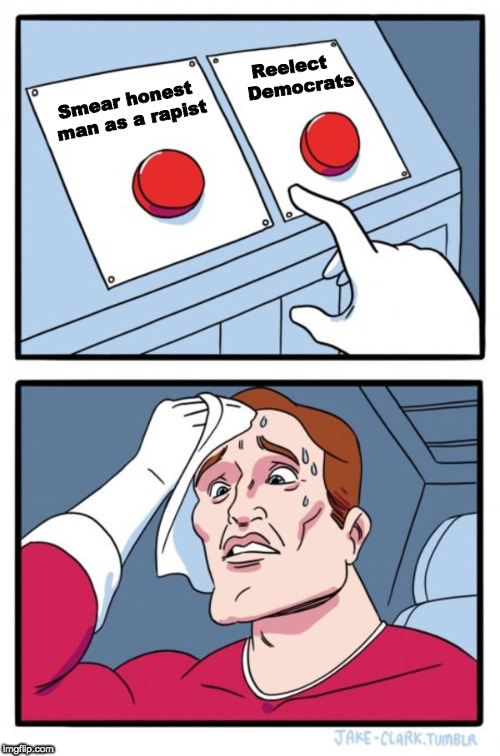
And you may ask yourself how did I get here why I didn’t do any blog posts about the “bombshell” Brett Kavanaugh allegations earlier this week? Simple: They were as obviously stupid as they were predictable. Thanks to my sloth foresight, I managed to avoid writing about the mess before the Democrats’ unpopular ploy collapsed into the stinking pile of garbage it always was!
The tactics they’re now employing against Kavanaugh, while extreme, are nothing new for them. They’ve always shot from the hip and aimed for the heart, hoping to sway public opinion by means of passion rather than reason. The more convinced they are of the righteousness of their cause—call it their “higher loyalty” to the arc of history—the more antic they get, like chimps in the zoo at feeding time, moving from whingeing servility to outright viciousness the hungrier they get. Left unchecked, even the cuddliest Cheetah eventually will rip off your face.
There should be a big difference between vague accusations of sexual assault 35 years ago and documented instances of assault from last year, as in the case of Keith Ellison. But the media seem strangely incurious about the congressman and DNC vice-chair…
Do all-girl preppie high schools typically approve of blackout drinking and teenage sex? I can’t even imagine anyone even trying to document such antics in my own high school yearbook.
“Trump Hit Iran With Oil Sanctions. So Far, They’re Working.” Or so says those notorious pro-Trump shills at the New York Times…
The real news is that Linux, the project, adopted the “Contributor’s Covenant” code of conduct and thereby acknowledged SJW ideological supremacy. The CC is an SJW vehicle promulgated by Coraline Ada and a related group of activist malcontents. While the CC appears on the surface to be a call of civility, it’s actually the tip of a very long and exsanguatory anti-meritocracy spear, one that ultimately seeks to elevate high-verbal-IQ non-technical politics-playing San-Francisco-residing cliques of social justice advocates into positions of recognition and authority in the free software world and beyond. If you write code and you’re good at it, these people are a direct threat to your status, your hobby, and your livelihood, because if these people get their way, your technical excellence becomes secondary to their wokeness.
#MeTooFar:
Also, got in hot water with upper management when I came to the defense of a coworker (unfairly) accused of 'sexual harassment'. His crime – passing out red roses on Valentine's Day. ALL of the women got them – even our 70+ yr old receptionist. This man almost lost his job.
Republican congressmen demonstrates provable sexual misconduct. GOP: “Resign, sleazeball.” Democratic state senator demonstrates sleazy, felonious personal conduct. Democrats: “We shall defend him to our last breath! Or, you know, until he’s actually convicted.” Result: Republicans now hold all those seats.
The operator of a Florida-based animal sanctuary says she was the target of an Oklahoma zookeeper who was indicted last week on federal murder-for-hire charges.
Carole Baskin of Big Cat Rescue said she’s clashed in the past with Joseph Maldonado-Passage, who goes by the nickname “Joe Exotic.”
“He’s been threatening me for many, many years,” Baskin told The Oklahoman after Maldonado-Passage’s arrest last week.
Prosecutors allege that Maldonado-Passage tried to hire two separate people to kill an unnamed woman, who wasn’t harmed. One of the unidentified people he sought to hire connected him with an undercover FBI agent, who met with Maldonado-Passage in December 2017. The indictment was unsealed Friday and Maldonado-Passage remains jailed in Florida. He didn’t reply to an email seeking comment and court records don’t list an attorney for him.
Content will also appear in a completely jumbled, totally incoherent order, even more so than before. “Something that was posted a few minutes ago you’ll probably never see, even if you try. But stuff that got posted three weeks ago, we’ll plaster your screen with it to no end.”
While U.S. attention was focused on Hurricane Florence, Typhoon Mangkhut, a much stronger storm, “a rare No. 10 typhoon warning signal,” was making landfall in China:
Mangkhut made landfall in Guangdong, a coastal province of southeast China, borders Hong Kong and Macau, on Sunday, packing wind speeds of more than 100 mph.
The national meteorological center said southern China “will face a severe test caused by wind and rain” and urged officials to prepare for a disaster.
The Hong Kong Observatory said Mangkhut had weakened, but its intense rainbands brought heavy downfall and high winds.
A compilation of footage from the storm:
My impression is that the building code in Hong Kong is much stricter than in other parts of China thanks to the legacy of British rule. It’s very possible that there will be more extensive damage in Guangdong, the heart of China’s high tech assembly industry.
I suppose that it’s too much to ask that Mangkhut to drive Mischief Reef completely beneath the waves…
Themes for today’s LinkSwarm: Jihad, rape and China. Not necessarily in that order…
So let me see if I have this story straight: New Mexico jihadis, one related to a New York City imam who might have been involved in 9/11, murdered three children, abused and starved 11 other children while teaching them to be school shooters, and the judge let them out on bail?
A New Mexico state judge ruled Monday that five alleged Muslim extremists accused of training children to conduct school shootings do not have to remain in jail while they await trial for child abuse.
Judge Sarah Backus released the five defendants, Siraj Wahhaj, Hujrah Wahhaj, Subhannah Wahhaj, Jany Leveille, and Lucas Morten, on a $20,000 “signature bond,” according to the Albuquerque Journal. That means that the defendants will not have to pay money unless they violate the conditions of their release
It’s a good thing there’s not a huge foreign nation immediately to the south with a porous border they can flee to…
If China really had a savings rate of 46%, the economy would look quite different. There would be very little debt in the system; the banks would have a very low loans to deposits ratio and low leverage, like banks in nineteenth century Britain. Consumer debt would be almost non-existent, while the Chinese market would have an enormous variety of saving and investment schemes, to take care of all the accumulated wealth. New company formation would be very high, but “venture capital” would be very scarce, because new companies would be capitalized from the savings of the founders’ relatives and friends. Overall, China might well have a rapid growth rate, but it would be a very contented, stable economy.
A recent Financial Times examination of China’s economy illustrates the problem; it shows consumer debt almost doubling as a share of GDP, from roughly 20% to 40% in the last five years and tells pathetic stories of young, highly educated Chinese who max out their credit cards, desperately hoping to boost their earnings sufficiently to pay that debt back. But Chinese elite youths brought up in a society with a 46% savings rate would have neither the desire nor the need for heavy credit card usage. First, they would have been brought up in families with a fanatical devotion to deferring consumption, so would regard the over-indebted Western Millennial lifestyle with undiluted horror. Second, because of their families’ savings habits, such elite youths would be beneficiaries of very substantial trust funds from their relatives, and so would have no need of credit cards.
If the savings rate is fiction, then so are all China’s economic statistics. GDP is at least one third lower than claimed, to account for the missing savings, and growth rates over the last decades correspondingly lower, On the other hand, China’s foreign debt is all too real, and most of the domestic debt also appears to be solid, so China’ s gross debt, already alarmingly high at 299% of GDP according to the Institute for International Finance, is in reality about 450% of true GDP, substantially higher than that of any other country. With such a level of debt, China is not about to overtake the West, it is in imminent danger of collapse. Indeed, it is at first sight something of a mystery why it has not collapsed already under the weight of its excesses.
Also: “China Buckles, Sends Trade Delegation to Washington to Seek End of Trade War.” Maybe, just maybe, President Donald Trump knows a thing or two about negotiating strategy…
“Evil is a make-believe concept we’ve invented to deal with the complexities of fellow humans holding values and beliefs and perspectives different than our own.” That quote comes from an American bicycling across several foreign countries, including one where Islamic State followers killed him, his wife, and two fellow-travelers thanks to their “different perspectives.” (Hat tip: Stephen Green at Instapundit.)
Google has released a report on the paid ads they’ve run on political campaigns. It’s not completely useless, but then you drill down to congressional district, it only shows you total spending, not how much was spent by each campaign, much less links to the relevant ads.
A theme that keeps recurring in histories of the worst abusers is that they were trained in seminaries that were run by homosexual men and saturated with gay-liberationist subculture. Reading accounts of students at one notorious California seminary making a Friday-night ritual of cruising gay bars, it becomes hard not to wonder if gay culture itself has not been an important enabler of priestly abuse.
Ace of Spades is surprised to find Disney holding firm on it’s firing of James “I Make Pedophile Jokes” Gunn. Also, in the course of slamming (perhaps a littler too strenuously) Trump-skeptical establishment conservatives on their hypocrisy on the issue (RE: Roseanne), he does nicely articulate the logic of taking’s the Guardians of the Galaxy director’s scalp, even if Gunn was only joking:
I will not be subject to one of your rules and yet permit you to be free of your own rule. If it’s your rule, you shall suffer under it just the same as me.
We do not (yet) have a formal caste system in America, despite the obvious longing from the left and the NeverTrump rump to establish over-castes and under-castes.
And it’s MUH #SacredPrinciple that we shall not have a tiered system of citizenship that the leftwing establishment as well as the “right”-leaning establishment so clearly crave.
And I’ll sacrifice anyone to make sure that they do not put me in their designated under-caste.
Trump may be both more relentless and obnoxious than his predecessors, but cries of “Fake News!” from the Oval Office are old hat. Presidents always blame the messenger. Even Barack Obama, the object of so much media fawning, groused about distorted coverage.
This time, though, we are taking it personally. Striking at the bait Trump dangles. Joining the war he’s declared. Allowing him to goad us into abandoning the fundamental principles of our profession.
Donald Trump is not responsible for the eroding trust in the media. He lacks the credibility to pull that off. The damage to our standing is self-inflicted.
The independent press was built on a foundation of objectivity. Through a tradition of conscientious commitment to telling all sides of a story we convinced our readers, listeners, viewers that we were the source of fair and balanced coverage. We were equal opportunity scourges of scoundrels on both sides of the political aisle.
Now, too many of us are following the websites, cable networks and blogosphere into point-of-view journalism that presents the news with equal parts fact and opinion. We’ve infused our reports with commentary and call it context.
Journalists once kept their personal views personal, lest anyone challenge the motives behind their reporting. Now reporters post their opinions on Facebook and Twitter. They sob in newsrooms over the results of an election. News meetings and editorial boards are often indistinguishable.
Respected journalists openly question whether remaining objective in the Donald Trump era is a sell-out rather than a virtue. Some have joined the resistance movement, blending journalism with activism.
No one in our profession can say with a straight face that we cover Donald Trump the same way we have past presidents. We are not only giving him more scrutiny — rightly so — but we are making more mistakes in our haste to discredit him. Our accuracy ratings have fallen as we turn to poorly vetted anonymous sources and repeat every rumor that fits the narrative that Trump is a disaster.
Yes, Trump is an extraordinary case. Chaos is the hallmark of his governing style. His personal conduct falls well short of presidential. But his administration has had successes, and the press is not as eager to cover those as it is his failures.
Journalism seems to have turned a corner in search of some higher purpose beyond simply digging out the truth, presenting it to our readers and letting them decide what to do with it.
Nothing about Donald Trump justifies tossing aside the standards that have allowed journalists to remain the trusted eyes and ears of the people.
MoviePass is getting ready to bite the moose. I can imagine a way you could make this thing work out: Make deals with large theater chains, exclude the first week of all movies, and the first few weeks for blockbusters, and make a deal to buy tickets at a steep discount to put butts in seats so theater owners can make more money off concessions. All things that MoviePass evidently never attempted…
The great plastic gun panic…of 1986. I think we can all remember how the widespread availability of the Glock resulted in the downfall of America…
In June 1996 — after the staffer had begun working for Feinstein — the FBI detected that the Chinese government was attempting to seek favor with the senator, who at the time sat on the East Asian and Pacific affairs subcommittee of the Foreign Relations Committee, which oversees US-China relations. Investigators warned her in a classified briefing that Beijing might try to influence her through illegal campaign contributions laundered through front corporations and other cutouts.
The warning proved prescient.
One Chinese bagman, Nanping-born John Huang, showed up at Feinstein’s San Francisco home for a fundraising dinner with a Beijing official tied to the People’s Bank of China and the Communist Party Committee. As a foreign national, the official wasn’t legally qualified to make the $50,000-a-plate donation to dine at the banquet.
After a Justice Department task force investigated widespread illegal fundraising during the 1996 Clinton re-election campaign, Feinstein returned more than $12,000 in contributions from donors associated with Huang, who was later convicted of campaign-finance fraud along with other Beijing bagmen. The DNC and the Clinton campaign had to return millions in ill-gotten cash.
Still, Beijing got its favored trade status extended — thanks in part to Feinstein. In speeches on the Senate floor and newspaper op-eds, she shamelessly spun China’s human-rights violations, as when in 1997 she compared Beijing’s 1989 massacre of hundreds of young demonstrators to the 1970 Kent State shootings, calling for the presidents of China and America to appoint a human-rights commission “charting the evolution of human rights in both countries over the last 20 to 30 years,” that “would point out the successes and failures — both Tiananmen Square and Kent State — and make recommendations for goals for the future.”
Feinstein also led efforts to bring China into the World Trade Organization in 1999, which gave Beijing permanent normal trade relations status and removed the annual congressional review of its human-rights and weapons-proliferation records.
Feinstein, still among the Senate’s most influential China doves, travels to China each year. Joining her on those trips is her mega-millionaire investor husband, Richard C. Blum, who has seemingly benefited greatly from the relationship.
Starting in 1996, as China was aggressively currying favor with his wife, Blum was able to take large stakes in Chinese state-run steel and food companies, and has brokered over $100 million in deals in China since then — with the help of partners who sit on the boards of Chinese military front companies like COSCO and CITIC.
China investments have helped make Feinstein, who lives in a $17 million mansion in San Francisco and keeps a $5 million vacation home in Hawaii, one of the richest members in Congress.
Academic dogma postulates that white people cannot be the victims of racism, and such banal white demonization has now seeped into the larger liberal commentariat. With that bias comes the notion that one can smear the white working classes with impunity. Caputo, however, was not brave or stupid enough to visit a Trump rally and to suggest to the crowd around him to get to a Clear Smile clinic.
If you are a non-white purveyor of such prejudice, venom like Jeong’s is contextualized through the lens of compensatory historical grievances. Someone’s grandfather mistreated your grandmother, so you can invert and then replay the roles with impunity. Or less charitably, life’s disappointments are always due to past cosmic injustice, not one’s own perceived tragic shortcomings or bad luck or just cruel fate.
If you are an elite white liberal, you are a twofer: virtue signaling your identity politics bona fides, while psychologically squaring the circle of your own privilege. Those who ridicule less fortunate white others for their supposed racial privilege—themselves often the products of old boy networks, elite upbringings, inherited perks, prep schools and parental leveraging—end up as the privileged smearing the non-privileged for their privilege.
Jeong is a Harvard Law graduate. Strzok has a master’s degree from Georgetown. The ridicule of the white working class by NeverTrump conservative pundits is read on the pages of the nation’s premier newspapers or voiced in hallowed symposia.
Is such ignorance of an entire class because of, or in spite of such, elite training?
Snip.
“In answer to the now hackneyed question, who or what created Trump? All these purveyors of class and racial prejudice need only look in the mirror.”
That “Democratic Socialist wave” crested and broke-up before it ever hit the shore: Just about all Bernie bros go down in Democratic primary defeats. “Rather than demonstrate that his movement has a broad reach across the electorate, Sanders has instead demonstrated that’s a fringe movement even within the Democratic Party.” (Hat tip: Director Blue.)
It is because the left, while it currently seems ascendant in our houses of culture and art, has in fact entered its decadent late phase, and it is deeply vulnerable. The left is afraid not of Peterson, but of the ideas he promotes, which are completely inconsistent with identity politics of any kind. When the poetry editors of The Nation virtuously publish an amateurish but super-woke poem, only to discover that the poem stumbled across several trip wires of political correctness; when these editors (one of them a full professor in the Harvard English department) then jointly write a letter oozing bathos and career anxiety and begging forgiveness from their critics; when the poet himself publishes a statement of his own—a missive falling somewhere between an apology, a Hail Mary pass, and a suicide note; and when all of this is accepted in the houses of the holy as one of the regrettable but minor incidents that take place along the path toward greater justice, something is dying.
When the top man at The New York Times publishes a sober statement about a meeting he had with the president in which he describes instructing Trump about the problem of his “deeply troubling anti-press rhetoric,” and then three days later the paper announces that it has hired a writer who has tweeted about her hatred of white people, of Republicans, of cops, of the president, of the need to stop certain female writers and journalists from “existing,” and when this new hire will not be a beat reporter, but will sit on the paper’s editorial board—having a hand in shaping the opinions the paper presents to the world—then it is no mystery that a parallel culture of ideas has emerged to replace a corrupted system. When even Barack Obama, the poet laureate of identity politics, is moved to issue a message to the faithful, hinting that that they could be tipping their hand on all of this—saying during a speech he delivered in South Africa that a culture is at a dead end when it decides someone has no “standing to speak” if he is a white man—and when even this mayday is ignored, the doomsday clock ticks ever closer to the end.
In the midst of this death rattle has come a group of thinkers, Peterson foremost among them, offering an alternative means of understanding the world to a very large group of people who have been starved for one. His audience is huge and ever more diverse, but a significant number of his fans are white men. The automatic assumption of the left is that this is therefore a red-pilled army, but the opposite is true. The alt-right venerates identity politics just as fervently as the left, as the title of a recent essay reproduced on the alt-right website Counter-Currents reveals: “Jordan Peterson’s Rejection of Identity Politics Allows White Ethnocide.”
If you think that a backlash to the kind of philosophy that resulted in The Nation’s poetry implosion; the Times’ hire; and Obama’s distress call isn’t at least partly responsible for the election of Donald Trump, you’re dreaming. And if you think the only kind of people who would reject such madness are Republicans, you are similarly deluded. All across the country, there are people as repelled by the current White House as they are by the countless and increasingly baroque expressions of identity politics that dominate so much of the culture. These are people who aren’t looking for an ideology; they are looking for ideas. And many of them are getting much better at discerning the good from the bad. The Democratic Party reviles them at its peril; the Republican Party takes them for granted in folly.
The global influence of Europe continues to wane, at least as defined by demographic robustness, technological innovation, the quality of higher education, and the ability to defend its interests. Its aristocratic elite classes are currently under constant challenge from populist reformers. And 73 years of peace have been hard on Europe, in the sense that the postmodern European cultural ideal is to avoid childbearing, most religion, and national defense.
Snip.
Europe continues to believe that the “Palestinian issue” is key to “peace” in the Middle East — a euphemism for distancing itself from Israel. In truth, the Middle East is undergoing the greatest revolution since the end of colonialism. The worries about Arab security are not the tardiness of Palestinian statehood but the existential threats emanating from theocratic Shiite Iran and the neo-Ottomanism of Recep Tayyip Erdogan’s Turkey. In that sense, a conventionally strong and nuclear Israel is for now allied with an Arab world at odds with both Tehran and Ankara, and is likely in any major war to be on the side of an Egypt or Saudi Arabia. Yet for Europe, the Palestinians are the rusty key to peace, even as the latter are increasingly under suspicion by Arab nations as pro-Hezbollah and pro-Iranian.
Europe for now is on the wrong side of the energy revolution, perhaps best epitomized by the near-suicidal green policies of Germany. As it dismantles coal and nuclear plants, Angela Merkel’s government finds its subsidized wind and solar projects utterly incapable of meeting Germany’s competitive industrial needs. The result will likely be a continual and massive importation of natural gas, increasingly from NATO’s supposed archenemy, Vladimir Putin’s Russia. The dream of hydraulic fracturing of shale gas throughout Europe is now largely dead and buried by opposition from radical environmental groups. The result is not a self-sufficient Europe enjoying renewable energy but a continent increasingly dependent for its mounting conventional energy needs on costly imports, with resulting energy costs that are making it uncompetitive with North American industries. Again, the contrast with the United States is telling: The latter went from foreordained, “peak oil” fossil-fuel dependence to becoming the largest oil, gas, and coal producer in the world.
One symptom of European demographic decline, multiculturalism, and military impotence is massive illegal immigration from the Middle East and North Africa. The ensuing crisis of large unassimilated populations is said to be analogous to the influxes of illegal immigrants into the United States from Central America and Mexico. But there are key differences. As an immigrant nation without a hereditary aristocracy, the melting pot of the United States even in postmodern times has far better integrated, assimilated, and intermarried newcomers. Illegal immigrants to the United States are largely Catholic; challenges to assimilation are national, ethnic, and linguistic but not additionally religious as in Europe. Congressional and presidential policy reflects a majority opinion in the United States that now supports secure borders and measured, legal, meritocratic immigration. In Europe, official immigration policy is still at odds with voters.
Woman who was the daughter and granddaughter of women who used men simply as sperm donors wonders why men are suspicious of her. Also, from the comments: “What the writer only lets on, deep into the article, is that she was raised in a lesbian commune.”
This sign was on the door of a restaurant in Kansas. Me and my clients went in and enjoyed a very nice steak dinner. No one was harassed, asked to leave, or in fear for their lives. And I expect 80% of us were carrying. It’s become a regular stop because it is a safe space pic.twitter.com/3bRtPGQvxn
I’m hoping that this week is Peak Busy for me. Enjoy a Friday LinkSwarm:
Rasmussen: “Today’s [President Donald Trump] approval ratings among black voters: 29% This time last year: 15%.” Overall Trump approval rating at 50%.
Related: “President Donald Trump was lauded by inner-city pastors, including one who said he may go down as the ‘most pro-black president’ in recent history, during a White House roundtable on Wednesday that was focused on efforts to reform the prison system.” (Hat tip: Da Tech Guy via The Other McCain.)
At long last, the Trump administration has created a “freedom option” for people suffering under Obamacare. A final rulemaking issued Wednesday reverses an Obama-era regulation that exposed the sick to medical underwriting. The new rule will expand consumer protections for the sick, cover up to two million uninsured people, reduce premiums for millions more, protect conscience rights, and make Obamacare’s costs more transparent. And unlike President Barack Obama’s implementation of his signature healthcare legislation, it works within the confines of the law.
Federal law exempts “short-term, limited duration” health insurance from having to carry the unwanted coverage and hidden taxes Obamacare requires. Many consumers have understandably taken refuge from soaring Obamacare premiums in short-term plans.
Hoping to force those consumers into Obamacare plans, the Obama administration sabotaged short-term plans by stripping them of crucial consumer protections. It cut the maximum plan term from 12 months to three months, and forbade issuers from offering “renewal guarantees” that allow the sick to continue purchasing short-term policies at healthy-person rates. State insurance regulators protested that these restrictions literally stripped sick patients of their coverage.
Wednesday’s rule reinstates and even expands the consumer protections Obama curtailed. It allows short-term plans to last 12 months, and allows insurers to offer them with renewal guarantees.
You read that right. Democrats curtailed consumer protections; Republicans are expanding them.
Is the newest member of the New York Times editorial board, Sarah Jeong, a racist?
From one perspective — that commonly held by people outside the confines of the political left — she obviously is. A series of tweets from 2013 to 2015 reveal a vicious hatred of an entire group of people based only on their skin color. If that sounds harsh, let’s review a few, shall we? “White men are bullshit,” is one. A succinct vent, at least. But notice she’s not in any way attacking specific white men for some particular failing, just all white men for, well, existing. Or this series of ruminations: “have you ever tried to figure out all the things that white people are allowed to do that aren’t cultural appropriation. there’s literally nothing. like skiing, maybe, and also golf. white people aren’t even allowed to have polo. did you know that. like don’t you just feel bad? why can’t we give white people a break. lacrosse isn’t for white people either. it must be so boring to be white.” Or this: “basically i’m just imagining waking up white every morning with a terrible existential dread that i have no culture.” I can’t say I’m offended by this — it’s even mildly amusing, if a little bonkers. (Has she read, say, any Shakespeare or Emily Dickinson?) But it does reveal a worldview in which white people — all of them — are cultural parasites and contemptibly dull.
A little more disturbing is what you might call “eliminationist” rhetoric — language that wishes an entire race could be wiped off the face of the earth: “#cancelwhitepeople.” Or: “White people have stopped breeding. you’ll all go extinct soon. that was my plan all along.” One simple rule I have about describing groups of human beings is that I try not to use a term that equates them with animals. Jeong apparently has no problem doing so. Speaking of animals, here’s another gem: “Dumbass fucking white people marking up the internet with their opinions like dogs pissing on fire hydrants.” Or you could describe an entire race as subhuman: “Are white people genetically disposed to burn faster in the sun, thus logically being only fit to live underground like groveling goblins.” And then there’s this simple expression of the pleasure that comes with hatred: “oh man it’s kind of sick how much joy I get out of being cruel to old white men.” I love that completely meretricious “old” to demean them still further. And that actual feeling: joy at cruelty!
Another indicator that these statements might be racist comes from replacing the word “white” with any other racial group. #cancelblackpeople probably wouldn’t fly at the New York Times, would it? Or imagine someone tweeting that Jews were only “fit to live underground like groveling goblins” or that she enjoyed “being cruel to old Latina women,” and then being welcomed and celebrated by a liberal newsroom. Not exactly in the cards.
Venezuela’s socialist President Nicolas Maduro admits that socialism doesn’t work. Just think how much pain could be avoided if he had admitted this before people had to eat their dogs…
Mistaken police call for an active shooter at a McAllen mall turns out to be an illegal alien robbery gang. Result? Seven illegal alien criminal suspects arrested.
Sheldon Silver Sentenced: Seven in Sing Sing. (Actually, it’s not clear the former New York Assembly speaker will be serving his sentence in Sing Sing, but we can only hope, for the sake of the alliteration…)
China cracks down on illegal coffins. Which is to say, any coffins, since cremation is now mandated. Including seizing and destroying coffins old people have spent their entire lives saving for.
When Bill de Blasio became mayor of New York in 2014, things changed drastically. I started to hear rumblings early on. My former colleagues who were dedicated public servants were concerned by a large-scale rollback of Bloomberg’s strategic initiatives. These seemed to be based on partisan politics and black-and-white thinking as opposed to critical analysis. It was very disappointing for me since I had also voted for de Blasio.
Although I was still working in the same social-services agency where I had remained at the end of Bloomberg’s term, my job changed radically. I had no contact with the new commissioner who appeared to be disengaged from substantive discussions about social-services programs for an extremely vulnerable population. In fact, she was much more preoccupied with renovating her office — I heard her new desk alone cost thousands of dollars. She even requested that a private bathroom be built for her. She had the attitude of an oligarch and was disturbed that she had to vet invitations to galas through legal and City Hall. She wanted carte blanche to attend expensive events.
She also refused to meet with the lawyers in her department and she kept the door to her office closed and didn’t know the names of the people who worked in her agency.
Under my commissioner, there were no benchmarks, no goals and she did not hold regular meetings with her general counsel. Under her tenure, the legal unit was gutted. And there were no consequences for failing to meet performance goals because there were no performance goals.
Comics video blogger Jeremy Hambly attacked at GenCon. “The Quartering also provided another update claiming five eyewitness have identified the attacker as Matt Loter, the owner of Elm City Games.” GenCon promptly expelled Loter. Ha! Just kidding!
GenCon is blocking and muting and banning people who talk about @TheQuartering’s assault on their official channels and social media accounts.
It’s almost as if they want to make people angry by censoring all conversation about the topic.
“Millennial Drops Support For Socialism After Learning How Hard It Is To Get Avocado Toast In Venezuela.” The Babylon Bee has just been tearing it up recently. I probably need to add them to the blog roll.