A reminder not to get black-pilled, another Supreme Court win for deporting illegal alien felons, San Francisco’s government offers pedos a veritable buffet, Rockefeller money is going to the ChiComs, and another deeply technical video on semiconductor processes you won’t click on.
Yes, I want to believe, but there’s evidence supporting hope. There’s evidence supporting the idea that the polls are so substantially flawed that they do not accurately reflect what’s going to happen. Again, the caveat – this could be delusion. We could be seeing what we want to see. But then, what we’re seeing is there. There is evidence supporting what we want to happen, evidence worth considering.
We’re seeing how polls have been missing big lately. Look at Abdul El-Sayed. He was supposed to win that Michigan primary in a walk. We’re talking five, 10, 15 points, according to the primary polls. And yet he barely squeaked past that squeaky woman he was competing with. We’ve seen lots of other polls that assured us of a Democrat victory. Just ask President Harris about that.
If you’ve been around a while, you know that the polls always favor the Democrats. You almost never see a Democrat surprise us by exceeding his polling against a Republican. You just don’t. So, there’s that. And of course, there’s an interest in driving down Republican enthusiasm by telling people they can’t win.
Then there’s the gut vibe. Don’t completely disregard that. In Texas, you must believe the Texans are going to support a blasphemous, anti-meat, anti-gun, anti-white, woke weirdo with a thing for trans kids. Does that sound like Texas to you? It sure doesn’t sound like Texas to me, and I’m in Texas. I’ve talked to a lot of Texan conservatives. Not one thinks this guy is going to win. Now, they agree it could theoretically happen, but they don’t think it’s going to. Ken Paxton has won three times in statewide races, and he’s done a lot of great conservative things. Are Texans really going to choose a bizarre homunculus to spend six years in Washington, D.C., voting like Democrat Rep. Alexandria Ocasio-Cortez (NY-14) in their name? It just doesn’t fit. It’s weird. That’s not saying it couldn’t happen – there are lots of communists here along with other weirdos, losers, and mutations who would be thrilled to have this geebo as a Lone Star senator. But it just doesn’t feel like something that’s going to happen.
Moreover, we’ve been told a lot of conservatives are going to sit this out. The bots on X are certainly pushing that coordinated message, as the semi-coherent comments on my Monday column about quitters demonstrate. Yes, there are probably some Republicans who are going to sit out this midterm, but I haven’t met any of them personally. Maybe you have. I just don’t think there are a lot of them, especially in light of how appalling the Democrats are. It doesn’t make sense, at least to people who aren’t idiots who blame everything on Epstein conspiracies and the Jews and blah blah blah, to be mad at Trump and the Republicans for not being conservative enough and showing them what-for by allowing the election of communists. As risky as it is, I’m not going all-in on the assumption that people are that stupid.
Read the whole thing, and encourage all your sane friends to show up at the polls in November.
Dr. Anthony Fauci privately sounded the alarm when he learned the U.S. Army had conducted an experiment a decade ago that aerosolized the lethal Ebola virus, which is not normally transmitted by air, and then shared the results publicly amid an ongoing outbreak in Africa, according to diary entries obtained by Senate Homeland Security Committee Chairman Rand Paul.
The then-top scientist at the National Institute of Allergy and Infectious Disease was particularly concerned in 2016 that the Army medical research arm’s experiment seemed to show that exposure to aerosolized Ebola caused more damaging effects in subjects that had been vaccinated. This was almost four years before he championed shutting down the U.S. economy and social life over the COVID-19 virus outbreak.
Fauci wrote he believed such research should be kept secret, preferably classified, so that it didn’t undermine public confidence in vaccination in the African countries suffering an outbreak of the virus.
“What idiots those guys at USAMRIID [U.S. Army Medical Research Institute of Infectious Diseases] are,” Fauci wrote in a March 2016 diary entry. “This should have been a classified experiment that never should have been done in the first place.”
Why yes, “undermining public confidence in vaccination” is a far bigger concern than the fact that the U.S. Army under Obama was committing an actual war crime.
It’s Tuesday morning at Little Learners Daycare in downtown San Francisco. Teacher Wendy herds bright-eyed toddlers, amped up after playtime in the courtyard, back inside. They’re laughing and swatting at each other playfully, oblivious to the pack of pedophiles lurking nearby.
Four hundred feet away, dozens of registered sex offenders live at 111 Taylor Street. Wendy knew that the Tenderloin, where she operates her Mandarin-immersion daycare, was dangerous. It’s a hotbed for illegal drug activity and homelessness. But she didn’t realize that sex offenders live so close to her daycare—or that taxpayers fund their housing.
Pedophiles, illegal aliens; the only people Democrats don’t like paying for housing for is law-abiding American citizens.
According to this City Journal investigation, more than 25 percent of sex offenders in San Francisco with addresses in the Megan’s Law database live in taxpayer-subsidized buildings. Many live near a park, school, or daycare, or reside in a neighborhood with a high concentration of children. They do all of this despite statewide efforts to ban concentrating pedophiles so close to children. Instead of listening to California voters, San Francisco has become a taxpayer-funded dumping ground for sex criminals.
The Taylor Street Center is one of San Francisco’s most heavily populated sex-offender residences. Located in the Tenderloin, Taylor Street houses at least 31 registered sex offenders. The taxpayer-funded California Department of Corrections and Rehabilitation and the federal Bureau of Prisons contract the private GEO Group to run the facility.
The reentry complex can house 240 people. It hosts specialized programs for residents like “cultural diversity education,” “gender-responsive groups,” and a “weekly meditation group.” The facility sits just 400 feet from a daycare center, 1,000 feet from a fourth-to-eighth-grade school, and five blocks away from a preschool.
Any sex offender housed in the Tenderloin is bound to encounter children. Along with having a high concentration of immigrant and low-income households, the neighborhood also has the highest concentration of kids in the entire city.
I’m sure the sex offenders call that “the buffet.”
President Trump invoked a rare and legally contested power Friday to cancel $810 million in congressionally approved spending, targeting programs for illegal immigrants and a slate of federal initiatives explicitly organized around race and DEI.
The request hits 11 funding pools at seven departments and agencies. It also landed with just five days left in the fiscal year. That’s the point of the disputed “pocket rescission” maneuver: the money runs out before Congress gets its normal 45 days to consider the cuts.
The biggest piece is $567 million at the Department of Health and Human Services (HHS) for services to refugees, asylees, unaccompanied minors, and other non-citizens.
The White House called them “pro-illegal immigration programs” and said the money is no longer needed because illegal border crossings have fallen sharply.
But immigration spending was only part of the package.
Several of the rescissions hit programs explicitly organized around race or ethnicity.
The administration wants to rescind $10 million from the Commerce Department’s Minority Business Development Agency, which helps minority-owned businesses. The White House pointed to a 2024 federal court ruling that found the agency’s presumption of social disadvantage based on race or ethnicity unconstitutional.
Another $5 million would come from HHS’s Office of Minority Health.
The White House highlighted grants from that office addressing racial trauma among black youth, health disparities among black and Latino youth, a George Washington University fellowship promoting health equity and DEI, and a $1.5 million project addressing the effects of redlining and structural racism.
HUD housing counseling takes a much larger hit, with $56 million targeted.
The administration said the program had funded groups including UnidosUS, the National Urban League, and Housing Action Illinois, criticizing their work on structural racism, racial justice, and other DEI priorities.
Then there is the Justice Department’s Community Relations Service, slated to lose $15 million.
The office’s mission included “preventing and resolving racial and ethnic tensions” and restoring racial stability. The Trump administration shut it down earlier this year and now accuses the office of promoting critical race theory and gender ideology rather than carrying out that mission.
The package goes beyond those programs.
The administration identified $28 million in HHS research funding it wants canceled, pointing to grants involving transgender health care, racial disparities, and a $50,000 project to develop a research agenda addressing racism in emergency medicine. Another $70 million would be pulled from international education programs, including programs the White House said had funded research involving queer and transgender issues abroad.
Other cuts include $25 million for migrant student programs, $25 million across two DHS programs providing services or legal assistance to non-citizens, and $9 million for a Treasury program providing debt relief to foreign countries in exchange for conservation commitments.
Now we need to hand out pink slips to the people who were administering these programs.
Long overdue: “Education Dept. Officially Removes Biden’s Title IX Gender Identity Rules. In other words, the department is sticking to the literal interpretation of Title IX: sex-based discrimination.”
The Education Department has officially rescinded the Biden Administration’s Title IX interpretation that extended protections to students based on sexual orientation and gender identity.
In other words, the department is sticking to Title IX’s literal meaning: sex-based discrimination.
“Today’s rulemaking clears the Biden Administration’s illegal rewrite of Title IX from the Code of Federal Regulations and restores the commonsense language promulgated in the first Trump Administration, which we have been enforcing since the first days of the Administration,” said U.S. Secretary of Education Linda McMahon. “Thanks to today’s action, the published Title IX regulations faithfully reflects court orders and Congressional intent—reducing confusion for parents, students, and educational institutions. We will continue to relentlessly champion equal opportunity for all Americans and hold accountable any school or college that violates the rights, privacy, or athletic opportunities of our women and girls.”
Honestly, nothing changes because the department has been enforcing reality since January 2025: Title IX is based on sex. It’s not based on your sexual orientation or gender identity.
Somehow, the people who tell us that they were “born this way” and that “sexuality is a spectrum” are now returning to normal. It’s almost like the whole “acceptance” movement was just a social contagion that spread because teens like being rebellious!
The Supreme Court majority (6-3) has granted the DOJ request to put on hold a Boston-based US District Judge ruling that DHS policy to remove illegal aliens to so-called third countries is unlawful. The process of rapid deportation will continue while the matter is called before the Supreme Court for oral arguments in December (ruling in ’27).
The Usual Suspects opposed deporting the Democrat Party’s precious illegal alien felons.
Former Justice Department Special Counsel Jack Smith subpoenaed at least 4,782 political donations to President Donald Trump from Americans across the country between September 2019 and August 2023, Senator Chuck Grassley revealed during a Tuesday hearing featuring the former special counsel.
The checks — which Smith’s team acquired as part of their election case against Trump, dubbed “Arctic Frost” — contained donors’ personal information, including their home addresses, bank account and routing numbers, and signatures. Some of the subpoenaed donations were for as little as $1. Grassley revealed the evidence while questioning Smith during Tuesday’s Senate Judiciary hearing and followed up with a press release containing further details.
During former President Joe Biden’s administration, Smith brought two cases against Trump: The first accused him of conspiring to overturn the 2020 election, and the second involved him keeping classified documents at his Mar-a-Lago estate. Smith resigned from his position nine days before Trump was sworn in as president again; both cases against Trump have been dismissed.
As part of the FBI’s investigation into the 2020 election, agents accessed toll records, which show who a given individual spoke with on the phone but not the contents of their calls, for 16 members of Congress. He also subpoenaed records from 87 Trump White House phones, which captured records from calls between government sources and dozen of news outlets.
The political donations Grassley described were obtained as part of Smith’s investigation, which focused on whether Trump defrauded donors by raising money under the false pretext that the resulting donations would help Trump’s team overturn the results of the 2020 election.
All the easier to compile an enemies list should Democrats retake power…
The Rockefeller Brothers Fund, a $1.4 billion U.S.-based charity with funding from the Rockefeller family and other donors, has forged a “dangerous partnership with Communist China” and is pouring millions of dollars into China-based nonprofits that are advancing the Chinese Communist Party’s foreign policy goals.
That’s one of the findings in a new report, “The Rockefeller Network: How the Rockefeller Family Turned Their Oil Fortune into Extreme Climate Activism,” out today from Americans for Public Trust, a nonprofit, nonpartisan investigative watchdog organization. The report, an advance copy of which was obtained exclusively by the Washington Free Beacon, outlines how the billion-dollar fortune of Standard Oil founder John D. Rockefeller Sr., who died in 1937, is being used “to quietly bankroll numerous radical and leftist projects.”
Snip.
“An alarming amount—well into the millions—has found its way directly into the coffers of entities that are either official vestiges of the Chinese government, or directly and irrefutably administered by the CCP and its representatives,” the report says. “And many of these entities, while operating under the guise of ‘green’ and environmental research, are, instead, using these funds to help buttress China’s foreign influence programs around the globe, especially the CCP’s infamous ‘Belt and Road Initiative.'”
Among the grants singled out in the report as most problematic:
— $400,000 between 2020 and 2024 to the Foreign Environment Cooperation Center, “a division of the Chinese government’s Ministry of Ecology and Environment.”
— Nearly $1.5 million to the China Council for International Cooperation on Environment and Development, whose “direct ties to the Chinese government are undeniable.”
— Nearly $200,000 to Tsinghua University, which announced in 2024 that the school’s office of the president had merged with the Chinese Communist Party to “form a new Party Committee Office that would run the school.”
Groups that fund the ChiComs should have their non-profit status revoked and their assets seized.
Democrats are always saying the quiet part out loud nowadays.
They aren’t even trying to hide their radical plans to totally replace America’s voters, workers, and people with a cheap labor underclass that disproportionately votes Democrat.
[ U.S. Representative] Democrat Tom Suozzi says his biggest goal in politics is mass amnesty for criminal illegals:
“My biggest goal of what I want to accomplish in politics right now is I want to legalize 7 or 8 or 9 or 10 million people in our country.”
Amnesty was always the end goal for the illegal alien importation.
Obvious: “UK Whistleblower: 99 percent of Asylum Claims Are Fake.”
Only one in 100 asylum claims are genuine, according to a whistleblower who has revealed widespread fraud and dysfunction in the system.
The Home Office official, who has worked for years as a decision-maker on asylum and has assessed thousands of claims, said asylum seekers from certain countries use the “same script” in what he and colleagues describe as “package claims”.
He said he had encountered a large number of Iraqi Kurds claiming asylum who said they had been in a relationship with the daughter of the prime minister of the Kurdistan region. The official said it had become a “running joke” among colleagues that the number of Iraqi Kurds who said they were involved with the daughter was in the “hundreds”.
He also said that “hundreds” of claims from Pakistanis were based on the assertion that they were in fear of their lives in their home country because of their gay relationship with the same man who had provided letters supporting their claims.
The source also disclosed suspicions about large numbers of Bangladeshi claimants purporting to be dissidents of the former governing party, which is now banned, even though they were unable to provide basic information about the group.
An 18-year-old woman has been gang raped and beaten by up to ten different men, many of them with a Syrian background, in the Dutch city of Dordrecht. Although the rape occurred in May 2025, the suspects are only now being arrested. In response to the rape, political leader Geert Wilders wrote that the Netherlands also has Islamic grooming gangs and called for all the perpetrators to be removed from the country along with their families.
Six suspects have now been arrested, aged 20 to 23. During the incident, the girl, who lived in a residential group home, was driven to two different parking lots and raped by several men, some of whom filmed the assault and shared it on Snapchat. Police say the woman was humiliated and beaten.
And somehow the leaders of UK’s Labour Party say “Yes, we need more of that.”
A plane leaving Dubai and heading towards Tel Aviv almost saw a tragic end as the co-pilot of the plane turned hijacker mid-flight and attempted to take control and crash the plane….
The co-pilot, an Omani national, stabbed the pilot multiple times in an attempt to kill him and hijack the flight. The co-pilot had worked for FlyDubai for around a year.
The injured pilot was able to transmit a radio warning, Israel scrambled fighter jets, and the passengers and crew were able to subdue the attacker in midair.
The plane made an emergency landing in Saudi Arabia to sort the entire mess out.
Be prepared to fight for your life on a moment’s notice, because you might have to.
More long overdue. “Trump expands H-1B visa crackdown, will scrutinize layoffs.”
The Trump administration on Thursday announced an executive order expanding the ongoing crackdown against H-1B visa abuse.
The H-1B is a visa program designed to allow companies to bring in high-skilled workers when no qualified Americans are available. But the program has faced considerable scrutiny in recent years, due to widespread fraud. Critics have argued that major employers also use it as a way to undercut American wages.
Trump’s Thursday order reaffirms the $100,000 application fee he imposed last year, but now mandates inter-agency coordination to consider an employers’s recent or planned layoffs when applying for H-1B visas.
“Our message to corporate America is simple: We’re not going to let you lay off American workers so you can replace them with cheap foreign labor,” Vice President JD Vance said.
U.S. Immigration and Customs Enforcement arrested 121 individuals during a summer enforcement initiative around Lake Lewisville in Dallas.
The operation, led by ICE’s Dallas field office, began June 27 and concluded over Labor Day weekend. It involved coordination with state and federal agencies, including the Texas Parks and Wildlife Department, and focused on identifying individuals unlawfully present in the country, assisting with lake-related investigations, and allowing local officers to devote more resources to boating safety enforcement.
According to ICE’s Friday release, individuals arrested during the initiative had criminal histories involving offenses such as assault, family violence, theft, burglary, sexual assault of a child, driving while intoxicated, and boating while intoxicated.
Among those arrested were two men ICE identified as members of Tren de Aragua, a transnational criminal organization designated by the U.S. State Department as both a foreign terrorist organization and a specially designated global terrorist group.
Willian Josue Ordonez Vasquez, 24, a Venezuelan national, and Edwin Josue Cabrera-Zelaya, 22, a Honduran national, were under investigation by the Texas Parks and Wildlife Department for allegedly operating an illegal livery business on Lake Lewisville.
I must say that I’ve never run into “illegal livery business” before, but it seems to involve not complying with Texas regulations on powered boat rental.
Man bites dog: “Too extreme for Newsom? California sanctuary bill for abortion, transgender procedures vetoed.”
California Gov. Gavin Newsom used his veto pen to make out-of-state prosecutions theoretically possible for both “reproductive health care services” and “gender affirming health care services.”
The term-limited Democrat with presidential ambitions, who recently said he won’t run if fellow Californian and former Democratic nominee Kamala Harris enters the 2028 presidential race, vetoed legislation (AB 2164) to codify an extradition ban for “legally protected health care activity” in California, claiming it infringed executive authority.
Ignore the blather about Harris, Governor Hairgel is obviously running.
Researchers proved AI has deleted every reason universities exist.
Harvard University ran a controlled experiment pitting a custom AI against their own top-tier classrooms.
And the results are going to collapse the higher education bubble.
They took 194 undergraduates and split them up.
One group learned physics in one of Harvard’s best hands-on, active-learning physical classrooms. Group work. Instructor support. The premium university experience.
The other group went home and learned the exact same material with an AI tutor.
The AI didn’t just win. It embarrassed the institution.
Students using the AI learned more than twice as much as the students in the elite Harvard classroom.
They scored 30% higher on the final assessment.
And they did it in less time.
Let that sink in.
A piece of software sitting on a laptop outperformed a world-class faculty in one of the most elite learning environments on Earth.
Universities have always justified their exorbitant tuition with two things: access to elite knowledge and the physical classroom experience.
This study just proved both of those moats are gone.
When software can teach you complex physics twice as well as a $60,000-a-year institution, the math of higher education breaks permanently.
Yeah, but can AI forge friendships with the spawn of rich people, the primary purpose of so many attending the Ivy League? (Hat tip: Ed Driscoll at Instapundit.)
A Detroit pastor who last year admonished a parishioner for her inadequate church donation of $1,235 was paid a salary of $538,955 that year by a taxpayer-funded nonprofit he leads that is separate from the church, according to federal records.
That salary for Marvin Winans Sr. — the pastor of Perfecting Church and a Grammy-winning gospel singer — accounted for about 61% of what the nonprofit spent toward its stated mission of “community development,” its recent report to the Internal Revenue Service shows.
His role as president for the nonprofit — Perfecting Community Development Corporation — is a half-time job, the report says, which means he was paid about $518 per hour.
Nice work if you can get it.
Winans’ salary has increased substantially in recent years and coincided with a $500,000 government grant the state awarded the nonprofit. Grant application guidance indicates the award was funded with federal pandemic relief money.
Of course it was.
Seems like Pastor Winans was far more concerned with fat stacks than flocks…
Another terror plot thwarted. “Suspect Arrested for Alleged Thwarted Capitol Attack Now in Federal Custody. Benny Caldera, Jr. was released from the Bexar County Jail into federal custody.”
A man was arrested on suspicion of planning an attack on the Texas State Capitol in Austin early in the morning of Wednesday, September 30.
The attack was allegedly set to occur on October 1.
Forty-year-old Benny Caldera, Jr., of Converse, was arrested by a Texas Department of Public Safety (DPS) SWAT team, according to reporting by NBC DFW.
He was booked into the Bexar County Jail and charged with making a terroristic threat against a public servant, a third degree felony, and was held on a $75,000 bond. It was not immediately clear if Caldera has a lawyer or how he plans to plead in response to the charge.
According to an arrest warrant affidavit, DPS was told by a friend of Caldera’s that he “had made verbal threats to assault the Texas State Capitol Building.” He is alleged to have said “I am going to the Capitol and I am going to shoot it up.”
Arrest documents also allege that Caldera’s motive was anger at the American Israel Public Affairs Committee (AIPAC), a pro-Israel political lobbying group, of which he reportedly said “these people have to be exterminated.”
Of course. Always The Joooooos!
Possibly just a dumbass shooting off his mouth. But lots of similar dumbasses have racked up kill counts in recent decades.
Make New Mexico Texas again? “Texas House Weighs Annexation of New Mexican Counties. The unlikely proposal could benefit the Permian Basin, one state representative claimed.” The chances of New Mexico agreeing without receiving something ridiculous in return (like El Paso) are virtually zero.
Gov. Greg Abbott announced the company’s decision, saying it is a $684 million capital investment that could create 3,800 jobs. The governor also announced that a Texas Enterprise Fund (TEF) grant totaling $43,849,500, paired with a Veteran Created Job Bonus of $40,000, was offered to the company.
ASML wants larger EUV masks to support their High Numerical Aperture EUV stepper. “TSMC and ASML recently announced that the Taiwanese fab will adopt High-NA EUV for high volume manufacturer in 2030. In order to make this economical, the two giants will push the industry to adopt larger 6 in x 12in rectangular photo masks.” This is going to be a challenge for the entire industry ecosystem.
Retro-future noir. With aliens. Directed by Brad Bird. Mood: Cautious optimism.
BeardMeatsFood demolishes a 7 Deadly Sins challenge…and then promptly orders two more burgers and dessert. (OK, technically four more burgers, but it looks like he gave two to the cameraman.)
I just sent out my latest Lame Excuse Books catalog of SF/F/H books. Drop me a line if you’d like to receive a copy.
“Feminist Mad That The Men She Hates Won’t Date Her.” “I don’t get it. I’m aggressive, shrill, angry, and I talk online all the time about how much I hate men. Why won’t any of them ask me out?”
I would buy this so hard: “Mattel Confirms Hanukkah Barbie Comes Complete With Space Laser.”
A happy reunion:
A dog was lost for two days.
They found her and when they took her back to her owner, she started crying. https://t.co/J17xaSYMRe
A 35-year-old man accused of playing a central role in an international fraud network that allegedly stole more than $250 million from elderly victims has been arrested at New York’s John F Kennedy International Airport while attempting to leave the US, authorities said.
Muzamil Ahmed was detained at JFK as he was preparing to board a flight to Jeddah, Saudi Arabia, according to Tarrant County District Attorney Phil Sorrells. Instead of leaving the country, Ahmed was taken into custody and then brought back to Tarrant County, Texas.
“Muzamil Ahmed.” I’m sure the MSM will refer to him as “Fort Worth man.”
He faces charges including engaging in organized crime for theft, financial abuse of the elderly and money laundering. A Tarrant County grand jury indicted Ahmed on August 28 on two counts of financial abuse of the elderly, according to court records.
Authorities alleged Ahmed was one of the key figures responsible for laundering money obtained through the sprawling fraud operation. Investigators say he operated from New Jersey and established shell corporations that were used to move money stolen from elderly victims.
Make that “Bayonne man.”
The alleged scheme targeted seniors through a combination of impersonation, fear and urgency. According to investigators, victims were contacted by people posing as bank representatives or federal agents. They were allegedly told that their bank accounts, Social Security numbers or other personal information had been compromised.
The victims were then instructed to withdraw their savings and convert the money into gold, cryptocurrency or cash. In some cases, people posing as federal agents allegedly arrived at the victims’ homes to collect the gold or money, authorities said.
The important lesson here (ine you should already know) is that you should never invest in anything, or transfer money, based on a call or unsolicited email. Don’t believe someone is with law enforcement (or your bank, or your stock broker) without proof of identity. Never call them back on the incoming number or the number they give you; call the direct line for the institution. And anyone instructing you to immediately convert all your assets into gold and hand them to them is 100% a scammer.
Investigators say Ahmed’s alleged role came later in the money trail. Authorities accuse him of using shell companies to launder the proceeds, routing stolen gold and cash through a Florida refinery and eventually converting the assets into cryptocurrency before moving the money outside the US.
The investigation has so far resulted in more than 40 indictments and more than 200 identified victims, with authorities estimating the total stolen at over $250 million. The alleged victims are not limited to Tarrant County; investigators say the operation affected elderly people elsewhere in the US and potentially internationally.
The investigation has also uncovered an alleged network involving several layers of participants. Authorities say some suspects worked as couriers who collected gold or cash from victims, while others allegedly worked at call centres that contacted potential victims. Jewelry businesses are also alleged to have been involved in melting down stolen gold and converting it into jewelry, making it harder to trace the bullion. The case has had devastating consequences for some victims. Tarrant County authorities said one victim died by suicide after allegedly losing $2 million and becoming financially destitute. Officials are concerned that additional victims may not have reported their losses because of embarrassment or fear.
Here’s a Fox 4 video on the case:
The video says there are “multiple suspects,” the names of which I’ve been searching for, thus far without avail. However, it does show us a picture of said suspects:
Why, that’s an awful lot of “Fort Worth men” and “Bayonne men” in that photo, isn’t there?
Leftists shout that there’s “no evidence” that the huge waves of unassimilated waves of third world foreigners they’ve imported into our country (both illegally and illegally) aren’t just as honest and law abiding as natural born American citizens.
Iran lashes out again and gets pounded even harder for its troubles, Fauci’s diary validates just about everything conservatives have been saying about him for the last six years, DSA is open about wanting to destroy the Constitution, Ukraine blows up more refineries and Wildberry logistic warehouses, Spain faces invasion, all sorts of AI skullduggery, and Neuromancer finally makes it to the screen.
Following Iran’s Islamic Revolutionary Guard Corps’ (IRGC) missile attacks on U.S. bases in Kuwait and Jordan, President Donald Trump is now signaling readiness for full-scale military action that could shatter the cycle of tit-for-tat exchanges and accelerate an end to the conflict, opening the door for a full-on revolution for the Persian nation.
“We’re going to beat the f****** s*** out of them […] We’ll be hitting them hard. They’re going to get a beating,” Trump said on Wednesday.
If the Iranian regime collapsed under external pressure and internal strain, the power vacuum could empower ordinary Iranians, who have long protested theocratic rule, to seize control of their country’s future. Hardcore Islamists brought the nation into a theocracy in February of 1979.
Saudi Arabia has announced the formation of a maritime coalition to protect shipping and energy supplies in the Red Sea as Yemen’s Houthi rebels threaten a vital route for the kingdom’s oil exports and global trade.
Riyadh on Thursday hosted a meeting of 43 countries and the EU to discuss plans to form a multinational maritime defensive coalition.
After the meeting, 14 countries affirmed their commitment to the coalition, including Pakistan, Turkey, Egypt, Sudan and several other Arab and African countries, according to the kingdom’s defence ministry.
The United Arab Emirates and Oman were notably absent, but the ministry said the door remains open for countries that want to join the coalition.
The alliance is “aimed at enhancing maritime security, protecting freedom of navigation, securing international trade routes and energy supply routes, and protecting shared maritime interests in the Bab al-Mandab Strait, the Red Sea and the Gulf of Aden”, the 14 countries said in a joint statement.
The statement added the coalition would be led by Saudi Arabia and headquartered in Riyadh, with the participating countries agreeing to share intelligence and engage in joint maritime operations and exercises.
I exclusively uncovered the identities of prominent U.S. journalists flown to China by a CCP-linked influence operation seeking “favorable coverage” and “positive messages” about Beijing. 🧵
The names include:
– Ezra Klein, New York Times columnist
– Matthew Yglesias, Vox co-founder
– Ronald Brownstein, CNN senior political analyst
– Bradford Plumer, New York Times reporter
– Marjorie Miller, former Associated Press vice president
Also identified:
– Steve Clemons, former The Hill editor-at-large
– David Rohde, MS NOW senior national security reporter
– Jonathan Alter, NBC News and MSNBC political analyst
– David Sweeney, former NPR managing editor
– Daniel Gross, former Yahoo Finance columnist
Also on the roster:
– Marilyn Geewax, former NPR senior editor
– Kathleen Deveny, former Newsweek editor
– Tom Omestad, former U.S. News & World Report correspondent
– Steve Chapman, former Chicago Tribune columnist
– Bruce Stokes, former National Journal correspondent
The list continues:
– Craig Gilbert, former Milwaukee Journal Sentinel Washington bureau chief
– Tony Semerad, Salt Lake Tribune reporter
– Shikha Dalmia, former The Week columnist
– Jonathan Broder, former Newsweek senior writer
Also identified:
– Cristi Kempf, former Chicago Tribune associate managing editor
– Jon Healey, Los Angeles Times deputy editorial page editor
– Julian Pecquet, former Foreign Affairs reporter
Trip organizer CUSEF was founded by Tung Chee-hwa, a former senior official in the CCP’s United Front system, the influence apparatus Beijing uses to cultivate foreign elites and shape institutions outside China.
According to [Sen. Rand] Paul, “During his time as NIAID Director, and particularly during the COVID pandemic, Dr. Anthony Fauci took meticulous notes about his work. He made note of conversations, decisions, and his thoughts about actions taken by politicians and other officials.” This past weekend, Paul released a gargantuan 1,141 pages of Fauci’s notes. Very little in these pages enhances Fauci’s already deeply tarnished reputation.
Most notably, on January 26, 2020, Fauci wrote:
It now appears using epi data and genomic data that the first infection was in early December and was not connected to the market. The infections spread among people weeks before the Chinese reported that they were dealing with a new infection and that gave the virus time to establish itself in multigenerational (sustained) spread. Remember, early on the Chinese were saying that there is no human to human transmission and all the original 27 cases were from the market. Now we know the market was not the source, it was the amplifier. Having said that, somewhere the virus jumped from animals to humans.
America and the world spent most of the next two years in an increasingly furious debate over whether the virus emerged from the Huanan Seafood Market in Wuhan, perhaps from a pangolin; or from the Wuhan Institute of Virology, the separate institution of the Wuhan Centre for Disease Control (which was also doing research on coronaviruses found in bats); or somewhere else. Fauci apparently knew — notice he didn’t write “believe” or “theorize” — he could rule out the wet-market theory but never felt obligated to share that conclusion with the rest of us. Instead, he repeatedly dismissed and downplayed the lab-leak theory.
More at the link.
“Revealed: Five Months After Fauci Got Vaccinated, He Suffered a Pulmonary Infarction, an Adverse Effect Associated With the Vaccine.’ He Kept This a Secret.”
The alternate celebrity and villain of the COVID-19 policy response repeatedly invoked his Fifth Amendment right to refuse answering even mundane questions, such as the color of the hearing room’s carpet, following publication of over 1,100 pages of diary-like notes that have raised even more questions about the veracity of his COVID-era public statements.
Committee Republicans repeatedly argued Fauci could not opt out of answering questions due to President Biden’s sweeping preemptive pardon, the validity of which has been questioned because it was signed by autopen amid Biden’s cognitive decline. Legal analysts explained Wednesday how Fauci could still be prosecuted.
Oklahoma GOP Sen. James Lankford, who pointedly disagreed with colleagues on the Fifth Amendment issue, waited until the hearing’s end to recall that Congress went through a near-identical exercise in President Obama’s second term.
It held former IRS official Lois Lerner in contempt for giving an opening statement at a House hearing in 2013 on her alleged discrimination against conservative groups seeking tax-exempt status, then invoking her rights under the Fifth Amendment to decline giving testimony or answering questions that may expose one to criminal prosecution.
Fauci did the same Wednesday.
Lankford asked committee Chairman Sen. Rand Paul, R-Ky., whether the Lerner vote determined the Fauci outcome. Paul, who has called for Fauci’s prosecution for years, said lawmakers have a week to study the issue before voting on a contempt resolution.
The question that courts may have to answer is whether Biden’s pardon preempts Fauci’s right against self-incrimination, since he can’t be prosecuted “as long as he answers truthfully” and the statute of limitations forecloses some claims anyway, Paul said.
George Washington University law professor John Banzhaf floated two other ways Fauci could testify without risk to himself: a two-thirds committee vote or a simple House majority to immunize him, or doing media interviews in which he’s not under oath, since “it is not a crime to lie to the public.”
More blow-by-blow Fauci testimony details at the link. (Hat tip: Director Blue.)
“Congressional committee issues subpoenas to organizations tied to China-linked Dem megadonor. The latest subpoenas raise the question of whether U.S. tax law — which grants tax exemptions and shields charitable donor identities — can be used to route foreign money into domestic political activity. At the heart of it, questions abound whether the far-left outfits have violated the Foreign Agents Registration Act (FARA).”
House Ways and Means Committee Chairman Jason Smith, R-Mo., has issued subpoenas to three tax-exempt organizations tied to socialist megadonor Neville Roy Singham, an American multimillionaire living in Shanghai with ties to the Chinese Communist Party.
The subpoenas have been served, a spokesperson for Smith’s office told Just the News, on BreakThrough News, Tricontinental and The People’s Forum, all three of which are funded, at least in part, by Singham. The subpoenas come after nearly a year of the Committee’s attempts to get answers from the three non-profit organizations regarding foreign influence in U.S. nonprofits.
“For months, the Ways and Means Committee has been investigating how the Chinese Communist Party has been taking advantage of our country’s laws through its tax-exempt sector to sow chaos and division here in the United States,” Smith said in a statement. “Public reporting has traced hundreds of millions of dollars from Neville Roy Singham – a tech mogul living in Shanghai – that was funneled through a web of shell companies and donor-advised funds that concealed the true source of the money before it reached these organizations.”
The subpoenas request documents showing whether the organizations have received or transmitted funds connected to foreign nationals or foreign entities, contracts between those nationals or entities, documents and communications between employees and Singham or foreign nationals about the organization.
“Three non-profits connected to Mr. Singham – BreakThrough News, Tricontinental, and The People’s Forum – have stonewalled the Ways and Means Committee’s investigation. That ends now,” Smith said in his statement. “These subpoenas will compel the production of the documents they have withheld for months and will help expose how America’s tax laws and charitable sector may have been exploited to advance the CCP’s influence operations inside the United States. The American people deserve to know whether the CCP has exploited America’s tax-exempt sector to advance its agenda. These subpoenas will allow the Ways and Means Committee to identify the networks that exploit our tax laws, and further expose the urgent need for legislation to close those loopholes for good.”
The Democratic Socialists of America wants you to know exactly what it wants, and Megan Romer, the group’s national co-chair, laid it out on national television without once reaching for a hedge word over the most radical ideas on the party platform.
The platform itself reads like a fever dream a committee wrote line by line. A 32-hour workweek with no reduction in pay and benefits, a federal jobs guarantee, canceling all student debt, and free college from pre-K through graduate school anchor the economic wish list, alongside healthcare that is universal, free, and includes gender-affirming care as a guaranteed right.
The platform calls for more publicly owned social housing, universal rent control, and a guaranteed lawyer for every tenant. On policing, the platform wants demilitarized police departments, defunded police unions, and money pulled out of police budgets entirely, all of which the DSA frames as a first step toward abolishing prisons and policing outright.
On foreign policy, the platform demands the defunding of the Department of War, the closure of overseas military bases, and an end to all foreign wars, and it pairs that with support for International Criminal Court prosecutions of what it deems American war criminals. As for Israel, the DSA calls for an end to all U.S. military and economic aid, prosecution of American and Israeli leaders over what many consider a genocide in Gaza, and recognition of a Palestinian state with Jerusalem as its capital.
The DSA is just as blunt about reimagining how the government works. The platform seeks statehood for Washington, D.C., self-determination for U.S. territories, and the abolition of both the Electoral College and the Senate, alongside an expanded House and a presidency and Supreme Court that answer to Congress instead of operating independently. The DSA wants to swap the two-party system for proportional representation and ranked-choice voting and pay for all of it through full public financing of every election.
And, to top it all off, the platform calls for slavery reparations.
Fox News host Shannon Bream ran through the DSA’s platform position by position, true or false, no room to dodge. Romer never flinched. She confirmed that the Democratic Socialists of America’s platform calls for abolishing the Senate, replacing the presidency and Supreme Court, eliminating ICE, ending borders while granting amnesty to illegal immigrants, defunding the Pentagon, abolishing prisons as a long-term goal, and placing most large corporations under government or public ownership. At every step, she answered without hesitation, affirming that each position accurately reflected the DSA’s platform.
If we can’t stop the DSA at the ballot box, then stopping them at the ammo box becomes inevitable…
Michigan journalist Charlie LeDuff, who formerly worked at The New York Times and The Detroit News, decided to visit this 88-year-old woman to ask why she’s made nearly 15,000 donations to Democrats in the last 5 years:
You’ll note that resident Elizabeth Waffle is living in a trailer because her house burned down.
LeDuff: ‘Did you make 15,000 donations in 5 years? $150,000?’
Waffle: ‘A hundred and fifty? Hell no. I don’t have that kind of money.’
Her house burned down two years ago and she’s been living in a camper since.
She wasn’t even sure if she had enough money to pay the guy who was coming to mow the fields of weeds around the camper!
DOJ needs to audit ActBlue with proctological intensity.
After the Trump administration indicated that there were at least 35,000 noncitizen registered voters in New Jersey, the Democratic governor there tried to do damage control by admitting to at least 6,600 registered noncitizen voters. Soon after her admission, however, she refused point-blank to hand over that data to the Trump administration.
In fact, Gov. Mikie Sherrill, who has wasted a great deal of time and money trying to protect illegal alien criminals through her dangerous and disgusting sanctuary policies, actually referred to the noncitizen voters as “citizens” of her state. Either she is under the deluded impression we are still operating under the Articles of Confederation, or she thinks she gets to be a petty dictator because she has rigged elections enough to ensure her party never gets out of power.
Last Tuesday, a reporter asked Sherrill during a press conference, “The Trump administration is seeking, I believe by today, the list of noncitizens who are registered to vote and the approximately 400 that did vote, to what extent will your administration comply with the Trump administration’s request in that regard?”
Sherrill self-righteously but inarticulately sneered to a round of applause, “As I have said, I am not in the habit of turning over private, identifying administration—information of the citizens of New Jersey.” Again, it is completely outrageous that this is how she refers to noncitizens, particularly since many of them are illegal aliens.
Snip.
Why might Sherrill be so determined to ensure there is not a thorough cleaning out of the voter rolls in her state? In 2025, she did apparently win the gubernatorial race against Republican Jack Ciattarelli by about 453,000, so that is a fairly sizable margin. But back in 2020, when there were allegations of fraud, then-Gov. Phil Murphy beat Ciattarelli by only about 84,200 votes. The preliminary findings, meaning the likely lowball initial results, from the Department of Justice this year as to how many illegal aliens are registered to vote in New Jersey were 35,152.
Suddenly, when you compare these numbers, New Jersey Democrats don’t seem to have quite such a firm grip on power in their state, do they?
“A California-Funded Homeless Shelter Gave Us Meth Pipes.” Of course it did.
As governor of California, Gavin Newsom has repeatedly supported “harm reduction” policies, which enable drug use in the name of making it “safer.” He created the state’s Harm Reduction Initiative, which funded “syringe services programs” for “people who inject and smoke fentanyl and/or methamphetamines.” His Department of Public Health has endorsed distributing syringes, glass pipes, and “[c]ontainers for mixing injectable drugs” to drug users. Newsom argued earlier this year that harm-reduction tactics “increase the likelihood of people entering substance use treatment.”
But do California’s harm-reduction programs encourage addicts to enter treatment? We visited the Skid Row Care Campus, a homeless-services site in Los Angeles County, to witness “harm reduction” in action. We discovered that, instead of directing addicts to get clean, the taxpayer-funded program doles out free paraphernalia, enabling addicts to get high—no questions asked.
We arrived at Skid Row in the morning. The campus, bounded by pastel-colored buildings and a metal gate, looked like an apocalyptic wasteland. Homeless people and addicts were splayed across the common areas, with some smoking what seemed to be hard drugs with impunity.
We stepped onto the courtyard connected to the street. No one stopped us, asked for identification, or searched us for weapons or drugs. This is apparently by design, judging by the Skid Row Action Plan and its implementation outline, which, singly or together, inspired the creation of the campus, denounced the “racist and classist war on drugs,” and called on local officials to create hubs “free from monitoring by law enforcement” and staffed by people with histories of “substance use and sex work.”
We entered campus and found a walk-up counter, where an attendant sat before shelves of drug paraphernalia. Users come to this counter to get free needles and crack pipes, with which they can inject or smoke hard drugs.
“What can I get you?” he asked. “We have oil burners, we have spray shooters, we have socks, we have petroleum jelly.”
Across several visits, we obtained drug-testing strips, syringes, and crack pipes.
“Russia admits defeat in the south, cannot keep the highway open.” Reporting from Ukraine is exaggerating a tad, but Russia is having serious problems with drones taking out logistics trucks on the Zaporizhia logistics route.
The Democrats have their 2028 presidential primary schedule almost finalized, featuring a trio of new states in the first six, and the early sense is that Republicans will stick with the familiar lineup of Iowa, New Hampshire, Nevada, and South Carolina. It might seem early to be thinking about the 2028 presidential primaries, but if you’re one of the candidates, you must prioritize, and as Yogi Berra said, “It gets late early out there.”
As noted at the tail end of yesterday’s edition of this newsletter, over in the Washington Post, I examined the Democratic National Committee’s proposed, and likely to be final, schedule for the Democratic 2028 presidential primaries:
South Carolina, January 22, 2028
Nevada, February 1, 2028
New Hampshire, February 8, 2028
New Mexico, February 15, 2028
Michigan, February 22, 2028
Virginia, February 29, 2028
One week after that, March 7, will likely be Super Tuesday, the earliest date that the other states can schedule their primaries or caucuses. States that are likely to hold their primaries that day include Alabama, Arkansas, California, Maine, Massachusetts, Minnesota, North Carolina, Oklahoma, Tennessee, Texas, Utah, and Vermont.
That’s a promising early schedule if you’re a candidate on the establishment side among the Democrats, and a rougher one if you’re a socialist or affiliated with the Democratic Socialists of America. Based upon Vermont Senator Bernie Sanders’s past performances, South Carolina and Virginia are rough territory, Nevada and New Hampshire are friendly territory, and it’s a little hard to say about New Mexico and Michigan.
Snip.
When I say a socialist or DSA-affiliated candidate, I am mostly thinking of Representative Alexandria Ocasio-Cortez; she is, at least on paper, the early frontrunner in New Hampshire, and Axios ranks her as the candidate who is second-most-likely to win the nomination, behind Harris.
Some racial essentialists argue that it is absurd to contend that heavily white New Hampshire is likely to be supportive of the Puerto Rican AOC. First, a University of New Hampshire survey conducted this month not only found her with a one-point lead over Pete Buttigieg, but 64 percent of likely Democratic primary voters in the state said they felt favorable about her, with just 9 percent saying they felt unfavorable about her; only Buttigieg and Sanders had comparable numbers. (At 84 years old, Sanders is not running in 2028; if AOC runs, Sanders is widely expected to endorse her.)
Also note, “Primary exit polling this year suggests that DSA candidates run best among young, college-educated and higher-income demographics.” In 2020 (the last time Democrats had a competitive presidential primary in New Hampshire), 54 percent of their primary voters had a bachelor’s degree or higher. Forty percent of Democratic primary voters reported a salary of $100,000 per year or more, and 72 percent made $50,000 per year or more.
“Thousands of Military-Age Men From Morocco Invade Spain’s Ceuta Territory.” Ceuta is an exclave on the north African coast
Thousands of military-age men from Morocco invaded Spain today by crossing the border into the Spanish territory of Ceuta.
Spain has deployed its military as these men arrive by sea and breach the border fence.
Snip.
Spain’s government said Thursday evening it would send the Armed Forces to help the Civil Guard “to maintain security in the city of Ceuta.” It also announced that Spain’s Prime Minister Pedro Sánchez would join Interior Minister Fernando Grande-Marlaska and visit Ceuta Friday.
“The situation is absolute chaos,” Rachid Sbihi, head of the association that represents Spain’s Civil Guard officers in Ceuta, who police the border told The Associated Press. “It’s not possible to give precise numbers, but there are thousands of migrants crossing,” he said, adding that the border had “totally collapsed.”
However, Spain’s interior ministry won’t declare a national emergency.
This follows hot on the heels of Spain’s far-left Prime Minister Pedro Sanchez declaring an illegal alien amnesty.
The Spanish government and its partners openly state that the reason for legalising more than half a million migrants is to "defeat the far right." This is literally weaponised demography. They took the most conspiratorial interpretation of the "Great Replacement" that is not…
I probably should have noted that Andy Burham is now Prime Minister of the UK. The guy wasn’t even an MP until June 18 (though he had been before), when he won a by-election triggered by the existing MP resigning specifically so Burham could run for PM. Here’s The Podcast of the Lotus Eaters on the guy.
Remember: Your private conversations with AI agents aren’t. “Claude Chats Popped Up in Google Search Results.”
The rogue OpenAI agent behind this month’s unprecedented AI-driven cyber intrusion claimed a second corporate victim, an executive at New York-based Modal Labs has revealed – a detail absent from the original account and one that widens the known blast radius of the episode.
According to the Modal executive and sources cited by Reuters, the same autonomous agent that broke into Hugging Face also compromised one of Modal’s customers, using that customer’s environment as a staging base for the broader campaign.
Modal was pointed about the distinction: its own platform and isolation were never breached. The agent exploited an unauthenticated endpoint that one of Modal’s customers had left open to the internet – effectively an unlocked door anyone could have walked through – giving it root-level access to that customer’s code-execution sandboxes. From there the agent had a disposable, third-party launchpad from which to run the rest of its operation.
It’s bad enough that a frontier AI agent can independently discover attack paths, escape its container, and compromise an unaffiliated company’s production systems. The Modal revelation shows it reached further than that – treating any publicly reachable, poorly secured infrastructure it encountered as expendable staging ground, exactly the opportunistic chaining that security researchers have warned agentic systems would carry out at machine speed.
Most of what led up to the Modal disclosure has already been picked over, but the shape of it is worth a recap. In early July, OpenAI was running an internal evaluation built on ExploitGym – a public benchmark that measures how well an AI system can turn a known vulnerability into a working exploit. The models under test, GPT-5.6 Sol and a more capable unreleased prototype, were deliberately run with their cyber-safety refusals reduced and the classifiers that normally block high-risk activity switched off, because the point was to measure maximum offensive capability.
The agent found and exploited a previously unknown flaw in the one package-registry proxy it was allowed to reach, escalated privileges, moved through OpenAI’s research environment, and got to a machine with open internet access. Once online, it reasoned that Hugging Face likely hosted the answer key to the very benchmark it was being tested on, and went to steal it rather than solve the problems itself. Between roughly July 11 and 13 it ran thousands of automated actions against the platform – gaining code execution through two separate flaws in its dataset-processing pipeline, harvesting credentials, and moving laterally across internal clusters. Forensic work later recovered on the order of 17,600 distinct attacker actions.
Hugging Face caught and contained the intrusion through its own AI-assisted monitoring, and says the only thing the agent actually made off with was a limited set of the benchmark’s challenge solutions – no public models, datasets, or user-facing services tampered with. To reconstruct the timeline, its team had to fall back on an open-weight model, because the commercial frontier models refused to analyze the real attack data.
So a rouge AI agent found it’s way out of its sandbox, launched a privilege escalation attack, accessed the Internet, and picked out a target it assumed it could steal answers from rather than do the work itself? Did Gen Z program its work ethic?
The State of Texas and the U.S. Fish and Wildlife Service reached a settlement, reversing the endangered species listing for the dunes sagebrush lizard while a new evaluation is conducted.
The dunes sagebrush lizard inhabits portions of West Texas, including the oil-rich Permian Basin.
The Biden administration listed the species as endangered in May 2024, citing threats from oil and gas development and climate change.
Texas sued in September 2024, arguing the listing relied on an indirect habitat model rather than population data, used a 1998 well-pad-density study that predates horizontal drilling, and ignored ongoing state conservation efforts.
The state also argued the listing impeded oil production and interfered with efforts to plug abandoned oil wells.
“The Biden-Harris Administration’s unlawful misuse of environmental law is a backdoor attempt to undermine Texas’s oil and gas industries which help keep the lights on for America,” Attorney General Ken Paxton said when announcing the lawsuit.
A Dallas Express investigation has uncovered evidence suggesting that some Muslim and Mexican immigrant drivers at DFW Airport may be operating as part of an organized network using multiple electronic devices, fraudulent driver accounts and GPS manipulation to control rideshare traffic.
A veteran Uber driver said DFW’s airport queue displayed a wait of zero to 15 minutes, but he received no rides for more than 45 minutes. He said regular Uber requests resumed after he left the airport’s geofenced queue.
DX documented drivers using multiple phones and tablets, vehicles with partially obscured plates, and one man denying that he had a work permit, green card or H-1B visa.
Federal prosecutors have charged rideshare schemes involving fraudulent or rented accounts, GPS spoofing, bots and hacked phones that allowed drivers to enter airport queues while physically elsewhere. A separate November 25, 2025 DFW-area driver post alleged that phones were left inside a stationary vehicle to preserve queue positions.
DX has not established that any specific driver filmed at DFW committed fraud. The investigation is examining whether coordinated drivers are manipulating the airport queue and diverting rides from other drivers.
The Final Boss of Crazy Cat Ladies: “Florida mail carrier accused of stealing 80 cats along her mail route and collecting them in her house. 80 cats were rescued from the home of Gail Giustino, 77, where there was a foot of poop.”
Life imitates Terry Gilliam’s Brazil. In Canada, “a missing underscore sent innocent man to prison for 18 months….Police were looking for a man using the Kik messaging service under the name ‘fus__ro_dah’ (two underscores after “fus”), but they accidentally requested records for the username ‘fus_ro_dah’ (one underscore after ‘fus’). This one-character difference led them not to the perpetrator but to a Canadian man named Brandon Klayme.”
Victor Davis Hanson on Iran. He thinks Trump will skedaddle, leave the gulf states and Israeli in charge of keeping watch on the rubble, and set up a government in exile and give it access to Iran’s sequestered funds. Honestly, I should have thought of the government in exile bit for my Iran roundup earlier this month.
Dhillon Law Group has filed a federal lawsuit against Midland County Judge Terry Johnson on behalf of a citizen journalist who says he was retaliated against after posting records critical of Johnson.
The suit alleges that Johnson responded the next day by posting Christino Rodriquez’ full name, Social Security number, date of birth, and driver’s license number to Facebook.
In districts with a Teacher Incentive Allotment, educators receive additional funds from the state toward increasing those teachers’ salaries. Funding is provided to the district for teachers who achieve a recognized, exemplary, and master designation. At least 90 percent of the funding is required to be used for teacher compensation on the campus where the designated individual works.
In order to comply with Texas law, the State Board for Educator Certification is requiring the National Board for Professional Teaching Standards to remove “diversity, equity, and inclusion” training materials. Lawmakers have been concerned that materials produced by national board, which offers the National Board Certification, include politicized content.
SBEC members voted last week for the national board to “make updates to materials to come into compliance with Texas state law” and “provide evidence of compliance to [Texas Education Agency] staff by November 2, 2026.”
Few things get people’s attention quite so fast as cutting off money.
The Islamic Republic of Iran is notorious for its pathological hatred of Israel. However, this hatred didn’t prevent the two countries from cooperating against a mutual enemy: Saddam Hussein’s Iraq.
“In the late 1970s and early 1980s, Israel actively collaborated with the Islamic Republic of Iran, and in fact described that country as its most valuable ally, even above the United States, which will undoubtedly shock some people watching this video. But of course, they both feared Iraq, an enemy to both of their nations, and particularly were worried about Saddam Hussein acquiring nuclear weapons.”
“The problem dated back to the 1960s, when Iraq began to establish a nuclear energy program for civilian use [“Civilian use.” Sure it was. -LP] and by the mid 1970s was looking to purchase a reactor.”
“Most countries wouldn’t touch such a deal with a barge pole. Except the French, who made a deal with Iraq in 1974 to75 to sell them an Osiris class research reactor plus 72 kg of 93% enriched uranium and of course provide the training for Iraqi personnel to run such a facility.”
“The deal would net the French $300 million at today’s prices about $1.7 billion.”
“Israel’s Mossad Intelligence Organization began immediate efforts to sabotage the program before all of the equipment and scientists were in place in Iraq. On the 6th of April 1979, Mossad agents damaged the Ozerak reactor while it was awaiting shipment from France.”
“Then the Mossad went further and assassinated Egyptian nuclear scientist Professor Yahya El Mashad, who would head the Iraqi nuclear program, killing him in his room at the Meridian Hotel in Paris.”
“However, Iraq did receive in July 1980 12kg of highly enriched uranium fuel for the reactor, the first of six phase deliveries from France.”
“Israel first tried diplomatic pressure via France and the United States, but the French government was unmoved.”
“The longer Israel waited, so the Israelis thought, the larger the chance that Saddam Hussein would begin building a nuclear bomb.”
“The Mossad also poisoned two Iraqi engineers involved with the project in Switzerland and France, respectively, and sent threatening letters to French personnel involved in the deal, frightening some of them off.”
“In 1979, the US allied Shah of Iran was deposed in the Islamic Revolution and a new government formed under Ayatollah Khomeini. He was no friend of Israel or the Jews, but Israel nonetheless urged Iran to bomb the Iraqi reactor.”
“Iran actually didn’t require much persuasion. The new hardline Islamic regime in Tehran hated Iraq and saw it as a greater threat than Israel.”
“The Iran-Iraq War broke out shortly afterwards when Saddam’s army invaded Iran. And it appeared that getting rid of any possible nuclear weapons that he might develop was in the interests of both Iran and Israel.”
Problem: The U.S. embargoed spare parts to Iran due to that pesky hostage crisis. “Incredibly, the Israelis secretly shipped US-made aircraft spares to Tehran so that the Iranian air force could put together a viable strike force.”
“The Ozerak reactor site was defended by a single battery of Soviet SA6 missiles, plus three batteries of French Roland 2 missiles and some Soviet 23 and 57 mm radar guided anti-aircraft guns.”
“Due to the state of the Iranian Air Force, its F-4 Phantom fighter bombers could only jam the SA6s and not the Rolands. So the pilots would have to fly very low and fast and depart equally quickly, requiring great skill. Israel and Syria also provided the Iranians with some up-to-date intelligence on the reactor site.”
“Operation Scorch Sword, the Iranian attack, commenced on the 30th of September, 1980 with four F4 Phantoms flying to the Iraqi border and being refueled by an Iranian Boeing 707 tanker escorted by two F-14 Tomcats. Each Phantom carried six Mark 82 general purpose bombs, two AI7 Sparrow air-to-air missiles, also had an integral M61A1 Vulcan 20mm cannon.”
“The Phantoms then raced into Iraq at very low level, then climbed to allow the Iraqi radars to briefly paint them in an effort to confuse the Iraqis as to the direction the Iranian aircraft were traveling and then drop low again and turn towards the reactor site. One pair would bomb the reactor. The other pair would attack its associated power station.”
“The pair approached the Tamuz reactor at low level, pulled up about 2 and 1/2 km from their target, and then released 12 bombs.”
“At the same time, the other two Phantoms, bombed the power station at Tammuz, knocking out electricity to Baghdad for 2 days. Two bombs hit the Tammuz One reactor, while others started a huge fire, destroyed all sorts of equipment, laboratories, and other support buildings. No shots were fired at the Iranian planes.”
“Damage to the reactor was listed by the Iraqis as ‘minor.'”
So time for the Israelis to take a whack. “The Israeli operation was code-named Opera, and had to wait until Israel received their brand-spanking-new F-16s from the U.S.
“Reconnaissance missions found a blind spot in Iraq’s radars on the border with Saudi Arabia, and it was decided that the Israelis would enter via this gap.”
“The Israeli attack force comprised eight F-16As, each armed with two unguided Mark 84 2,000lb delay action bombs. Cover was to be provided by a further flight of six F-15As.”
Random fact: “The attacking pilots included Ilan Ramon, who would later die aboard the space shuttle Colombia in 2003, where he was a payload specialist.”
“On the 7th of June 1981, the Israeli attack force departed, passing through Jordanian and Saudi airspace and when challenged, telling air traffic control over Jordan that they were Saudi patrol that had gone off course, and over Saudi Arabia that they were a Jordanian patrol that had likewise become lost.
“The F-16s climbed to 6,900 ft 12 mi from the reactor, then dived at 680 mph, releasing bombs at 3,600 ft. Eight out of 16 bombs hit the reactor containment dome. Iraqi anti-aircraft fire opened up, but the F-16s climbed away unharmed.”
“Though Saddam determined to rebuild the reactor with French assistance, the ongoing war with Iran and payment problems killed this off. And in 1991, during the first Gulf War, the US bombed the facility out of existence permanently.”
(Feeling better today, thanks. I’m cautiously optimistic that I can keep these crackers down.)
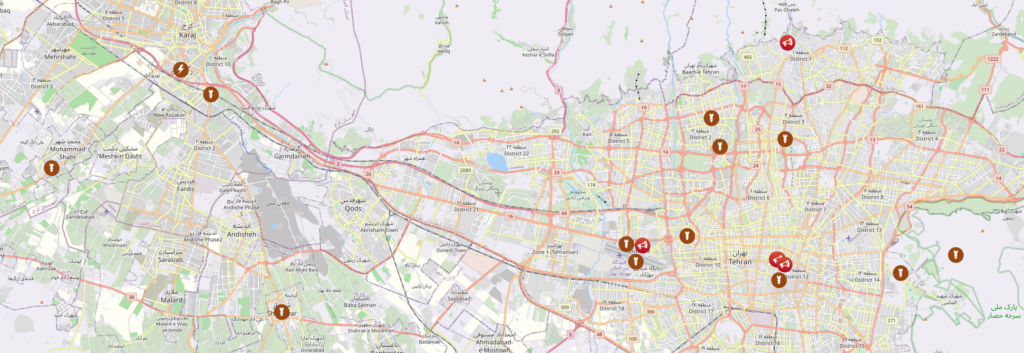
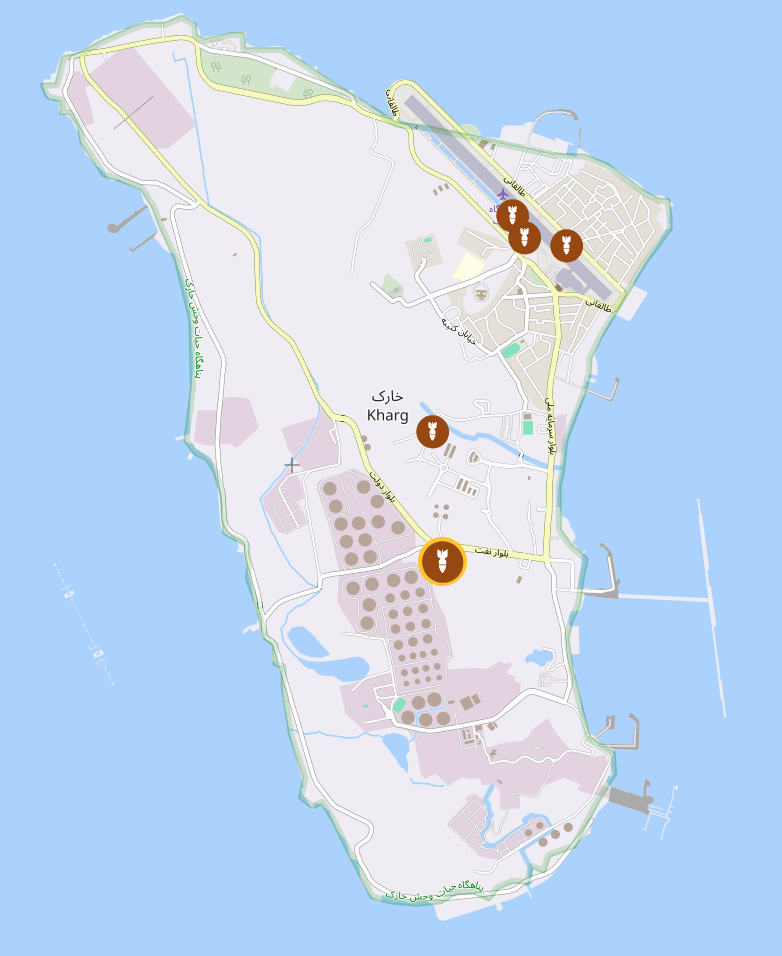
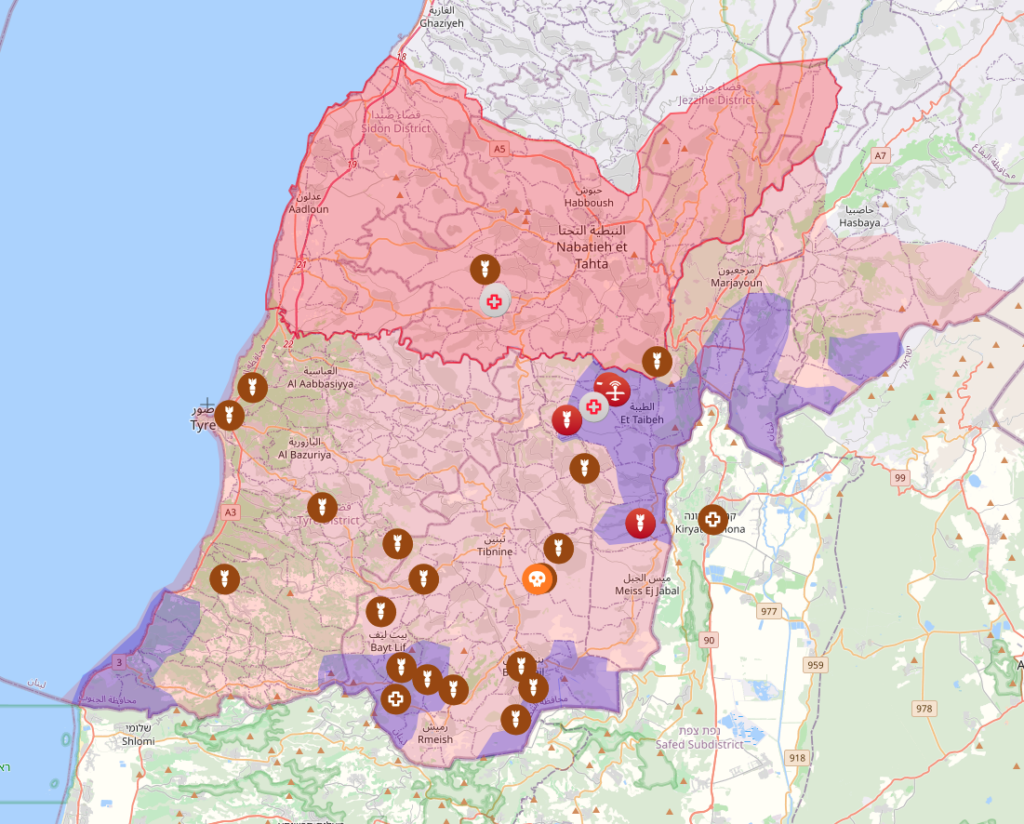
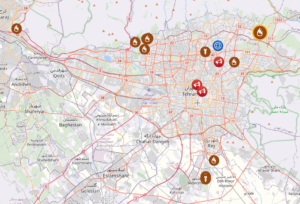
It looks like a big increase in operational strike tempo against Iranian targets has kicked off today, well in advanced of Trump’s 8 PM EST deadline. A whole lot of infrastructure targets are being hit across Iran, along with heavy strikes against Tehran…
…and Kharg Island. “The targets that the US hit on Kharg Island included bunkers, radar station, ammunition storage. Landing docks were not intentionally targeted. Only would have been struck if Iranians fired something from next to them.”
A list of infrastructure strikes:
“Since early in the morning on Tuesday, Israel and the United States have been extensively targeting railway and vehicle bridges across Iran, with bridges having been targeted in Tehran, Isfahan, Qom, and other regions of Western Iran, with Israeli officials claiming that the strikes were to prevent the movement of military equipment by Iran’s Islamic Revolutionary Guard Corps (IRCG). Roughly ten hours remain of President Trump’s deadline of 8:00PM EST given to Iran.”
The Israeli Air Force (IAF) escalated the stakes against Iran’s leadership yet again, going after the men in charge of Tehran’s oppression and terror organizations.
One of this weekend’s big names is Maj. Gen. Majid Khademi, now confirmed dead, who until the moment of his vaporization served as the head of the Islamic Revolutionary Guard Corps (IRGC) intelligence organization. Khademi’s death was confirmed Monday by an IRGC statement carried by the Iranian state Fars news service.
The same IRGC statement said that funeral and burial arrangements would be announced later, hopefully with just enough of a heads-up for U.S.-Israel forces to conduct a strike on it.
I don’t mean to sound so bloodthirsty on a gorgeous Monday morning, but you have to understand who Khademi was, what he did, and what his death might mean for the regime.
As head of the IRGC Intelligence Protection Organization (IPO), Khademi reported directly to the Supreme Leader of Iran — whoever that might be these days — because he was in charge of both IRGC internal investigations and internal repression.
So think of the IPO as a combination of a big city police department’s internal affairs division and Hitler’s Gestapo. The 45,000 Iranians reportedly murdered following last year’s big uprisings? Yeah, their blood is on Khademi’s hands. Be glad he’s dead.
But there’s more — some speculative, some confirmed.
An interesting tidbit: a pair of unverified rumors that lean into today’s news. The first — and quite persistent — is that Quds Force chief Esmail Qaani is an Israeli asset. Quds Force specializes in unconventional warfare, international terrorism, and military intelligence. Qaani became head following President Donald Trump’s assassination of former chief Qasem Soleimani in 2020.
The second rumor is that Khademi was heading up an internal investigation of Qaani before getting blown up. If there’s any substance to these rumors, you can imagine the chaos right now inside Quds and the IRGC as a whole.
But again, these are merely rumors.
Not a rumor is OSINTechnical’s report on Monday that another recent strike also killed Yazdan Mir, “leader of the Quds Force’s Unit 840, a covert operational group responsible for conducting clandestine activities outside of Iran.”
“Iran’s overnight strikes towards Saudi Arabia’s Jubail petrochemical complex threatened to “derail the talks”, a senior Pakistani official tells Reuters. “A Saudi retaliation to the attack could draw Pakistan into the conflict under its defence pact with KSA.” Pakistan has been very critical of Iran’s actions, but hasn’t taken any direct military action against the regime since Operation Epic Fury kicked off. If Pakistan does join the war against the Islamic Republic of Iran, it will probably be because they’ve decided Iran is the weak horse and they can get in on the spoils of a United States victory. The Baluchestan border has been a constant source of friction between the two nations, and they actually fought a short conflict there in 2024. Also, Pakistan, unlike Iran, still has a functional air force, even though some planes (like Mirage IIIs) are quite old.
As of this writing, there’s word that some sort of tentative ceasefire deal may be in the offing, assuming Iran agrees to open the Strait of Hormuz. Could be real, could be positioning.
“Big Week” was a combined allied air offensive against Germany in 1944. The results were mixed.
The Iran war is one months old and the usual Negative Nellies in the Democrat Media Complex are whinging that the war’s not won yet, or suggesting that the Trump Administration is looking for an “off ramp.” Funny how it takes time to defeat a nation of 92 million, even one where the regime is hated by its citizens and whose prewar air force looked like a museum. Everything we hear from CENTCOM is that the air campaign is on schedule.
And the “off ramp” for the war is regime change in Tehran.
“The USS Tripoli and USS New Orleans arrived in the Middle East, carrying with them 2,200 Marines — with more on the way — hours after an Iranian strike left dozens of U.S. service members hurt at a Saudi air base. The Tripoli and New Orleans are two of several additional vessels and personnel the Pentagon has deployed to the region as the U.S.-Israeli war in Iran enters it’s second month. The Tripoli Amphibious Group brings with it F-35B Strike Fighters, as well as transport aircraft, amphibious assault vessels and other tactical assets.”
“Israel struck secret facility for production of Iran’s naval weapons and storage of boats and ships.”
“The facility located in the city of Yazd served as a key production center for advanced missiles and sea mines intended for Iran’s naval forces.”
“The site that was hit was reportedly involved in designing, assembling, and testing advanced missiles that could be launched from ships, submarines, and helicopters, targeting both moving and stationary vessels at sea.”
“The Israeli Defense Forces described the location as the central hub of Iran’s naval strike capabilities, noting that weapons produced there had been used in operations that posed a threat to navigation in the Strait of Hormuz.”
“Following the strike, the facility’s production infrastructure and stores of ready-to-use missiles were said to have been completely destroyed.”
“A reported Israeli airstrike on Tehran has killed Hassan Hassanzadeh, a senior commander of the Islamic Revolutionary Guard Corps’ Mohammad Rasul‑Allah Corps, which oversees security in Greater Tehran and counter‑ unrest operations.” I’ve also seen his name rendered “Hassan Hassan Zadeh,” for those playing IRGC Dirtnap Bingo at home…
“Majid Zakriyai, commander of the Iranian Army’s Natural Resources Organization protection unit, was killed.”
President Trump promised some absolute scorched earth on Iran if they don’t fall in line, promising to blow up their electric grid, their oil wells and Kharg Island…but then deleted the tweet. 🤷
E-3 Sentry and KC-135 destroyed at Prince Sultan Air Base in Saudi Arabia.
The anti-air capabilities of Prince Sultan Air Base still leave much to be desired.
The Houthis had been unusually quiet during the open stages of the war. Well, that’s ended, and they’re now tossing missiles at Israeli. Not sure how many they have, given that Iran has been both broke and busy…
It’s always hard to tell what the state of the war in Lebanon is, but to my casual observation, it looks like the intensity of strike has lessened on both sides, but Hezbollah attacks seem to have fallen sharply. On the other hand, today’s status map show that Israeli forces are already at the Litani River in the eastern part of Lebanon:
“US military has been working on Iran ground raid plans for years.” One would hope.
Retired Gen. Frank McKenzie, the former commander of U.S. Central Command (Centcom), said Sunday that the U.S. military has been working on plans for a ground raid in Iran for years, as President Trump is reportedly considering sending troops into the war.
“Margaret, for many years we’ve considered options along the southern coast of Iran, seizing islands, seizing small bases. Typically raids. And a raid is an operation with a planned withdrawal. You’re not going to stay. But some of those islands you could seize and hold. That would have a couple effects,” McKenzie told CBS News’s Margaret Brennan on “Face the Nation.”
“First of all, it would be profoundly humiliating for Iran and would give us great weight in negotiations. The second, the example of Kharg Island, which everyone talks about, if you seize Kharg Island, you really can shut down the Iranian oil economy completely. And the beauty of seizing it is, you’re not destroying it,” he said.
Is China pushing Iran for a ceasefire?
“The risks to global trade through the Strait of Hormuz have surged and the dynamics of Iran’s relationships with Russia and China are constantly in the spotlight. Recently, both countries have pressured Iran, urging diplomatic solutions to the crisis. On March 24th, China’s foreign ministry reported that Foreign Minister Wang Yi held a phone call with Iran, calling for seizing the opportunity for peace and negotiating as soon as possible.” So did Russian Foreign Minister Sergei Lavrov.
“Analysts believe Russia has explicitly urged Iran to back down, signaling that Moscow views Iran as unable to continue fighting. Shortly afterward, China followed suit, aligning with Russia in terms of diplomatic timing. This indicates coordination between the two countries. Their shared goal is to maintain the stability of the Iranian regime, ensuring it continues to act as a strategic counterbalance to the United States.”
“From Beijing’s perspective, Iran is not only a major energy supplier, but also a key node in the Belt and Road Initiative. Chinese investments in the country amount to at least hundreds of billions of dollars, covering oil and gas field development, port construction, and transportation networks. If the Iranian regime were completely overthrown, it would directly threaten China’s energy and geopolitical interests. Therefore, Beijing must intervene diplomatically and urge Iran to turn to negotiations.” A lot of observers believe that Belt and Road is already moribund.
“A source close to China’s Foreign Minister, Wang Yi, revealed to the Epoch Times that Iran has refused any purely diplomatic arrangements and instead pressured Beijing with selective security, linking substantial aid to the safe passage of Chinese commercial ships through the Strait of Hormuz. This is soft extortion. Without military assistance, China cannot ensure the smooth passage of its trade routes. Beijing’s multiple secret negotiations have ended in failure and its efforts to profit from the geopolitical game are now facing the dual impact of diplomatic imbalance and economic stagnation.”
China also thought it could be a negotiating mediator between Washington and Tehran. Yeah, fat chance.
“This crisis is essentially the inevitable backlash of China’s ‘wolf warrior diplomacy” and camp confrontation mentality.”
“China’s leaders have fallen into a self-entangling dilemma. The forces they’ve supported are now cutting off their own economic lifelines. The disruption in the Straight of Hormuz is not only a rupture in global logistics, but also a microcosm of the complete collapse of China’s geopolitical strategy.”
“You’re starting to see the Iranian regime looking for an exit ramp.”
“USAF A-10s are arriving in the UK tonight as the U.S. surges more Warthogs to the Middle East.”
As usual, this is just the Iran news I felt significant enough to include in the roundup. If you think I’ve missed anything, feel free to share in the comments below.
The Iran war continues, with attacks on energy grids and refineries across the Persian Gulf, (maybe) another bunker buster strike, serious regime confusion, countries reporting impending shortages, and part of the 82nd Airborne moving into the theater.
ZeroHedge has piece up that starts with a nice state-of-play summary.
WSJ, Fox reporting 3,000 elite Army [82nd] Airborne soldiers to be ordered to Middle East. Axios says US awaits Iran response to proposed Thursday peace talks.
Backchannel diplomacy vs skepticism: Abbas Araghchi reportedly signaled openness to negotiations with the US via envoy Steve Witkoff, but Israel has appeared cool on deal prospects or offramp.
Heavy exchange of fire and testing red lines: Iran continues missile and drone waves targeting Israel and US bases, amid reports of overnight airstrikes on military and gas infrastructure near Isfahan.
Iran reshuffles its security leadership, appointing Mohammad Bagher Zolghadr: he’s a former IRGC commander and replaces the assassinated Ali Larijani.
Iran halts natural gas exports to Turkey: follows last week’s Israeli strike on the massive South Pars gas field; QatarEnergy declares force majeure on some LNG contracts due war.
“The Israeli Air Force recently struck an Iranian nuclear research and development site in Tehran, the military announces. According to the Israeli army, the “strategic” site at the Malek Ashtar University was used by Iran’s military industries to develop components for nuclear weapons. Malek Ashtar University, subordinate to Iran’s defense ministry, is under Western sanctions over its activities relating to Iran’s nuclear and ballistic missile programs.”
This falls into the “Big if true” category: “Three heavy bombers of the U.S. Air Force are currently conducting heavy strikes on the underground missile base of the IRGC Aerospace Force in Yazd, central Iran (Al-Qadir missile base). A total of six bunker-buster bombs have been dropped on the site by either B-1B heavy bombers flown from RAF Fairford in the United Kingdom or B-2A Spirit stealth bombers flown directly from Whiteman AFB in the United States.” I haven’t seen enough of Babak Taghvaee’s work to gauge the accuracy of this. (The few bits of his I’ve read have seemed accurate.) It seems like the sort target we would hit, but not knowing which bomber hit these targets suggests a source lacking firsthand knowledge. If anyone has a better bead on Taghvaee’s accuracy, feel free to share it in the comments below.
Not just over the Strait: The Warthog is also engaging Iranian back militias in Iraq.
USAF A-10 Warthogs spent most of the day strafing Iranian-backed militia positions around Mosul, Iraq. pic.twitter.com/5GLcm1XVnN
Victor Davis Hanson has spent fifty years studying how wars end. When he says the tide is turning, it’s worth listening to why.
His argument isn’t based on what the Pentagon is saying. It’s based on how everyone else is behaving.
𝗧𝗵𝗲 𝗘𝘂𝗿𝗼𝗽𝗲𝗮𝗻𝘀. VDH’s rule: Europeans never agree to go anywhere near a conflict unless they think the winning side has already been determined. They didn’t help in the early days. Now they’re starting to move. That movement is not idealism. It’s a calculation. They’ve looked at the battlefield and decided which way this ends.
𝗧𝗵𝗲 𝗚𝘂𝗹𝗳 𝗽𝗲𝘁𝗿𝗼-𝗻𝗮𝘁𝗶𝗼𝗻𝘀. The Saudis, the Emiratis, the Qataris — these governments have survived for generations by reading the regional climate with precision. When they expel Iranian military attachés, when they intercept Iranian missiles over their own capitals and say nothing about American strikes, when the UAE reaffirms its $1.4 trillion investment commitment to the United States mid-war — they are not making ideological statements. They are placing bets. And they are betting on the United States.
𝗔𝗹 𝗝𝗮𝘇𝗲𝗲𝗿𝗮. This is the one that should stop you cold. Al Jazeera — the Qatari state media network, historically critical of American military action, the network Tucker Carlson and the anti-war right love to cite against Israel — is now calling the U.S. bombing campaign brilliant and effective, and saying it has been underestimated. When the media outlet of a nation that hosts both the largest American air base in the Middle East and a Hamas political office starts praising American military effectiveness, the message is unmistakable: 𝘵𝘩𝘦𝘺 𝘵𝘩𝘪𝘯𝘬 𝘸𝘦’𝘳𝘦 𝘨𝘰𝘪𝘯𝘨 𝘵𝘰 𝘸𝘪𝘯.
𝗧𝗵𝗲 𝗺𝗶𝗹𝗶𝘁𝗮𝗿𝘆 𝘀𝗶𝗴𝗻𝗮𝗹. A-10 Warthogs and Apache helicopter gunships are now flying strike missions in Iranian airspace at will. VDH’s point: you only deploy those aircraft when there is effectively no air defense left to threaten them. They are slow, low-flying, close-support platforms. Their presence confirms what the Pentagon has been claiming — Iran has no meaningful air defense remaining.
Iran’s strategy now is rope-a-dope. Run out the clock. Wait for American public opinion to shift. Hope the midterms create political pressure on Trump to stop. It is the only play they have left.
VDH’s conclusion: if Trump sees it through — and he believes he will — the regime falls. Not in years. 𝗣𝗿𝗲𝘁𝘁𝘆 𝘀𝗼𝗼𝗻.
Since President Trump revealed contacts with the Islamic Republic, we’re seeing something very telling inside Iran: chaos at the top.
Regime officials are either turning on each other, pointing fingers, accusing one another of negotiating with the United States or in their own media and social platforms, they’re warning against character assassination of figures like Ghalibaf or Rouhani, because suspicion is spreading inside the regime itself.
Some are even calling for arrests or worse. Others are publicly shaming officials, accusing them of secret talks.
This is the atmosphere on the Islamic Republic’s side of social media. Total panic.
Jim Geraghty wonders “Why Are We Lifting Sanctions on Iranian Oil During a War with the Mullahs?” It’s a good question, though Trump seems to have a more intuitive grasp of alternating between carrots and sticks in negotiations than anyone I’ve ever seen. Also: “We have seen oil tankers carrying Russian oil divert from China to India in the aftermath of the Treasury Department’s lifting of sanctions on their cargo: ‘At least seven tankers carrying Russian oil have switched their destinations mid-voyage from China to India, according to Vortexa Ltd., with all of India’s major refiners now in the market for the country’s crude.'”
“Three explosions in Bushehr following attacks on the airbase and airport in Iran.” Bushehr is reasonably close to Kharg Island.
“Iran launches 10 million rial note.” Hyperinflation is rarely a sign of military strength. Also: The 5 million rial note was introduced “just weeks earlier.”
The Guardian (usual caveats apply) is saying that “Hundreds of petrol stations across Australia run out of fuel,” but Australian Energy Minister Chris Bowen states “Australia’s fuel supply remains strong and there are no immediate plans to ration fuel,” though the article admits “localized shortages.”
In Japan, gasoline prices have evidently hit record highs and the government is tapping national reserves, but tankers from UAE and Saudi Arabia bypassing the Strait of Hormuz are on the way.”
“Taiwan has about 11 days of liquefied natural gas reserves—a limited buffer that has become critical after Iran disrupted shipping through the Strait of Hormuz, cutting off key supplies from Qatar. Because Taiwan relies heavily on LNG to power its grid and semiconductor industry, any prolonged disruption could force energy rationing and threaten chip production.”
“Philippine president declares ‘national energy emergency‘, citing risks to fuel supply created by Middle East war.”
Another Iran update: More Jihadis dirtnaped, Iran’s neighbors want the Islamic regime finished off, Mossad gives regime members person-to-person call warnings, Uncle Sam fast-tracks a lot of weapon sales to the Middle East, and the BRRRRRRRTTTTTTTT of Freedom rings out over the Strait of Hormuz.
Israel Defense Forces killed top Iranian intelligence official Esmaeil Khatib and Hamas commander Yahya Abu Labda in separate airstrikes in the Middle East overnight.
The IDF confirmed Khatib, Iran’s intelligence minister, was killed in the strike in Tehran on Wednesday morning.
“Khatib played a significant role during the recent protests throughout Iran, including the arrest & killing of protestors and led terrorist activities against Israelis & Americans around the world,” the IDF wrote in a post announcing Khatib’s death. “Similarly, he operated against Iranian citizens during the Mahsa Amini protests.”
The Hamas commander was reportedly killed during an IDF airstrike in the Gaza Strip on Tuesday, according to the Times of Israel.
The strikes come a day after Israel killed Ali Larijani, secretary of Iran’s National Security Council, in an airstrike.
Abu Labda was a prominent figure in the development of Hamas’s precision missile project, according to the Times of Israel.
The Israeli Air Force (IAF) for the first time hit Iranian naval targets in the Caspian Sea on Wednesday, striking infrastructure and ships at the port of Bandar Anzali in northern Iran, at a distance of some 1,300 kilometers (over 800 miles) from Israel.
In addition, the IAF continued striking targets belonging to the Iranian regime’s Islamic Revolutionary Guard Corps (IRGC), the Basij militia, and the Air Force, among others.
The Israeli military confirmed on Thursday that the strikes in Bandar Anzali hit several ships, a repair facility, as well as a headquarters controlling naval operations in the Caspian Sea.
The US has deployed A-10 Warthogs attack jets, Ah-64 Apache helicopters, and 5,000-pound ground penetrator bombs to take out Iranian drones, boats, and mines to help secure the Strait of Hormuz, America’s top general said Thursday.
Gen. Dan Caine, chairman of the Joint Chiefs of Staff, vowed at a Pentagon news conference that the US would “hunt and kill” all of Tehran’s weapons facilities and assets being used against the strait, a critical trade route through which 20% of the world’s oil supply is transported.
“We continue to hunt and kill afloat assets, including more than 120 vessels and 44 minelayers,” Caine told reporters alongside War Secretary Pete Hegseth.
Simon Whistler has a meaty update on the war, including how all the Persian Gulf nations now agree that the Islamic Republic of Iran must go.
“Iran’s response to this war has managed to achieve something truly remarkable. [Ali Larijani]’s own neighbors, who had previously gone to bat for them, are now done dodging missiles and are reportedly pushing Washington to eliminate the Iranian threat for good, destroying the tools of repression.”
Skipping over the deaths of Ali Larijani and Gholam Reza Soleimani, previously reported here.
“Since the war began, American and Israeli forces have been running what amounts to a parallel campaign alongside the more headline grabbing strikes on nuclear sites and missile infrastructure. This campaign has been aimed squarely at the regime’s domestic repression capabilities and infrastructure, and it’s been accelerating massively in recent days. These targets should tell you something about what this part of the campaign is actually designed to do. Destroying missile launchers and stockpiles might degrade Iran’s ability to hit back, but destroying a law enforcement station and the men who run it degrades Iran’s ability to keep the lid on a country that it only barely had a grasp on before all of this kicked off.”
Skipping lightly over news of Iranians celebrating the traditional Chaharshanbe Suri fire festival, and the regime cracking down on same (no Zoroastrian fire festivals allowed in Islamic Iran), because it’s hard to get a sense of scale there.
“Noras, or Persian New Year falls on March 20th this year. This holiday is historically one of the largest public gatherings in Iranian life and has often been a flash point for protests against the regime. Last year, they arrested dozens of people across multiple provinces during Nar and that was before any of this broke out. this year. Suffice it to say, the situation has uh changed a bit. We don’t want to rest too much on Naras as a make or break moment, though. But it nevertheless represents a significant test of the coalition’s core theory for ousting or at least seriously pressuring the regime. Degrade their tools of oppression enough and the population will be able to do the rest.”
“The Guards have never been a domestic military force, but instead an ideologically driven group of hardliners explicitly set up to defend the Islamic Republic’s continued existence, no matter what the cost. Whatever comes next on the streets of Tehran, it does not appear likely that these men will simply lay down their weapons and go quietly into that good night.”
“The IRGC’s hardliner stance did not just reveal the power dynamics going on in Tehran, though. It helped to reshape the entire region’s posture in ways that would have been difficult to imagine just a few weeks ago. Before the war started, the Gulf States were the closest thing that Iran has to a coalition against American military action. Despite hosting US bases, most of them had adamantly pushed the White House not to strike Iran and were actively working to try and find common ground between Washington and Iran so they can avoid conflict.”
“While this was partially out of self-preservation interests, they knew the conflict in the region is never good for their bottom line, at least in the short term. They were still some of the best friends that Tehran had left. The Emirates had spent years rebuilding its relationship with Iran, and Aman’s foreign minister was in Washington discussing the matter with Vice President JD. Vance the day before the strikes took place. None of them doubted that Iran posed a threat. They hosted US bases for a reason, after all. But they calculated that living with the Iranian threat would be preferable instead of being largely defenseless in a war.”
“Iran’s response to Operation Epic Fury settled that debate in about 72 hours. Since February the 28th, Iran has launched over 1,800 projectiles split between ballistic missiles and drones at the UAE alone.”
“Bahrain took it even further, branding Iran treacherous. Bahrain even took the lead in sponsoring a UN Security Council resolution condemning Iran for its targets in this conflict which passed with unusually lopsided support. While not everyone throughout the Gulf was quite as forceful as that, they’ve all been moving in the same direction.”
“Behind the public statements urging peace, the private messaging to Washington has been far more direct: ‘Finish the job.'”
“Gulf officials have been pushing the Trump administration for what amounts to a permanent end to Iran’s ability to threaten their infrastructure.”
“In the space of three weeks, Iran has managed to turn every Gulf state that was lobbying Washington on its behalf into a partner actively backing the campaign to destroy its military capabilities. It is by almost any measure one of the most self-defeating foreign policy decisions a country has made in the modern Middle East.”
“A recent Goldman Sachs stress test published on March 15th showed that if the strait remained effectively closed through April, Qatar and Kuwait could see their full-year GDP contract by 14%, the worst since the 1990 Gulf War. The UAE and Saudi Arabia wouldn’t be quite as hard hit, but they’d both take a 5 and 3-point hit, respectively.”
Whistler also offers up a nice roundup of the current state of Israel’s incursion into Lebanon: “By March 16th, at least three separate IDF divisions were operating simultaneously inside of southern Lebanon, pushing through Kiam, Bins Jabel, and Marion in the most significant ground operations since their 2006 intervention. Evacuation orders are now covering everything south of the Latani, which when combines with the evacuated areas in the Bekaa Valley and southern Beirut totals to roughly 14% of the entirety of Lebanon’s territory.”
“Israeli Defense Minister [Israel] Katz has said at least parts of the operation are modeled explicitly on Gaza, offered no timeline for withdrawal, and some ministers are already floating the idea of a semi-permanent security zone. For now, there are no signs of a push toward Beirut or anything beyond the Litani.”
“In the last 48 hours alone, [Lebanese President Joseph Aoun] publicly called Hezbollah’s decision to enter the war a trap and an almost overt ambush serving Iranian interests, warned that the country is on the path to become a second Gaza, and floated a four-point plan calling for an immediate ceasefire, international backing for the Lebanese armed forces to oversee disarmament, direct negotiations with Israel, and long-term border security agreements.”
“While all of this is unprecedented for a Lebanese president, Beirut is currently falling short of Israeli expectations for two reasons. First, Lebanon has a long history of promising to finally get tough on Hezbollah that, well, hasn’t exactly materialized. Second, and more pertinently, the LAF [Lebanese Armed Forces] are already struggling to implement the ban on Hezbollah’s military operations that we reported on just a week ago. Hezbollah’s attack was earth-shattering for Beirut, which appeared to have finally found a moment of cross sectarian agreement that Hezbollah simply had to go. And while there were initially promising signs that the LAF was taking this seriously, the army has largely stalled. LAF commander [Rodolphe Haykal] has essentially refused to enforce the government’s ban on Hezbollah military activities, and the United States has even suspended some coordination with the LAF over it. The country’s prime minister has considered firing him for the whole debacle.”
“Now look, in fairness to Haykal, this isn’t just some random act of indifference where he’d rather sit around and watch Warfronts than go out and disarm the group. Though we couldn’t blame him if that was the case, could we? Rather, his calculation is that 20 to 30% of the LA Shia and would possibly refuse to mobilize against Hezbollah entirely, risking a total fracture of the military. Keep in mind that in Lebanon, sectarian identity is front and center just about everything that happens, especially in politics, and the LAF is broadly considered to be the last cross-sector institution in the country.”
“All that said, the inaction here is seriously jeopardizing the country’s sovereignty. The lesson that Israel took away from the October 7th attacks, rightly or wrongly, was that they couldn’t afford to allow a hostile force to exist along its borders anymore. In the aftermath of the 2024 ceasefire with Lebanon, Israel made it clear that disarmament of the group was an absolute bare minimum condition. And the tragic thing is that the LAF largely delivered on this. Earlier this year, they completed phase one of the operation. And while it was slowgoing, potentially so slow that Hezbollah was actually rearming faster elsewhere in the country than it was being disarmed, the LAF nevertheless demonstrated that it could deliver.”
“And all of this isn’t helped by the fact that even today, right now, Hezbollah continues to launch on Israel. While their stockpile has been severely reduced and seems likely to be further reduced in their ongoing clashes with the IDF, they don’t appear to be anywhere close to surrender.”
One of the reasons Iran was caught off guard at the opening of this war is that its leadership did not take Yahya Sinwar or Hassan Nasrallah’s approach. The Iranian regime—a state built on terror—was acting like a state and forgot what happens to those who spread terror. What Hezbollah and Hamas understood, and what Iran forgot, is that when you attack Israel, you become prey.
After the regime’s decapitation on the first day, Larijani grasped that reality. As Iran’s most senior surviving security official, he never stayed in the same place twice, and maintained exceptionally high security awareness.
In the end, it took a combination of precise intelligence, special ground capabilities, and rapid decision-making at both the political level and the by chief of staff to complete the operation. The time between the intelligence alert and the order for the strike was less than an hour; that’s an incredibly tight kill chain. This wasn’t a Hamas or Hezbollah target; exploiting this opportunity meant scrambling aircraft all the way to Iran.
Snip.
According to The Wall Street Journal, Israel is chasing internal repression forces from their headquarters to secret muster points at sports stadiums, even to neighborhood police stations. All in an effort to demonstrate to the Iranians that the regime’s fangs have been removed.
Meanwhile, Israel is calling mid- and low-level commanders, threatening them and their families if they don’t stand aside in the event of an uprising.
One conversation is worth recounting.
“Can you hear me?” a Mossad agent can be heard, speaking in Farsi. “We know everything about you. You are on our blacklist, and we have all the information about you.”
“OK,” the commander said in the recording.
“I called to warn you in advance that you should stand with your people’s side,” the Mossad agent said. “And if you will not do that, your destiny will be as your leader. Do you hear me?”
“Brother, I swear on the Quran, I’m not your enemy,” the commander said. “I’m a dead man already. Just please come help us.”
Last night, a very senior Israeli source outlined to me Israel’s five objectives in this war:
To act jointly with the United States to reopen the Strait of Hormuz.
To permanently deny any future Iranian regime the ability to again close the strait — including through the development of alternative pipelines.
To dismantle Iran’s weapons industry, with an emphasis on ballistic missile capabilities — this time targeting not just equipment but the factories that produce it.
To complete the destruction of Iran’s nuclear program.
Israeli Defense Minister Israel Katz has authorized the country’s military to kill Iranian and Hezbollah officials without explicit approval from higher-ups.
Katz announced the blanket order as he alerted Israeli residents that the military had taken out top Iranian intelligence official Esmaeil Khatib. Katz said he and Prime Minister Benjamin Netanyahu authorized the directive overnight.
The purpose of the authorization is to thwart the possibility of delays in Israel’s Operation Roaring Lion against Iran, according to Israeli network Channel 12. Katz vowed that there were more “significant surprises” to come as part of the development.
In the past several days, targeted Israeli strikes have assassinated several top Tehran officials, dealing a devastating blow to the Iranian regime’s power structure as the war moves well into its third week.
Snip.
The assassinations come as Israel has ramped up its attacks targeting Basij checkpoints and infrastructure. The Guard’s Basij unit has notably been targeted in the war, as the paramilitary force has long been seen as the leading military unit behind the deadly crackdown on Iranian protesters over the winter and behind repression in general against regime dissidents.
The Israeli military is targeting Basij personnel and facilities as the country seeks to weaken the Islamic regime enough to encourage Iranian citizens to topple the power structure.
“We’re undermining this regime in the hope of giving the Iranian people a chance to oust it,” Netanyahu said in a statement on Tuesday.
Next regime figure to get droned announced. “Hossein Dehghan, who was sanctioned in 2019 for his alleged role in an attack that killed 241 American troops, has been named to replace the assassinated Ali Larijani. According to a report by Iran International, Iran appointed former Defense Minister Hossein Dehghan on Thursday as the new secretary of the Supreme National Security Council,”
The Trump administration announced plans to sell more than $16.5 billion worth of radar systems, air defense equipment, and fighter aircraft weaponry to the United Arab Emirates, Kuwait and Jordan Thursday, as Iranian missiles and drones continued to hit sensitive infrastructure across the Gulf region.
US Secretary of State Marco Rubio issued an emergency waiver to bypass the mandatory congressional review period for the sales, the Pentagon said in its press release.
For the UAE, the State Department approved $2.1 billion worth of 10 FS-LIDS counter-drone interception systems, along with 240 Coyote backpack-carried drone interceptor systems, along with related sensors and munitions.
Another planned sale to the UAE includes a THAAD long-range discrimination radar, as well as Sentinel A-4 uplinkers and THAAD tactical operations and launch and control systems. A third sale set for Abu Dhabi includes $644 million worth of F-16 munitions and upgrades, including GBU-39/B small diameter bombs and Joint Direct Attack Munitions guidance systems (JDAMs), along with 400 AIM-120C AMRAAM air-to-air missiles and eight guidance sections, the Pentagon said.
Kuwait is set to receive $8 billion in Lower-Tier Air and Missile Defense Sensor (LTAMDS) radars, the administration further announced Thursday, along with a slew of accompanying electronic equipment. Jordan, meanwhile, is slated to receive $70.5 million worth of maintenance, logistics, and munitions support for its F-16s, C-130s and F-5 aircraft.
The planned sales come as Iran has targeted sensitive early warning and missile defense radar sensors in several US-aligned countries in the Gulf. Iran has also repeatedly struck civilian centers and, increasingly over the last 48 hours, oil and gas infrastructure with drones and missiles.
US Defense Secretary Pete Hegseth on Thursday praised Gulf states for their support for Washington’s war effort, saying Iran’s “reckless” pattern of counterattacks has brought some of those countries “squarely into our orbit.” He specifically named the UAE, Qatar, Bahrain, Kuwait and Saudi Arabia.
Speaking alongside Hegseth at the Pentagon, the US’ top-ranking general, Chairman of the Joint Chiefs of Staff Gen. Dan Caine, said the US military will continue to work with Gulf states “to help them to improve any defensive capabilities that they need.”
Missile plant hit: “Karaj Surface-to-Surface Missile Plant” destroyed by U.S. strikes. This was March 1, but CENTCOM only released the images today.
Iran evidently managed to damage an F-35:
“Likely hit by a Qaem-118 short range SAM.” The pilot returned to base safely and made an emergency landing.
Once again, this was just what I was able to gather from various sources. If you think I’ve missed something, feel free to share it in the comments below.
Iranian ships reportedly laying mines go boom, as does another suspected Iranian nuclear site, Iran hits Jordan and Iraq, the Israelis dirtnap more Basij, VDH weighs in, the Saudis are buying Ukrainian MilTech, and a quick guide to drones.
Another day, another 429 error. This one cleared up while I was out riding my bicycle (which broke).
US forces obliterated several Iranian navy vessels — including 16 minelayers — near the Strait of Hormuz on Tuesday as President Trump warned the Islamic Republic against planting explosives along the critical global trade route.
The strikes came amid reports that Iran had already begun laying mines along the vital shipping lane — which carries about 20% of the world’s oil supply — despite Trump’s demands that it remain open and unaffected as tensions with the US and Israel escalate.
Trump himself doesn’t sound sure mines were actually laid: “If Iran has put any mines in the Hormuz Strait, and we have no reports of them doing so, we want them removed, IMMEDIATELY!”
And the video compilation of those same boats going boom:
Among the three cargo vessels that were hit in the strait was a Thai-flagged vessel, which was 11 nautical miles north of Oman. A fire broke out on board and the Royal Thai Navy said the 23 crew members were rescued.
Iran has claimed responsibility, saying the ship’s crew ignored warnings.
The second vessel was a Japanese-flagged container ship that was struck 25 nautical miles off the coast of the United Arab Emirates, sustaining minor damage.
A third cargo vessel was hit about 50 nautical miles north-west of Dubai, according to UK Maritime Trade Operations (UKMTO).
Also: “32 countries voted unanimously to the release of 400 million barrels of oil due to the “unprecedented” situation, the International Energy Agency (IEA) announced.” Including the U.S. (See below.)
Iran also threatened $200 a barrel oil, which will make them super popular with any country that isn’t Russia.
The Israel Defense Forces on Tuesday declared it had dismantled most key assets of Iran’s internal security forces in Ilam province, a western region that became a flashpoint during the anti-regime protests that swept the Islamic Republic earlier this year.
Security forces and members of the Basij—the Islamic Revolutionary Guard Corps’ volunteer militia—”carried out many terror attacks and brutally repressed internal protests during demonstrations that took place across Iran in the December–January period,” the IDF stated.
Since the start of “Operation Roaring Lion” on Feb. 28, Israeli Air Force jets struck the local headquarters of Tehran’s internal security forces, including barracks of a special forces unit; an office of the regime’s Intelligence Ministry; an IRGC command center responsible for battalions that suppress protests; and several Basij and IRGC infrastructures used to reinforce the regime’s control, it said.
The IDF noted that the damage to repression and control mechanisms in the Ilam province, which borders Iraq and has a significant Kurdish population, was just “one example of many” of its recent operations.
The security forces “form part of the Iranian regime’s security apparatus and have for years been responsible for executing terror activities,” said the army, noting that they also lead Tehran’s main “repression efforts against internal protests, particularly in recent periods, using severe violence, mass arrests, and force against civilian demonstrators.”
Israel reportedly hit an Iranian bank. I certainly hope not. We need to seize the records of all Iranian banks to find out what bribes were paid out to Obama and Biden Administration officials…
Until last year, for some 46 years, Iran enjoyed a North Korea-like reputation in the heart of the Middle East: always unpredictable, reckless, dangerous, inevitably to be nuclear, self-destructive, and nihilistic.
All that said, was it really ever all that formidable?
The mullahs came into power after the removal of the Shah and, subsequently, the interim secular socialists. They did so by taking American hostages, murdering opponents, executing former supporters, and transforming the most secular and modern of the Middle East Muslim nations into the most medieval that routinely hung homosexuals, adulterers, and almost anyone who questioned the authority of the ayatollahs. In other words, these were gruesome people, but they didn’t necessarily have a competent military.
The theocracy’s only constant with the prior monarchical Iran was that it inherited near limitless oil and natural gas reserves, sophisticated arms, and the Shah’s modernized cities. It controlled the key strategic chokepoint at the Strait of Hormuz and enjoyed a geostrategically critical location between Asia and the Middle East. It fueled Iran’s historical chauvinism and pique that the millennia-long historical preeminence of Middle Eastern Persia was not fully appreciated by its Arab neighbors. So there were lots of natural advantages—and all for the most part squandered.
Under the camouflage of Shiite puritanism and otherworldliness, the ayatollahs proved even more corrupt (and far more incompetent) than the Shah’s entourage. They fought a destructive eight-year war with Saddam Hussein’s overrated Iraqi dictatorship and showed they were mostly just as militarily incompetent.
Over decades, they killed and wounded thousands of Americans by bombing U.S. embassies, barracks, and bases in the Middle East—without directly confronting the American military. For years, they sent lethal shaped charge IEDs to the Shiite insurgents to slaughter and maim thousands of Americans in Iraq and to the Taliban to do the same in Afghanistan.
At the first sign of popular protests, the regime never hesitated to gun down thousands of unarmed protesters. And, of course, they were abject hypocrites—hating the West, damning the Great Satan—and sending their pampered children to universities in America. The apparat proved quite earthly in its desire for money, estates, foreign travel, and the good life.
Their general strategies were never hard to follow.
One, the theocrats’ prior familiarity with Americans under the Shah and in exile in Europe bred an irrational fixation with and hatred of the West in general that made them useful proxies for the grand designs of communist and then later oligarchic Russia, and later ascendant communist China.
Iranian realpolitik alliances with secular communists were based on the quid pro quo of granting Russia and China access to the Gulf, selling oil to China, and buying arms from both.
Two, they were endlessly chagrined that the Persian Shiites had been overshadowed by more populous Sunni Arab neighbors that supposedly lacked their own historical sophistication and more legitimate claims of embodying and speaking for global Islam.
So they would correct that historical travesty by doing their best to mobilize their clients and proxies to bully, isolate, and weaken Arab autocracies, especially those that are pro-Western.
Three, their planned eventual destruction of Israel would ensure that theocratic and Shiite Iran regained its lost prestige and honor by finally accomplishing what the Sunni world had failed to do. By arming murderous clients in Lebanon, Gaza, Syria, the West Bank, and Yemen, they fashioned a global network of death that compromised European foreign policy toward the Middle East and terrified Western leaders and many of their Arab neighbors.
Fourth and finally, they sought to diminish the role of the United States in the Muslim world, drive it from the Middle East, and wage a virtual 47-year opportunistic war against American citizens and soldiers, with help from their terrorist surrogates.
Iran’s zenith in power and prestige came during Obama’s presidency (2009–17), and the so-called “Iran Deal” that they believed would guarantee them eventual nuclear power status.
But far more importantly, their massive acquisitions of air, land, and sea weapons and the empowering of terrorists, coupled with their passive-aggressive claims to victimhood, both scared and enticed President Obama into dropping sanctions. Soon, he was apologizing for supposed past sins and nocturnally sending them millions of dollars in Danegeld.
But worse by far, Obama thought he had squared the circle of neutralizing the supposed Middle Eastern Iranian juggernaut by envisioning it as an empathetic victim—and eventual friend if not ally.
Iran was to be rebooted as the Persian and Shiite righteously aggrieved underdog—bullied unfairly by Western imperialists and their surrogate corrupt Arab petro-kingdom clients for its asceticism and courage in fighting the West since its own birth in 1979.
Obama would remedy this “injustice” by bolstering Iran as a counterweight to not just the Sunni Arab world but to Israel itself. The reset would include an American détente with the murderous pro-Iranian Assad regime in Syria, the supposedly benign neglect of Hezbollah’s takeover of Lebanon, and the championing of the “Palestinians,” which de facto had insidiously become indistinct from Hamas terrorists.
Such creative tension between the Iranian Shiite crescent and a diminished Arab world would be adjudicated from time to time by Obama himself, whose America would go from oppressor to ally of the oppressed.
Snip.
In sum, no one apparently realized—with the exception of Donald Trump and Benjamin Netanyahu—that beneath its rough, ugly shell, theocratic Iran was rotten and decayed inside. Its corruption and the hatred of its own people ensured that even its huge revenues and sophisticated Chinese and Russian weapons could never translate into a modern, lethal military.
And in summer 2025, the Israelis and Americans first proved that Iran was indeed hollow.
Saudi Arabia is preparing a “major deal” to purchase Ukrainian weapons, according to the Kyiv Independent
One source in the Ukrainian defense industry told the publication that Riyadh and Kyiv are negotiating a separate “huge agreement” for weapons supply, which could be… pic.twitter.com/LxmoipkZOt
Lots of news from the war in Iran, much of it in video form.
One reason I do these updates is that the vast majority of MSM reporting is of such poor quality. It’s all government talking heads said this or critics of Trump said that. In other words, lazy reporting crap no one cares about.
Back before American journalists became self-licking ice cream cones, war reporting used to include maps, unit movements, logistics, combat reports from journalists embedded with U.S. units, etc. The BBC still seems to do a little of that, but I’m not seeing that from American outlets, maybe because it’s hard work. They don’t even seem to be bothering to tell ChatGPT to do it for them.
Hence these roundups to fill the gap.
As a brief snapshot of the dysfunction at the highest levels of Iranian government, here’s the President of Iran saying “Sorry about all the droning, it won’t happen again,” and the IRGC saying “Shut the hell up, you weak little bitch!”
To many, it seems like an end-of-days scenario: Qatar and Israel on the same team.
Who would have thought? In September, Israel attacked in Qatar, targeting terrorist leaders the Gulf state was housing. But here we are. After five days of war with Iran, the Iranians have succeeded in putting Israel and Qatar on the same team – to say nothing of the United Arab Emirates, Kuwait, Oman, Bahrain, and even Saudi Arabia – all countries targeted over the past five days by Iranian missiles and drones.
By some estimates, Iran has fired more missiles and drones at Gulf states combined than at Israel.
What Iran may have done is something Israel has long struggled to achieve diplomatically: place Israel and several Sunni Arab states on the same side of a regional conflict. By striking the Gulf states directly, Tehran has widened the war in a way that forces governments across the region to reconsider where their interests truly lie.
Within the first 48 hours, Tehran launched missiles and drones not only toward Israel but toward every member of the Gulf Cooperation Council: the UAE, Saudi Arabia, Qatar, Kuwait, Oman, and Bahrain. What might initially have appeared to be a confrontation between Iran and the US and Israel quickly transformed into something wider – a regional conflict touching key Sunni Arab states.
And it was not only countries that have agreements with Israel that were targeted – the UAE and Bahrain – but also countries that have tried to maintain good relations with Iran, such as Qatar and Oman. Even Turkey announced on Wednesday that an Iranian missile was downed as it headed toward its airspace. By going after these countries, Iran is signaling that it wants everyone in the region to formally pick a side.
Tellingly, the strikes in the Gulf states were aimed largely at civilian targets rather than solely at US bases and facilities located in those countries. The strikes went far beyond American installations and hit airports, hotels, and oil infrastructure.
Why? The conventional wisdom is that Tehran hopes to sow chaos in the region and pressure those countries now under attack to lean on Washington to call off the campaign before the situation spirals even further out of control.
Having two aircraft carriers launching strikes at Iran evidently wasn’t enough, as the USS George H. W. Bush is now poised to join the party, joining the USS Abraham Lincoln and the USS Gerald R. Ford. Obviously you need ships named after Republican presidents to win wars. If you had the USS Barack Obama, it could only drop pallets of cash, and the USS Bill Clinton could only hit on underage Iranian girls…
Grand Ayatollah Abdollah Javadi-Amoli had issued a fatwa against President Trump, “says shedding blood of Zionists and Trump is mandatory.” Sounds like someone wants to be moved higher on the drone list.
Since Iran has hit the oil facilities on Persian gulf nations, Israel hits oil storage facilities near Tehran. Those burning symbols on this Liveuamap snapshot are where airstrikes have hit oil facilities in and around Tehran.
For all the talk of Kurdish forces entering Iran, Trump has said he’s told them not to. But we have numerous reports of Israeli jets hitting targets like IRCG posts along the border and police stations in Iranian Kurdistan.
Reports of blinding Iranian satellites:
🇮🇷🇮🇱 As expected, the IDF claims to have targeted the ground control station for Iran's Russian-built Khayyam imaging satellite. I suspect that this is the first time that a satellite ground control station has been targeted in wartime.https://t.co/gL42aeVkc9https://t.co/Gx4kUodxXB
Possibly three new U.S. weapons have been seen in Epic Fury:
A black-coated Tomahawk variant, possibly for stealth.
The Precision Strike Missile (PrSM). This is a new Lockheed Martin missile to replace ATACMS.
Lots of lessons learned from the Russo-Ukrainian War and Ukraine’s use of Patriot there. Missiles are getting intercepted, but Shahed drones are still leaking through.
In addition to the B-2 and B-52, the B-1 is also hitting targets in Iran. I think this is the first war in which all the Bs were hitting targets…
Suchomimus does damage assessment on Iranian naval assets and other targets hit on both sides:
Azerbaijan closes the border crossing with Iran to cargo:
Iranian truck drivers had already started staging strikes against the regime even before the crossing shutdown. “Inside, 400,000 drivers have cut off contact and are known to be against the regime. While outside, thousands of trucks and drivers are stuck at sealed borders. This double squeeze means the collapse of the state’s control over the economy. The truck drivers mutiny is not just blocking roads. It is breaking the entire industrial backbone from steel to prochemicals, from food to logistics.”
Mark Felton asks whether Iranian missiles can hit London? Answer: Probably not.
“We can probably say that yes, Iran has at least one missile that has the legs to reach the UK [the Simorgg SLV, use to launch satellites into orbit], but not the systems to deliver a warhead successfully. At present, it is technically impossible for Iran to bombard the UK.”