Posts Tagged ‘Greece’

EuroDoom Update for February 6, 2012

Monday, February 6th, 2012

Greece and the EU are having their final showdown (I tell you final! This time we mean it! Lather, rinse, repeat!) over the Greek debt crises. Until they do it all over again two months from now.

Some people wonder just what all this has to do with the U.S. economy? Well, the one good thing about having a crack house at the end of the street: No one worries about how crappy your own house looks, because it’s great by comparison. But once the PIIGS start defaulting, getting kicked out of the EuroZone, or both, people are going to start to notice that Obama hasn’t mowed the lawn in months…

Metaphors! I mix them! Now back to all that exciting Euro-defaulting action:

  • A startling infographic of just how much money has been lent to the PIIGS.
  • Europe tells Greece take the deal or else. Of course, as Bob Dylan once noted: “When you got nothin, you got nothin to lose.” At this point, who does throwing Greece out of the EuroZone hurt worse: Greece, or Europe? Alternate metaphor: Maybe you should have cut off that gangrenous toe before it spread to your thigh…
  • And what’s this unacceptable demand Europe is making? To cut deficit spending by…1.5% of GDP. For a country running a deficit of, what, 9% of GDP? “Son, you’ve got to promise you’ll cut down on shooting smack by one-sixth.” Hey Greece (and, for that matter, Europe. And Obama): How about you (and try to keep up with me here) stop all deficit spending? That would take care of the problem, no?
  • The real reason Germany is asking for total control of Greek finance in exchange for the next bailout? To make Greece say no so they don’t have to bail out the rest of the PIIGS: “How do you preclude Portugal, Ireland and, indeed, Spain from asking for the same deal as Greece, if the negotiations succeed? Answer; you can’t. So the Germans throw a politically impossible demand in front of the Greeks, in effect saying, “No more money unless you effectively surrender your national sovereignty.” And that’s the implied warning ahead for the other periphery countries which look to secure the deal currently on the table for Greece. In effect, the Germans (behind the auspices of the troika) are saying, “It’s fiscal austerity on our terms. You try to renegotiate like the Greeks and we take you over. The other alternative is that you leave.” This article goes into detail about how exactly they lied.

  • The leader of the Greek Coalition of the Radical Left says the EU won’t dare kick Greece out. And he also wants a three-year suspension of all payments by Greece to foreign creditors. He may be on to something. When you owe the bank $3,000, you have a problem. When you owe the bank $30 billion, the bank has a problem. The OJ Simpson/Clevon Little technique of holding a gun to your own head just might work. “Do what he says! He’s crazy!”
  • I already had that written when Instapundit linked Megan McCardle having much the same thought.
  • Youth unemployment i various European countries. It’s above 50% in Spain.
  • Alexander Hamilton 1, the EU 0.
  • Spain’s fourth largest airline collapses. “The airline was seen as a flagship of the regional government of Catalonia, which had helped it stay afloat with more than 150m euros of subsidies. The government refused to provide more funding on Friday.”
  • EuroDoom Roundup: Waiting for the Inevitable Greek Default

    Monday, January 30th, 2012

    You know the problem with doing one of these roundups on the European Debt Crises? I can search for “Euro” just about anytime of the day and night on Google News and come up with a dozen things I could potentially include. So just consider this a Whitman’s European Despair Sampler of possible bad news, as there’s a lot more where this came from:

  • European Finance Minsters on Greece’s latest bond offer: REJECTED.
  • “A Greek Default: It’s a-Comin'”.
  • In exchange for bailing out Greece yet again, Germany wants Greece to cede control over its tax rates and budget to an EU commission (i.e., Germany). It’s almost touching, this German naivety that Greeks can actually be compelled to obey German laws when they can’t even be compelled to obey Greek laws even now. But despite the fact that such government dictates would be ignored just like they are now, Greeks are still furious at the proposal. (Hat tip: Ace.)
  • And if Berlin doesn’t get to call the tune? “Germany and the Netherlands are likely to quit the eurozone rather than swallow an indefinite number of ‘unrequited transfers’ to the union’s crisis-stricken nations.”
  • And even if a deal is reached, it will probably trigger credit default swaps.
  • And if Greece doesn’t blow up the Euro, Portugal will.
  • Fitch downgrades Spain, Belgium, Italy, Slovenia, and Cyprus. (Hat tip: Ace, again.)
  • What will European currency look like after a Euro-zone breakup? Like this.
  • Another month, another EuroZone bailout fund. The rules for the New and Improved Euro Bailout Fund is: 1. “Access [will] be made conditional on signing a new treaty on fiscal discipline.” 2. “Countries representing 85 percent of the fund’s capital [will make] decisions instead of unanimity among the eurozone 17 – will only apply to authorise ESM loans from existing funds.” So 1.) We get an entire new set of fiscal discipline guidelines for the PIIGs governments to ignore, and 2. Germany will call the tune, and the rest of the Eurozone will dance. At least until the next shuffling of the fiscal deck chairs.
  • Well, here’s a headline sure to fill investors with confidence: “From now on, in Europe, everything gets worse.”
  • Spanish unemployment hits 23.4%. And what happens when austerity means they can no longer pay people not to work? That’s he problem with cradle-to-grave European welfare state: sooner or later you run out of your grandchildren’s money…
  • Eurofudge.
  • The Soviet Union yesterday: “We pretend to work, and they pretend to pay us.” Greece today: “The old dynamic—with Greece pretending to make structural changes and its lenders pretending to save it from default—has become untenable.”
  • The whole EU illusion has been predicated on the assumption that Greeks can be made to behave like Germans, and that the EU could manage to forge a new, multi-ethnic, post-national identity in 20 years when Belgium hasn’t been able to do it in almost 200.
  • Cameron caves. Sadly, this behavior is far more in line with his previous record than his brief stint of standing on principle.
  • House Republicans are working to rescind the $100 billion IMF bailout fund Nancy Pelosi helped create. They may not succeed, but they might force the Obama Administration to defend backstopping the Euro at a time when the federal budget is still hemorrhaging red ink…
  • Last week: France’s credit rating makes our latest Euro bailout fund rock solid. This week: oops.
  • The threat of default is also holding up the merger of two Greek banks, maybe because it’s as yet unclear just how they’ll put European taxpayers on the hook for their losses. Once that’s figured out, I’m sure the merger will fly through…
  • Those bondholders who can’t stick it to taxpayers are looking at 70% losses for Greek debt.
  • Just because Italy is broke is no reason for them to drop a bid for the Olympics.
  • EuroDoom Roundup for January 11, 2012

    Wednesday, January 11th, 2012

    The race to a Euro-crackup seems to have slowed down to merely a jaunty saunter this week. Maybe once everyone made it to the New Year without a sovereign default, the Eurocrats might have breathed a sigh, confident that there’s still a few miles yet before they went over the falls

  • In The Wall Street Journal, Robert Barro provides a credible exit strategy for the Euro:

    Germany could create a parallel currency—a new D-Mark, pegged at 1.0 to the euro. The German government would guarantee that holders of German government bonds could convert euro securities to new-D-mark instruments on a one-to-one basis up to some designated date, perhaps two years in the future. Private German contracts expressed in euros would switch to new-D-mark claims over the same period. The transition would likely feature a period in which the euro and new D-mark circulate as parallel currencies.

    Other countries could follow a path toward reintroduction of their own currencies over a two-year period. For example, Italy could have a new lira at 1.0 to the euro. If all the euro-zone countries followed this course, the vanishing of the euro currency in 2014 would come to resemble the disappearance of the 11 separate European moneys in 2001.

    Of course, this would mean that any bonds from the PIIGS with a maturity date more than two years in the future would trade at a heavy discount, but that’s far preferable to the looming Euro crash. But a bigger problem to this proposal actually being implemented is that it reverses the drive to centralize European bureaucracy, and Eurocrats will never stand for that.

  • Speaking of PIIGS bonds, there are more downgrades coming.
  • Could Spain be the next of the PIIGS to go bust?
  • There’s a good chance that Germany will let the Euro die this year.
  • Also, Germany’s economy is shrinking.
  • Denmark says no thanks to the new financial transaction tax.
  • For some reason, Greece is still able to sell six month bonds
  • …despite continuing bank runs. “All faith in the country’s banks has now been lost and Greece is officially a zombie economy.”
  • Hell, Greece can’t even afford asprin.
  • The government might have a bit more money if they didn’t subsidize pedophiles.
  • The strange conversion of Irish Euro-skeptic Declan Ganley to proposing a “United States of Europe”.
  • (Hat tips: Insta, Ace (most of the Greek stories), and Sundry.)

    Dave Barry Brings The Funny

    Monday, January 2nd, 2012

    With his annual year in review. This year’s theme (ever so appropriate for the Obama Administration): “The Festival of Sleaze.” Some highlights:

  • “The month’s biggest story is a tragedy in Tucson, where a man opens fire on a meet-and-greet being held by U.S. Rep. Gabrielle Giffords. The accused shooter turns out to be a mentally unstable loner with a history of drug use; there is no evidence that his actions had anything to do with uncivil political rhetoric. So naturally the blame for the tragedy is immediately placed on: uncivil political rhetoric.
  • “In Europe, the economic crisis continues to worsen, especially in Greece, which has been operating under a financial model in which the government spends approximately $150 billion a year while taking in revenue totaling $336.50 from the lone Greek taxpayer, an Athens businessman who plans to retire in April. Greece has been making up the shortfall by charging everything to a MasterCard account that the Greek government applied for — in what some critics consider a questionable financial practice — using the name ‘Germany.'”
  • “The European economic crisis worsens still further as Moody’s downgrades its credit rating for Spain following the discovery that the Spanish government, having run completely out of money, secretly sold the Pyrenees to China and is now separated from France only by traffic cones.”
  • “A major crisis is barely avoided when Congress, after frantic negotiations, reaches a last-minute agreement on the federal budget, thereby averting a government shutdown that would have had a devastating effect on the ability of Congress to continue spending insanely more money than it actually has.”
  • “Things are even worse in Europe, where Moody’s announces that it has officially downgraded Greece’s credit rating from ‘poor’ to ‘rat mucus’ following the discovery that the Acropolis has been repossessed.”
  • “May: the big story takes place in Abbottabad, Pakistan, where Osama bin Laden, enjoying a quiet evening chilling in his compound with his various wives and children and porn stash, receives an unexpected drop-in visit from a team of Navy SEALs. After due consideration of bin Laden’s legal rights, the SEALs convert him into Purina brand Shark Chow; he is then laid to rest in a solemn ceremony concluding upon impact with the Indian Ocean at a terminal velocity of 125 miles per hour. While Americans celebrate, the prime minister of Pakistan declares that his nation (a) is very upset about the raid and (b) had no earthly idea that the world’s most wanted terrorist had been living in a major Pakistani city in a large high-walled compound with a mailbox that said BIN LADEN.”
  • “August: Standard & Poor’s makes good on its threat to downgrade the U.S. credit rating, noting that the federal government, in making fiscal decisions, is exhibiting ‘the IQ of a turnip.’ Meanwhile Wall Street becomes increasingly jittery as investors react to Federal Reserve Board Chairman Bernanke’s surprise announcement that his personal retirement portfolio consists entirely of assault rifles.”
  • “President Obama returns from his Martha’s Vineyard getaway refreshed and ready to tackle the job he was elected by the American people to do: seek reelection. Focusing on unemployment, the president delivers a nationally televised address laying out his plan for creating jobs, which consists of traveling around the nation tirelessly delivering job-creation addresses until it’s time for another presidential getaway.”
  • “Mitt Romney unexpectedly exhibits a lifelike facial expression but is quickly subdued by his advisers.”
  • “An International Monetary Fund audit of the 27-nation European Union reveals that 11 of the nations are missing…Meanwhile in Greece, thousands of rioters take to the streets of Athens to protest a tough new government austerity program that would sharply reduce the per diem rioter allowance.”
  • “Attorney General Eric Holder announces that the FBI has uncovered a plot by Iran to commit acts of terror in the United States, including assassinating the Saudi ambassador, bombing the Israeli Embassy, and—most chillingly—providing funding for traveling productions of ‘Spider-Man: Turn Off the Dark.'”
  • Not that I need to tell you, but read the whole thing.

    Slow Motion EuroZone Trainwreck Continues

    Monday, December 19th, 2011

    It didn’t take long for cracks to start appearing among national politicians who are not nearly so sanguine over the prospect of Anschluss II as their counterparts in Brussels.

    The French people are not wild about it either. But French politicians only pay slightly more attention to the French people than they do to the American government, which is to say: precious little.

    The Portuguese threaten nuclear default.

    Did the announcement calm markets elsewhere? Not so much:

    Some of the world’s most powerful investment banks were downgraded by ratings agency Fitch as Germany’s cherished European fiscal compact appeared to be unraveling. The banks that were downgraded [Wednesday] night include US banks Bank of America and Goldman Sachs, Barclays and France’s BNP Paribas. Switzerland’s Credit Suisse and Germany’s Deutsche Bank were also cut.

    Even France is in danger of a downgrade.

    Of course, all this supposes that the new EuroPact will actually accomplish something. Fitch Ratings is not so sure. After warning of rating downgrades on “Belgium, Cyprus, Ireland, Italy, Slovenia and Spain,” they come to the bracing conclusion that “a ‘comprehensive solution’ to the eurozone crisis is technically and politically beyond reach.”

    And now for the section of the roundup in which I quote whopping large chunks of Ambrose Evans-Pritchard on the whole thing.

    First, the EU would like the UK to throw more money into the black hole. The UK is telling them to get stuffed:

    Euro rage is reaching new heights over Britain’s latest outrage.

    Our refusal to pony up a further €31bn we cannot afford, to prop up a monetary union that was created against our wishes and better judgment, and with the malevolent purpose of accelerating the great leap forward to a European state that is inherently undemocratic.

    It is being presented as treachery, Anglo-Saxon perfidy, and the naked pursuit of national self-interest.

    Let me just point out:

    1) The UK never agreed to such a commitment in the first place. The line was written into the December 9 summit communiqué in an attempt to bounce Britain into handing over the money.

    2) The UK does not consider the rescue machinery to be remotely credible as constructed.

    3) The eurozone has the means to tackle its own debt crisis, if it is willing to use them. These include fiscal pooling and the mobilisation of the ECB.

    As eurozone politicians never tire of reminding us, their aggregate debt levels are lower than those of the UK, US, or Japan. They are right. So get on with it and stop begging.

    Euroland is of course entitled not to deploy eurobonds or the ECB if these mean a) a breach of the German constitution b) violate the ECB’s mandate. But that is entirely their choice. Both the Grundgesetz and the ECB mandate can be changed.

    It was EMU members who created this dysfunctional currency. They are now trying to shift the consequences of their error onto others rather than taking the minimum steps necessary to fix the problem at root.

    Second, his pointing out that the proposed treaty actually accomplishes very little:

    The leaders of France and Germany have more or less bulldozed Britain out of the European Union for the sake of a treaty that offers absolutely no solution to the crisis at hand, or indeed any future crisis. It is EU institutional chair shuffling at its worst, with venom for good measure.

    [snip]

    And what for? All this upheaval for a mess of pottage, a flim-flam treaty? The deal is not a “lousy compromise”, said Angela Merkel. Well, actually that is exactly what it is for eurozone politicians searching for a breakthrough.

    It tarts up the old Stability Pact without changing the substance (although there will be prior vetting of budgets). This “fiscal compact” is not going to make to make the slightest impression on global markets, and they are the judges who matter in this trial by fire.

    Yes, there is more discipline for fiscal sinners, but without any transforming help. Even the old “Marshall Plan” of the July summit has bitten the dust.

    There is no shared debt issuance, no fiscal transfers, no move to an EU Treasury, no banking licence for the ESM rescue fund, and no change in the mandate of the European Central Bank.

    In short, there is no breakthrough of any kind that will convince Asian investors that this monetary union has viable governance or even a future.

    Germany has kept the focus exclusively on fiscal deficits even though everybody must understand by now that this crisis was not caused by fiscal deficits (except in the case of Greece). Spain and Ireland were in surplus, and Italy had a primary surplus.

    As Sir Mervyn King said last week, the disaster was caused by current account imbalances (Spain’s deficit, and Germany’s surplus), and by capital flows setting off private sector credit booms.

    The Treaty proposals evade the core issue.

    Ironically, the actual text of the new agreement has all sorts of things (like requiring a Balanced Budget Amendment to national constitutions) that, had it been in place and enforced 15 years ago might have prevented the situation in the first place. But if the nations of Europe had been capable of balancing their budgets, they wouldn’t have needed a Euro-fueled spending spree to keep their welfare states solvent in the first place.

    For the PIIGS, growth is neither possible nor enough: “There is at this point no conceivable policy scenario which somehow makes Italy and Greece grow by as much as 2% a year for the next few years.”

    Fed says no Euro bailout. But one might wonder at the firmness of their resolve. Especially since the head of the IMF says they need funds from outside the EU. Because who doesn’t love throwing good money after bad?

    European bank walks are starting to turn into bank jogs.

    Gold prices have plunged since the Euro treaty was announced. A sign the worst has passed? No, quite the opposite: Europe’s banks are selling their gold reserves in an attempt to stay solvent.

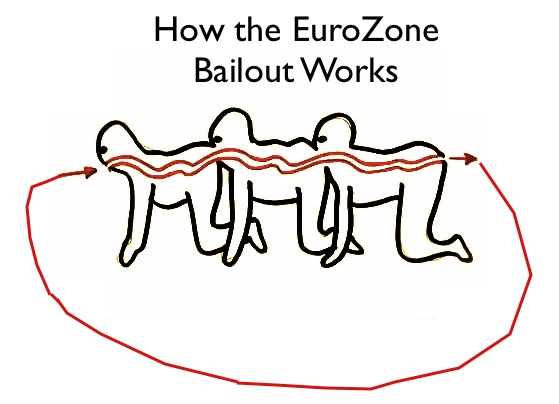
    Let’s see if I’ve got this straight: EuroZone members, threatened by sovereign default on their bonds, are giving money backed by those same bonds to the IMF, which will use the money to prop up the EuroZone in order to prevent EuroZone countries from defaulting on their bonds. In order to help readers understand the genius of this maneuver, I have slightly altered a graphic from a recent movie to explain the concept:
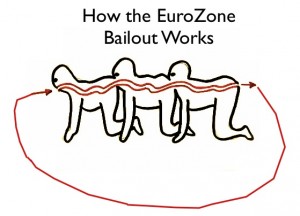
    (Hat tips: Insta, Ace, and The Corner, plus no doubt a few I’ve forgotten.)
    Could All Of Europe Declare Bankruptcy?

    Tuesday, November 22nd, 2011

    That’s the option being openly talked about:

    Europe may need to pull a Chapter 11 – a US-style bankruptcy, which would permit a market shutdown and Euro Zone reorganization before reopening for business.

    The EU desperately needs a break from market pressures in order to allow the political apparatus to really gather its forces and finally move Europe and its debt crisis ahead of the curve. Here we are just a couple of weeks after the feeble attempt to apply an EFSF plaster on the problem and we’re already back to Square One: the EU debt crisis has reached the point at which none of the readily available tools or institutions are sufficient to match the magnitude of the crisis. This dictates the need for an out-of-the-box solution.

    EU policy makers played the extend and pretend game for as long as they could – but now the writing is on the wall: popular outrage is on the rise and putting increasing pressure on the political process – as we are seeing increased demonstrations and grass-root activity taking over both the political agenda and the media. And markets are now balking as empty promises and now a real lack of funds are seeing bond yields beginning to spike out of control. The self-reinforcing cycle of downgrades and austerity and recession are taking us to the very brink of a full scale Crisis 2.0.

    Or, alternately, the EU could just jetison all that inconvenient democracy to keep the Ponzi scheme going just a little bit longer, trying to hide the fact that Europe has run out of money.

    Says Walter Russell Mead: “Right now the world’s largest economic bloc is running around like a chicken with its head cut off.”

    So how could Europe possibly display the terminal bankruptcy of the high tax, high spending, highly unionized, cradle-to-grave welfare state, European/Blue State social model? How about if EU staffers went on strike?

    Dear Greek Citizens: I hope you weren’t so foolish as to believe that the Swiss bank accounts containing the money you earned actually belong to you, do you? You’re going to have to return them to Greek banks so we can steal them. Love, the EU.

    The Euro may have been great for Greek elites, but not necessarily great for average Greeks.

    How are things in the rest of Europe? In Spain, unemployment is 22.6%.

    The EU may crack before the Euro.

    China is not coming to the rescue, as China is suffering from the same demographic maladies afflicting Europe: “A population that is no longer growing very fast and is quickly aging. The proportion of the population that depends on the state for pensions and medical care is overwhelming the proportion that works and pays taxes to the state.”

    Plus, Chinese rating agencies just downgraded Greek debt.

    The IMF has quitely changed its rules to make it easier to bail out Europe. With your tax dollars.

    (Hat tips: Ace, Insta, and the usual suspects.)

    Greeks Will Not be Allowed to Vote on Their Own Future

    Thursday, November 3rd, 2011

    The scheduled referendum on the bailout of Greece as been canceled.

    Once again, the glorious dream of European integration is far to important to let details like the consent of the governed interfere…

    Scenes from the EuroZone Summit

    Sunday, October 23rd, 2011

    There have been high level Euro rescue talks going on all weekend. How are they faring? Not well.

    Just when the eurozone governments thought it could not get worse for Europe’s single currency, it did.

    Shell-shocked EU finance ministers meeting in Brussels on Saturday were already reeling from the worst Franco-German rift for over 20 years and a fractious failure to resolve the problems that have brought Greece, and the euro, close to the brink.

    But then a new bombshell hit as a joint report by the EU and the International Monetary Fund (IMF) warned that, without a default, the Greek debt crisis alone could swallow the EuroZone’s entire €440 billion bailout fund – leaving nothing to spare to help the affected banks of Italy, Spain or France.

    Of course, the problem with following this story from abroad is how the news of the summit gets distorted like some intercontinental game of telephone, especially when filtered through the dulcet-toned hearing aids of welfare state boosters. Thus this overly enthusiastic piece in left-wing newspaper The Guardian, citing that a deal was near based on unnamed “EU diplomats” becomes this blipvert in the left-wing Daily Beast stating that a deal had been reached, becomes this Fark thread in which clueless liberals crow that no one should ever have doubted the soundness of either the Euro or the glorious European welfare state. And also that ratings agencies are evil.

    And yet, as of right now, this “done deal” to rescue the Euro has yet to materialize. How strange!

    Somehow, how France (a country running a a $90+ billion dollar budget deficit) and Germany (a country whose ruling party has lost every local election since it started shoveling money down the Greek bailout chute), were to magically comes up with some €1.6 trillion Euros (the difference between the current bailout fund and the super-sized fund required to backstop the Euro following the inevitable Greek default) is nowhere specified. After all, it was hard enough for Chancellor Angela Merkel to get Germany’s contribution to the fund boosted from €123 billion to €211 billion in the first place.

    As a result of all this happy, confident talk of how the Euro will never be allowed to falter? Moody’s downgraded Spain’s credit rating. They also threatened to do the same for France, especially if they decided to throw more taxpayer money into the Greek debt maw.

    The Good Ship Europe bears its load of bailout guarantees straight for the center of the Greek Debt crisis.

    And if you’re the EU, how do you prevent your debt from being downgraded? A.) Stop borrowing so much, B.) Increase your emergency reserves, or C.) Make it illegal for bond rating companies to downgrade your debt?

    Yeah, that will work.

    How badly awry has the Eruo project gone? The problem with this Hoover Institute piece on is what not to quote from it:

    The champions of the European Union once touted it as a “bold new experiment in living” and “the best hope in an insecure age.” But these days “fear is coursing through the corridors of Brussels,” as the B.B.C. reported in September. Such fear is justified, for the nations of Europe are struggling with fiscal problems that challenge the integrity of the whole E.U.-topian ideal. Greece teetering on the brink of default on its debts, E.U. nations squabbling about how to deal with the crisis, debt levels approaching 100 percent of GDP even in economic-powerhouse countries like Germany and France, and European banks exposed to depreciating government bonds are some of the signposts on the road to decline.

    A monetary union comprising independent states, each with its own peculiar economic and political interests, histories, cultural norms, laws, and fiscal systems, was bound to end up in the current crisis. All that borrowed money, however, was necessary for funding the lavish social welfare entitlements and employment benefits that once impressed champions of the “European Dream.” Yet, despite the greater fiscal integration created by the E.U., sluggish, over-regulated, over-taxed economies could not generate enough money to pay for such amenities. Now, the president of the European Council, Herman Van Rompuy, admits, “We can’t finance our social model.”

    This financial crisis means the government-financed dolce vita lifestyle once brandished as a reproach to work-obsessed America is facing cutbacks and austerity programs immensely unpopular among Europeans otherwise used to amenities like France’s 35-hour work week, or Greece’s two extra months of pay, or England’s generous housing subsidies that cost $34.4 billion a year. No surprise, then, that from Athens’ Syntagma Square to Madrid’s Puerta del Sol, austerity measures attempting to scale back government spending have been met with strikes, demonstrations, boycotts, and protests, some violent, on the part of citizens for whom such government entitlements have become human rights. In fact, such transfers of wealth have been formalized as rights in Articles 34 and 35 of the E.U.’s Charter of Fundamental Human Rights.

    The Euro crises will likely lead to another recession in the U.S. That is, if you think we ever came out of the Obama recession in the first place, which we didn’t.

    Europe’s private sector shrank for the first time in two years last month.

    Again: The question of a Eurozone collapse is not “if,” it is “when.” And how much of the losses European banks can put taxpayers on the hook for.

    “Greece is not salvagable”

    Friday, September 30th, 2011

    That’s the rather bracing judgment from this Stratfor overview of Greece’s problem. Moreover, they’re saying that about its existence as a nation-state, even absent the European debt crises. Also: “Greece has to be kicked out of the Eurozone if the Eurozone is to survive.” Problem? They don’t have enough “firebreak” funds to do it. “Until the Europeans have 2 trillion Euro in funding stashed away, they can’t kick Greece out of the system.”

    I’m not sure I share the pessimism about Greece in the long run. After all, nation-states can exist for an awful long time, despite crappy conditions (see, for example, Haiti). Of course, that assumes that a newly Islamic Turkey doesn’t decide to settle old scores by conquering them outright. (Assuming, of course, that Turkey is still predominately Turkish rather than Kurdish. Claire Berlinski is a little more sanguine about that prospect.)

    Honestly, of the two, I think Greece will outlast the Eurozone by a good measure. The question isn’t the whether Eurocrats can prevent the Eurozone from breaking up, but rather how long they can delay the inevitable, how much sovereign debt can they put taxpayers on the hook for, and how much harder will the inevitable market correction be when it comes? It seems to be a race between how much European taxpayer money can be wasted propping up Europe’s bankrupt welfare states vs. how much of American taxpayer money can the Obama administration waste channeling payouts to well-connected Democratic cronies. The Eurocrats may be winning the race to insolvency, if only due to the lack of a European Tea Party.

    In other Euro Debt Crises news:

  • Europe votes to throw more money down the rat hole.
  • But don’t take that as any kind of victory for the Euro. Quite the opposite. “The furious debate over the erosion of German fiscal sovereignty and democracy – as well as the escalating costs of the EU rescue machinery – has made it absolutely clear that the Bundestag will not prop up the ruins of monetary union for much longer. Horst Seehofer, the leader of Bavaria’s Social Christians, said his party would go ‘this far, and no further’.”
  • Greece passes the tax increase the Eurocrats say is necessary to stave off default.
  • How broke is Europe? They’re considering a tax on every financial transaction. This is great news…for stock exchanges outside of Europe.
  • How Charles de Gaulle foresaw the Euro crackup.
  • The German finance minister says that a leveraged Euro-TARP is dead. I would say why U.S. regulators were pushing such a scheme was puzzling, except of course it isn’t. The goal is to put off the Euro-collapse until after the 2012 elections.
  • Meanwhile, liberal moneybags mastermind George Soros says that the Euro crises is dragging us toward another depression. His solution? I know you’re going to be shocked, shocked to learn that it’s bigger, more central government. “The governments of the eurozone must agree in principle on a new treaty creating a common treasury for the eurozone. In the meantime, the major banks must be put under the direction of the European Central Bank.” To be followed shortly thereafter by the formation of the First European Airborne Swine Squadron.
  • Is there any other place desperate Eurocrats can get money to prop up their falling welfare states? Are they perhaps hoping that Obama will bail them out? After all, what’s a few more trillions in unsupported debt between friends?

    More Greek Default Rumblings

    Sunday, September 25th, 2011

    Actually, less rumblings than the roar of an approaching train. And since I temporarily seem to be ahead of the latest Ace of Spades Doom roundup, I’m going to try and give you a nice clear view of the coming crash.

    “No longer a question of if, but when – that is the tone of discussions over Greece which has dominated the summit of finance ministers in Washington over the weekend.” Former Britain’s former finance minister Alistair Darling agrees, calling default “only a matter of time.”

    The talk now is of how to put in a “firewall” to prevent the contagion of an inevitable Greek default from spreading throughout the European banking system.

    The Euroskeptics have been completely vindicated:

    Very rarely in political history has any faction or movement enjoyed such a complete and crushing victory as the Conservative Eurosceptics. The field is theirs. They were not merely right about the single currency, the greatest economic issue of our age — they were right for the right reasons. They foresaw with lucid, prophetic accuracy exactly how and why the euro would bring with it financial devastation and social collapse.

    I think at this point UK residents should be feeling vrey glad indeed that they didn’t abandon the Pound for the Euro.

    Bret Stephens talks about the long line of deceit and fraud that lead Europe to the current crises. “What is now happening in Europe isn’t so much a crisis as it is an exposure: a Madoff-type event rather than a Lehman one.”

    Mark Steyn, using the ever popular music and political metaphor gambit, compares the breakup of the Eurozone with the breakup of R.E.M. while bringing the usual Steyn goodness: “Attempting to postpone the Club Med welfare junkies’ rendezvous with self-extinction will destabilize internal German politics (which always adds to the gaiety of nations).” And this:

    As its own contribution to the end of the world as we know it, the Obama administration has just released a document called “Living Within Our Means and Investing in the Future: The President’s Plan for Economic Growth and Deficit Reduction.” If you’re curious about the first part of the title — “Living Within Our Means” — Veronique de Rugy pointed out at National Review that under this plan debt held by the public will grow from just over $10 trillion to $17.7 trillion by 2021. In other words, the president’s definition of “Living Within Our Means” is to burn through the equivalent of the entire German, French, and British economies in new debt between now and the end of the decade. You can try this yourself next time your bank manager politely suggests you should try “living within your means”: Tell him you’ve got an ingenious plan to get your spending under control by near doubling your present debt in the course of a mere decade. He’s sure to be impressed.

    Germany is near the limit of their willingness to bail out Greece.

    There may even be a taxpayer revolt brewing in the Aegean.

    And if the other PIIGS are doing better than Greece, it is only a matter of degrees: “Italy is the new Lebanon, Portugal the new Venezuela, Spain the new Vietnam, Ireland the new Argentina and nothing is more risky than Greece, according to today’s credit default swap market.”

    But it’s not just Greece and Europe that are hitting the wall. China’s housing bubble may finally be bursting. Worse still: “growth in China may be zero [and] China has ‘European kind of numbers’ when it comes to debt.”

    And the Chinese housing bubble isn’t just affecting China. It’s also affecting Canada.

    And at least one observer has drawn parallels to a certain hopemonger currently residing in the White House:

    Obama has no intention of really solving the debt crisis. And that brings us back to Greece. That government has been doing the same thing for a decade and the chickens have now come home to roost. Greece’s debt is 150 percent of its Gross Domestic Product. Our debt has just reached 100 percent of GDP and the debt is accumulating faster than it ever has. If we were looking out the windshield down the road, we could see the crash that’s just up around the bend.

    But rather than put on the brakes, the president has chosen to pick a fight with the other passengers in the car he is driving. Talk about distracted driving! He is gambling that this fight will convince the passengers to let him stay behind the wheel for another four years. But we certainly can’t wait that long. He’s turned up the radio in hopes we won’t hear the ambulance sirens.

    It looks like its going to be another rough week for world markets…