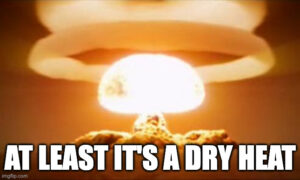
More specifically, what happens when you stand next to an atomic bomb when it goes off?
I’m sure you understand generally, but this video delves into the specifics.
“What would happen if you were standing two meters, or about six and a half feet, from one at the instant it detonated? Not the mushroom cloud. Not the blast wave crossing a city. Just the first few hundred millionths of a second.”
Trinity’s Gadget: “On the 16th of July 1945 it released the energy of about 21,000 tonnes of TNT. That is our starting point. Now let us put someone two meters away. The first microsecond X-rays cross two meters in 6.7 nanoseconds. Fission neutrons, carrying around two million electronvolts apiece, are far slower, taking roughly 100 nanoseconds, about 95 nanoseconds behind the light. Just to be clear, a nanosecond is a billionth of a second. But those are only the first arrivals. Glasstone and Dolan*, in the standard American reference on nuclear weapons effects, put it this way: within perhaps a hundredth of a microsecond the weapon residues are fully ionised, and because their temperature is of order several times ten million degrees, most of the energy radiated in that first microsecond comes out as soft X-rays. In sea-level air, soft X-rays are absorbed within a few metres of the burst point. That sphere of X-ray-heated air is the fireball. Glasstone calls it the isothermal sphere, because at those temperatures a photon travels further than the sphere is wide before anything absorbs it, so the temperature is near enough uniform throughout.”
“The X-rays do not pass straight through the body and strip every atom bare at once. Soft X-rays are absorbed extremely efficiently by matter, be that air or human tissue which is mostly water. The NIST absorption data shows that low-energy X-rays dump their energy over very short distances indeed. Around two and a half micrometres at one keV, a couple of millimetres at ten keV. So the energy does not go in evenly. It lands on the surface. The outer layer of tissue absorbs it, loses its electrons and boils away into plasma. That material blows clear, exposing what is underneath, which does the same, all while the person is being engulfed by air that is itself turning into plasma.”
“The energy landing on a body-sized cross-section at two metres exceeds what is needed to completely ionise seventy kilograms of tissue by a factor of several hundred to a few thousand. Energy is not the limiting factor. What limits it, is how quickly the boiled-off material can get out of the way. And the X-ray pulse arrives inside about a microsecond. That puts the conversion of a human body into superheated plasma at under about ten microseconds, and probably closer to one. By then there is no recognisable body and no ordinary biological material. Cells have stopped being cells. Water has stopped being water.”
“Proteins, DNA and bone no longer have their molecular structure.”
“The explosion does not remove the matter that is a human body from existence. It just destroys the organization that the matter had, down through cells, through molecules, into ionised atomic material. Later, as the fireball cools, electrons recombine, ordinary atoms reappear, and they enter entirely new chemistry. Gases, oxides, water vapor, carbon compounds. The matter remains. The arrangement that was a person does not.”
“Is it really hotter than the Sun? Inside the weapon, yes, but only just, and only for a moment. The residues reach several tens of millions of degrees, comfortably above the Sun’s 15 million degree core. The fireball never does. By one microsecond it is already below it, and falling.”
“You would never know it had happened. A single nerve impulse lasts somewhere between a fraction of a millisecond and a millisecond. Even at its fastest, the signal from your ear takes around 10 milliseconds simply to reach the base of the brain, before any processing, let alone before you could form a thought about it. Everything described so far happens on a scale of about a microsecond. A thousand times quicker than the fastest thing your nervous system can do. There is no time to see the flash, hear the explosion, or register pain. By the time the nervous system could begin turning any stimulus into conscious perception, it, along with the rest of you, has long since ceased to exist.”
What about the people Hiroshima or Nagasaki? Those were airburst bombs detonated at 1,900 feet, so their last moments of existence were very different. “Those X-rays never reached the ground as X-rays at all. They were absorbed within a few meters of the bomb, and their energy came back out as ordinary light and heat. The Nagasaki weapon, Fat Man, was the same implosion design as Gadget, 21 kilotons, detonated at 503 metres, or 1,650 feet. Its fireball grew to roughly 470 metres (1,550 feet) across, which means the underside of it stopped some 270 metres (880 feet) short of the ground. Nobody at ground zero was inside it. They were underneath it. So the sequence runs completely differently. Light arrives in 1.7 microseconds. The thermal pulse peaks about a tenth of a second later, delivering something like 100 calories per square centimetre, around ten times what it takes to cause third-degree burns, and driving ground surfaces to 3,000 or 4,000 degrees Celsius, some 5,400 to 7,200 Fahrenheit. And the blast wave, moving through air rather than at the speed of light, does not arrive for roughly six tenths of a second. Which means there was time to see it. Survivors a kilometer or two out described a blinding white light and no sound at all, then a gap, then the blast.”
All things being equal, it’s best not be killed in a nuclear explosion, but if you are, it’s best to be close to ground zero, where you’ll be gone before you even realize it happened.
*I don’t have Glasstone and Dolan’s The Effects of Nuclear Weapons, I have an earlier edition where Glasstone was the sole author. If you want to get a physical copy, make sure you get one with the handy circular “circular computer” yield wheel in the pocket at the back of the book. You can also use this nuclear blast simulator (which relies heavily on Glasstone) to simulate nuking various cities or other targets. Fun for the whole family!