Posts Tagged ‘Joe Nixon’

Who Says You Can Redistrict Mid-Decade? The Supreme Court

Sunday, August 17th, 2025

Since the Constitution talks about having a census every ten years, some have interpreted this to mean redistricting can only occur every ten years, making Texas Governor Greg Abbott’s mid-decade redistricting plan unconstitutional. You know who says that idea is bunk? The United States Supreme Court.

Texas finds itself once again embroiled in a familiar political storm. Republicans control both chambers of the legislature and the governor’s office and are considering revising the state’s congressional map before the next census.

Democrats and their allies in the press are portraying the move as a threat to democracy. “Mid-decade redistricting!” they cry. “Republican partisans drawing Republican seats is an outrage!”

But Republicans are simply engaging in the same political hardball Democrats themselves played for decades when they were in charge, and the courts have repeatedly stated that the practice is perfectly legal.

In 2003, the Republicans gained the majority in the Texas Legislature after 150 years of Democrat rule and Democrat favored district lines. Texas Democrats had redrawn district lines in 2001 to send as many Democrats to Congress as they could. When the legislature flipped in 2003, the Republican majority wanted to draw a new congressional map that would send more Republicans.

To thwart the will of the legislature, more than 50 Democratic House members fled across state lines to Oklahoma to prevent a quorum and stop the redistricting bill from advancing. Their absence stalled the process for weeks and forced Gov. Rick Perry to call multiple special sessions.

The spectacle drew national media attention but ultimately failed. The Democrats returned, the map passed, and, of course, they sued.

When that case, LULAC v. Perry, reached the Supreme Court in 2006, the justices addressed the core question directly: Is there anything in the Constitution that limits redistricting to once per decade? The answer was a resounding no.

The Court concluded that “nothing in the Constitution prevents a state from redrawing its congressional districts more than once during a census cycle,” so long as it complies with equal population and federal voting rights requirements.

The ruling didn’t just settle the Texas dispute but confirmed that mid-decade redistricting is a legitimate tool available to any legislature with the votes to pass a new plan.

Snip.

“Redistricting is an inescapably political enterprise,” the Justices wrote, “which federal courts should make every effort not to pre-empt.” In Abbott v. Perez (2018), the Court went further to say that redistricting is a “local function” and “federal-court review of districting legislation represents a serious intrusion on the most vital of local functions.”

And to reinforce the right of legislatures to complete their constitutional duties, the Supreme Court in 2024 declared the obvious: the good faith of state legislatures “must be presumed” in matters of redistricting.

In Alexander v. S.C. State Conference of the NAACP, the Court ruled that state legislators have taken the same oath of office to uphold the Constitution as judges and every other office holder and have a “strong presumption” of acting on good faith. If the redistricting plans do not involve a constitutional or statutory defect, the lower courts must let the plan stand unaltered.

If that’s not enough for anxious Democrats, the Court in Rucho v. Common Cause (2019) held that state legislatures may redistrict on the basis of partisanship. Partisanship does not involve constitutional issues for the courts to review.

So that’s that.

For over two centuries, legislatures have gerrymandered congressional districts for partisan advantage. Indeed, the word “Gerrymander” dates all the way back to 1812, named after a district created under the leadership of Massachusetts Governor Elbridge Gerry.
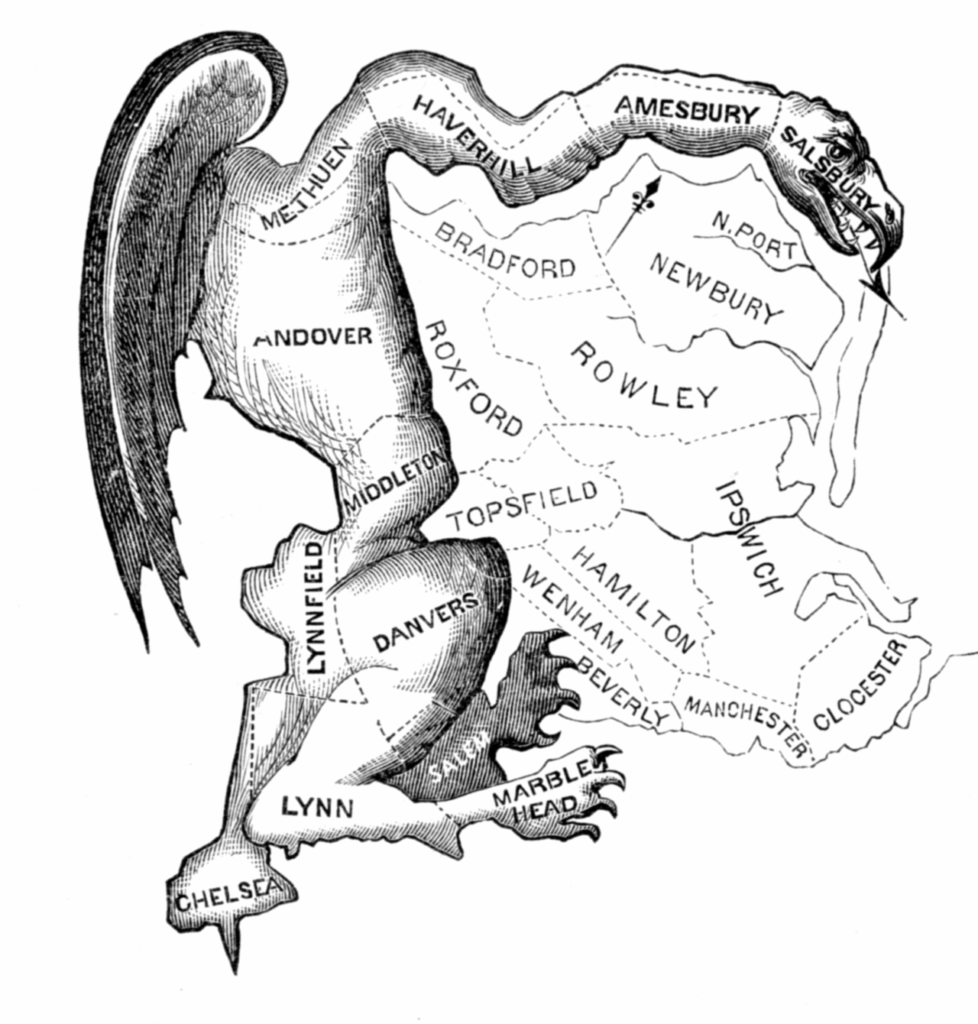
For the overwhelming majority of that two century history, Democrats have been the ones wielding the gerrymander pen, reaping the partisan advantage of lopsided representation. Now that Republicans are finally in a position to do the same, they want to cry foul.

Democrats made their bed, now they can lie in it.

The deserve everything that’s coming to them.

Democratic Voting Rights Act Lawsuit Could Mean Less Democratic Seats

Thursday, May 16th, 2024

In a classic case of unintended consequences, Democrats suing over a perceived Voting Rights Act violation could result is less Democrats in office.

A voting rights lawsuit that could cost Texas Democrats seats across all levels of government received a hearing Tuesday by the full Fifth Circuit Court of Appeals in New Orleans, known as the most conservative federal appellate court in the country.

The Galveston County redistricting case is challenging how the appellate court has previously interpreted the Voting Rights Act, which was passed to protect individual minority groups but has been “twisted” for political advantage.

At issue is whether Section 2 of the law requires the county to create a majority-minority district by grouping a “coalition” of black and Hispanic voters.

Neither blacks nor Hispanics are a large enough group in Galveston County to create a majority district.

The county contends that the Voting Rights Act does not protect coalition districts—which represent political, not racial, alliances—nor does it guarantee that Democrats will be elected.

Courts in other federal circuits do not allow aggregating distinct minority groups to force what are almost always Democrat districts.

“The Voting Rights Act was meant to right wrongs. It wasn’t meant to subsidize political parties with legislative seats. That’s what this case is about—the real meaning of the Voting Rights Act, or, how it has been twisted by coalition districts,” said J. Christian Adams, President and General Counsel of the Public Interest Legal Foundation, representing Galveston County in the case.

A win by Galveston County would be a blow to Texas Democrats.

The case began in 2021 when Galveston County’s Republican-majority commissioners court, headed by County Judge Mark Henry, drew new boundaries for the county’s four commissioner districts following the decennial census.

The plan eliminated the lone Democrat commissioner’s majority-minority precinct, a coalition district of blacks and Hispanics. The commissioner is black and has served on the court since 1999.

Three sets of plaintiffs then sued the county: a group of current and former Democrat officeholders (the Petteway plaintiffs), local chapters of the NAACP and LULAC, and the U.S. Department of Justice. The three federal lawsuits were consolidated into Petteway v. Galveston County.

Following a two-week trial last August, a federal judge in Galveston ruled in favor of the plaintiffs’ claim of vote dilution in violation of Section 2 of the Voting Rights Act. The decision was based on a nearly 40-year-old Fifth Circuit precedent supporting coalition claims.

Galveston County appealed to the Fifth Circuit.

After hearing arguments in November, a panel of three appellate judges said that the circuit court’s past decisions supporting coalition claims “are wrong as a matter of law” and “should be overturned.” Only a ruling by the full Fifth Circuit or the U.S. Supreme Court can overturn the precedent.

In December, another three-judge panel granted the county’s request to use the new boundaries in the 2024 election. The U.S. Supreme Court upheld that decision.

During Tuesday’s en banc hearing, all Fifth Circuit judges heard arguments from attorneys representing Galveston County and the three plaintiffs.

Attorney Joe Nixon with the Public Interest Legal Foundation argued on behalf of Galveston County.

“There is nothing left for the court to decide,” Nixon told the judges. “You just need to look at Section 2. What words require coalition districts? There are none.”

Conclusion: “If Galveston County prevails in its challenge to coalition districts, Democrats in Texas, Louisiana, and Mississippi (states covered by the Fifth Circuit) stand to lose seats at the local, state, and congressional levels.”

It takes a special kind of dumb to lose numerous seats across three states in a effort to save one commissioners court seat in Galveston County.

The Voting Rights Act was a specific remedy at a specific point in time for a specific type of constitutional rights violation, namely that Democratic controlled states in the South were depriving black citizens of their constitutional rights to participate in elections. Over the years, Democrats have twisted it into a “No fair! Republicans are winning!” Get Out Of Competitive Elections Free card. Ironically, Republicans have used the precise terms of the Voting Rights Act to crowd blacks into a single district to help create more Republican seats.

The situation for which the Voting Rights Act was passed no longer exists. Instead of race-aware solutions, constitutional rights should be guaranteed in color-blind way for a nation in which all men are created equal. Rather than continue to insist on racial election carve-outs, the Act itself should be retired.