Posts Tagged ‘Petteway v. Galveston County’

Petteway v. Galveston County v. New York?

Saturday, January 24th, 2026

There are all sorts of Constitutional principles that seem to evade the dubious mental grasp of New York Democrats. Yesterday Letita James displayed her ignorance of freedom of religion, freedom of association and the need for the government to avoid viewpoint discrimination when she shut down a Jewish group for opposing jihad.

Today another Democrat is trying to ban Republicans in the name of racial discrimination.

New York City had Republican mayors within living memory. And in 2024, President Trump had his biggest gains in New York. Especially in the borough of Staten Island where he won 2/3rds of the vote. So now Gov. Hochul’s former lawyer, currently serving as a ‘judge’, has declared the existence of Republican representation in Staten Island to be ‘unconstitutional‘.

A judge on Wednesday threw out the boundaries of the only congressional district in New York City represented by a Republican, ordering the state to redraw its borders because its current composition unconstitutionally dilutes the votes of Black and Hispanic residents.

In his ruling Wednesday, Justice Jeffrey Pearlman said the New York district represented by Republican U.S. Rep. Nicole Malliotakis, which includes all of the borough of Staten Island and a small piece of Brooklyn, should be reconfigured before this year’s midterm elections.

The lawsuit, filed by an election law firm aligned with the Democratic Party, argued that the lines of the district don’t account for a rise in Staten Island’s Black and Latino population. It pushed for the district to be redrawn to include parts of lower Manhattan, which leans more liberal.

Whoa. Hold up a minute there, Pearlman.

Now I may be just be a simple country Hyper-Chicken blogger, but it seems to me that the criteria Pearlman articulated as the reason for his decision, namely the need to carve out race-conscious districts, is precisely the criteria the Fifth Circuit said you couldn’t use in Petteway v. Galveston County.

Indeed, since partisan advantage was cited as an acceptable guiding principle for redistricting in that same decision, Pearlman could have stood hunched over like Gollum and declared “We hates them the nasty Republicans! Hates them! They keeps deporting our precious illegal alien rapists!” and still been on firmer constitutional ground.

Presumably Pearlman is ignoring the decision because New York isn’t in the Fifth Circuit and the case hasn’t been heard by the Supreme Court yet. But when it is heard, Pearlman has articulated the precise criteria the decision declared unconstitutional as a consideration for redistricting, giving Republicans a ready-made criteria for getting the decision overruled if the Supreme Court (as expected) validates the Fifth Circuit ruling.

That’s some might find lawyering, Pearlman…

(Hat tip: Director Blue.)

Abbott Signs Redistricting Bill

Sunday, August 31st, 2025

The day has arrived: Texas Governor Greg Abbott signed the redistricting bill into law.

Texas Gov. Greg Abbott has signed into law a Republican plan to make the state’s congressional district map “more red” ahead of the 2026 midterm elections.

“Today, I signed the One Big Beautiful Map into law,” Abbott announced in a Friday afternoon video post on X.

The Republican redistricting plan adds five new GOP-opportunity congressional districts.

Republicans currently hold 25 of the state’s 38 U.S. House seats.

Recent legal decisions cleared the way for Texas Republicans to redraw district boundaries based on partisan political performance and increase the party’s advantage in future elections to reflect voting shifts seen in 2024, when President Donald Trump won support from unprecedented numbers of minority voters.

To explicate those “recent legal decisions” for readers coming into this story tableau rasa: Democrats launched the Petteway v. Galveston County lawsuit trying to save one Galveston County commissioner’s seat, whereupon the Supreme Court ruled that those black/Hispanic coalition minority districts carved out to benefit the Democratic Party were unconstitutional. So Democrats have hoist themselves on their own petard, and nobody should have the slightest bit of sympathy for them.

Abbott said the new map “ensures fairer representation.”

The governor also thanked “all of the legislature who stayed in the Capitol and got this law to my desk.”

Texas lawmakers passed the Republican redistricting plan last week on party-line votes, after House Democrats delayed the inevitable by breaking quorum for two weeks.

Thrice Democrats have used the quorum break tactic in an effort to thwart redistricting, and thrice they have failed. Other than vainglorious virtue signaling, you wonder what they get out of the tactic and why they keep deploying it.

“Texas is now more red in the United States Congress,” said Abbott after signing the measure, known as House Bill 4.

Several Democrat-aligned groups filed legal challenges to the new congressional map before it was signed into law.

Organizations suing include the League of United Latin American Citizens (LULAC), the National Association for the Advancement of Colored People (NAACP), the Mexican American Legal Defense and Educational Fund (MALDEF), and the Mexican American Legislative Caucus (MALC). A group of Texas residents is also suing.

Plaintiffs claim the new map is racially gerrymandered to eliminate majority-minority districts required by the Voting Rights Act, unconstitutionally diluting the voting strength of minority voters, and is “intentionally discriminatory.”

The author and sponsor of HB 4, State Rep. Todd Hunter (R–Corpus Christi) and State Sen. Phil King (R–Weatherford), assured lawmakers that the map is “legal under all applicable law” and meets the requirements of “one person, one vote” and compactness.

Both Hunter and King repeatedly emphasized that the new district lines were drawn based on partisan political performance, which the U.S. Supreme Court has ruled permissible, not racial data.

State Sen. Adam Hinojosa (R–Corpus Christi) said the map represents a political shift in the state, including South Texas, which he represents.

“This is not a racial shift. This is a values shift, and no amount of shouting ‘racism’ is going to change that,” argued Hinojosa on the Senate floor.

Despite all the talk of lawsuits, Democrats are already announcing which of the new districts they’ll be running for, and the chances of lawsuits overturning them, the occasional rogue judge notwithstanding, would seem to be extremely slim. Indeed, the Supreme Court seems more likely to sweep away all creaky Voting Rights Act considerations of race as unconstitutional than to toss districts drawn in a colorblind manner aside because they don’t elect enough Democrats.

If Democrats continue to cling to the the same radical social justice politics that got them thumped in 2024, they shouldn’t expect their 2026 to turn out any better, no matter the district lines.

Texas Redistricting Passes Senate, Headed To Abbott’s Desk

Sunday, August 24th, 2025

After passing the Texas House, the redistricting bill has now passed the Texas Senate and is headed to Governor Greg Abbott’s desk to sign.

A Republican plan to redraw Texas congressional districts ahead of the 2026 midterm elections is on its way to the governor’s desk after passing the Senate early Saturday morning, paving the way for a shake-up in the state’s U.S. House delegation.

Senators passed the congressional redistricting plan on a party-line, 18-11 vote, following hours of debate and a threatened filibuster that fizzled.

The new map, drawn to improve Republican political performance, adds five new GOP-opportunity seats.

State Sen. Phil King (R–Weatherford) sponsored the redistricting plan, House Bill 4 by State Rep. Todd Hunter (R–Corpus Christi), which the House passed on Wednesday.

“The area of redistricting law is very robust and gets very complex, very quickly,” King opened Friday morning. “We’re not in a courtroom today.”

Yet throughout the day, Democrats pressed King on specific redistricting legalities and made clear they intend to challenge the map in court.

King said HB 4 is “legal under all applicable law” and meets the requirements of “one person, one vote” and compactness.

He repeatedly emphasized that the map was drawn based on partisan political performance, which the U.S. Supreme Court has ruled is permissible, not racial data.

“In contrast to the complications that are involved with race-based redistricting, political performance is really a pretty easy map to draw, and it’s absolutely permissible as a basis for drawing electoral districts,” said King.

The map flips five congressional districts from Democrat- to Republican-leaning: CD9 in Houston, CD28 in the Rio Grande Valley, CD32 in Dallas, CD34 in coastal South Texas, and CD35 in San Antonio.

I analyzed the effects of district movement on their incumbents here.

“There’s no question Democrats are not in favor of this map… because it elects more Republicans,” said King. “It was also very clear from testimony that a lot of people want us to create maps that reflect specific percentages of ethnic groups, and that’s illegal. We can’t do that.”

State Sen. Adam Hinojosa (R–Corpus Christi), the first Republican to hold Senate District 27 since Reconstruction, said the new map—which increases majority-minority voting districts—gives South Texas Hispanics “a voice that reflects their values, not outdated assumptions about race or party.”

“This is not a racial shift. This is a values shift, and no amount of shouting racism is going to change that,” said Hinojosa.

For over half a century, Democrats have used the Voting Rights Act as a tool to racially gerrymander themselves legislative majorities. More recently, Republican have flipped the script on them, concentrating minority voters in deep blue urban districts to make other districts more favorable to Republicans while fulfilling the letter of the Voting Rights Act. Then Democrats launched the Petteway v. Galveston County lawsuit trying to save one Galveston County commissioner’s seat, whereupon the Supreme Court ruled that those black/Hispanic coalition minority districts carved out to benefit the Democratic Party were unconstitutional.

Depending on only partisan affiliation date, Texas Republicans have now produced districts that are notably more compact than logical than many Democratic Party racially gerrymandered maps. Texas Republicans have garnered five additional Republican seats and helped America move closer to colorblind society. I count that as a win-win.

Texas Redistricting Finally Passes House

Thursday, August 21st, 2025

After all the unnecessary and futile drama of the Democrat’s quorum break, the Texas House has finally passed the congressional redistricting bill.

After weeks of gridlock, the Texas House has approved a new congressional redistricting plan that Republicans say will strengthen their hold on Washington, adding five GOP-leaning seats across the state.

The issue has been a priority for Gov. Greg Abbott, who placed congressional redistricting on the call during the first special session earlier this summer. But Democrats brought the chamber to a standstill when they broke quorum and fled to Illinois and other states to prevent the map from advancing.

Their walkout effectively killed the first special session, but with Abbott calling lawmakers back for a second 30-day session, Democrats returned on Monday. By Wednesday, Republicans had rushed the proposal out of committee and onto the House calendar, where it passed on a party-line vote.

State Rep. Todd Hunter (R–Corpus Christi), who carried the legislation, defended the process while laying out the plan on the floor.

“This plan originated in the first called special session before the chamber left a quorum,” said Hunter. “In that session, we held three public hearings—we were not required to hold those hearings. At these hearings, we heard testimony from members of Congress and citizens alike. The underlying goal of this plan is straightforward: improve Republican political performance.”

The map, which reshapes districts in Dallas and Houston as well as Central and South Texas, is designed to reflect population growth while giving Republicans an even stronger advantage. Each new district is required to be nearly equal in population, with the ideal congressional size sitting around 766,900 residents.

Democrats blasted the proposal as “illegal and racially discriminatory.”

President Donald Trump, meanwhile, cheered the move on Truth Social, calling it “ONE BIG, BEAUTIFUL CONGRESSIONAL MAP!” He praised Abbott and House Speaker Dustin Burrows for restoring a quorum, writing, “With the Texas House now in Quorum, thanks to GREAT Speaker Dustin Burrows, I call on all of my Republican friends in the Legislature to work as fast as they can to get THIS MAP to Governor Greg Abbott’s desk, ASAP.”

The detailed county-by-county breakdown maps of the new districts can be found here. On a personal note, I am thankfully being moved out of Democrat Lloyd Doggett’s District 37 and into Republican August Pfluger’s District 11.

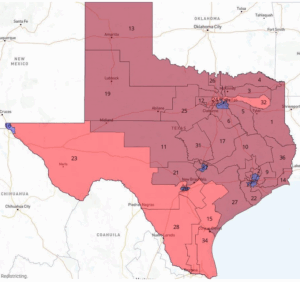
Here’s a snapshot of the new districts from The Texan.

“The final vote was 88 ayes — all Republicans including House Speaker Dustin Burrows (R-Lubbock), who normally doesn’t vote on legislation — to 52 nays.”

Republicans drew this new map at the behest of President Donald Trump and with his 2024 election performance top of mind, ensuring that each of the projected five GOP pickups were areas the president won last year by at least 10 points.

Those five seats are the 9th, 28th, 32nd, 34th, and 35th congressional districts; two are in South Texas, one in Dallas, one in Houston, and one on the outskirts of San Antonio.

The Democrats currently representing those districts are Al Green of Houston (9th), the currently indicted Henry Cuellar of Larado (28th), Julie Johnson of Farmers Branch (32nd), Vicente Gonzalez of McAllen (34th), and infamous commie twerp Greg Casar of Austin (35th).

My guess is that Cuellar and Gonzalez are simply gone, since the Rio Grande Valley was already trending Republican and there are no friendly districts anywhere nearby for them to run in. Green could quite conceivably run in the now-vacant 18th congressional district, previously represented by the deceased Sylvester Turner, and before that by the daughter of the also-deceased Sheila Jackson Lee, and before that by Lee. While Johnson could theoretically run in neighboring Marc Veasey’s 33rd congressional district, that’s a Hispanic and black majority district (and I suspect it’s getting even more so in the current redistricting), which is a tough hill to climb for any white candidate, much less a gay white girl in a suburban district, so I suspect she’s toast as well. The redistricting sets up a Thunderdome showdown between Doggett and Casar for the Austin-based 37th, unless Doggett (who is 79) retires.

Now on to the Texas Senate, where which passed its own redistricting bill handily in the first special session and will likely pass this one in quick order.

I have been (and will continue to be) quite critical of House Speaker Dustin Burrows’ membership in the Straus-Bonnen-Phelan cabal that stays in power thanks to Democrat votes and special interest/gambling money, but in this instance he has delivered on a very important Republican priority.

Remember: All this was set in motion by Petteway v. Galveston County, a lawsuit Democrats filed in order to save one Galveston County commissioner’s seat, whereupon the Supreme Court ruled that “black/brown” coalition minority districts carved out to benefit the Democratic Party were unconstitutional. So instead of saving one county commissioner’s seat, they’re going to lose five U.S. Congressional seats.

Democrats did this to themselves, and have no one else to blame…

Special Session Agenda: Flood, THC, Redistricting

Thursday, July 10th, 2025

People were wondering what agenda items Texas Governor Greg Abbott would lay out for the forthcoming special session, and now we know.

Gov. Greg Abbott has officially released the agenda for the upcoming special legislative session, identifying 18 items for lawmakers to tackle when they return to Austin on Monday, July 21.

The announcement ends weeks of speculation about what issues would be included on the call and contains a mix of responses to both recent events and long-standing conservative priorities.

“We delivered on historic legislation in the 89th Regular Legislative Session that will benefit Texans for generations to come,” said Abbott. “There is more work to be done, particularly in the aftermath of the devastating floods in the Texas Hill Country. We must ensure better preparation for such events in the future.”

Included in the call are several flood-related items aimed at improving early warning systems, emergency communications, and local relief funding. The agenda also includes a sweeping review of rules related to disaster preparation and recovery.

Abbott is also calling for legislation to eliminate the STAAR test, cut property taxes, and overhaul regulations on THC products—an issue that has divided state leadership since Abbott vetoed a proposed ban last month. Instead of an outright ban, the governor is asking for new restrictions on potency and synthetic compounds without “banning a lawful agricultural commodity.”

We covered the issues surrounding marijuana and THC regulation here. The law that was vetoed would likely have clashed with federal legislation on the issue.

Several conservative priorities also made the list, including a ban on taxpayer-funded lobbying, a constitutional amendment granting the Attorney General the power to prosecute election crimes, and protections for women’s privacy in sex-segregated spaces. Legislation to further protect unborn children by strengthening the state’s ban on abortion-inducing drugs also made the cut.

Other agenda items include measures to protect victims of human trafficking from criminal liability, protections for law enforcement personnel files, and action on title theft and deed fraud. Abbott also called for legislation addressing judicial department operations and incentives for water conservation in building projects.

As expected, redistricting is officially on the agenda, following pressure from President Donald Trump’s team to secure additional Republican seats in Congress. The item calls for revisions to Texas’ congressional maps “in light of constitutional concerns raised by the U.S. Department of Justice.”

I have mixed feelings about redistricting. On the one hand, it would be nice to give House republicans a little more breathing room. On the other, Article I, Section 2 of the Constitution of the United States of America states that “The actual Enumeration shall be made within three Years after the first Meeting of the Congress of the United States, and within every subsequent Term of ten Years, in such Manner as they shall by Law direct,” and it has not been ten years since the last census and redistricting. Still, plenty of states have had to perform redistricting based on court orders, and for decades Democrats used them for partisan advantage, so this is a case of what’s good for the goose in good for the gander.

My understanding is that the Fifth Circuit Court ruling in Petteway v. Galveston County opens the door for redistricting to be performed in light of an altered reading of Voting Rights Act remedies (no longer need black and Hispanics be combined into the same district for “coalition” majority districts, much to the annoyance of the Democrat Party). Indeed, that is the precise outcome we discussed the last time we covered Petteway v. Galveston County. And Democrats were the ones who filed the lawsuit to try to save save one commissioners court seat in Galveston County.

We told them over and over again that they weren’t going to like living under the “New Rules” they instituted, and now they get to find out why, good and hard…

Democratic Voting Rights Act Lawsuit Could Mean Less Democratic Seats

Thursday, May 16th, 2024

In a classic case of unintended consequences, Democrats suing over a perceived Voting Rights Act violation could result is less Democrats in office.

A voting rights lawsuit that could cost Texas Democrats seats across all levels of government received a hearing Tuesday by the full Fifth Circuit Court of Appeals in New Orleans, known as the most conservative federal appellate court in the country.

The Galveston County redistricting case is challenging how the appellate court has previously interpreted the Voting Rights Act, which was passed to protect individual minority groups but has been “twisted” for political advantage.

At issue is whether Section 2 of the law requires the county to create a majority-minority district by grouping a “coalition” of black and Hispanic voters.

Neither blacks nor Hispanics are a large enough group in Galveston County to create a majority district.

The county contends that the Voting Rights Act does not protect coalition districts—which represent political, not racial, alliances—nor does it guarantee that Democrats will be elected.

Courts in other federal circuits do not allow aggregating distinct minority groups to force what are almost always Democrat districts.

“The Voting Rights Act was meant to right wrongs. It wasn’t meant to subsidize political parties with legislative seats. That’s what this case is about—the real meaning of the Voting Rights Act, or, how it has been twisted by coalition districts,” said J. Christian Adams, President and General Counsel of the Public Interest Legal Foundation, representing Galveston County in the case.

A win by Galveston County would be a blow to Texas Democrats.

The case began in 2021 when Galveston County’s Republican-majority commissioners court, headed by County Judge Mark Henry, drew new boundaries for the county’s four commissioner districts following the decennial census.

The plan eliminated the lone Democrat commissioner’s majority-minority precinct, a coalition district of blacks and Hispanics. The commissioner is black and has served on the court since 1999.

Three sets of plaintiffs then sued the county: a group of current and former Democrat officeholders (the Petteway plaintiffs), local chapters of the NAACP and LULAC, and the U.S. Department of Justice. The three federal lawsuits were consolidated into Petteway v. Galveston County.

Following a two-week trial last August, a federal judge in Galveston ruled in favor of the plaintiffs’ claim of vote dilution in violation of Section 2 of the Voting Rights Act. The decision was based on a nearly 40-year-old Fifth Circuit precedent supporting coalition claims.

Galveston County appealed to the Fifth Circuit.

After hearing arguments in November, a panel of three appellate judges said that the circuit court’s past decisions supporting coalition claims “are wrong as a matter of law” and “should be overturned.” Only a ruling by the full Fifth Circuit or the U.S. Supreme Court can overturn the precedent.

In December, another three-judge panel granted the county’s request to use the new boundaries in the 2024 election. The U.S. Supreme Court upheld that decision.

During Tuesday’s en banc hearing, all Fifth Circuit judges heard arguments from attorneys representing Galveston County and the three plaintiffs.

Attorney Joe Nixon with the Public Interest Legal Foundation argued on behalf of Galveston County.

“There is nothing left for the court to decide,” Nixon told the judges. “You just need to look at Section 2. What words require coalition districts? There are none.”

Conclusion: “If Galveston County prevails in its challenge to coalition districts, Democrats in Texas, Louisiana, and Mississippi (states covered by the Fifth Circuit) stand to lose seats at the local, state, and congressional levels.”

It takes a special kind of dumb to lose numerous seats across three states in a effort to save one commissioners court seat in Galveston County.

The Voting Rights Act was a specific remedy at a specific point in time for a specific type of constitutional rights violation, namely that Democratic controlled states in the South were depriving black citizens of their constitutional rights to participate in elections. Over the years, Democrats have twisted it into a “No fair! Republicans are winning!” Get Out Of Competitive Elections Free card. Ironically, Republicans have used the precise terms of the Voting Rights Act to crowd blacks into a single district to help create more Republican seats.

The situation for which the Voting Rights Act was passed no longer exists. Instead of race-aware solutions, constitutional rights should be guaranteed in color-blind way for a nation in which all men are created equal. Rather than continue to insist on racial election carve-outs, the Act itself should be retired.