Posts Tagged ‘Simferopol’

Russia Update: Gas Shortages, Plane Shortages, Crimea’s Collapse

Thursday, July 2nd, 2026

The longer Russia’s illegal war of territorial aggression against Ukraine continues, the more things in Russia (and occupied Ukraine) seem to be breaking.

First up: gasoline shortages across Russia.

The lines are growing at Russian gas stations — and so is the frustration and uncertainty as several months of Ukrainian attacks have set oil refineries ablaze and choked supplies for motorists across the vast country.

Ukrainian forces struck Russia’s major Ufa oil refinery for the second time in a week, Ukrainian President Volodymyr Zelensky said Wednesday.

Almost daily long-range attacks on Russian oil facilities have created a fuel crisis and heaped political pressure on the Kremlin as its all-out invasion of Ukraine stretches into its fifth year.

The Ufa refinery is one of Russia’s largest producers of lubricants and is located more than 600 miles from Ukraine, Zelensky said on social media.

Ukraine also struck a plant producing missile components in Russia’s Penza region southeast of Moscow, some 300 miles from Ukraine, Zelensky said.

Russian officials did not confirm the strikes, which could not be independently verified. The Russian Defense Ministry reported intercepting 179 Ukrainian drones over 16 Russian regions, the annexed Crimea and waters of the Azov and the Black Sea.

Evidence suggests that Ukrainian drones are most often intercepted by their targets.

Fuel rationing has been introduced in many Russian regions, with hourslong queues of cars snaking beside roads. Social media videos show drivers aghast at the lines or swearing at empty gas pumps and rising prices. The mayor of the Siberian city of Irkutsk even ordered portable toilets brought in to accommodate those in line.

Siberia is full of oil, yet there’s still a shortage of gasoline there.

The fuel crisis — unprecedented for a nation that is one of the world’s biggest energy producers — has brought Moscow’s full-scale invasion of Ukraine home to ordinary Russians like few other events in the war, now in its fifth year.

It drew a rare admission from President Vladimir Putin, who acknowledged “problems persist for both motorists and businesses,” and “there are still queues at petrol stations, and finding the right grade of petrol isn’t always easy.”

He insisted the shortages are “not critical” and “temporary.”

I’m sure the situation will ease once the three day special military operation concludes…

But that appeared to do little to reassure at least one motorist in Moscow, the wealthy capital typically better-insulated from economic shocks than the rest of the country.

“I think the situation is not very good,” the motorist waiting in line told the Associated Press on Monday, the day after Putin’s televised remarks.

“They say one thing on television, and in reality it’s another. … People are queueing everywhere,” he added, declining to give his full name out of safety concerns.

Zelensky on Monday echoed that sentiment, writing on Telegram that “Putin can go on and on, claiming on TV that he supposedly has everything under control,” but Russians can see that the war “has reached the point where even an oil state — a gas station, as Russia used to be called — is now facing gas shortages.”

An AP count shows over 50 reported attacks by Ukraine on oil refineries, depots, terminals and other energy infrastructure in Russia and the illegally annexed Crimean Peninsula since March. Often, the same facility was hit more than once -– such as the refinery in the Black Sea town of Tuapse that was struck four times.

See pretty much every LinkSwarm over the last year for details.

The amount of crude oil Russia processed into fuel in June was down 25% from a year ago, to 3.95 million barrels per day — the lowest level in over two decades, said Gary Peach, oil markets analyst at Energy Intelligence.

“The outages are extraordinary,” he said.

Gasoline production has fallen 17% to 850,000 barrels a day, from 1.03 million a day a year ago — far short of what the domestic market needs. Russia exports relatively little gasoline.

About a third of Russia’s oil refining capacity is offline, said Chris Weafer, CEO of Macro-Advisory Ltd. Consultancy, noting that because refineries don’t publicly confirm the extent of the damage, his estimate comes from anecdotal evidence and oil industry sources.

“It comes at a very critical time for the Russian economy, in that the agriculture season, particularly the harvest season, is now starting to ratchet up,” increasing demand, Weafer said.

Ukrainian officials describe the strikes as a campaign to pressure Moscow to end the war by undermining military logistics and supply lines and weakening its ability to mount front-line assaults.

In particular, Kyiv has sought to isolate Crimea, which was seized from Ukraine in 2014 in a move most nations don’t recognize. Attacks this year forced the Moscow-installed authorities to enact fuel rationing on the peninsula in May and halt sales to civilians there altogether. Limited sales later resumed in the city of Sevastopol.

Speaking of occupied Crimea, so many people are seeking to escape the resource-starved peninsula that the traffic jam at the Kerch Strait Bridge is visible from space.

  • “Thousands of cars rushed the last route out of Crimea, now jamming the Kerch Bridge with thousands of cars at a complete standstill.”
  • “The delays result not only from the number of people wanting to leave, but also from repeated closures during Ukrainian drone alerts, intensified security inspections, and worsening logistical disruption across Crimea.”
  • A “few motorists still driving into Crimea strapping industrial fuel tanks onto the roofs of their cars and connecting them directly to their fuel tanks with hoses. The improvised setup is extremely dangerous, creating obvious fire and explosion risks, yet many drivers appear willing to accept those dangers simply to carry enough gasoline to be able to escape the peninsula once they finished what they came to Crimea to do.”
  • “Russian military decisions are simultaneously making the situation even worse, as Russian commanders have redirected both civilian and military traffic onto the Kerch Bridge. Instead of being one of several transport arteries, the bridge has become the peninsula’s primary logistics lifeline, working beyond its practical capacity, due to the Ukrainian strikes that have repeatedly disrupted the Melitopol-Mariupol corridor and heavily damaged northern Crimean crossings.”
  • “Military convoys, fuel trucks, civilian traffic, and freight vehicles all compete for the same limited crossing. Rather than solving Russia’s logistics problems, rerouting traffic has concentrated nearly everything onto a single vulnerable bottleneck.”
  • “The resulting congestion has forced Russian authorities to adopt extraordinary measures, declaring a state of emergency within Crimea. This grants them broad powers to restrict civilian movement and establish procedures to prioritize military transportation over civilian traffic.”
  • “Residents increasingly complain that gasoline has become unavailable and that public transportation is being disrupted because minibuses cannot obtain sufficient fuel. These shortages coincide with repeated Ukrainian strikes targeting Crimea’s broader energy network, including the Kerch and Simferopol thermal power plants, electrical substations, gas compressor stations, and various major and minor fuel and gas depots. Together, these attacks have affected electricity generation, gas distribution, fuel storage, and logistics simultaneously, causing rolling blackouts, water supply disruptions, and persistent fuel shortages affecting civilian life.”
  • “Instead of easing the burden by facilitating departures, Russian authorities are using emergency powers to preserve transport capacity primarily for military logistics. Civilians therefore bear much of the cost of sustaining Russian operations, finding themselves trapped by restrictions while essential supplies are increasingly directed toward the military.”
  • And after four years of war, the Russian military is running out of, well, pretty much everything.

  • “Russia is running out of bombers, and it can’t replace those that are being destroyed. There’s a deep crisis in Russia’s aviation sector, and it spells disaster for Putin’s plans for 2027.”
  • “There is nothing that demonstrates Russia’s problems better than what is happening with its Tu-22 bombers. On June 16, Euromaidan Press revealed that Russia started its war with Ukraine with a stockpile of 41 Tu-22M3 bombers. Now, it may only have nine left.” Euromaidan is, of course, firmly pro-Ukrainian.
  • ‘Every Tu-22 that goes down is an airframe that can’t be used to pelt Ukraine with missiles and bombs.”
  • “Russia hasn’t made any new Tu-22s since 1993. Russia has been losing Tu-22s by the bucketload, and absolutely none of them are being replaced.”
  • “Since the beginning of the Ukraine war, at least 24 Tu-22s have been destroyed or damaged, and all that Russia has in place is a modernization program designed for the declining stockpiles of Tu-22s that it still has in its arsenal. There are no spare parts. Even minor damage to one of these bombers can result in it being completely written off, as Russia doesn’t have what it needs to make repairs. That means that every Tu-22 that goes down is a bomber that Russia will never be able to replace.”
  • “It’s a systemic production failure problem that extends to the entire Russian aerospace industry, both military and commercial.”
  • Management turnover at Tupolev snipped.
  • “Russia’s Defense Ministry received almost $53.5 million in combined settlements from Tupolev. That number is interesting, because it is roughly the same as the cost to modernize a Tu-95MS bomber, and it’s about a quarter of the amount that Russia spends to build a Tu-160M. In other words…not a whole lot. And if that’s all that Russia’s Defense Ministry claimed, it reveals plenty about the state of Russian bomber manufacturing. The company that is supposed to be refurbishing Russia’s aging fleet could even push one Tu-95MS out of its doors. Looking beyond that, the company was also supposed to produce four Tu-160Ms for the ministry, all of which were to be built between 2022 and 2023, and delivered in 2025. But only two ever reached the Russian military, and both arrived in 2026, which is a year after the initial deadline.”
  • “One of the biggest problems Russia faces [is] being forced to burn through multiple old tanks just to get one up and running again. Euromaidan Press reported on this issue in April, noting that Russia was running out of T-72Bs that it could refurbish, which had led to it cannibalizing older T-72As just to get some metal on the battlefield. At the time, Russia had between 800 and 900 T-72As, though only around 500 could be possible candidates for refurbishment. The rest would have to be stripped for parts to be used in that refurbishment, and Russia would likely have been far short of what it needed to get all 500 possible refurbs functioning.”
  • “Now, take that problem and transplant it into a bomber fleet for which there are only a few dozen airframes available, rather than hundreds. Cannibalization still has to happen. But Russia runs out of the parts it needs much faster, and, as with its tanks, it doesn’t have the facilities needed to build more. These are, by and large, Soviet-era bombers, and Russia has long shut down many of the plants that made the parts used to build these airframes decades ago.”
  • “Since production resumed on the Tu-160 in 2019, only six have been delivered to the Russian armed forces. Russia lost twice that many bombers to Operation Spiderweb alone, and it’s lost many more besides.”
  • “This is a problem that we see across all of Russia’s military. The Soviet-era systems on which Putin has relied so heavily in the war against Ukraine are one-and-done. Geopolitical Monitor says that in the air, Su-25 close support aircraft are no longer produced, meaning that the airframe has the same problems as Russia’s bomber fleet. The T-80 tank family also can’t be replaced, which means every ‘new’ T-80 we see on the battlefield is really just another refurb that Russia managed to create by stripping away parts from other T-80s.”
  • “TL;DR: If it was made during the Soviet era, Russia no longer has the tools or know-how to replace it.”
  • “Russia is launching 180 to 250 glide bombs at Ukraine every single day, which requires the flying of 200 sorties per day, which, in turn, places enormous amounts of stress on pilots and their airframes. Now, consider this rate of aerial attack when stacked up against Russia’s bomber problem. Russia’s bombers are used to launch cruise missiles and glide bombs. Every single time one of those bombers goes down, be it to a Ukrainian attack, a crash at a base, or simple maintenance issues caused by flying far too many sorties, that’s an attacking threat that is permanently grounded.”
  • “Slowly, but surely, Russia is running out of its irreplaceable Tu-22s and Tu-95s, and it isn’t building Tu-160s at anywhere near the rate needed to keep up the pressure. When the bombers run out, the attacks stop.”
  • Then there’s the nuclear issue, as all those dwindling numbers of bombers are nuclear weapon capable. “Given how much Russia loves to throw around its nuclear weight as an intimidation tactic, the real-time crumbling of a large part of its nuclear triad is a situation that actively weakens Russia on the global stage, not just in Ukraine. Russia’s nuclear threat is losing muscle by the month.”
  • Russia has similar problems keeping it’s seized Boeing and Airbus airliners flying. “In January, The Moscow Times reported that one of Russia’s solutions for the inevitable shortages this situation creates is going to be to send Russian airlines mothballed Soviet-era aircraft in 2026 and 2027. That isn’t a solution. It’s a continuation of the problem that we’re seeing in Russia’s bomber fleet.”
  • “Not even Russia’s modern airframes can escape the sanctions problems. In both the Su-34 and Su-35S, around 80% of the critical electronic components needed to make those jets usable are made in the West.”
  • “There is no road to recovery that can be followed while the Ukraine war continues.”
  • Every day Putin continues his illegal war of territorial aggression against Ukraine, more and more things in Russia break.

    How Ukraine Is Hammering Russian Logistics

    Sunday, June 7th, 2026

    In this week’s LinkSwarm, I briefly touched on how Ukraine is absolutely hammering Russia’s logistics behind the front lines. So here are a couple of videos that go into more detail. First up: Task & Purpose.

  • “Right now, Ukraine is hammering away at Russia’s logistics in a big way.”
  • “Over the past several months, Ukrainian forces have been expanding what are being called middle strikes. Drone attacks against Russian logistics, air defenses, command posts, and support areas dozens of miles behind the front line. These attacks have been reported as typically happening between about 30 and 180 km behind the line of contact, which means roughly 19 to 112 miles.”
  • “They’ve branded this new campaign as ‘The Logistics Lockdown,’ and Kiev says it is allocating another five billion Hryvnias, or about $13 million, to expand their middle strike capabilities against Russian logistics, warehouses, equipment, command posts, and supply routes.”
  • “These middle strike drones are being used to hit the stuff that keeps the front line alive.”
  • “Ukrainian units are using systems like the Chaklun-B, B2, and Decrotia drones to hit Russian targets far from the trenches.”
  • “If a drone can reliably reach 80, 100 or 150 km behind the front, Russia has to reconsider where it places things that used to feel far enough in the rear. Fuel depots, ammo dumps, repair facilities, all those things that we’ve already mentioned may now have to be pulled back, dispersed, hardened, or used for shorter periods of time before relocating.”
  • “The farther you pull back, the more that you complicate logistics.”
  • “This is becoming a significant problem for Russia, especially in occupied southern and eastern Ukraine, where these routes connect Russia with occupied Donetsk, Zaporizhzhia, and Crimea. The Institute for the Study of War says that these Ukrainian strikes are hampering Russia’s ability to move personnel and material along key arteries like the M14 Highway from Rostov to Crimea.”
  • “More recently, Ukraine’s 412th Nemesis Brigade used a so-called new secret strike drone against the R-280 highway, also called by Russian occupation authorities, the Novorossiya route.” Novorossiya is in Russia’s extremely far east, so I think this is probably a joke. “This route runs through occupied Mariupol, Melitopol, and Simferopol, linking occupied southern Ukraine with Crimea and serving as a key logistics corridor for Russian military equipment and supplies. They claimed that these new strike drones destroyed dozens of trucks and fuel tankers and forced Russia to limit heavy equipment movement along the highway.”
  • “There are also reports about a drone called Hornet. Defense Express reported that Ukrainian forces have used Hornet strike drones against Russian logistics routes at depths of roughly 50 to 150 km. and they describe the system as a fixed-wing UAV associated with visual navigation and target detection or target capture algorithms.”
  • “If they’re using onboard terminal guidance through AI chips with cameras, then you really can’t jam them through the typical GPS spoofing or GNSS spoofing. So, these might be kind of a secretish weapon that they’re now using AI to guide to the target.”
  • “But whether the drone is Hornet, Decrotia—” I don’t which drone this is; the drone they’re showing on the screen is usually referred to as Shark; if you know what a “Decrotia” drone is, or how to properly spell it, feel free t0 share in the comments. “—Chaklun-B, B2, or something still being kept out of public view, it doesn’t really matter.”
  • Skipping over the section on fiber-optic drones, well-covered and I would be flabbergasted if they’re using them for such long strikes.
  • “Ukraine is showing what happens when cheap and medium-range drones start focusing on boring logistics trucks and support sites far from the front.”
  • “Logistics wins wars. So Ukraine is trying to and they’re succeeding in making Russian logistics slower, farther away, more expensive, and just more stressful. And if Russia wants to keep attacking and hold on to the ground that it has taken, it still has to solve the same basic problem that every army has always had to solve ever. Getting the right stuff to the right people at the right time.”
  • From Task & Purpose to the guy who used to present the Task & Purpose videos, here’s Cappy Army on the same topic.

  • “Ukrainian forces launched a new logistics lockdown campaign that’s systematically crippling Russian supply lines. Ukraine’s focused on destroying Russian supply trucks and disrupting logistics in a new approach that’s now causing severe problems for the Kremlin. As we’ll see today, I want to examine why this approach has experts licking their finger and saying the strategic winds are now blowing in Ukraine’s favor.”
  • “The reason why Russia’s supply lines are suddenly collapsing is because of a key concept called Battlefield Air Interdiction, or BAI. It refers to the broader military campaign of using air power or drone strikes to isolate the battlefield. It’s the strategy to destroy transportation arteries. BAI is about denying the enemy the use of crucial logistics lines to sustain immediate frontline operations.”
  • “Abstract concepts like BAI become reality when you look at the highways leading from Russia into Ukraine. They are just lousy with charred husks of Russian armored vehicles that now sit by the side of logistics roads. Footage has been flooding social media showing Ural heavy recovery trucks destroyed with their tires melted by drone strikes. Open source analysts have counted over 200 strikes just on Russian logistics vehicles.”
  • He too highlights the importance of attacks on the R-280 highway. “Ukraine has increased the rate of these attacks by five-fold in just a few months.”
  • “How were they able to do such a feat in mass production? Zelensky announced that they’re already mass-producing attack drones in four European countries, Germany, the United Kingdom, Denmark, the Netherlands, and there are plans to expand drone production into Norway and Sweden soon.” Plus expanding domestic production.
  • Medium range is also where soldiers rotate to and from the front-lines to decompress. “Middle- range strikes remove any feeling of safety for Russian troops. Ukraine now fires over 160 of these middle-range strikes per month, hitting logistics and ammo depots. They hit drone control points and command posts. It’s hard to appreciate how massive this change really is when you think about four times the amount of strikes compared to February.”
  • “The new mid-range drones have a payload of about 220 lb, 10 times more powerful and accurate than artillery shells.” The drones shown on screen are the FP-2 Fire Point, the AN-196 Liutyi, and the Peklo, none of which go all the way up to 220 pounds. But the new drones are now cost effective for going after logistics trucks.
  • “The middle range is the priority right now. Because Ukraine is hitting everything that’s feeding Russia’s front line, that constant pressure is causing some serious problems for the Russian army.”
  • “Ukrainian drone operators say that before middle-range strike campaign went into full gear, Russia was holding large portions of their supplies and ammunition in the range of between 60 to 80 km back from the front line. But now they’ve had to push all of their supplies twice the distance away to 120 km away. When you’re talking about having to feed Russian artillery teams to match their rate of fire of about 10 to 15,000 rounds a day during surge fighting, every additional kilometer moved back from the front is a huge cost.”
  • “The US government just signed off on a $370 million deal authorizing sending JDAM extended range glide bomb kits to Ukraine. It would send 1,500 of these glide bombs to Ukrainian fighter jets to fire at targets up to 75 kilometers away with 500 pound bombs. This is the kind of weapon system you send to support offensive operations.”
  • Back to the M-14 attacks. “The attacks have forced Kherson Oblast’s occupation head Vladimir Soldo to sign a decree restricting the movement of civilian vehicles to only Russian military vehicles here. As a result, Russia’s having an even harder time resupplying its entire southern grouping of forces. A Russian affiliated mil-blogger complained that restricting civilian trucks makes it more difficult for them because now Ukraine knows every vehicle on the highway is a military target. They don’t have to worry about hitting civilians if there are no civilians.”
  • “Artillery once accounted for 70% of casualties on the battlefield. It’s drones that now account for at least 70% of battlefield deaths.”
  • “Everyone was shocked when Ukraine’s 129th heavy mechanized brigade went on the offensive, assaulting the town of Odradne in Kharkiv. Armored vehicles pushed forward under artillery fire. Drone strikes blasted Russian soldiers out of trenches. Ukrainian infantry cleared out fortified fighting positions. When it was all said and done, it recaptured the town and 22km with it.”
  • “And it wasn’t a one-off. Ukraine’s ground forces recaptured 400km largely from the southern sector of Zaporizhzhia. Further east, soldiers retook the city of Kupyansk just when it looked like it was about to fall to Russia. These are just a few of the mounting signs that the momentum of the war is shifting.”
  • “The clearest indication of a shift came in April when the war hit a major milestone. Moscow lost more territory than they gained for the first time in two years, a net negative of 116km.”
  • “Russia’s forces [are] slowly losing the ability to sustain the war at the same intensity and momentum.”
  • There are signs Ukraine is preparing for a new offensive. “The Ukrainian army has started switching from a system of loose brigades with little coordination to a new command level of army corps. The concept puts about five brigades or 80,000 Ukrainian troops, all their drone units, artillery guys, infantry, intelligence officers under one unified command for the first time. The new roughly 18 to 20 something different corps, each report to one of four regional commands. It’s a clear sign that Ukraine is preparing to regain operational maneuver warfare capability.”
  • “What it means is Ukraine is finally moving away from the old Soviet era model to a NATO style command. This allows for joint planning between brigades for the first time.”
  • “The old brigade-centric army was good for holding front lines and plugging gaps. Now they will be able to coordinate assault actions. Ukraine is now offense maxing their army’s organization. Another indicator that Ukraine is preparing for localized counterattacks is that in 2026, Ukraine started building two new mechanized brigades, the 160th and the 50th. They’re converting old light infantry formations into mechanized units that ride into battle.”
  • Skipping over Clausewitz on the importance of morale. “When the Ukrainian war became longer than World War II and less than 1% of territory had been captured since 2023, this was a major turning point in the minds of many Russian troops.”
  • “Manpower and recruitment are becoming a problem for the Kremlin. Ukraine has come up with the new way to reduce the manpower advantage. They came up with a campaign to kill or wound 50,000 Russian troops per month. Then they gamified it so soldiers get points for every confirmed kill.” We covered the Gamification of the Russo-Ukrainian War here.
  • “Now evidence shows that the casualty rate is creeping up and retention and recruitment is creeping down. Russia is now struggling to match this rate with fresh recruits. Most open-source analysts have concluded that they’re losing more than they’re recruiting. Most analysts put the numbers at somewhere around 30,000 troops being recruited per month and roughly 35,000 lost each month.”

  • “This kind of high casualty rate has a negative impact on troops morale.”
  • “A 24-year-old Russian soldier was fighting in the Donbas last year and he deserted from his unit and spoke to the New York Times about it, saying they spent a month trying to establish a foothold in a small town outside of Pokrovsk, and his unit would move in and then they would get wiped out by Ukrainian drones. Then his commander ordered them to try something different, to start infiltrating in two-man teams to slip through. They eventually had some success with this, and then he deserted to avoid being sent on more assaults.”
  • Ukraine is also having manpower issues, “and this has led to widespread use of robotic ground systems. In April, Ukraine seized the battlefield position without humans on the ground for the first time of the war, and an estimated 20,000 missions were conducted by ground robots.”
  • Ukraine seems to winning the technology war. A “one-two punch of the Kremlin blocking telegram messaging apps for many Russian troops because they were unable to monitor it. But it has kneecapped Russian soldiers communications.”
  • “Then the second punch was Starlink was turned off for Russia by Elon Musk…After access was cut off, Russian commanders were forced to rely on inaccurate maps. They deployed with no means of communication or the ability to use their drones.”
  • “European countries have agreed to send $100 billion for Ukraine through 2027 to keep their war economy running. When Viktor Orban was defeated in his election recently in Hungary, it unlocked this because he was cock-blocking/vetoing for the deal for years.”
  • We’ll see if Ukraine can turn their technological advantage in mid-range strikes into more offensive gains.

    Melitopol Strike, Black Market Stingers, And Gusts From The Fog of War

    Sunday, December 11th, 2022

    It can be hard to determine the truth in any war zone, especially one like Ukraine where honest, English-speaking reporters seem to be thin on the ground. Sometimes people are trying to be accurate and get things wrong, and others fall for propaganda, like Snake Island and the “Ghost of Kiev.” (I use pro-Ukrainian examples here because most Russian propaganda has been unbelievable, clumsy, and poorly executed (and the last two apply to so many aspects of Russia’s illegal war of aggression)).

    Example the first: A commenter mentioned that Stingers sent to Ukraine had shown up on “black markets all over the world.” Possible, but I hadn’t heard anything about it. I went searching, where I found this piece:

    On September 17, 2022, a worrying claim circulated on social media: FIM-92 Stinger man-portable air-defense systems (MANPADS) were reportedly available for sale online in Germany.

    According to the post, which was picked up by prominent figures in Russia, authorities were alerted by a student in Bremen and “local journalists” found that the systems originated in Ukraine and were “meant for the Kharkov counteroffensive”.

    A short video was posted alongside the tweet, showing what appears to be a partially disassembled Stinger system with its Identification friend or foe (IFF) antenna missing. The feet of several people in paramilitary clothes can be seen in the footage, and a German voice can be heard in the background.

    he posts received thousands of likes and shares, including from the Deputy Representative of Russia to the United Nations Dmitry Polyanskiy, who suggested that delivering weapons to Ukraine was backfiring.

    English language coverage has not been widespread, but Russian media published numerous articles with differing variations of the claim. Some add that this is not the first time that Stingers have appeared on the European black market.

    However, many others state that weapons provided to Ukraine by NATO countries have been discovered on black markets across the world. All the articles claim that the case resulted in “a scandal” in Germany, attracting the interest of authorities, the media, and spurring discontent among its citizens.

    But further down, we find this:

    The articles and social media posts refer to German authorities having supposedly intercepted a deal and apprehending the culprits. However, no statement about such an operation has been posted by any of Germany’s law enforcement agencies.

    The posts also mention that local German journalists investigated and determined that the weapons were meant for the Ukrainian offensive. However, there is no proof that this took place, and the story was not covered by any prominent German media outlet.

    Responding to a Twitter post sharing the video, Lars Winkelsdorf, one of the leading German arms trafficking experts, dismissed the claim.

    “At the moment, nothing like that has been found by the authorities, nor have I found anything like this through my own research,” Winkelsdorf said.

    The original source of the report seems to be the Journalisten friekorps Telegram channel, which is billed as a “channel for honest journalism”.

    “Our task is to help the German state and the German people. The people must be united, Germany must be free,” the channel’s description reads.

    One of the Telegram posts state that the channel is created by the team behind Socialharmony.de, an initiative which lists discontinuing arms shipments to Ukraine and stopping support to Ukrainian refugees among its main goals.

    Conclusion:

    It can be stated, with a high degree of certainty, that the claim regarding FIM-92 Stinger MANPADS being shipped to Ukraine and found on the German black market, is false.

    The claim states that the weapon dealers were apprehended by German authorities, yet the German police denies being involved.

    The video, provided as evidence, contains a sound recording that was filmed in January 2022. The letters from Ukrainian authorities, provided as a confirmation of connection with Ukraine, also appear to be counterfeit.

    Finally, claims that the case was highly prominent and even resulted in a scandal in Germany, do not appear to hold water. This was only covered by social media channels of dubious origin and several sensationalist websites.

    So that one we can chalk up to propaganda followed by the social media game of telephone.

    The next example is from two sources on the Russo-Ukrainian War that are usually pretty solid.

    First up, Suchomimus (whose videos I’ve feature a lot here) has a report on an attack on a Russian headquarters barracks in Melitopol that may have killed some 200 officers:

    I thought I’ll take a look at last night’s strike on a Russian barracks in Melitopol. I guess most of you have seen the news by now, as this was a pretty major incident reports are saying around 200 soldiers were killed in this strike.

    Snip.

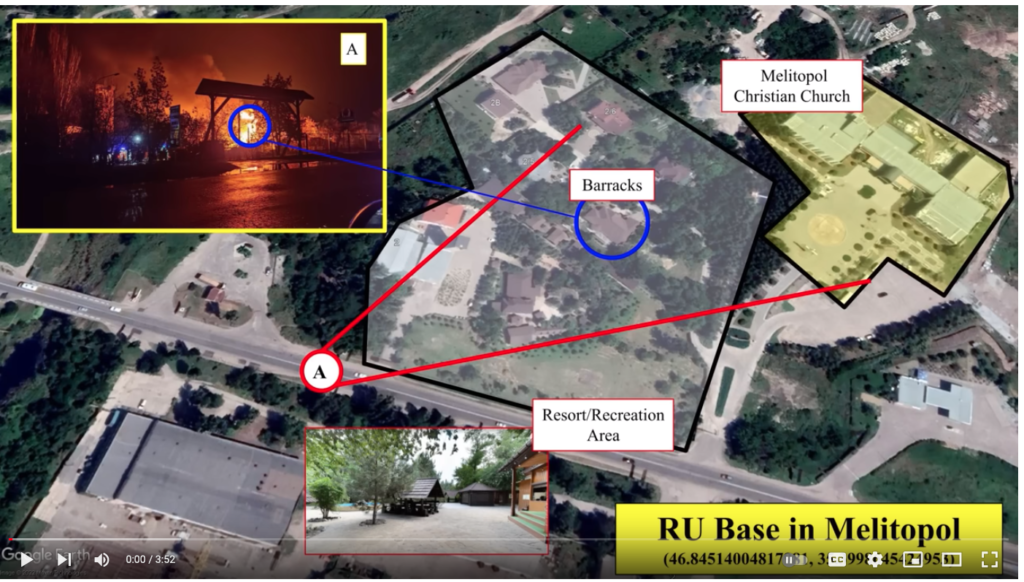
    Let’s take a look at the site itself this graphic was put together by a Twitter user TheIntelCrab. Now, a few sources online have said that the strike was of a Melitopol Christian Church. That is not exactly accurate. It was near there, but instead, it hit the area circle to the left, which was being used by the barracks.

    Here’s a screen cap:

    So it didn’t hit the church itself. Now, this is quite interesting. These photos here of some of the rooms at this place. This was a luxury resort. A few people say it was a spa.

    Suchomimus goes on to explain why such luxurious accommodations were probably used by officers. “If this was indeed officer’s accommodation, then this is a even more important strike than realized, especially for numbers of 200 gone are accurate.”

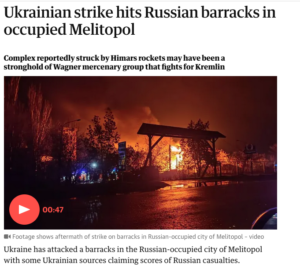
    The Guardian reports on the story, using much the same pic:

    But here’s Ukraine News TV (“Josey here”) with his daily update, including reporting various strikes in Russian occupied territory:

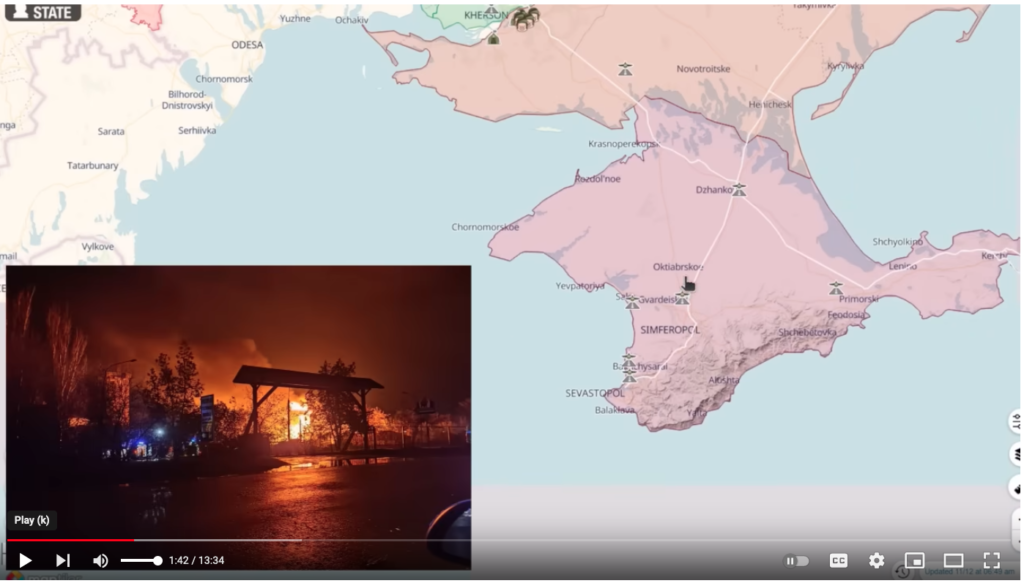
    At 1:38 in, he notes “explosions as well at the airport at Simferopol, so a little bit into the the middle of the peninsula.” Part of this screen cap should look familiar:

    That fire behind that distinctive gate looks awfully familiar, doesn’t it?

    CNN is also reporting the blast in Simferopol, so presumably that actually happened as well. Later in the video (starting about 7 minutes in), Josey reports on the Melitopol strikes, noting a wide range of estimates for casualties, stating “possibly 200-300.” So that’s mostly in accord.

    The most likely explanation is that Josey simply grabbed the wrong image for the Simferopol image. These things happen.

    But it’s a reminder that war news reporting (including my blogging) is an aggregation of already aggregated sources one or more steps removed from the actual front lines. Everything you see or hear about it deserves at least a basic level of judicious skepticism.

    More Russian Bases In Crimea Go Boom

    Tuesday, August 16th, 2022

    Looks like more Russian bases in Crimea are blowing up despite being hundreds of miles from the front lines.

    First up: France 24 reports explosions on a base in NE Crimea:

    Caveat: The video map calls the location Mayskoye, which isn’t in Crimea, but across the Kerch strait in Russia proper. Later, they show a tweet with the location as Dzhankoi, which matches up with the location shown on the map.

    More video, where you can see subsequent munitions explosions, and which says that Mayskoye is 14 miles from Dzhankoi:

    I assume that the Crimean Mayskoye is a local town or subdivision too small to show up in Google Maps.

    There are also reports of explosions on the Russian-occupied airfield near Simferopol.

    The Russian mass media report of clouds of black smoke over the military airfield in the village of Hvardiiske, Simferopol district of Russian-occupied Crimea.

    Source: Kommersant publication with reference to local residents, Christo Grozev, head of Bellingcat on Twitter

    Details: Local residents also confirm that clouds of black smoke are seen above the airbase in Hvardiiske.

    According to them, several explosions were heard earlier on the territory of the military base.

    According to the source, local military departments and law enforcement agencies assume it could be an attack by a small unmanned aerial vehicle that hit an ammunition storage.

    Supposedly this is video of the explosion. Usual caveats apply.

    And this is supposedly video of Russians lining up to leave Simferopol following the strikes:

    A few takeaways:

  • The size of the explosions suggest that Ukraine continues to receive good location intelligence about Russian military infrastructure and ammo dumps.
  • From the beginning of Russia’s invasion to last week, reports of major Ukrainian strike on Crimea were all but non-existent. Since then we’ve had several. Clearly Ukraine sees a new need and/or ability to strike these farther targets.
  • This may be an attempt to cripple Russian supply lines and air support in support of Ukraine’s slow-developing Kherson counteroffensive.