Liberals Double-Down on Arizona Racism Charges

May 17th, 2010

I previously mentioned liberal outrage at the Arizona border control bill, despite 61% of the nation approving of the same bill. But liberals doubled-down on the charges of racism, with numerous left-leaning locales calling for boycotts. Hell, Obama even apologized to China (you know, the same China that killed 60-75 million of their own people) for Arizona trying to enforce the same laws his administration is unable (or unwilling) to enforce.

Result? 71% of Americans now support Arizona’s bill.

That’s some might fine politicking you’ve done there, Lou…

Book Review: David Pryce-Jones’ The Closed Circle

May 14th, 2010

David Pryce-Jones
The Closed Circle: An Interpretation of the Arabs
Harper & Row, 1989.

I had heard this was one of the best overviews of Arab culture, and I’ve been reading it off and on between other things. It’s enlightening and depressing. Pryce-Jones asserts that all Arab nations are mired in a power-challenging/money-favoring culture based largely on a shame-honor response. By his account (and he calls on an extensive array of sources to back up his arguments), Arab (and, to a lesser extent, Turkish, Berber and Persian) cultures have always been ruled by strong men succeeding in establishing themselves by force and ruling through violence and money-favoring to eliminate or control possible rivals. The powerful rule (not only for themselves, but for their clan and allied clans) and the weak obey. It reminds me of that line from Black Hawk Down: “In Somalia, killing is negotiation.” In his view, Islamofascism, socialism, communism, Baathism, Pan-Arabism and modernization have all had whatever ideas they originally espoused suborned to become just another avenue for power-challengers to intrigue against the current power-holder, and likewise an excuse for the power-holder to ruthlessly suppress and eliminate possible rivals. He says that all outsiders (Western as well was Soviet) have misread the intentions of various power-holders by taking them at their word rather than viewing their statements as mere excuses or pretexts for their actions, to be discarded as easily as an old shirt should the situation call for it. He also says that mercy, human rights, democracy, etc., are all viewed as signs of decadent weakness by those within power-challenging cultures. In some ways, his is a very compelling argument; in others, it’s such a totalizing worldview that just about any action can be explained in power-challenging terms, and a system that explains everything explains nothing. Still, it’s a fascinating book (including very interesting chapters on how Nazi propaganda took root in the middle east, and the Arab-Israeli conflicts), and an important part of the puzzle as to why the Middle East seems to remain stubbornly immune to “rational” solutions.

My Contribution to Everyone Draw Mohammed Day

May 12th, 2010

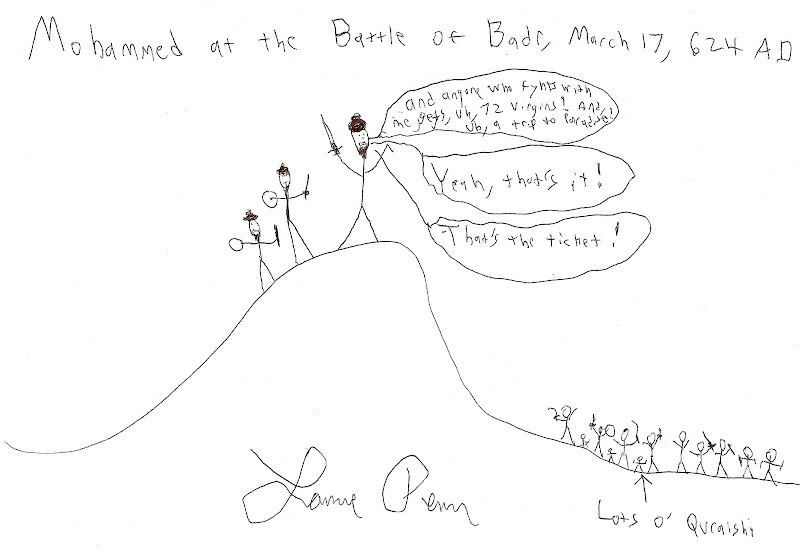
In celebration of Everyone Draw Mohammed Day, I’ve produced my own artistic contribution to the form. I’ve taken as my subject a particular historical even in the life of Mohammed, the Battle of Badr, in 624 AD, in which Mohammed first promised paradise to his followers in battle. The original was rendered in black ink on an 8 1/2″ x 11″ sheet of laser printer paper. I considered digitally cleaning up mistakes, but thought that would detract from the overall “art brut” feel of the piece.

Below find a thumbnail of drawing. Click on the thumbnail to see a larger version.

Mohammed at the Battle of Badr, 624 AD

In addition to (Wahabbist-defined) blasphemy, this work also commits the sin of resurrecting a two-decades stale Saturday Night Live catchphrase.

I think this drawing goes a long way to explain why I’m a writer rather than an artist…

Previous information on “Everyone Draw Mohammed Day” can be found here and here.

How Many Liberals Does It Take to Change a Lightbulb?

May 10th, 2010

Unless you’ve been on an extended off-Internet vacation the last few weeks, you’ve probably heard about Arizona’s enactment of the “Support Our Law Enforcement and Safe Neighborhoods Act,” AKA Senate Bill 1070, AKA the Arizona Illegal Alien Bill. You can find the complete text of the law here. (At 16 pages, it’s relatively short as such things go, though the use of all capital letters throughout for the actual statute language (a sadly common practice) does tend to strain the eyes.) The bill is the result both of the federal government’s inability to control the illegal alien problem for several decades, as well as the Obama Administration’s apparent disinterest in even pretending to to care about border control issues.

Liberal reaction to the bill was as swift as it was predictable: They called everyone who supported it racists. (Note also the inevitable liberal politically correct speak in calling illegal aliens “undocumented citizens.” Oh they’re citizens, all right: citizens of Mexico. (And, in a few cases, points further south.)) And they’ve been calling supporters of the law racist pretty much non-stop pretty much ever since the bill was passed.

And what effect has all those accusations of racism had on the law itself? It’s more popular than ever. 61% of voters polled approve of it.

Not only that, a majority of Democrats say the bill shouldn’t be repealed until we see how well it works first.

If liberals intended to stigmatize those who support securing the border as ignorant racists, then the project has been a miserable failure. Just like their attempt to brand Tea Party supporters as racists was a miserable failure. Just like their attempt to smear opponents of ObamaCare as racists was a miserable failure.

In light of all this, one must come to one of the following conclusions:

A. A majority of the American people are racists.

B. Liberals have finally cried wolf so many times that no one believes them when they accuse political opponents of racism anymore.

Personally, I’m going with B.

All of which made me think up this joke:

Q: How many liberals does it take to change a light bulb?

A: None. They believe that if they call the light bulb a racist long enough, they’ll force the light bulb to change itself.

How Many People Did Communism Kill?

May 7th, 2010

When I posted about making May 1st Victims of Communism Day, I was not at all surprised that some on the left would get their knickers into a knot over the very idea. However, I was surprised that one left winger took exception not only to the date, but the idea that communists had killed millions of people at all. It was rather like coming face-to-face with a flat-earther or a Holocaust denier; you know such people exist, but you never expect to run into them in polite society. I thought such thinking had disappeared even on the left except among such hardcore dead-ender communist apologists as CPUSA or the Spartacist League (and, of course, Internet trolls). The only question today is not “did the communists kill tens of millions of people,” but “precisely how many did they kill?”

Since historical awareness of the sheer vastness of communism’s legacy of genocide seems to have faded, now would be a good time to review the extensive historical record of communism’s crimes against humanity.

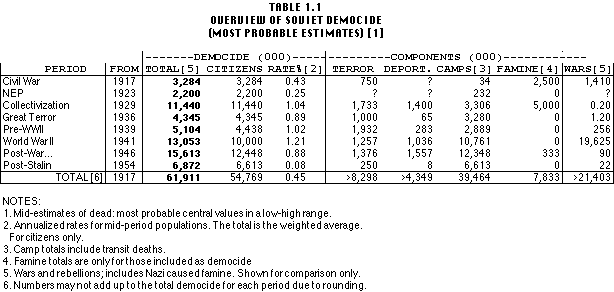
In Death by Government, R. J. Rummel estimates the total Soviet death toll at just under 62 million. You can see the breakdown here. That breakdown shows 11.4 million deaths under Collectivization, which would include the Ukrainian Famine, also known as the Holodomor.

In Robert Conquest’s definitive The Harvest of Sorrow: Soviet Collectivization and the Terror-Famine (based on hundreds of sources of information, including dozens of interviews with famine survivors), he puts the total for the entire Collectivization/”De-Kulakization” period (including the Ukranian Famine, the Soviet suppression of the Kazakhs and the Crimean Tartars, etc.) at 14.5 million.

The Final Report of International Commission of Inquiry Into the 1932–33 Famine in Ukraine produced by The Stockholm Institute in 1990 came up with a total of 7.5 million.

The Black Book of Communism came up with a smaller total of 4 million for the Holodomor, and 2 million for Dekulakization, as well as a total communist death toll of 94 million (smack dab in the middle of the 85-100 million death toll estimate in the summary), broken down as follows:

65 million in the People’s Republic of China
20 million in the Soviet Union
2 million in Cambodia
2 million in North Korea
1.7 million in Africa
1.5 million in Afghanistan
1 million in the Communist states of Eastern Europe
1 million in Vietnam
150,000 in Latin America
10,000 deaths “resulting from actions of the international communist movement and communist parties not in power.”

Rummel, by contrast, came up with the following estimates in Death By Government:

62.9 million in the Soviet Union
32.9 million in the PRC while in power, plus an additional 3.5 million killed by the communist Chinese before taking control
2 million in Cambodia
1.7 million in Vietnam
1.5 million post-WWII Poland
1 million in Tito’s Yugoslavia
plus a suspected 1.6 million in North Korea

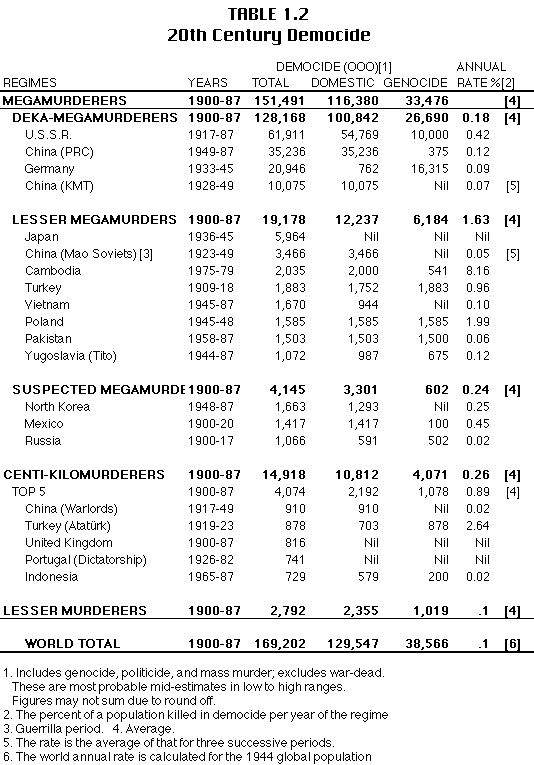
If I added that up correctly, that comes out to 103.6 million people. (Rummel’s overall total for the 20th century includes murder and genocide carried out by non-communist regimes.)

In light of more recent scholarship, Rummel has adjusted his estimate of Mao’s victims upwards from 38,702,000 to 76,702,000. (Note: I do not own Rummel’s Statistics of Democide, which goes into considerable statistical detail concerning how he arrived at his estimates.)

In Jasper Becker’s Hungry Ghosts, he estimates Mao’s victims at 30-80 million.

Pretty much all the sources on the Khmer Rouge genocide give estimates in 1-3 million range, most around 2 million.

Ethiopia’s deposed Marxist dictator Mengistu Haile Mariam is one of the few communists actually convicted of genocide in a court of law.

In summation: Communism probably killed at least 85 million people, and might have killed as many as 140 million people.

I hope to have interviews with with of the most notable authors/historians on issues of communist genocide in the near future.

A Select Bibliography of Communist Genocide in the 20th Century

Below are some books I can recommend on the subject. Keep in mind that the edition I own is probably the first edition listed here, while the Amazon links go to more recent in-print editions.

Round Rock School Board Elections Saturday, May 8

May 6th, 2010

Just a reminder to vote in the upcoming Round Rock ISD Election on May 8th if you live in the district. I haven’t been following the election that closely, but Holly Hansen at Smart Girl Politics has been all over it, so give her a read if you live in these environs. Austin residents will want to read up on other local races over at Blue Dot Blues. So edumacate yourself, and vote on Saturday!

Which Left-Wing Media Outlet Deserves to Die First?

May 5th, 2010

Today the Washington Post announced that it was putting money-losing news magazine Newsweek up for sale. You may remember Newsweek‘s decision a couple of years ago to remake itself as a liberal opinion magazine (something ably lampooned by the indispensable Iowahawk). Since then, Newweek has managed the amazing feat of actually losing readers faster than most legacy media.

Of course, that brings up an interesting question: Which left-wing news outlet would you most like to see go out of business first? To that end, I’ve created a poll:

The Washington Post just announced they’re putting Newsweek up for sale. Which left-wing media outlet deserves to go out of business first?
CBS News
Los Angeles Times
MSNBC
Newsweek
New York Times
National Public Radio
Salon
Time
Washington Post
  
Free polls from Pollhost.com

Vote away, good reader, vote away!

Today is Victims of Communism Day

May 1st, 2010

The fine folks over at The Volokh Conspiracy have come up with the brilliant idea of making May 1st Victim’s of Communism Day. If the victims of a brutal ideology that killed over 100 million people doesn’t deserve a memorial day, then who does?

Here’s an Amazon carousel widget featuring a small selection of books on victims of communist oppression.

More on estimating just how many people communism killed on R. J. Rummel’s Democide page.

“A BLT, another Spaten, and a high chair for my wife.”

April 27th, 2010

Both Molly Norris, the original cartoonist who came up with Draw Mohammed Day, and Jon Wellington, the creator of the Facebook page dedicated to it, have dropped out of the effort. Funny how Los Angeles Times writer Jimmy Orr never seems to have thought to ask the single most obvious question about their change of heart: Have you received any death threats from Muslim extremists, and is this why you changed your mind? You would think that would be an obvious question to ask when dealing with Islamic extremists, but evidently the question is not of particular interest to those fabled watchdogs in the media.

However, just because the originator pulled out doesn’t mean that Draw Mohammed Day is canceled. After all:

Bloggers made of sterner stuff have picked up the idea and run with it, including:

I plan on contributing my own modest graphic skills to the endeavor. Moreover, I think we should go beyond individual efforts and ask every single professional cartoonist to participate. I encourage you to write your favorite cartoonist and ask them to join in.

And, as he so frequently does, Chris Muir’s Day by Day nails the dismount (and is the source of the blog title).

Give Up on Giving Peace a Chance

April 26th, 2010

I’ve noted the irrational nature of believing in the “Middle East Peace Process” before. Now former Presidential adviser (and former peace process true believer) Aaron David Miller has penned an article demolishing the Middle East peace process for the delusion and sham it is.

Some choice quotes:

Etymologists tell us that the word “religion” may come from the Latin root religare, meaning to adhere or bind. It’s a wonderful derivation. In both its secular and religious manifestations, faith is alluring and seductive precisely because it’s driven by propositions that bind or adhere the believer to a compelling set of ideas that satisfy rationally or spiritually, but always obligate.

And so it has been and remains with America’s commitment to Arab-Israeli peacemaking over the past 40 years, and certainly since the October 1973 war gave birth to serious U.S. diplomacy and the phrase “peace process” (the honor of authorship likely goes to a brilliant veteran State Department Middle East hand, Harold Saunders, who saw the term appropriated by Kissinger early in his shuttles). Since then, the U.S. approach has come to rest on an almost unbreakable triangle of assumptions — articles of faith, really. By the 1990s, these tenets made up a sort of peace-process religion, a reverential logic chain that compelled most U.S. presidents to involve themselves seriously in the Arab-Israeli issue. Barack Obama is the latest convert, and by all accounts he too became a zealous believer, vowing within days of his inauguration “to actively and aggressively seek a lasting peace between Israel and the Palestinians, as well as Israel and its Arab neighbors.”

Like all religions, the peace process has developed a dogmatic creed, with immutable first principles. Over the last two decades, I wrote them hundreds of times to my bosses in the upper echelons of the State Department and the White House; they were a catechism we all could recite by heart. First, pursuit of a comprehensive peace was a core, if not the core, U.S. interest in the region, and achieving it offered the only sure way to protect U.S. interests; second, peace could be achieved, but only through a serious negotiating process based on trading land for peace; and third, only America could help the Arabs and Israelis bring that peace to fruition.

As befitting a religious doctrine, there was little nuance.

He also points out that America has three much more pressing concerns in the Middle East, each of which is more important than the Arab-Israeli conflict:

First, there are the wars in Iraq and Afghanistan, where tens of thousands of Americans are in harm’s way and are likely to be for some time to come. Add to the mix the dangerous situation in Pakistan, and you see volatility, threat, and consequences that go well beyond Palestine. Second, though U.S. foreign policy can’t be held hostage to the war on terror (or whatever it’s now called), the 9/11 attacks were a fundamental turning point for an America that had always felt secure within its borders. And finally there’s Iran, whose nuclear aspirations are clearly a more urgent U.S. priority than Palestine. Should sanctions and/or diplomacy fail, the default position — military action by Israel or even the United States — can’t be ruled out, with galactic consequences for the region and the world. In any event, it’s hard to imagine Netanyahu making any big decisions on the peace process until there’s much more clarity on what he and most Israelis regard as the existential threat of an Iran with a bomb.

Read the whole thing, but keep one thing in mind: All in all, I think Miller is entirely too optimistic. He thinks some form of progress might still be made by American negotiators. I don’t.