Great line: “Where is it written that Republicans have to be spineless jellyfish?”
Whatever Ricardo Sanchez Was Doing in Q3, It Wasn’t Fundraising
October 19th, 2011National Journal is reporting that Ricardo Sanchez raised a disasterous $83,000 in Q3. He also spent over $112,000 for the quarter and finished with $119,000 in the bank.
Digging into his Q3 FEC report makes his quarter seem, if anything, even worse. I get a total of 108 individual donations for the period, or an average of only slightly more than one a day. You should be able to get more than that by having a guy with a sandwich board standing next to a campaign table down in Hemisfair Park. I count only $25,249.26 in out-of-state donations, which is pretty sad for the DNC’s hand-picked candidate. And only four of those were max donations; a serious Democratic candidate should be able to get twice that many just from a single luncheon with trial lawyers. And a Melanie Gray of Houston sent in $4,600, which is over the FEC $2,500 limit.
Let’s look at some of his largest disbursements:
So we have a candidate picked by the Democratic establishment, a campaign run out of D.C. and New York, that none the less doesn’t seem to be pulling in Democratic establishment money.
Just what has the Ricardo Sanchez campaign been doing the last three months? (Besides scrubbing any mention of tax cuts from his campaign website.) He hasn’t been raising money. He hasn’t been making campaign appearances. He hasn’t been tweeting. He hasn’t been generating any notable buzz.
All this is good news for whoever wins the Republican nomination, but if I were a Texas Democrat, I’d feel insulted. The DNC has foisted a Potemkin Candidate on you, one who shows no signs of being willing to run a serious, energetic campaign. More than ever, Sanchez looks vulnerable to a serious challenge from the left. But so far it doesn’t look like there’s a single Democrat in the state of Texas up to that challenge.
“Red State” Turns Out To Be “Red Ink State”
October 18th, 2011I have no particular sentiment for, or against, Kevin Smith. Dogma was good, but I thought Clerks was mediocre and overrated. His video rants can be intermittently amusing, but he hasn’t made a movie I was remotely interested in seeing in over a decade. When I became aware sometime last year that he was making a film called Red State, about those sinister, inbred redneck freaks of Jesusland, it was just another example of liberal Hollywood bias I wasn’t going to see.
So today I’m browsing the new Amazon Blu-Ray releases when I see it listed there.
Wait, you mean they’ve already released it? I wasn’t even aware it had even hit theaters.
Evidently, neither was anyone else. It brought in just barely over $1 million at the box office. Given that it cost $4 million to make, and the rule of thumb is that a film must gross three times production costs to turn a profit, it’s likely that Red State probably lost the studio somewhere in the neighborhood of $11 million.
In this, it joins a long line of money-losing, America-bashing films coming out of Hollywood. It turns out that those sinister, gun-toting, bible-thumping residents of Jesusland just happen to be the people who pay to see movies in theaters, and there evidently aren’t enough liberal urban hipsters in the world to make anti-American films profitable (unless you disguise them as science fiction and throw in hot blue chics).
Think Hollywood will take note and stop greenlighting them? I doubt it. But one can always hope.
Snowflakes in Hell is Now Shall Not Be Questioned
October 18th, 2011They changed over a couple of days ago.
I have mixed feelings. Certainly anyone can change the name of their own blog, but I think the old name was more distinctive, and I can’t say I’m a fan of the redesign. The colonial typeface and sepia feel is not as instantly readable as the old version.
An Open Letter to Howard Stern
October 18th, 2011Dear Mr. Stern,
I just wanted to thank you for your reporter’s incisive, man-in-the-streets interviews with various Occupy Wall Street participants.
While listening, it occurred to me that you are ideally situated to test Eric Cartman’s theory that hippies can’t stand death metal. Have you considered driving a sound truck down to Zuccotti Park and blasting a Slayer CD at the assembled throngs?
My hope is that this simple expedient might end the Occupy phenomena with minimal effort, sparing New York City the necessity of constructing a giant hippie drill, and allow the city to get back to utilizing its resources for more important tasks, like banning salt and building the Ground Zero Mosque.
Sincerely,
Lawrence Person
https://www.battleswarmblog.com
New Poll Shows Cruz and Dewhurst Neck and Neck
October 17th, 2011The Cruz campaign alerted me to a new poll from the Azimuth Research Group that shows David Dewhurst and Ted Cruz neck and neck. In fact, they show Cruz leading, 32% to 31%, though they note that before rounding, the actual amount is less than 1%, and in any case within the +/-3% margin of error. Tom Leppert was third with 8%, Lela Pittenger as fourth with 5%, and Elizabeth Ames Jones edged out Glenn Addison for fifth, 4% to 3%.
While this is certainly good news for the Cruz campaign, a few caveats are in order:
Still, even with those caveats, this is great news for Cruz five months out from the primary, as it shows a huge bump from the PPP poll of a month ago, which showed him at 12%. Even if you think the methodology overstates Cruz’s gain by 50%, that would still put him at 22%, a 10% increase in a single month. The poll was conducted 10/12-10/17, so it might show the effect of Cruz’s National Review cover appearance.
Outlier or not, I can’t imagine anyone is happy with this result over at the Dewhurst campaign. With his money and name recognition, Dewhurst was supposed to be winning the race running away at this point. He’s not.
Red State, Blue State
October 16th, 2011Tax revenues in Texas rose 11.8% in September compared to September a year ago.
Meanwhile, California took in 4 percent less than anticipated in September, falling $300 million short in September alone and $700 million short for the year.
These numbers offer me a chance to offer up my long-in-gestation comparison between Texas and California.
Both Texas and California share a number of similarities: They are the two most populous states in the Union, both are southern states with warm climates, both have long coastlines and important ports handling international trade, both share a border with Mexico, both have diverse populations and diversified economies, including extensive portions of the agriculture, energy, and high tech sectors.
The biggest difference between the two is their respective governments. Texas, of course, is the paragon of the red state model (low tax, low spending, limited government, non-union) whereas California is the classic example of the blue state model (high tax, high spending, expansive welfare state, closed shop). Texas kept government small, tightened its belt and lived within its means. California spent like there was no tomorrow, jacked tax rates into the stratosphere, and gave generous contracts to public employee unions. Now Texas is doing well and California is going broke.
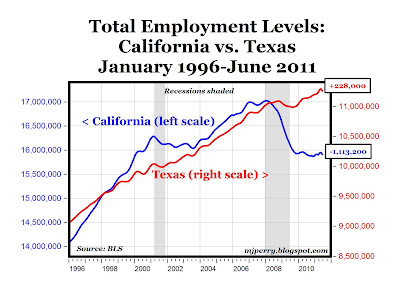
So what example should America follow, that of deficit-slaughtering, budget-cutting, seriously limited government in Texas, which has added 730,000 jobs in the past decade, or that of regulation-happy, spend-mercilessly, owe-everything, flee-this-place-quickly California, which has lost 600,000 jobs during the same period?
Texas has some of the best cities for jobs in the country. California? It “boasted zero regions in the top 150.”
Chief Executive ranks Texas as the best state for business, and California as the worst.
High tech companies are fleeing California for low tax states. In fact, high earners inevitably flee high tax states for low tax states:
Examining IRS tax return data by state, E.J. McMahon, a fiscal expert at the Manhattan Institute, measured the impact of large income-tax rate increases on the rich ($200,000 income or more) in Connecticut, which raised its tax rate in 2003 to 5% from 4.5%; in New Jersey, which raised its rate in 2004 to 8.97% from 6.35%; and in New York, which raised its tax rate in 2003 to 7.7% from 6.85%. Over the period 2002-2005, in each of these states the “soak the rich” tax hike was followed by a significant reduction in the number of rich people paying taxes in these states relative to the national average. Amazingly, these three states ranked 46th, 49th and 50th among all states in the percentage increase in wealthy tax filers in the years after they tried to soak the rich.
Here’s a comparison between California and Texas that explains, in great detail, how and why Texas is kicking California’s ass. Remember those job creation numbers, so ably depicted by WILLisms?

Now compare Texas to California via this chart from Mark J. Perry’s Carpe Diem blog:
Another reason Texas is thriving is that it doesn’t have overpaid, all-powerful public sector unions.
High tech employees are fleeing California for Texas, because they can keep more of what they make, the government isn’t going bankrupt, and the roads and schools are now better in Texas. Despite all the money California spends on a a bloated public sector, the actual core services delivered are worse in California than they are in Texas:
“Today, you go to Texas, the roads are no worse, the public schools are not great but are better than or equal to ours, and their universities are good. The bargain between California’s government and the middle class is constantly being renegotiated to the disadvantage of the middle class.”
Just how broke California is became apparent in a recent Michael Lewis piece in Vanity Fair. It illustrates who irretrievably broken California’s politics and finances are, and just how little a dent Gov. Arnold Schwarzenegger made in fixing the problem:
David Crane, the former economic adviser—at that moment rapidly receding into the distance—could itemize the result: a long list of depressing government financial statistics. The pensions of state employees ate up twice as much of the budget when Schwarzenegger left office as they had when he arrived, for instance. The officially recognized gap between what the state would owe its workers and what it had on hand to pay them was roughly $105 billion, but that, thanks to accounting gimmicks, was probably only about half the real number. “This year the state will directly spend $32 billion on employee pay and benefits, up 65 percent over the past 10 years,” says Crane later. “Compare that to state spending on higher education [down 5 percent], health and human services [up just 5 percent], and parks and recreation [flat], all crowded out in large part by fast-rising employment costs.” Crane is a lifelong Democrat with no particular hostility to government. But the more he looked into the details, the more shocking he found them to be. In 2010, for instance, the state spent $6 billion on fewer than 30,000 guards and other prison-system employees. A prison guard who started his career at the age of 45 could retire after five years with a pension that very nearly equaled his former salary. The head parole psychiatrist for the California prison system was the state’s highest-paid public employee; in 2010 he’d made $838,706. The same fiscal year that the state spent $6 billion on prisons, it had invested just $4.7 billion in its higher education—that is, 33 campuses with 670,000 students. Over the past 30 years the state’s share of the budget for the University of California has fallen from 30 percent to 11 percent, and it is about to fall a lot more. In 1980 a Cal student paid $776 a year in tuition; in 2011 he pays $13,218. Everywhere you turn, the long-term future of the state is being sacrificed.
It’s even worse at the local level, where cities are going broke do to outrageous union pensions, such as in San Jose:
It shows that the city’s pension costs when he first became interested in the subject were projected to run $73 million a year. This year they would be $245 million: pension and health-care costs of retired workers now are more than half the budget. In three years’ time pension costs alone would come to $400 million, though “if you were to adjust for real life expectancy it is more like $650 million.” Legally obliged to meet these costs, the city can respond only by cutting elsewhere. As a result, San Jose, once run by 7,450 city workers, was now being run by 5,400 city workers.
What do the citizens of California get for some of the highest public sector wages in the country? Police and firefighters that stand around watching a man drown.
San Jose is far from the worst:
Back in 2008, unable to come to terms with its many creditors, Vallejo declared bankruptcy. Eighty percent of the city’s budget—and the lion’s share of the claims that had thrown it into bankruptcy—were wrapped up in the pay and benefits of public-safety workers.
You cannot tax your way to prosperity.
You cannot spend your way to prosperity.
Government can only create the conditions that allow the free market to create jobs.
The red state model works.
The blue state model doesn’t.
Texas Senate Race Update for October 14, 2011
October 14th, 2011And still more Texas Senate Race news:
Leppert Raises $640,000 in Q3, Tosses in Another $500,000 of His Own Money
October 14th, 2011Tom Leppert’s campaign announced that it raised $640,000 in donations in Q3. In addition, it announced that Leppert, as he did in Q2, threw in another half million of his own money.
Those are significant sums, and by no means disasterous, but it’s slightly less than the $750,000 in contributions he raised in Q2, which was, in turn, less than the $1 million in contributions and $1.6 million in self-funding he raised in Q1.
So far Leppert has run a relatively smart and disciplined campaign, and currently has more cash on hand than Cruz, but he’s still in third place. He hasn’t generated the grassroots enthusiasm and buzz that Cruz has, and I’m reasonably sure he can’t self-fund at nearly the level David Dewhurst can. Though Leppert has positioned himself as a conservative (and issued many conservative position papers on a range of issues), he seems to draw more from Dewhurst’s establishment base in the business community, and the slight decrease in Q3 numbers may indicate that Dewhurst is already eating into those funding sources. Further, I see no signs that Leppert has successfully moved beyond his geographical base of support in the greater Dallas Metroplex.
On the plus side, Leppert hasn’t seen quite the falloff in donations predicted by Cruz consultant Jason Johnson and he’s continued to attend the candidate forums (though he does not seem to be generating a lot of enthusiasm at them), which is more than you can say for Dewhurst. Also, no more skeletons have fallen out of his closet since the SEIU and ACORN revelations. That might change. (I might even shake a bone or two myself in coming weeks…)
Obviously the Cruz campaign would like to see Leppert drop out to make it a clear one-on-one campaign against Dewhurst. However, while Leppert has not set the grass roots on fire, he has run a solid race, which is more than you can say for Elizabeth Ames Jones. If things continue on in the same vein, Leppert is well-positioned if one of the frontrunners stumbles or withdraws. After all, it’s politics, and stranger things have happened.
However, right now Leppert is clearly in third place, and I expect Cruz’s new, National Review-boosted profile to result in a Q4 contribution increase sufficient to erase Leppert’s current self-funded edge in cash-on-hand.
Leppert is hanging tough and running a competitive campaign, but in the end I don’t think that will be enough to get him into the runoff.
(Edited to add: After I published, this I noticed that the Dallas Morning News link at the top had been updated to say that Elizabeth Ames Jones pulled in $235,000 for Q3. He doesn’t provide a link for this, and I can’t yet find confirmation on her website, Facebook page or Twitter feed. If true, I don’t see how Jones thinks she can compete with three candidates who all have ten times as much cash on hand as she does.)
Sanchez Campaign Scrubs Mention of Tax Cuts From Their Website
October 14th, 2011You may remember back in June, when I noticed that Ricardo Sanchez’s campaign website mentioned tax cuts as a means of creating jobs and improving the economy. Given that was so out of character for a Democrat, I thought I better get a screen shot to prove it was there:
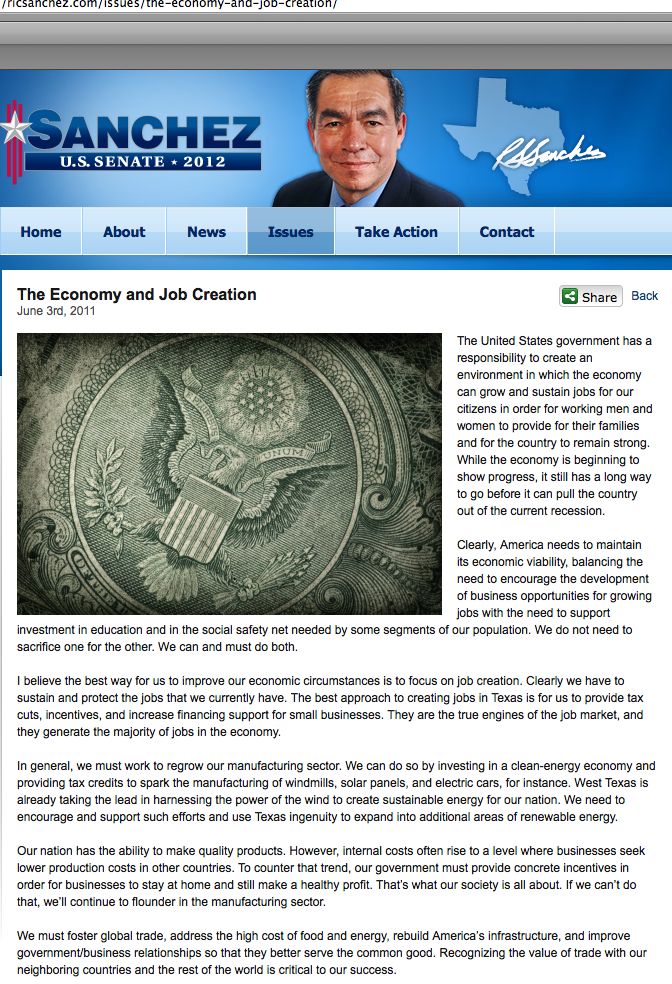
It’s in the third paragraph. Click to embiggen.
It’s a good thing I did, as the Sanchez campaign has scrubbed the phrase “tax cuts” from the page. The old phrase was:
The best approach to creating jobs in Texas is for us to provide tax cuts, incentives and increase financing support for small businesses.
That same sentence today has excised the words “tax cuts”:
The best approach to creating jobs in Texas is for us to provide incentives and increase financing support for small businesses.
In fact, as far as I can tell, that’s the only change to that page.
I have written the Sanchez campaign for an explanation of the change. I’ll let you know what they have to say if I ever receive a reply.
Evidently tax cuts are so anathema to Democrats that even the hand-picked DNC candidate, running without serious primary opposition, running to be Senator from a very conservative state, and sure to be a heavy underdog in a general election in which Democratic control of the Senate will be up for grabs, is not allowed to mention them on his website.