“A BLT, another Spaten, and a high chair for my wife.”

April 27th, 2010

Both Molly Norris, the original cartoonist who came up with Draw Mohammed Day, and Jon Wellington, the creator of the Facebook page dedicated to it, have dropped out of the effort. Funny how Los Angeles Times writer Jimmy Orr never seems to have thought to ask the single most obvious question about their change of heart: Have you received any death threats from Muslim extremists, and is this why you changed your mind? You would think that would be an obvious question to ask when dealing with Islamic extremists, but evidently the question is not of particular interest to those fabled watchdogs in the media.

However, just because the originator pulled out doesn’t mean that Draw Mohammed Day is canceled. After all:

Bloggers made of sterner stuff have picked up the idea and run with it, including:

I plan on contributing my own modest graphic skills to the endeavor. Moreover, I think we should go beyond individual efforts and ask every single professional cartoonist to participate. I encourage you to write your favorite cartoonist and ask them to join in.

And, as he so frequently does, Chris Muir’s Day by Day nails the dismount (and is the source of the blog title).

Give Up on Giving Peace a Chance

April 26th, 2010

I’ve noted the irrational nature of believing in the “Middle East Peace Process” before. Now former Presidential adviser (and former peace process true believer) Aaron David Miller has penned an article demolishing the Middle East peace process for the delusion and sham it is.

Some choice quotes:

Etymologists tell us that the word “religion” may come from the Latin root religare, meaning to adhere or bind. It’s a wonderful derivation. In both its secular and religious manifestations, faith is alluring and seductive precisely because it’s driven by propositions that bind or adhere the believer to a compelling set of ideas that satisfy rationally or spiritually, but always obligate.

And so it has been and remains with America’s commitment to Arab-Israeli peacemaking over the past 40 years, and certainly since the October 1973 war gave birth to serious U.S. diplomacy and the phrase “peace process” (the honor of authorship likely goes to a brilliant veteran State Department Middle East hand, Harold Saunders, who saw the term appropriated by Kissinger early in his shuttles). Since then, the U.S. approach has come to rest on an almost unbreakable triangle of assumptions — articles of faith, really. By the 1990s, these tenets made up a sort of peace-process religion, a reverential logic chain that compelled most U.S. presidents to involve themselves seriously in the Arab-Israeli issue. Barack Obama is the latest convert, and by all accounts he too became a zealous believer, vowing within days of his inauguration “to actively and aggressively seek a lasting peace between Israel and the Palestinians, as well as Israel and its Arab neighbors.”

Like all religions, the peace process has developed a dogmatic creed, with immutable first principles. Over the last two decades, I wrote them hundreds of times to my bosses in the upper echelons of the State Department and the White House; they were a catechism we all could recite by heart. First, pursuit of a comprehensive peace was a core, if not the core, U.S. interest in the region, and achieving it offered the only sure way to protect U.S. interests; second, peace could be achieved, but only through a serious negotiating process based on trading land for peace; and third, only America could help the Arabs and Israelis bring that peace to fruition.

As befitting a religious doctrine, there was little nuance.

He also points out that America has three much more pressing concerns in the Middle East, each of which is more important than the Arab-Israeli conflict:

First, there are the wars in Iraq and Afghanistan, where tens of thousands of Americans are in harm’s way and are likely to be for some time to come. Add to the mix the dangerous situation in Pakistan, and you see volatility, threat, and consequences that go well beyond Palestine. Second, though U.S. foreign policy can’t be held hostage to the war on terror (or whatever it’s now called), the 9/11 attacks were a fundamental turning point for an America that had always felt secure within its borders. And finally there’s Iran, whose nuclear aspirations are clearly a more urgent U.S. priority than Palestine. Should sanctions and/or diplomacy fail, the default position — military action by Israel or even the United States — can’t be ruled out, with galactic consequences for the region and the world. In any event, it’s hard to imagine Netanyahu making any big decisions on the peace process until there’s much more clarity on what he and most Israelis regard as the existential threat of an Iran with a bomb.

Read the whole thing, but keep one thing in mind: All in all, I think Miller is entirely too optimistic. He thinks some form of progress might still be made by American negotiators. I don’t.

Everybody Draw Mohammed Day

April 25th, 2010

Here’s an event I can get behind: Everybody Draw Mohammed Day on May 20.

If you’re not up on Comedy Central’s cowardly censorship of the latest South Park episode, this Mark Steyn piece will get you up to speed, as well as being full of the usual Mark Steyn goodness.

Just in case you haven’t seen it, here’s Jon Stewart on The Daily Show on the controversy:

The Daily Show With Jon Stewart Mon – Thurs 11p / 10c
South Park Death Threats
www.thedailyshow.com
Daily Show Full Episodes Political Humor Tea Party

And, of course, this is obligatory:

Updated: The blackboard quote for tonight’s episode of The Simpsons was “South Park: We’d be standing beside you if we weren’t so scared.”

Carbon Offsets Offsets

April 24th, 2010

Heh.

The “Mystery” of the Resilient Texas Economy

April 23rd, 2010

Daniel Gross on Slate and Mickey Kaus on his campaign website (he’s running against incumbent Barbara Boxer for the California Democratic Senate nomination) ruminate on why the Texas economy is so much more resilient than that of most states. Gross points out that Texas has successfully globalized our economy, that energy is more resistant to recessions than most industries, that high tech plays a bigger role than crude oil, and that the independent nature of the Texas Interconnect Grid meant Texas was able to deregulate its energy sector without having to play “mother may I” with the feds. Kaus argues that since Texas is a Right-to-Work state, we don’t have unreasonably powerful public sector unions to drive up budgets, and the lack of rigid work rules results in a more dynamic economy. All of which is true. However, being from the left, Gross and Kaus both miss one of the biggest reasons for Texas’ economic success:

Texas has no state income tax.

People want to move to Texas (and people already here want to stay) because we get to keep more of our own money. Not only does this make our economy more resilient during downturns, but it limits the size and scope of state government. Numerous studies have shown that high earners flee high-tax states for low-tax states. California and New Jersey’s loss is Texas’ gain. There’s a reason blue states are the ones hit hardest by the recession.

Liberals never bring this up because, well, big government and high taxes go hand in hand, and love of big government and its redistributionist policies are all the left have left these days. Even relatively sane anti-New Left liberals like Kaus want to believe that bigger government can improve people’s lives with the right reforms/cost controls/etc., which is why he favored the abomination that is ObamaCare.

Clueless liberals have been calling for a state income tax for decades. Indeed, when you see a newspaper editorial headlined with “Texas Needs a More [Equitable/Fair/Robust/Just] Tax System,” when you read it you see that what they want is an income tax, and what they really want is bigger government. It’s no wonder that when you look at the board of the pro-state income tax group Citizens for Tax Justice, their guiding board is filled with union cronies. State income taxes mean more money for public employee unions, which is why unions always push for higher taxes. (Are you reading, Mickey?)

Here’s a handy breakdown of the differences between California and Texas. Note that it only covers up to 2007; since then, the economic and budgetary picture for California has only deteriorated.

To be sure, the lack of a state income tax isn’t a cure-all panacea; Florida and Nevada are hurting badly in The Great Recession, mainly because they were among the hardest hit in the housing bubble collapse. But Nevada’s estimated $1.24 billion 2010 deficit, and Florida’s $6 billion shortfall, look positively Utopian next to the yawning chasm of California’s $41.6 billion deficit.

Despite liberal contention to the contrary, it is low tax states that have low budget deficits, and high tax states that have the largest problems, and the lack of a state income tax is a big contributing factor to state budget discipline. That’s unlikely to change, even when the current recession ends.

Edited to add: Here’s a fine piece by Kevin D. Williamson that appeared in National Review on why Texas is doing so comparatively well. I had read it when it came out last year, but didn’t realize it was now available online. Well worth reading.

Climategate Redux: A Look at the State of Play

April 19th, 2010

Between finishing my taxes and the House District 52 race, I’ve had precious little time to post updates on other issues, but despite my personal lacunae interesting developments in Climategate have been bubbling right along.

This piece in the Telegraph does a good job of covering some of the further revelations. One of the more interesting points:

“The first report centred directly on the IPCC itself. When several of the more alarmist claims in its most recent 2007 report were revealed to be wrong and without any scientific foundation, the official response, not least from the IPCC’s chairman, Dr Rajendra Pachauri, was to claim that everything in its report was ‘peer-reviewed’, having been confirmed by independent experts.

“But a new study put this claim to the test. A team of 40 researchers from 12 countries, led by a Canadian analyst Donna Laframboise, checked out every one of the 18,531 scientific sources cited in the mammoth 2007 report. Astonishingly, they found that nearly a third of them – 5,587 – were not peer-reviewed at all, but came from newspaper articles, student theses, even propaganda leaflets and press releases put out by green activists and lobby groups.”

And who would you get to provide an objective, disinterested analysis of IPCC claims? Why, obviously “chair of Falck Renewables, a firm that has wind farms across Europe, and chair of the Carbon Capture and Storage Association, ‘a lobby group which argues that carbon capture could become a $1 trillion industry by 2050.'” Who else? That’s like asking G. Gordon Liddy to perform a dispassionate, objective analysis of Watergate.

You would think that Climategate, the failure of the last “cap and trade” bill, the deep unpopularity of ObamaCare, and the continued poor jobs situation would conspire to prevent Democrats from pushing a huge, job-killing, tax-and-spend global warming bill. You would be wrong. Under the bipartisan fig-leaf of the ever more RINO-ish Lindsey Graham, Harry Reid and company are getting ready to unveil Cap-and-Trade Junior. And they plan to do it in secret, without all those messy public committee meetings. There doesn’t seem to be any limit to how low congressional Democrats are willing to drive their poll numbers in order to get the government’s fingers into as many economic pies as possible before the reckoning comes in November.

The battle over cap-and-trade, and Climategate, is far from over. If you know anyone in South Carolina, they should be ringing Graham’s phone off the hook to oppose this. Speaking of which, here’s the contact information for Graham’s offices off his official website:

Washington Office
290 Russell Senate Office Building
Washington, DC 20510
Main: (202) 224-5972

Upstate Regional Office
130 South Main St.
7th Floor
Greenville, SC 29601
Main: (864) 250-1417

Midlands Regional Office
508 Hampton Street
Suite 202
Columbia, SC 29201
Main: (803) 933-0112

Pee Dee Regional Office
McMillan Federal Building
401 West Evans Street, Suite 226B
Florence, SC 29501
Main: (843) 669-1505

Lowcountry Regional Office
530 Johnnie Dodds Boulevard, Suite 202
Mt. Pleasant, SC 29464
Main: (843) 849-3887

Piedmont Regional Office
140 East Main Street, Suite 110
Rock Hill, SC 29730
Main: (803) 366-2828

Golden Corner Regional Office
124 Exchange Street
Pendleton, SC 29678
Main: (864) 646-4090

Here’s the email form: http://lgraham.senate.gov/public/index.cfm?FuseAction=Contact.EmailSenatorGraham.

Republicans to Gain 100 Seats in House?

April 14th, 2010

Sean Trende at Real Clear Politics suggests that Democrats could be in for a bigger shellacking this November than the suffered even in 1994.

A 1994-style scenario is probably the most likely outcome at this point. Moreover, it is well within the realm of possibility – not merely a far-fetched scenario – that Democratic losses could climb into the 80 or 90-seat range. The Democrats are sailing into a perfect storm of factors influencing a midterm election, and if the situation declines for them in the ensuing months, I wouldn’t be shocked to see Democratic losses eclipse 100 seats.

He foresees a bad economy, a controversial agenda (i.e, the deep unpopularity of runway spending in general and ObamaCare in specific) and the reversal of the 2006-2008 Democratic wins in traditionally Republican districts combining for a perfect storm of voter anger directed at the Democratic party.

Also this:

Remember, Republicans don’t need to win in Massachusetts for a landslide; they could pick up seventy seats without winning a single one in a Democratic-leaning district.

Certainly it’s too early for premature celebration; six months is a long time in politics. But there’s good reason for Republicans to be optimistic…if they don’t blow it.

If Michael Steele isn’t scrambling to make sure every Democratic incumbent has at least one Republican challenger for the general election, he’s not doing his job.

Gonzales Trounces Gordon

April 13th, 2010

Early returns have Larry Gonzales trouncing John Gordon by a sizable margin in the Texas House District 52 race. As of 8:34 PM, Gonzales had 2,519 votes to Gordon’s 1,096, with just under half the votes counted. I’m going to go out on a (very short) limb here and predict that Gonzales will win. (For my next shocking prediction: Obama will not balance the federal budget next year!) I like to think my endorsement had a tiny effect on the final outcome, but the vast majority of the difference is the fact that Larry Gonzales was a much better candidate, and ran a much better campaign.

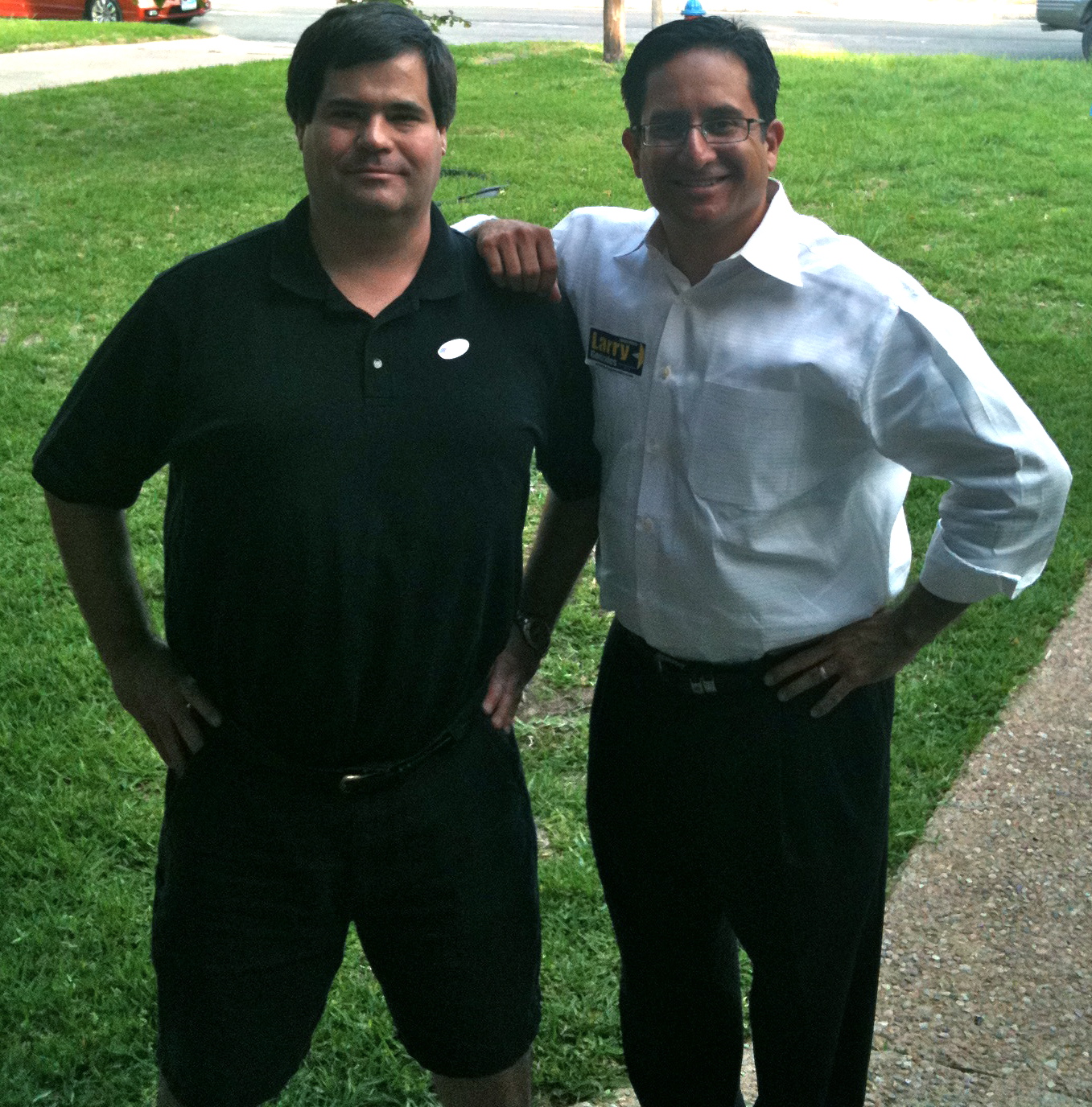
I did have a chance to drop by Gonzales victory party on my way home, where a fellow attendee was able to snap this pic before both Larry and I had to rush off elsewhere:

Lawrence Person and winning candidate Larry Gonzales

I was only able to spend a few minute there, but in person he seemed just as smart and personable as he seemed via email. (In addition to politics, we talked about the early days of desktop publishing, his work dealing with the Texas legislature, and compared our iPhones.) Congratulations to Larry for a well-earned victory.

Now I have to get back back to finishing those pesky taxes…

Updated: Preliminary final results are even more a Gonzales landslide: Gonzales 3,601 (71.28%), Gordon 1,451 (28.72%), a fairly dramatic reversal considering that Gordon garnered a slight lead in the March primary.

Updated the Blog Roll

April 13th, 2010

I’ve added a few more sites to the blog roll, especially those focusing on local politics and gun rights. So feel free to give them some sweet link-clicking goodness.

Remember to Vote in the April 13 Republican Primary Runoff

April 12th, 2010

Here are poll locations for Williamson County voters.

And here’s where you can find them for Travis County.