Archive for the ‘Economics’ Category

Red State, Blue State

Sunday, October 16th, 2011

Tax revenues in Texas rose 11.8% in September compared to September a year ago.

Meanwhile, California took in 4 percent less than anticipated in September, falling $300 million short in September alone and $700 million short for the year.

These numbers offer me a chance to offer up my long-in-gestation comparison between Texas and California.

Both Texas and California share a number of similarities: They are the two most populous states in the Union, both are southern states with warm climates, both have long coastlines and important ports handling international trade, both share a border with Mexico, both have diverse populations and diversified economies, including extensive portions of the agriculture, energy, and high tech sectors.

The biggest difference between the two is their respective governments. Texas, of course, is the paragon of the red state model (low tax, low spending, limited government, non-union) whereas California is the classic example of the blue state model (high tax, high spending, expansive welfare state, closed shop). Texas kept government small, tightened its belt and lived within its means. California spent like there was no tomorrow, jacked tax rates into the stratosphere, and gave generous contracts to public employee unions. Now Texas is doing well and California is going broke.

Jay Ambrose asks:

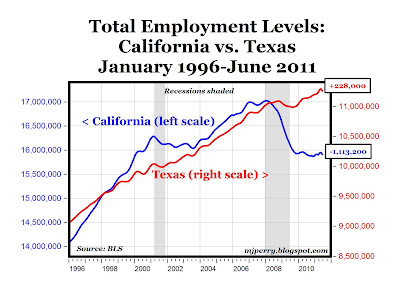
So what example should America follow, that of deficit-slaughtering, budget-cutting, seriously limited government in Texas, which has added 730,000 jobs in the past decade, or that of regulation-happy, spend-mercilessly, owe-everything, flee-this-place-quickly California, which has lost 600,000 jobs during the same period?

Texas has some of the best cities for jobs in the country. California? It “boasted zero regions in the top 150.”

Chief Executive ranks Texas as the best state for business, and California as the worst.

High tech companies are fleeing California for low tax states. In fact, high earners inevitably flee high tax states for low tax states:

Examining IRS tax return data by state, E.J. McMahon, a fiscal expert at the Manhattan Institute, measured the impact of large income-tax rate increases on the rich ($200,000 income or more) in Connecticut, which raised its tax rate in 2003 to 5% from 4.5%; in New Jersey, which raised its rate in 2004 to 8.97% from 6.35%; and in New York, which raised its tax rate in 2003 to 7.7% from 6.85%. Over the period 2002-2005, in each of these states the “soak the rich” tax hike was followed by a significant reduction in the number of rich people paying taxes in these states relative to the national average. Amazingly, these three states ranked 46th, 49th and 50th among all states in the percentage increase in wealthy tax filers in the years after they tried to soak the rich.

Here’s a comparison between California and Texas that explains, in great detail, how and why Texas is kicking California’s ass. Remember those job creation numbers, so ably depicted by WILLisms?

Now compare Texas to California via this chart from Mark J. Perry’s Carpe Diem blog:
Another reason Texas is thriving is that it doesn’t have overpaid, all-powerful public sector unions.

High tech employees are fleeing California for Texas, because they can keep more of what they make, the government isn’t going bankrupt, and the roads and schools are now better in Texas. Despite all the money California spends on a a bloated public sector, the actual core services delivered are worse in California than they are in Texas:

“Today, you go to Texas, the roads are no worse, the public schools are not great but are better than or equal to ours, and their universities are good. The bargain between California’s government and the middle class is constantly being renegotiated to the disadvantage of the middle class.”

Just how broke California is became apparent in a recent Michael Lewis piece in Vanity Fair. It illustrates who irretrievably broken California’s politics and finances are, and just how little a dent Gov. Arnold Schwarzenegger made in fixing the problem:

David Crane, the former economic adviser—at that moment rapidly receding into the distance—could itemize the result: a long list of depressing government financial statistics. The pensions of state employees ate up twice as much of the budget when Schwarzenegger left office as they had when he arrived, for instance. The officially recognized gap between what the state would owe its workers and what it had on hand to pay them was roughly $105 billion, but that, thanks to accounting gimmicks, was probably only about half the real number. “This year the state will directly spend $32 billion on employee pay and benefits, up 65 percent over the past 10 years,” says Crane later. “Compare that to state spending on higher education [down 5 percent], health and human services [up just 5 percent], and parks and recreation [flat], all crowded out in large part by fast-rising employment costs.” Crane is a lifelong Democrat with no particular hostility to government. But the more he looked into the details, the more shocking he found them to be. In 2010, for instance, the state spent $6 billion on fewer than 30,000 guards and other prison-system employees. A prison guard who started his career at the age of 45 could retire after five years with a pension that very nearly equaled his former salary. The head parole psychiatrist for the California prison system was the state’s highest-paid public employee; in 2010 he’d made $838,706. The same fiscal year that the state spent $6 billion on prisons, it had invested just $4.7 billion in its higher education—that is, 33 campuses with 670,000 students. Over the past 30 years the state’s share of the budget for the University of California has fallen from 30 percent to 11 percent, and it is about to fall a lot more. In 1980 a Cal student paid $776 a year in tuition; in 2011 he pays $13,218. Everywhere you turn, the long-term future of the state is being sacrificed.

It’s even worse at the local level, where cities are going broke do to outrageous union pensions, such as in San Jose:

It shows that the city’s pension costs when he first became interested in the subject were projected to run $73 million a year. This year they would be $245 million: pension and health-care costs of retired workers now are more than half the budget. In three years’ time pension costs alone would come to $400 million, though “if you were to adjust for real life expectancy it is more like $650 million.” Legally obliged to meet these costs, the city can respond only by cutting elsewhere. As a result, San Jose, once run by 7,450 city workers, was now being run by 5,400 city workers.

What do the citizens of California get for some of the highest public sector wages in the country? Police and firefighters that stand around watching a man drown.

San Jose is far from the worst:

Back in 2008, unable to come to terms with its many creditors, Vallejo declared bankruptcy. Eighty percent of the city’s budget—and the lion’s share of the claims that had thrown it into bankruptcy—were wrapped up in the pay and benefits of public-safety workers.

California has some of the highest taxes in the country, and it can’t make ends meet because it’s welfare state and public employee unions suck up every available dollar and more.

You cannot tax your way to prosperity.

You cannot spend your way to prosperity.

Government can only create the conditions that allow the free market to create jobs.

The red state model works.

The blue state model doesn’t.
Sanchez Campaign Scrubs Mention of Tax Cuts From Their Website

Friday, October 14th, 2011

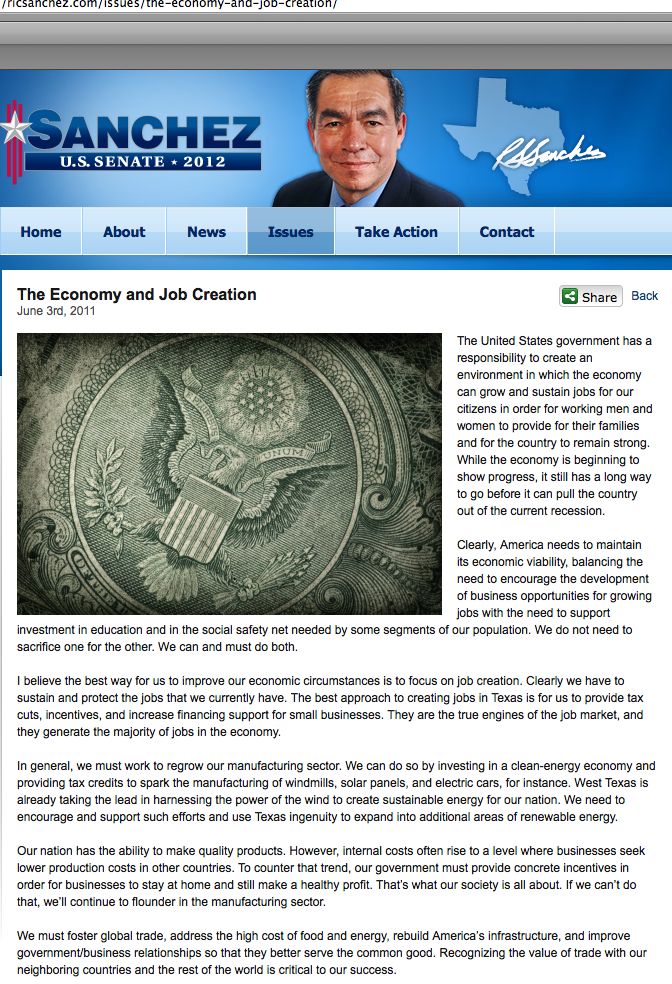
You may remember back in June, when I noticed that Ricardo Sanchez’s campaign website mentioned tax cuts as a means of creating jobs and improving the economy. Given that was so out of character for a Democrat, I thought I better get a screen shot to prove it was there:

It’s in the third paragraph. Click to embiggen.

It’s a good thing I did, as the Sanchez campaign has scrubbed the phrase “tax cuts” from the page. The old phrase was:

The best approach to creating jobs in Texas is for us to provide tax cuts, incentives and increase financing support for small businesses.

That same sentence today has excised the words “tax cuts”:

The best approach to creating jobs in Texas is for us to provide incentives and increase financing support for small businesses.

In fact, as far as I can tell, that’s the only change to that page.

I have written the Sanchez campaign for an explanation of the change. I’ll let you know what they have to say if I ever receive a reply.

Evidently tax cuts are so anathema to Democrats that even the hand-picked DNC candidate, running without serious primary opposition, running to be Senator from a very conservative state, and sure to be a heavy underdog in a general election in which Democratic control of the Senate will be up for grabs, is not allowed to mention them on his website.

Obama by the Numbers

Tuesday, October 4th, 2011

Well done, and in convenient video form. Put together by the folks at Minnesota Majority, based on original work by the folks at Ace of Spades.

Cruz, Dewhurst Trade Punches

Tuesday, October 4th, 2011

I think it’s safe to say that Ted Cruz now has David Dewhurst’s attention.

First came the Chupacabra ad, then news of the National Review cover. Then yesterday, the Cruz campaign noted that Dewhurst floated the idea of a wage tax (i.e., a thinly disguised income tax) back in 2005.

Today the Dewhurst campaign stepped down from the Ivory Tower to punch back, calling attention to a story that Cruz, in his career as a private appellate lawyer, represented a Chinese firm in a patent dispute with an American firm, and to an interview with Laura Ingraham in which he expressed opposition to a Senate bill that seeks sanctions against China for currency manipulation. (A complete transcript of the Ingraham show appearance can be found here.)

Here’s the exact language from Steven Cheung of Dewhurst for Texas:

The day after Texas Monthly’s Paul Burka reported on Ted Cruz acting as legal counsel to a Chinese company accused of patent infringement against an American inventor, Cruz again showed his true colors by again defending China’s interests on the Laura Ingraham Show. To check out our latest video that has highlights, please click here.

By standing on the same side as President Barack Obama, a fellow elitist, Harvard attorney with zero business experience, Cruz and Obama strongly oppose a bill that would curb China’s predatory trade and currency practices in a time when they are taking over ownership of the American economy.

“It’s about holding China accountable for what China is doing that is completely without integrity and subverting the principles of free trade,” said Ingraham. Moments later, Ingraham correctly declared, “Obama’s with you on this bill!”

At a time when millions of Americans are without jobs, why does Ted Cruz consistently put the needs of China before America?

To my mind, this is fairly weak sauce by the Dewhurst campaign, and the tone is overreaching. Representing clients is what lawyers do, and it’s not like Cruz is working pro bono for convicted terrorists.

And I happen to be on Cruz’s side on the China bill, as are (as far as I can tell) the vast majority of conservitive commentators and economists. Sure, China manilpulates it’s currency…but so do we, Europe, and just about everyone else. Protectionism is still loser economics, and starting a trade war in the midst of a recession is not a great idea.

Whether these criticisms will play with Republican primary voters is another question. Tom Leppert’s been using the lawyer line of attack on Cruz without any notable effect for months now, but China bashing is seldom unpopular; it’s also, as far as I can tell, seldom an effective wedge issue, either.

But it’s interesting to note that the gloves have finally come off for the Dewhurst campaign. I don’t think his soi distant Ivory Tower approach was going to tide him over until he could carpet-bomb the primary with big direct mail and ad buys. Despite Dewhurst’s status as presumptive frontrunner, Cruz continues to make noise and rack up conservative endorsements both locally and nationally.

The Dewhurst campaign seems to have finally realized they have a fight on their hands.

“Greece is not salvagable”

Friday, September 30th, 2011

That’s the rather bracing judgment from this Stratfor overview of Greece’s problem. Moreover, they’re saying that about its existence as a nation-state, even absent the European debt crises. Also: “Greece has to be kicked out of the Eurozone if the Eurozone is to survive.” Problem? They don’t have enough “firebreak” funds to do it. “Until the Europeans have 2 trillion Euro in funding stashed away, they can’t kick Greece out of the system.”

I’m not sure I share the pessimism about Greece in the long run. After all, nation-states can exist for an awful long time, despite crappy conditions (see, for example, Haiti). Of course, that assumes that a newly Islamic Turkey doesn’t decide to settle old scores by conquering them outright. (Assuming, of course, that Turkey is still predominately Turkish rather than Kurdish. Claire Berlinski is a little more sanguine about that prospect.)

Honestly, of the two, I think Greece will outlast the Eurozone by a good measure. The question isn’t the whether Eurocrats can prevent the Eurozone from breaking up, but rather how long they can delay the inevitable, how much sovereign debt can they put taxpayers on the hook for, and how much harder will the inevitable market correction be when it comes? It seems to be a race between how much European taxpayer money can be wasted propping up Europe’s bankrupt welfare states vs. how much of American taxpayer money can the Obama administration waste channeling payouts to well-connected Democratic cronies. The Eurocrats may be winning the race to insolvency, if only due to the lack of a European Tea Party.

In other Euro Debt Crises news:

  • Europe votes to throw more money down the rat hole.
  • But don’t take that as any kind of victory for the Euro. Quite the opposite. “The furious debate over the erosion of German fiscal sovereignty and democracy – as well as the escalating costs of the EU rescue machinery – has made it absolutely clear that the Bundestag will not prop up the ruins of monetary union for much longer. Horst Seehofer, the leader of Bavaria’s Social Christians, said his party would go ‘this far, and no further’.”
  • Greece passes the tax increase the Eurocrats say is necessary to stave off default.
  • How broke is Europe? They’re considering a tax on every financial transaction. This is great news…for stock exchanges outside of Europe.
  • How Charles de Gaulle foresaw the Euro crackup.
  • The German finance minister says that a leveraged Euro-TARP is dead. I would say why U.S. regulators were pushing such a scheme was puzzling, except of course it isn’t. The goal is to put off the Euro-collapse until after the 2012 elections.
  • Meanwhile, liberal moneybags mastermind George Soros says that the Euro crises is dragging us toward another depression. His solution? I know you’re going to be shocked, shocked to learn that it’s bigger, more central government. “The governments of the eurozone must agree in principle on a new treaty creating a common treasury for the eurozone. In the meantime, the major banks must be put under the direction of the European Central Bank.” To be followed shortly thereafter by the formation of the First European Airborne Swine Squadron.
  • Is there any other place desperate Eurocrats can get money to prop up their falling welfare states? Are they perhaps hoping that Obama will bail them out? After all, what’s a few more trillions in unsupported debt between friends?

    LinkSwarm for September 27, 1011.

    Tuesday, September 27th, 2011
  • Texas’ economy under Perry kicks the ass of Massachusetts under Romney.
  • I was previously unaware of the Texanomics blog, but the blogger there (curiously anonymous; there’s nothing in the About Me page) is giving WILLisms a run for his money in charting the superiority of Texas over the other 49 states (or, if you’re Barack Obama, the other 56 states, including Wyomorado).
  • Thanks to Obama’s magic touch, 2012 is actually shaping up to be worse for Democrats than 2010.
  • Jonah Goldberg says that Obama has woken the bear of America’s natural conservative tendencies.
  • The Daily Caller interviews Michael Totten about his new book, In the Wake of the Surge. I’m reading his previous book on Lebanon, The Road to Fatima Gate intermittently (mixed up with the usual science fiction), and enjoying it a great deal.
  • Speaking of books, I suppose I should mention that Adam Winkler’s Gunfight: The Battle over the Right to Bear Arms in America is now out. Previous coverage of an excerpt from that book can be found here.
  • Well, here’s some cheerful news: “Moldovan authorities believe that 2.2 pounds of weapon-usable uranium is held by traffickers who have in the past sought to sell the material to North African buyer.” (Hat tip: Bruce Sterling’s Twitter feed.)
  • The open-minded liberals at the University of Wisconsin-Stout are threatening a professor because his poster quoted a line from Firefly. (Hat tip: Neil Gaiman’s Twitter feed.)
  • More Greek Default Rumblings

    Sunday, September 25th, 2011

    Actually, less rumblings than the roar of an approaching train. And since I temporarily seem to be ahead of the latest Ace of Spades Doom roundup, I’m going to try and give you a nice clear view of the coming crash.

    “No longer a question of if, but when – that is the tone of discussions over Greece which has dominated the summit of finance ministers in Washington over the weekend.” Former Britain’s former finance minister Alistair Darling agrees, calling default “only a matter of time.”

    The talk now is of how to put in a “firewall” to prevent the contagion of an inevitable Greek default from spreading throughout the European banking system.

    The Euroskeptics have been completely vindicated:

    Very rarely in political history has any faction or movement enjoyed such a complete and crushing victory as the Conservative Eurosceptics. The field is theirs. They were not merely right about the single currency, the greatest economic issue of our age — they were right for the right reasons. They foresaw with lucid, prophetic accuracy exactly how and why the euro would bring with it financial devastation and social collapse.

    I think at this point UK residents should be feeling vrey glad indeed that they didn’t abandon the Pound for the Euro.

    Bret Stephens talks about the long line of deceit and fraud that lead Europe to the current crises. “What is now happening in Europe isn’t so much a crisis as it is an exposure: a Madoff-type event rather than a Lehman one.”

    Mark Steyn, using the ever popular music and political metaphor gambit, compares the breakup of the Eurozone with the breakup of R.E.M. while bringing the usual Steyn goodness: “Attempting to postpone the Club Med welfare junkies’ rendezvous with self-extinction will destabilize internal German politics (which always adds to the gaiety of nations).” And this:

    As its own contribution to the end of the world as we know it, the Obama administration has just released a document called “Living Within Our Means and Investing in the Future: The President’s Plan for Economic Growth and Deficit Reduction.” If you’re curious about the first part of the title — “Living Within Our Means” — Veronique de Rugy pointed out at National Review that under this plan debt held by the public will grow from just over $10 trillion to $17.7 trillion by 2021. In other words, the president’s definition of “Living Within Our Means” is to burn through the equivalent of the entire German, French, and British economies in new debt between now and the end of the decade. You can try this yourself next time your bank manager politely suggests you should try “living within your means”: Tell him you’ve got an ingenious plan to get your spending under control by near doubling your present debt in the course of a mere decade. He’s sure to be impressed.

    Germany is near the limit of their willingness to bail out Greece.

    There may even be a taxpayer revolt brewing in the Aegean.

    And if the other PIIGS are doing better than Greece, it is only a matter of degrees: “Italy is the new Lebanon, Portugal the new Venezuela, Spain the new Vietnam, Ireland the new Argentina and nothing is more risky than Greece, according to today’s credit default swap market.”

    But it’s not just Greece and Europe that are hitting the wall. China’s housing bubble may finally be bursting. Worse still: “growth in China may be zero [and] China has ‘European kind of numbers’ when it comes to debt.”

    And the Chinese housing bubble isn’t just affecting China. It’s also affecting Canada.

    And at least one observer has drawn parallels to a certain hopemonger currently residing in the White House:

    Obama has no intention of really solving the debt crisis. And that brings us back to Greece. That government has been doing the same thing for a decade and the chickens have now come home to roost. Greece’s debt is 150 percent of its Gross Domestic Product. Our debt has just reached 100 percent of GDP and the debt is accumulating faster than it ever has. If we were looking out the windshield down the road, we could see the crash that’s just up around the bend.

    But rather than put on the brakes, the president has chosen to pick a fight with the other passengers in the car he is driving. Talk about distracted driving! He is gambling that this fight will convince the passengers to let him stay behind the wheel for another four years. But we certainly can’t wait that long. He’s turned up the radio in hopes we won’t hear the ambulance sirens.

    It looks like its going to be another rough week for world markets…

    Greece Getting Ready to Default?

    Monday, September 12th, 2011

    According to Seeking Alpha last week: “Yields on two-year Greek government bonds reached 46.84% recently. This is roughly comparable to yields on Argentine bonds in early December 2001 – only a month before the country defaulted on its debt.”

    Other signs of the Euro crisis: The Euro hit a six month low against the dollar, and a ten year low against the yen.

    Now Walter Russell Mead is reporting that markets around the world have a serious case of the jitters due to the possibility of a European meltdown. “Creating a monetary union without a true federal government is looking more and more like the biggest European policy mistake since Britain and France let Hitler have the Sudetenland.”

    It’s not just Greece. Investors are now worrying about the potential solvency of French banks.

    Last week, Powerline linked to this cheerful piece over at Zero Hedge, which outlines some consequences of a Euro breakup: “Were a stronger country such as Germany to leave the Euro, the consequences would include corporate default, recapitalisation of the banking system and collapse of international trade.” Lovely. Other possibilities: The rise of authoritarian or military governments to contain the crisis, or civil war.

    Despite all this, the EU itself, when not pushing for further austerity, denies it’s preparing for a Greek default. Should we be more worried that the Eurocrats running the show are liars or idiots?

    Here’s Peter Morici calling Greece to default and abandon the Euro, although comically, he’s saying that it’s Greece that is the exploited nation “at the mercy of Germany and other rich states who exploit European unity to live well at the expense of their poorer brethren.” Of course this is an inversion of the actual situation, with wastrel cousin Stavos living high on the hog off of Uncle Fritz and Aunt Helga’s credit rating.

    But that might be coming to an abrupt end. Despite a slew of austerity measures introudced over the weekend, the Greek government only has enough money to last through the middle of October. There are technical obstacles to still more bailouts from Germany, assuming Uncle Fritz was even willing to extend more credit. Signs are that he isn’t. Indeed, German Chancellor Angela Merkel is openly discussing “an orderly bankruptcy of Greece.” The bond market is already treating a Greek default like a near certainty. It seems like the plan to prop up Greece until banks can stick European taxpayers with the bill may be coming undone.

    So, you think gold prices would soar, right? Wrong. “Gold futures slumped as traders cashed out of the perceived refuge asset to cover losses in other markets while Europe’s debt crisis seemed poised to take a turn for the worse.” So it’s gotten so bad that traders need to sell gold in order to cover losses in everything else but gold.

    Hang on, folks. We could be in for a very rough ride…

    Obama Jobs Speech Bingo

    Thursday, September 8th, 2011

    Pity the pundit forced by duty to watch an Obama speech. Barring a Teleprompter malfunction, there are few events more tedious and predictable. When even uber-Democrat James Carville says that between an Obama speech and a Republican debate, “I would have watched the debate and I’m not even a Republican or even close to being a Republican,” you know you’re in store for some deep hurting.

    So how can we assuage the agony of those poor, dedicated souls who will be watching Obama’s jobs speech tonight? Barring an announcement that he’s abandoning Big Government liberalism for budget and tax cuts, the chances for another Obama snoozefest are vast, while the possibility of anything new and substantive are slim. How can we keep their attention focused on the POTUS, and not on the desperate need for another highball or passing a sanity roll?

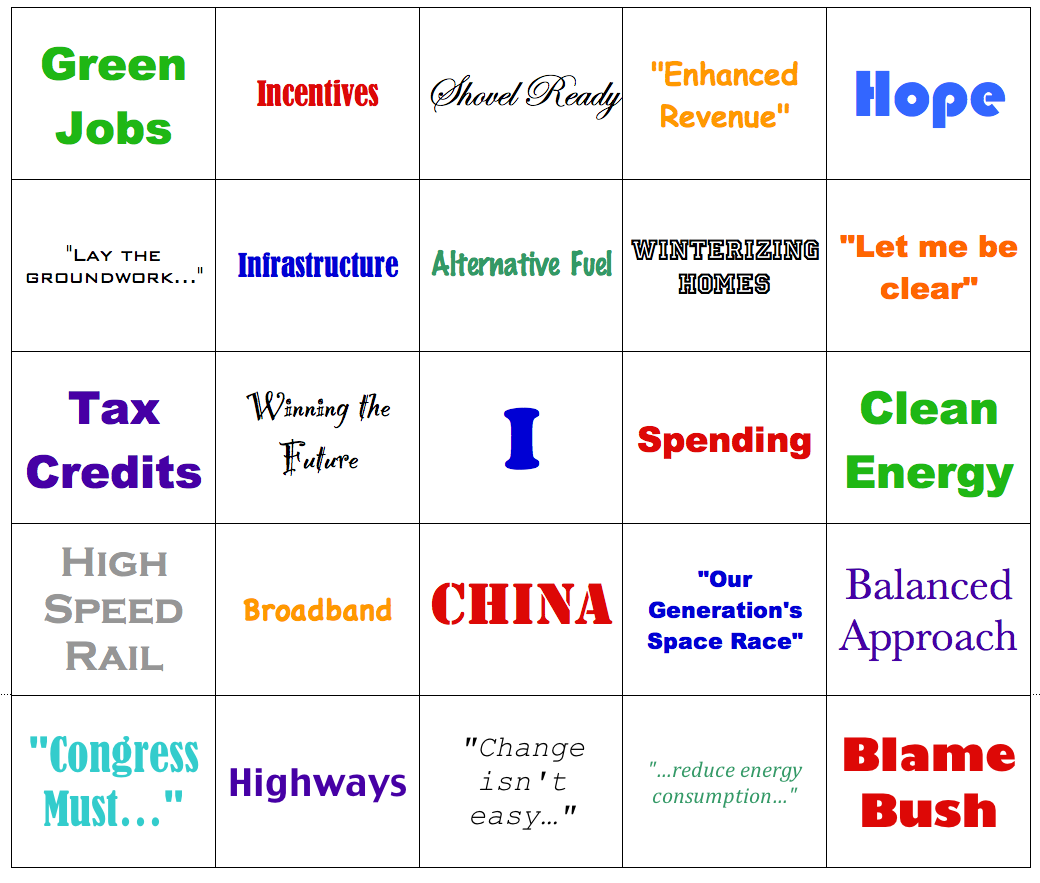
    Simple: With my handy Obama Jobs Speech Bingo chart below! Just print out and place a marker every time Obama trots out one of his stock job speech phrases. Which I’m confident will be pretty darn often.

    Which dedicated pundit will be the first to post “Bingo! #ObamaBingo” to Twitter tonight?

    Click to embiggen

    Edited to add: Welcome Powerline readers! As you can tell from the blogroll on the right, Powerline has long been one of my favorite blogs, so feel free to look around for news from the hot, dusty heart of Texas.

    Audio Interview With Ted Cruz: Part 1

    Tuesday, September 6th, 2011

    When I did this video interview with Ted Cruz on July 30, I also did an audio interview with him at the same time using an iPhone App called Recorder Pro. The video interview was done by Cruz’s staff (who have a much better camera than I do), and the resulting video was editing done to a sort of “Best of” piece emphasizing his campaign themes. I actually think the full interview will be more interesting to conservatives, as he goes into more detail about a number of topics, including border control, the budget deficit, and federal commerce clause overreach and the 10th Amendment, including a discussion of Wickard vs. Filburn.

    It’s taken a good bit longer to get it the audio up here than I wanted to, mainly because I’ve been pretty busy, but also because it was something of a pain to edit the interview and get it up here. First, I had Recorder Pro record in CAF format, which isn’t particularly widely used, so I needed one program to convert it into a .WAV file, and then another to edit the file (there was about a minute and a half of extraneous setup noise I wanted to spare you). Then, after all that, I found out the resulting audio file was too large post all at once, so I’ve split it into two chunks. The first half of the interview is below as an MP3. I’ll try to put up the second half in the next day or so, assuming I don’t get distracted by shiny objects.

    Ted Cruz Interview Part 1

    Also, as a bonus, here’s an essay by Ted Cruz and Mario Loyola on Federalism that discusses Wickard vs. Filburn.