In related news, here’s a piece from last year in the liberal Texas Observer talking about Republican outreach to Hispanics. That seems to be working out a lot better than the “inevitable Democratic majority” theory people like Ruy Teixeira have been pushing for the last decade.
Iowahawk on Andrew Breitbart: “How did this socially liberal Jewish RINO from Brentwood become the Emmanuel Goldstein of the left’s unhinged 2-Minutes Hate? A big, lovable, random, generous, fearless, patriotic grinning goofball.”
Down With Wind: “If wind power was going to work, it would have done so by now. The people of Britain see this quite clearly, though politicians are often wilfully deaf. The good news though is that if you look closely, you can see David Cameron’s government coming to its senses about the whole fiasco. ” (Hat tip: Powerline.)
UT to student media director: Balance your department budget. Student media director: OK, how about we sell these TV and radio licenses? UT: Not that balanced. You’re fired. (Hat tip: Mike Godwin’s Facebook page.)
I’ve been reading up a bit more on the compromise redistricting lines released by the San Antonio district court. Texas Attorney General Greg Abbot was able to keep most of what the legislature passed, and the Governor signed, intact, but a few changes were made to satisfy Democratic demands to win in court what they couldn’t at the ballot box settle lawsuits by various minority interest groups under the provisions of the Voting Rights Act.
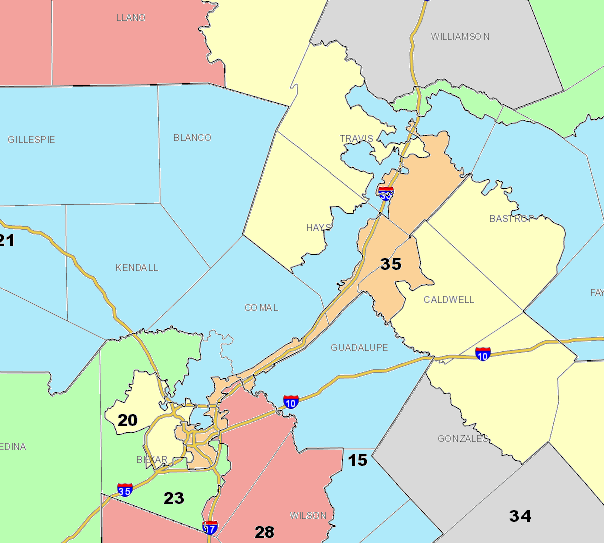
Though U.S. Congressional Districts, State Senate Districts, and State House districts were all affected by the new maps, I want to focus on three U.S. Congressional Districts, including some shown in this map here:
District 35: Lloyd Doggett may not be gone, but District 35, the one Doggett plans to run in, is now 65% Hispanic and mostly based in San Antonio. And the recriminations have already started among Democrats: “If Lloyd Doggett would man up and spend that $3 million he’s been hoarding for the last decade, then we could have an extra Democratic seat.” Doggett dodged a bullet when District 20 incumbent Charlie Gonzalez (son of long-time Congressmen Henry B. Gonzalez, who held the office before him) announced he was retiring, letting up-and-comer Joaquin Castro run for that seat instead of 35, but there’s no shortage of San Antonio-based Democratic contenders, including Bexar County Tax Assessor-Collector Sylvia Romo. (There are two Republicans running for District 35, Susan Narvaiz and Rob Roark, both of San Marcos, but given that the new district went for Obaama by 63%, it’s going to be quite an uphill climb for any Republican.) One of the candidates currently running in District 35 is former Democratic Congressman Ciro D. Rodriguez (who is very pissy indeed about redistricting), who previously represented:
District 23: This seat is currently held by Republican Francisco “Quico” Canseco, who beat Rodriguez by a little over 7,000 votes in 2010. The redistricting map passed by the legislature made Canseco’s district more Republican, but the compromise district scales back Republican gains. It’s now slightly more Republican (50% of the new district voted for Obama in 2008, down slightly from 51% in the old district), but it’s still close enough that Democrats have to consider this a prime takeover target. Still, Canseco now has the power and name recognition of incumbency, and even if Obama wins (doubtful and frightful, but possible), I doubt his coattails will be particularly long in San Antonio. Texas State Rep. Peter Gallego is the likely Democratic candidate, but so far Canseco is beating him in the fundraising race over three to one. (Disclaimer: Canseco is one of two U.S. congressional candidates I donated to in the 2010 election cycle (three if you count attending a couple of John Carter’s picnics at $10 a pop).)
Over on the left side of the Blogsphere, the Kos Kids have put up the a breakdown that includes numbers on how each District voted in the 2008 Presidential race.
The new redistricting maps, that is. Sounds like they haven’t been made final just yet, but most likely will be. If that happens this week, that might mean a late April (rather than May) primary.
Does this mean Maine might actually elect a Republican who actually votes, you know, Republican? I doubt it. Maine is pretty liberal, and even someone like Scott Brown might find it difficult to win there. I think you could still potentially elect a Republican more conservative than Snowe (which is, lets face it, not too hard), but the differences will be more in degree than in kind. But it might be possible to elect someone who wouldn’t vote for Obama’s pork-laden stimulus.
Will this make it more difficult for the Republicans to take the Senate? Maybe, but I still think a Republican takeover is more likely than not.
(Hat tip: Ace, who thinks “there’s something we’re not being told yet.” Illness? Obama making her Ambassador to Canada? Who knows?)
Trying to catch back up with the Senate race after my trip, so some of this may be slightly old news:
The biggest recent news in the Senate race is the newest Texas Tribune/UT poll that shows David Dewhurst leading the race at 38%, but with Ted Cruz up to 27%. Tom Leppert and Craig James are tied way back in third place at 7% each, an outcome that must be discouraging for the Leppert team, given that he’s been running for over a year and James has only been running for two months. Glenn Addison and Lela Pittenger are the only other candidates to get any support at all at 1% each. However, the margin of error is ±5%. Full results in PDF form here.
Dewhurst managed to pull in big bucks from a big donor in Washington. A big democratic donor. “He was doing what he always does: reaching across the aisle. He’s not a Washington insider yet, and he’s already a Washington insider. No wonder the Texas press has so often labeled him ‘bipartisan’…This is a critical race for the Tea Party and for conservatives across the country. If Dewhurst wins, we’ll have yet another squish on our hands – and a squish who is only too eager to rub elbows with the liberal establishment.” (Hat tip: Must Read Texas.)
This Kate Alexander piece in the Austin-American Statesman is pretty interesting, not so much for the information there (BattleSwarm readers will find very little I haven’t already covered), but for the approach. Overall the piece is probably mildly negative on Cruz, but not unfairly negative. Unlike, say, certain of Robert T. Garrett’s pieces in The Dallas Morning News, the issues she raises are generally real and non-trivial, though not ones that most conservatives will find of burning importance.
Cruz womps the field in a survey of the North Texas Tea Party.
The Dewhurst campaign attacks Cruz for “not supporting Sen. John Cornyn for Republican Senate Whip.”
Cruz has previously told reporters it’s more important to elect Senators who would pledge fealty to a divisive challenge to GOP leadership than it is for Republicans to regain its U.S. Senate majority this year. Cruz’s glaring lack of support for Sen. Cornyn, who’s now responsible for Republican efforts to retake that majority, effectively puts Cruz’s personal ambition and interests above conservative attempts to organize and stop the Obama agenda.
So Dewhurst is attacking Cruz for actually wanting to enact conservative ideas rather than just paying lip-service to it while toeing the Republican establishment line. Got it. (Maybe someone on Team Dewhurst might want to take a look at this.)
Scott Haddock interviews Tom Leppert Part 1 and Part 2.
The Texas Tribune did an interview with Craig James:
Glenn Addison gets a profile by the Houston Chronicle‘s Joe Holley. Addison’s evident friendliness with the John Birch society (yes, it’s still around) is not a plus in my book. I am gratified to see that Holley, who I dinged heavily, correctly lists both the number of candidates for each party, as well as their names.
That same TT/UT poll shows the Democratic side of the race virtually tied, with Sean Hubbard at 12%, Paul Sadler, Daniel Boone, and Addie D. Allen all tied at 10%, and John Morton (who the Democrats kicked off the ballot two months ago) at 3%. That’s good news for Hubbard (frontrunner again!) and Allen (whose campaign might be charitably called “low-key”), and bad news for anointed Democratic establishment candidate Sadler and “Gene Kelly 2.0” Boone. But the margin of error for Democrats is even higher at ±6%, so it’s still anyone’s race at this point.
Democrat Addie D. Allen now has a website (though it just has the GoDaddy parking page for now) and a Twitter feed.
University of Texas Democrats endorse Paul Sadler. That should be good for an extra five, maybe even six votes, easy…
Daniel Boone appeared before the Llano Tea Party, which I think makes him the first Democratic senate candidate to take up the repeated Tea Party offers for Democrats to speak. Good for him.
Pro-tip for Boone: Most people put the newest content at the top of their blog, not the oldest.
As far as I can tell, Craig James, Charles Holcomb, Ben Gambini, Joe Agris and Addie D. Allen have not filed Q4 reports with the FEC. Maybe none of them conducted any fundraising in the quarter.
I just got back from a business trip abroad, so it’s taking me a little time to get back up to speed. One thing I did want to note was David Jennings of Big Jolly Politics taking a couple of my senate race posts and running with them.
First, he took a look at that donation chart I did, and then produced several additional interesting charts. He also dug deeper into Dewhurst’s 800+ page Q4 report and noticed something that I didn’t, namely that Dewhurst loaned his campaign $2 million, then the campaign paid off the loan four days later, then loaned his campaign another $2 million on December 31. Which means he spent $2.4 million, not $4.4 million, in Q4. Why he did that I couldn’t tell you, unless there’s some sort of campaign finance reason, or he wants to make it look like he put more money into his campaign than he actually did.
I do, however, have differences with Jennings on interpreting the data. When he says “Much has been made of Dewhurst’s and Leppert’s ability to self-fund,” that’s like saying “Much has been made of Wolfgang Mozart and Antonio Salieri’s composing ability.” Tom Leppert has a net worth of $12 million, David Dewhurst has a net worth of $225 million. Leppert simply can’t self fund to the extent that Dewhurst can, which is probably a big reason why Leppert went from throwing in $1 million in self-funding in both Q1 and Q2 to only half that in Q3 and Q4.
Likewise, his contention that Leppert has slipped into second place relies on taking that internal Dewhurst poll as gospel, which (as I’ve argued time and time again) we can’t do due not only to its provenience, but also the opaque nature of its methodology. And his list of Cruz “stumbles” is mostly much ado about nothing, as I don’t see anything on his list that would cause Republican voters to change their vote.
Still, they’re interesting posts on the race, even if I disagree with some of the conclusions.
Today Instapundit Glenn Reynolds asks: “Back in 2008, the social-cons were all-in for Romney, to the point where Hugh Hewitt’s take became a running tagline (“You know who this is good for? Mitt Romney!”) that’s still used by by bloggers from time to time. Now, not so much. So what changed about Romney since 2008 to make him un-conservative?”
A good question, even though I wasn’t a Romney guy back in 2008. But three obvious answers occur to me:
The Tea Party Happened: The election of Obama and Obama’s extreme big-spending, big-government ways have “radicalized” Republican voters to the point that it’s no longer acceptable to campaign like a conservative and vote like a liberal. As the 2010 primary defeats of Charlie Crist and Mike Castle proved, Republican primary voters are no longer willing to give establishment Republicans a pass on their own free-spending, big government ways, and Mitt Romney is as Establishment as they come.
ObamaCare Happened: Before ObamaCare, Republicans might have been willing to downplay the socialistic, anti-freedom aspects of RomneyCare and its own individual mandate under the guise of state rights and the 10th Amendment. But after the passage of ObamaCare, RomneyCare has become a far greater political and ideological liability to Romney, and one that largely negates one of Republicans’ greatest attack issues against Obama, thus making it a much greater problem than it was in 2008.
Romney Isn’t Running Against john McCain: Despite John McCain’s many personal virtues, his voting record is far more that of an establishment Republican than a rock-ribbed conservative. Be it McCain-Feingold or the Gang of 14, McCain has constantly flirted with RINO-hood in his Senate career, making himself a media darling and infuriating the base. In 2008, there was a solid case to make that Mitt Romney was more conservative than McCain. It’s much harder to make the case that Romney is more conservative than Rick Santorum.
Bottom Line: Romney had flaws that were easier to overlook in 2008. You know whose conservative reputation the last four years have been bad for? Mitt Romney!
When I first started covering the senate race, I would grab just about any scrap of information I could about and throw a link to it. Now? The firehose is starting to open up, and I’m getting a bit more selective. For example, I’m not feeling the need to link to Democrat Paul Sadler calling out David Dewhurst over education funding (or Dewhurst’s response), especially since Sadler repeats the lie that the state cut education funding, when it actually increased slightly. (Actually, Sadler attacking Dewhurst, and Dewhurst counter-attacking, is good for both of them; by attacking each other, not only do they garner publicity, but it’s easier for them to ignore the primary challengers that threaten them from their left and right flanks (respectively.) Likewise, I’m not going to link to the Politifact piece on Cruz, since doing so would suggest Politifact has something resembling credibility, which it doesn’t.
Maybe I’m just feeling cranky today.
Politico looks at the Cruz-Dewhurst contest. The idea that Tom Leppert is in second place is mainly supported by that internal Dewhurst poll, which is (as I’ve argued before) dubious due to the completely opaque nature of the methodology,
David Dewhurst: The GOP’s Bad Side Personified: Dewhurst’s “complete disregard for the voters has become so pervasive an issue that it threatens to throw him into a downward spiral; and rightfully so…familiarity with Dewhurst makes it easy to discern that the more he interacts with the right-wing base, the higher his negatives grow.” Ouch!
Ted Cruz was interviewed several times at CPAC. Here he is on Fox Business News:
He also gets some love from The American Spectator.
Dewhurst campaign endorsed by HOSPICE, errr, HOSPAC, the Texas Hospital Association’s political action committee. I can see Dewhurst seeking these business group endorsements, I just can’t see why he would think announcing them to the world at large would cause anyone to vote for him. Every single one of them is like a big rubber stamp that reads APPROVED REPUBLICAN ESTABLISHMENT CANDIDATE.
Dewhurst picks up the endorsement of the Texas Agricultural Aviation Association, which means…wait, really? That’s a real organization? There are enough cropdusters in Texas that they have their own PAC? How can I be sure they’re not just making it up to see if I’ll link to it?
This tiff by the Glenn Addison campaign over Cruz campaign “dirty tricks” is much ado about nothing. You mean opposition research staffers actually sign up for opponent’s emails? Do tell. The piece also mentions that Team Dewhurst is the one pushing for inclusion of Addison in the debates, since he potentially siphons conservative votes from Cruz. That’s smart thinking from the Dewhurst campaign, and even principled, as Addison has run a hard-working, serious Senate campaign in every aspect except fundraising.
Craig James gets some fundraising help from fellow “Pony Express” backfield star (and NFL Hall of Famer) Eric Dickerson.
He also endorsed Rick Santorum for President. That’s probably a pretty canny move for him, as Santorum (for good or ill) seems to be consolidating support as the anti-Romney conservative candidate, and thus, very possibly, the actual GOP candidate. (Now that I’ve said that, given my previous prognostication skills when it comes to predicting Presidential races, expect Ron Paul to sweep Super Tuesday.) It’s quite possible that some Santorum supporters take a closer look at him on that basis alone.
James discusses his endorsement on (you guessed it) Mark Davis of WBAP, who seems to be the go-to radio guy for this race:
I’ve been meaning to update the blog roll for a while, so now’s as good a time as any.
Today’s addition is An American Housewife, Formerly in London. She spent five years in London, then moved back to Houston, and blogs about a variety of issues, both personal and political, from the expat (and repat) life and mothering to the latest Obama idiocy.
Anyway, she’s been linking and dropping into BattleSwarm with useful comments for a while now, so I’m happy to return the favor. Do drop by when you get a chance.
This piece by Dan McLaughlin encapsulates why the Tea Party exists, and why it has to fight a willfully heedless Republican establishment, so well that I’m going to quote whopping great chunks from it:
As anyone with a passing familiarity with Republican politics over the past four or five decades knows, conservative magazines and think tanks have been making detailed entitlement reform proposals for most of those years, and Republicans running for offices high and low have been running on platforms of reducing the size and cost of government for just as long. And then nothing happens.
That’s why Congress’ battles over the debt ceiling and related issues provide such a potent example. Basically all Republican Senators profess to be in favor of smaller government, and yet so few are willing to go to the barricades to make it a reality. Now, I’m a realist – there are limits to how much we could expect even a completely united GOP to bring home as long as Obama is the President and Harry Reid the Senate Majority Leader. But the repeated spectacle of leading pundits and Beltway Republicans tut-tutting Boehner and company for even trying to use their leverage to exact real concessions is a sign that the message Republican voters have been sending is not getting through to everyone.
(snip)
The related point here – and one that says much about why RedState has put so much energy into intra-party primary battles rather than the production of white papers – is that personnel is policy. The ideas are already there; what is lacking is the necessary corps of people with the will to fight for them.
(snip)
The point of my essay was not to denounce anyone, but to explain the history and depth of the current popular distrust on the Right of leaders who seem unwilling to lead. The battle to restrain runaway government spending is so much smoke and mirrors unless the people who profess to support it in word are dedicated to it in deed. No wealth of position papers, endorsements and Power Point presentations can demonstrate that. Voters and activists who have figured this out are rightly skeptical of those who don’t seem to “get it”. And they are more than willing to embrace flawed champions – even such a creature of the Beltway as Newt Gingrich – if they demonstrate the willingness to actually do something to stop the runaway train of federal spending. Every time some Beltway figure calls Newt or some Tea Party candidate crazy, voters think again, “he might actually be crazy enough to upset some applecarts to get things done.”