Welcome to the last LinkSwarm of one wild year!
Happy 2018, everyone!
Welcome to the last LinkSwarm of one wild year!
Happy 2018, everyone!
Several North Korea news items worth noting:
The draft, seen by Reuters on Thursday, seeks to ban nearly 90 percent of refined petroleum product exports to North Korea by capping them at 500,000 barrels a year and demand the repatriation of North Koreans working abroad within 12 months.
It would also cap crude oil supplies to North Korea at 4 million barrels a year. The United States has been calling on China to limit its oil supply to its neighbor and ally.
According to South Korea’s Chosun Ilbo, U.S. recon satellites have photographed around 30 illegal transactions involving Chinese vessels selling oil to North Korea on the West Sea in October. The images allegedly showed large Chinese and North Korean ships transacting in oil in a part of the West Sea closer to China than South Korea. The satellite pictures even showed the names of the ships.
A government source said, “We need to focus on the fact that the illicit trade started after a UN Security Council resolution in September drastically capped North Korea’s imports of refined petroleum products.” Meanwhile, on paper, China’s trade with North has recently collapsed after U.S. President Donald Trump unleashed a barrage of sanctions in September targeting North Korea’s imports of refined petroleum products.
Back in November, the US. Treasury Department sanctioned an additional six North Korean shipping and trading companies and 20 of their ships after the satellite pictures surfaced. In the above picture, the North Korean ship named Ryesonggang 1, was easily identified and connected to the illegal sale of oil from China.
According to Chosun Media, “the department noted that the two ships appeared to be illegally trading in oil from ship to ship to bypass sanctions.”
For all the talk of Donald Trump being unworthy of the Presidency and inadequate for the job, there have been a number of positive developments in a surprising number of places this year, not least of which is the Middle East.
That mostly wretched hive of scum and villainy haven’t turned into stable democratic states (nor is that likely to happen in my lifetime), but there has been modest-to-radical improvement on a number of fronts:
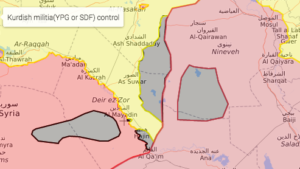
To be sure, myriad problems continue to plague the Middle East: The Syrian civil war, the Saudi-Iran proxy war, Turkey’s oppressive Islamist government, instability in Lebanon, and Qatar’s friction with other gulf nations (and possibly continued support for terrorism). It is, after all, still the Middle East. But there has still been remarkable (and frequently unexpected) improvement in a number of areas in the Middle East during Donald Trump’s first year as President of the United States of America.
After having secured the Syrian border, Iraq has declared the war against the Islamic State over. Syria strongman Bashar Assad’s patrons the Russians have likewise declared Syria liberated from the Islamic State as well. Both of these statements are slightly premature, but not by much.
Right now isis.livemap shows the Islamic State disjointed into five enclaves, two in sparsely populated desert areas in Syria, one similar area in Iraq, and two small enclaves along the Euphrates in Syria southeast of Deir ez-Zor, both of which are being systematically crushed by the forces of Assad’s Syrian government of the Kurdish-led and U.S.-backed Syrian Democratic Forces.
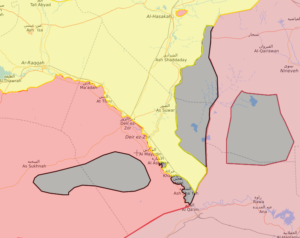
Once those small pockets are crushed, the military war against the Islamic State is effectively won, though expect it to linger on as yet another international jihadist terrorist organization, a tiny shadow of its former self, until the last of it’s many affiliates are either crushed or pledge allegiance to another leader.
More Islamic State news:
Remember how every time Israel committed an act of self-defense, a chattering array of The Usual Suspects would freakout and accuse Israel of “risking war,” “escalating tensions,” “derailing the peace process,” or whatever standard platitudes the global political establishment use to make anytime Israel did something other than pretend to make nice with those Arabs trying to kill them?
Those days appear to be over.
In a follow-up to last week’s story about Israel threatening to hit Iranian bases in Syria, guess what happened? Israel hit an Iranian base in Syria.
Israeli warplanes attacked an Iranian military base near the Syrian city of Al-Kiswah early Saturday morning, according to Sky News Arabia and other Arab media outlets. The construction of the base, which was the target of the airstrike, began last year and had accelerated in recent months.
According to the reports, the Israeli fighter jets fired from Lebanese airspace and the Syrian defense systems responded by firing anti-aircraft missiles. It was also reported that the Syrian missiles were fired from Damascus’ Mezzeh base and that the Israeli aircraft were flying at a low altitude above the Lebanese city of Baalbek. Media outlets affiliated with the Syrian regime confirmed that several missiles were fired at the Iranian base, which was apparently used for storing ammunition.
Israel has an extraordinarily good air force, and they usually hit what they aim at. And like most Middle East operations since the U.S. withdraw from Iraq in 2011, reporting is so sparse that it’s hard to judge how successful the operation was.
But Israel’s latest strike is most notable for all the dogs that didn’t bark after it occurred. This is the sort of story that used to dominate media cycles for a day or two, but this time around, if you blinked, or weren’t scanning Twitter shortly after it happened, you very likely missed it.
So what’s changed? I can think of two possibilities:
Mark this down as yet another thing that the Trump Administration has changed, though most likely indirectly. Less indirect is the fact that relations between Saudi Arabia and Israel are probably the warmest they’ve been since Israel’s founding (having common enemies will do that for you).
There appears to be more real reform afoot in the Middle East right now than the “Arab Spring” ever unleashed…
Several loud explosions echoed across central Harare in the early hours of Wednesday after troops deployed on the streets of the capital and seized the state broadcaster.
The developments in the Zimbabwe capital fuelled speculation that a coup was under way against president Robert Mugabe, after the head of the armed forces threatened to “step in” over the sacking of an influential vice president.
Zimbabwe’s ruling party accused General Constantine Chiwenga of treason over his comments, after the rare appearance of the military vehicles in Harare.
Armed soldiers were assaulting passers-by in the early morning hours in Harare, according to the Associated Press, while soldiers were seen loading ammunition near a group of four military vehicles.
Aggressive soldiers told passing cars to keep moving through the darkness. “Don’t try anything funny. Just go,” one told a Reuters reporter on Harare Drive.
Two hours later, soldiers overran the headquarters of the ZBC, Zimbabwe’s state broadcaster and a principal Mugabe mouthpiece, and ordered staff to leave. Several ZBC workers were manhandled, two members of staff and a human rights activist said.
This is one of those instances where a coup is likely to improve human rights and democracy. I would say it couldn’t happen to a nicer dictator, but there are a few worse than Robert Mugabe (though less than ten). I know extremely little about Constantine Chiwenga, but he’d have to try really hard not to be better than the oppressive misery Mugabe has inflicted on his own people.
Here’s hoping the coup succeeds and that the people of Zimbabwe become at least slightly less wretched and miserable as a result.
Here’s news from (mostly) a few weeks ago: Islamic State fighters have been defeated in the Philippines:
The Philippines has declared an end to five months of fighting in southern Marawi City between the armed forces and militants loyal to Islamic State, the country’s defence minister says.
“There are no more militants in Marawi,” Delfin Lorenzana told reporters in Clark during a meeting of regional defence ministers.
The announcement comes as Philippine troops captured a building where pro-Islamic State militants made their final stand, and found dozens bodies of suspected gunmen inside, two security officials said.
The officials spoke on condition of anonymity because they were not authorised to make public the latest developments in Marawi, where government forces have begun a gradual withdrawal as the fighting eased in recent days.
Armed forces chief General Eduardo Ano said at least 42 bodies of rebels had been found in two buildings and a mosque in the battle zone.
Despite the battle being “over,” mop-up operations continued into this week when 11 remaining militants were killed in the harbor area of Marawi City. “More than 900 militants, 165 troops and policemen and 47 civilians were killed in the fighting in Marawi.”
Other good news from that battle: Islamic State leaders Isnilon Hapilon and Omar Maute (AKA Omarkhayam Maute) were both killed, as was Omar’s brother Abdullah Maute a bit earlier.
From the ABC report:
National police chief Ronald dela Rosa told reporters that there was intelligence that a Malaysian militant, Amin Baco, survived and has assumed leadership of the militants, but military officials said they believe Baco was killed in Sunday’s fighting or in recent weeks, and that troops were searching for his body.
“Contrary to recent pronouncements by some officials that it is now headed by a certain Amin Baco, the Armed Forces of the Philippines strongly believes that the group is now leaderless and without direction,” [Maj. Gen. Restituto] Padilla said.
This probably means that the Maute group is effectively defunct, although Abu Sayyaf, of which Hapilon was the head, appears to still be active in Basilan, a smaller island south of Mindanao.
(Previously.)
I’m hardly the most astute of Saudi-watchers, but a tremendous amount of upheaval has wrecked Saudi Arabia in a very short period of time:
So what’s going on? Here’s my half-assed guess:
The Saudis are getting their asses kicked on two fronts:
Because America is the Saudi’s unipolar patron and main weapon supplier, there’s fark all they can do about Problem 2. Either they need to take the war directly Iran, or they need to buy themselves some economic breathing room and hope oil prices rise again.
My guess is that Crown Prince Mohammed bin Salman is about to lay a serious perestroika-style smackdown on the largely hidebound, stagnant Saudi economy, along with just enough glasnost to make the whole thing palatable to the non-royal Saudi masses. If this theory is correct, the “hey, woman can drive” thing was actually a trial balloon designed to smoke out the most fervent traditionalists out of the woodwork so he can sideline them while he puts his plan into action.
Of course they could very well be bracing for more direction action against Iran as well. There’s a lot more they could do against Iran, including more direct support for the largely-Sunni Kurds.
The Saudis are not our friends, just the least bad of various options in the region (just imagine theocratic Iran or a revitalized Islamic State in charge of Mecca). It will be a significant improvement if Mohammed bin Salman can merely make them a bit less loathsome.
The Syrian army just ousted the Islamic State from their last urban stronghold in Syria.
Syrian government forces have liberated the last remaining Isis stronghold in the country as the group’s self-proclaimed caliphate continues to crumble.
The Syrian military said it had driven extremist fighters from Deir Ezzor and regained full control of the eastern city on the west bank of the Euphrates following weeks of fighting, state media reported.
Isis had held most of the city since 2014, except for one large pocket where Syrian army troops and 93,000 civilians were trapped for three years.
Syrian forces and pro-government allies first broke the militant group’s siege on the city in a Russian-backed offensive in September and have been advancing against Isis positions ever since.
The recapture of the city, the largest in eastern Syria, leaves Isis militants isolated and encircled in the region’s countryside.
In a statement issued on Friday through state TV, army spokesman General Ali Mayhoub said the military had “completely” liberated the city and declared it had entered the “last phase” of its fight to annihilate Isis.
Isis is estimated to have lost 90 per cent of its territory since 2014, including key urban strongholds Mosul in Iraq and Raqqa in northern Syria.
Deir Ezzor was strategically significant to the extremist group due to its location near the Iraqi border and its importance as the capital of the oil-rich province which shares its name.
The city’s liberation all but reduces Isis’s self-proclaimed caliphate to a pair of border towns on the Iraq-Syria frontier.
Iraqi forces and allied Shia militia are chasing remnants of the terror group inside the town of al-Qaim, on the Iraqi side of the border.
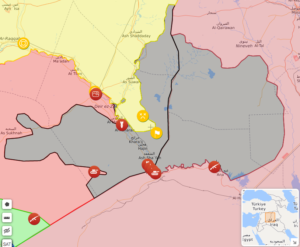
Deir ez-Zor, rumored to be the Islamic State’s backup capital after the encirclement of Raqqa, was fully invested by the Syrian Army and Syrian Democratic Forces one month ago.
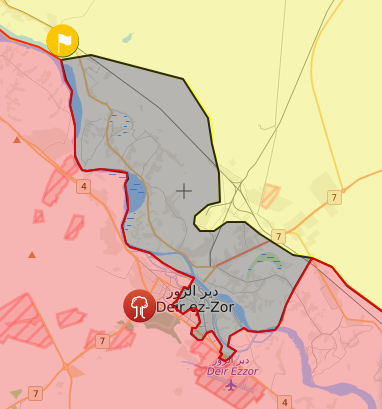
And here’s the same territory today:
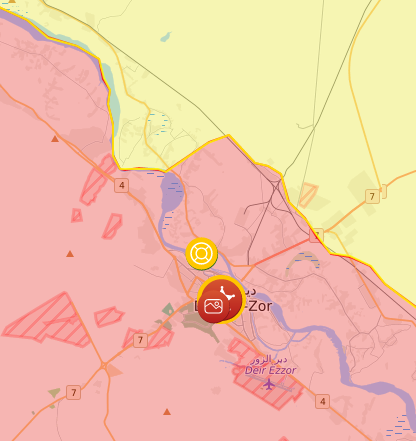
(Pictures, as usual, from http://isis.liveuamap.com/.)
Elsewhere in the war against the Islamic State, Iraqi forces have taken Qaim on the border between Iraq and Syria. That leaves Rawa City, a town of some 20,000 east of Quim in western Anbar province, as the last populated Islamic State stronghold in Iraq. That’s expected to fall soon as well.
In Abu Kammal, one of the last towns in Syria held by the Islamic State, security checkpoints have been abandoned as both civilians and Islamic State fighters are fleeing the area to due to Russian Air Force bombardment.
What remains of Islamic State territory after that is largely uninhabited.
After the falls of Raqqa and Mosul, there may be no true “Last Stand” for the Islamic State, no Fuhrer bunker end for al-Baghdadi, just the rest of the supposed caliphate’s territory melting away as onetime fighters flee into the night and try to melt back into the civilian population. Meanwhile, expect the Islamic State to turn into just another stateless jihadist terror network like al Qaeda, blowing people up across the world but holding no territory, and thus no moral authority upon which to demand the allegiance of Muslims worldwide:
Al‑Qaeda is ineradicable because it can survive, cockroach-like, by going underground. The Islamic State cannot. If it loses its grip on its territory in Syria and Iraq, it will cease to be a caliphate. Caliphates cannot exist as underground movements, because territorial authority is a requirement: take away its command of territory, and all those oaths of allegiance are no longer binding.
It’s possible that the failure of the Islamic State will take wind out of the sails of Islamic fundamentalism for a generation. This wouldn’t mean an end to Islamic terrorism and attempts to Islamicize the west in general and Europe in particular, only a lessening of it.
But the fall of the Islamic State’s last remaining territory is still a cause for celebration among the millions once enslaved by its brutal medieval death cult.