In the course of talking about a phony-baloney, Dewhurst-friendly poll, Paul Burka has proven, yet against, that he doesn’t understand Republicans in general and conservatives in specific. You have to scroll down a little to find out his reaction to Richard Mourdock terminating Dick Lugar’s senate career, but it exhibits the same keen insight we’ve come to expect from his political commentary:
I can tell you what I think of Lugar’s loss. I think Republicans have gone nuts. Lugar has been a distinguished senator for many years.
It used to be that Republicans could skate by talking like conservatives then voting like liberals. That was several trillion dollars worth of debt ago. Now Republican voters demand that their representatives actually do something about out-of-control federal spending and unconstitutional enlargement of a runaway federal government, and those that don’t will find themselves being sent home in short order.
When Burka says “a distinguished senator for many years,” what actual conservative voters (perhaps Burka should make the acquaintance of a few) see is someone who has become part of the problem: The get-along-to-go-along Republican establishment that was willing to let the federal welfare state grow indefinitely rather than fight to control it.
Either we get runaway government spending under control, or we go the way of Europe, where the cradle-to-grave welfare state is destroying economies across the entire continent and “unacceptable austerity” is reducing Greece’s budget from 9% of GDP to 7.5% of GDP.
The Red State model of government embodied by Texas under Rick Perry is kicking the ass of the Blue State model represented by Jerry Brown’s California, much to the consternation of Burka and his fellow liberal MSM journalists. Low taxes, holding the line on government spending, and a business friendly climate do wonders for your state economy. Democratic control, high taxes, out of control spending, and powerful labor unions bleeding the state dry? Not so much.
If Republican elected officials won’t scale back the size and scope of federal power and spending, we’ll replace them with people who will. Republican voters have been sending that message to Washington loud and clear for the last three years, and even the Republican establishment has been forced to take notice. I think Texans will send that message at the polls loud and clear May 29, and Americans on November 6.
And it’s quite possible that Burka will be just as baffled by the results.
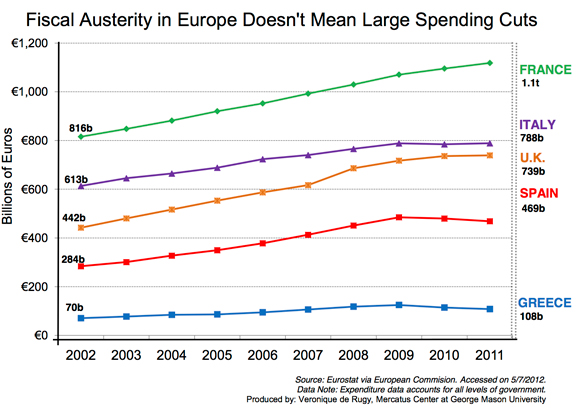
The media insists on describing recent election results in Europe as a blow to “austerity,” when in fact Europe’s recent policies are anything but. Government spending has continued to rise across much of Europe, and even those countries that have made small cuts have not reduced government spending to pre-recession levels.
He in turn references this Veronique de Rugy piece at NRO (though the link is broken, so I had to go Googling) which also gives us this handy chart:
None of these “austerity” measures eliminated deficit spending, and none addressed the issue that’s driving all of Europe (and us) bankrupt, namely unwillingness to carry out structural reforms of the welfare state. The few tiny reforms that have been undertaken have been, as NRO’s Michael Tanner notes, ridiculously timid, and even those have been heavily weighted in future years. “So far, European governments haven’t even been willing to take a penknife to the welfare state, let alone an axe.” Plus a huge round of tax hikes:
It should come as no surprise that all those new taxes, combined with a lack of spending restraint, has threatened to throw Europe back into a double-dip recession. Is it any wonder that French, Greek, and British voters were anxious to “throw the bums out”?
Wait, this sounds familiar. Tax hikes on the rich accompanied by vague promises of future spending restraint, while refusing to restructure entitlement programs. That sounds a lot like . . . Barack Obama.
Actual austerity would mean (at a minimum) reducing spending to the amount of money actually taken in. As best I can tell, none of the PIIGS, or France, or the UK has undertaken such real austerity. That “severe” Greek austerity that just caused a change in government? It reduced Greece’s official deficit spending from 9.0% of GDP to 7.5% of GDP. They didn’t even want Greece to stop digging a hole, they just wanted them to dig more slowly.
I suspect that some 20-30 years hence, this mania for deficit spending will be seen as absolute madness, with future generations unable to fathom how politicians were so resolute in destroying their countries economies in order to maintain the welfare state, a folly for the ages. Hyperinflation is probably already baked into the Greek pie for its inevitable exit from the Eurozone, the only question is whether it will be Argentina 1999-2002 style hyperinflation, or Weimer Germany 1919-1923 style hyprinflation, and how much of Europe (and the rest of the world) will follow in their tracks.
The challenge with covering the respective fortunes of Texas and California is where to cut off the news roundup. Here’s news of how California is sucking, and Texas isn’t, from the last month or so:
Things will only get worse in the coming years as Democratic Gov. Jerry Brown and his green cadre implement their “smart growth” plans to cram the proletariat into high-density housing. “What I find reprehensible beyond belief is that the people pushing [high-density housing] themselves live in single-family homes and often drive very fancy cars, but want everyone else to live like my grandmother did in Brownsville in Brooklyn in the 1920s,” Mr. Kotkin declares.
Also this:
Middle-class workers—those who earn more than $48,000—pay a top rate of 9.3%, which is higher than what millionaires pay in 47 states.
California Governor Jerry Brown (his aura smiles and never frowns) is hiking state income taxes that were already the highest in the nation. (Hat tip: Prairie Pundit.)
California not only has the five most polluted cities in the country, it has the top five most polluted cities in all three categories of air pollution (ozone, short term particle pollution, and year-round particle pollution).
Chances are good that Europe’s interesting Eurozone times are about to get more interesting still with elections scheduled across the continent today, including those in France and Greece. So what does all this mean? Well, for one thing, the French socialist candidate (who has a good chance to kick Nicolas Sarkozy out of office) wants to renegotiate the fiscal discipline treaty. Perhaps even a socialist can tell a rotting fish when he smells one. And in Greece, the anti-bailout parties are expected to make dramatic gains at the expense of the “center-right” New Democracy (Tweedledee) and “center-left” Pasok (Tweedledum) parties who managed to bring Greece to this lovely pass in the first place.
Opposing Tweedledee and Tweedledum are a motley collection of small parties, including the Neo-Nazi Golden Dawn. Now in Europe, everyone to the right of the Christian Democrats seems to be labeled a “neo-Nazi,” be they libertarians, Geert Wilders, or the British National Party, but Golden Dawn appears to be the real thing. Take a look at their flag:
The overall color scheme seems vaguely familiar. Where have I seen that before? Let me think…
Of course, Golden Dawn is unlikely to gain enough votes to be a real player in the Greek parliament, so we may be denied the irony of seeing neo-Nazis oppose Greece’s German overlords.
There are also elections in Serbia and Armenia, lower level elections in Italy, and in Germany, regional elections in Schleswig-Holstein. While “regional elections in Schleswig-Holstein” must be almost as exciting a topic to American readers as enhanced rescission authority, it might go a long way toward determining whether Angela Merkel will continue in her role as Europe’s Sugar Momma Dominatrix.
Could the ruling parties lose everywhere? Well, since the ruing parties have collectively lost every single election since 2009, yeah. Now, whether the Eurocratic elite are will to let a little thing like “democracy” derail their dreams for an integrated Europe remains to be seen.
With government debt expected to hit 80% of GDP by the end of 2012, Spain has become like a family with a big mortgage where the primary breadwinner has lost his job. Unless they find a way to increase their income, they are going to go bankrupt. It is only a matter of time.
If people want to know what life looks like in the “Prohibitive Range” of the Laffer Curve, all they have to do is to visit Athens. Greece is literally falling apart. Unfortunately, by raising taxes, Spain is making exactly the same mistake that the Greeks made.
Of course, whatever the outcome of today’s elections are, we can be pretty sure they won’t do the one thing that might help get them out of the crises: rolling back the European welfare state.
The a persistent drumbeat among American liberals that in Europe austerity has failed. This is a myth. In fact, it’s never been tried.
After much back and forth with his campaign trying to find a date, I was finally able to interview Texas Senate candidate Craig James on March 21 at the Rudy’s on South 360 here in Austin. This was, alas, not an ideal atmosphere for an interview (it got better when one of his staffers asked Rudy’s to turn off their piped in music for the area, which is something I should have thought of asking for), and the first part of the interview makes it hard to hear. After the first question, I stopped the camera and moved it closer to James so you can hear his answers, so the audio gets much better about 1:35 in, though I seem to have cut off the top of his head in the process. So let me apologize in advance for the less-than-sterling sound and video quality for various parts of the interview, but the vast majority of the interview is intelligible. I filmed this with my Mino Flip camera and did a light edit in iMovie, so the crappiness is 100% my fault (or that of the environment it was filmed in).
Thoughts:
James is a very confident, well-spoken and personable speaker with a lot of natural charisma. He seems to get the big picture of the conservative agenda (a constitutionally limited government, and a commitment to free markets) and obviously comes from a social conservative background.
I like that he would eliminate the Department of Education, but it’s a bit hard to square with his emphasis on vocational training in the second part of the answer. It’s not that I disagree that it’s a good idea, it’s just that after the elimination of the Department of Education, I don’t see any viable (or proper) role for such fine-grained educational policy control at the federal level.
I’m not particularly interested in the Texas Tech question that starts part 2, but since it’s the most famous controversy he’s been involved in, the interview would have felt incomplete without it.
There are a couple of interesting admissions I give him credit for: admitting that Texans for a Better Tomorrow was created as a vehicle for him to explore a role in politics, and admitting that he would root for the New England Patriots (for whom he played in the NFL) were they to meet the Cowboys in the Superbowl, a brave position that’s obviously not pandering to his constituents.
I didn’t like the vagueness of his positions beyond a few policy specifics, and the fact he tried to straddle both sides of some issues (such as PIPA/SOPA in the second half of the interview). Both Ted Cruz and Tom Leppert were occasionally vague on some points, but James is already sounding awfully vague for someone who hasn’t ever held elective office.
The low-point of the interview (about 3:15 into the second part) was finding out that James has never heard of the Posse Comitatus Act. This is not an obscure statute, it’s one of the fundamental laws governing the limitations of using federal troops. I would expect not only anyone with an interest in politics to at least have heard of the Posse Comitatus act, I would actually expect the same of anyone with a basic college education.
I’d like to thank Craig James for taking time out of his busy schedule to speak with me, and his staff for their assistance in setting up the interview.
Now I’ve interviewed all the major Republican Senate candidates but David Dewhurst. If his campaign would get in touch with me to set a convenient date in the next few weeks, I’d like to correct that oversight…
Proving that she’s become part of the problem, Kay Bailey Hutchison took Planned Parenthood’s side in the current funding dispute. It’s an object lesson in why, even if she hadn’t retired, Hutchison was no longer going to be a Senator after January 3, 2013. As Texas has gotten more conservative, Hutchison has gotten more liberal. And her argument that Planned Parenthood is vital to the Texas’ Women’s Health Program is bunk.
Not only should the U.S. government not be providing taxpayer funded abortions, they shouldn’t be subsidizing family planning services period, because it’s not the proper function of the federal government. The idea that Uncle Sam should dispense abortions and condoms is a recent one, and panders not only to big government feminism, but also (speaking of debunked) neo-Malthusian thinking and religious environmentalism. Defunding Planned Parenthood and its ilk should be an easy decision for both economic and religious conservatives. The fact that Hutchison is far more concerned with hoovering up federal dollars just goes to prove Rick Perry’s assertion in the 2010 gubernatorial race that “Washington changed Kay.”
There has long been grumbling about Hutchison not being conservative enough, but only in her last term did it become loud enough to ensure that somebody would launch a primary challenge against her; her suicidal attempt to bring down Perry in 2010 just hastened the process. (Why both she and another moderate Republican woman, Carole Keeton McClellan Rylander Strayhorn, both felt such burning animus toward Perry that each destroyed their careers in futile attempts to take him out is an interesting topic I don’t have enough insight on to address.)
Both Sarah Palin and Michelle Bachmann have proven that it’s possible to be elected as a strong conservative woman. It’s just a shame that Texas doesn’t have one as a U.S. senator.
And next week the Supreme Court will hear arguments on its constitutionality. Many are suggesting that a decision in ObamaCare’s favor will actually damage Obama’s reelection chances.
More specifically, eight out of the eleven “Stupak Block Flippers” (i.e., the theoretically staunch pro-life Democrats who swore up and down they would never, ever, ever vote for ObamaCare if it included taxpayer funding for abortion, right up until they voted for taxpayer-funded abortion) went down in electoral defeat. At the time, the insistence for public funding for abortion seemed like a tactical error on the part of liberals. After all, why bother with that tiny sop to feminists when you’re busy nationalizing one-sixth of the economy?
But since then, the fervor with which Democrats have pursued imposing this mandate on Catholics (part and parcel of their contempt for religion), their white hot fury at Rush Limbaugh’s (admittedly foolish) remarks, and the continuing overheated, drama queen “war on women” rhetoric coming from the left side of the blogsphere suggests that yes, that was what ObamaCare was really about, and they’re willing to remain a permanent political minority to maintain it.
So be it. If forcing taxpayers to pay for abortions is the hill they want to die on*, I suppose we should let them. (Though not at the cost of failing to mention Obama’s failure on the economy, on creating the conditions for private industry to create jobs, Fast & Furious, or his naked cronyism.) As Mickey Kaus has noted, this issue is a serious political loser for Obama, and we should keep hammering away on it, not despite the shrieks of outrage from liberalism’s feminist amen corner, but because of them.
*”Violent, eliminationist” military metaphor offered up as free rhetorical bonus!
A left-wing Irish documentary maker sets out to make a documentary about the plight of the Palestinians, but gets waylayed by those annoying facts, and instead decides to tell both sides of the story. Guess what? His friends aren’t interested. “The problem began when I resolved to come back with a film that showed both sides of the coin. Actually there are many more than two. Which is why my film is called Forty Shades of Grey. But only one side was wanted back in Dublin. My peers expected me to come back with an attack on Israel. No grey areas were acceptable.”
Israel and Hamas declare a ceasefire after four days of fighting. Honestly, maybe because I was traveling, or because I no longer feel the need to consult MSM news sources on a daily basis, I was actually unaware that there was slightly more violence than usual in the Middle East. The fact that Hamas cried uncle after a mere four days, despite the fact that Israel set it off by giving Hamas leader Zuhair al-Qaissi an express ticket to paradise, tells you that they must really have been getting their asses kicked by the IDF. Maybe Zuhair al-Qaissi really was important, or possibly Iran and Syria have had their hands too full to dole out the Qassam rockets with their customary generosity.
Monty, the guy who does the Daily Doom over at Ace of Spades, is taking a break, which means that I have to do my own damn research step into the breach, so here a roundup of European Debt Crises news:
And the Greeks, in turn, pass “tough spending cuts”. Presumably those “tough cuts” would be the ones reducing the annual budget deficit from 9% to 7.5% of GDP. They’re don’t even require Greece to stop digging, they just want them to dig slower. And even that assumes that such cuts will actually be implemented.
Among the austerity measures were a reduction in the minimum wage, including a 22% cut on the standard minimum monthly wage of 751 euros, and a 32% for those under 25. A good idea and necessary, but once again the sons are paying for the sins of the fathers.
Unions, realizing their role in helping bankrupt Greece, have meekly accepted the cuts. Ha, just kidding. They’re going on strike.
Following the downgrade, the European Central Bank announced that they would stop taking Greek debt as collateral, at least until the new Greek bailout package goes into effect.
Germany is thinking of sending German tax collectors to Athens. I’m sure it’s impossible that Greeks would take this in the wrong way.
Speaking of Germany, their high court has ruled yet again that a parliamentary panel set up to approve action by the euro zone bailout fund is unconstitutional.
Portugal is also digging more slowly, having cut its budget deficit from 5.9% of GDP last year to 4.5% this year. Meanwhile, it’s economy also contracted by 3.3%.
The Finns are in, supporting the Greek bailout to the tune of 2.3 billion Euros.
Ireland is actually allowing its citizens to vote on the European stability treaty. Of course, if they vote no, expect them to have to keep voting until they ratify the result the Eurocrats have already chosen for them.
Seeking Alpha makes the obvious point that you don’t want to hold any of the PIIGS sovereign debt. I would go further and suggest that you don’t want to hold any sovereign debt denominated in Euros…
So who, above all, wants to avoid a Euro default among the PIIGS? Would you believe Goldman Sachs? “At the end of 2011, Goldman Sachs had sold $142.4 billion of single-name swaps, contracts that pay out in the event of a default, on the five countries.” That’s an awful of of incentive to keep the game running until all the rubes taxpayers can be fleeced…
Even big-spending, welfare state cheerleader and all-around leftwing mouthpiece Paul Krugman thinks Greece will have to leave the Euro. So it only took two years for Krugman to come part of the way toward realizing what what Mark Steyn did two years ago. Of course, Krugman’s analysis is short term and technical, whereas Steyn saw the unsustainable nature of the welfare state a long time ago. Do you think Kurgman might want become a bit less of a cheerleader for big government? I wouldn’t hold your breath…
Spain balks at letting their government reduce spending by 4%of GDP. Problem: Their annual budget deficit is 8% of GDP. That’s the problem when you get that far down the hole to serfdom: Even slowing the digging becomes unacceptable, much less stopping…
“Decades of cradle-to-grave socialism, a short work week and long vacation periods for European Union workers have taken a toll on the treasuries of the nation states. The good life lived in Europe without a thought of tomorrow has brought on these days of reckoning. Greece is an example of the limits of a European welfare state.”
What would a real solution to Greece’s problems look like? “They must roll back bureaucracy, free up entrepreneurs and reduce the burden of the welfare state, so that the private sector can begin to grow….Regrettably, this is not the approach that has prevailed so far. Indeed, as things stand a whole host of European Union and European Central Bank policies are pushing things in precisely the opposite direction.”
American liberals love to talk about Northern Europe’s welfare states, but don’t like mentioning Southern Europe. “For all their fascination with Europe, southern Europe doesn’t loom large for the American Left. But France, Italy, Spain, Belgium, Portugal and Greece are more representative of European outcomes than Sweden, Denmark, and Finland, and have equally sized welfare states. Their failure should not be ignored in the American debate.”
Well, ain’t that a pisser. “‘European solidarity is not an end in itself and should not be a one-way street. Germany’s engagement has reached it limits,’ said the text, drafted by Chancellor Angela Merkel’s Christian Democrats and Free Democrat (FDP) allies.”
Has Germany’s willingness to throw bad money after good to bail out wastrel Greece’s unsustainable welfare state finally reached an end? Maybe. Or maybe Merkel is angling for more leverage over Greece to force them to cough up some more sovereignty, or even to (fat chance) actually implement austerity measures rather than just give them lip service. But without Germany, the IMF isn’t going to cough up, and without the two of them, there probably isn’t enough in the kitty to finance even the latest round of Greek bailout, much less the larger fund needed to staunch the contagion once the Greek default dominoes start tumbling.
The game of musical chairs may finally be reaching its end.
Greek bureaucrats in their Social Security office stage a walk-out. Now if all government employees went on strike and stayed there, they might just have a chance…
Want to know exactly how the Greek debt bond swaps will proceed? Me neither, but here it is anyway. Just part of full-service blogging, Ma’am….
Spain’s housing market makes ours look healthy by comparison. “Repossessed houses in Spain are valued at 43 percent less on average than the appraisals on the mortgages.”