Still getting back up to speed after Christmas, so here are a few links that I’ve been squirreling away like nuts for winter:
Additional hat tips to Insta and Ace.
Still getting back up to speed after Christmas, so here are a few links that I’ve been squirreling away like nuts for winter:
Additional hat tips to Insta and Ace.
It didn’t take long for cracks to start appearing among national politicians who are not nearly so sanguine over the prospect of Anschluss II as their counterparts in Brussels.
The French people are not wild about it either. But French politicians only pay slightly more attention to the French people than they do to the American government, which is to say: precious little.
The Portuguese threaten nuclear default.
Did the announcement calm markets elsewhere? Not so much:
Some of the world’s most powerful investment banks were downgraded by ratings agency Fitch as Germany’s cherished European fiscal compact appeared to be unraveling. The banks that were downgraded [Wednesday] night include US banks Bank of America and Goldman Sachs, Barclays and France’s BNP Paribas. Switzerland’s Credit Suisse and Germany’s Deutsche Bank were also cut.
Even France is in danger of a downgrade.
Of course, all this supposes that the new EuroPact will actually accomplish something. Fitch Ratings is not so sure. After warning of rating downgrades on “Belgium, Cyprus, Ireland, Italy, Slovenia and Spain,” they come to the bracing conclusion that “a ‘comprehensive solution’ to the eurozone crisis is technically and politically beyond reach.”
And now for the section of the roundup in which I quote whopping large chunks of Ambrose Evans-Pritchard on the whole thing.
First, the EU would like the UK to throw more money into the black hole. The UK is telling them to get stuffed:
Euro rage is reaching new heights over Britain’s latest outrage.
Our refusal to pony up a further €31bn we cannot afford, to prop up a monetary union that was created against our wishes and better judgment, and with the malevolent purpose of accelerating the great leap forward to a European state that is inherently undemocratic.
It is being presented as treachery, Anglo-Saxon perfidy, and the naked pursuit of national self-interest.
Let me just point out:
1) The UK never agreed to such a commitment in the first place. The line was written into the December 9 summit communiqué in an attempt to bounce Britain into handing over the money.
2) The UK does not consider the rescue machinery to be remotely credible as constructed.
3) The eurozone has the means to tackle its own debt crisis, if it is willing to use them. These include fiscal pooling and the mobilisation of the ECB.
As eurozone politicians never tire of reminding us, their aggregate debt levels are lower than those of the UK, US, or Japan. They are right. So get on with it and stop begging.
Euroland is of course entitled not to deploy eurobonds or the ECB if these mean a) a breach of the German constitution b) violate the ECB’s mandate. But that is entirely their choice. Both the Grundgesetz and the ECB mandate can be changed.
It was EMU members who created this dysfunctional currency. They are now trying to shift the consequences of their error onto others rather than taking the minimum steps necessary to fix the problem at root.
Second, his pointing out that the proposed treaty actually accomplishes very little:
The leaders of France and Germany have more or less bulldozed Britain out of the European Union for the sake of a treaty that offers absolutely no solution to the crisis at hand, or indeed any future crisis. It is EU institutional chair shuffling at its worst, with venom for good measure.
[snip]
And what for? All this upheaval for a mess of pottage, a flim-flam treaty? The deal is not a “lousy compromise”, said Angela Merkel. Well, actually that is exactly what it is for eurozone politicians searching for a breakthrough.
It tarts up the old Stability Pact without changing the substance (although there will be prior vetting of budgets). This “fiscal compact” is not going to make to make the slightest impression on global markets, and they are the judges who matter in this trial by fire.
Yes, there is more discipline for fiscal sinners, but without any transforming help. Even the old “Marshall Plan” of the July summit has bitten the dust.
There is no shared debt issuance, no fiscal transfers, no move to an EU Treasury, no banking licence for the ESM rescue fund, and no change in the mandate of the European Central Bank.
In short, there is no breakthrough of any kind that will convince Asian investors that this monetary union has viable governance or even a future.
Germany has kept the focus exclusively on fiscal deficits even though everybody must understand by now that this crisis was not caused by fiscal deficits (except in the case of Greece). Spain and Ireland were in surplus, and Italy had a primary surplus.
As Sir Mervyn King said last week, the disaster was caused by current account imbalances (Spain’s deficit, and Germany’s surplus), and by capital flows setting off private sector credit booms.
The Treaty proposals evade the core issue.
Ironically, the actual text of the new agreement has all sorts of things (like requiring a Balanced Budget Amendment to national constitutions) that, had it been in place and enforced 15 years ago might have prevented the situation in the first place. But if the nations of Europe had been capable of balancing their budgets, they wouldn’t have needed a Euro-fueled spending spree to keep their welfare states solvent in the first place.
For the PIIGS, growth is neither possible nor enough: “There is at this point no conceivable policy scenario which somehow makes Italy and Greece grow by as much as 2% a year for the next few years.”
Fed says no Euro bailout. But one might wonder at the firmness of their resolve. Especially since the head of the IMF says they need funds from outside the EU. Because who doesn’t love throwing good money after bad?
European bank walks are starting to turn into bank jogs.
Gold prices have plunged since the Euro treaty was announced. A sign the worst has passed? No, quite the opposite: Europe’s banks are selling their gold reserves in an attempt to stay solvent.
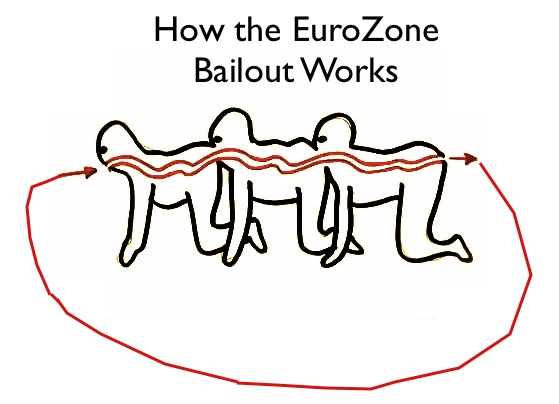
Let’s see if I’ve got this straight: EuroZone members, threatened by sovereign default on their bonds, are giving money backed by those same bonds to the IMF, which will use the money to prop up the EuroZone in order to prevent EuroZone countries from defaulting on their bonds. In order to help readers understand the genius of this maneuver, I have slightly altered a graphic from a recent movie to explain the concept:
(Hat tips: Insta, Ace, and The Corner, plus no doubt a few I’ve forgotten.)
To set the historical record straight, it is necessary from time to time to point out that the majority of “Left Wing Intellectuals” did not spend the Cold War criticizing communist governments for oppressing their people, but rather attacking any attempt by the U.S. government or conservatives to oppose communism. In their eyes, Ronald Reagan was an “insane imperialist warmonger” for calling the Soviet Union an Evil Empire and attempting to fight communism throughout the world.
So in the High Church of the American Left, praising America’s fight against communism was the ultimate sin, right up there with opposing global warming. Even so, some may find it surprising just how viciously that High Church’s uncrowned Pope, Noam Chomsky, attacked Vaclav Havel for the sin of praising America as a “defender of freedom.”
Sayeth Pope Chomsky to his leftwing pal Alexander Cockburn:
As a good and loyal friend, I can’t overlook this chance to suggest to you a marvelous way to discredit yourself completely and lose the last minimal shreds of respectability that still raise lingering questions about your integrity. I have in mind what I think is one of the most illuminating examples of the total and complete intellectual and moral corruption of Western culture, namely, the awed response to Vaclav Havel’s embarrassingly silly and morally repugnant Sunday School sermon in Congress the other day. We may put aside the intellectual level of the comments (and the response) — for example, the profound and startlingly original idea that people should be moral agents. More interesting are the phrases that really captured the imagination and aroused the passions of Congress, editorial writers, and columnists — and, doubtless, soon the commentators in the weeklies and monthlies: that we should assume responsibility not only for ourselves, our families, and our nations, but for others who are suffering and persecuted. This remarkable and novel insight was followed by the key phrase of the speech: the cold war, now thankfully put to rest, was a conflict between two superpowers: one, a nightmare, the other, the defender of freedom (great applause).
Reading it brought to mind a number of past experiences in Southeast Asia, Central America, the West Bank, and even a kibbutz in Israel where I lived in 1953 — Mapam, super-Stalinist even to the extent of justifying the anti-Semitic doctor’s plot, still under the impact of the image of the USSR as the leader of the anti-Nazi resistance struggle. I recall remarks by a Fatherland Front leader in a remote village in Vietnam, Palestinian organizers, etc., describing the USSR as the hope for the oppressed and the US government as the brutal oppressor of the human race. If these people had made it to the Supreme Soviet they doubtless would have been greeted with great applause as they delivered this message, and probably some hack in Pravda would have swallowed his disgust and written a ritual ode.
I don’t mean to equate a Vietnamese villager to Vaclav Havel. For one thing, I doubt that the former would have had the supreme hypocrisy and audacity to clothe his praise for the defenders of freedom with gushing about responsibility for the human race. It’s also unnecessary to point out to the half a dozen or so sane people who remain that in comparison to the conditions imposed by US tyranny and violence, East Europe under Russian rule was practically a paradise. Furthermore, one can easily understand why an oppressed Third World victim would have little access to any information (or would care little about anything) beyond the narrow struggle for survival against a terrorist superpower and its clients. And the Pravda hack, unlike his US clones, would have faced a harsh response if he told the obvious truths. So by every conceivable standard, the performance of Havel, Congress, the media, and (we may safely predict, without what will soon appear) the Western intellectual community at large are on a moral and intellectual level that is vastly below that of Third World peasants and Stalinist hacks.
So: Vaclav Havel, a man who spent most of his adult life fighting communist oppression and imprisonment, was “morally repugnant” and worse than a “Stalinist hack” for saying that the U.S. was ” the defender of freedom.” Oh, and compared to any place America was fighting communism, “East Europe under Russian rule was practically a paradise.” So sayeth Pope Chomsky.
Havel wasn’t the only formerly left-wing public figure dying this week who attracted Pope Chomsky’s scorn for heresy. Christopher Hitchens also received condemnation for suggesting that Osama Bin Laden was, in fact, demonstrably more evil and culpable in the death of innocents than Bill Clinton. Hitchens, of course, gave at least as well as he got, and also noted the moral bankruptcy of Chomsky’s attack on Havel:
The last time we corresponded, some months ago, I was appalled by the robotic element both of his prose and of his opinions. He sought earnestly to convince me that Vaclav Havel, by addressing a joint session of Congress in the fall of 1989, was complicit in the murder of the Jesuits in El Salvador that had occurred not very long before he landed in Washington. In vain did I point out that the timing of Havel’s visit was determined by the November collapse of the Stalinist regime in Prague, and that on his first celebratory visit to the United States he need not necessarily take the opportunity to accuse his hosts of being war criminals. Nothing would do, for Chomsky, but a strict moral equivalence between Havel’s conduct and the mentality of the most depraved Stalinist.
Less than a year later, Hitchens himself would have enough of his former allies on the left and take leave from the High Church’s oldest organ, The Nation:
It’s obvious to me that the “antiwar” side would not be convinced even if all the allegations made against Saddam Hussein were proven, and even if the true views of the Iraqi people could be expressed. All evidence pointed overwhelmingly to the Taliban and Al Qaeda last fall, and now all the proof is in; but I am sent petitions on Iraq by the same people (some of them not so naïve) who still organize protests against the simultaneous cleanup and rescue of Afghanistan, and continue to circulate falsifications about it. The Senate adopted the Iraq Liberation Act without dissent under Clinton; the relevant UN resolutions are old and numerous. I don’t find the saner, Richard Falk-ish view of yet more consultation to be very persuasive, either.
This is something more than a disagreement of emphasis or tactics. When I began work for The Nation over two decades ago, Victor Navasky described the magazine as a debating ground between liberals and radicals, which was, I thought, well judged. In the past few weeks, though, I have come to realize that the magazine itself takes a side in this argument, and is becoming the voice and the echo chamber of those who truly believe that John Ashcroft is a greater menace than Osama bin Laden. (I too am resolutely opposed to secret imprisonment and terror-hysteria, but not in the same way as I am opposed to those who initiated the aggression, and who are planning future ones.) In these circumstances it seems to me false to continue the association, which is why I have decided to make this “Minority Report” my last one.
Condemning Havel, driving out Hitchens; two small examples of just how extensively a reflexive anti-Americanism and hatred of conservatism has warped the judgment of those still filling the pews of the High Church of the American Left.
Europe’s most famous Cold War warrior and former communist political prisoner was excluded from a ceremony yesterday where Russia and the U.S. took steps toward world peace.
Vaclav Havel, the president of Czechoslovakia and then Czech Republic for 13 years, was not invited to the signing of the START II nuclear arms reduction treaty by President Obama and his Russian counterpart Dmitry Medvedev, which took place in Prague Castle’s Spanish Hall, where the playwright-politician gave his farewell speech to a standing ovation from the Czech Parliament.
Was the ceremony snub Obama’s revenge because Havel, along with 20 other ex-Central and Eastern European leaders, signed an open letter to the American president last summer that warned of a menacing Russia and complained that their region was “no longer at the heart” of U.S. foreign policy?
This is sadly typical, since the left wing of the Democratic Party has always seemed more interested in signing meaningless “peace” treaties with tyrants than worrying about the freedom or security of those threatened by them. This “no enemies on the left” mentality is why they’ve proven themselves far readier to stand with left-wing tyrants like Fidel Castro and Hugo Chavez than the people those tyrants imprison and arrest.
Let me see if I can get this straight:
UK Prime Minister David Cameron, objecting to the Deutschland Uber Alles renegotiation of the Maastricht Treaty, is now causing the creation of a new SuperDuper Europe, with Germany reoccupying the Rhineland taking leadership of the whole shebang, finally erasing the rest of the continent’s reluctance at receiving orders from Berlin?
I mean, when even the Europhillic New York Times says that “Twenty years after the Maastricht Treaty, which was designed not just to integrate Europe but to contain the might of a united Germany, Berlin had effectively united Europe under its control,” maybe the citizens of those stodgy old entities we used to call “countries” should consider the possibility that they might may be making a mistake. I am especially surprised that the non-Euro-using generalgouvernement Poland gave in so readily, as their previous experiences with rule from Berlin have been less than exemplary.
But what’s sacrificing the last of your country’s vestigially sovereignty compared to the glorious dream of saving the Euro?
Assuming, of course, that forging this Pact of Steel (including a 500 billion Euro bailout fund) actually saves the Euro, which is a dubious proposition at best. And at least one U.S. general says we should be prepared for civil unrest if Euro ends up exploding anyway.
The irony, of course, is that David Cameron, the wetest Tory Wet PM since Neville Chamberlain, refused to give in to another Eurotreaty British citizens wouldn’t get a chance to vote on less than two months after refusing to allow a vote on the previous EU treaty British citizens were not allowed to vote on. It would be ironic if Cameron actually ended up pulling the UK out of the EU because, in a moment of weakness, he actually exhibited rare and uncharacteristic streaks of firm principle and common sense.
Will the citizens of Europe actually get a chance to vote on this Reich closer European integration? Doubtful. Ireland’s Taoiseach is being “cagey” about a vote. (Translation: Fark no, you peasants won’t get a vote.) I doubt any of his brothers in Europe’s Permanent Ruling Class will feel any less “cagey.”
Through a thousand small steps, from committees and working groups and consultations and emergency decrees, Eurocrats have done their very best to remove power for all important decisions from the hands of the people and entrust it into their own well-greased palms. And also, not so coincidentally, to avoid taking the blame for the ruin their cradle-to-grave welfare states, and the huge and ever-growing debts necessary to pay for them, have made of Europe’s once free nations and productive economies.
Other Eurozone news, some possibly stale and out of date:
For years, Europeans loved to lecture Americans on the both the safety and soundness of the continent’s banking system as opposed to our own, and how their economic system worked so much better than ours. Well, one lesson of the 2011 financial crisis is that many of their banks are probably in worse shape than the US banks were in 2008.
At least our banks’ troubled investments were tied to real estate, which may rebound once our economy improves. Their banks are holding debt tied to some of the world’s least productive, no-growth countries.
Why so underproductive? Most of the evidence points to the failure of the European welfare state.
Europeans loved to lecture Americans on how government-run health-care and cradle-to-grave entitlements provided such safety and comfort for the masses. People supposedly didn’t mind paying higher taxes because it enhanced their standard of living.
Until, of course, it didn’t enhance anything — and Greece, Italy, Spain and Portugal face the collapse of their safety nets because they can’t borrow to pay for them anymore, even as unemployment is rampant. (Meanwhile, France is not far behind.)
So says a piece in the Financial Times, here excerpted from behind the paywall.
Things are moving very fast indeed on the Euro front:
From the beginning, the Brussels elites made it clear that, to adapt Abraham Lincoln, their paramount object was to save the Union. Never mind if that meant imposing epochal poverty and emigration on the southern members, and unprecedented tax rises on the northern. Never mind if it meant toppling the elected prime ministers of Italy and Greece and replacing them with Eurocrats (respectively a former European Commissioner and a former vice president of the European Central Bank — two perfect specimens of the people who caused the crisis in the first place). They were prepared to pay any price to keep the euro together — or, more precisely, to expect their peoples to pay, since EU employees are generally exempt from national taxation.
The only beneficiaries of the State’s assumption of [Anglo Irish Bank]’s liabilities are taxpayers in the countries whose banks were the reckless lenders to Anglo. Anglo, for all the guff at the time of the bank guarantee, had no systemic importance to the Irish economy. Irish taxpayers had no moral or other liability for its debts.
The sole reason for saving it was the ECB’s insistence that no euro zone bank should fail. Had Anglo failed, the costs would have been borne primarily by European banks and consequently by European taxpayers.
So the undertaking by the Irish State to stump up €47 billion to pay those private debts is an act of extreme (if extremely demented) euro-altruism. We are Europe’s ragged-trousered philanthropists, bailing out the euro with money we don’t have and that our European partners are kindly lending us at penal interest rates.
And this single act of insane generosity wipes out every red cent we’ve got from Europe since 1973.
[snip]
And for what? For less than nothing. For a moment of panic, a daft notion, a stupid indulgence in bluster and bravado. Some bleary-eyed fools decided, in the middle of the night, that they could bluff the markets by throwing all the chips we might ever have on to the table. It didn’t take long for the markets to realise that their hand contained nothing better than a pair of deuces.
But the gamble failed for Europe too. There might be some kind of (very expensive) pride in being able to say that little Ireland took the hit to save the euro zone, like the starry-eyed gal who takes a bullet for the outlaw in a corny western. But we saved nothing. All we managed to do was to buy the euro zone leaders more time in which to delude themselves that there was no real crisis.
“In a direct echo of previous events in Libya, France has formally recoginsed the opposition Syrian National Council and proposed that international troops should protect civilians.”
Meanwhile, those rebels are calling for international air strikes against the Assad regime.
It’s quite possible that the Assad regime could unravel much faster than Moammar Gadhafi’s regime in Libya did, since whole army units have already defected, and Assad is much more isolated from his country’s Sunni majority that Gadhafi was (at least ethnically) from his.
Alain Juppe, France’s foreign minister, has raised the possibility that western powers could intervene directly intervene [sic – LP] to protect civilians in Syria from the Assad regime.
He suggested that “humanitarian corridors or humanitarian zones” could be established to protect those under attack.
As the Assad regime presses ahead with its attacks on Syrian rebels, Mr Juppé has become the first senior western figure to raise the possibility of such an intervention. He said the issue would be discussed by European Union foreign ministers at a meeting next month.
Of course he goes on to say that “full scale military intervention by the west in Syria was not being considered.” But I remember hearing much the same thing about the intervention in Libya, and we all know how that turned out.
France’s sudden belligerence may seem out-of-character, but they’ve been pissed at Assad ever since he had Lebanese Prime Minister Rafik Hariri assassinated in 2005. France has a long history of ties with Lebanon, and the Hariri assassination was just the most overt act in Syria’s semi-successful attempt to turn Lebanon into a puppet state. I have no doubt that France would be happy to knock off Assad if they were sure they had NATO (or at least American and UK) backing and could be sure the job was done right.
In other news, UNSECO’s executive board unanimously elected Syria to a committee dealing with human rights—even though the U.S. has a representative on the committee. Must be more of that Obama Administration “smart diplomacy” we keep hearing about…
Sometimes different stories you’re following twine together in weird and unexpected ways. Today it’s news from MEMRI that former mujahideen commander, Islamic radical, and all-around-asshole Gulbuddin Hekmatyar is taking credit for inspiring Occupy Wall Street.
If you don’t remember Gulbuddin Hekmatyar, he first rose to prominence as commander of the Hezb-i islami faction of the mujahideen fighting the Soviet invasion of Afghanistan in the 1980s. Fighting the Soviets was pretty much the last decent thing Hekmatyar ever did, and he wasn’t very good at it, especially compared to his chief rival, Ahmed Shah Massoud, commander of Jamiat-i Islami, who was one of the greatest guerrilla warfare commanders of the 20th century. If “Hezb-i islami” sounds an awful lot like “Hezbollah,” that’s because they’re both different branches of the same transnational affiliation of radical Shia Islamic fundamentalism. Hekmatyar the sort of guy who thought the Ayatollah Khomeini was too much of liberal softie. Hekmatyar spent almost as much time fighting Massoud as he did fighting the Soviets, and after the Soviets left he changed sides so many times in the various Afghan civil wars that followed (in the government, out of the government, with the Taliban, against the Taliban, etc.) that it’s hard to keep track. He was also one of Osama Bin Laden’s drinking buddies in the 1990s. Pretty much anytime he showed up was bad news for Afghanistan, and now he’s one of the head jerks fighting the Afghan government.
Now he’s taking credit for “inspiring” Occupy Wall Street. Yeah, right. I think you would be hard-pressed to find anyone at Occupy Wall Street that had even heard of Gulbuddin Hekmatyar (or even any foreign political figure before Bush43 that isn’t featured on a t-shirt).