Lindybeige and The Chieftain talk about three of the worst tanks in the Bovington Tank Museum:
The three are:
The Japanese Type 95 Ha-Go light tank, first fielded in 1936 with a 37mm cannon. Mechanically inferior to contemporary light tanks like the Panzer I and the American M2, the Type 95 was just fine for chewing up Chinese infantry, but were hopelessly outclassed when they started to run up against more modern American and British armor.
The Australian Sentinel, which never saw combat, and…
Our old friend the Valiant! They didn’t even get to my favorite tidbit about the Valiant: “The driver was almost crippled by the cramped driving position and was in danger of being injured by the controls.”
Dwight and Borepatch have both weighed in on this one already, but as (I think) the only one of us who has actually visited the Tank Museum in Bovington, I though I would weigh in as well.
This is not a bad list, and since it’s production tanks only, it doesn’t include the the execrable Valiant. However, I think you have to bump one of those five out to include this:
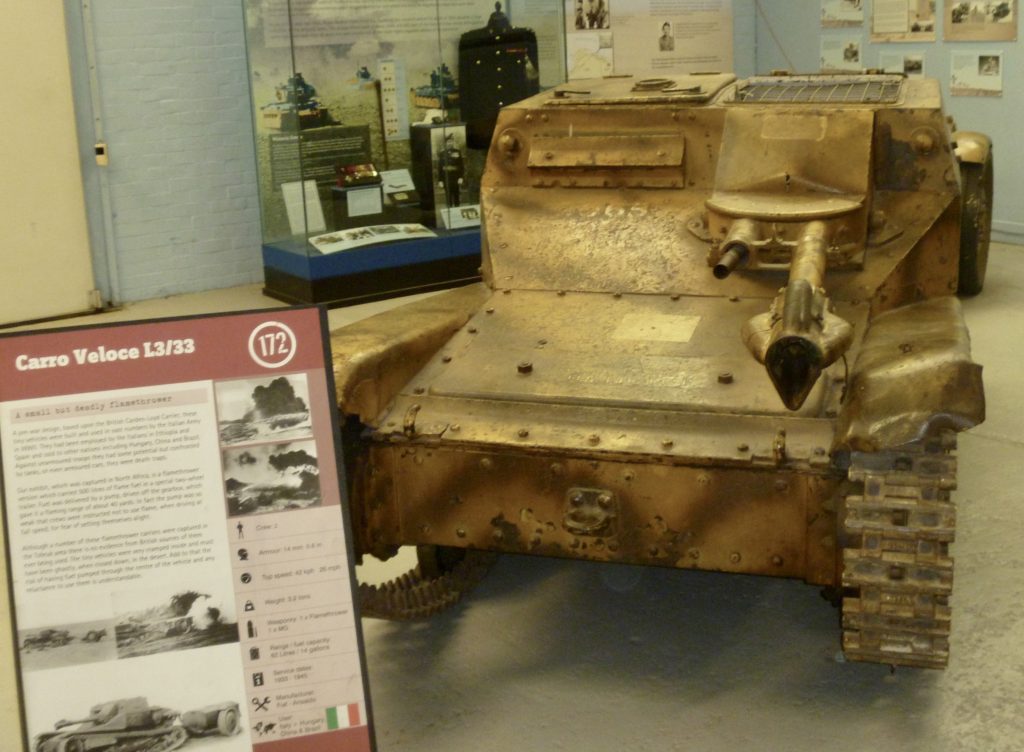
That is the Italian Carro Veloce L3 flamethrower tank. A two man tank just over four feet high, today it’s been retroactively reclassified as a “tankette.” At the back right, you can barely see the edge of the 133 gallon tank it towed behind it on a two-wheel trailer. It deserves a place on this list due to the nasty tendency to roast the crew alive due to leaks in the gasoline lines.
So which of the five in that video come out? I’m going to say the Jagdtiger. Not because anything in the video is wrong: it was a tremendously resource-hungry tank that required another parallel supply chain for its massive 128mm gun. However, that wasn’t clear in 1942, when it was first conceived, or 1943, when the bulk of development occurred. The main concern was dealing with massive numbers of Soviet tanks on the Eastern front, and where heavier Soviet tanks like the KV-85 were just starting to come online. In that environment, making the tradeoffs necessary to build that massive tank-killer probably seemed more justified in 1943, and the first Jagdtiger’s were delivered in January 1944. And even for the first few months after Normandy, there probably would have been no way to reclaim the material already allocated in the supply chain to build them. But any of them built after, say, September, were indeed a bad use of resources.
In Tigers in the Mud, Panzer commander Otto Carius noted other flaws with Jagtiger (which are called “Hunting Tigers” in the English translation of the book), one of the biggest of which was the tendency of 128mm cannon to be jolted out of alignment during movement, which meant it had to be put into travel lock before maneuvers. Worse still, the travel lock “had to be removed from the outside during contact with the enemy!”
German defense company Rheinmetall has unveiled a prototype of a 130mm smoothbore gun for a future main battle tank (MBT). Combined with a state-of-the-art auto-loader, this system is the latest evolvement in Rheinmetall’s, Main Battle Tank Advanced Technologies competence. According to the company, the increase of 8 percent in caliber results in 50 percent more kinetic energy over the 120mm smoothbore gun from Rheinmetall, installed in thousands of main battle tanks worldwide. The 130mm developmental cannon delivers leap ahead capabilities in lethality for next generation main battle tanks.
A MBT equipped with the 130mm cannon would be capable of successfully engaging better-protected opponents at greater ranges with superior firepower. Rheinmetall developed its 130mm main gun technology demonstrator to address the emerging necessity of gaining significant performance enhancements against modern armored vehicles. The 130mm live fire demonstrator has completed developmental efforts that have showcased superior energy and output performance when compared to the standard 120mm L55/L55A1 cannon in a direct live fire test with modern targets. The 130mm/L51 smoothbore gun weighs (without mounting components) 3,000 kilograms with a barrel length of 6.63 meters.
Since Rheinmetall currently supplies the L/55 120mm cannon used as the main gun on the M1A2 Abrams (as well as the German Leopard 2, Japan’s Type 90 and Korea’s K1A2), I expect the 130mm to get a serious look as an upgrade for the M1A2, or in the next-generation tank currently being designed under the Next Generation Combat Vehicle—Future Decisive Lethality project, though that effort is said to be looking at lighter and faster tanks.
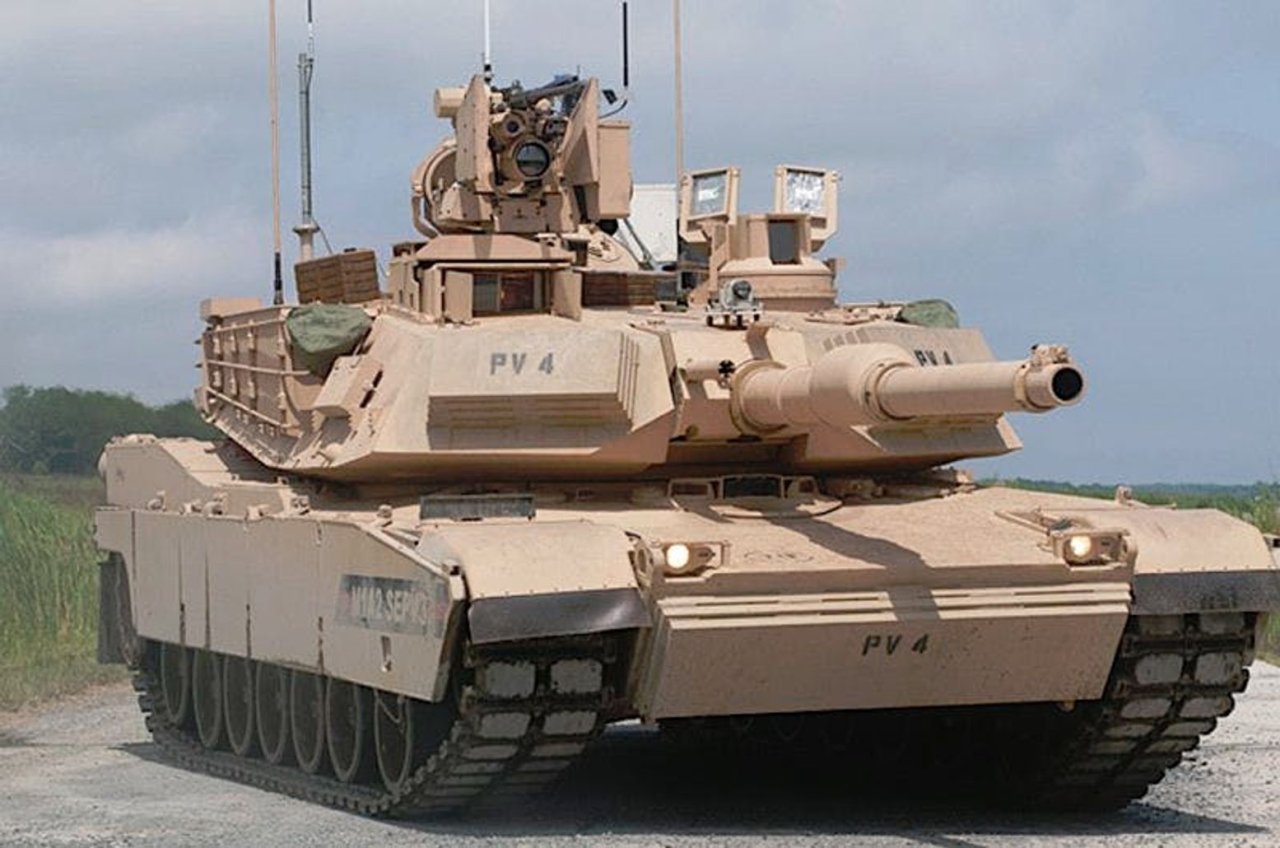
Soldiers at Fort Hood, Texas, have begun receiving the US Army’s M1A2C Abrams main battle tank (MBT), also known as the M1A2 System Enhancement Package (SEP) version 3 (M1A2 SEP v3), and are preparing for upcoming live-fire exercises.
On 21 July, the service announced that over the past few weeks it has been delivering the vehicle upgrade to members of the 3rd Battalion, 8th Cavalry Regiment, 3rd Armored Brigade Combat Team, 1st Cavalry Division.
“This is the first time we have fielded a new tank in about 16 years,” said Lieutenant Colonel Nicholas Sinclair, commander of 3rd Battalion, 8th Cavalry Regiment. “We will be the first ones trained on this so it’s really special to us to make sure we’re doing it right.”
Among the key features are full integration of the Israeli Trophy active protection system (to defend against RPGs, etc.), additional armor plates to the front turret face, and improved electronics.
The National Interest offered up this picture last year:
Yesterday’s post on autloaders made me wonder how Russia’s T-14 Armata main battle tank project is coming along. The answer seems to be: not so hot.
Despite a reduction in Russian defense spending caused by lower oil prices, which came after the Kremlin opted not to cut production, the Russian military is charging ahead with its Armata combat vehicle program. It is being overseen by Rostec Corporation – the Moscow conglomerate that specializes in consolidating strategically important companies in Russia’s defense sector.
This includes the Armata T-14 main battle tanks (MBT) first demonstrated during the May 2015 Victory Parade in Moscow. Sergi Chemezov, Rostec Corporation’s chief executive officer, told reporters last week that while any new projects would be discontinued the Armata projects – which include the T-14 as well as the T-15 heavy infantry fighting vehicle and T-16 armored repair and recovery vehicle – were still on track.
However, when these tanks might be delivered is still very much in question.
As of January, the Russian Ground Forces (RGF) had not taken delivery of its first batch of the third-generation T-14s, and delivery has been delayed multiple times around. Delivery was expected on the first nine tanks by Russian tank manufacturer Uralvagonzavod (UVZ) in 2018, before the target date was pushed back to 2019.
Work on the Armata project began in 2010, when the Russian Ministry of Defence terminated work on “Object-195” – the T-95 program. The entire project was seen to be a huge technological leap from Soviet-era military hardware designs and from the ground up the T-14 is very much distinct from past Soviet/Russian tank platforms.
The outline of the tank, from its hull to its long and boxy turret, which resembles Western tank turret designs, is a notable departure from past Soviet designs.
Interestingly, the conventional long, boxy turret wasn’t part of the early Armata sketches released, which showed a radical, low-profile design theoretically made possible by the autoloader. That was completely gone by the time the first prototypes appeared (and stalled) at the 2015 Moscow Victory Day Parade.
It isn’t just the profile of the Armata T-14 that sets this tank apart from its predecessors.
Among its innovative characteristics is its unmanned turret, which includes a remotely controlled 125mm 2A82-1M smoothbore main gun with fully automated loading. The turret’s magazine contains a total of 45 rounds of ammunition, but the main gun can also fire laser-guide missiles. In addition, the 2A82 125mm gun can even be upgraded to the 2A83 152mm gun, while the T-14 can also be fitted with secondary weapons such as the Kord 12.7mm machine gun or a PKTM 7.62mm machine gun.
I don’t believe the the T-14 can ever be uparmed with the 152mm cannon. There simply doesn’t seem to be enough room to fit it in. That was what was supposed to go in the cancelled T-95/Object 195 program, which was a larger platform, and which Russia killed in 2010 after Uralvagonzavod produced a prototype which it never showed to the press and for which no field maneuver footage seems to exist. Which means it was even more good old-fashioned Russian vaporware than Black Eagle, of which they seemed to have produced one running prototype. Oh, and they also said Black Eagle could have been uparmed to the 152mm cannon as well. So a 152mm cannon-armed T-14 isn’t just vaporware, it’s third generation vaporware (if not even older).
As important to its offensive capabilities is the MBT’s ability to keep its crew protected. Here too is where the T-14 excels. This tank features a low-silhouette that reduces exposure to enemy fire, and that enhances the safety and survivability of the three-man crew.
The “low-silhouette” point is simply wrong. The T-14 is 3.3 meters high, compared to 2.2 meters for the T-90 and 2.44 meters for the M1A2. That’s higher even than the World War II M3 Lee tank the Soviets (who got them via Lend-Lease) called “a coffin for seven brothers.”
The driver, gunner and tank commander are housed in a crew compartment that is located in an armored capsule at the front portion of the hull, isolated from the automatic loader as well as the ammunition storage in the center of the tank.
The crew compartment is made from composite materials and protected by multilayer armor, which according to analyst reports can withstand a direct hit of nearly any type of round that currently exists including sub-caliber and cumulative rounds.
This smells like more hype. The crew compartment does seem to be very well-protected, but it remains to be seen whether it can stand up to a strike from a Javelin or Hellfire 2. RPG-29s (hardly state-of-the-art anti-tank tech) have taken out Challaneger 2s and Merkavas when it hit them just right, and they had proven Chobham composite armor rather than whatever composite armor Russia has managed to develop.
Supposedly the T-14 was tested in Syria, according to TASS, and if you can’t trust Russia’s own propaganda organ, who can you trust?
Here’s a video that discusses various T-14 problems from a YouTuber who tends to be a lot more positive about the T-14 (and Russian tanks in general) than I am.
The main problem plaguing the T-14 is the same one plaguing the rest of the Russian military: Russia is broke and they can’t maintain their current military infrastructure, much less adequately fund future weapons development. They were broke before oil prices hit the toilet, and the strain of Vald’s Excellent Adventures in Syria and Ukraine haven’t helped. That’s why dry docks sink and nuclear subs explode.
And even if all those problems are overcome, Russia has only ordered 100 of them, and production seems to be so slow they may not even hit that. Its fate may be like the Type 3 Chi-Nu tanks Japan produced late in World War II: A formidable peer to American tanks on paper, but produced in such small numbers they never saw combat.
The Chieftain Nicholas Moran talks about the pros and cons of autoloaders, a subject we’ve touched on before, especially in relation to the Russian T-14 Armata.
The point about autoloaders providing better crew safety through thicker ammunition storage bulkheads is a good one, as is the immediate capacity advantage of immediately accessible ammunition.
He comes down on the side of yes, autoloaders are the wave of the future, but no, we should try to retrofit the M1 Abrhams for them.
A couple of mild caveats on his assertion that an autoloader won’t be any more prone to malfunction than other tank mechanical components:
Other tank components have undergone a century of evolutionary pressure in actual combat environments. Autoloaders are bootstrapping on decades of civilian factory automation innovations, but those happened outside the chaotic, dust-and-debris filled atmosphere of a moving combat platform. Experience as to how autoloaders break down in actual high-intensity conflict is scarce, with the possible exception of Russian tanks. (Lots of things went wrong with Russia’s invasion of Chechnya, and I get the impression that autoloader issues did not loom significant among them. And T-64s and T-72s were so badly outmatched in Desert Storm that I doubt much useful information got back to Russia about their field performance. Hard to get after-action reports on autoloader failure modes when your tanks start blowing up before getting off a shot…)
Current turret confines probably provide sufficient space for autoloader maintenance and troubleshooting. But if turrets shrink to reduce weight/increase armor in absence of a loader crew, that’s probably going to reduce maintainability. In which case a significant number cannon issues will probably go from crew-fixable to depot maintenance.
This Sunday before Memorial Day we honor the life of Cpl. Henry F. Warner, an antitank gunner who single-handedly destroyed three German tanks and killed the commander of a fourth:
Serving as 57-mm. antitank gunner with the 2d Battalion, he was a major factor in stopping enemy tanks during heavy attacks against the battalion position near Dom Butgenbach, Belgium, on 20-21 December 1944. In the first attack, launched in the early morning of the 20th, enemy tanks succeeded in penetrating parts of the line. Cpl. Warner, disregarding the concentrated cannon and machinegun fire from 2 tanks bearing down on him, and ignoring the imminent danger of being overrun by the infantry moving under tank cover, destroyed the first tank and scored a direct and deadly hit upon the second. A third tank approached to within 5 yards of his position while he was attempting to clear a jammed breach lock. Jumping from his gun pit, he engaged in a pistol duel with the tank commander standing in the turret, killing him and forcing the tank to withdraw. Following a day and night during which our forces were subjected to constant shelling, mortar barrages, and numerous unsuccessful infantry attacks, the enemy struck in great force on the early morning of the 21st. Seeing a Mark IV tank looming out of the mist and heading toward his position, Cpl. Warner scored a direct hit. Disregarding his injuries, he endeavored to finish the loading and again fire at the tank whose motor was now aflame, when a second machinegun burst killed him. Cpl. Warner’s gallantry and intrepidity at the risk of life above and beyond the call of duty contributed materially to the successful defense against the enemy attacks.
This time Moran climbs around an M1A1 Abrams tank and talks about his time serving inside one during (I’m assuming) Desert Storm [evidently the Iraq War]. Highlights include how an Iraqi bullet missed his head by three inches, and how a tank designer including a pressure sensor on a loading door kept it from taking his arm off when they forgot to throw the proper safety switch.
Edited to add:
Desert Storm? Why do people keep thinking I'm that old…? Add about 13 years to the story….
Not sooner do I start writing about Sherman tanks than suddenly all sorts of Sherman-related information starts popping up.
First, here’s are two really detailed videos from Nicholas Moran, AKA The Chieftain, of the features of a Sherman M4A1:
Second, Dwight sent me this twitter thread, that goes into a great deal of detail about how the Sherman’s later reputation for being Not So Great came almost entirely for the way they were deployed in roles they were not specialized for.
Here’s a Tweet from that thread that talks about the weird (but highly effective) redesign that became the Sherman M4VC Firefly used by the British Army:
The story of the Sherman Vc's development is amazing (and look I've fixed the meme for you)… but they arrive at units with a shitty No. 43 Telescope with 3x magnification.
It's marginally better than the standard offering, but isn't really even remotely suitable. /27 pic.twitter.com/ZrHOtGM0Qr