Trump’s Iran blockade twists Iran’s arm into opening the Strait of Hormuz, Ukraine blows up a bunch more Russian oil and gas infrastructure, leftists try to remove more rights from their political opponents, and this weekend in Austin you can get a dog for $5!
It’s the Friday LinkSwarm!
I got my taxes done and mailed off. (I owed nothing because I made so little money last year.)
Trump wins again. “Iran, U.S. Announce Strait of Hormuz ‘Completely Open’ for Commercial Ships.”
The Strait of Hormuz is “completely open” for all commercial ships, the U.S. and Iran said Friday, after the agreement of a cease-fire in Lebanon.
“IRAN HAS JUST ANNOUNCED THAT THE STRAIT OF IRAN IS FULLY OPEN AND READY FOR FULL PASSAGE. THANK YOU!” President Trump said in a post on Truth Social, appearing to refer to the Strait of Hormuz.
The president also said that Iran would begin working to remove all of the sea mines from the strait, with the help of the U.S.
He said in a second post that the U.S. naval blockade of Iranian ports “WILL REMAIN IN FULL FORCE AND EFFECT” until peace negotiations with Iranian leaders are “100% COMPLETE.”
The blockade was first put into effect on Monday, with U.S. forces looking to stop Iranian and Iran-linked ships. The blockade came after negotiations in Pakistan to end the Iran war collapsed.
The president said at the time that the blockade would be enforced in an effort to stop Iran from policing the strait to its economic benefit while other countries suffer.
Iran had imposed a toll on vessels passing through the strait and has limited oil exports. It had allowed only a handful of countries, including China and India, to pass through the strait.
“Iran promised to open the Strait of Hormuz, and they knowingly failed to do so…as they promised, they better begin the process of getting this INTERNATIONAL WATERWAY OPEN AND FAST!” Trump said earlier this week.
Days before Saturday’s failed negotiations in Pakistan, Trump announced a two-week cease-fire, contingent upon Iran agreeing to the “complete, immediate, and safe opening” of the Strait of Hormuz.
Meanwhile, Trump on Thursday announced that Israel has agreed to a ten-day cease-fire in Lebanon. Israeli Prime Minister Benjamin Netanyahu said that Israel had an “opportunity to forge a historic peace agreement with Lebanon” but said Israeli forces would remain inside Lebanese territory in a “reinforced security buffer zone.”
How is an open Strait but the U.S. keeps the blockade anything but a complete win for Trump?
All ships can sail through the Strait of Hormuz but this needs to be coordinated with Iran’s Islamic Revolutionary Guard Corps (IRGC), a senior Iranian official told Reuters, adding that unfreezing Iranian funds was part of the deal.
Foreign Minister Abbas Araqchi wrote on X that the strait was open after a ceasefire accord was agreed in Lebanon, while U.S. President Donald Trump said he believed a deal to end the Iran war would come “soon”, although the timing remains unclear.
Hundreds of ships and 20,000 seafarers have remained stranded inside the Gulf waiting to pass through the key waterway, which handles about 20% of the world’s oil and liquefied natural gas flows.
It’s still unclear who is actually calling the shots in Tehran these days.
It looks like Iran’s rulers have finally blinked — but that doesn’t mean they won’t try to weasel out of every promise they’re now making.
Tehran announced Friday that it’s opening the Strait of Hormuz, and supposedly even cooperating with US forces to sweep out all mines.
President Donald Trump says the regime has even agreed to end its quest for nuclear weapons and hand over its “nuclear dust” — nearly 1,000 pounds of highly-refined uranium now buried below various bunkers destroyed by American bombing last year.
But Trump knows Tehran has a long history of breaking its word — and it’s not even certain that the figures we’re negotiating with are the ultimate decision-makers.
Nor if Iran’s current leaders will be in charge next month: Regime factions will be a while realigning after US and Israel attacks slaughtered most of the top ranks — no one there or here knows how it’ll play out.
Snip.
Remember: Even the Islamic Republic’s so-called moderates are still Islamic fundamentalists who despise America and the West and believe that lying to non-Muslim leaders is entirely moral.
Meanwhile, a lasting peace deal that ensures Iran can’t go nuclear requires a reliable process for monitoring compliance, including “inspect anywhere, anytime” rules.
Also a must-monitor: Bans on acquisition of new missiles and missile tech, lest Tehran again threaten the entire region.
Plus financial controls to prevent the Revolutionary Guard’s Quds Force from again fostering and commanding terrorists far outside Iran.
If the regime doesn’t agree to these terms, and institutionalize enforcement, its oil exports must remain blocked as the bombing resumes.
For the past five weeks, opponents of the Trump administration have repeatedly called this “a war of choice,” a conflict the president launched without cause or coherent purpose. “[W]hen we ask, What is the administration doing? they can’t answer that question because they don’t know why they’re there in the first place,” Jake Sullivan told progressive talk-show host Jon Stewart. “They haven’t been able to give us an answer as to what this is all about.”
The administration has, in fact, made a clear and compelling case. It reduces to two interlocking imperatives. The first is Trump’s long-standing red line. As the president has stated repeatedly for years, “Iran cannot have a nuclear weapon. It’s very simple.” The second is the enabling condition that made this red line urgent: overmatch. Iran’s drones and ballistic missiles can overwhelm the air and missile defenses of Israel, the United States, and their Gulf allies.
In the June 2025 “12-Day War,” Iran absorbed heavy losses to its ballistic arsenal, which fell to roughly 1,500 missiles, and to key production sites. President Trump hoped that those losses would moderate Iranian behavior and bring Tehran to the negotiating table. That hope proved unfounded.
The IRGC moved immediately to rebuild. Work resumed at production plants, and stockpiles in hardened underground missile cities grew. IRGC Aerospace Force Commander Majid Mousavi stated in January 2026 that the arsenal had grown since the June war and that output across multiple sectors had already exceeded prewar levels. Israeli intelligence assessed that Iran was on track for a stockpile of roughly 8,000 ballistic missiles by 2027.
At the outset of the war, Secretary of State Marco Rubio described overmatch as the factor that drove America to act. “The United States is conducting an operation to eliminate the threat of Iran’s short-range ballistic missiles and the threat posed by their navy, particularly to naval assets,” he said at a March 2 press conference. He then quantified the threat. “They are producing, by some estimates, over 100 of these missiles a month. Compare that to the six or seven interceptors that can be built a month.”
The arithmetic spoke for itself and posed two interlocking threats. The first was conventional. Iran would soon have enough missiles and drones to overwhelm the defenses of Israel and every American base in the region. The second was nuclear. The huge conventional arsenal would serve as a shield behind which Iran could pursue a nuclear weapon without fear of retaliation—directly violating the president’s red line. If Iran were left unchecked, Rubio explained, it would soon “have so many conventional missiles, so many drones, and can inflict so much damage, that no one can do anything about their nuclear program.” Once Iran crossed that threshold, which Rubio called the “point of immunity,” the window for action would close permanently.
America therefore had three choices: to do nothing, in which case Iran would soon enter a zone of immunity guaranteed by overmatch; to let Israel attack alone, in which case Iran would attack American forces and cause significant casualties; or to work together with Israel to eliminate an intolerable threat to both countries.
Myth 2: The Joint Comprehensive Plan of Action had moderated Iran and stabilized the Middle East before Trump broke it.
While arguing about the war, former Obama and Biden staffers are attempting to justify Obama’s nuclear deal and the strategy that produced it. The JCPOA, Sullivan tells Stewart, worked. Iran was “complying with the deal. Even the Israeli intelligence were saying they were complying with the agreement.” Trump’s 2018 unilateral withdrawal, Sullivan suggests, discarded this successful state of affairs.
This story fails to comport with reality in three crucial ways. First, the timeline doesn’t work. Trump withdrew from the nuclear deal in May 2018. Tehran did not begin enriching its uranium to 60%, a major threshold that dramatically shortens the path to a nuclear weapon, until April 2021. In other words, Tehran made this crucial leap toward weaponization on Biden’s watch, not Trump’s.
And how did Biden respond? With conciliation. The administration stopped enforcing sanctions, especially against Chinese buyers. Iranian oil exports surged, and with them regime revenues. As Iran’s breakout time shrank to a matter of weeks, Biden and his team painted the increasing threat it had created as Trump’s fault. Every Iranian nuclear advance became, in their telling, not only a consequence of the 2018 withdrawal but also a justification for further conciliation. Then National Security Adviser Sullivan said so explicitly in April 2022, when Iran was racing forward under Biden’s presidency, that its progress “is a direct impact of [Trump’s] pulling out of the nuclear deal, making us less safe, giving us less visibility. And it’s one of the reasons we pursued a diplomatic path, again, when the president took office.”
Biden restored the core logic of the JCPOA unilaterally. Sanctions relief flowed while nuclear constraints collapsed. Tehran blew past the restrictions on the size of its uranium stockpiles and levels of enrichment while Washington relaxed pressure and pursued diplomacy on Iran’s terms. What Sullivan presents as the collapse of the deal was its continuation on asymmetric terms, slavish compliance in Washington without reciprocity in Tehran.
As sanctions enforcement weakened and oil revenue from China flowed, the regime did not moderate. Iran accelerated its missile and drone programs, deepened its support for proxies, and hardened the capabilities that now define the battlefield. Sanctions relief generated revenue. Revenue funded missiles, drones, and proxies. Those capabilities produced the overmatch that eroded deterrence.
The JCPOA and Biden’s de facto implementation of it financed and enabled the capabilities that drove the region toward large-scale conflict. Under Biden, Iran reached 60% enrichment and expanded its missile and drone programs. The Oct. 7 massacre in Israel was a direct result of Iran’s increasingly advantageous strategic posture.
The United States faced the same strategic choice at the end of the JCPOA process as it did at the beginning, but under worse conditions and against a stronger adversary. The policy, that is to say, ensured that the confrontation would come after Iran had advanced closer to immunity.
If ever we had a president who believes that “bigger is better,” it’s Donald Trump, and his administration just embiggened the blockade against Iran to include sanctioned ships from anywhere.
“In addition to enforcing the blockade, all Iranian vessels, vessels with active OFAC sanctions, and vessels suspected of carrying contraband, are subject to belligerent right to visit and search,” U.S. Naval Forces Central Command (NAVCENT) announced on Thursday. But here’s where it gets really interesting: “These vessels, regardless of location, are subject to visit, board, search, and seizure.”
Emphasis added because that’s serious.
Regardless of location? If I’m reading that right, the “Persian Gulf blockade” just went global.
Joint Chiefs chair Gen. Dan Caine confirmed the expanded scope this morning during a presser with War Secretary Pete Hegseth. “Under the command of Adm. Paparo, we’ll actively pursue any Iranian-flagged vessel or any vessel attempting to provide material support to Iran,” Caine said. “This includes dark fleet vessels carrying Iranian oil. As most of you know, dark fleet vessels are those illicit or illegal ships evading international regulations, sanctions, or insurance requirements.”
Baltimore can’t decide who gets to ladle out the fraud. “Baltimore Reparations Fund Plagued by Infighting and Struggles for Control. ‘The City Hall says the mayor has final say, while commissioners maintain the body was created to independently manage the funds.'”
When the state of Maryland legalized marijuana for personal use a few years ago, it designated a percentage of sales to be put in a special fund, which would be used in part to pay reparations for slavery and to fund various social programs.
The fund now contains upwards of $35 million, but almost none of the money has been paid out because of an ongoing power struggle to control it between pretty much everyone involved in the program. Who could have predicted such a thing?
FOX News reports:
$35 million in reparations money remains unused as Baltimore officials battle over who gets control: report
Millions in reparations money remain unused as Baltimore officials battle over who gets control, according to a local report.
The Baltimore Beat reported that the $35 million in revenue from the recreational cannabis tax has not reached residents yet due to infighting between City Hall and the Community Reinvestment and Reparations Commission, a 17-member body established in November 2024 to oversee how the funds are distributed.
Since Maryland legalized recreational cannabis three years ago, “not a single dollar has reached the people it was meant to help, and the first round of funding may still be a year away,” the report said.
Why, it’s almost like that was the design…
“Huge Drone Strike on Tuapse Port! Oil Storage Hit,” an oil export terminal on the Black Sea Ukraine has hit before.
“German bill would ban home purchases for people with the wrong political views.” Germans banning rights for being an enemy of the ruling party? I think I’ve seen this movie before…
A Carrollton candidate who confessed to committing voter fraud in a past election is back on the mayoral ballot this May. While the situation is unusual, it’s not unlawful.
In 2024, Zul Mohamed pleaded guilty to more than 100 felony counts of voter fraud in his failed 2020 campaign for Carrollton mayor. A jury sentenced him to four years in state prison while agreeing with his attorney that Mohamed is mentally ill.
But Mohamed is appealing parts of his conviction and sentencing, arguing that the sting operation used to trace a mail-ballot fraud scheme back to him was constitutionally suspect, as is the court’s condition of probation that bars Mohamed from engaging in election-related activities.
Under Texas election law, a person is ineligible to be a candidate if they have been “finally convicted of a felony” or determined by a court to be “mentally incapacitated.”
(Previously.) Seems like the average 7-11 has more stringent vetting than Carrollton…
Attorney General Ken Paxton has announced an investigation into Diversity, Equity, and Inclusion policies at the University of North Texas.
“The DEI ideology has been a calamitous way that radical leftists have pushed a woke agenda in our educational institutions,” Paxton stated.
As part of the investigation, Paxton sent a letter to Nicole Dash, Dean of the College of Public Affairs and Human Sciences, asking UNT to detail their compliance with state law. While Dash’s academic writing primarily focuses on disaster recovery, she has also written about racial issues.
Paxton is also seeking information about “DEI policies and guidance from the University, details regarding DEI in accreditation standards, and all correspondence between UNT leadership and staff regarding DEI.”
Paxton’s investigation stems from an undercover video that was released earlier this week by Accuracy in Media.
In the video, Paige Falco, a field education coordinator in social work at UNT’s College of Public Affairs and Health Sciences, told an investigator with a hidden camera that DEI is “definitely still a focus” at the institution.
Falco told the investigator that she removed DEI keyphrases from course titles and descriptions, while continuing to teach the concepts.
Later in the video, Falco discussed how “antiracism, diversity, equity, and inclusion” is a competency for the Council on Social Work Education, which accredits the school. The Steve Hicks School of Social Work at UT-Austin also requires so-called “antiracism” training as part of its accreditation with this organization.
Senate Bill 17, a law state lawmakers passed in 2023, prohibits DEI in university human resource policies. SB 17 contains explicit exemptions for accreditation and course content.
The Texas Office of the Attorney General (OAG), alongside the Federal Trade Commission (FTC), announced a settlement with three prominent advertising companies over alleged violations of antitrust laws.
The settlement comes after a multi-state complaint was filed to “combat unlawful media censorship.” The three companies involved are Dentsu US, Inc.; GroupM Worldwide LLC, now known as WPP Media; and Publicis, Inc.
The multi-state complaint also saw participation from Florida, Indiana, Iowa, Montana, Nebraska, Utah, and West Virginia. The complaint alleges the companies violated the 1890 Sherman Antitrust Act, and calls the companies’ conduct “anticompetitive.”
The complaint alleges that the ad agencies, working through the World Federation of Advertisers’ Global Alliance for Responsible Media and the American Association of Advertising Agencies’ Advertiser Protection Bureau, blocked certain websites from being eligible for advertising revenue because they were labeled “misinformation.” The companies allegedly created “brand-safety” rules that made these “misinformation” websites ineligible for business.
The OAG’s announcement stated that the increase in online media coverage has led to large corporations “conspiring ways to suppress certain viewpoints,” favoring particular perspectives and “suppressing disfavored opinions as ‘misinformation.’”
The FTC stated that the defendants’ unlawful collusion “to impose common ‘brand safety’” standards across the industry weakened competitive behavior.
According to the FTC, upon approval by a federal judge, the order will prevent “the biggest U.S. advertising agencies” from restricting advertising based on ideological or political differences.
Although the settlement is subject to court approval, the advertising companies have agreed to several arrangements. The companies reportedly agreed to not enforce limitations on advertising spending based on ideological positions or diversity, equity, and inclusion commitments. They also agreed to not restrict business with any company based on “its news and political or social commentary content.”
Reading between the lines, this was part of the Democrat Media Complex’s attempt to keep anyone from advertising with any conservative media.
Ma Xingrui, a former high-flying technocrat and Xinjiang party secretary, is officially under investigation for corruption charges. That makes him the third member of the current Chinese Communist Party (CCP) Politburo to fall amid President Xi Jinping’s latest purge, as well as the first civilian member.
There are two likely reasons for Ma’s targeting. The first is that Ma was exceptionally capable. He handled politically sensitive assignments in Xinjiang and earlier in Guangdong and the city of Shenzhen with skill and ruthlessness. As I noted in last week’s China Brief, Xi tends to find that kind of talent and ambition threatening.
Second, it’s possible that Ma’s background leading China’s space agencies connected him to the corruption being probed within the People’s Liberation Army Rocket Force. However, Ma left the aerospace sector in 2013, before the Second Artillery Corps was reorganized into the Rocket Force and received the surge of funding and authority that enabled such corruption.
Ma’s time in Xinjiang certainly offered opportunities for large-scale graft, from the expropriation of Uyghur property and businesses to the notoriously corrupt paramilitary organization that runs much of the region’s industry, the Xinjiang Production and Construction Corps.
This purges are sort of an under-reported story, and Xi has purged at least two other Politburo members in the last year.
“Wisconsin sheriff sues Pakistani-American woman who said ICE detained her for two days when she was actually at hotel spa.”
US citizen Sundas ‘Sunny’ Naqvi, 28, gained national attention last month when she and a band of supporters – including Cook County, Ill., Commissioner Kevin Morrison — publicly insisted she was unlawfully detained by ICE officers for roughly 43 hours.
Keep Morrison in mind, because we’re going to get back to him in a sec.
Naqvi claimed that after landing back in the US from a work trip to Turkey on the morning of March 5, she was detained for nearly 30 hours at Chicago O’Hare International Airport, then transferred to another ICE facility in Broadview, Ill., before winding up at Dodge County Jail in Wisconsin.
Snip.
Now Naqvi and Morrison are the subjects of a federal defamation lawsuit filed by Dodge County Sheriff Dale Schmidt on Friday — as his office released new details of Naqvi’s actual actions during the alleged hoax period.
‘She checked into the Hampton Inn and Suites in Rosemont, Ill., for the entire duration of this alleged event,’ Schmidt said during a press conference, where he presented a hotel bill and text receipts to illustrate Naqvi’s time there.
The folio shows Naqvi checked in at the Hampton Inn — just a 10-minute drive from the airport — at 1:17 p.m. March 5, while text messages with an unidentified witness over the following days show she enjoyed free food, spa services, and trips to the gym.
Bonus: “Naqvi was previously convicted of making a false report in Cook County, Illinois, and was sentenced to probation.” Also, I’m sure you’ll be shocked to know that Kevin Morrison is a Democrat…
Former Virginia Lieutenant Governor Justin Fairfax shot and killed his wife before turning the gun on himself early Thursday in what the Fairfax County Police Department is calling a murder-suicide.
Police believe Fairfax shot his wife in the basement of their Annandale home, ran upstairs, and shot himself. The couple’s children were in the home at the time of the murders and called 911, according to Fairfax County Police Chief Kevin Davis.
“This has been an ongoing domestic dispute surrounding what seems to be a complicated or messy divorce,” Davis said. “I don’t think it’s a secret that there’s been a divorce proceedings that have been ongoing. From what I understand in this early stage, former Lieutenant Governor Fairfax was recently served some paperwork associated with an upcoming court proceeding that apparently led to this incident last night.”
The couple had been married 20 years, but was currently separated and still living together, according to authorities.
“Separated and still living together” seems like an oxymoron.
Cerina Fairfax filed for divorce in July, according to court records.
Fairfax served as the lieutenant governor under former Democratic Governor Ralph Northam from 2018 to 2022. While in office, the lieutenant governor was accused of sexually assaulting two women years earlier. He maintained the sexual encounters, one of which took place in 2000 and another in 2004, were consensual. He then launched an unsuccessful bid for Virginia governor in 2021, coming in fourth in the Democratic primary. Prior to his tenure as lieutenant governor, Justin Fairfax served as a federal prosecutor.
Funny how many Democrats hyped as “the next big thing” (Stacey Abrams, Andrew Gillum) turned out to have dark secrets, though none quite as dark as a murder-suicide.
Phil Collins has been elected to the Rock and Roll Hall of Fame, along with Oasis, Billy Idol, Wu-Tang Clan, Luther Vandross, Sade, Joy Division/New Order and Iron Maiden. You can argue that Collins is more pop than rock in his solo career, but he’s certainly more rock than Vandross, Sade, and a lot of already-inducted artists.
Greetings, and welcome to a rare Saturday LinkSwarm! This week: The Supreme Court stays the injunction against the Texas redistricting map, a bunch of Twitter fakes exposed, Trump drops the boom on Somali illegal alien scumbags,
U.S. Supreme Court Justice Samuel Alito issued an administrative stay of Tuesday’s ruling by an El Paso panel of federal judges that rendered the new congressional map passed by Texas Republicans this summer unusable for the 2026 midterm election.
The order restored the new map, pending consideration of the appeal by the State of Texas, and directed the Democratic-aligned parties to submit their response by Monday.
Snip.
The ruling drew a particularly pointed dissent from Judge Jerry Smith, the lone dissenter on the panel, who asserted that the motivation behind the redraw was clearly partisan gain — a position that sits outside the jurisdiction of the court.
Following that ruling, Attorney General Ken Paxton appealed the ruling to the U.S. Supreme Court on Friday, asking for an administrative stay — which Alito granted.
“Compounding the harm, the district court entered its sweeping injunction far too late in the day — ten days after Texas’s candidate filing period had already opened. The injunction changes the boundaries of all but one of the State’s 38 congressional districts, enjoining Texas from using its duly enacted 2025 map and resurrecting the repealed 2021 map,” Texas wrote in its appeal.
“The chaos caused by such an injunction is obvious: campaigning had already begun, candidates had already gathered signatures and filed applications to appear on the ballot under the 2025 map, and early voting for the March 3, 2026, primary was only 91 days away. The lateness of the district court’s injunction (issued 38 days after the hearing) alone warrants a stay.”
As things stand, Texas Republicans’ map is back in effect while the U.S. Supreme Court considers the case in expedited fashion.
Texas’ candidate filing deadline is December 8, 2025.
Twitter/X turns on locations and it turns out a lot of “American” account pushing that “GOP civil war”` nonsense were foreign psyops.
There are thousands of accounts like this. Many of them explicitly claim to be American or Western, but are run by random people in Asia and Africa to sow chaos and get clicks.
BREAKING – Waves of Democrat influencers are being exposed as foreigners under X’s new location update, including leftist X agitator Alex Cole, who claimed he voted for Kamala but has now been revealed to be Canadian. pic.twitter.com/3LrAsYCiMw
Temporary Protected Status (TPS) is supposed to be used in extreme cases of humanitarian need for short terms (usually for 6, 12, or 18 months), allowing foreign refugees a safe haven in America.
As deportation efforts have ramped up, however, the American public has learned that some foreigners have remained in the country on TPS for decades. Some politicians and businesses have purposely imported large numbers of foreigners into small American towns, such as Haitians in Ohio and Pennsylvania, as cheap labor to replace Americans.
President Donald Trump’s initiative to eliminate government waste and fraud through a Department of Government Efficiency (DOGE) has quietly disbanded with a full 8 months still left on its charter.
Earlier this month when Reuters asked Office of Personnel Management Director Scott Kupor about the status of DOGE, Kupor replied, “That doesn’t exist.”
Representative Tim Burchett (R-TN) said that Elon Musk, who headed up the DOGE effort, was pushed out Washington D.C. because he was getting too close to exposing corrupt officials who are enriching themselves through dark money non-governmental organizations (NGOs).
Burchett told Benny Johnson, “NGO money pours into Washington and ends up in politicians’ pockets as dark money.”
DOGE had made dramatic impact on the federal government during the early months of Trump’s second term, shrinking the size of federal agencies and cutting their budgets or revealing astonishing amounts of questionable money flowing through NGO coffers.
Sound like a good reason to continue the work, not abandon it…
All that “don’t obey illegal orders” nonsense Democrats are regurgitating? Yeah, it’s Soros-funded, “Sponsored by Win Without War, a progressive advocacy group,” which in turn is funded by Soros’ Open Society Foundations.
Marjorie Taylor Greene resigned from congress. As in the NFL, there’s always someone that has to “set the edge,” and MTG was the person who did that in the Trump era.
What the hell? Is China committing war crimes in Philippines coastal waters?
The Philippine Navy recently caught Chinese Fishing Militia putting Cyanide in the water near the BRP Sierra Madre at the Second Thomas Shoal.
The incident that was recorded on camera demonstrates the brutality & destruction meted out by the Chinese Fishing Militia inside… pic.twitter.com/L7NCI0UIik
The apparent reason Armata failed is this: sanctions.
But there’s more to the story, too. In fact, several interlocking factors account for the T-14’s failure to materialize as intended.
Let’s first look at costs and priorities: the unit cost of the T-14 was estimated at several million dollars – far higher than Russia had budgeted for.
The increase in cost meant that it couldn’t actually be sustained at scale. And, faced with heavy losses in Ukraine and urgent demands to ramp up numbers, Moscow opted to modernize its legacy platforms, such as the T-90, rather than invest in an expensive and unproven system. A tough choice, but a logical one.
The domestic production line for the T-14 never actually achieved accurate serial output, in large part thanks to sanctions and industrial bottlenecks.
There was no assembly line. Yes, really: every vehicle was hand-built like a luxury car. Sanctions and supply-chain constraints further hindered the manufacture of key components and high-end electronics required for the platform.
But even if Russia had been able to assemble more of the tanks before the sanctions really kicked in, it might not have changed the reality on the battlefield. Even when the war in Ukraine created a burning need for armored vehicles, Russia hesitated to commit T-14 units to the frontline for one worrying reason: they were vulnerable.
With the rise of automated systems, drone warfare, and long-range combat, those tanks may have proven as vulnerable as older units – and losing tanks built pre-sanctions would mean replacing them with older tanks.
That wouldn’t have made sense.
For more than a decade, the T-14 Armata has embodied Russia’s ambition to leap ahead of the West in tank design and warfare.
But it failed.
The usual lefty sorts are trying to raise Maryland’s minimum wage to $25. Virginia’s minimum wage will be $12.77 in 2026. Which state will businesses choose?
Brown County Judge Shane Britton was suspended from office without pay on Tuesday, one day after he was arrested on multiple charges that included allegations he assaulted a female prosecutor and interfered with the prosecution of a family violence case.
According to indictments handed down by a grand jury last week, Britton has been charged with three felonies: tampering with a witness in a family violence case, assault of a public servant, and tampering with a government document.
To understand the difference, it helps to look at what each chip was originally built to do. A GPU is a “general-purpose” parallel processor, while a TPU is a “domain-specific” architecture.
The GPUs were designed for graphics. They excel at parallel processing (doing many things at once), which is great for AI. However, because they are designed to handle everything from video game textures to scientific simulations, they carry “architectural baggage.” They spend significant energy and chip area on complex tasks like caching, branch prediction, and managing independent threads.
A TPU, on the other hand, strips away all that baggage. It has no hardware for rasterization or texture mapping. Instead, it uses a unique architecture called a Systolic Array.
The “Systolic Array” is the key differentiator. In a standard CPU or GPU, the chip moves data back and forth between the memory and the computing units for every calculation. This constant shuffling creates a bottleneck (the Von Neumann bottleneck).
In a TPU’s systolic array, data flows through the chip like blood through a heart (hence “systolic”).
It loads data (weights) once.
It passes inputs through a massive grid of multipliers.
The data is passed directly to the next unit in the array without writing back to memory.
What this means, in essence, is that a TPU, because of its systolic array, drastically reduces the number of memory reads and writes required from HBM. As a result, the TPU can spend its cycles computing rather than waiting for data.
Google’s new TPU design, also called Ironwood also addressed some of the key areas where a TPU was lacking:
They enhanced the SparseCore for efficiently handling large embeddings (good for recommendation systems and LLMs)
It increased HBM capacity and bandwidth (up to 192 GB per chip). For a better understanding, Nvidia’s Blackwell B200 has 192GB per chip, while Blackwell Ultra, also known as the B300, has 288 GB per chip.
Improved the Inter-Chip Interconnect (ICI) for linking thousands of chips into massive clusters, also called TPU Pods (needed for AI training as well as some time test compute inference workloads). When it comes to ICI, it is important to note that it is very performant with a Peak Bandwidth of 1.2 TB/s vs Blackwell NVLink 5 at 1.8 TB/s. But Google’s ICI, together with its specialized compiler and software stack, still delivers superior performance on some specific AI tasks.
The key thing to understand is that because the TPU doesn’t need to decode complex instructions or constantly access memory, it can deliver significantly higher Operations Per Joule.
“TPU v6 is 60-65% more efficient than GPUs.”
Austin’s APL bookstore Recycled Reads will be closing in January and the stock distributed to individual library sales shelves. I doubt I’ll be visiting various library branches to book scout. Maybe they should go back to the book sale events they used to hold.
We’ve covered some of this before, but here’s a nice roundup of why Russia’s major weapons systems suck. It’s a handy tour through the world of over-promised, under-performing vaporwear.
“Before February 24th, 2022, the Russian Federation looked like it would deploy or soon be able to field some pretty formidable new weapons.” At least among those who hadn’t noticed Russia’s previous vaporware claims.
“In everything from fifth generation fighter jets to modern tanks, to new body armor and even tsunami-causing nuclear torpedoes, there was enough hype to make even informed Western national security experts worry about what they were seeing.”
“Little wonder that they believed Ukraine would fall in days in the months prior to the invasion. Those predictions did not turn out to be the case. And now two years later, Russia still finds itself fighting a war of attrition with no end in sight.”
It covers Russia’s one aircraft carrier, the Admiral Kuznetsov, how it’s been under repairs since 2018, is markedly less technologically advanced than American carriers, and how it has a history of corruption as well. It”s supposed to enter service again this year. I wouldn’t count on it.
Admiral Kuznetsov isn’t Russia’s only naval problem. “It is steadily retiring its Soviet-era ships and replacing them with lighter, less combat-worthy vessels.”
There’s the new, formidable (on paper) Lider-class destroyers, first unveiled in 2015 and capable of using a host of advanced new weapons. Tiny problem: “On paper” is the only place you can see them, since they haven’t started building them yet.
Then there’s “the Belgorod submarine, and particularly its Poseidon Torpedo, are two other items of hype in the Russian Navy that don’t seem to stand up to scrutiny. The Belgorod and Poseidon have often been items of fear in Western media and national security circles, which have nicknamed the former Russia’s ‘Doomsday Submarine.'”
“According to the Kremlin’s hype, the submarine and its arsenal of smart drone Poseidon torpedoes can unleash a 100 megaton yield capable of creating radioactive tsunamis that would inundate coastal communities and make them unlivable.”
“However, tests of the Poseidon have seemingly proven less than satisfactory. That shouldn’t be too surprising, because for the Poseidon torpedo to work as the Russians claim, it would need to be able to house all of the equipment needed for a nuclear reactor to convert atomic fission into electricity and propulsive force, while ensuring negligible waste heat (to avoid detection). It would also need the hardware to shield its sensitive electronics from the nuclear fission process.”
“Unfortunately for Moscow, the torpedo is too small to do this, meaning that it is either an object of hype or Russian engineers have come upon a technological leap enabling exotic engineering methods. We’ll let you decide which of the two scenarios is likelier.”
“The likeliest scenario is a yield of about one to two megatons per torpedo, which would be enough to inundate a coastal area with dangerous radioactive waters, but not to create a tsunami.” And the hundred knot speed is also bunk for numerous technical reasons.
“We now journey from the sea to the skies and look at the Russian answer to the American fifth generation F-22 and F-35 fighter jets – the Su-57 Felon. To be fair, the Su-57 does have some impressive features, like its 3D thrust vectoring engines, climb rate of 64,000 feet per minute, 66,000-foot service ceiling, Mach 2 speed, and range of 2,186 miles without refueling. In a plane vs. plane battle, the Su-57 should be a capable opponent against almost any fighter jet on the planet.”
“However, the Su-57 has a big drawback – its comparative lack of stealth. Aviation experts regard the Su-57 as being by far the least stealthy of the fifth generation fighters currently in service. For example, the F-22 Raptor is detectable at a range only under 10 miles, while the Su-57 would be detectable at a range of 35 miles.”
“Its stealth features are also concentrated in the front of the plane, meaning that if it turns or maneuvers, it is far more detectable.” Good thing fighter aircraft never need to turn or maneuver…
“Some aviation experts are even less kind and believe the Su-57’s radar cross section is similar to that of the F/A-18 Super Hornet, which is 1,000 times less stealthy than the F-35 Lightning II.”
“The Su-57 has played little part in the war in Ukraine, as the Russian aerospace forces have refused to field it in Ukrainian airspace. Instead, it has only attacked targets at long range from within Russian airspace.”
Then there’s the ridiculously low production rate. “The Kremlin ordered 76 Su-57s in 2019. 22 are in service as of December 2023, after several years of delays.” And we only have Russia’s word that they’ve produced that many. The real total could be lower. By contrast, Lockheed Martin has produced over 1,000 F-35s.
Next it’s a familiar punching bag, the T-14 Armata. “To be fair, the T-14 Armata does have significant improvements over the tanks Russia has usually fielded in Ukraine – the T-72, T-80, and T-90. These tanks have been lost in their thousands during the fighting in Ukraine, thanks to bad doctrine and their own design flaws. Because they do not segregate their ammunition magazines in a sealed compartment, they have often suffered from complete destruction with jack-in-the-box explosions.”
“The T-14 Armata mitigates this flaw with a protective capsule isolating the crew from their vehicle’s ammunition magazine.”
Unfortunately, the video goes on to say the T-14 has a low profile, which simply isn’t true. As I’ve noted before, the T-14 is 3.3 meters high vs. 2.44 meters for the M1A2, 3 meters for the Leopard 2, and 2.49 for the Challenger 2. 3.3 meters is higher even than the World War II M3 Lee tank the Soviets (who got them via Lend-Lease) called “a coffin for seven brothers.”
“The Armata’s main weapon is a 125mm 2A82-1M smoothbore gun which can fire related rounds and laser-guided missiles. This weapon would be a significant threat to the Western main battle tanks that Ukraine began fielding in larger numbers last year.” The “large numbers” are pretty small numbers.
“Unfortunately for Russia, this gun is not backward-compatible with its older tanks, which means only the Armata can field it, and that’s a problem, because there has never been a confirmed sighting of the T-14 in Ukraine. Russia has even fewer T-14 Armata tanks than it does Su-57 fighter jets.”
There follows a discussion of the T-14’s X-shaped engine that has evidently engendered a lively debate online, so I’m not going to get into it here.
“Meanwhile, the electronics for the Armata’s sensory and fire control systems are no longer as widely available due to the sanctions put in place as a result of its invasion of Ukraine. Indeed, there has not even been an assembly line built for the Armata and all of the prototypes have been made by hand. Given all of these problems, don’t expect to see the Armata fielded in large numbers, if at all, anytime soon.”
“Russia’s body armor has also been a subject of embarrassment. Many of Russia’s soldiers, especially the conscripts Putin mobilized in the autumn of 2022, have lacked proper protection. Infamously, some Russian troops were issued airsoft versions of the Ratnik body armor. Despite its problems in this area, Russia has made bold claims about what it has coming down the pike – its next-generation Sotnik body armor, which it says will be able to stop a .50 caliber Browning Machine Gun round.” Yeah, no.
We’re not even going to bother with the MiG-41, which doesn’t exist yet. Vaporware all the way down.
It’s always safest to assume that the latest Russian wunderwaffen is vaporware unless proven otherwise.
We’ve already covered why Russia’s T-14 Armata tank isn’t all that. Here’s a somewhat more balanced look from David Willey of The Tank Museum:
The first ten minutes covers the basics of Soviet tank design (the philosophy of favoring firepower over just about everything else, and how political rivalries led to various Soviet tank designs). Then he goes into the details of the Armata.
Much of the Armata comes from the abandoned T-95 project. “Although the T14 is looked at as new, it actually relies on systems and ideas from some much earlier projects.”
“The smoothbore 2A821M 125mm cannon is an upgrade from the weapon on the T-90. Russian sources claim its muzzle energy is far greater compared to the Rheinmetall 120mm gun.”
The unmanned turret means no need for a fume extractor.
Theoretical fire rate of 10-12 rounds a minute. I suspect this is highly optimistic and the fire rate is probably the slower one round every ten seconds we already covered.
“The new Vacuum One armor-piercing, fin-stabilized, discarding-sabot round is fitted with a 90cm [900mm] long rod penetrator. That’s unusually long. It is said to be capable of penetrating one meter of rolled homogeneous armor at about 2000 meters.” That is quite long. The rod penetrator on the U.S. M829 APFSDS round is 684mm long. Western consensus seems to be that the Vacuum One and Vacuum Two penetrator cores are made of depleted uranium or tungsten.
“The A853 engine was a copy of a German x-shaped engine from the war years…the A853 was not however a reliable product, and from all reports it seems to have had major issues.”
When working, it theoretically has twice the horsepower of a T-72 engine and capable of reaching 56 miles and hour with a range of 500 kilometers.
“The T14 has new 70 centimeter diameter road wheels, and an electronically adjustable suspension system on at least the first two road wheels, and possibly the last ones, and [that’s] called an active suspension system but is fitted over a main torsion bar suspension. It also has rubber-blocked tracks.”
The Armata’s sealed crew compartment will have air conditioning, which was introduced in Russian tanks with the T-90M in 2016. (Starting with M1A2 SEPv2, the Abrams has cooling, but it’s mainly geared toward cooling the electronics.)
Digital screens with remote cameras.
“The gunner can see his target, but he can also choose through those screens a relevant ammunition type.”
“The chassis and turret are equipped with a ‘Malachit’ dual explosive reactive armor system, and on the front sides and the top there’s stealth coatings.” Assuming the ERA is actually there and not fake, as on so many captured and destroyed Russian tanks in Ukraine.
“The active protection system has a radar to detect and tract incoming anti-tank munitions it states a maximum speed of incoming interceptable target is 1700 meters a second, or Mach 5.” Let’s just say I have grave doubts that it actually works. The Pentagon went with Israel’s Trophy active protection system over Raytheon’s homegrown Quick Kill system for M1A2 SEPv3, and Raytheon is good at developing reliable, high tech weapons. Unlike Russia.
“The top of the vehicle is still vulnerable to top attack munitions.” So much for defense against Javelin. Which first entered service in 1996.
“However, on closer inspection a number of these technologies and features are not fitted to some of the vehicles. Some you can see there’s covers where the technology or that piece of equipment should be on others is fitted for, but not with.” And that was on parade demonstration vehicles before sanctions. Odds that Russia would have enough parts to fully equip high tech parts to all Armatas supposedly in Ukraine would appear to be slim.
Though reusing a lot of features from the abandoned T-95 project, “the new T14 tank is a radical departure in sense of its scale, its layout, its design features and technology from that era of evolutionary Soviet-designed vehicles.”
“Originally intended to replace all Russian army tanks, the Russian military had planned to acquire about 2,300 T-14s between 2015 and 2020…but by 2018, delays were announced until at least 2025. Subsequently announcements indicated the apparent cancellation of the main production run.” In between it announced it was going to build 100 of them, though that number may have included other armored vehicles using the same platform.
“The [Russian] Deputy Minister of Defense said, quote, there is currently no need to mass produce the Armata when it’s older predecessors, namely the latest variants of the T-72, remain effective against American, German, and French counterparts.” Here the Deputy Minister of Defense is engaged in a time-honored Russian rhetorical device known as “lying his ass off.”
“The gradual tightening of sanctions, and then with the Russian invasion of Ukraine, the problem of sourcing the essential microelectronics has come to the fore. Russian industry has been critically dependent on foreign microelectronics and associated technologies. These are no longer available due to sanctions.”
“The sights from France and other components are no longer available.”
“Other issues come into play that affect the wider Russian defense industries. One is the perennial Russian problem of corruption. Since 2011, a staggering 72,000 officials have appeared before the course on corruption charges.”
“The mythic way many Russian military systems and products have been promoted and sold has met a crushing reality in Ukraine.”
Even though there may only be 20 test vehicles available, there is an expectation they will make appearance in the battle. A British ministry defense statement said, and I quote, any T-14 deployment is likely to be a high-risk decision for Russia. 11 years in development, the program has been dogged with delays reduction in planned Fleet size and reports of manufacturing problems. If Russia deploys a T-14 it will likely primarily be for propaganda purposes. Production is probably only in the low tens, while commanders are unlikely to
trust the vehicle in combat.
So even a balanced, objective analysis of the T-14 Armata isn’t particularly optimistic about its chances in combat.
Russia has begun using its new T-14 Armata battle tanks to fire on Ukrainian positions “but they have not yet participated in direct assault operations,” the RIA state news agency reported on Tuesday, quoting a source close the matter.
RIA said that the tanks have been fitted with extra protection on their flanks and crews have undergone “combat coordination” at training grounds in Ukraine.
The T-14 tank has an unmanned turret, with crew remotely controlling the armaments from “an isolated armoured capsule located in the front of the hull.”
The tanks have a maximum speed on the highway of 80 kilometres (50 miles) per hour, RIA reported.
In January, British military intelligence reported that Russian forces in Ukraine were reluctant to accept the first tranche of the tanks due to their “poor condition.”
It also said that any deployment of the T-14 would likely be “a high-risk decision” for Russia, and one taken primarily for propaganda purposes.
“Production is probably only in the low tens, while commanders are unlikely to trust the vehicle in combat,” the British military said.
“Eleven years in development, the programme has been dogged with delays, reduction in planned fleet size, and reports of manufacturing problems.”
Here’s a brief overview video:
The T-14 has had more than its share of developmental problems, and there are plenty of articles and videos detailing its shortcomings. Lazer Pig’s “The T-14 Armata tank sucks” is a long example of the genre.
If your interest level doesn’t support viewing a full hour of Armata-bashing, here are some takeaways:
“The T14 combines all the ultimate Russian technology previously introduced onto NATO tanks 25 years ago in a way that only a country trying to inflate the share prices of Raytheon would understand.” (Raytheon makes Javelin.)
“It does away with all the unnecessary ERA systems of the T90, which cannot protect the tank against missiles that were invented in the 80s, and instead replaces them with an active protection system that can almost defend the tank against missiles that were invented in the 90s.”
“An auto loader famous for jamming that now cannot be accessed and cleared when it does jam, is somehow heavier and slower than the tank it has replaced, and comes combined together in a package so expensive the company that made it immediately went bankrupt. The country that bought it cannot afford it and it has about as much export potential as English whiskey.”
“For a while, every idiot with even the vaguest sense of military interest was banging on about this tank as if Stalin had come back to life and had personally forged the hull from his own ball sack. And that all tanks across every nation in the world had just been rendered obsolete.”
Sections on repeated post-Soviet tank design failures, like the T-95 and Black Knight, and coverage of Russian brain drain, omitted.
The weird, Tiger-2 derived engine is unreliable.
The driver’s vision sucks.
No crew access to the turret internally.
The autoloader is slower than the manual fire rates on T-80s, T-72s and Abrams.
“The qualifying time for [an Abrams] loader to pass training is seven seconds, and the best crews claim they can reload in about four to five seconds. Meaning a good Abrams can fire twice before the T-14 has reloaded.”
“Ukrainian hackers found that most of the electronic systems on board, including the digital sights, the night vision, the infrared, were all in fact western imports. Most notably, these were last generation French optics from Leclerc MBTs left over from when they were all upgraded to ICONE in 2009.”
Current Russian tank optics are actually available to the general public. “They’re not even the best that are currently available. If you’ve got a spare five grand, you can go into any high-end spy gadget store and buy a drone that will give you better night vision and IR tracking capabilities than the latest generation of modern Russian tanks.”
China reportedly found out that none of the tank’s systems actually worked. “The soft kill defense systems were simply smoke screens, and the hard kill systems designed specifically to stop the Javelin and the TOW missile could not detect if either of these systems had been fired at the tank, and relied entirely on the crew being able to notice a missile traveling at the speed of sound flying towards them.”
“To top it off, there was no evidence of the supposed electronic warfare systems that could render guided missiles and mines inert.”
“Nothing in the Armata is new.”
The idea that western tanks need to catch up to the Armata is laughable. “By the time the Armata enters service, it will already be outdated.”
“Everything the Armata is has been done before, and in many cases has been done better.”
“Russia is not an equal to the United States and NATO, it’s an equal to North Korea, both technologically backwards nations.”
Will all those problems still be present when the Armata engages enemy armor in Ukraine? Some certainly will. I doubt Armata electronics or optics can compare to those on western vehicles, and I bet that its active protection package is miles behind Trophy (which I don’t think will be on any Ukrainian tanks anyway). But I do suspect they’ve had enough time to improve the reliability of the engine, and I’m guessing the armor and autoloader improvements will improve survivability for the tank crew.
Can the Armata take out Ukraine’s legacy Soviet tanks? Almost certainly. Can it take out Challenger 2s, Leopard 2s, and M1A2 Abrams? If it’s able to close in and get off the first shot, probably. But I’m guessing it will find the opportunities to do so few and far between.
Ukraine is carving out big gains in Kharkiv, Texas is in the money, Biden taps Clinton’s bagman to divy up the graft manage climate change funds, more groomers unmasked, and some big changes in the UK. Plus a bit about tanks. It’s the Friday LinkSwarm!
Ukrainian successes on the Kharkiv City-Izyum line are creating fissures within the Russian information space and eroding confidence in Russian command to a degree not seen since a failed Russian river crossing in mid-May.
Ukrainian forces in the Kharkiv Oblast counteroffensives advanced to within 20 kilometers of Russia’s key logistical node in Kupyansk on September 8.
Ukrainian forces will likely capture Kupyansk in the next 72 hours, severely degrading but not completely severing Russian ground lines of communication (GLOCs) to Izyum.
Ukrainian forces are continuing to target Russian GLOCs, command-and-control points, and ammunition depots in Kherson Oblast.
On Thursday, the state comptroller reported that the Lone Star State’s tax revenue rocketed by 25.6% to a total of $75.21 billion.
It’s only the fifth time since 1988 that revenue grew by a double-digit percentage — and it’s double the next largest increase over that 34-year span.
“Revenues continue to outpace even our most recent forecast as All Funds tax collections closed the fiscal year $841 million above the projection in our Certification Revenue Estimate,” said state Comptroller Glenn Hegar in an official release.
That’s a stark contrast to California, which saw July revenue come in 12% below forecast.
Texas has been a major beneficiary of migration from California: Over the last census cycle, 34% of new Texans arrived from California alone. Meanwhile, New York saw personal income tax collection fall 3.2% from April 1 through July.
Joe Biden has hired John Podesta to be the new Clean Energy Czar, citing his experience in progressive causes….
Bottom line, John Podesta is being now being hired to divvy up the $316 billion in Green New Deal money recently authorized by congress. That is what Podesta specializes in, the distribution of taxpayer money to DNC allied groups and networks in advance of the 2022 midterms. Podesta, Hillary’s fixer, is a bagman, nothing more.
Worse, one of the many bag clients he’s adept at channeling money into Democratic pockets for is China.
President Joe Biden on Friday tapped John Podesta to oversee $370 billion in climate spending, a move that has China hawks on Capitol Hill concerned over Podesta’s encouragement of Chinese investment in American infrastructure and praise for the top U.S. adversary on climate change.
Podesta has called for Chinese investment in American infrastructure, arguing in 2013 that there are “great opportunities for Chinese firms to directly invest in this nation, to build American infrastructure, to create American jobs, and generate steady and handsome returns.” He added, “There’s also the ability for Chinese firms to invest here and learn best practices, and take those home to the tremendous and growing middle class market in China.”
Instead, in the intervening decade, the Chinese government has committed widespread economic espionage—one 2017 estimate found that China steals up to $600 billion in trade secrets a year. Engineers in China, meanwhile, use popular social media platform TikTok to access nonpublic data from U.S. users.
Podesta has also praised China’s efforts to combat climate change, arguing in 2015 that the Chinese “are beginning to do a fair amount.” China, which is the world’s top carbon emitter, went on to dramatically accelerate its coal consumption, which reached a record high in 2020.
That record has China hawks on the Hill concerned that America’s top adversary has a new—and powerful—ally in the White House. Podesta’s role will see the liberal consultant implement $370 billion in spending toward alternative energy, a sector that China dominates when it comes to raw materials. As such, alternative energy companies receiving the Podesta-steered funding could turn to China to secure supplies. The new Biden aide will likely take no issue with that dynamic, given that he has argued the United States and China should “align” on a green economy. Sens. Marsha Blackburn (R., Tenn.) and Ted Cruz (R., Texas) argued that the move reflects the White House’s soft-on-China stance.
Democratic County Administrator Robert Telles charged in the death of journalist Jeff German, “an investigative reporter with the Las Vegas Review-Journal who had spent the last few months exposing misdeeds and turmoil in the official’s office.” For all Sundown Joe’s dark mutterings about “UltraMAGA,” it seems like Democrats are the ones doing all the killing…
A now-former elementary school teacher previously charged with sexual abuse of a 7-year-old student was arrested again and charged with sexually assaulting a second victim.
Victor Moreno, 28, was charged in July with continuous sexual abuse of a child, a first-degree felony, and an improper relationship between a student and educator, a second-degree felony.
The accused pedophile’s victim was a second-grade girl in Irving Independent School District, where Moreno was a teacher at the time of the alleged assaults during the 2020-2021 school year.
Snip.
Meanwhile, a teacher’s aide in Mesquite Independent School District was arrested Tuesday after being accused of engaging in inappropriate relationships with students.
Bryan Garcia, 22, was charged with two counts of sexual assault of a child and one count of indecency with a child.
“Higher Ed’s New Woke Loyalty Oaths: A ballooning number of hiring and tenure decisions require candidates to express written fealty to political doctrines.” And you can bet those doctrines have nothing to do with constitutionally limited government based on universal rights…
Indeed, they’re talking about restarting old production lines to start manufacturing older BMP-2s. “The costs and challenges of bringing more modern designs into production are now surely aggravated by Western sanctions cutting access to many basic electrical components, requiring pricey and time-consuming workarounds.”
This is like a scene from a porn movie, only a lot creepier. “Las Vegas landlord requires tenant to sign sex contract in order to lease home.”
“Kim Kardashian Is Starting Her Own Private Equity Company.” Why not? But I’m betting being a genius at self-promotion doesn’t equate to being a genius at investing, especially since she’s starting in the middle of a fierce, widespread downturn…
Easiest way to win Dad of the Year? Pick your son up from school in a tank. Looks like a Scorpion light tank, most likely the FV107 Scimitar reconnaissance variant.
“FBI Drops Investigation After Discovering Trump’s Top Secret Nuclear Documents Were Just Print-Outs Of Hillary Clinton Emails.”
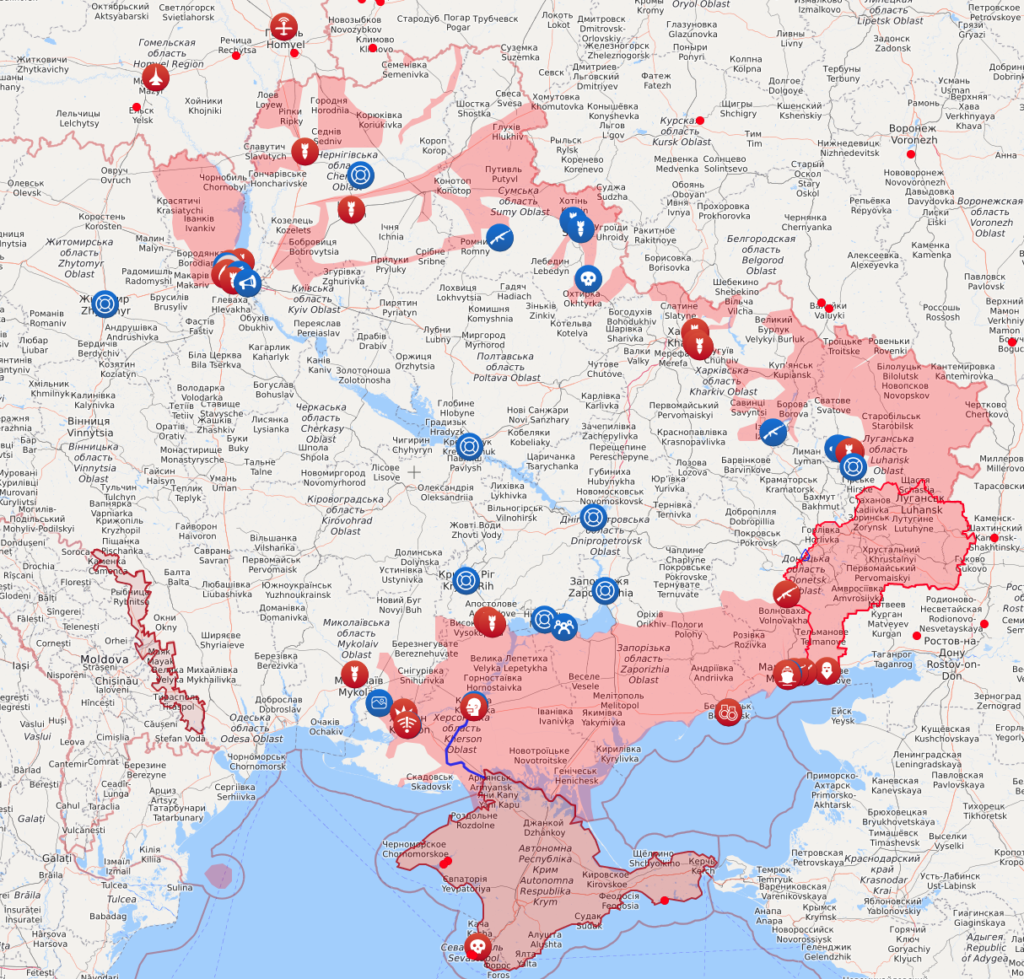
Some significant changes since the last update, mainly that Russian forces have finally taken Mariupol, allowing Russian forces in the east to linkup through Donetsk. But elsewhere a slow, grinding stalemate seems to prevail.
Ukrainian forces have defeated the initial Russian campaign of this war. That campaign aimed to conduct airborne and mechanized operations to seize Kyiv, Kharkiv, Odesa, and other major Ukrainian cities to force a change of government in Ukraine. That campaign has culminated. Russian forces continue to make limited advances in some parts of the theater but are very unlikely to be able to seize their objectives in this way. The doctrinally sound Russian response to this situation would be to end this campaign, accept a possibly lengthy operational pause, develop the plan for a new campaign, build up resources for that new campaign, and launch it when the resources and other conditions are ready. The Russian military has not yet adopted this approach. It is instead continuing to feed small collections of reinforcements into an ongoing effort to keep the current campaign alive. We assess that that effort will fail.
The ultimate fall of Mariupol is increasingly unlikely to free up enough Russian combat power to change the outcome of the initial campaign dramatically. Russian forces concentrated considerable combat power around Mariupol drawn from the 8th Combined Arms Army to the east and from the group of Russian forces in Crimea to the west. Had the Russians taken Mariupol quickly or with relatively few losses they would likely have been able to move enough combat power west toward Zaporizhiya and Dnipro to threaten those cities. The protracted siege of Mariupol is seriously weakening Russian forces on that axis, however. The confirmed death of the commander of the Russian 150th Motorized Rifle Division likely indicates the scale of the damage Ukrainian defenders are inflicting on those formations. The block-by-block fighting in Mariupol itself is costing the Russian military time, initiative, and combat power. If and when Mariupol ultimately falls the Russian forces now besieging it may not be strong enough to change the course of the campaign dramatically by attacking to the west.
Russian forces in the south appear to be focusing on a drive toward Kryvyi Rih, presumably to isolate and then take Zaporizhiya and Dnipro from the west but are unlikely to secure any of those cities in the coming weeks if at all. Kryvyi Rih is a city of more than 600,000 and heavily fortified according to the head of its military administration. Zaporizhiya and Dnipro are also large. The Russian military has been struggling to take Mariupol, smaller than any of them, since the start of the war with more combat power than it is currently pushing toward Kryvyi Rih. The Russian advance on that axis is thus likely to bog down as all other Russian advances on major cities have done.
The Russian military continues to commit small groups of reinforcements to localized fighting rather than concentrating them to launch new large-scale operations. Russia continues to commit units drawn from its naval infantry from all fleets, likely because those units are relatively more combat-ready than rank-and-file Russian regiments and brigades. The naval infantry belonging to the Black Sea Fleet is likely the largest single pool of ready reserve forces the Russian military has not yet committed. Much of that naval infantry has likely been embarked on amphibious landing ships off the Odesa coast since early in the war, presumably ready to land near Odesa as soon as Russian forces from Crimea secured a reliable ground line of communication (GLOC) from Crimea to Odesa. The likelihood that Russian forces from Crimea will establish such a GLOC in the near future is becoming remote, however, and the Russian military has apparently begun using elements of the Black Sea Fleet naval infantry to reinforce efforts to take Mariupol.
The culmination of the initial Russian campaign is creating conditions of stalemate throughout most of Ukraine. Russian forces are digging in around the periphery of Kyiv and elsewhere, attempting to consolidate political control over areas they currently occupy, resupplying and attempting to reinforce units in static positions, and generally beginning to set conditions to hold in approximately their current forward positions for an indefinite time. Maxar imagery of Russian forces digging trenches and revetments in Kyiv Oblast over the past several days supports this assessment.[1] Comments by Duma members about forcing Ukraine to surrender by exhaustion in May could reflect a revised Russian approach to ending this conflict on terms favorable to Moscow.
Stalemate will likely be very violent and bloody, especially if it protracts.
What the invasion revealed about the Russian military:
Lots of problems, including a reiteration of the inability of the Russian air force to conduct combined arms operations, especially given their limited flight training (8 hours a month).
Speaking of limitations:
#Russia's active tank fleet is actually not 12,000 strong. In reality it is just over 2,500. By active tanks I mean tanks that are actually in service in an organised unit (i.e. a tank battalion, regiment, brigade etc.) and are not undergoing field tests (T-14 Armata). pic.twitter.com/fJYrGjc5L4
Lots of tweets wonder aloud why there have been no confirmed T-14 Armata sightings in theater in Ukraine. We’ll know Russia is really desperate if they start hauling T-64s out of mothballs and into service. (Ukraine actually has a lot of modernized T-64 Bulats, as the original T-64 factory is there.)
“We Have Questions About Russia’s Claimed Kinzhal Hypersonic Missile Use In Ukraine.” “In the end, not everything adds up here. That’s just the reality. It is just as possible we are seeing a standard Iskander-M attack in the video as one by Kinzhal.” Russia had produced an awful lot of vaporware when it comes to wonderwaffen, and it wouldn’t surprise me to see their hypersonic missile fall into this category.
And since we’re talking hypersonic and eastern Europe:
Ukrainian civilian drone enthusiasts are carrying out realtime coordinated reconnaissance on Russian troops:
News from St. Petersburg:
St Petersburg, Russia tonight chanting "No to war", "Shame", and "Ukraine is not our enemy!" Russia has been arresting protesters all day and yet the crowd has grown. pic.twitter.com/V6ZtOIam2t
Yesterday’s post on autloaders made me wonder how Russia’s T-14 Armata main battle tank project is coming along. The answer seems to be: not so hot.
Despite a reduction in Russian defense spending caused by lower oil prices, which came after the Kremlin opted not to cut production, the Russian military is charging ahead with its Armata combat vehicle program. It is being overseen by Rostec Corporation – the Moscow conglomerate that specializes in consolidating strategically important companies in Russia’s defense sector.
This includes the Armata T-14 main battle tanks (MBT) first demonstrated during the May 2015 Victory Parade in Moscow. Sergi Chemezov, Rostec Corporation’s chief executive officer, told reporters last week that while any new projects would be discontinued the Armata projects – which include the T-14 as well as the T-15 heavy infantry fighting vehicle and T-16 armored repair and recovery vehicle – were still on track.
However, when these tanks might be delivered is still very much in question.
As of January, the Russian Ground Forces (RGF) had not taken delivery of its first batch of the third-generation T-14s, and delivery has been delayed multiple times around. Delivery was expected on the first nine tanks by Russian tank manufacturer Uralvagonzavod (UVZ) in 2018, before the target date was pushed back to 2019.
Work on the Armata project began in 2010, when the Russian Ministry of Defence terminated work on “Object-195” – the T-95 program. The entire project was seen to be a huge technological leap from Soviet-era military hardware designs and from the ground up the T-14 is very much distinct from past Soviet/Russian tank platforms.
The outline of the tank, from its hull to its long and boxy turret, which resembles Western tank turret designs, is a notable departure from past Soviet designs.
Interestingly, the conventional long, boxy turret wasn’t part of the early Armata sketches released, which showed a radical, low-profile design theoretically made possible by the autoloader. That was completely gone by the time the first prototypes appeared (and stalled) at the 2015 Moscow Victory Day Parade.
It isn’t just the profile of the Armata T-14 that sets this tank apart from its predecessors.
Among its innovative characteristics is its unmanned turret, which includes a remotely controlled 125mm 2A82-1M smoothbore main gun with fully automated loading. The turret’s magazine contains a total of 45 rounds of ammunition, but the main gun can also fire laser-guide missiles. In addition, the 2A82 125mm gun can even be upgraded to the 2A83 152mm gun, while the T-14 can also be fitted with secondary weapons such as the Kord 12.7mm machine gun or a PKTM 7.62mm machine gun.
I don’t believe the the T-14 can ever be uparmed with the 152mm cannon. There simply doesn’t seem to be enough room to fit it in. That was what was supposed to go in the cancelled T-95/Object 195 program, which was a larger platform, and which Russia killed in 2010 after Uralvagonzavod produced a prototype which it never showed to the press and for which no field maneuver footage seems to exist. Which means it was even more good old-fashioned Russian vaporware than Black Eagle, of which they seemed to have produced one running prototype. Oh, and they also said Black Eagle could have been uparmed to the 152mm cannon as well. So a 152mm cannon-armed T-14 isn’t just vaporware, it’s third generation vaporware (if not even older).
As important to its offensive capabilities is the MBT’s ability to keep its crew protected. Here too is where the T-14 excels. This tank features a low-silhouette that reduces exposure to enemy fire, and that enhances the safety and survivability of the three-man crew.
The “low-silhouette” point is simply wrong. The T-14 is 3.3 meters high, compared to 2.2 meters for the T-90 and 2.44 meters for the M1A2. That’s higher even than the World War II M3 Lee tank the Soviets (who got them via Lend-Lease) called “a coffin for seven brothers.”
The driver, gunner and tank commander are housed in a crew compartment that is located in an armored capsule at the front portion of the hull, isolated from the automatic loader as well as the ammunition storage in the center of the tank.
The crew compartment is made from composite materials and protected by multilayer armor, which according to analyst reports can withstand a direct hit of nearly any type of round that currently exists including sub-caliber and cumulative rounds.
This smells like more hype. The crew compartment does seem to be very well-protected, but it remains to be seen whether it can stand up to a strike from a Javelin or Hellfire 2. RPG-29s (hardly state-of-the-art anti-tank tech) have taken out Challaneger 2s and Merkavas when it hit them just right, and they had proven Chobham composite armor rather than whatever composite armor Russia has managed to develop.
Supposedly the T-14 was tested in Syria, according to TASS, and if you can’t trust Russia’s own propaganda organ, who can you trust?
Here’s a video that discusses various T-14 problems from a YouTuber who tends to be a lot more positive about the T-14 (and Russian tanks in general) than I am.
The main problem plaguing the T-14 is the same one plaguing the rest of the Russian military: Russia is broke and they can’t maintain their current military infrastructure, much less adequately fund future weapons development. They were broke before oil prices hit the toilet, and the strain of Vald’s Excellent Adventures in Syria and Ukraine haven’t helped. That’s why dry docks sink and nuclear subs explode.
And even if all those problems are overcome, Russia has only ordered 100 of them, and production seems to be so slow they may not even hit that. Its fate may be like the Type 3 Chi-Nu tanks Japan produced late in World War II: A formidable peer to American tanks on paper, but produced in such small numbers they never saw combat.
In an NBC News interview yesterday, Cardinal Blase Cupich of Chicago insisted that it was more than acceptable for Pope Francis to refuse to discuss Archbishop Carlo Maria Viganò’s shocking testimony, which implicates a host of Catholic Church leaders — including the pope — in covering up sexual abuse and immorality.
“The pope has a bigger agenda,” Cupich told interviewer Mary Anne Ahern when asked about the pope’s refusal to discuss Viganò’s claims. “He’s got to get on with other things, of talking about the environment and protecting migrants and carrying on the work of the Church.
“What’s a few raped children when we might be able to lower global temperatures a fraction of a degree a century from now?”
“There’s a widespread consensus that at no time in the past 40 years, since Saddam Hussein acquired absolute power and led Iraq into a series of ruinous wars, has Baghdad been as free and as fun as it is now.” (Hat tip: Ann Althouse.)
Remember Russia’s new T-14 Armata tank? They were going to build 2,300 of them. Now? 132. And that number is split between the T-14 and the T-15 heavy infantry fighting vehicle, which shares the same chassis. Which means Russia will have to continue to rely on older T-72 and T-90 tanks as the mainstays of their armored forces for the foreseeable future. By comparison the United States has over 1,500 M1A2s and over 4,000 M1A1s, both of which proved capable of taking out T-72s in the Gulf War. As Stalin once put it, “Quantity has a quality all it’s own.” And the essential brokeness of Russia is why I’m not worried about their costly adventurism in Syria. (Hat tip: Stephen Green at Instapundit.)
John McCain was admired by liberals; that is, when they weren’t calling him a senile plutocrat warmonger.
Humphrey would be the last Democratic presidential nominee to represent the values of Truman and JFK: compassionate big government at home, and resolute anti-Communism abroad. Instead, a new Democratic party was born, one that increasingly reflected the radical views of the Chicago protesters: that America, not Communism, was the real force for evil that needed to be contained and transformed. That Democratic party would nominate George McGovern in its 1972 convention and become a party obsessed with social justice, identity politics, and America’s past sins — essentially the party it is today. Meanwhile mainstream Democratic voters began their flight to the Republican party, “Reagan Democrats” who would enable the GOP to win four of the next five presidential elections and who later became the foot soldiers of the Trump insurgency.
Israel is developing a new, Artificial Intelligence-equipped version of its Merkava tank that is also designed to fight in cities.
Israel’s Armored Corps likens the Barak (“lightning”) to the Israeli Air Force getting the F-35 stealth fighter.
The Barak, an advanced version of the current Merkava 4 tank, is scheduled for deployment by 2021. “The Merkava Mk. 4 Barak will be the first tank to have a smart mission computer that will manage the tanks’ tasks,” according to an Israel Defense Forces announcement . “This advanced artificial intelligence will reduce the team members’ workload and help them more accurately locate and strike targets.”
In addition, the Barak will have upgraded sensors, networking with other tanks, and a Virtual Reality system embedded into the tank, which the crew can access via special helmets. The VR equipment will allow the crew to perceive the environment around the vehicle, as well as conduct virtual training and mission rehearsal inside their tank rather than having to travel to a special training center.
“The helmet is called Iron View, and it will allow the combat soldiers to see the outside environment from inside the combat vehicle,” said a senior Armored Corps officer. The Barak will have systems to warn the driver of obstacles, similar to those found on luxury automobiles, as well as an active protection system (presumably the Trophy anti-missile system), an IDF commander told Israel’s Walla news site. The tank will also have improved logistics that will enable it to carry out missions that are 30 percent longer than current operations.
Most interesting is the Barak’s new target. Tanks traditionally have been designed to fight other tanks, or provide support to infantry, on a regular battlefield. But the IDF has designed Barak for urban warfare, especially against insurgents such as Hamas. During Operation Protective Edge, Israel’s 2014 incursion into Gaza, Israeli troops found themselves embroiled in fierce street fighting — including Hamas fighters popping up from tunnels — on a confined battlefield where enemy combatants and civilians were mingled.
Snip.
The 65-ton Merkava is a unique design built around Israel’s needs, in particular the overriding desire to protect the crew from harm. The engine is in the front of the vehicle, which provides additional protection, while the rear has an armored compartment to carry up to eight infantry or three stretchers. The Merkava 4 is armed with a 120-millimeter cannon and the Trophy active protection system, which fires a barrage of shotgun-like shells to destroy incoming anti-tank rockets.
The Merkava’s rear door also facilities rapid resupply of cannon rounds, which the Israel found to be a particularly pressing need after many tanks ran out of ammo during the course of the Six Day War. The 120mm main cannon is a smoothbore, very similar to the Rheinmetall M256 120mm smoothbore cannon mounted on the M1A2.
Here’s a not-completely-useless video on it that pulls some of the VR clips from the IDF video linked from the National Interest piece:
Speaking of the M1A2, to counter a possible Chinese invasion, Taiwan is buying 100 of them to replace Taiwan’s aging tanks (presumably M48s and M60s) at a cost somewhere between $650 million and $1 billion.
“T-14’s got a three-man crew,” one specialist said, sitting behind the .50-caliber gun atop the Abrams. “All the crews in the hole, so it sounds pretty safe.”
The specialist zeroed in on the T-14’s autoloader.
“You looked around in here,” he said. “You see how sandy it is? You need something that’s going to work in all terrain.”
“Generally, I think the Russians like to build things that — like the AK, you can throw it through the mud and it’ll keep shooting,” the specialist said. “I feel like with the T-14, they got their eye off the ball, trying to be fancy.”
The specialist also said a crew member could load the cannon faster than existing mechanical autoloaders — so I asked what the point of an autoloader was.
“If the ammunition is so heavy, and so long — it’s a small turret here,” the specialist said. “The T-14 has gotten around that by having an entirely automated turret. What happens, though, if something goes wrong in the middle of battle, and somebody’s gonna have to get up in there, get out of their position? I don’t know.”
“Let’s say there’s a misfire,” another crew member interjected. “How much work would it take to get that machine open, get that breach open, and get down in there?”
I then asked what they thought about the idea that the T-14 could eventually be an unmanned tank .
“Maintenance-wise, an unmanned tank is going to be really difficult,” the specialist said. “All I do is maintain tanks … and these tanks still go down.”
Despite unveiling the tank in 2015, Russia has still not mass-produced the T-14 because of the high cost of the platform. Moscow initially said it would produce 2,300 T-14s by 2020 , but last year, it said it would make only 100 in that time.
Not sure I agree on the autoloader speed part. Industrial automation has gotten plenty fast, so there’s no reason a properly designed autoloader wouldn’t be faster than a human crew. Whether the Russians got it both fast and reliable enough for all-terrain combat situations is another matter…
And here’s a piece on how China’s Type 99 tank stacks up against American and Russian tanks:
China’s Type-99 combines a hull that closely resembles an elongated T-72 with a Western-style turret inspired in part by the German Leopard 2. First appearing as the Type 98 prototype tank in a National Day parade in a 1999, the vehicle was re-designated the Type 99 and entered service in 2001. At 57 tons, it comes in between the 70-ton Abrams and the 48-ton T-90 in terms of weight. Several upgrades, including the new Type 99A2 variant, boast advanced new technologies. Beijing fields nearly 500 Type 99s in sixteen armored battalions, and has produced 124 of the newer 99As so far. The type is not offered for export, though some of its technology is used in China’s VT4 export tank.
The Type 99 and the T-90 rely on a 125 millimeter cannons using carousel autoloaders descended from Soviet-era designs. This weapon proved underpowered verses Abrams and Challenger tanks in the Gulf War, but new improved tungsten ammunition leaves it capable of piercing the frontal armor of an Abrams at shorter combat ranges.
The new Type 99A2 comes with a longer barrel main gun, which in theory should impart higher muzzle velocity to sabot shells and improve their armor penetration and accuracy. It also boasts fancy new stabilizer technology.
Reportedly, China intends to eventually install a larger 140 millimeter gun on the Type 99, but early tests have cracked up the weapon. This, incidentally, mirrors Russia’s plans to up-gun its new T-14 Armata tank to a similar caliber weapon.
China has developed its own depleted uranium ammunition for its 125 millimeter gun, which it claims can penetrate the M1 up to ranges of 1.4 kilometers.
The Abrams uses a fourth crewmember to load the gun, which American tankers argue is more reliable, offers a higher rate of fire, and gives the tank a spare hand if one of the other crew members is incapacitated. However, the space needed to accommodate a fourth crew member makes the M1 larger and heavier.
The Type 99 and T-90 both can fire anti-tank missiles from the gun tube, while the Abrams cannot. (The Type 99 uses AT-11 Refleks missiles licensed from Russia). This could theoretically be useful for combat at very long ranges, or against low-flying helicopters. However, tank-launched missiles have existed for fifty years without seeing much use.
Effective sensors for spotting and aiming are arguably as decisive in tank engagements as firepower. Russia has made some strides in tank sights and thermal imagers in recent years, though the general sentiment is that Western sights and sensors remain superior. The T-90A does not carry Russia’s best hardware (some have been upgraded with French Catherine thermal sights), while the T-90MS has an improved Kalina targeting system.
China is known for its excellent electronics, and the Type 99A2 supposedly carries a new infrared tracking system that enables it hunt enemy tanks efficiently and is believed to be superior to the systems on the T-90A.
The Type 99 benefits both from composite armor, and Explosive Reactive Armor (ERA), bricks of explosives onto the tank that prematurely detonate incoming shells. The new Type 99A2 variant uses a multi-layered system thought to be similar to the Relikt ERA developed by Russia, which uses a radar to detonate the ERA before hostile shells impact. It is intended to defeat tandem-charge missiles capable of overcoming older-generation ERA.
The T-90A uses the older Kontakt-5 ERA, while the new T-90MS tanks serving in India sport the Relikt system. Though most effective against anti-tank missiles, both systems also diminish the penetrating power of tank shells.
The Type 99 also comes with a Laser Warning Receiver which warns the tank commander if his vehicle is being painted with hostile targeting lasers, affording the driver a chance to back away out of danger. Given all the videos from Syria and Yemen of tanks sitting obliviously as anti-tank missiles meander towards them (often taking 20 seconds or more to impact), this could significantly improve survivability.
The Type 99 also is believed to come with its own unique high-powered ‘dazzler’ laser designed to jam laser- and infrared-guided missiles, damage enemy sights, and blind the eyes of hostile gunners, possibly with a permanent effect. Fortunately, high-power tank-mounted dazzlers have never been used in combat before, so we have no idea how well they would work.
The Abram’s Rheinmetal 120 millimeter gun, equipped with politically-controversial M829 depleted-uranium rounds, can penetrate around 15-25% more armor. The U.S. now produces new generations of M829 rounds capable of piercing the advanced Kontakt and Relikt reactive armor systems developed by Russia (more on those below).
All interesting stuff, but the author loses me here:
The M1 Abrams lacks its own Laser Warning Receiver, Active Protection Systems or Explosive Reactive Armor, though it is conceivable future upgrades will incorporate some of these features.
The author’s observation that the Type 99 is faster and less gas-guzzling than the M1A2 is, alas, probably accurate.
Instead of retiring the T-80, Russia is upgrading it:
In 2017 the T-80BVM, a deep modernization of the T-80BV, was revealed to the public. This included the new standard Sosna-U thermal sight, a new Relikt explosive reactive armor (ERA) fit and a general overhaul of the chassis, bringing the T-80BV up to the standard of the T-72B3.
The T-80BVM is even superior to the T-72B3 in some aspects, as the ergonomics of the gunner’s station are said to be better than the B3 as the Sosna-U station is placed directly in front of the gunner as opposed to off to the side on the T-72B3. The superior characteristics of the T-80BVM have resulted in it being assigned to the elite 4th Guards Tank Division “Kantemirovskaya” instead of T-72 or T-90 variants.
Canada is having trouble find a good home for its retired Leopard C2 tanks. While I would be happy to take delivery of one, I suspect the cannon muzzle would stick out in the street, and I fear the tank’s weight would degrade my driveway. Plus there are all those pesky federal regulations… (Hat tip: Ace of Spades HQ.)
Update: This is curious:
National Interest screwed up the byline here. I did not write the article on the Type 99. I couldn’t tell you who did.