Daily Mail online carried a headline on the 8th of June: Healthy young people are dying suddenly and unexpectedly from a mysterious syndrome – as doctors seek answers through a new national register.
This is SADS – an acronym that stands for Sudden Adult Death Syndrome – and according to the Royal Australian College of GPs, it occurs most commonly in people under 40. This is properly scary; I don’t mind telling you. Healthy young people are going to their beds of an evening and not waking up ever again, or otherwise going about their everyday business and dropping dead, for no identifiable medical reason.
The best anyone in the health professions can apparently do is describe it as mysterious, baffling even, that there are people under 40 dropping in their traces for no known cause. At the same time, around the world, there have been reports of many hundreds of sports men and women dying suddenly and unexpectedly in the past year – super fit individuals uniquely focused on their own health – keeling over dead, often on the field of play.
Here at home we have had updated information campaigns about how important it is to be aware of the incidence of heart attacks and strokes. It has been deemed appropriate to remind us as well that heart attacks are not unknown in children. It’s almost as if we’re not to be unduly alarmed by the sight of passers-by dropping to their knees and clutching at their chests. Elsewhere there is a poster campaign about a rise in the number of cases of shingles. The small print on the posters mentions shingles may strike people with lowered immune systems. Fancy that.
Deaths have been attributed by coroners to the Covid vaccines. The numbers are disputed, but people have died on account of the jabs. That much at least is undeniable. Around the world there are millions of cases of alleged adverse reactions to the jabs – lives severely compromised in some cases. I won’t get into the numbers, because those are always disputed too – but the facts remain. People are dying.
The elephant in the room here is the Covid-19 vaccines – and again I make no apology at all about banging on about this topic week after week. The push to move on, to leave all talk of Covid and pandemic behind us, is palpable and, I would say, downright sinister. I am nowhere near ready to move on – not while there is still so much we do not know, so much we are not allowed to say, think and ask.
We are told all about Covid 19 – and all manner of ways in which it might affect health long after a person has recovered from the initial infection. But as well as the pandemic, the other momentous arrival among us – indeed in just the past year and a half – is the biggest mass vaccination campaign in the history of the world – vaccination with products that had emergency approval, but in my opinion are experimental and for which no long-term data is available – on account of their being brand new and just out of the box.
Billions of people around the world have submitted to the procedure. In a coercive and bullying atmosphere created by politicians and the media, that was mandatory in feel, if not in fact, unknown and unknowable numbers of people did so simply to keep their jobs, to get on a plane and go on holiday or to a gig – and yet in the midst of one report after another of otherwise unexplained sudden deaths in the past 18 months or so, the only emergent variable, the only new thing in the world that we are not allowed to discuss, absolutely not allowed to discuss far less point accusatory fingers at, is the mass vaccination programme.
Again, I ask the question I posed at the top of this piece – are we stupid? Or are we just being treated as if we’re stupid? Which is it?
Sri Lanka was a product of that government following, you know, the the madness of [World Economic Forum] inspired policies: Net Zero, the stripping of fertilizers, and all the rest of it…wholesale strife, collapsing crops and all the rest of it. You would think in a sane world the politicians in each of the countries would respond to the people, but I suspect they won’t. We saw something similar in Canada with the trucker’s freedom convoys, but look what happened there. Obviously Justin Trudeau was was told to get a grip of that situation. He clamped down on it violently, arrested bank accounts and took away the funding for that movement.
Bit on Sri Lanka skipped.
I think what you’re looking at in The Netherlands, for example, is the deliberate dismantling of the land owning class. 85% percent of the of the land in The Netherlands is held by farmers, and has been for generations, and that’s an inconvenient situation for globalist leftist politicians who’ve got other ideas for the land, which is specifically to build houses to cope with the with the levels of immigration that are going on. They’ve empowered themselves the politicians to help themselves to 30 percent of the Dutch farmer’s land, and surprise, surprise! Just as I suspect you would or I would, if the government came into our homes and said they were taking 30% everything we had we owned and had worked for, the farmers have said no…It’s a blatant land grab.
It gets harder and harder to ignore the intent by by leftist globalist governments to return us to some form of feudalism. All these people like us owning property, owning homes, living lives independent of the state. You know what the intention is there, to take people’s independence away. Take away their property, take away the land, and if you control the farmland, you control the food. And if you control the food, you control the people. So you can plainly see what the agenda is.
One need not agree with every one of Oliver’s conclusions to agree that the pattern he deduces, of elites acting against the best interests of the countries they govern and the people they ostensibly serve, seems very real.
This is a catch-all post of various instances of Democrats acting badly I meant to include in the last few LinkSwarms and just didn’t manage to squeeze in.
On Wednesday, Reuters revealed that more than 5 million barrels of oil from the nation’s Strategic Petroleum Reserves were sent overseas as part of President Joe Biden’s latest release initiated in March.
Some of that oil went to India, some to the Netherlands, and some was sent to China where the president’s son has engaged in years of potentially criminal business activity embroiling the Biden White House in scandal since the 2020 campaign.
On Thursday, the Washington Free Beacon published new details about the Chinese oil shipments from the U.S. emergency reserves that Biden promised were tapped to “ease the pain that families are feeling” in the United States from high energy prices.
“The Biden administration sold roughly one million barrels from the Strategic Petroleum Reserve to a Chinese state-controlled gas giant that continues to purchase Russian oil, a move the Energy Department said would ‘support American consumers’ and combat ‘Putin’s price hike,’” the Beacon’s Collin Anderson reported. “Biden’s Energy Department in April announced the sale of 950,000 Strategic Petroleum Reserve barrels to Unipec, the trading arm of the China Petrochemical Corporation. That company, which is commonly known as Sinopec, is wholly owned by the Chinese government.”
Sinopec is also tied to Hunter Biden, whose private equity firm, BHR Partners, bought a $1.7 billion stake in the company seven years ago.
Hunter Biden’s lawyer told the New York Times in November that the president’s son, “no longer holds any interest, directly or indirectly, in either BHR or Skaneateles.”
According to the Washington Examiner, however, Hunter Biden remained listed as a part-owner of the firm as late as March.
“Business records from China’s National Credit Information Publicity System accessed Tuesday continue to identify Skaneateles as a 10% owner in BHR, and Washington, D.C., business records continue to list Biden as the only beneficial owner of Skaneateles,” the paper reported. “The White House has routinely deflected questions about Biden’s business dealings to his attorneys, who have remained largely mum.”
“It’s possible that China’s business registry hasn’t yet been updated to reflect a potential transfer or sale of Skaneateles’s 10% stake in BHR to another party,” the Examiner added.
Meanwhile, Biden’s Energy Department has refused compliance with requests under the Freedom of Information Act probing the administration’s improper use of the nation’s strategic oil reserves maintained for emergencies. Last week, the Functional Government Initiative, a nonprofit government watchdog, filed a lawsuit to compel records concerning administration officials’ decision to tap the oil reserves in the absence of a sudden disruption in supply such as a hurricane or cyberattack.
I would say it’s quite revealing how quickly Democrats resorted to racist slurs against Justice Clarence Thomas following the overturning of Roe vs. Wade, but not really. They’ve long shown they are racist against any minority that refuses to toe the leftist line.
Twitter has been a cesspool of liberals calling Justice Thomas endless racist slurs … and of course, Twitter does nothing. Samuel Jackson called him ‘Uncle Clarence,’ and several people reported him and said they were told by Twitter it was not against the rules to call him that slur.
Why has Clarence Thomas become the target of so much flak following the Supreme Court’s overturning of Roe v Wade? It’s because he’s black. It’s because, as someone with black skin, he is not meant to hold conservative views on issues like abortion. In the eyes of the furious woke agitators who are haranguing Thomas even more than they are the other Roe-sceptical justices, he has not only made a bad legal decision – he has also betrayed his race. His sin is twofold: he has undermined the right to abortion and he has failed in his racial duty to nod unquestioningly along to every ‘progressive’ idea. He’s a racial transgressor, a bad black man, and therefore he must be reprimanded even more severely than the white folk on the Supreme Court. Ladies and gentlemen, behold the scourge of woke racism.
We have just witnessed one of the clearest examples yet of identity politics crossing the line into flagrant, undeniable racism. No sooner had it been announced that the Supreme Court was ditching Roe v Wade than so-called progressives were gunning for Thomas. They’ve never liked Thomas, who has been serving on the Supreme Court since 1991. Sure, he might be just the second African American to sit on the court, but for the identitarian elites he’s the wrong kind of African American, so his historic achievement doesn’t count. He’s Catholic – ‘decidedly and unapologetically Catholic’, as he says – and he’s not down with abortion or same-sex marriage. ‘Wait, I thought all blacks were BLM-supporting, pro-trans, sassy progressives like the ones I know from Twitter?’, you can almost hear the upper-middle-class left say. Thomas doesn’t compute for them. To paraphrase Biden, ‘He ain’t black!’.
And so it was inevitable he would get it in the neck following the fall of Roe. Vile racial hatred has been hurled his way since the ruling. Angry woke Twitter has even used the N-word. Thomas is ‘just another dumb field nigger’, said one tweeter. Another called him a ‘nigger slave’ to his white ‘nutcase’ wife. He’s a ‘coon-ass motherfucker’, apparently. And of course he’s an Uncle Tom. Or ‘Uncle Clarence’, as Samuel L Jackson called him. As a result, ‘Uncle Clarence’ trended online for hours. Welcome to the twisted moral universe of Silicon Valley, where you can be banned for life for saying ‘he’ about someone with a penis but you can happily surf a wave of retweets for using racial slurs about high-ranking black men.
For some reason that I really can’t fathom, the progressive left is escalating its hounding of conservative Supreme Court Justices. If they’re trying to turn off normal Americans, they’re doing a great job. If they’re trying to intimidate or coerce SCOTUS, they are failing miserably. But radicals gotta radical.
Justice Brett Kavanaugh already was the target of an attempted assassination. But the hounding and targeting of him continue.
Politico reports that Justice Kavanaugh was escorted by his security team out the back door of a DC restaurant because leftists were “protesting” outside.
On Wednesday night, D.C. protesters targeting the conservative Supreme Court justices who signed onto the Dobbs decision overturning the constitutional right to abortion got a tip that Justice BRETT KAVANAUGH was dining at Morton’s downtown D.C. location. Protesters soon showed up out front, called the manager to tell him to kick Kavanaugh out and later tweeted that the justice was forced to exit through the rear of the restaurant.
In a rare move, Supreme Court Marshal Gail Curley has sent letters to Maryland Gov. Larry Hogan, Montgomery County Executive Marc Elrich, and Virginia Gov. Glenn Youngkin demanding that authorities put an end to picketing and “threatening activity” outside the homes of SCOTUS justices.
The letter seeks to use state laws to achieve what the Justice Department has clearly rejected under federal law. If the letter prompts arrests, we could see a major free speech challenge in the courts. The timing of the letter, however, is particularly interesting and may reflect a recognition of the limits of the federal law.
Snip.
Under a federal law, 18 U.S.C. 1507, any individual who “pickets or parades” with the “intent of interfering with, obstructing, or impeding the administration of justice, or with the intent of influencing any judge, juror, witness, or court officer” near a U.S. court or “near a building or residence occupied or used by such judge, juror, witness, or court officer” will be fined or “imprisoned not more than one year, or both.”
The Hunter Biden shenanigans, though illegal, immoral and infuriating, is just more of the foreign graft rakeoff that Joe Biden and other high ranking Democrats have been pulling off for years. But the radical unhinged attacks on the Supreme Court after Dobbs v. Jackson Women’s Health Organization overturned the Democratic Party’s most Holy of Holies shows that the new pitch of derangement Democrats showed after Donald Trump’s unexpected election was not a temporary aberration.
These days, the Democratic Party seems less a political party than a criminal graft conspiracy married to a crazed social justice cult enraged by any setbacks to its grandiose plans or any questioning of their delusional status as anointed saviors of designated victims.
As reality crashes through their swaddling cocooned delusions and limitless self-regard, expect the derangement to get worse.
The U.S. Army on Tuesday selected General Dynamics Land Systems to build a light tank meant to improve mobility, protection and direct-fire capabilities for Infantry Brigade Combat Teams.
The production deal is a key step forward for Army Futures Command, which has promised faster and more successful modernization programs through a competitive prototyping approach.
GDLS will deliver 26 vehicles initially, but the contract allows the Army to buy 70 more over the course of low-rate initial production for a total of $1.14 billion, according to the Army.
At least eight of the 12 prototypes used during competitive evaluation will be retrofitted to be fielded to the force, service officials in charge of the competition said.
The first production vehicles are expected to be delivered in just under 19 months. The first unit will receive a battalion’s worth of MPF systems — 42 vehicles — by the fourth quarter of fiscal 2025. The Army plans to enter full-rate production in calendar year 2025, according to GDLS.
It uses 105mm main gun (the same caliber used in the first iteration of the M1 Abrams) and weighs 35 tons.
The German company said the Panther KF51 (KF is short for Kettenfahrzeug, or tracked vehicle; the number indicates it falls into the 50-ton plus class) “is destined to be a game changer on the battlefields of the future.” It sets “new standards” in “lethality, protection, reconnaissance, networking and mobility,” the company boasted in a statement.
Jan-Phillipp Weisswange, Rheinmetall’s assistant head of public relations, told Breaking Defense that the vehicle was designed on the company’s own funds and not in response to a client’s request. Weisswange said the tank was not designed as a candidate for the Franco-German Main Ground Combat System (MGCS) project, launched in 2012 to replace the Leopard 2 and Leclerc main battle tanks, but rather for an export market.
Still, those two systems could provide a sense of where Rheinmetall could target potential sales. Users of the Leopard 2 are Austria, Canada, Chile, Denmark, Finland, Greece, Hungary, Indonesia, Netherlands, Norway, Poland, Portugal, Qatar, Singapore, Spain, Sweden, Switzerland, Turkey, while the Leclerc is used by Jordan and the UAE.
The Panther’s chassis uses components of the Leopard 2 hull, but the turret is entirely new. According to the company, the 59-ton vehicle has a maximum operating range of about 500 kms (310 miles).
The main armament is the Rheinmetall 130mm cannon, designed for the MGCS project’s Future Gun System (FGS). The FGS is automatically loaded from two revolver-type magazines which each hold 10 rounds of insensitive munition-compliant ammunition. According to the company, the FGS “enables a 50% longer kill range to be achieved [than 120mm] with an unrivalled rate of fire due to the autoloader performance.” It can fire kinetic energy rounds as well as programable airburst ammunition and practice rounds.
There’s also a integrated drone launcher option. Here’s a short video on the tank, showing the location of the autoloader in the rear turret bustle:
Speaking of Germany, they’re evidently blocked Spain’s sale of used Leopard 2 tanks to Ukraine. (I have a skeleton post full of videos (some from this guy) about Germany announcing that it was thinking of sending heavy weapons to Ukraine, then dragging its feet with bureaucratic paperwork to actually do anything. It’s a strange, frustrating topic someone with more experience than myself in the arcane practice of Germany bureaucracy should research…)
The Economist published a thumbsucker on the future of the tank. It covers some familiar ground, including covering Russian failures during the opening phases of the Russo-Ukrainian War. Also includes a scrolling web-graphic thingee covering parts of modern tanks.
Welcome to the second half of 2022! The Biden Economy suckage becomes more obvious, the world’s most taboo lawsuit wants justice for real women being raped by fake women that the state of California forced on them, the Supreme Court slaps the EPA with a ruler over regulating carbon dioxide without congressional authority, and Eric Adams finally realizes he’s running a hellhole. It’s the Friday LinkSwarm!
Welcome to the world’s most taboo legal case, a lawsuit over imprisoned woman having the right not to be raped by men who “identify” as women.
On November 17, 2021, the Women’s Liberation Front, or WoLF, filed a civil rights lawsuit in California that drew almost no coverage. A press corps gearing up to be outraged en masse by the Amber Heard-Johnny Depp defamation case had zero interest in a lawsuit filed by far poorer female abuse victims.
Janine Chandler et al vs. California Department of Corrections targeted a new California state law, the “The Transgender Respect, Agency, and Dignity Act,” a.k.a. S.B. 132. The statute allows any prisoner who self-identifies as a woman — including prisoners with penises who may have stopped taking hormones — into women’s prisons. There was nothing TV-friendly about the scenes depicted in the complaint:
Plaintiff Krystal Gonzalez (“Krystal”) is a female offender currently incarcerated in Central California Women’s Facility. Krystal was sexually assaulted by a man transferred to her unit under S.B. 132. Krystal filed a grievance and requested single-sex housing away from men; the prison’s response to Krystal’s grievance referred to her assault by a “transgender woman with a penis.” Krystal does not believe that women have penises…
After a week spent denounced for reviewing the Matt Walsh documentary What is a Woman?, and for saying things I think will be boring conventional wisdom within a year, I was ready to never go near trans issues again and move to the impending financial disaster. But accident sucked me back. I’d made a point of pride of not reading a line of commentary about Heard-Depp, but listened to an episode of Blocked and Reported that touched on it after it was over, and learned three things that made me furious and think immediately of Chandler.
One, the ACLU, in apparent exchange for a pledge of $3.5 million, ghost-wrote Heard’s offending editorial, and in particular a line about her having “felt the full force of our culture’s wrath for women who speak out.” Two: Guardian writer Moira Donegan declared, “We are in a moment of virulent antifeminist backlash.” Three: Vice proclaimed without irony, “We’ve all failed Amber Heard.” Almost as one, the establishment press declared itself concerned with the suffering of a rich actress. However, there’s a gaping loophole in their concern for women, and Chandler sits in the middle of it.
Let’s talk about “the full force of our culture’s wrath for women who speak out” in the context of this case:
Chandler is the headline legal action in a nationwide battle over whether or not prisoners who self-identify as women, including those with histories of rape or sexual abuse, should be allowed to transfer to women’s correctional facilities. There have been both official and unofficial policy changes on this front in a growing collection of states across the country. These often happen with little to no public debate, because this issue may be the most impenetrable media taboo in America now.
The group bringing the suit, WoLF, has been targeted from every conceivable angle by pressure and censorship campaigns. While we at least heard about protesting Canadian truckers having their GoFundMe campaigns frozen, WoLF didn’t even bother trying to raise money on that platform, “because they just ban you really easily,” as legal director Lauren Adams put it.
They moved to a purportedly speechier platform, GiveButter, hoping they would have “less of a censorious kind of view.” But even GiveButter soon gave WoLF the boot (I reached out to the company, which hasn’t provided public comment yet). “It was just a general fundraiser,” Adams explains. “And they said we violated their community standards. So now we’re on GiveSendGo, which is a Christian crowdfunding site.”
If there’s a better illustration of the upside-down state of politics in 2022 America, it’s a feminist activist group forced to seek cyber-refuge in a Christian fundraising company.
Snip.
Most of the cross-dressing men claiming a “transgender identity” and granted transfer… are sex offenders, most are heterosexual men who want to be housed with women to get penis-in-vagina sex, most stop taking any feminizing hormone medications right after getting into women’s prison, they all refer to themselves as men when speaking to the women inmates, many have threatened to “fight you like a man” to women inmates, many have threatened to rape us, and they all have working penises that they are using to have sex with female inmates.
Transexism is now so central to the social justice victimhood politics ideology that controls the Democratic Party that it leads to letting men rape women rather than question the holy tenant that a man can magically become a women by declaring it so.
Notice how that “giant backlash” against the overturning of Roe vs. Wade seems to be limited to leftwingers freaking out on social media? Here’s a good explanation why:
This sums up my evolution better than I could have. Bet it’s highly highly a common sentiment.
Speaking of which, New York City mayor Eric Adams is shocked, shocked to discover that the city he runs sucks.
During an exclusive interview conducted as Adams rode the subways overnight for more than three hours last week, the former NYPD transit cop said he was astounded by the botched “deployment of resources” that has New Yorkers on edge amid a nearly 40 percent surge in major crimes this year.
“Let me tell you something: When I started looking into this, I was shocked at how bad this place is,” he said of the city.
Adams — who campaigned on a promise to restore order to an increasingly lawless Gotham — said the scales fell from his eyes when he began reviewing internal city operations following his swearing in moments after midnight on New Year’s Day.
Yet somehow I could tell that despite living some 1,700 miles away, thanks to the magic power of “paying attention” and “not depending on the MSM for news.”
Nowhere is the shift more pronounced — and dangerous for Democrats — than in the suburbs, where well-educated swing voters who turned against Trump’s Republican Party in recent years appear to be swinging back. Over the last year, far more people are switching to the GOP across suburban counties from Denver to Atlanta and Pittsburgh and Cleveland. Republicans also gained ground in counties around medium-size cities such as Harrisburg, Pennsylvania; Raleigh, North Carolina; Augusta, Georgia; and Des Moines, Iowa.
Who has the highest debt in the EU? Exactly who you would think: The PIGS (Greece, Italy, Portugal and Spain, in that order), then France, Belgium and Cyprus.
Following other western tech giants, Cisco plans to exit Russia permanently. Unless you’re in the sector, you might underestimate just how many pies Cisco has fingers in. (Hat tip: Stephen Green at Instapundit.)
This year? Not so much. In fact, the situation has flipped to such a degree that a factory owner told hundreds of students waiting to see if they can get a job that he’s only paying 9 yuan (about $1.35 an hour), and they can take it or leave it. Most stay.
Never mind the “Fight for $15” an hour. That’s not $15 a day.
Between the worldwide stagflation, the Russo-Ukrainian War, and the continuing Flu Manchu lockdowns, China’s house of cards economy is coming apart at the seems quicker than anticipated.
Remember how Sri Lanka managed to wreck agricultural yield by forcing the country to use organic fertilizer? “Not only had Sri Lanka’s ban on fertilizers, pesticides, weedicides, and fungicides resulted in massive food shortages, it also led to the doubling in price of rice, vegetables, and other market staples.”
Sri Lanka’s prime minister is increasing efforts to revive the country’s “completely collapsed” economy amid a lack of foreign exchange reserves and severe shortages of essential items.
“We are now facing a far more serious situation beyond the mere shortages of fuel, gas, electricity, and food. Our economy has faced a complete collapse,” Prime Minister Ranil Wickremesinghe told parliament on June 22.
“It is no easy task to revive a country with a completely collapsed economy, especially one that is dangerously low on foreign reserves,” he said.
This video goes into more depth of just how badly Sri Lanka is screwed.
Some takeaways:
“The government’s gross mismanagement in agriculture is just a small symptom in a much larger problem. Sri Lanka has run out of money and is now facing down the barrel of complete economic collapse.”
“In a span of just two years, its reserves of foreign currency has gone from $9.2 billion to just $50 million, not enough to cover a single day’s worth of imports, and not nearly enough to cover the $6.6 billion it needs to make loan payments. On April 12th, the government announced it will no longer be making such payments as a result it’s been cut off from international loans.”
“Basic necessities are hard to come by and daily rolling blackouts are shutting down businesses.”
Sri Lanka may be the first poorly managed developing country to fall, but it won’t be the last.
On paper, it shouldn’t be a basket case. It had a thriving tourism industry before a 2019 terrorist attack and 2020’s Flu Manchu.
“Sri Lanka, being a small developing country, imports a huge amount of commodities. As such, it’s been running a large trade deficit.”
Enter the nepotism:
Strongman Gotabaya Rajapaksa Gota built a name for himself viciously ending the civil war as head of the ministry of defense, with his brother Mahinda acting as president from 2005 to 2015. Gota ran on the promise of bringing forth vistas of prosperity and splendor in wake of an opposition party seen as too weak to handle domestic threats. Gota’s party won a landslide victory in parliament and he appointed his brother as prime minister. With a two-thirds majority, Gota quickly got to work rewriting the constitution, allowing him to appoint many top-level officials, including ministers and judges. He stuffed these positions with relatives, and has been slowly cementing greater unrestrained power.
How did he deal with the tourism downturn? He started printing money. “The budget deficit widened and its stockpile of foreign currency started to burn away.”
“Now more than ever, Sri Lanka was burning through its foreign reserves. This was further accelerated by the government’s desire to keep the rupees exchange rate at 200 rupees equal to one US dollar.” In the post-Bretton Woods world, fixed exchange rates are disasters waiting to happen.
The attempt to defend the rupee meant that foreign currency reserves went from $9.2 billion to just $1.6 billion in 2021.
“This caused the government to enact strange policies, like banning the importation of fertilizer in hopes of easing its trade deficit. Claiming the ban was to make Sri Lanka organic was simply a way to conceal its dire situation.” Yes, cutting back the ability of your own people to grow food in order to hide the manifest incompetence of your economic policies is quite the recipe for happiness.
Then Russia invaded Ukraine, and prices for food and energy skyrocketed.
“Basic necessities in Sri Lanka have become too expensive. The rupee is now just half of its original value. Schools have stopped testing for certain grades because they can’t buy ink.”
“The government has instituted daily 15 hour blackouts to save on energy imports but they have crippled industries. The nation has declared a state of emergency as massive mobs attack politicians and even set roadblocks to prevent them from escaping the country.”
Sri Lanka may be the first, but it won’t be the last.
With rapid global commodity inflation, supply shortages, and the likely coming global recession, many nations appear to be on the tipping point. There is growing unrest in Tunisia because of prices. Pakistan’s currency is plummeting and Argentina’s economy is straining under the weight of massive debt. The longer current conditions persist, the more likely we are to see what is happening in Sri Lanka to happen across the globe.
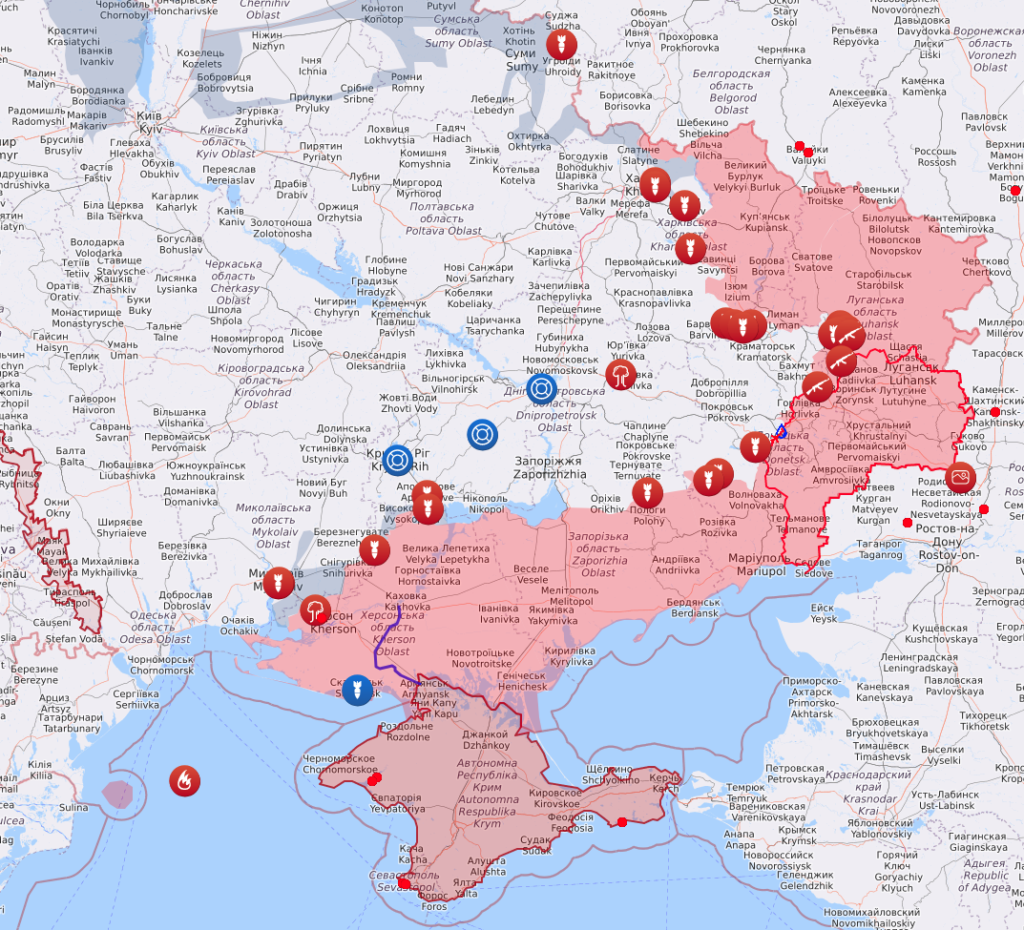
The general course of the Russio-Ukrainian War seems the same (Russia grinding out slow gains in the Severodonetsk front, while Ukraine gains back territory on the wings near Kharkiv and Kherson), but there are a lot of interesting stories out on the periphery of the conflict.
First, the requisite map snap:
(These snapshots are not the end-all and be-all of the situation, but back when I was covering the war against the Islamic State, I found that they were helpful in jogging my memory reviewing the course of the war at later dates.)
Members of the Russian military community continue to comment on the shortcomings of Russian force generation capabilities, which are having tangible impacts on the morale and discipline of Russians fighting in Ukraine. Russian milblogger Yuri Kotyenok claimed that Russian troops lack the numbers and strength for success in combat in Ukraine. Kotyenok accused Russian leadership of deploying new and under-trained recruits and called for replenishment of forces with well-trained recruits with ground infantry experience—though the Russian military is unlikely to be able to quickly generate such a force, as ISW has previously assessed. Despite growing calls for increased recruitment from nationalist figures, Russian leadership continues to carry out coercive partial mobilization efforts that are only producing limited numbers of replacements while negatively impacting the morale and discipline of forcibly mobilized personnel. Ukraine’s Security Service (SBU) claimed that Russian authorities in Luhansk are arranging gas leaks in apartment buildings to force men who are hiding from mobilization into the streets. The Ukrainian Main Intelligence Directorate (GUR) additionally reported that Russian soldiers in occupied Tokmak, Zaporizhia Oblast, are appealing to local Ukrainian doctors to issue them certificates alleging medical inability to continue military service.
Ukrainian forces conducted a drone strike (likely with a loitering munition, though this cannot be confirmed) on a Russian oil refinery in Novoshakhtinsk, Rostov Oblast, on June 22. Russian Telegram channel Voenyi Osvedomitel claimed that the strike, which targeted Russian infrastructure within 15 km of the Ukrainian border, originated from Donetsk Oblast. Ukrainian forces have not targeted Russian infrastructure for several weeks, and this strike is likely an attempt to disrupt Russian logistics and fuel supply to Russian operations in eastern Ukraine.
Though they also note that Russia has been using its anti-air capabilities to better deal with Ukrainian drones.
Well, a June 14 press release from Freeport LNG notes that “the incident occurred in pipe racks that support the transfer of LNG from the facility’s LNG storage tank area to the terminal’s dock facilities. … Preliminary observations suggest that the incident resulted from the overpressure and rupture of a segment of an LNG transfer line, leading to the rapid flashing of LNG and the release and ignition of the natural gas vapor cloud. Additional investigation is underway to determine the underlying precipitating events that enabled the overpressure conditions in the LNG piping.” The statement added that federal authorities were assisting with its investigation.
However, what was not explained is how a critical overpressure event could have occurred without safety systems kicking into action. Two LNG pipeline experts I talked to, who both asked to remain anonymous due to potential retaliatory damage to their business interests, say that pipeline corrosion and other material failures can cause critical incidents. Still, the FBI’s investigative involvement, the specific nature of this explosion, and the scale of damage incurred do raise major questions. The experts suggested that piping from a storage tank to a terminal, as in this explosion, should have extensive safeguards to prevent overpressure events. One expert was highly confident that control of pipeline flows would be undertaken from a networked control facility.
That brings us to the Russian cyber unit involved in the targeting reconnaissance against Freeport LNG.
Named XENOTIME by researchers, the unit has utilized boutique TRITON/TRISIS malware developed by the Russian Ministry of Defense’s Central Scientific Research Institute of Chemistry and Mechanics. That malware is designed for the seizure of industrial control systems and the defeat of associated safety systems. In 2017, GCHQ (Britain’s NSA-equivalent signals intelligence service) outlined the need for network compartmentalization to protect safety systems against this malware better. In March 2022, the FBI warned that TRISIS malware remained a threat.
XENOTIME is assessed by the U.S. and British governments as a critical infrastructure-focused, advanced persistent threat actor. The unit’s modus operandi involves targeting industrial control systems and supervisory control systems in order to effect unilateral control of a network. XENOTIME has caused specific concern in Western security circles for its targeting of safety systems that would otherwise mitigate threats to life during a cyberattack. XENOTIME’s activity has escalated in 2022. Evincing as much, an April 13 U.S. government cybersecurity warning noted, “By compromising and maintaining full system access to [industrial control system]/[safety] devices, [threat] actors could elevate privileges … and disrupt critical devices or functions.”
Snip.
While the Freeport LNG explosion remains under investigation, multiple sources told me they were struck by the overpressure event along a key pipeline transit route and the evident failure of safety systems to engage. This fits with XENOTIME’s modus operandi.
That’s an “interesting but unproven” in my book… (Hat tip: Jim Geraghty at NRO.)
More than 3 tons of gold was shipped to Switzerland from Russia in May, according to data from the Swiss Federal Customs Administration. That’s the first shipment between the countries since February.
The shipments represent about 2% of gold imports into the key refining hub last month. It may also mark a change in perception of Russian bullion, which became taboo following the invasion. Most refiners swore off accepting new gold from Russia after the London Bullion Market Association removed the country’s own fabricators from its accredited list.
While that was viewed as a de facto ban on fresh Russian gold from the London market, one of the world’s biggest, the rules don’t prohibit Russian metal from being processed by other refiners. Switzerland is home to four major gold refineries, which together handle two-thirds of the world’s gold.
Almost all of the gold was registered by customs as being for refining or other processing, indicating one of the country’s refineries took it. The four largest — MKS PAMP SA, Metalor Technologies SA, Argor-Heraeus SA and Valcambi SA — said they did not take the metal.
In March, at least two major gold refineries refused to remelt Russian bars even though market rules permit them to do so. Others, such Argor-Heraeus, said they would accept products refined in Russia prior to 2022, so long as there were documents proving that the gold had not been exported from Russia after beginning of the war, and that accepting them would not benefit Russia, a Russian person or entity anywhere in the world.
he fight for Severodonetsk is a Russian information operation in the form of a battle. One of its main purposes for Moscow is to create the impression that Russia has regained its strength and will now overwhelm Ukraine. That impression is false. The Russian military in Ukraine is increasingly a spent force that cannot achieve a decisive victory if Ukrainians hold on.
Russian President Vladimir Putin is therefore trying to turn his invasion of Ukraine into a brutal contest of wills. He’s betting his army on breaking Ukrainians’ collective will to fight on in their country. His own won’t likely break. Fortunately, Ukraine doesn’t need it to. If Ukrainians can weather the current Russian storm and then counterattack the exhausted Russian forces they still have every chance to free their people and all their land.
Putin amassed the wreckage of Russian combat forces into a lethal amalgam around the cities of Severodonetsk and Lysychansk in Ukraine’s eastern Luhansk Oblast. That amalgam is crawling forward using massive artillery barrages to obliterate everything in its path allowing Russia’s demoralized and frightened soldiers to walk into the rubble.
The Ukrainian defenders are wisely withdrawing in the face of this reckless barbarism, but at a high price to their own morale and their will to continue the fight. Ukrainian soldiers and citizens are criticizing their government for not supporting the troops on the front lines. Ukrainians are starting to doubt that they can prevail for the first time since they won the Battle of Kyiv. Delays in the provision of Western aid and refusals by the U.S. and other countries to provide certain needed weapons systems are helping to fuel those doubts. And now voices are rising in the West calling on Ukraine to offer concessions.
All of which is exactly what Putin needs. He cannot defeat Ukraine militarily as long as Ukrainians retain the will to fight and the West the will to back them. So he attacks the will of both by forcing his own troops into the most vicious and brutal offensive of this war, hoping to persuade everyone that he’s finally harnessed the mass and power of Russia that Stalin wielded to defeat Hitler—and thus that resistance to his demands is futile. Putin also holds hostage critical export supplies of Ukrainian food and fuel, hoping to impose high enough costs on the West to persuade it to abandon Ukraine.
Neither Ukrainians nor their friends around the world must give in to Putin or be deluded by the current mirage of Russian success and power he is presenting in the Battle of Severodonetsk. For mirage it is. Russia’s drive in Luhansk is the desperate gamble of a dictator staking the last of the offensive combat power he can scrape together in hopes of breaking his enemies’ will to continue the fight. and let him claim that he’s taken all of Luhansk Oblast. It is a historical rhyme with Hitler’s determination to seize Stalingrad in 1942 or to hold Kharkov in defiance of his commander’s advice. There are no Russian large reserves coming behind this force to carry its successes forward. On the contrary, Putin has created it only by denuding other key axes of the forces they need to defend against Ukrainian counterattacks. This offensive will likely culminate soon because even this slow, grinding advance will exhaust the forces conducting it. Putin will then be unable to launch another for quite some time.
I thought this would be a longer update, but I’m running out of day…
Lithuania has begun a ban on the rail transit of goods subject to European Union sanctions to the Russian far-western exclave of Kaliningrad, transport authorities in the Baltic nation said on June 18.
The EU sanctions list includes coal, metals, construction materials, and advanced technology.
Anton Alikhanov, the governor of the Russian oblast, said the ban would cover around 50 percent of the items that Kaliningrad imports.
Alikhanov said the region, which has an ice-free port on the Baltic Sea, will call on Russian federal authorities to take tit-for-tat measures against the EU country for imposing the ban. He said he would also seek to have more goods sent by ship to the oblast.
The cargo unit of Lithuania’s state railways service set out details of the ban in a letter to clients following “clarification” from the European Commission on the mechanism for applying the sanctions.
Previously, Lithuanian Deputy Foreign Minister Mantas Adomenas said the ministry was waiting for “clarification from the European Commission on applying European sanctions to Kaliningrad cargo transit.”
The commission stated that sanctioned goods and cargo should still be prohibited even if they travel from one part of Russia to another but through EU territory.
The European Union, United States, and others have set strict sanctions on Moscow for its unprovoked invasion of Ukraine.
As to why Russia ended up with a formerly German enclave between Poland and Lithuania, History Matters provides a handy guide:
The importance to Kaliningrad is that it’s Russia’s only ice-free port on the Baltic Sea and home to the Russian Baltic fleet at Baltiysk.
Anyone who remembers the history of the Cold War knows that there’s no love lost between Lithuanians and Russia.
Peter Zeihan (him again) explains why this is such a big problem for Russia. “Russia is already shitting solid gold kittens over this…in any sort of meaningful conflict between Russia and NATO, Kaliningrad would probably fall in a matter of days if not hours.” So Russia is likely to put in more nuclear missiles.
Plus a bit on Europe abandoning their green delusions to embrace coal, and how German accounting chicanery artificially inflates the amount of renewable energy they’re actually generating and ignore a lot of coal generation for official figures.
Lefty sorts are always whining that other countries have high speed rail networks and we don’t. Many point to China’s extensive network of high speed rail as what we should be doing.
Tiny problem: China’s high speed rail network is a giant, unprofitable sinkhole of $1.8 TRILLION worth of debt.
Some take-aways:
The average operating loss for the system is $24 million per day.
The official amount for China National Railway debt for high speed rail is $900 billion, but since roughly half of the debt comes from local governments, the total is probably closer to $1.8 trillion.
For comparison sake, $1.8 trillion is about South Korea’s entire yearly GDP.
“Shanghai, the richest city in China, has a total GDP of $600 billion in 2020, which means that even the whole year of Shanghai’s GDP won’t be able to cover the debt of China National Railway.”
It’s extensive: 37,900km, nearly double the length from 2015.
Return on high speed rail investment is only about 2%, and the bulk of bond payments for loans are coming due over the next few years. “Cash flow from railway transportation revenue isn’t enough to cover the operating costs, let alone the ability to pay the debt and interest.”
Local government debt levels are around 100%.
“More than 85% of the funds raised through urban investment bonds are earmarked for repaying old debts with new ones.”
Even the most profitable high speed rail stretch, Beijing to Shanghai, only earns a return on investment of 5%.
Japan’s successful high speed rail network serves three metropolitan areas (Tokyo, Nagoya and Osaka) that have 55% of that nation’s population.
“A professor at the School of Economics and Management of Beijing Jiaotong University concluded that the operating costs are only just covered when the transport density of a high-speed rail line reaches 36 million passenger kilometers per kilometer. In China the average transport density is only about 17 million passenger kilometers per kilometer.”
High speed rail can’t transport heavy freight.
“The Lanzhou Uramuchi HSR in western China can run more than 160 trains per day. In reality, this route only runs four trains per day.”
High speed rail occupancy rate is only 30%, and is still too expensive for most Chinese to use.
High speed rail construction has squeezed out much-needed construction of regular rail. “China’s rail freight capacity can’t meet market demand. China’s market share of road freight turnover has risen rapidly to 49% market share in 2016.” China rail has jacked up freight costs to make up for losses on high speed rail.
China’s freight trucks get overloaded all the time.
China’s containerized shipping accounts for 40% of global trade, but “the proportion of China’s sea rail intermodal transport volume in 2017 was only about 2.5 percent.” 84% of port containers go out by road.
So why all the money poured into high speed rail? Opportunities for corruption.
Officials see the high-speed rail project in which China is involved as a lucrative opportunity. China’s former minister of railways, known as the father of high-speed rail, was sentenced to death for corruption. Emerging industries such as high-speed rail, which offer both substantial commercial value and political achievements for local officials, have enormous room for corruption. In a systemically corrupt environment white elephant projects, that is a large project that falls significantly short of its goals, and the costs of upkeep outweigh its usefulness, are favored by many officials and businessmen looking to make a fortune. The vast majority of high-speed railways around the world can’t make ends meet on passenger revenues alone to cover their construction and operating costs. Most operate at a loss.
In light of all that, why do American leftists keep complaining about America’s lack of high speed rail? Simple: It’s the corruption, stupid. High speed rail construction offers boundless opportunities for graft and corruption, and refusing to build any keeps them from getting their snouts into another giant trough of taxpayer money…
(I didn’t expect this past week to become a string of “China’s economy is smoke and mirrors all the way down” posts, but I keep running into more examples.)
Here’s another entry for the “China’s economy is smoke and mirrors all the way down” file. Remember the previous story on the mountains of unused bikes for failed Chinese bike-sharing startups? Well, evidently the exact same thing happened with “green” cars:
The mechanics of the scam:
First they put together a down payment, order a batch of vehicles, and license them at a vehicle administration office.
Then they contact government officials, present the vehicles in their hands and apply for permission on the grounds that they are operating an online car sharing business.
The third step is to get the government’s permission, then go to the bank to get a loan.
The fourth step is to find a financer and present the vehicles and the government papers to secure some venture capital from the financer.
Last mortgage the vehicles to some smaller financial institutions to squeeze out their final value.
After all these steps are completed, the scammers disappear. The bank, the financer and the small financial institution are left with triangular disputes while the vehicles rot somewhere in the wilderness.
More takeaways:
China offers subsidies for new “green” cars.
Lots of these subsidized cars are bought by ride-sharing startups…
…that just happen to be subsidiaries of the the Chinese car companies manufacturing the cars being subsidized. (Presumably these are different companies than the pure scammers, but who the hell knows?)
Despite not being used, many have new license plates and up-to-date inspections.
Though there are minimum mileage requirements to get the subsidies, the businesses (in best Chinese fashion) just falsify the data.
“Especially the electric cars produced in previous years, the battery has a short range and the performance declines quickly. It’s worthless. At present it costs more to replace a new battery than the value of the old car.”
Most insane of all: China’s communist government required scrapping vehicles after 10 years or 100,000 kilometers. How’s that for “green”?
They later revised this to 15 years with annual inspections, then revised it again to a maximum of 600,000 kilometers.
And, of course, you can bribe inspectors to pass the inspection.
Green subsidy scams and failed startup detritus is hardly unknown in the U.S. (witness all those electric scooter sharing startups that are just now starting to go bankrupt), but China’s corner-cutting, get-rich-quick mentality combined with green government subsidies, interlocking corporate ownership, the usual Chinese scam artists and loose, bribe-able enforcement at various levels of Chinese government all combined for an especially appalling mountain of waste.