Chinese commie money is helping fund American commie wins, Rapey McNazi drops out, Ukrainian drones feast on Russian ships and hit Russia’s largest oil refinery (among others), Labour wants to install Big Brother into YouTube, and a victory for right to repair. Plus: Trebuchet!
It’s the Friday LinkSwarm!
Non-link summary of the state of Iran war: Bombing currently paused, but the ceasefire is over and, oh yeah, supposedly Iran is plotting to assassinate
President Trump.
One of the most consequential groups behind the surge of radical leftist candidates in New York’s and Colorado’s congressional primaries was a super PAC formed earlier this year, calling itself American Priorities. After filing with the Federal Election Commission (FEC) in February of this year, the group pledged to spend more than $10 million during the 2026 midterms and declared that its goal, according to founder Hannah Fertig, was “to make sure that someone’s there to protect candidates who question these [pro-Israel] policies,” countering the influence of the American Israel Public Affairs Committee (AIPAC).
The group invested about $2 million in supporting Adam Hamawy, an Egyptian-born physician who has testified on behalf of Omar Abdel-Rahman, the blind sheikh convicted of seditious conspiracy for his part in the 1993 World Trade Center bombing. Thanks in part to the group’s generous contributions, Hamawy handily won the Democratic primary in New Jersey’s 12th District.
American Priorities then spent an additional $2 million across the river in New York, contributing to the successful campaigns of Brad Lander, who unseated the incumbent, Congressman Dan Goldman, in a campaign focused largely on vilifying Israel, and Darializa Avila Chevalier, who unseated Adriano Espaillat in New York’s 13th District while doubling down on a host of controversial statements, from using the American flag as a napkin to supporting Hamas in the immediate aftermath of Oct. 7, 2023. The super PAC also spent $150,000 on TV ads to help democratic socialist Melat Kiros win Colorado’s 1st District primary.
Who, then, is behind American Priorities?
Public reports reveal that the group’s two largest donors, by far, are Omer Hasan and Mohammad Waqas Javed, who were described in the press as former Silicon Valley executives who recently became involved in politics and about whom “little is publicly known.”
But Hasan and Javed, as a simple web search reveals, are both alums of the same company, the mobile advertising and data company AppLovin, founded in 2012.
The company’s path to becoming one of the world’s most highly valued ad tech companies is highly unorthodox. According to The Economist, for example, the company’s share price has climbed more than 30-fold between 2022 and 2025, an astonishing feat for any company but particularly for one that, for years, wallowed in obscurity in the murky waters of app-monetization solutions.
In 2018, six years after it was launched, the company introduced a mobile-gaming publishing arm. “The result,” explained ad tech analyst Rio Longacre, “was a self-reinforcing flywheel: more games meant more first-party data, which fueled better optimization, which in turn strengthened both the AdTech stack and the company’s foothold in the gaming ecosystem.” Which, naturally, also raised considerable concerns: AppLovin was now both running the advertising platform and selling inventory, which inspired many critics to strongly doubt the validity of the numbers it was reporting.
But the company’s growth—and the vehemence of its critics—grew far more exponentially in 2022, when it pivoted away from being primarily a gaming company to “an AdTech company powered by AI-driven performance optimization,” a giant de facto machine learning operation. The company’s many detractors, Longacre noted, now charged it with “money flowing between entities the public can’t fully scrutinize, creating the illusion of third-party demand when some of it may simply be internal recycling. They also highlight the quality of traffic inside the system, pointing to patterns that resemble click-farm-adjacent behavior—bursts of installs from low-value regions, strange retention curves, and activity that seems optimized more for algorithmic signaling than real user engagement.”
To assess the validity of these claims, it helps to know who AppLovin partners with. In 2016, the company agreed to be bought by Orient Hontai Capital, a state-backed Chinese private equity firm. The Committee on Foreign Investment in the United States, an interagency government body dedicated to monitoring the national security implications of large-scale business transactions, objected, and the deal was subsequently amended.
The Chinese connection, however, was far from over: One of the company’s largest investors is one Hao Tang, who, according to regulatory filings in 2025, owned 3.2% of AppLovin, valued at roughly $4.6 billion. Other reports claim that Tang controls, through shell companies, at least 9.8% of Class A shares, making him the company’s largest individual shareholder beside AppLovin’s CEO, Adam Foroughi, who told Fox News in April, when AppLovin was trying to acquire TikTok’s non-Chinese assets, that he remains the largest shareholder.
Snip.
At the moment, $2 million of American Priorities’ war chest comes from Hasan and Javed (an additional $500,000 came from another former AppLovin team member, Tariq Afaq Ahmed, according to FEC filings). As attention on both the left and the right continues to focus on AIPAC and its alleged impact on American politics, it’s worth noticing that the most prominent PAC on the scene right now is funded primarily by two veterans of a shady tech colossus with strong links to China and repeated allegations of ties to the Communist Party in Beijing.
A new analysis from a Texas think tank found a correlation between district attorneys’ non-prosecution policies and increases in crime, but with few state options for addressing so-called “rogue” prosecutors, the group suggests that Texas lawmakers should consider reforms next year.
Ross Jackson, a senior policy analyst for Right on Crime at the Texas Public Policy Foundation, said he has been researching the issue since last fall.
“There are correlations that are particularly evident in Austin and Minneapolis and some other cities around the country and it’s more evident in cities and counties where there hasn’t historically been a huge crime rate like in Austin,” Jackson told The Texan.
According to Jackson’s report, Austin experienced one of the most dramatic surges in violent and property crimes in recent years, which saw the city’s homicide rate climb by over 60 percent between 2016 and 2024.
Travis County District Attorney Jose Garza, who was first elected in 2020, has been accused of dropping or reducing charges in hundreds of criminal cases, including one in which an appeals court had called for a new trial. Last year, Garza’s office reportedly failed to bring timely indictments for crimes that included violent felonies, leading to the dismissals of hundreds of cases.
Attempts to remove Garza through House Bill (HB) 17, a state law enacted in 2023, have failed, and he has ignored calls for his resignation over mishandled cases. Jackson noted that HB 17 is limited to removing district attorneys who officially adopt non-prosecution policies in conflict with state law, and does not apply to those who adopt informal policies or internal guidance.
Jackson noted that some proposed legislative remedies face high hurdles.
The policy solutions examined by Jackson include mechanisms to discipline or remove district attorneys, as well as avenues for prosecuting serious crimes when the local district attorney or a county prosecuting attorney fails to do so.
One possibility suggested by Jackson is creation of a new state commission to provide oversight and administer discipline. The model he suggested is based on the state’s former Prosecuting Attorneys Coordinating Council that operated between 1977 and 1983. While state lawmakers could create such a council through statute, Jackson noted that an amendment to the Texas Constitution would be needed to allow the council to remove district attorneys.
Constitutional amendments require the support of two thirds of both chambers of the Legislature, which usually requires bipartisan support, as well as approval by voters in a statewide election.
Jackson also noted that state lawmakers could give authority to the State Commission on Judicial Conduct to discipline rogue prosecutors, but giving it a removal mechanism would also likely require a constitutional amendment.
One possibility for prosecuting cases dropped by prosecutors would be to give that power to the Texas Office of the Attorney General (OAG). Under a 2021 Texas Criminal Court of Appeals opinion, the OAG may only prosecute cases referred by a local district attorney or county attorney.
“Unless the Court reverses their decision, giving the OAG that authority would definitely require a constitutional amendment,” said Jackson. “I think that would be the most difficult option legislatively, just given the partisan nature of that position. I don’t see many crossover voters on something like that.”
Other options include creating a state prosecutor or creating five new regional district attorneys, each anchored in one of Texas’ urban areas.
Jackson says that lawmakers appear to have the authority to create a state prosecutor or regional district attorneys through statute, but the regional approach may also require a constitutional amendment and may necessitate the creation of new courts — a more costly option for taxpayers.
Earlier this year, Gov. Greg Abbott cited Garza’s history as Travis County’s district attorney in his call for new legislation to create a statewide prosecutor and a mechanism for removing rogue prosecutors. Texas Sen. Mayes Middleton (R-Galveston), now the GOP nominee for state attorney general, has also voiced support for a statewide prosecutor.
In addition to Garza, Jackson’s report identified concerns over district attorney policies in both Bexar and Dallas counties. In Bexar County, District Attorney Joe Gonzales gave local law enforcement officers the option to issue tickets for certain “drug, theft, and traffic misdemeanors in lieu of jail time,” and Dallas County District Attorney John Creuzot announced that he would no longer pursue charges against “low-level, first-time drug offenders.” Cruezot rescinded a previous policy in 2022 of declining to prosecute low-level theft.
The FBI has arrested 113 active spies from foreign nations, agency director Kash Patel said on Wednesday.
The arrests of foreign spies “means our tech stays home and our defense secrets stay locked down,” a video shared by Patel on X said. “But the FBI didn’t stop there. They forced 62 removals of Chinese spies in 2026 alone.”
The video added that this has shattered the Chinese Communist Party’s (CCP’s) deep cover operations against the United States.
The House Committee on Homeland Security released a report in February 2025 detailing multiple cases of espionage conducted by the CCP in the United States since 2021.
The cases, spread across 20 U.S. states, involved the transmission of sensitive military information to Beijing, stealing trade secrets to benefit the regime, transnational repression schemes targeting Chinese dissidents, and obstruction of justice. Every 12 hours, the FBI opened new cases to counter Beijing’s intelligence operations, according to the report.
The report noted that the CCP’s theft of U.S. intellectual property amounts to roughly $4,000 to $6,000 annually per American family of four after paying taxes.
In one prominent case, a senior adviser to the State Department was arrested in October 2025, accused of taking thousands of top-secret documents and meeting with Chinese officials. The individual allegedly downloaded and saved documents related to U.S. fighter jets and weapons capabilities.
On Jan. 12 this year, the Department of Justice (DOJ) announced that a former U.S. Navy sailor was sentenced to 200 months in prison for spying for Beijing.
The person had access to sensitive national defense information about the amphibious assault ship U.S.S. Essex, such as its weapons, propulsion, and desalination systems. These ships are a “cornerstone of the U.S. Navy’s amphibious readiness and expeditionary strike capabilities,” according to the DOJ statement. The sailor sold critical information to a Chinese intelligence officer for $12,000.
More recently, on June 4, the DOJ announced that a U.S. citizen pleaded guilty to acting as an agent for China. The man, who lived in China, would travel to the United States to meet with individuals who could provide him, and ultimately the Chinese Ministry of State Security, with important information.
Finally: “Vance announces investigation into alleged H-1B visa fraud.”
Vice President JD Vance announced Wednesday that the Trump administration has opened an investigation into allegations of fraud within the H-1B visa program, which allows foreign workers to legally work in the United States on a temporary basis.
The visas allow U.S. companies to hire high-skilled foreign workers to serve in occupations such as healthcare, technology and education, while critics argued big businesses use the program to import cheap labor to replace Americans.
“Big corporations and fraudsters overseas are using this program to undercut the wages of American workers,” Vance said in a speech in Milwaukee. “If you are trying to take advantage of that visa program, you are not allowed into the United States.”
President Donald Trump tapped Vance as his “fraud czar” in early April. Since his appointment, he has overseen major fraud busts across the nation, including against allegedly fraudulent hospices in Los Angeles and other operations in Minneapolis and Maine.
Labor Department Inspector General Anthony D’Esposito said the administration is also investigating alleged fraud in the Permanent Labor Certification visa process, and that investigators have already begun to issue dozens of subpoenas in relation to the probe.
“This is another example where fraud is fueling violent crime,” D’Esposito told Fox Business. “Much of the visa and the human trafficking that we see when it comes to this foreign labor is tied to cartels, is tied to transnational gangs, and this is the work that we should be doing, not only to make America safe again, but to make America more affordable again.”
“Ukrainian Drones Hit Omsk Refinery! Russia’s Largest! Su-57’s Deployed in Defence!” As I’ve said before, if they can hit Omsk, they should target the Transiberian railway bridge over the Irtysh river.
Hours after USA Today published an interview between one of its journalists and Cuban President Castro’s grandson, Raúl Guillermo Rodríguez Castro, the communist-run island experienced an island-wide power grid collapse.
The electrical workers’ union said the entire power grid went offline and that officials were investigating the cause. Cuba’s energy ministry confirmed the blackout and said crews were working to restore service.
“A total disconnection of the National Electric Power System is occurring. The causes are being investigated,” the electrical workers’ union wrote on X.
And that was the first blackout. It just blacked out again today…
According to Transparency USA, Soros has already funneled over $1 million into the Texas Majority PAC. The federal American Bridge PAC, long aligned with Soros, has contributed $7.57 million to the Texas Majority PAC.
The Soros family has poured a staggering $103 million nationwide into the 2026 election cycle so far.
The Texas Majority PAC exists to turn Texas into a blue state by electing Democrats to statewide offices.
Snip.
Texas Gun Rights is warning that Texas Majority PAC-backed candidates, including James Talarico, Gina Hinojosa, Vikki Goodwin, Nathan Johnson, Sarah Eckhardt, Jon Rosenthal, and Clayton Tucker, support radical anti-gun policies such as red flag laws, raising the age to purchase guns, gun-registration schemes, and the outright banning and seizure of common semi-automatic firearms.
“Soros and his allies are not investing millions in Texas because they think this is a lost cause. They are doing it because they believe Texas can be flipped,” warned Texas Gun Rights President Chris McNutt.
“Abbott Appoints Comptroller Candidate Don Huffines to Fill Outgoing Hancock’s Unexpired Term.” Huffines ran against Abbott for the 2022 Republican gubernatorial nomination.
A federal appellate court has upheld an agreement between Texas and the Trump administration ending in-state tuition for illegal aliens in compliance with federal law.
The Texas Dream Act, enacted in 2001, formerly allowed qualifying illegal alien students to pay in-state tuition rates at public colleges and universities.
In June 2025, the U.S. Department of Justice sued the State of Texas, arguing that federal law preempted the Texas Dream Act.
According to the suit, federal law preempts any state rules that grant illegal aliens benefits not afforded to all U.S. citizens. The Texas Dream Act did this because U.S. citizens from outside the state were forced to pay higher rates than the qualifying aliens.
Texas Attorney General Ken Paxton ultimately agreed with the DOJ, settling the case.
Webb County Sheriff Martin Cuellar, the brother of Democrat U.S. Rep. Henry Cuellar, faces a state court hearing Thursday as proceedings move forward in an effort to remove him from office while he awaits trial on federal fraud and money laundering charges.
A docket control conference is set for 9 a.m. in the 49th District Court in the case seeking Cuellar’s removal under Chapter 87 of the Texas Local Government Code.
The removal petition was filed in May by former Laredo City Councilman Alfonso “Poncho” Casso, who alleges Cuellar committed official misconduct based on the conduct underlying a federal criminal indictment returned last year.
According to the U.S. Department of Justice, Cuellar conspired with former Webb County Sheriff’s Office Assistant Chief Ricardo Rodriguez and others to operate a private disinfecting business during the COVID-19 pandemic using sheriff’s office employees, equipment, and other county resources.
Federal prosecutors allege the business, Disinfect Pro Master, secured a $500,000 contract to disinfect schools in the United Independent School District while relying almost entirely on sheriff’s office personnel and supplies to perform the work.
Lt. Gov. Dan Patrick and Texas House Speaker Dustin Burrows sent a letter this week to the University of Texas Health Science Center in Houston (UTHealth Houston), University of Texas Medical Branch (UTMB), and Texas Health and Human Services Commission (HHSC).
The letter refers to Senate Bill (SB) 2308, passed in the 89th Legislature, which created a state-sponsored consortium for the purpose of conducting research and clinical trials into ibogaine, a naturally occurring psychoactive compound. The drug is being studied for its potential benefit for those suffering from traumatic brain injury, post-traumatic stress disorder, addiction, and other mental health conditions.
However, as the letter affirms, no proposals set forth by pharmaceutical companies met the standards required for the state to move forward with clinical trials.
Patrick and Burrows commented on the lack of readiness to proceed: “This should not preclude the State of Texas from independently proceeding with this vital work through our university research partners as spelled out in the March 31 press release from both the House and Senate.”
The press release in reference announced Texas’ allocation of $50 million toward research into the drug.
American video-sharing platform YouTube told users in Britain that, under pressure from the left-wing Labour Party government, independent creators will likely see their content suppressed.
The British government has been accused of attempting to silence political opposition, with YouTube telling UK creators that proposed new rules would include a “prominence regime” that would force sites like YouTube to give a “privileged position” to the BBC, ITV, Channel 4, and other legacy media.
The notice said that artificially propping up establishment media would naturally result in independent media being downranked and obscured from view, as “pushing this group forward means pushing everyone else downward. Mandatory prioritisation of broadcasters would affect how your content reaches your audience, regardless of what your audience actually wants to see.”
“Mandating prominence for established media networks would push the UK’s diverse mix of independent journalists, educators, and digital-first businesses down the line,” YouTube added.
Snip.
The government is said to have told the site that legacy broadcasters had the “trust” of the state to provide accurate reporting, which YouTube noted implies that “digital-first voices are less credible, damaging the foundational trust that sustains the creator economy.”
Translation: Labour to suppress coverage of Muslim rape gangs and anything else that makes it look bad.
This comes despite the BBC recently facing significant scandals involving the accuracy of its reporting, including last year when it was forced to apologise to U.S. President Trump after a documentary produced by the public broadcaster deceptively spliced together different sections of his speech on January 6th 2021, to falsely give the impression that he had encouraged supporters to riot, when he did the exact opposite.
Just last month, the BBC was also forced to issue an apology to Brexit leader Nigel Farage after one of its presenters fabricated fictitious quotes from the Reform UK leader in the wake of the killing of handcuffed teen Henry Nowak.
Commenting on the notice from YouTube, Mr Farage said: “Look at this appalling state censorship. Labour now want to seize control of YouTube’s algorithm. They want YouTube to artificially boost the BBC and Channel 4’s content, and suffocate independent journalists and producers.
“The BBC has been biased to pro-mass migration, open borders, and Net Zero views these past few decades. It’s part of the reason we’re in a mess. The BBC’s own internal reports admit and document some of this bias.
“People have moved to X and YouTube in part as a response to it. And now, Labour want to control what they see there? Reform will scrap this heavy handed lunacy.”
Listen to this extraordinary exchange between [GB News Broadcaster] Camilla Tominey and Labour’s Health Secretary James Murray. It is genuinely jaw-dropping.
Camilla: “You’re quite pro-trans, aren’t you? Do you think a woman can have a penis? Because you did previously?”
Murray: “No, I don’t.”
Camilla: “So you’ve changed your mind?”
Murray: “Yes.”
Camilla: “Why?”
Murray stumbles. He says he’s been thinking about the issue over recent years and would not now say trans women are women.
The Labour Party is in many ways more loony than the Democrats. If tranny madness has broken there, maybe it’s finally receding globally.
Speaking of the UK, former Tory and current Reform MP Ann Widdecombe was murdered in her home. Police have a 26 year old man in custody.
“ICE Agent Fatally Shot Man During Houston Operation in Self-Defense. Federal officials say a Mexican national used his truck as a weapon during a Magnolia Park enforcement operation before an ICE agent shot him.” Magnolia Park is an old Houston neighborhood southeast of downtown along Buffalo Bayou.
The man has been identified as Lorenzo Salgado Araujo.
According to the Department of Homeland Security, ICE agents attempted to stop Salgado Araujo’s vehicle around 6:50 a.m. in the 6800 block of Canal Street. DHS said Salgado Araujo rammed an ICE vehicle, ignored multiple verbal commands and used his vehicle in an attempt to run over an agent, who then fired his weapon in self-defense. Three other people were detained during the stop.
Salgado Araujo suffered a gunshot wound to his abdomen, according to the Houston Fire Department, and was taken to Ben Taub Hospital, where he was pronounced dead.
Two separate federal investigations are now underway. The FBI’s Houston field office is investigating a possible assault on a federal officer, while the Department of Homeland Security’s Office of Inspector General is reviewing the shooting itself.
Houston police said they have no role in the case and referred questions to federal authorities.
“Texas Stock Exchange Has Officially Begun Trading. TXSE officially opened its doors to begin trading on Monday.”
Based in Dallas, TXSE began its phased rollout in July. The firm’s launch comes as major financial institutions, including BlackRock and Citadel Securities, have invested over $120 million in the new exchange since 2024. The exchange gained federal approval last year and attracted investment from several other firms, bringing total investment to more than $275 million.
TXSE opened its doors at 8:30 a.m. on Monday morning to approved brokers, banks, and trading firms. For now, brokers are trading only test stocks. Thousands of symbols, such as TSLA (Tesla), will come online in July, with an announcement to precede it. That rollout will officially allow the public to trade stocks on the exchange.
TXSE officials also hope to have exchange-traded products, or ETPs, trading by the end of the third quarter. ETPs allow investors to gain exposure to a wide variety of investment products, such as oil or the S&P 500.
While all trading is primarily done through electronic mediums, exchange locations still matter because brokers predominantly invest in local businesses. TXSE has the ingredients for success, including a large number of Fortune 500 companies that have recently relocated to Texas and a rapidly growing financial district in Dallas.
Stockbrokers tend to make a fair bit of money, and Dallas will enjoy some second order economic benefits from having the exchange there.
At just 16 years old, Calla Walsh was celebrated by the New York Times as part of an “influential new force in Democratic politics” for her work on the campaigns of Senator Ed Markey (D., Mass) and Senator Elizabeth Warren (D., Mass.)
But six years on, Walsh is making headlines again for a much different reason: She recently appeared in an Iranian state-media interview calling the late Ayatollah Ali Khamenei the “greatest anti-imperialist leader” of her lifetime.
Walsh, now a 22-year-old full-time resident of Lebanon, has descended from a progressive wunderkind to a radical who has been placed on a suspicious persons watch list by the U.S. government for her “expansive dealings with the governments of Cuba and Iran … as well as a spiderweb of U.S.-designated terrorist groups,” according to the Free Press.
“He was a leader to all people of the world who struggle against imperialism, arrogance, against Zionism, against genocide,” Walsh said of Khamenei while speaking with Iran’s PressTV about her attendance at his funeral Saturday.
Snip.
At just 14, she knocked on doors in Cambridge to encourage residents to support a bill that would prohibit “gender-identity-based discrimination” in public places. One year later, she helped coordinate thousands of young protesters for an international “climate strike” at Boston’s City Hall. At 17, she served as one of the youngest delegates at the Democratic Socialist of America’s National Convention. That same year, the Boston Globe called her a “force in the world of climate activism.”
She volunteered for Warren’s 2020 presidential campaign and also helped Boston Mayor Michelle Wu’s campaign.
She received significant notoriety for her efforts in the “Markeyverse” in 2020, an online Gen Z–led movement credited with helping the incumbent senator secure a 2020 primary win over then–Representative Joe Kennedy III. “The Markeyverse carried out a devastating political maneuver, firmly fixing the idea of Senator Markey as a left-wing icon,” the Times reported.
She went on to hold several other roles in Democratic politics: She served as communications director for Massachusetts state house candidate Jordan Meehan, and she did digital-media work for Boston City Councilor Julia Mejia’s reelection campaign in 2021. She also worked as a regional organizer and strategist for Act on Mass, a progressive nonprofit.
But the candidates she was working to elect were falling short of her increasingly radical politics. Just two months after she helped to secure Markey’s reelection, she was already protesting outside his office, according to the Free Press. She partnered with CodePink and The People’s Forum to protest the senator’s support for a bill to increase U.S. defense spending in East Asia.
The makings of her radicalization were beginning to fall in place as early as 2021, when she was invited to Cuba at just 17 years old. She then visited the country four times between 2022 and 2024.
By the end of 2021, Walsh announced her exit from the Democratic Party and electoral politics. She explained that she’d been disappointed by Markey in the aftermath of his reelection win and that she’d learned that no party or candidate could spur the revolutionary change she wanted — it might be achieved only by “direct action, protest, and internationalist solidarity.”
Soon after, she posted a Me Too account of an inappropriate relationship she had with a 27-year-old campaign field director in Massachusetts when she was just 16. She and the older man had sexually explicit conversations during a yearlong relationship that included in-person meetings but did not involve sex.
“Most of the interactions I have with men and adults I work with in politics are tainted by my trauma and fears of being sexually exploited again,” she wrote.
In addition to her trips to Cuba, Walsh also notably appeared in Chinese state-media propaganda videos in 2022 to criticize then–House Speaker Nancy Pelosi for leading a congressional delegation to Taiwan. Walsh was involved, at least for a time, with CodePink and The People’s Forum which are led by Neville Roy Singham and his wife, Jodie Evans, who are both under investigation for their suspected ties to Chinese intelligence services.
Her trips to Cuba ultimately led to her introduction to Fergie Chambers, a Marxist organizer and millionaire heir to the Cox Communications empire. Walsh met Chambers, who is 20 years her senior, at a 2022 conference in Cuba. That meeting seemed to supercharge her extremism.
Democrat, liberal, progressive, social justice warrior, radical, extremist, socialist, communist, terrorist. It’s funny how, say, 40 years ago, these were distinct categories, but now it’s an ever tightening Venn diagram of extremism. What’s the line between a “progressive” and an “extremist”? The first time they assault a Jew?
We previously covered Walsh’s pro-Ayatollah policies here.
Important safety note for Windows users: Microsoft’s GDID can track you even if you use a VPN.
A victory for right to repair: “FTC chairman announces settlement with John Deere to let farmers fix their own equipment again.”
The Federal Trade Commission, along with five states, secured an important settlement in an antitrust lawsuit against farm equipment manufacturer Deere & Company that will ensure farmers can enjoy the right to repair their own John Deere tractors and farm equipment.
For the next decade, Deere will be required to give farmers and independent repair shops “the same equipment repair resources, including applicable software capabilities” as its stealerships – err, dealerships.
‘Today’s settlement enables farmers to do what they’ve done for generations — fix their own tractors and other farm equipment — without having to pay an authorized John Deere dealer to do it for them,’ said FTC Bureau of Competition Director Daniel Guarnera. ‘The settlement with Deere will help lower costs for American farmers. The FTC will continue fighting against anticompetitive restrictions on American consumers’ right to repair.’
In this week’s LinkSwarm, I briefly touched on how Ukraine is absolutely hammering Russia’s logistics behind the front lines. So here are a couple of videos that go into more detail. First up: Task & Purpose.
“Right now, Ukraine is hammering away at Russia’s logistics in a big way.”
“Over the past several months, Ukrainian forces have been expanding what are being called middle strikes. Drone attacks against Russian logistics, air defenses, command posts, and support areas dozens of miles behind the front line. These attacks have been reported as typically happening between about 30 and 180 km behind the line of contact, which means roughly 19 to 112 miles.”
“They’ve branded this new campaign as ‘The Logistics Lockdown,’ and Kiev says it is allocating another five billion Hryvnias, or about $13 million, to expand their middle strike capabilities against Russian logistics, warehouses, equipment, command posts, and supply routes.”
“These middle strike drones are being used to hit the stuff that keeps the front line alive.”
“Ukrainian units are using systems like the Chaklun-B, B2, and Decrotia drones to hit Russian targets far from the trenches.”
“If a drone can reliably reach 80, 100 or 150 km behind the front, Russia has to reconsider where it places things that used to feel far enough in the rear. Fuel depots, ammo dumps, repair facilities, all those things that we’ve already mentioned may now have to be pulled back, dispersed, hardened, or used for shorter periods of time before relocating.”
“The farther you pull back, the more that you complicate logistics.”
“This is becoming a significant problem for Russia, especially in occupied southern and eastern Ukraine, where these routes connect Russia with occupied Donetsk, Zaporizhzhia, and Crimea. The Institute for the Study of War says that these Ukrainian strikes are hampering Russia’s ability to move personnel and material along key arteries like the M14 Highway from Rostov to Crimea.”
“More recently, Ukraine’s 412th Nemesis Brigade used a so-called new secret strike drone against the R-280 highway, also called by Russian occupation authorities, the Novorossiya route.” Novorossiya is in Russia’s extremely far east, so I think this is probably a joke. “This route runs through occupied Mariupol, Melitopol, and Simferopol, linking occupied southern Ukraine with Crimea and serving as a key logistics corridor for Russian military equipment and supplies. They claimed that these new strike drones destroyed dozens of trucks and fuel tankers and forced Russia to limit heavy equipment movement along the highway.”
“There are also reports about a drone called Hornet. Defense Express reported that Ukrainian forces have used Hornet strike drones against Russian logistics routes at depths of roughly 50 to 150 km. and they describe the system as a fixed-wing UAV associated with visual navigation and target detection or target capture algorithms.”
“If they’re using onboard terminal guidance through AI chips with cameras, then you really can’t jam them through the typical GPS spoofing or GNSS spoofing. So, these might be kind of a secretish weapon that they’re now using AI to guide to the target.”
“But whether the drone is Hornet, Decrotia—” I don’t which drone this is; the drone they’re showing on the screen is usually referred to as Shark; if you know what a “Decrotia” drone is, or how to properly spell it, feel free t0 share in the comments. “—Chaklun-B, B2, or something still being kept out of public view, it doesn’t really matter.”
Skipping over the section on fiber-optic drones, well-covered and I would be flabbergasted if they’re using them for such long strikes.
“Ukraine is showing what happens when cheap and medium-range drones start focusing on boring logistics trucks and support sites far from the front.”
“Logistics wins wars. So Ukraine is trying to and they’re succeeding in making Russian logistics slower, farther away, more expensive, and just more stressful. And if Russia wants to keep attacking and hold on to the ground that it has taken, it still has to solve the same basic problem that every army has always had to solve ever. Getting the right stuff to the right people at the right time.”
From Task & Purpose to the guy who used to present the Task & Purpose videos, here’s Cappy Army on the same topic.
“Ukrainian forces launched a new logistics lockdown campaign that’s systematically crippling Russian supply lines. Ukraine’s focused on destroying Russian supply trucks and disrupting logistics in a new approach that’s now causing severe problems for the Kremlin. As we’ll see today, I want to examine why this approach has experts licking their finger and saying the strategic winds are now blowing in Ukraine’s favor.”
“The reason why Russia’s supply lines are suddenly collapsing is because of a key concept called Battlefield Air Interdiction, or BAI. It refers to the broader military campaign of using air power or drone strikes to isolate the battlefield. It’s the strategy to destroy transportation arteries. BAI is about denying the enemy the use of crucial logistics lines to sustain immediate frontline operations.”
“Abstract concepts like BAI become reality when you look at the highways leading from Russia into Ukraine. They are just lousy with charred husks of Russian armored vehicles that now sit by the side of logistics roads. Footage has been flooding social media showing Ural heavy recovery trucks destroyed with their tires melted by drone strikes. Open source analysts have counted over 200 strikes just on Russian logistics vehicles.”
He too highlights the importance of attacks on the R-280 highway. “Ukraine has increased the rate of these attacks by five-fold in just a few months.”
“How were they able to do such a feat in mass production? Zelensky announced that they’re already mass-producing attack drones in four European countries, Germany, the United Kingdom, Denmark, the Netherlands, and there are plans to expand drone production into Norway and Sweden soon.” Plus expanding domestic production.
Medium range is also where soldiers rotate to and from the front-lines to decompress. “Middle- range strikes remove any feeling of safety for Russian troops. Ukraine now fires over 160 of these middle-range strikes per month, hitting logistics and ammo depots. They hit drone control points and command posts. It’s hard to appreciate how massive this change really is when you think about four times the amount of strikes compared to February.”
“The new mid-range drones have a payload of about 220 lb, 10 times more powerful and accurate than artillery shells.” The drones shown on screen are the FP-2 Fire Point, the AN-196 Liutyi, and the Peklo, none of which go all the way up to 220 pounds. But the new drones are now cost effective for going after logistics trucks.
“The middle range is the priority right now. Because Ukraine is hitting everything that’s feeding Russia’s front line, that constant pressure is causing some serious problems for the Russian army.”
“Ukrainian drone operators say that before middle-range strike campaign went into full gear, Russia was holding large portions of their supplies and ammunition in the range of between 60 to 80 km back from the front line. But now they’ve had to push all of their supplies twice the distance away to 120 km away. When you’re talking about having to feed Russian artillery teams to match their rate of fire of about 10 to 15,000 rounds a day during surge fighting, every additional kilometer moved back from the front is a huge cost.”
“The US government just signed off on a $370 million deal authorizing sending JDAM extended range glide bomb kits to Ukraine. It would send 1,500 of these glide bombs to Ukrainian fighter jets to fire at targets up to 75 kilometers away with 500 pound bombs. This is the kind of weapon system you send to support offensive operations.”
Back to the M-14 attacks. “The attacks have forced Kherson Oblast’s occupation head Vladimir Soldo to sign a decree restricting the movement of civilian vehicles to only Russian military vehicles here. As a result, Russia’s having an even harder time resupplying its entire southern grouping of forces. A Russian affiliated mil-blogger complained that restricting civilian trucks makes it more difficult for them because now Ukraine knows every vehicle on the highway is a military target. They don’t have to worry about hitting civilians if there are no civilians.”
“Artillery once accounted for 70% of casualties on the battlefield. It’s drones that now account for at least 70% of battlefield deaths.”
“Everyone was shocked when Ukraine’s 129th heavy mechanized brigade went on the offensive, assaulting the town of Odradne in Kharkiv. Armored vehicles pushed forward under artillery fire. Drone strikes blasted Russian soldiers out of trenches. Ukrainian infantry cleared out fortified fighting positions. When it was all said and done, it recaptured the town and 22km with it.”
“And it wasn’t a one-off. Ukraine’s ground forces recaptured 400km largely from the southern sector of Zaporizhzhia. Further east, soldiers retook the city of Kupyansk just when it looked like it was about to fall to Russia. These are just a few of the mounting signs that the momentum of the war is shifting.”
“The clearest indication of a shift came in April when the war hit a major milestone. Moscow lost more territory than they gained for the first time in two years, a net negative of 116km.”
“Russia’s forces [are] slowly losing the ability to sustain the war at the same intensity and momentum.”
There are signs Ukraine is preparing for a new offensive. “The Ukrainian army has started switching from a system of loose brigades with little coordination to a new command level of army corps. The concept puts about five brigades or 80,000 Ukrainian troops, all their drone units, artillery guys, infantry, intelligence officers under one unified command for the first time. The new roughly 18 to 20 something different corps, each report to one of four regional commands. It’s a clear sign that Ukraine is preparing to regain operational maneuver warfare capability.”
“What it means is Ukraine is finally moving away from the old Soviet era model to a NATO style command. This allows for joint planning between brigades for the first time.”
“The old brigade-centric army was good for holding front lines and plugging gaps. Now they will be able to coordinate assault actions. Ukraine is now offense maxing their army’s organization. Another indicator that Ukraine is preparing for localized counterattacks is that in 2026, Ukraine started building two new mechanized brigades, the 160th and the 50th. They’re converting old light infantry formations into mechanized units that ride into battle.”
Skipping over Clausewitz on the importance of morale. “When the Ukrainian war became longer than World War II and less than 1% of territory had been captured since 2023, this was a major turning point in the minds of many Russian troops.”
“Manpower and recruitment are becoming a problem for the Kremlin. Ukraine has come up with the new way to reduce the manpower advantage. They came up with a campaign to kill or wound 50,000 Russian troops per month. Then they gamified it so soldiers get points for every confirmed kill.” We covered the Gamification of the Russo-Ukrainian War here.
“Now evidence shows that the casualty rate is creeping up and retention and recruitment is creeping down. Russia is now struggling to match this rate with fresh recruits. Most open-source analysts have concluded that they’re losing more than they’re recruiting. Most analysts put the numbers at somewhere around 30,000 troops being recruited per month and roughly 35,000 lost each month.”
“This kind of high casualty rate has a negative impact on troops morale.”
“A 24-year-old Russian soldier was fighting in the Donbas last year and he deserted from his unit and spoke to the New York Times about it, saying they spent a month trying to establish a foothold in a small town outside of Pokrovsk, and his unit would move in and then they would get wiped out by Ukrainian drones. Then his commander ordered them to try something different, to start infiltrating in two-man teams to slip through. They eventually had some success with this, and then he deserted to avoid being sent on more assaults.”
Ukraine is also having manpower issues, “and this has led to widespread use of robotic ground systems. In April, Ukraine seized the battlefield position without humans on the ground for the first time of the war, and an estimated 20,000 missions were conducted by ground robots.”
Ukraine seems to winning the technology war. A “one-two punch of the Kremlin blocking telegram messaging apps for many Russian troops because they were unable to monitor it. But it has kneecapped Russian soldiers communications.”
“Then the second punch was Starlink was turned off for Russia by Elon Musk…After access was cut off, Russian commanders were forced to rely on inaccurate maps. They deployed with no means of communication or the ability to use their drones.”
“European countries have agreed to send $100 billion for Ukraine through 2027 to keep their war economy running. When Viktor Orban was defeated in his election recently in Hungary, it unlocked this because he was cock-blocking/vetoing for the deal for years.”
We’ll see if Ukraine can turn their technological advantage in mid-range strikes into more offensive gains.
First up: A Ukrainian F-16 scores its first recorded air-to-air kill of the war against a Russian Su-35:
The Su-35 was shot down over Kursk Oblast, indicating Ukrainian planes are now more comfortable operating near the front line than previously.
A lot has been made of a fourth generation fighter taking down a fifth generation fighter, but America’s kit has pretty much always been better than Soviet/Russian kit, and the Su-35 is more of a “4.5 Generation” fighter anyway, and suffers from a lack of stealth and high maintenance costs.
Reportedly French special forces units are operating as volunteers fighting against Russian forces in Kharkiv:
Caveat: Reporting from Ukraine has lots of detailed information about how particular battles in the war unfold, almost none of which can be independently verified.
They also hit a Russian fuel train in Zaporizhia:
Looks like it blew up real good…
But that’s not the only rail attack! They also evidently used rail grain cars to hit a train transporting tanks and other military vehicles:
Information is sketchy, and a location hasn’t been released or pinpointed yet. But using grain cars to launch drones to attacks targets on the same train is going to have Russian counterintelligence crawling out of their skins yet again. They already had units stopping shipping trucks after Operation Spiderweb, and now they have to do the same for train cars? That’s going to have Russians slowing down their own logistics all over the country hunting secret drone nests.
Russia has lost 996,150 troops in Ukraine since the beginning of its full-scale invasion on Feb. 24, 2022, the General Staff of Ukraine’s Armed Forces reported on June 8.
The number includes 1,120 casualties that Russian forces suffered just over the past day.
According to the report, Russia has also lost 10,911 tanks, 22,748 armored fighting vehicles, 51,225 vehicles and fuel tanks, 28,892 artillery systems, 1,410 multiple launch rocket systems, 1,183 air defense systems, 414 airplanes, 337 helicopters, 39,651 drones, 28 ships and boats, and one submarine.
Such estimates should always be treated with grains of salt.
That’s the news I found worth rounding up. Feel free to share anything you think I missed in the comments.
This is an interesting video of Ukrainian tanks taking out a Russian strongpoint dubbed “Moscow.”
Takeaways:
They had to break off the attack and return to base for more ammunition. “A tank has 22 shells, which isn’t enough for attack.” By contrast the M1A2 holds 42 rounds. The rapid depletion of ammo in the Yom Kippur War was one reason the Israelis designed the Merkava with a rear access door to allow quick ammo resupply.
“They didn’t expect our tanks. They thought it would be just infantry.”
“We used all our ammo up in two minutes.”
Instead of the squadron commander participating in the attack (as per Soviet doctrine), “he used quadracopter drones and could see the combat scenes and command the tanks in real time.”
“Our personnel worked with infantry and special forces. We cleared the way through the forest for them.” That involved clearing lots of mines and booby traps.
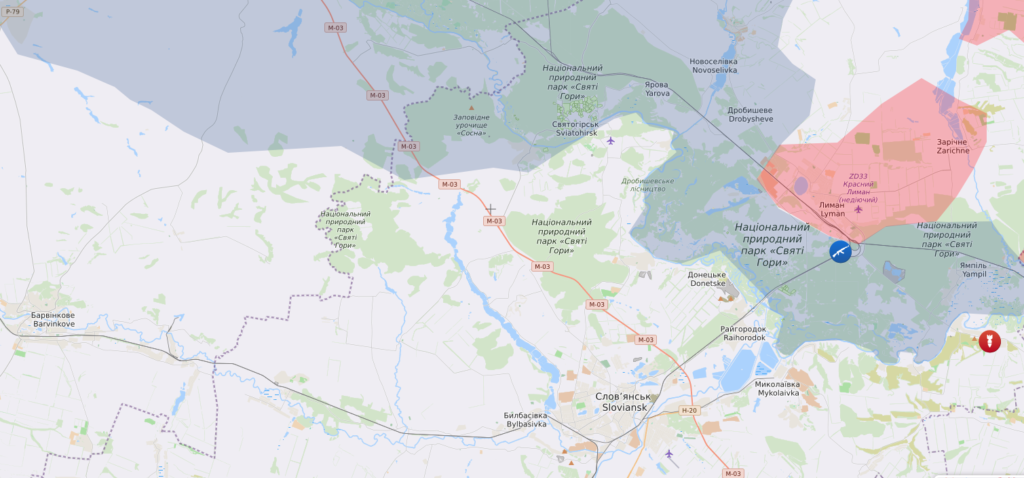
They said they cleared the way from Husarivka to Bayrak. Which means they were probably involved in the push on Lyman. Husarivka is just east of Barvinkova in the bottom left of this map.
As has become the norm, retreating Russian soldiers left behind buttloads of ammo. The Russians may have depleted their smart munitions, but they don’t appear to have any shortage of the dumb variety. “A 15 kilometer forest was full of empty ammo boxes.”
Troops breaking and retreating despite plenty of ammo suggests continuing low morale among the invading Russians (or their local conscript cannon fodder).
“There was good coordination between our infantry, tanks and artillery.” Classic western combined arms doctrine, something the Russians have seemed mostly incapable of pulling off.
Also, the Ukrainian military have reported entering Lyman:
Faced with the continued erosion of Russia’s military position in Ukraine, Vladimir Putin has chosen to double-down on failure.
Russian President Vladimir Putin on Wednesday announced the partial mobilization of military reservists, a significant escalation of his war in Ukraine after battlefield setbacks have the Kremlin facing growing pressure to act.
In a rare national address, he also backed plans for Russia to annex occupied areas of southern and eastern Ukraine, and appeared to threaten nuclear retaliation if Kyiv continues its efforts to reclaim that land.
It came just a day after four Russian-controlled areas announced they would stage votes this week on breaking away from Ukraine and joining Russia, in a plan Kyiv and its Western allies dismissed as a desperate “sham” aimed at deterring a successful counteroffensive by Ukrainian troops.
Before this announcement it was apparent that Russia basically had no reserves, so a mobilization isn’t a surprise. Why admit failure when you can simply get more of your countrymen slaughtered for doubling-down on your own mistake?
It won’t be easy or fast to call up that many reservists, according to military experts, because Russia basically doesn’t have a reserve.
A 2019 RAND study noted that “Russia has paid little attention to developing an effective and sizable active reserve system that might be immediately required in the event of a major war.” RAND estimates that Russia has an effective reserve of only 4,000-5,000 men.
The country’s former army reserve units had been disbanded from 2008-2010 as part of the military’s modernization program, with their equipment — all of it older — going into storage or scrapped.
That doesn’t mean that Russia can’t conscript, train, organize, and arm 300,000 new soldiers, but it won’t be quick or easy.
One problem, as Foreign Affairs analyst Oliver Alexander put it, is “effectively readying and equipping these reservists. Russia already has problems equipping its professional armed forces.”
Then there’s the speed problem. Dara Massicot wrote back in August — weeks before Kyiv’s stunning counteroffensive in Kharkiv — that “Even if the Kremlin pulls all levers available, declaring a general mobilization to call up sufficient armored equipment and trained personnel, that process would still take time.”
That’s because with something like 80% of Russia’s combat power already fighting in Ukraine, plus wartime losses to their NCO and officer corps, the Russian army will need to train more trainers before anything like 300,000 men can be mobilized.
Just last month, Putin ordered an increase in the size of the Russian military of 137,000 troops. But as I reported to you then, Putin’s order only meant that “Starting next year, the Russian military will be authorized to find another 137,000 troops.” The country has long had a problem with draft dodgers, one that Putin’s “special military operation” won’t help.
He also notes the problem of obtaining new equipment. Even the first wave of Russian invasion included troops who were armed with ancient rifles. With the sanctions in place, none of that is going to get any better. Plus the fact that Russia essentially used up all their smart ordinance during the first stage of the war and that sanctions ensure they can’t easily make more.
Is there a Peter Zeihan video on the topic? Of course there is.
Some takeaways:
Reiterates why everything in the Russia army travels by rail. “The Ukrainians were able to take a couple of re-up depots in eastern Ukraine and Kharkiv a couple weeks ago and the front just collapsed.”
“We might be seeing a repeat of that in the Donbas.”
“The Russians are now discovering that they’re actually outnumbered locally, and that with all the captured equipment, the Ukrainians actually now have more artillery and more ammo.”
“This is the sort of war the the Russians know how to fight: Just throw bodies after it.”
The influx of new troops “doesn’t mean that the nature of the war is
fundamentally changed,” but now they’ll be able to rotate fresher troops in, “and continue fighting the war more or less the way that they have been now, which is to say poorly.”
Russia is already crashing demographically, and the main cohort of this war is coming from the men who should be fathering children. “This is a potentially a country killer. Before I thought that this was Russia’s last war. Now I’m certain of it.”
Says Ukraine can still win, but they need to do the Kharkiv counteroffensive twenty times over.
Says they need to continue hitting Russian logistics nodes. “The one I am most interested in, of course, is Miriapol. Because if the Ukrainians can reach Mariupol, they basically isolate Russian forces throughout southern Ukraine, and then you’re talking about a hundred thousand Russian troops that are just stranded with no hope of resupply at all.” (Assuming his later mention of taking out the Kerch Strait Bridge.)
Nor are the sham referendums likely to make any difference either.
Russian-appointed occupation officials in Luhansk, Donetsk, Kherson, and Zaporizhia oblasts announced on September 20 that they will hold a “referendum” on acceding to Russia, with a vote taking place from September 23-27. The Kremlin will use the falsified results of these sham referenda to illegally annex all Russian-occupied parts of Ukraine and is likely to declare unoccupied parts of Donetsk, Kherson, and Zaporizhia oblasts to be part of Russia as well.
The Kremlin’s annexation plans are primarily targeting a domestic audience; Putin likely hopes to improve Russian force generation capabilities by calling on the Russian people to volunteer for a war to “defend” newly claimed Russian territory. Putin and his advisors have apparently realized that current Russian forces are insufficient to conquer Ukraine and that efforts to build large forces quickly through voluntary mobilization are culminating short of the Russian military’s force requirements. Putin is therefore likely setting legal and informational conditions to improve Russian force generation without resorting to expanded conscription by changing the balance of carrots and sticks the Kremlin has been using to spur voluntary recruitment.
Putin may believe that he can appeal to Russian ethnonationalism and the defense of purportedly “Russian peoples” and claimed Russian land to generate additional volunteer forces. He may seek to rely on enhanced rhetoric in part because the Kremlin cannot afford the service incentives, like bonuses and employment benefits, that it has already promised Russian recruits. But Putin is also adding new and harsher punishments in an effort to contain the risk of the collapse of Russian military units fighting in Ukraine and draft-dodging within Russia. The Kremlin rushed the passage of a new law through the State Duma on September 20, circumventing normal parliamentary procedures. This law codifies dramatically increased penalties for desertion, refusing conscription orders, and insubordination. It also criminalizes voluntary surrender and makes surrender a crime punishable by ten years in prison. The law notably does not order full-scale mobilization or broader conscription or make any preparations for such activities.
ISW has observed no evidence that the Kremlin is imminently intending to change its conscription practices. The Kremlin’s new law is about strengthening the Kremlin’s coercive volunteerism, or what Chechen leader Ramzan Kadyrov called “self-mobilization.”
The Kremlin is taking steps to directly increase force generation through continued voluntary self-mobilization and an expansion of its legal authority to deploy Russian conscripts already with the force to fight in Ukraine.
Putin’s illegal annexation of occupied Ukrainian territory will broaden the domestic legal definition of “Russian” territory under Russian law, enabling the Russian military to legally and openly deploy conscripts already in the Russian military to fight in eastern and southern Ukraine. Russian leadership has already deployed undertrained conscripts to Ukraine in direct violation of Russian law and faced domestic backlash. Russia’s semi-annual conscription cycle usually generates around 130,000 conscripts twice per year. The next cycle runs from October 1 to December 31. Russian law generally requires that conscripts receive at least four months of training prior to deployment overseas, and Russian President Vladimir Putin has repeatedly denied that conscripts will be deployed to Ukraine. Annexation could provide him a legal loophole allowing for the overt deployment of conscripts to fight.
Russian-appointed occupation officials in Kherson and Zaporizhia oblasts announced the formation of “volunteer” units to fight with the Russian military against Ukraine. Russian forces will likely coerce or physically force at least some Ukrainian men in occupied areas to fight in these units, as they have done in the territories of the Russian proxy Donetsk and Luhansk People’s Republics (DNR and LNR).
The Russian State Duma separately passed new incentives for foreign nationals to fight in Russia’s military to obtain Russian citizenship and will likely increase overseas recruitment accordingly. That new law, which deputies also rushed through normal procedures on September 20, allows foreign nationals to gain Russian citizenship by signing a contract and serving in the Russian military for one year. Russian law previously required three years of service to apply for citizenship.
Putin’s appeals to nationalism may generate small increases in volunteer recruitment from within Russia and parts of occupied Donetsk and Luhansk. However, forces generated from such volunteers, if they manifest, will be small and poorly trained. Most eager and able-bodied Russian men and Ukrainian collaborators have likely already volunteered in one of the earlier recruitment phases.
Local Russian administrators will continue to attempt to form volunteer units, with decreasing effect, as ISW has previously reported and mapped.
Russian forces and the Wagner Private Military Company are also directly recruiting from Russian prisons, as ISW has previously reported. These troops will be undisciplined and unlikely to meaningfully increase Russian combat power.
Putin likely hopes that increasing self-mobilization, and cracking down on unwilling Russian forces, will enable him to take the rest of Donetsk and defend Russian-occupied parts of Luhansk, Kherson, and Zaporizhia oblasts. He is mistaken. Putin has neither the time nor the resources needed to generate effective combat power. But Putin will likely wait to see if these efforts are successful before either escalating further or blaming his loss on a scapegoat. His most likely scapegoat is Defense Minister Sergei Shoigu and the Russian Ministry of Defense. Reports that Shoigu would accompany Putin while Putin gave a speech announced and then postponed on September 20 suggest that Putin intended to make Shoigu the face of the current effort.
That decree is every bit as popular as you would expect.
Takeaways:
“Today, people went to the streets from Moscow to the Far East to protest. Even though it only concerned those in reserve, everyone sees where this is going.”
“Former Security Minister of the Donetsk People’s Republic called on Russia’s military command to better supply existing units on the ground. He also added that lack of equipment is the main reason why the Ukrainians keep advancing in Kherson.”
He thinks the conscripts will work logistics jobs, free up contractors to do the fighting. I remain doubtful that the effective military contractor pool for this war is terribly deep.
Neither the mobilization nor the sham referendums change any immediate facts on the ground in Ukraine. It will take many months to take new “recruits” up to even the most basic soldiering standards. Or maybe they’ll just give them three days training and send them into battle with old rifles and old ammunition like they did before, with the same results.
Either way, it doesn’t solve any of Putin’s immediate problems…
Russia acknowledges defeat in Kharkiv, ultranationalists start to turn on Putin, Lyman is the new battleground, and unconfirmed reports of Russian troops abandoning Melitopol.
The Kremlin has recognized its defeat in Kharkiv Oblast, the first defeat Russia has acknowledged in this war. The Kremlin is deflecting blame from Russian President Vladimir Putin and attributing it instead to his military advisors.
The Kremlin is likely seeking to use the defeat in Kharkiv to facilitate crypto mobilization efforts by intensifying patriotic rhetoric and discussions about fuller mobilization while revisiting a Russian State Duma bill allowing the military to send call-ups for the regular semiannual conscription by mail. Nothing in the Duma bill suggests that Putin is preparing to order general mobilization, and it is far from clear that he could do so quickly in any case.
The successful Ukrainian counter-offensive around Kharkiv Oblast is prompting Russian servicemen, occupation authorities, and milbloggers to panic.
Russia’s military failures in Ukraine are likely continuing to weaken Russia’s leverage in the former Soviet Union as Russia appears unwilling to enforce a violated ceasefire it brokered between Armenia and Azerbaijan or to allow Armenia to invoke provisions of the Russia-dominated Collective Security Treaty Organization in its defense.
Ukrainian troops likely continued ground attacks along the Lyman-Yampil-Bilohorivka line in northern Donetsk Oblast and may be conducting limited ground attacks across the Oskil River in Kharkiv Oblast.
Russian and Ukrainian sources indicated that Ukrainian forces are continuing ground maneuvers in three areas of Kherson Oblast as part of the ongoing southern counter-offensive.
Russian troops made incremental gains south of Bakhmut and continued ground attacks throughout Donetsk Oblast.
Ukrainian forces provided the first visual evidence of Russian forces using an Iranian-made drone in Ukraine on September 13.
Oleksiy Arestovych, an adviser to Zelenskiy, said Ukrainian troops were now trying to retake the Russian-held town of Lyman in Ukraine’s Donetsk region and were eyeing territorial gains in the neighbouring Luhansk region which is under Russian control.
“There is now an assault on Lyman,” Arestovych said in a video posted on YouTube.
“And that is what they fear most – that we take Lyman and then advance on Lysychansk and Sievierodonetsk,” he said, referring to twin cities in the Luhansk region taken by Russia after fierce fighting in June and July.
The Ukrainian mayor of Melitopol said that Russians are evacuating Melitopol, the Zaporizhia Oblast city between Mariupol and Kherson, and heading to Crimea. I treat this report with a fair amount of skepticism, because if true it would essentially mean Game Over for Russia’s southern front.
I'm hearing more & more reports that Russians are evacing Melitopol. This remains UNCONFIRMED. If true, Ukr can reach the Black Sea, blow the Kerch bridge, & utterly destroy every Russia military unit in southern Ukraine and Crimea. And THAT would be a nation-ending event. pic.twitter.com/8cCDnDEbVl
DEEP STRIKE: Major explosions rocked the RU air station at Taganrog, followed by a number of secondaries & fires. Russian AWACs, including the including the newest A-100 platforms, are forward deployed at Taganrog. This strike will negatively affect RU air defense in the region. pic.twitter.com/iKPeaIW5w8
In the newly-liberated areas, relief and sorrow are intertwined – as accounts emerge of torture and killings during the long months of Russian occupation.
Artem, who lives in the city of Balakliya in the Kharkiv region, told the BBC he was held by Russians for more than 40 days, and was tortured with electrocution.
Balakliya was liberated on 8 September after being occupied for more than six months. The epicentre of the brutality was the city’s police station, which Russian forces used as their headquarters.
Artem said he could hear screams of pain and terror coming from other cells.
The occupiers made sure the cries could be heard, he said, by turning off the building’s noisy ventilation system.
“They turned it off so everyone could hear how people scream when they are shocked with electricity,” he told us. “They did this to some of the prisoners every other day… They even did this to the women”.
And they did it to Artem, though in his case only once.
“They made me hold two wires,” he said.
“There was an electric generator. The faster it went, the higher the voltage. They said, ‘if you let it go, you are finished’. Then they started asking questions. They said I was lying, and they started spinning it even more and the voltage increased.”
Artem told us he was detained because the Russians found a picture of his brother, a soldier, in uniform. Another man from Balakliya was held for 25 days because he had the Ukrainian flag, Artem said.
A school principal called Tatiana told us she was held in the police station for three days and also heard screams from other cells.
The disaster in Kharkiv is so massive and apparent that even some of the pro-war Russian pundits are realizing it.
Life comes at you fast: pundits on Russian TV realize that their military is failing and their country is in trouble. They are starting to play the blame game. Some of them finally understand that their genocidal denial of the Ukrainian identity isn't working in Russia's favor. pic.twitter.com/jNNn5xifI5
For Putin, losing ultranationalists is much more dangerous than criticism from more liberal segments of Russian society.
Their criticism is that Putin is not doing enough. That the special military operation is insufficient, and that Putin should declare full mobilization. These ultranationalists are largely represented by those Russian military bloggers that have become quite famous during the war. The most famous one is probably Igor Girkin. These bloggers make sometimes very good military analyses, and they clearly have a network of sources that provide information about the situation on the frontlines. And we also know that their views are shared by many of the soldiers. For example, there have been studies that show that these ultranationalist views are pretty common in spetsnaz units. And these ultranationalist voices are a real challenge for the Putin regime. Because obviously he can’t dismiss them as being unpatriotic or foreign agents or something like that. And what is happening now is that these ultranationalists are turning against Putin. And that is dangerous for him.
The shift has been from “If you support the troops, you have to support Putin” to “If you support the troops, you have to blame Putin for fucking things up so badly.”
Ben Hedges: Ukraine will retake all pre-February 23rd territory this year, and recapture Crimea next year. “It could be quicker.”
More scenes of captured equipment in Izyum.
Ukrainians issued Russian passports find out they’re worthless to get into Crimea or obtain government services.
Ukrainian troops using the Polish-built Krab self-propelled howitzer say it’s like night and day compared to their old Soviet equipment. “It’s like a Porsche vs. a Lada.”
Russian politician Dmitry Medvedev reacts well to suggestion the West give Ukraine security guarantees. “The land will be on fire and the concrete will melt.”
Things in Ukraine are moving so fast that the only thing I can be sure of is that what I post here will probably be obsolete before I press the Publish button.
What was a very successful Ukrainian counter offensive in Kharkiv Oblast is now a massive rout of Russian forces throughout the extent of their northeast line. All of Kharkiv (save a tiny bit east of the Oskil River) has been liberated.
“Ukraine controls all the land west of the Oskil River.”
The Russians left massive amounts of equipment behind, too much for any sort of orderly withdrawal, and they don’t appear to have torched any of it, either. They just turned tail and fled. “This is an armored brigade worth of vehicles. Looking at this, I think Russia has given more military aid to Ukraine than the United States.” Also, Russian civilians are fleeing the captured territories, only to be refused entry at the border.
“Fuck, every one of us can get a tank.”
Rus, Rus, Rus of the Ukraine
Fleeing as fast as he can flee
Rus, Rus, Rus of the Ukraine
Watch out for that tree!
Got to disagree with the first video: it’s damn hard to see if you’re peering out the forward driver’s port, and it’s quite possible the tank driver was unaware troops were falling off.
It looks like logistical problems and those long-documented Russian morale problems have finally intersected to destroy the ability of numerous Russian units to function as effective fighting forces. Here’s a recorded Russian phone soldier’s phone call from back in August illustrating low morale and how much Russian soldiers hate the war:
Russian soldiers don’t seem to be eager to die for a mistake. The extent to which Russian forces in Kharkiv Oblast have been routed and broken makes it an open question whether any can be reconstituted as effective fighting forces and redeployed to Donbas. That may explain why Russia seems to be trying to carry out a stealth conscription mobilization:
On their way out, the Russian army has given Ukraine a parting gift: destruction of Kharkiv’s civilian infrastructure. “Kharkiv and Donetsk regions were cut off. In Zaporizhia, Dnipropetrovsk, Sumy there are partial problems with power supply.”
Total dick move, but not necessarily a war crime; power generating facilities are usually considered legitimate military targets. Russia obviously held off attacking them because they expected to control the territory.
Now that Ukraine has that territory back, a lot more Russian logistic routes (especially those out of Belgorod) are under threat of disruption from Ukrainian artillery. Indeed, Belgorod now loses a lot of value as a logistics hub, since it’s farther away from the frontlines, on worse roads. Russia may shift to routing everything through Kamensk-Shakhtinsky or Rostov-On-Don.
Ukraine continues to grind out more modest gains in the Kherson counteroffensive. As for the next phase of the war, it’s an open question whether to attempt to push Russian troops out of Luhansk next, or to apply more pressure toward the center of the Russian line and retake Lysychansk and Severodonetsk. But it’s clear that right now Ukraine enjoys the strategic initiative.
As Ukraine’s Kharkiv counteroffensive developed earlier this week, it was apparent that the occupied city of Izyum, the linchpin of Russia’s northeast line, was in danger of being encircled. I anticipated a few weeks of hard fighting while Ukraine slowly tightened the noose while pounding the besieged city with artillery.
Russian forces have withdrawn from key eastern towns, as a rapid Ukrainian counter-attack makes further gains.
Ukrainian officials said troops entered Kupiansk, a vital eastern supply hub for Russian forces, on Saturday.
Russia’s defence ministry then said its troops have retreated from nearby Izyum to allow them “to regroup”.
The ministry also confirmed the withdrawal of troops from a third key town, Balaklyia, in order to “bolster efforts” on the Donetsk front.
The Ukrainian advances – if held – would be the most significant since Russia withdrew from areas around Kyiv in April.
In his nightly video address on Saturday, President Volodymyr Zelensky claimed that Ukraine had now liberated 2,000 sq km (700 sq miles) from Russia since beginning a renewed counter-offensive earlier this month.
His claim would suggest that half of that area has been recaptured in the last 48 hours alone – as it istwice the area of territory Mr Zelensky said had been liberated when he spoke on Thursday evening.
The announcement by Russia that its troops had withdrawn from Izyum is also significant, as it was a major military hub for Moscow.
“A three-day operation was carried out on the drawdown and organised transfer of the Izyum-Balakliya group of troops to the territory of the Donetsk People’s Republic,” the Russian statement said.
Taking Kupiansk is also huge. It’s a major crossroads and an important crossing over the north end of the Oskil River.
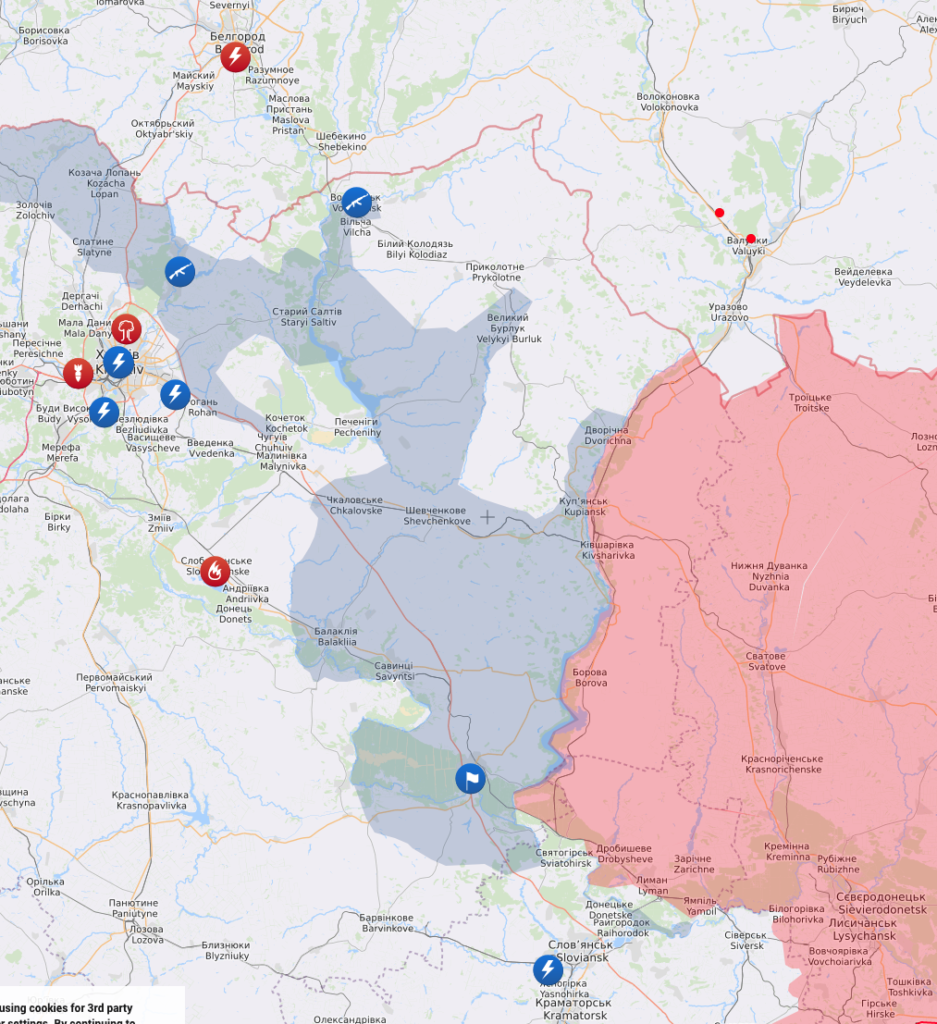
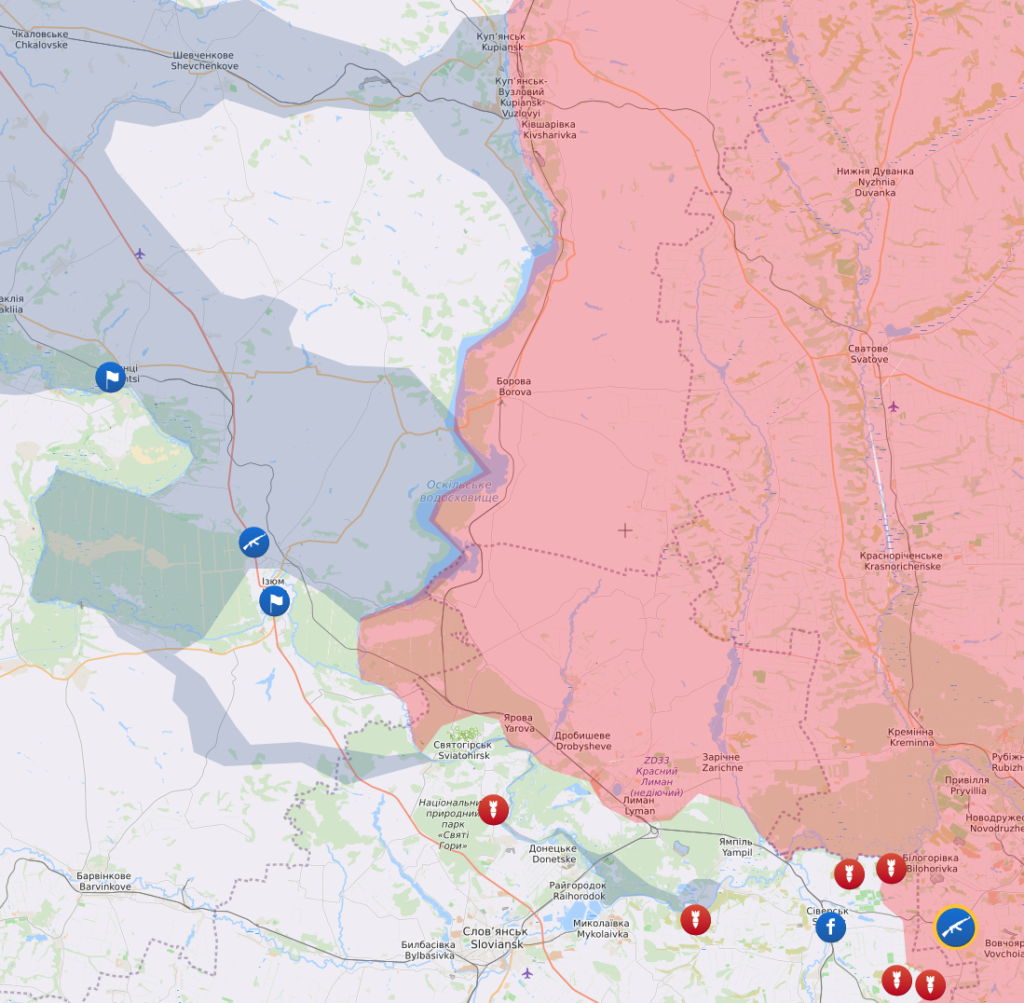
Livemap confirms it:
See that little blue rifle down in the southeast corner of the map? That indicates that Ukrainian troops are just outside Lysychansk, the Ukrainian city Russia spent so much time and effort taking back in July. Suchomimus says Ukrainian troops are even on the edge of Severodonetsk.
Supposedly Russia left a lot of gear behind as well.
There are indications that Ukraine, in addition to the Kherson counteroffensive, is conducting a counteroffensive in Kharkiv Oblast, and has apparently captured Volokhiv Yar, Balakliya and Yakovenkove, towns between Kharkiv and Russian-occupied Izyum.
It’s unclear whether this is a feint, a spoiling attack or a full-blown counteroffensive, but the scale of the initial success suggests it’s too large to be a mere probing attack.
Ukrainian forces conducted a counterattack in Kharkiv Oblast near Balakliya that likely drove Russian forces back to the left bank (north side) of the Severskyi Donets and Serednya Balakliika rivers on September 6. Ukrainian forces likely captured Verbivka (less than 3 km northwest of Balakliya) on September 6. Geolocated footage posted on September 6 shows Ukrainian infantry in eastern Verbivka (less than 3 km from Balakliya). Multiple Russian sources acknowledged Ukrainian gains in Verbivka and reported that Russian forces demolished unspecified bridges in Balakliya‘s eastern environs to prevent further Ukrainian advances. Images posted on September 6 also show a destroyed Russian bridge over the Serednya Balakliika River—a geographic feature behind which the Russian front line in this sector likely lies. Social media users reported that Russian forces withdrew from checkpoints six kilometers west of Balaklia on September 6.
Russian forces likely no longer maintain their previous positions in Bairak and Nova Husarivka (just south of Balakliya on the right bank of the Seversky Donets River). Russian forces likely abandoned Bayrak and Nova Husarivka in late August. Images posted on August 30 show that Russian forces blew the bridge over the Seversky Donetsk River near Bayrak on an unspecified date. Bridge demolition activity indicates a planned Russian withdrawal. Ukraine’s General Staff reported on September 6 that Russian forces conducted air strikes against Bayrak, indicating that Ukrainian forces may have advanced in the area.
Russia’s deployment of forces from Kharkiv and eastern Ukraine to Ukraine’s south is likely enabling Ukrainian counterattacks of opportunity. The September 6 Ukrainian counterattack in Kharkiv was likely an opportunistic effort enabled by the redeployment of Russian forces away from the area to reinforce Russian positions against the Ukrainian counteroffensive in Kherson Oblast. Obituary data on Russian servicemen indicates that Russia deployed elements of the 147th Artillery Regiment of the 2nd Motorized Rifle Division of the 1st Guards Tank Army to Kherson Oblast no earlier than late August. This is the first time ISW has observed elements of Russia’s elite 1st Guards Tank Army operating in southern Ukraine. Elements of the 147th previously fought in Bucha in Kyiv in March and elements of the 1st Guards Tank Army were active primarily along the Kharkiv Axis after the Russian withdrawal from Kyiv.
Reporting from Ukraine (a pro-Ukrainian source) breaks down the counteroffensive.
Suchomimus analyzes the news as of yesterday. There are “reports that Russia is blowing up bridges, a sign that they are in a bit of a panic and expect Ukraine to advance.”
And here he shows a video of Ukrainian forces entering Yakovenkove further east, from which he surmises that they must have already taken Balakliya.
Bonus: Ukrainian aircraft shoots down a Russian Su-25:
Map snapshot, which is already slightly out of date:
Izyum is the linchpin of Russia’s north-central front. Losing it would not only spell an end to any further Russian advances in Kharkiv for the immediate future, but also put Russia’s hard-won conquest of Severodonetsk and Lysychansk in jeopardy.
With Russia reportedly buying artillery from North Korea (Caveat: This comes from Biden’s Pentagon, so grains of salt are in order) and two separate counteroffensives chewing up units, it’s possibly that Russia’s territorial gains in Ukraine have already peaked.
Edited to add: Reporting from Ukraine has a video up detailing how different thrusts of the counteroffensive developed: