Good evening. I’m not Chevy Chase, and you’re not either. (Unless the real Chevy Chase is reading this, in which case: 1. Loved you on the original SNL, and 2. Stop being such a total dick.)
Take a look at this update: “German Chancellor Angela Merkel has mooted the idea that Greece should hold a referendum on the euro alongside its second round of elections next month.” Well, no use even pretending that the Greeks have a say in their own future, is there?
How bad will the Euro-collapse be? “This type of shock could produce instability at least as extensive as the aftermath of the collapse of Lehman Brothers.”
Der Spiegel goes all Amityville Horror on Greece: GET OUT.
Speaking of prominent German media outlets slamming Greece (insert your own Cartman’s Mother joke here), can anyone tell me why the Greek finance ministry offices look like an episode of Hoarders? My German is a bit rusty to watch a 45 minute documentary, but what are in the garbage bags? Tax returns?
Spain’s housing bubble gets compared to Ireland’s housing bubble, including how it’s getting ready to drag down the banking sector. Actually, it also sounds an awful lot like Japan’s housing bubble. But Spain’s economy isn’t nearly as strong as Japan’s…
No matter what Greece does, “the country faces years of austerity after years of mismanagement, whatever the election result. Even at the height of the global financial crisis, it was obvious the museum-piece economies of Europe, weighed down by bulging public payrolls, entrenched welfare state systems and archaic work practices, faced greater upheavals and decades of poorer living standards than the US.”
Time for another roundup of Texas vs. California news:
I would say California is broke again, but it’s been so long since California wasn’t broke that it would have to be “California Still Broke,” which isn’ t exactly news…
How unions and big government hijacked California: “A state with 12 percent of the country’s population and one third of its welfare recipients. A state with the nation’s lowest bond ratings, the second-highest marginal income tax rate and the third highest unemployment rate. Most important – a state that CEOs rank the worst in the country for doing business. Dead last! For the eighth year in a row.”
Gov. Jerry Brown insists those who say California is unfriendly to business are wrong. But Mr. Brown, of course, is not the chief executive officer of a private business. He is the top executive of a deficit-burdened, intrusive, bloated government bureaucracy that has perfected squandering other peoples’ money while botching delivery of services such as education and lavishing public employees with unaffordable pay and benefits.
California public school teachers are the nation’s highest-paid, while their students’ performance ranks among the worst. The state’s various unfunded pension and retirement health care benefits promise to bankrupt the already overextended government.
California is following the French fiscal model. I would have said Greece, but close enough for government work.
Finally, I’ll close with a tweet from the indispensable Iowahawk: “It’s a proven fact that government creates jobs. As long as the governments are in California & Illinois, and the jobs are in Texas.”
Cherokee genealogist to Elizabeth Warren: “Your ancestors are found in plenty of historical records, and every time, they are found living as white people among other white people. Never are your ancestors ever found living among the Cherokees.”
Ten things about Rille Hunter. Words “crazy” and “golddigger” strangely absent. But the fact her father once paid a hitman to kill his own daughter’s horse is plenty weird…
A look at the Senate District 5 race. I supported Ben Bius the last time around, mainly because I thought Steve Ogden had been in the office too long, was dismissive of constituent concerns and insufficiently conservative. This time around, I’m a lot more comfortable with Charles Schwertner’s conservative bonafides than I was with Ogden’s. Schwertner will probably win the race running away.
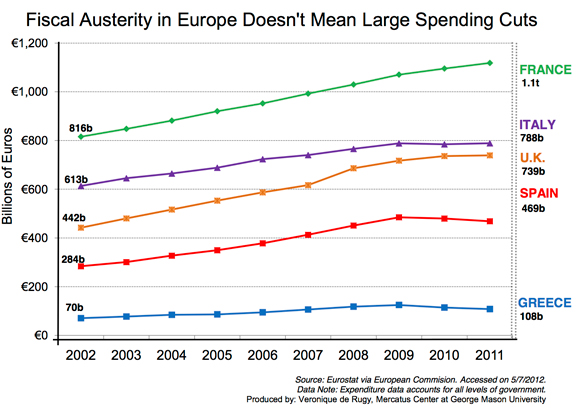
The media insists on describing recent election results in Europe as a blow to “austerity,” when in fact Europe’s recent policies are anything but. Government spending has continued to rise across much of Europe, and even those countries that have made small cuts have not reduced government spending to pre-recession levels.
He in turn references this Veronique de Rugy piece at NRO (though the link is broken, so I had to go Googling) which also gives us this handy chart:
None of these “austerity” measures eliminated deficit spending, and none addressed the issue that’s driving all of Europe (and us) bankrupt, namely unwillingness to carry out structural reforms of the welfare state. The few tiny reforms that have been undertaken have been, as NRO’s Michael Tanner notes, ridiculously timid, and even those have been heavily weighted in future years. “So far, European governments haven’t even been willing to take a penknife to the welfare state, let alone an axe.” Plus a huge round of tax hikes:
It should come as no surprise that all those new taxes, combined with a lack of spending restraint, has threatened to throw Europe back into a double-dip recession. Is it any wonder that French, Greek, and British voters were anxious to “throw the bums out”?
Wait, this sounds familiar. Tax hikes on the rich accompanied by vague promises of future spending restraint, while refusing to restructure entitlement programs. That sounds a lot like . . . Barack Obama.
Actual austerity would mean (at a minimum) reducing spending to the amount of money actually taken in. As best I can tell, none of the PIIGS, or France, or the UK has undertaken such real austerity. That “severe” Greek austerity that just caused a change in government? It reduced Greece’s official deficit spending from 9.0% of GDP to 7.5% of GDP. They didn’t even want Greece to stop digging a hole, they just wanted them to dig more slowly.
I suspect that some 20-30 years hence, this mania for deficit spending will be seen as absolute madness, with future generations unable to fathom how politicians were so resolute in destroying their countries economies in order to maintain the welfare state, a folly for the ages. Hyperinflation is probably already baked into the Greek pie for its inevitable exit from the Eurozone, the only question is whether it will be Argentina 1999-2002 style hyperinflation, or Weimer Germany 1919-1923 style hyprinflation, and how much of Europe (and the rest of the world) will follow in their tracks.
The challenge with covering the respective fortunes of Texas and California is where to cut off the news roundup. Here’s news of how California is sucking, and Texas isn’t, from the last month or so:
Things will only get worse in the coming years as Democratic Gov. Jerry Brown and his green cadre implement their “smart growth” plans to cram the proletariat into high-density housing. “What I find reprehensible beyond belief is that the people pushing [high-density housing] themselves live in single-family homes and often drive very fancy cars, but want everyone else to live like my grandmother did in Brownsville in Brooklyn in the 1920s,” Mr. Kotkin declares.
Also this:
Middle-class workers—those who earn more than $48,000—pay a top rate of 9.3%, which is higher than what millionaires pay in 47 states.
California Governor Jerry Brown (his aura smiles and never frowns) is hiking state income taxes that were already the highest in the nation. (Hat tip: Prairie Pundit.)
California not only has the five most polluted cities in the country, it has the top five most polluted cities in all three categories of air pollution (ozone, short term particle pollution, and year-round particle pollution).
Chances are good that Europe’s interesting Eurozone times are about to get more interesting still with elections scheduled across the continent today, including those in France and Greece. So what does all this mean? Well, for one thing, the French socialist candidate (who has a good chance to kick Nicolas Sarkozy out of office) wants to renegotiate the fiscal discipline treaty. Perhaps even a socialist can tell a rotting fish when he smells one. And in Greece, the anti-bailout parties are expected to make dramatic gains at the expense of the “center-right” New Democracy (Tweedledee) and “center-left” Pasok (Tweedledum) parties who managed to bring Greece to this lovely pass in the first place.
Opposing Tweedledee and Tweedledum are a motley collection of small parties, including the Neo-Nazi Golden Dawn. Now in Europe, everyone to the right of the Christian Democrats seems to be labeled a “neo-Nazi,” be they libertarians, Geert Wilders, or the British National Party, but Golden Dawn appears to be the real thing. Take a look at their flag:
The overall color scheme seems vaguely familiar. Where have I seen that before? Let me think…
Of course, Golden Dawn is unlikely to gain enough votes to be a real player in the Greek parliament, so we may be denied the irony of seeing neo-Nazis oppose Greece’s German overlords.
There are also elections in Serbia and Armenia, lower level elections in Italy, and in Germany, regional elections in Schleswig-Holstein. While “regional elections in Schleswig-Holstein” must be almost as exciting a topic to American readers as enhanced rescission authority, it might go a long way toward determining whether Angela Merkel will continue in her role as Europe’s Sugar Momma Dominatrix.
Could the ruling parties lose everywhere? Well, since the ruing parties have collectively lost every single election since 2009, yeah. Now, whether the Eurocratic elite are will to let a little thing like “democracy” derail their dreams for an integrated Europe remains to be seen.
With government debt expected to hit 80% of GDP by the end of 2012, Spain has become like a family with a big mortgage where the primary breadwinner has lost his job. Unless they find a way to increase their income, they are going to go bankrupt. It is only a matter of time.
If people want to know what life looks like in the “Prohibitive Range” of the Laffer Curve, all they have to do is to visit Athens. Greece is literally falling apart. Unfortunately, by raising taxes, Spain is making exactly the same mistake that the Greeks made.
Of course, whatever the outcome of today’s elections are, we can be pretty sure they won’t do the one thing that might help get them out of the crises: rolling back the European welfare state.
The a persistent drumbeat among American liberals that in Europe austerity has failed. This is a myth. In fact, it’s never been tried.
After much back and forth with his campaign trying to find a date, I was finally able to interview Texas Senate candidate Craig James on March 21 at the Rudy’s on South 360 here in Austin. This was, alas, not an ideal atmosphere for an interview (it got better when one of his staffers asked Rudy’s to turn off their piped in music for the area, which is something I should have thought of asking for), and the first part of the interview makes it hard to hear. After the first question, I stopped the camera and moved it closer to James so you can hear his answers, so the audio gets much better about 1:35 in, though I seem to have cut off the top of his head in the process. So let me apologize in advance for the less-than-sterling sound and video quality for various parts of the interview, but the vast majority of the interview is intelligible. I filmed this with my Mino Flip camera and did a light edit in iMovie, so the crappiness is 100% my fault (or that of the environment it was filmed in).
Thoughts:
James is a very confident, well-spoken and personable speaker with a lot of natural charisma. He seems to get the big picture of the conservative agenda (a constitutionally limited government, and a commitment to free markets) and obviously comes from a social conservative background.
I like that he would eliminate the Department of Education, but it’s a bit hard to square with his emphasis on vocational training in the second part of the answer. It’s not that I disagree that it’s a good idea, it’s just that after the elimination of the Department of Education, I don’t see any viable (or proper) role for such fine-grained educational policy control at the federal level.
I’m not particularly interested in the Texas Tech question that starts part 2, but since it’s the most famous controversy he’s been involved in, the interview would have felt incomplete without it.
There are a couple of interesting admissions I give him credit for: admitting that Texans for a Better Tomorrow was created as a vehicle for him to explore a role in politics, and admitting that he would root for the New England Patriots (for whom he played in the NFL) were they to meet the Cowboys in the Superbowl, a brave position that’s obviously not pandering to his constituents.
I didn’t like the vagueness of his positions beyond a few policy specifics, and the fact he tried to straddle both sides of some issues (such as PIPA/SOPA in the second half of the interview). Both Ted Cruz and Tom Leppert were occasionally vague on some points, but James is already sounding awfully vague for someone who hasn’t ever held elective office.
The low-point of the interview (about 3:15 into the second part) was finding out that James has never heard of the Posse Comitatus Act. This is not an obscure statute, it’s one of the fundamental laws governing the limitations of using federal troops. I would expect not only anyone with an interest in politics to at least have heard of the Posse Comitatus act, I would actually expect the same of anyone with a basic college education.
I’d like to thank Craig James for taking time out of his busy schedule to speak with me, and his staff for their assistance in setting up the interview.
Now I’ve interviewed all the major Republican Senate candidates but David Dewhurst. If his campaign would get in touch with me to set a convenient date in the next few weeks, I’d like to correct that oversight…
This piece by Dan McLaughlin encapsulates why the Tea Party exists, and why it has to fight a willfully heedless Republican establishment, so well that I’m going to quote whopping great chunks from it:
As anyone with a passing familiarity with Republican politics over the past four or five decades knows, conservative magazines and think tanks have been making detailed entitlement reform proposals for most of those years, and Republicans running for offices high and low have been running on platforms of reducing the size and cost of government for just as long. And then nothing happens.
That’s why Congress’ battles over the debt ceiling and related issues provide such a potent example. Basically all Republican Senators profess to be in favor of smaller government, and yet so few are willing to go to the barricades to make it a reality. Now, I’m a realist – there are limits to how much we could expect even a completely united GOP to bring home as long as Obama is the President and Harry Reid the Senate Majority Leader. But the repeated spectacle of leading pundits and Beltway Republicans tut-tutting Boehner and company for even trying to use their leverage to exact real concessions is a sign that the message Republican voters have been sending is not getting through to everyone.
(snip)
The related point here – and one that says much about why RedState has put so much energy into intra-party primary battles rather than the production of white papers – is that personnel is policy. The ideas are already there; what is lacking is the necessary corps of people with the will to fight for them.
(snip)
The point of my essay was not to denounce anyone, but to explain the history and depth of the current popular distrust on the Right of leaders who seem unwilling to lead. The battle to restrain runaway government spending is so much smoke and mirrors unless the people who profess to support it in word are dedicated to it in deed. No wealth of position papers, endorsements and Power Point presentations can demonstrate that. Voters and activists who have figured this out are rightly skeptical of those who don’t seem to “get it”. And they are more than willing to embrace flawed champions – even such a creature of the Beltway as Newt Gingrich – if they demonstrate the willingness to actually do something to stop the runaway train of federal spending. Every time some Beltway figure calls Newt or some Tea Party candidate crazy, voters think again, “he might actually be crazy enough to upset some applecarts to get things done.”
Since that piece came out December 19, it’s hardly cutting edge news. But I’ve been ruminating on it for a while to try and figure out if I have anything more to add. I think I do. And with the Iowa Caucuses looming, I probably should.
I haven’t covered much of the 2012 Presidential race, mainly because I’ve been focusing on the Texas Senate Race and everyone and their dog was blogging every twist in the POTUSA race.
OMG! Ron Paul is up 3 points!
Plus I don’t have cable, so I wouldn’t be able to watch the interminable numerous debates.
Finally, a baseball team the Astros can beat
Which is why I didn’t see Perry commit his brain freezes, of which there were many. (My theory is that he was still hopped up on goofballs from his back operation.)
Percocet makes me see tiny little Jim Hightowers, and I have to grab and crush each and every one of them
Having lived in Texas for the entirety of Rick Perry’s tenure as governor, I can attest that he is not a perfect candidate. There have been times (Gardasil, the Trans-Texas Corridor) when he’s strayed from conservative principles. And he’s not as polished as Mitt Romney or as articulate as Newt Gingrich.
But Perry isn’t running against the second coming of Ronald Reagan, or even Sarah Palin. Every other major Republican contender is not only at least as flawed, they’re considerably more so.
Despite cheer-leading from the likes of Kathryn Jean Lopez and Jennifer Rubin, Mitt Romney has always struck me as a phony without any real core convictions except that he should be in charge; sort of the Republican answer to Bill Clinton, without the charm or adultery. Pick an issue and Romney’s been on both sides of it at one time or another. He seems the most likely of all the major candidates to be praised by The New York Times and The Washington Post for “growing” in office. Romney is most likely to disappoint me in caving in to D.C.’s usual free-spending, pork-barrel log-rolling.
I could get behind voting for the Newt Gingrich of 1994, the one whose laser-like focus on the holding the Democrats accountable for their misdeed and promoting the Contract With America helped Republicans take the House and Senate, set the stage for a welfare reform and helped (temporarily) balance the budget. Sadly, that Gingrich is not up on offer. We have to deal with the idea-a-minute-and-many-of-them-bad, ex-lobbyist, “Big Government Conservative” Newt Gingrich of 2012, the one so devastatingly and accurately skewered by Mark Steyn in this week’s National Review. (As Bruce Sterling once said at a Turkey City Writer’s Workshop, “Cruel, but fair!”) No matter how many times he tries to sound like Reagan, there are all those other times when he sounds like everyone from Al Gore to Faith Popcorn. I imagine that I would be disappointed many times in a Gingrich Presidency. Unlike Romney, I’m sure Gingrich would find entirely new and innovative ways to disappoint me.
I could almost get behind Ron Paul, based on his absolute, rock-steady position on the biggest problem facing America: out-of-control government spending and ever-increasing size and power of the federal government. The debt bomb is an existential threat to American prosperity, and If we don’t shrink government and get the deficit under control, none of the other issues really matter. And I lean heavily on the libertarian side of the spectrum. But even given that, there’s just too much weirdness (what Kevin Williamson called “his Ronness”) about the rest of Paul’s policies: the newsletters, the footsie with racism, the conspiracy theories, the weirdness about gays and wishing Israel didn’t exist, the running against Reagan. Being just one of 435 House members was a great place for Paul to be, since he could bring up conservative and Libertarian issues without any chance that his wackier ideas would ever end up in legislation, but the Presidency is a different kettle of fish. Plus there’s the problem of his electability, or rather lack thereof. With all his diverse baggage, I believe that Paul is the GOP candidate Obama would have the best chance of defeating. Ignore all the hard-left liberals talking up Paul as a better choice than Obama; it’s just a smokescreen that would evaporate at the first excuse to jump back on the Obama bandwagon. William F. Buckley always said conservative should support the right-most viable candidate. I don’t think Paul is a viable candidate.
Michelle Bachmann’s star has faded even more than Perry’s, and she doesn’t have Perry’s executive experience or record on job creation. The fact she’s neither dumb nor crazy doesn’t mean the MSM won’t pull the Full Sarah Palin Treatment on her (Andrew Sullivan womb-diving optional) were she to get the nod.
Rick Santorum: Too little, too late, he lost his last election, and his strengths don’t lie in the economy and job creation.
Jon Huntsman: Which part of “Republican” was unclear?
By process of elimination, that leaves Perry. As I said before, Perry isn’t perfect, but he has a record on holding the line on government spending and enabling job creation that puts Romney to shame. One again, let’s go to the charts that the indispensable Will Franklin of Willisms has provided on Texas job creation:
And the case for Perry over Romney (again thanks to WILLisms) is even more stark:
While I have criticized Perry’s campaign budget proposals for being too timid, Perry insisted on balancing the Texas budget without tax hikes. I assure you that California would love to have Texas’ budget. Indeed, adjusted for inflation, population growth, and federally-mandated spending, the Texas state budget has actually gone down under Perry. His guiding principle has been “don’t spend all the money,” and it’s one that Washington desperately needs.
One final, very big reason to support Perry: He can win. Perry’s never lost a race, because he’s a tough and tenacious campaigner who’s not afraid to hit his opponents hard. Everyone thought Kay Bailey Hutchison was going to cream Perry in the 2010 governor’s race, and he beat her like a rented mule.
Or maybe a rented donkey.
In the general election against Bill White, he ran an ad featuring a police widow talking about how her husband had been killed by a multi-arrested illegal alien while White was touting Houston as a “sanctuary city.”
Even professional MSM Perry hater Paul Burka says that Perry is a hard man. “He is the kind of politician who would rather be feared than loved.” Perry will have absolutely no fear of taking the fight to Obama and going negative early and often, and he won’t let political correctness cow him into treating Obama with kid gloves.
Will the media savage Rick Perry for his flubs? Of course they will. But, as Ace noted, they’ll always find a way to crucify any Republican candidate to make Obama look better. They’ll use the same “he’s an idiot” line of attack they used on Reagan and Bush43…and you saw how far that got them.
If you’re still undecided on Perry, this video should at least give you a more rounded picture of him:
For those who think Perry is already out of the race, remember that at this point in 2004, the consensus was that Howard Dean was going to be the nominee. There’s a reason Americans actually get to vote, and they frequently prove the pundits wrong.