Bunch of Texas news, none of which I feel like doing a separate post on. Ready? Go!
Posts Tagged ‘Texas Public Policy Foundation’
Texas News Roundup for November 9, 2017
Thursday, November 9th, 2017LinkSwarm for June 23, 2017
Friday, June 23rd, 2017Welcome to another Friday LinkSwarm! There’s so much news I’m going to punt “The Pelosi Question” to the weekend:
A former State Department employee was arrested Thursday and charged with espionage for allegedly transmitting Top Secret and Secret documents to a Chinese government agent, according to an affidavit filed with the U.S. District Court in Alexandria, VA.
Kevin Mallory, 60, of Leesburg is a self-employed consultant who speaks fluent Chinese. Court filings show that Mallory was an Army veteran who worked as a special agent for U.S. State Department’s Diplomatic Security Service from 1987 to 1990. Since then, Mallory has worked for various government agencies and defense contractors, maintaining a Top Secret security clearance. The Washington Post reports that Mallory was also an employee of the CIA.
We do know that Wednesday’s congressional attacker, James Hodgkinson, shared a conspiracy-tinged Change.org link on March 22, accompanied by the caption, “Trump is a traitor.” Once again, it has to be stressed that this information is woefully insufficient to conclude that the perpetrator was motivated by Russia-oriented conspiracy theories. Motivations are multifaceted, and often political beliefs “intersect” with mental distress, causing people to act violently. But the sharing of the link does indicate that Hodgkinson has been affected by the frenzied climate Democrats have stoked around the Russia issue.
Once again, for extra emphasis: calling attention to the link Hodgkinson shared is not to say that Democrats are directly culpable for this shooting. That would be ridiculous. But the shared link does show that he was to some extent enmeshed in the conspiratorial paranoia that Democrats have knowingly fostered, at full-blast, for approaching an entire year. One ancillary consequence of fostering conspiratorial paranoia for a full year is that certain people with unstable mental predispositions may latch on and commit violent acts. But Democrats and liberals, in their self-assuredness, have been reticent to acknowledge this byproduct of their current political strategy. Proclaiming that the president engaged in treason — as many members of Congress and media figures have — is going to have an influence on the broader public, and included in that broader public are people who might be deranged and/or have violent inclinations.
If you deny that the kind of overblown rhetoric that Democrats have specialized in over the past months — warning about traitorous subterfuge and foreign infiltration — can have any trickle-down effect on regular people, you’re deluding yourself.
Democrats want a resistance. They want to impeach the President. They want full-blown socialism. They want to go further to the left than the tea party wanted to go right. A lot of activist Democrats are already interpreting Jon Ossoff’s loss as him not being aggressively anti-Trump enough.
The Democrat base has moved way further left than where the American public is and at a time we seem to be in a pendulum swing back to the right, that could hurt them. As they start challenging Democrat incumbents with more liberal activists and start winning primaries in swing seats with radical progressives, they risk their ability to win.
What makes this fun to watch is knowing they reject that idea and think the more radical and more militant the more likely their candidates will win. I cannot wait to watch their slate of moonbat crazy challengers.
Simply put, the bill doubles down on the fundamentally flawed architecture of Obamacare and if implemented, will neither increase the actual care available to the people nor drive down the cost of care or insurance. It maintains Obamacare’s subsidy regime, retains almost the entirety of the regulatory architecture driving up people’s premiums and deductibles, continues the previous Administration’s unconstitutional bailouts to insurers, and maintains the Medicaid expansion for five more years before slowly attempting to reform the program.
The disappearing ACA insurance market https://t.co/YDTeIiVFNK pic.twitter.com/Yz6Qznh8Sv
— Axios (@axios) June 19, 2017
The extraordinarily high prosecutorial burden of proof in any criminal trial is intentionally designed to heavily favor defendants, because we long ago embraced as a society Blackstone’s principle. Formulated in the seventeen-sixties by the English jurist William Blackstone, the presumption is that it is better to have ten guilty people go free than that one innocent person suffer. Hard as it is to stomach today, embracing that calculus means that we should even want ten rapists (not to mention terrorists and murderers) to go free in order to protect the one falsely accused. Unfortunately, Cosby is one of those to escape criminal punishment. And, to put a fine point on the over-all gendered impact of requiring proof “beyond a reasonable doubt,” the inevitable effect of the heavy tilt toward defendants is that in sexual-assault trials, which involve mostly male defendants and mostly female accusers, men are favored over women.
What works in Bill Cosby’s favor also works in Bill Clinton’s favor… (Hat tip: Christina Hoff Summers’ Twitter feed.)

TPPF Legislative Update Recap
Thursday, June 8th, 2017Tuesday I attended the Texas Public Policy Foundation‘s Legislative Update following the close of the regular 85th Texas Legislative Session. I meant to live-blog it, but I neglected to get the WiFi password before it started, so I ended up live-tweeting it from my iPhone instead.
So here’s a recap in tweet form of what was discussed.
The panel was introduced by TPPF Executive Vice President Dr. Kevin Roberts.
Most bills filed this session didn't pass. #TPPFLegUpdate
— BattleSwarm (@BattleSwarmBlog) June 6, 2017
.@TPPF's Kevin Roberts on the #txlege regular session that ended last week: "As conservatives, we're happy the government went home."
— Cassi Pollock (@cassi_pollock) June 6, 2017
Next was Dr. Vance Ginn, economist at the center for Public Policy.
.@VanceGinn at #TPPFLegUpdate: Purpose of government is to preserve Liberty.
— BattleSwarm (@BattleSwarmBlog) June 6, 2017
.@VanceGinn: 1 of our priorities was passing a conservative spending limit. #TPPFLegUpdate
— BattleSwarm (@BattleSwarmBlog) June 6, 2017
.@VanceGinn Only 45% of state spending is covered by constitutional spending limit. #TPPFLegUpdate
— BattleSwarm (@BattleSwarmBlog) June 6, 2017
SB9 would have expanded limit to 55% of budget. Didn't pass. @VanceGinn #TPPFLegUpdate
— BattleSwarm (@BattleSwarmBlog) June 6, 2017
Government spending is at 11% above inflation plus population growth. @VanceGinn #TPPFLegUpdate
— BattleSwarm (@BattleSwarmBlog) June 6, 2017
#Texas model works best. @VanceGinn #TPPFLegUpdate
— BattleSwarm (@BattleSwarmBlog) June 6, 2017
#Texas unemployment rate has been at or below 5% for 34 straight months. #TPPFLegUpdate #txlege https://t.co/BnK6SRWeaQ
— Vance Ginn (@VanceGinn) June 6, 2017
Overspending amounts to $22 billion this biennium or $1,600 per avg family of four. #TPPFLegUpdate #txlege https://t.co/x2TbUc1yhj
— Vance Ginn (@VanceGinn) June 6, 2017
Next was James Quintero, who you may remember from this interview on the Texas municipal debt crisis.
New byword at the Texas Capitol is Liberty. #Ridesharing #uber #TPPFLegUpdate
— BattleSwarm (@BattleSwarmBlog) June 6, 2017
HB100 pushed for a low regulatory environment. Good first step. -JQ #TPPFLegUpdate
— BattleSwarm (@BattleSwarmBlog) June 6, 2017
Tried to get through reduction in local debt. Didn't pass. #TPPFLegUpdate
— BattleSwarm (@BattleSwarmBlog) June 6, 2017
Got close on local debt reform. Next session: Pushing for teeth, transparency. Add tax increase to ballot language #TPPFLegUpdate
— BattleSwarm (@BattleSwarmBlog) June 6, 2017
Defined benefit pensions are a big issue.need defined contribution. #TPPFLegUpdate
— BattleSwarm (@BattleSwarmBlog) June 6, 2017
Defined contribution stalled, but got modest reform in #Houston. #TPPFLegUpdate
— BattleSwarm (@BattleSwarmBlog) June 6, 2017
Forced annexation reform is in the unfinished bucket. #TPPFLegUpdate
— BattleSwarm (@BattleSwarmBlog) June 6, 2017
Annexation reform filibustered in the Senate. #TPPFLegUpdate
— BattleSwarm (@BattleSwarmBlog) June 6, 2017
Property tax reform disn't make it. @GovAbbott has press conference scheduled today. #specialsession #TPPFLegUpdate
— BattleSwarm (@BattleSwarmBlog) June 6, 2017
That was Gov. Abbott’s call for a special session, and one of the items on his agenda was indeed property tax reform.
Next was Stephanie Matthews, Senior Policy Advisor of the Center for Education Freedom.
.@TXEdFreedom supporting #ESA #vouchers #TPPFLegUpdate
— BattleSwarm (@BattleSwarmBlog) June 6, 2017
ESA mentioned here stands for Education Savings Accounts.
Special needs parents big behind #vouchers. @TXEdFreedom #TPPFLegUpdate
— BattleSwarm (@BattleSwarmBlog) June 6, 2017
.@DanPatrick big behind #vouchers and education reform. @TXEdFreedom #TPPFLegUpdate
— BattleSwarm (@BattleSwarmBlog) June 6, 2017
Once again, Joe Straus House killed #SchoolChoice. @TXEdFreedom #TPPFLegUpdate
— BattleSwarm (@BattleSwarmBlog) June 6, 2017
House threatened to kill bill over pilot funding for #SchoolChoice for 6000 special need kids. #TPPFLegUpdate
— BattleSwarm (@BattleSwarmBlog) June 6, 2017
Next was Dr. Derek Cohen, Deputy Director of the Center for Effective Justice.
.@CohenAtTPPF Let's lock up the violent offenders and look at the rest. #CriminalJusticeReform #TPPFLegUpdate
— BattleSwarm (@BattleSwarmBlog) June 6, 2017
Now talking about #CivilForfiture reform. @CohenAtTPPF #TPPFLegUpdate
— BattleSwarm (@BattleSwarmBlog) June 6, 2017
Passed: Probation reform. @CohenAtTPPF #TPPFLegUpdate
— BattleSwarm (@BattleSwarmBlog) June 6, 2017
.@MADDOnline supported 1 time DUI reform. @CohenAtTPPF #TPPFLegUpdate
— BattleSwarm (@BattleSwarmBlog) June 6, 2017
#CriminalJusticeReform meant money saved in extra prison capacity. @CohenAtTPPF #TPPFLegUpdate
— BattleSwarm (@BattleSwarmBlog) June 6, 2017
The final panelist was Brandon Logan, Director of the Center for Families and Children.
State has a one size fits all approach to child neglect and abuse. @TPPF #TPPFLegUpdate
— BattleSwarm (@BattleSwarmBlog) June 6, 2017
Actual child abusers amounts to 15% of #Texas #childwelfare cases. Most are neglect cases. #TPPFLegUpdate
— BattleSwarm (@BattleSwarmBlog) June 6, 2017
#Texas has tripled CPS funding, doubled case workers, only 10% more children seen. #TPPFLegUpdate
— BattleSwarm (@BattleSwarmBlog) June 6, 2017
CPS needs reform, not a check. #TPPFLegUpdate
— BattleSwarm (@BattleSwarmBlog) June 6, 2017
CPS is a broken system. Reform was a priority for @GovAbbott this session. Small victories. #TPPFLegUpdate
— BattleSwarm (@BattleSwarmBlog) June 6, 2017
Gov should remove child only if they were in danger of immediate abuse. #TPPFLegUpdate
— BattleSwarm (@BattleSwarmBlog) June 6, 2017
"Predictive analytics": Government Predicting which parents will abuse their children. #FutureCrime #TPPFLegUpdate
— BattleSwarm (@BattleSwarmBlog) June 6, 2017
In case it’s unclear from the tweet, Logan was not enthused at the prospect of CPS using predictive analytics.
I hope these tweets give you at least the gist of what was discussed.
If you want to attend yourself, the Legislative Update has other dates around the state open to the public, so sign up for free tickets in advance if you’re interested.
TPPF Call on ObamaCare Replacement: “Mend and Expand, Not Repeal and Replace”
Wednesday, March 8th, 2017I just got off a conference call with the Texas Public Policy Foundation on the House GOP ObamaCare replacement discussed yesterday. Here are some brief notes from the call:
Chris Jacobs:
Dr. Deane Waldman:
Chip Roy:
I asked a followup question of Chris Jacobs about the preventative and contraception mandate. He said it’s left entirely in place. While that mandate can be eliminated administratively by HHS Secretary Tom Price, Democrats could reinstitute it by the same method in the future.
Chip Roy: This bill fundamentally embraces all that is wrong with ObamaCare.
TPPF Looks at House’s ObamaCare Repeal and Replace Plan…and is Not Impressed
Tuesday, March 7th, 2017House Republicans have finally produced the long-awaited ObamaCare replacement bill.
Chris Jacobs of the Texas Public Policy Foundation took a look at the plan and was distinctly unimpressed:
The bill falls far short of making good on the promise to fully repeal Obamacare and fails to fundamentally change federal control over supply and demand of healthcare. This plan fails to repeal most of the costly mandates and insurance regulations driving up premiums and deductibles. This plan replaces Obamacare’s subsidy scheme with a new costly federal entitlement in the form of a refundable tax credit. This plan leaves significant portions of the flawed and costly Medicaid expansion intact by delaying the freeze on Medicaid enrollment, maintaining the expansion of the program to the able bodied, and providing a pathway for non-expansion states to accept enhanced federal dollars. Congress should be focused on policy solutions that respect states, patients, doctors, and families by lowering costs, increasing quality of care, and providing greater choice and competition in healthcare while empowering states. This plan does not live up to those benchmarks and continues many of the flawed solutions first promulgated under Obamacare.
This doesn’t sound good:
Some conservatives may note the significant changes in the program when compared to the leaked discussion draft — let alone the program’s initial variation, proposed by House Republicans in their alternative to Obamacare in 2009. These changes have turned the program’s focus increasingly towards “stabilizing markets,” and subsidizing health insurers to incentivize continued participation in insurance markets. Some conservatives therefore may be concerned that this program amounts to a $100 billion bailout fund for insurers — one that could infringe upon state sovereignty.
This sounds pretty heinous as well:
Continuous Coverage: Requires insurers, beginning after the 2018 open enrollment period (i.e., open enrollment for 2019, or special enrollment periods during the 2018 plan year), to increase premiums for individuals without continuous health insurance coverage. The premium could increase by 30 percent for individuals who have a coverage gap of more than 63 days during the previous 12 months. Insurers could maintain the 30 percent premium increase for a 12 month period. Requires individuals to show proof of continuous coverage, and requires insurers to provide said proof in the form of certificates. Some conservatives may be concerned that this provision maintains the federal intrusion over insurance markets exacerbated by Obamacare, rather than devolving insurance regulation back to the states.
There are good things in the bill: It zeroes out penalties from the insurance mandate, repeals a host of ObamaCare taxes, and defunds Planned Parenthood. But it leaves in place the structure of federal interference in health insurance. That’s a huge disappointment, considering that pretty much every House Republican ran for election on a platform of full repeal of ObamaCare.
They can do better.
(Note: I’m also not seeing language that makes good on President Trump’s joint address promise to allow health insurance sales across state lines. I’m waiting to hear back Jacobs to see if I missed that.)
Edited to add: Just after I published this I got a reply:
It does not. Likely wouldn't pass muster with Senate parliamentarian for procedural reasons. @realDonaldTrump says he wants to pass later… https://t.co/6bSunqMDxb
— Chris Jacobs (@chrisjacobsHC) March 7, 2017
Interview with TPPF’s James Quintero on the Texas Municipal Pension Debt Crisis
Monday, January 2nd, 2017James Quintero, the Director of the Center for Local Governance at the Texas Public Policy Foundation, was kind enough to provide some detailed answers to questions I sent him about the municipal pension crisis in Dallas and other large Texas cities. My questions are in italics.
The Dallas police/fireman’s pension fund issue is generally described as stemming from the fund manager’s risky real estate speculation. Are there any additional structural problems that helped hasten that fund’s crisis?
When it comes to Texas’ public retirement systems, one of my greatest concerns is that there are other ticking time-bombs, like the DPFP, out there getting ready to explode. It’s not just Dallas’ pension plan that’s taken on excessive risk to chase high yield in a low-yield environment.
Setting aside the issue of risk for a moment, the DPFP, like most other public retirement systems around the state, suffers from a fundamental design flaw. That is, it’s based on the defined benefit (DB) system, which guarantees retirees a lifetime of monthly income irrespective of whether the pension fund has the money to make good on its promises or not. This kind of system is akin to an entitlement program, warts and all, and is very much at the heart of pension crises brewing in Texas and across the country.
One of the biggest problems with DB plans is that they rely on a lot of fuzzy math to make them work, or at least give the appearance of working. Take the issue of investment returns, for example. Many systems assume an overly optimistic rate of return when estimating a fund’s future earnings. Baking in these rosy projections is, among other things, a way to understate a plan’s pension debt. In an October 2016 study that I co-authored with the Mercatus Center’s Marc Joffe, I wrote the following to illustrate this very point:
For example, the Houston Firefighters’ Relief and Retirement Fund (HFRRF) calculates its pension liability using a long-term expected rate of return on pension plan investments of 8.5%. During fiscal year 2015, the plan’s investments returned just 1.53%. Over a 7- and 10-year period the rates of return were 6.4% and 7.9%, respectively. Not achieving these investment returns year-after-year can have a dramatic fiscal impact.
Even a small change in the actuarial assumptions can have major consequences for the fiscal health of a pension fund. According the HFRRF’s 2015 Comprehensive Annual Financial Report, a 1% decrease in the current assumed rate of return (8.5%) would almost double the fund’s pension liabilities, from $577.7 million to $989.5 million.
So while risky real estate deals were certainly a catalyst in the current unraveling of the DPFP, I suspect that its refusal to move away from the defined benefit model and into a more sustainable alternative—much like the private sector has already done—would have ultimately led us to this same point of fiscal crisis.
To what legal extent (if any) is Dallas police/fireman’s pension fund backstopped by the City of Dallas and/or Dallas County?
Let me preface this by saying that I’m not a lawyer nor do I ever intend to be one. However, Article XVI, Section 66 of the Texas Constitution plainly states that non-statewide retirement systems, like DPFP, and political subdivisions, like the city of Dallas, “are jointly responsible for ensuring that benefits under this section are not reduced or otherwise impaired” for vested employees. Given that, it’s hard to see how the city of Dallas—or better yet, the Dallas taxpayer—isn’t obligated in some major way when their local retirement system reaches the point of no return, which may be a lot closer than people think given all the lump-sum withdrawals of late.
Likewise, does the state of Texas have any statutory backstop to the Dallas police/fireman’s pension fund, or any other local pension funds?
For non-statewide plans, I don’t believe so. Again, I’m not a lawyer, but the Texas Attorney General wrote something fairly interesting recently touching on aspects of this question.
In September 2016, House Chairman Jim Murphy asked the AG to opine on “whether the State is required to assume liability when a local retirement system created pursuant to title 109 of the Texas Civil Statutes is unable to meet its financial obligations.” Title 109 refers to 13 local retirement systems in 7 major metropolitans that are a small-but-important group of plans that have embedded some of their provisions in state law (i.e. benefits, contribution rates, and composition of their boards) I’ve written a lot about this problem in the past (read more about it here).
In response to Chairman Murphy’s question, the AG had this to say:
In no instance does the constitution or the Legislature make the State liable for any shortfalls of a municipal retirement system regarding the system’s financial obligations under title 109. The Texas Constitution would in fact prohibit the State from assuming such liability without express authorization.
…a court would likely conclude that the State is not required to assume liability when a municipal retirement system created under title 109 is unable to meet its financial obligations.
So at least in the AG’s opinion, state taxpayers wouldn’t be required by law to bail out this subset of local retirement systems. But of course, the political calculus may be different than what’s required by law.
Compared to the Dallas situation, how badly off are the Houston, Austin and San Antonio public employee pension funds?
If you’re a taxpayer or property owner in one of Texas’ major cities, I’d be concerned. Moody’s, one of the largest credit rating agencies in the U.S., recently found that: “Rapid growth in unfunded liabilities over the past 10 years has transformed local governments’ balance sheet burdens to historically high levels,” and that Austin, Dallas, Houston, and San Antonio had a combined $22.6 billion in pension debt—and it’s growing worse!
Using the Pension Review Board’s latest Actuarial Valuations Report for November 2016, we can parse the systems within each municipality to get a little bit better sense of where the trouble lies. Pension debt for the retirement systems in the big 4 looks like this:
Of course, it’s important to keep in mind that the figures use some of the same fuzzy math as described above, so the actual extent of the problem may be worse than the PRB’s latest figures indicate.
What similarities, if any, are there to current Texas municipal pension issues and those that forced California cities like San Bernardino, Stockton and Vallejo into bankruptcy? What differences?
The common element in most, if not all, of these systemic failures is the defined benefit pension plan. Because of the political element as well as the inclusion of inaccurate investment assumptions in the DB model, these plans are almost destined to fail, threatening the taxpayers who support it and the retirees who rely on it. And sadly, that’s what we’re witnessing now across the nation.
As far as the differences go, California’s municipal bankruptcies as well as Detroit’s were preceded by decades of poor fiscal policy and gross mismanagement. I don’t see that same thing here in Texas, but it’s also important that we don’t let it happen too.
California pensions were notoriously generous (20 years and out, spiking, etc.). Do any Texas state or local pensions strike you as unrealistically generous?
Any plan that’s making pension promises but has no plan on how to make good on those promises is being unrealistically generous. And unfortunately for taxpayers and retirees alike, a fair number of plans can be categorized as such.
The Pension Review Board’s Actuarial Valuations Report for November 2016 reveals that of Texas’ 92 state and local retirement system, only 4 of them are fully-funded. At the other extreme, a whopping 19 of the 92 plans have amortization periods of more than 40 years. Six of those 19 plans have infinite amortization periods, which effectively means that they have no plan to keep their promises but are instead planning to fail.
As far as specific plans go, there’s no question that the Dallas Police and Fire Pension System is the posterchild for the overly generous. The Dallas Morning News recently covered the surreal levels of deferred compensation offered, finding that:
The lump-sum withdrawals come from the Deferred Retirement Option Plan, known as DROP. The plan allows veteran officers and firefighters to essentially retire in the eyes of the system and stay on the job.
Their benefit checks then accrue in DROP accounts. For years, the fund guaranteed interest rates of at least 8 percent. DROP made hundreds of retired officers and firefighters millionaires. And once they stopped deferring the money, they received their monthly benefit checks in addition to their DROP balance. [emphasis mine]
It’s probably fair to say that any public program that makes millionaires out of its participants is probably being too generous with its benefits.
There seem to be only two recent local government bankruptcies in Texas, neither of which were by cities: Hardeman County Hospital District Bankruptcy and Grimes County MUD #1. Did either of these involve pension debt issues?
I’m not familiar with those instances, but when it comes to the issue of soaring pension obligations, I can tell you that the system as a whole is moving in bad direction.
In November 2016, Texas’ 92 state and local retirement systems had racked up over $63 billion dollars of unfunded liabilities, with more than half owed by the Teacher Retirement System. That’s a staggering amount of pension debt that’s not only big but growing fast. And worse yet, that’s in addition to Texas’ already supersized local government debt-load.
How we’re going to make good on all of these unfunded pension promises is anyone’s guess. But I imagine that it’ll involve some combination of much higher taxes, benefit reductions, and fewer city services.
What limits or constraints does Texas place on Chapter 9 bankruptcy?
The Pew Charitable Trusts’ Stateline has some good information on this, at least as far as municipal bankruptcy is concerned. A November 2011 report, Municipal Bankruptcy Explained: What it Means to File for Chapter 9, had this to say about the process:
Who can file for Chapter 9? Only municipalities — not states — can file for Chapter 9. To be legally eligible, municipalities must be insolvent, have made a good-faith attempt to negotiate a settlement with their creditors and be willing to devise a plan to resolve their debts. They also need permission from their state government. Fifteen states have laws granting their municipalities the right to file for Chapter 9 protection on their own, according to James Spiotto, a bankruptcy specialist with the Chicago law firm of Chapman and Cutler. Those states are Alabama, Arizona, Arkansas, California, Idaho, Kentucky, Minnesota, Missouri, Montana, Nebraska, New York, Oklahoma, South Carolina, Texas and Washington.
Hopefully this is a process that can be avoided entirely, but given the fiscal condition of the DPFP and potentially a few other systems, I’m not sure that’ll be the case.
Next to Dallas, which municipal pensions would you say are in the worst shape?
I’m most concerned about the local retirement systems in Title 109. The reason, again, is that these 13 local retirement systems are effectively locked into state law and there’s little that taxpayers or retirees in those communities can do to affect good government changes without first going to Austin. These systems have basically taken a bad situation and made it worse by fossilizing everything that counts.
In the Texas Public Policy Foundation’s 2017-18 Legislator’s Guide to the Issues, I cover this issue in a little more detail. In the article (see pgs. 122 – 124), I write of these plans’ fiscal issues which can be seen below, albeit with slightly older data.
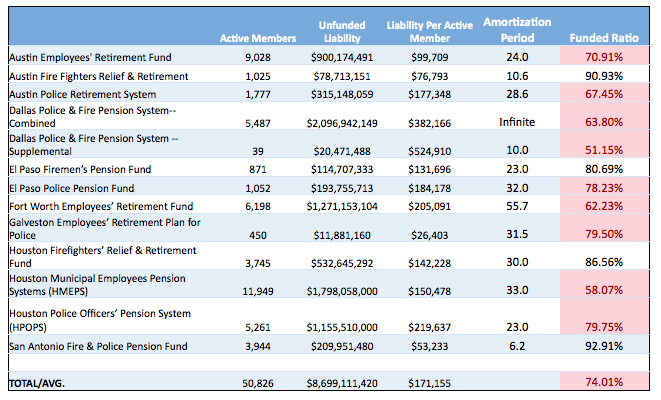
(Funded ratios marked in red denote systems that are below the 80% threshold, signifying a plan that may be considered actuarially unsound. Source: Texas Bond Review Board.)
The fact that these systems either are in or are headed for fiscal muck is a big reason why the Texas Public Policy Foundation is helping to educate and engage on legislation that would restore local control of these state-governed pension plans. People on the ground-level should have some say over their local plans, and that’s what we’ll be fighting for next session. Encouragingly, a bill’s already been filed in the Senate (see SB 152) and there should be legislation filed shortly in the House to do just that.
Should Texas government agencies switched over to defined contribution (i.e. 401K) plans over standard pension plan, and if so, how might this realistically be accomplished without endangering existing retirees?
ABSOLUTELY. Ending the defined benefit model and transitioning new employees into something more sustainable and affordable, like a defined contribution system, is one of the best things that the state legislature can do. This is something I’ve long been an advocate of.
In fact, in early 2011, I played a very minor role in the publication of some major research spearheaded by Dr. Arthur Laffer, President Ronald Reagan’s chief economist, that advanced this same reform idea (see Reforming Texas’ State & Local Pension Systems for the 21st Century). I’ve also written a lot about the need to make the DC-switch, making the case recently in Forbes that:
DC-style plans resemble 401(k)s in the private sector and the optional retirement programs (ORP) available for higher education employees in Texas. These DC-style plans put the power of an individual’s future in their own hands instead of depending on the good fortune of government-directed DB-style plans. DC-style plans are portable and sustainable over the long term as they are based on the contributions of retirees and a defined government match.
With DC-style plans, retirees will finally have the opportunity to determine how much risk they are willing to take. They also reduce the risk that the government will default on their retirement or fund those losses with dollars from taxpayers who never intended to use these pensions. By giving retirees more freedom on how to best provide for their family, they will be in a much better position to prosper.
Because of their efficiency, simplicity and fully funded nature, the private sector moved primarily to DC-style plans long ago. For the sake of taxpayers and retirees dependent on government pensions, it’s time for all governments to move to these types of plans as well.
As far as dealing with transition costs, some much smarter people than I have written on this issue and found that it’s not as big of a challenge as it’s made out to be. Dr. Josh McGee, a vice president with the Laura and John Arnold Foundation, a senior fellow with the Manhattan Institute, and Chairman of the Pension Review Board, had this to say about the matter:
Moving to a new system would have little to no effect on the current system. State and local pensions are pre-funded systems, and unlike Social Security, the contributions of workers today do not subsidize today’s retirees. Future normal cost contributions are used to fund new benefit accruals that workers earn on a go-forward basis and are not used to close funding gaps. Therefore, it matters little whether the normal cost payments are used to fund new benefits under the current system or a new system.
(Source: The transition cost mirage—false arguments distract from real pension reform debates.)
Another pension expert, Dr. Andrew Biggs with the American Enterprise Institute, published research that found that:
In this study, I show that if a pension plan were closed to new hires, over time the duration of liabilities would shorten, and the portfolio used to fund those liabilities would become more conservative. However, the effects of these transition costs are so small as to be barely perceptible.
(Source: Are there transition costs to closing a public-employee retirement plan?)
I’m confident that with the right plan in place, Texas’ state and local retirement systems can make the switch to defined contribution and we’ll be all the better for it.
Thanks to James Quintero for providing such a detailed analysis!
And since we’re on the topic, here’s a roundup of news on the Dallas Police and Fireman’s pension fund crisis:
Dallas created the police and fire plan in 1916. The system’s trustees eventually persuaded the state legislature to allow employees and pensioners to run the plan. Not surprisingly, the members have done so for their own benefit and sent the tab for unfunded promises—now estimated at perhaps $5 billion—to taxpayers. Among the features of the system is an annual, 4 percent cost-of-living adjustment that far exceeds the actual increase in inflation since 1989, when it was instituted. A Dallas employee with a $2,000 monthly pension in 1989 would receive $3,900 today if the system’s annual increases were pegged to the consumer price index. Under the generous Dallas formula, however, that same monthly pension could be worth more than $5,000. No wonder the ship is sinking.
The system also features a lavish deferment option that lets employees collect pensions even as they continue to work and earn a salary. Moreover, the retirement money gets deposited into an account that earns guaranteed interest. Governments originally began creating these so-called DROP plans as an incentive to encourage experienced employees to keep working past retirement age, which in job categories like public safety can be as young as 50. In Dallas, the pension system gives workers in the DROP plan an 8 percent interest rate on their cash, at a time when yields on ten-year U.S. Treasury notes, a standard for guaranteed returns, are stuck at less than 2 percent. According to the city, some 500 employees working past retirement age have accumulated more than $1 million in these accounts—on top of the pensions that they will receive once they officially stop working.
Over the years, the Dallas Police and Fire Pension System fund has amassed $2 billion to $5 billion in unfunded liabilities, the result of bad real estate investments and blatant self-enrichment from prior management. Coupled with a possible setback in ongoing litigation over public safety salaries, Dallas is in the most financially precarious position in its history.
City officials are openly uttering the word bankruptcy, not just of the pension fund but the city itself. As Mayor Mike Rawlings told the Texas Pension Review Board this month, “the city is potentially walking into the fan blades that might look like bankruptcy.”
The state Legislature created this mess by not giving the city a meaningful voice in the fund’s operation and allowing the former board of the pension fund to unilaterally sweeten its membership’s promised benefits without concern to the overall fiscal damage being done. Now it must help the city clean up the mess.
Dallas already provides nearly 60 percent of its budget to support public safety services and recently contributed $4.6 million to increase its share of pension contributions to 28.5 percent — the maximum allowed under state statute. However, if Dallas loses the lawsuit over salaries and no changes are made to the pension fund, the city could take an $8 billion hit. That is roughly equal to eight years of the city’s general fund budget.
Austin, Dallas, Houston and San Antonio collectively face $22.6 billion worth of pension fund shortfalls, according to a new report from credit rating and financial analysis firm Moody’s. That company analyzed the nation’s most debt-burdened local governments and ranked them based on how big the looming pension shortfalls are compared to the annual revenues on which each entity operates.
“Rapid growth in unfunded pension liabilities over the past 10 years has transformed local governments’ balance sheet burdens to historically high levels,” the report says.
Chicago had the most dire ratio on the national list. Dallas came in second. According to the report, the North Texas city has unfunded pension liabilities totaling $7.6 billion. That’s more than five times the size of the city’s 2015 operating revenues.
Both those cities may turn to the public to partially shore up their shortfalls. Houston Mayor Sylvester Turner wants to use $1 billion in bonds to infuse that city’s funds. Dallas police officer and firefighter pension officials also want $1 billion from City Hall, an amount officials there say is too high.
Meanwhile, Austin ranked 14th on the Moody’s list with unfunded pension liabilities of $2.7 billion. San Antonio ranked 22nd with a $2.3 billion shortfall.
A Roundup of Texas Lawsuits of Note
Wednesday, October 26th, 2016A number of lawsuits related to local or federal overreach in Texas are working their way through the court system. Here’s a quick roundup of developments in a few notable cases.
Texas Attorney General Ken Paxton won a sweeping victory in court Friday when Federal District Judge Amos L. Mazzant III dismissed a fraud case the Securities and Exchange Commission had brought against him.
Mazzant, who was appointed to the federal bench by President Barack Obama, found that even if all the facts the SEC alleged were true, they didn’t amount to any violation of securities law by Paxton.
The SEC had dogpiled on Paxton after Collin County special prosecutors got a local grand jury to indict Paxton under state securities law in August 2015.
TPPF Sues Over Wilco Cave Spider
Monday, December 21st, 2015Here’s something on the surface that seems like a small local story, but it’s one that could potentially have huge national implications.
The Texas Public Policy Foundation (TPPF)’s Center for the American Future representing Williamson County resident John Yearwood and Williamson County, Texas today filed suit to intervene into the pending lawsuit seeking delisting of the Bone-Cave Harvestman from the Endangered Species Act. Mr. Yearwood and Williamson County, Texas challenge the authority of the federal government to use the Interstate Commerce Clause to regulate non-commercial interactions with the Bone Cave Harvestman arachnid, which only exists in two central Texas counties, is not bought nor traded in interstate commerce, and does not otherwise affect interstate commerce.
“This lawsuit centers around respect for the rule of law and recognition that the Constitution establishes our federal government as having limited, enumerated powers,” said Robert Henneke, director of the Center for the American Future at the Texas Public Policy Foundation. “Congress has the power to regulate commerce among the states, i.e. Interstate commerce. Congress’ Commerce power through the Endangered Species Act should not, therefore, extend to regulate the Bone-Cave Harvestman species – an intrastate cave-arachnid existing only in caves in Central Texas without any commercial value. For there to be rule of law, there must be limits to government power.”
The Interstate Commerce Clause is the camel’s nose by which the federal government has stuck its vast regulatory powers into just about every crevice of the body politic. Because the Williamson cave spider case clearly has no impact on interstate commerce, there’s the potential for the case to unravel a whole host of intrusive New Deal-era commerce clause rulings, of which Wickard vs. Filburn is probably the most egregious.
There’s no guarantee the case will get to the Supreme Court, but if it does…
TPPF: Why the Texas Model Supports Prosperity
Wednesday, October 21st, 2015I could roll this up into the next California vs. Texas update, but I thought this Texas Public Policy Foundation paper by Vance Ginn on why Texas’ low tax, low regulation model generates prosperity was meaty enough to be worth a separate post.
The Texas model has been touted as an approach to governance that other states and Washington, D.C. would be wise to follow. This approach promotes individual freedom through lower taxes and spending, less regulation, fewer frivolous lawsuits, and reduced federal government interference. Does this Texas restatement of the unalienable rights of “Life, Liberty and the pursuit of Happiness” actually promote freedom, prosperity, and jobs when compared to the largest states and U.S. averages?
To answer this question, this paper (in most cases) compares various measures in California, Texas, New York, and Florida—the states with the largest populations and economic output—and U.S. averages during the last 15 years. Five fiscal measures of economic freedom and government intervention for these states show that Texas generally leads the pack as the most free with the least government intrusion. Eight measures of the labor market indicate that Texas provides the best opportunities to find a job. Five measures of income distribution and poverty show that Texas leads in most categories with a more equal income distribution and less poverty despite fewer redistributionary policies than these large states, particularly California and New York.
Though a mere 15 pages, the paper offers up an in-depth survey of various economic metrics and studies, where Texas repeatedly comes out on top, and New York and California repeatedly come in last and second-to-last.
A few more tidbits:
Read the whole thing.