Posts Tagged ‘China’

China’s Semiconductor Industry: Shell Games All The Way Down

Wednesday, April 7th, 2021

I’ve written about China’s semi-illusory semiconductor businesses before: “In China the question is always how much of that investment is real, and how much is illusion. A lot of those ‘under construction’ fabs never materialize, either unable to attract investors or having their funds magically siphoned off to some other enterprise.” While researching yesterday’s piece on the current semiconductor shortage, I came across this Emily Feng NPR piece on more multi-million dollar shenanigans in that space:

In 2019, the U.S. sanctioned two major Chinese telecom firms, temporarily cutting them off from a vital supply of semiconductor chips — bits of silicon wafer and microscopic circuitry that help run nearly all our electronic devices.

Wuhan Hongxin Semiconductor Manufacturing Co. promised a way out, toward self-reliance in the face of increasingly tough U.S. curbs on this technology. The private company once boasted on its website that it would raise a total of $20 billion to churn out 60,000 leading-edge chips a year.

None of that would come to pass.

Hongxin’s unfinished plant in the port city of Wuhan now stands abandoned. Its founders have vanished, despite owing contractors and investors billions of yuan.

The company is one of six multibillion-dollar chip projects to fail in the last two years. Their rise and fall is a cautionary tale in an industry that is flush with state cash but still scarce on expertise — and a preview of the expensive and winding road China will have to take toward semiconductor self-sufficiency, now a national security priority.

Hongxin Semiconductor began in November 2017 as a joint venture between Wuhan’s Dongxihu district government and a company called Beijing Guangliang Lantu Technology.

The venture got off to a good start — on paper — but a closer look shows there were a number of issues. One of the co-founders of Guangliang had only finished elementary school and was allegedly using false credentials and a different identity, Cao Shan, according to 36Kr, a Chinese tech news outlet. Another co-founder, Li Xueyen, dabbled in selling Chinese traditional medicine, alcohol and tobacco before starting Hongxin, according to corporate records reviewed by NPR.

These are not the profiles you look for in semiconductor startup founders.

The two could not be reached for comment.

Yeah, I bet.

To balance out their lack of technical know-how, the Hongxin founders lured in one of Taiwan’s most famous semiconductor engineers, Chiang Shangyi, to serve as director. He left the company in 2020 to become the deputy chairman of China’s Semiconductor Manufacturing International Corp., telling Hong Kong paper South China Morning Post that his time at Hongxin was “a nightmare.” Chiang did not respond to NPR requests for comment.

Hongxin made headlines in December 2019 when it managed to buy an older model lithography machine made by Dutch company ASML, despite American lobbying to prevent its sale to the Chinese chipmakers.

OK, on the face of it that sounds pretty impressive. If you want to have a cutting edge fab, you have to have one of ASML’s top of the line Extreme Ultraviolet (EUV) steppers. In almost every other segment in the semiconductor equipment market, there’s competition between the three big players (Applied Materials, LAM Research and Tokyo Electron) and occasionally other companies (like Axcelis for ion implanters). But while you might be able to get away with lesser Deep Ultraviolet (DUV) lithography machines from Nikon or Canon for some tasks, for the smallest features on cutting edge 7 and 5nm nodes, you simply can’t do without an ASML EUV stepper. (More background here.)

Well, guess what? The vaunted ASML tool Hongxin bought is apparently an older 1980 model (presumably this one, which dates from 2015, not 1980) which is DUV, not EUV.

Back to the NPR piece.

ASML sold the multimillion dollar piece of equipment — used to etch semiconductors — because of Jiang’s top-notch reputation, according to two people familiar with the sale who were not authorized to speak publicly about it. ASML declined to comment.

Feng (or her editors) goofed here. ASML makes lithography machines, not etch tools.

Hongxin’s timing was opportune. Chinese chip companies still rely heavily on European, American and Japanese technology — much of which, in turn, relies on American intellectual property, which the U.S. appears determined to keep out of Chinese hands. China’s semiconductor demand continues to surge beyond what it can supply itself; trade data show that in 2019, Beijing imported around $350 billion worth in chips.

Given that reliance, China’s central and local governments have been pumping money into the sector to accelerate domestic chip design and manufacturing. The country’s latest five-year economic planning document released in March identifies integrated circuits — semiconductors — as a priority sector for research and development funding.

When governments starts pumping big money into private companies, you can be sure multiple scams are never far behind.

The all-out approach has notched achievements. Successful chip design companies such as Cambricon and Huawei’s HiSilicon have allowed Huawei to replace some of its U.S.-designed chips in its mobile phones.

Cambricon and HiSilicon are both fabless design houses, and both get their chips fabbed at foundries like TSMC. Huawei is one of the largest electronics companies in the world, with over $100 billion in annual sales, and they don’t own their own fab.

Not far from Hongxin is Yangtze Memory Technologies Co. (YMTC), a partially state-owned company that plans to double its output of memory chips to overtake South Korea’s Samsung and SK Hynix, which currently dominate production.

Memory is a tough business. SK Hynix exists because Hyundai and LG (aka Lucky Goldstar), two huge Korean chaebols who hate each other only slightly less than rival Samsung, found the sledding too tough to go alone and had to combine their respective semiconductor operations to survive. Memory makes money hand-over-fist in boom times, but barely breaks even during busts. It’s less technically demanding than some other semiconductor segments, so China could conceivably make some headway there.

YMTC is a subsidiary of Tsinghua Unigroup, a wholly owned business unit of Tsinghua University. Hu Haifeng, Communist Party secretary of Tsinghua Holdings, is the son of Hu Jintao, former CCP General Secretary and President of the People’s Republic of China.

Hongxin sought to capitalize on this momentum. It rented a discreet office on the 25th floor of Wuhan’s Dongxihu district government headquarters.

“Cao” and his partners promised to pitch in 1.8 billion yuan ($276 million) in investment on top of 200 million yuan ($30.7 million) in starting funds from Dongxihu district.

Wuhan’s city government was, around the same time, also beginning construction on a cybersecurity park to provide office and residential space for technology businesses, and it was looking for a flagship company to anchor the complex. In 2018 and 2019, the city named Hongxin its most important “critical construction project” and the company began building its factory next door.

As early as late 2019, even while Hongxin was being lauded by Chinese media for securing an ASML machine, several Wuhan-based construction crews were scrambling to get paid for millions of dollars of work for Hongxin.

“Four months ago, [Hongxin’s] payments to us started to be short, and now we are missing 18 million yuan [$2.76 million],” one contractor, Lu Haitao told another, Wang Liyun in December 2019, according to phone recordings NPR obtained. Wang confirmed the authenticity of the recordings when reached by phone. Lu did not respond to several texts and calls from NPR. Wuhan’s municipal government did not respond to a request for comment.

Meanwhile, two other semiconductor companies — Tacoma Semiconductor Technology Co. Ltd. and Dehuai Semiconductor Technology Co. Ltd. — were also running out of cash.

Tacoma was over 350 miles from Hongxin along the Yangtze river, in the port city of Nanjing. There, the Taiwanese entrepreneur Joseph Lee had initially found a welcome harbor for his own ambitions, starting Tacoma in the city in 2015. He pledged to raise $3 billion to make wafer chips, with consultation from Israeli company Tower Semiconductor (formerly TowerJazz). Tower declined to comment for this story.

Lee continued pitching other local governments. In 2016, he co-founded a second company in Jiangsu province’s Huai’an city, named Dehuai Semiconductor. (Lee sold his stake the same year, citing a clash in vision with the firm’s other managers.)

In 2017, Lee invited Chinese media to tour Tacoma’s facilities, declaring the company had somehow scored 200 million yuan ($30.7 million) in sales. Tacoma had yet to even finish construction on its manufacturing facilities.

Lee initially agreed to an NPR interview for this story but later retracted it, citing state pressure. “Officials have told me not to talk to the media,” he said by text.

Yeah, I bet.

By 2018, Tacoma’s employees were blasting an online forum run by the Nanjing mayor’s office with complaints about unpaid salaries. Chinese corporate records show at least 50 legal complaints have been filed against Tacoma in provincial court, all seeking to recoup construction costs or unpaid wages. Lee disputes owing employees 20 million yuan in unpaid wages.

“Real or fake, the truth is in the hearts of the people,” Lee wrote shortly after these allegations, on Wechat, the Chinese messaging app, and cited a verse from the New Testament: “Now faith is the certainty of things hoped for, a proof of things not seen.”

Citing bible verse when rumbled for his scam. Classic.

Hongxin, Tacoma and Dehuai were able to secure billions of yuan in state funding on the condition they would match that with investment of their own — a commitment that never materialized. Tacoma eventually raised only a fraction — 250 million out of 2.5 billion yuan — of what it promised.

“We never imagined that when our cash flow dried up, we would not be able to find new [cash flow sources], that we would get in so deep,” he told Japanese broadcaster NHK this March.

And this is the problem with doing business in China in general: it’s shell games all the way down. At lot of times, loans and investments are siphoned through four or five different entities from the purposes for which they were originally obtained. Everyone’s trying to get rich, and they hope to survive on smoke and mirrors long enough to get profitable. Imagine if Kleiner Perkins invested $25 million in a software startup, only to find that money was spent on a noodle shop, a used car dealership and a golf club manufacturer.

Sometimes it works. You can build a company on margin, get profitable quickly, and be paying off investors and contractors before anyone realizes how shaky the entire enterprise is.

But you can’t do that with semiconductor manufacturing. The startup costs are simply too high, easily in the billions. Very, very few companies can afford to be in a game that expensive. China’s two biggest semiconductor manufacturing success stories, SMIC and Tsinghua Unigroup, all have have CCP direct government investment.

In this game, little hucksters working the margins have no chance.
Texas vs. California Update for April 5, 2021

Monday, April 5th, 2021

After a long hiatus, the Texas vs. California update is back!

The update, focusing on news about the two biggest states in the union, and contrasting the the red and blue state models of governance for each, was a regular staple of the blog a few years ago, but as I got busy I fell behind, and the links kept piling up. As a result, this update is extra huge and some of the news here is very old indeed, with some links dating back to 2017. Recently I’ve been updating and triaging so I can finally publish this. I’ve tried to put the newest and most important stories at the top, but there is stil some old news of note further down.

  • New Yorkers and Californians can’t stop moving to Texas:

    According to a new U.S. Census Bureau report, of the 15 fastest-growing cities larger than 50,000 people, seven are in Texas including the top three: Frisco, New Braunfels, and Pflugerville. Frisco’s growth rate was 8.2 percent, some 11 times faster than the national rate of 0.7 percent.

    Of the cities with the greatest population gain from July 1, 2016 to July 1, 2017, San Antonio, Texas, took the prize, adding some 66 people every day. Texas had the most cities in the top 15 of this category as well with five making the list and three of the top five overall in addition to San Antonio: Dallas, Fort Worth, Frisco, and Austin.

    San Antonio now has more than 1.5 million people and ranks as the nation’s seventh-largest city, just behind Philadelphia. Fort Worth, meanwhile, knocked Indianapolis, Ind., out of the top-15 with a population of 874,168. Houston is America’s fourth-largest city and is also the most diverse large city in the nation.

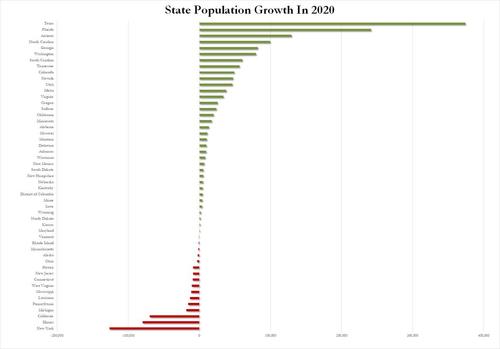
  • In fact, Texas was he number one state for net in-migration in 2020, while California lost the third most residents of any state.

  • Why high tech companies are leaving California:

    In a stunning procession in December, California lost the leadership of three iconic firms — Hewlett Packard Enterprise, Oracle and Tesla — all to Texas, which this year even took the Rose Bowl’s place in hosting the college football playoff. In addition, many California tech firms, including Uber and Lyft, as well as Apple, have been shifting jobs outside the state.

    This has been widely described as California’s “tech exodus.” Though it’s still less than a torrent and more a steady, long-term drip, it augurs some very bad trends. In recent years, California has been losing market share of innovative industries compared with 11 states with high concentrations of innovation-oriented firms, according to research by Ken Murphy, a professor at UC Irvine’s business school.

    Since 2005, California’s share of the number of firms in the innovation sector (composed of 13 of the nation’s highest-tech, highest R&D advanced industries) has shrunk while competitors like Florida, Oregon, Arizona and Utah have expanded their share slightly.

    The pandemic-induced push to move work online could hasten this shift. With 2 out of 3 tech workers willing to leave the Bay Area if they could work remotely, Big Tech could readily spread talent and wealth to other states.

    Increasingly, California’s cities must compete with metro areas in Texas, Tennessee and even parts of the Midwest. Housing prices are a particularly critical concern: California has all three of the most unaffordable metro regions for first-time home buyers, according to a recent AEI survey, and six of the top 10. The flow of tech workers during the pandemic has gone to places like Phoenix, Dallas-Fort Worth and Raleigh, N.C., and away from big coastal cities with higher living costs.

    Software-based tech companies can access knowledge workers outside California, and often at lower costs. At the same time, states like Texas and Arizona have been sought to replicate the California formula for tech industry growth — public university expansion, more suburban housing and public investment in downtowns, all meant to appeal to workers and their bosses.

    Snip.

    But more recently, as the tech industry becomes more virtual and services-based, the companies’ workforces have less of a need to all be in one place. While these companies create vast wealth for a relatively small group of people, this is not a formula for broad-based economic prosperity.

    In contrast to the old Silicon Valley, the Bay Area has become “a region of segregated innovation,” as described by CityLab, where the upper class waxes, the middle class wanes, and the poor live in poverty that is unshakable.

    The state leadership’s cavalier response when major employers depart is to assume that California will continue to create new businesses to replace the high-paying jobs lost.

    Yes, venture capital is piling into tech startups, driven by the low cost of money and pandemic disruption, and the state is expecting $26 billion more in revenue this year in part because of the roaring initial public offering market. But brushing off recent departures as part of a routine industrial cycle is naive and allows politicians to avoid making choices that would keep entrepreneurs, their businesses and good jobs in California.

    California already has the nation’s highest income tax, with the top marginal tax rate at 13.3%. A new proposal, Assembly Bill 1253, would add three new tiers of surcharges on people earning $1 million a year and above. Lawmakers also introduced Assembly Bill 2088, which would apply a 0.4% wealth tax on net worth above $30 million. Neither bill passed the Legislature last month, but both may come back in the new legislative session.

    Tech companies may be adept at avoiding taxes, but their top managers, investors and most skilled employees could see these measures as more reasons to leave — particularly when competing states like Texas, Tennessee, Nevada and Florida have zero state income taxes.

    Another law, Assembly Bill 5, which limits contract employees, could prove damaging to small startup business that cannot afford many full-time workers. And for some industries, particularly those involved in energy-intensive industries like cloud computing and advanced manufacturing, California’s energy prices — one of the highest in the continental U.S. and double the cost in places like Texas — are another incentive to move commercial activities elsewhere.

  • Indeed, California is so desperate for tax revenue that they want to tax residents even after they’ve left the state:

    As the catastrophic state of California’s finances finally begins to set in among politicians, anti-tech media personalities, and far left cultural influencers, the narrative on California’s techxodus — that is, the migration of California’s technology industry out of the state — has shifted from mockery, and “we’ll be better off without you,” to a far more sober, and increasingly-desperate “leaving California is immoral.”

    As it is simply too embarrassing for politicians to admit the state needs the technology industry after more than a decade of antagonizing the men and women who built it, and as it is political suicide for incumbent politicians in a one-party state to admit that every one of the problems we’re facing has been created by our elected leaders, a moral argument for tech’s responsibility to California, and specifically the Bay Area, has recently been produced. It goes something like this: young ambitious people moved to the state, and struck gold. But rather than “give back” to the land, they’re leaving with resources they “took” from the region. Like the milkshake guy from There Will Be Blood, sucking oil from the earth. Like the evil army people from Avatar, and their unquenchable thirst for unobtanium.

    Snip.

    “Extracted,” she says. Smh. A week or so later, in the psychotic San Francisco Board meeting where our local representatives voted 10 to 1 to officially condemn Mark Zuckerberg for donating 75 million dollars to a hospital (really, this happened), the word came up again. When the floor was opened to the public, an activist downplayed what was, as Teddy Schleifer reports, “the largest single private gift to a public hospital ever,” and accused Zuckerberg of “extraction.” Our local politicians did not think this strange.

    Snip.

    I take extreme issue with the notion that industry leaders have taken something from the “community,” defined here as the “talent,” the “incubators,” and the “mentors.” This is precisely the opposite of reality. The men and women leaving are the talent, they have started the incubators, they have built the companies, they have funded the startup ecosystem, and they have mentored countless young people. This is the “network.” They are the network. Technology workers do not “extract” value from the region, they are what makes the region valuable.

    California is beautiful — San Francisco is truly, I think, one of the most beautiful cities in the world — but the soil isn’t made of magic, there’s no such thing as digging for microcode, and the Bay Area’s nativist, anti-immigration political climate has certainly not created the tech community, which is populated largely by immigrants, be they from out of the state or out of the country.

    Among many things, including talent, opportunity, and soft power, the technology industry has brought tremendous tax revenue to the Bay Area. The budget of San Francisco literally doubled this decade, from around six billion to over twelve billion dollars. With our government’s incredible, historic abundance of wealth, the Board of Supervisors has presided over: a dramatic increase in homelessness, drug abuse, crime — now including home invasion — and a crippling cost of living that can be directly ascribed to the local landed gentry’s obsession with blocking new construction. This latter piece is important, as it appears to be the only thing our Board cares about. This is because significantly increasing the local housing supply would decrease the value of the multi-million dollar homes almost every single one of our Supervisors owns, and we could never have that.

    These past ten years I often wondered where the city’s money went. Could the leadership really be this stupid, or was there corruption? Turns out both. We’ve recently discovered our politicians are literally criminals, but they’re also bad at crime.

    Snip.

    The Bay Area housing, homeless, and drug crises are all exacerbated by the state government, which is as incapable of managing its finances as it is incapable of managing its public land; we are now teetering on the edge of true financial ruin in a state of endemic, constant wildfire. But let’s take a closer look at this issue of money. On one hand we have insane, nativist property tax codes, which punish new homeowners at the expense of longtime landlords, and on the other our income taxes have skyrocketed. Since income taxes are structured progressively, the state has backed itself into a position of extreme uncertainty, as the top one percent of earners pay half the state’s taxes — while politicians argue the state’s wealthiest men and women, who already pay more in taxes than the wealthiest men and women of any other state and most free countries in the world, are not paying their “fair share.” As if rudimentary economic threats were not enough, politicians have made cultural platforms of their anti-technology, anti-industry attitudes, and have done everything in their power to drive our top one percent of earners out of the state. In this, our politicians are succeeding.

    Such success in driving top earners from the state only further exacerbates the state’s political disasters, with our government of bloated, corrupt services now starving for income. This has in turn increased the political appetite for all manner of draconian, anti-business practices among politicians with no apparent ability to conceive of the second order effects of their legislation, a deficiency in basic intelligence that led, for example, to the unmitigated disaster that was AB5. In other words, everything is structured to further deteriorate.

  • “S.F. restaurant owners say rise in property crime is making dire situation worse.”

    Beleaguered San Francisco restaurants are struggling with a recent citywide rise in burglaries, including a slew of brazen break-ins at popular restaurants between the Thanksgiving and Christmas holidays. It’s a situation many restaurant owners say is exacerbating an already bleak outlook for the local food scene.

    San Francisco Police Department data shows burglaries in the city climbed from 4,918 reported incidents a year ago to 7,248 as of Dec. 27. The data does not specifically show how many restaurants have been affected, but the rise in burglaries is reflected in the stories being told by business owners in interviews and on social media. It’s a hard reality for local restaurants that have now gone almost 10 months with diminished revenue, forced hibernation periods, and only occasional approval for indoor and outdoor dining service.

    In mid-December alone, San Francisco’s nostalgic Toy Boat Dessert Cafe posted on Instagram about having had its door kicked in during an attempted burglary. Also in the Richmond District, Cassava took to social media to post about losing roughly $3,000 worth of equipment, including iPads, after a break-in. And Epic Steak and Waterbar on the Embarcadero each lost a similar amount when thieves stole alcohol and damaged property.

    Owners say the shelter-in-place order provides thieves with opportunities to break into businesses. Streets are empty because people are staying home. The ghost-town effect is increased as a growing number of restaurants and other businesses are either permanently or temporarily closed. The break-ins are all the more painful when restaurants aren’t even bringing in income to cover the cost to repair or replace stolen or damaged items.

    (Hat tip: Instapundit.)

  • Speaking of government officials being stupid crooks: “SF City Administrator Naomi Kelly Resigns Over Bribery Allegations. Husband Harlan Kelly, SF PUC Manager, had been arrested after accepting international trips, vacation to China, meals, jewelry, and personal car services.” As with the Biden clan, graft, corruption and shady links to China all seem to be part of the family trade for Democratic power families…
  • How California’s catch and release approach to crime kills.

    Jerry Lyons, 31, had spent his entire adult life committing crimes. He had dozens of arrests in California — attempted robbery, burglary, evading police, driving a stolen vehicle, weapons charges, drug charges, shoplifting, trespassing, etc. — but kept getting turned loose until Thursday, when he finally killed somebody. Sheria Musyoka, 26, was an immigrant from Kenya who had graduated from Dartmouth and moved to San Francisco with his wife and three-year-old son. Lyons was behind the wheel of a stolen car when he killed Musyoka.

  • 2018: Poverty in California:

    Despite improvements, the official poverty rate remains high.

    According to official poverty statistics, 14.3% of Californians lacked enough resources—about $24,300 per year for a family of four—to meet basic needs in 2016. The rate has declined significantly from 15.3% in 2015, but it is well above the most recent low of 12.4% in 2007. Moreover, the official poverty line does not account for California’s housing costs or other critical family expenses and resources.

    Poverty in California is even higher when factoring in key family needs and resources.
    The California Poverty Measure (CPM), a joint research effort by PPIC and the Stanford Center on Poverty and Inequality, is a more comprehensive approach to gauging poverty in California. It accounts for the cost of living and a range of family needs and resources, including social safety net benefits. According to the CPM, 19.4% of Californians (about 7.4 million) lacked enough resources to meet basic needs in 2016—about $31,000 per year for a family of four, nearly $7,000 higher than the official poverty line. Poverty was highest among children (21.3%) and lower among adults age 18–64 (18.8%) and those age 65 and older (18.7%). The overall poverty rate went unchanged between 2015 and 2016, following two years of decreases.

    About four in ten Californians are living in or near poverty.

    Nearly one in five (18.9%) Californians were not in poverty but lived fairly close to the poverty line (up to one and a half times above it). All told, two-fifths (38.2%) of state residents were poor or near poor in 2016. But the share of Californians in families with less than half the resources needed to meet basic needs was 5.6%, a deep poverty rate that is smaller than official poverty statistics indicate.

  • 2018: “LA Doubled Homeless Budget, Doubled Homeless Crime.” Bonus: Homeless people were behind many of the big California fires.
  • Los Angeles is seeking a $3.9 billion coronavirus bailout. “Last year, roughly 20,000 city employees’ average pay exceeded $147,000, costing taxpayers $3 billion, Open the Books auditors found. Nearly 2,000 employees out-earned California Gov. Gavin Newsom’s salary of $202,000.” (Hat tip: Pension Tsunami.)
  • “2 out of 3 tech workers would leave SF permanently if they could work remotely.”
  • “In California, Illegals Come First; Californians Don’t Matter.”

    The number of homeless Californians in the Los Angeles county has reached 58,936, New York Times reported this weekend.

    But Californians don’t seem to be the priority of democratic governor Gavin Newsom.

    Under an agreement between Gov. Newsom and Democrats in the state legislature, low-income adults between the ages of 19 and 25 living in California illegally would be eligible for California’s Medicaid program, known as Medi-Cal.

    State officials estimate that will be about 90,000 people at a cost of $98m a year.

    This decision will make California the first state in the US to pay for illegal immigrants to have full health benefits.

  • “Gavin Newsom’s Property Taxes Are Chronically Delinquent and There’s No Excuse.”

    For the 2018-2019 tax year, the bill was sent to the Newsoms on September 28, 2018. The two installments were due in December 2018 and April 2019, and the bill became delinquent on July 1, 2019. They finally paid their second installment, along with about $3,000 in penalties, on September 3, 2019. This is significant because the Newsoms’ Fair Oaks mansion was purchased for $3.7 million cash in November 2018. Newsom’s spokesman claims it was the Newsoms’ cash even though there is no documentation of that; the home was purchased in the name of Gavin Newsom’s cousin and longtime PlumpJack business partner, Jeremy Scherer.

    If the Newsoms had $3.7 million in cash lying around, why wait to pay $22,000 in property taxes until the next year and incur a $3,000 penalty? Wealthy people aren’t in the habit of paying thousands of dollars in penalties.

    In 2018 the Newsoms were sent a supplemental property tax bill on May 15, covering a revaluation and some school and health bonds. That bill was due in two installments; the installments became delinquent June 30 and October 31, respectively.

    He finally paid them on December 10, 2018, along with $750 in penalties.

    The last time their property tax bill was paid on time was when they received the “sweetheart” cashout refinancing deal in December 2017 ($3,225,000 cashout on a home worth $3,500,000) – presumably because the bank would only close the loan if the property taxes were paid at the same time.

  • “Many people are moving from California to Texas. The cost of living, as well as high taxes and red tape, are precipitating the push.”

    “EVERYONE IS FROM California. Are they kicking y’all out?” asks a curious bureaucrat at the Department of Public Safety in Plano, a city near Dallas. In the previous week she had helped 20 people from California apply for a Texas driving licence. Those keeping score in the contest between the two states do not have to look far to notch up points for Texas. On the way to the state Capitol building in Austin to interview Greg Abbott, the governor, your correspondent discovered that her driver had recently relocated from southern California to start a family in a more affordable city.

    Between 2007 and 2016 a net 1m American residents, or 2.5% of the state’s population, left California for another state. Texas was the most popular destination, attracting more than a quarter of them. More Americans have left California than moved there every year since 1990, though immigrants still arrive from abroad.

    Companies are also moving. Last year McKesson, a medical-supplies company, and Core-Mark, a supplier to convenience stores, shifted their headquarters from California to Texas, as did Jamba Juice, a smoothie company. Many Californian firms are also adding jobs outside the Golden State. Charles Schwab, a financial-brokerage firm based in San Francisco, received more than $6m in incentives from Texas, and by the end of this year will have more employees there than in California.

    What explains the one-way traffic? There are four reasons for California’s weaker position. First, it has become very expensive, especially for housing. “If there’s one risk factor in this state, it’s affordability,” says Gavin Newsom, California’s governor. “The thing we most pride ourselves on—the California dream, a notion of social mobility that we export around the world—is in peril.” A third of Californians are thinking of moving out of state because of the high cost of housing, according to a recent survey by the Public Policy Institute of California, a non-profit research firm. Most of those leaving California for Texas earn less than $50,000 a year and have only a high-school education…

    The middle class is also struggling. In California home-ownership rates are at their lowest level since the 1940s and among the lowest in America, with black and Hispanic families particularly hard hit. In the past ten years around 75,000 new housing units received permits annually, only 40% of the projected need. “From the perspective of a young, upwardly mobile family, California is nearly impossible, unless you have rich parents, rob a bank, or get money from your firm going public,” says Joel Kotkin, a professor at Chapman University, who believes that the state is experiencing a new kind of “feudalism”, where the ultra-rich thrive and others suffer.

    As a symbol of how out-of-reach the once accessible state has become, last year the small house that was the setting for “The Brady Bunch”, a television show in the 1970s about a middle-class Californian family, sold for a whopping $3.5m, nearly double its asking price. Companies expanding elsewhere find that many employees are happy to give it a go in a state where they can afford to buy a house and raise a family.

    The states also have wildly different tax regimes, which is a second reason for Texas gaining favour as a destination. With a top rate of 13.3%, California has the highest state income-tax rate for top earners. Texas does not charge residents a state income tax. Instead, they pay higher property taxes to local governments, and the state gets most of its money from a sales tax. Because of recent changes to the tax code, residents of California and other high-tax states will no longer be able to deduct all of their state and local taxes from federal payments, which could further dampen people’s willingness to remain in the state.

    Taxes on businesses are increasing, too. In the past six elections California voters have approved more than 800 local taxes on businesses and residents, according to Larry Kosmont of Kosmont Companies, an economic advisory firm. (This does not include voters’ decision to raise the income-tax rate on the state’s highest earners.) For example, last year voters in San Francisco approved the controversial Proposition C, which taxes businesses with more than $50m in gross revenues to fund services for the homeless. Companies with fat profit margins can afford higher taxes, but lower-margin businesses cannot, and these are the ones most likely to consider an alternative location.

    Third, Texas has pursued a concerted strategy of wooing and cultivating businesses, whereas California has not. This began with Rick Perry, who served as Texas’s governor from 2000 to 2015. He travelled to California and other states on “hunting trips” to poach businesses, ran ads on radio encouraging people and companies to move, and offered large incentives to create jobs in Texas. Mr Abbott has continued with these pro-business policies and still operates a “deal-closing fund” to incentivise businesses to come. He is a cheerleader for his state’s advantages, including low costs, a central location with good airports and a convenient time zone for doing business with both coasts. He describes Texas as “the quintessential free-enterprise state”.

  • Midland County, Texas was the fastest growing county in America in 2018.
  • “Meet the Dallas-area woman shepherding a ‘Move to Texas from California!’ migration.”

    Here’s what the “liberal Californians, go home” crowd misses: The vast majority of West Coast dwellers who make up Bailey’s more than 11,500 Facebook followers lean conservative.

    And after spending a few days perusing Bailey’s page, I’d say this comment best sums up its audience: “We fell in love with Texas immediately … we’re conservative Christians who love God, country, freedom, family, gun rights and barbeque.”

    Bailey said cost of living and taxes are hot buttons for commenters, but so are gridlocked roads, the homeless and illegal immigration.

    The Realtor welcomes people of all political stripes onto her page — after all, she’s in this to make money. And she and her husband, Scott, identify as libertarian.

  • 2019: Can California be saved?

    Our state debt is over $1.5t. We have the highest gasoline prices in the nation. Oh, and we are a sanctuary state that protects all manner of illegal immigrants, no matter how serious the crimes they’ve committed. Think Jose Garcia Zanate who killed Kate Steinle. He had been deported seven times but was out and about on the streets of San Francisco with the blessings of SF law enforcement; they aim to protect the criminals at the expense of the law-abiding. ICE is the enemy in sanctuary cities and states, the thugs are victims.

    State taxes in California are the highest in the nation, as are our sales taxes. We fall nearly last in education. We have the most homeless, the most illegal migrants. The state spends $30.b on illegal immigration per year. Like all cities run by progressives, our entire state is a disaster of Democratic making. San Francisco, Los Angeles, and San Diego have been overrun by homeless people, most of them drug addicted and/or mentally ill. Entire areas of these cities are befouled by used needles, feces, trash, garbage, rats and now diseases long-thought to be extinct in the West. Persons who work in downtown Los Angeles have contracted typhus! As true in other cites long run by Democrats (Chicago, Baltimore, Seattle, Detroit, Flint) it is the implementation of ridiculous utopian Marxist policies so beloved by progressives that has destroyed these once grand cities. Socialist strategies always fail. Democrats cheat, (ballot harvesting) are re-elected, and the state continues to decline. Venezuela is the current example of the massive failure of socialism on the world stage. What is happening there is beyond tragic; the people are starving in every sense of the word. But will our own Alexandria Ocasio-Cortez condemn socialism? Absolutely not. She, Bernie Sanders and their fellow travelers mean to take this country the way of Venezuela, the road California has already been on for too long; possibly too long to ever recover. This state is slowly becoming a third-world nation. But, as in Venezuela, the rich and politically powerful stay rich, keep their mansions and their private planes unperturbed by the devastation they generate.

  • How California could be saved:

    First, the problem of corruption must be addressed. It’s no secret that public unions rule the legislative process in this state. They’re even funding the redecorating of the Lieutenant Governor’s office, using money confiscated from the state’s lowest-paid workers. De-funding the unions through an “Uncheck the Box” campaign aimed informing union workers that they can opt out of union dues (opt-outs made possible by the Janus decision) should be a top priority for activist groups in the state. De-funding the unions will have a positive domino effect on everything in California.

    Corruption in the regulatory process, at the state and local levels, is rampant and an open secret. Lately the Los Angeles Times has done a great job of investigating the problems with homelessness and trash piles, but their investigations stop short of fully placing blame where it belongs. People who are truly fed up with the condition of our state need to put their money where their mouth is and fund true investigative reporting (because you know Silicon Valley won’t be capitalizing any non-socialist journalistic startups).

    Next, laws which prioritize criminals, homeless bums (as opposed to those who are homeless because of mental illness), and illegal immigrants over the state’s children and families must be revised or abolished. Did you know that a homeless bum’s shopping cart (which they stole from some business somewhere) is considered their “home” or “property” and cannot be taken away from them? Homeless people with true mental illness should be treated with the dignity they deserve (as Kurt Schlichter said on KABC today), and not left on the streets to fend for themselves.

    The true causes of the third-world conditions in Los Angeles and San Francisco must be addressed. Some well-meaning laws or programs relating to homelessness are causing negative unintended consequences. In Los Angeles, some of the blame for the massive trash piles can be placed directly on City Hall – their RecycLA program resulted in massive increases in sanitation costs for businesses and missed pickups.

    The state’s ballot harvesting law must be amended. Currently anyone – without ID or training – can pick up a ballot from any voter and turn it in to elections officials. The harvester has to sign their name to the outside of the ballot, but there is no process for elections officials to verify that the person turning in the ballot is the person who signed the outside, or that the name they used is actually their real name. The process is ripe for fraud.

    These are all from 2019, and we’re no closer to any of them being implemented…

  • Get paid to move your business out of California.
  • “Data company Harmonate announced it will relocate its corporate headquarters from San Jose, California, to Austin.”
  • Military eyeware provider Wiley X moving from livermore, California to Frisco in Texas.
  • In fact, a nunch of companies are moving to the Metroplex:

    Lion Real Estate Group LLC, which has about 150 employees and $1 billion in assets under management, is moving its headquarters into office space at 3811 Turtle Creek Blvd., the company’s co-founders said in an exclusive interview with the Dallas Business Journal in January. The fast-growing real estate firm focuses on multifamily investment and is relocating its corporate headquarters to Dallas from Los Angeles.

    The company will keep its Los Angeles office to support West Coast operations.

    Lion Real Estate Group’s decision to relocate its headquarters to Dallas aligns with Lion’s strategy of acquiring multifamily assets outside of the urban core, both in Texas and in other high-growth cities across the Sunbelt and Southeast, said Jeff Weller, co-founder and managing principal of the firm…

    The National Rifle Association, meanwhile, has retained Colliers International to help it scout space for a new corporate headquarters in DFW or elsewhere in Texas in the event it opts to pull the trigger on a prospective relocation from Northern Virginia.

    The nonprofit intends to restructure as a Texas-based organization and has formed a committee to explore the prospect, which could include a headquarters move.

    In court documents, the NRA asked the U.S. Bankruptcy Court in Dallas, the venue for its Chapter 11 reorganization, for permission to retain Colliers to help it find office space for rent or purchase. The search will mostly likely be focused on the “Dallas-Fort Worth region,” the court documents say.

    The first few months of 2021 has sustained the momentum the area saw in 2020 when several companies decided to relocate to North Texas. Last year, one of the biggest corporate relocations to DFW was CBRE Group Inc. (NYSE: CBRE), the world’s largest commercial real estate services and investment firm, which moved its headquarters from Los Angeles to Dallas.

    Financial services giant Charles Schwab moved its San Francisco headquarters to the North Texas community of Westlake at the start of this year, in a relocation announced in 2020.

    Hundreds of small and midsize firms like Lion Real Estate and Wiley X have relocated to DFW over the last few years.

    According to Dallas Regional Chamber, there are 102 major corporations considering headquarters relocation or expansion to North Texas currently.

  • “Texas is tops in the U.S. for commercial development impact,” contributing more than $65 billion to the Texas economy. (Usual DMN paywell disclaimer.)
  • “Jim Breyer, CEO of venture capital and private equity investor Breyer Capital, announced in August 2020 that Breyer Capital would be opening a second office in Austin. While Breyer Capital’s original office and interest in Silicon Valley remain, Breyer himself has also moved to Austin and is investing in what he sees as the city’s potential as an emerging tech hub.”
  • Speaking of which, here he is on why Austin will be the next Silicon Valley:

    after lots of planning and due diligence, I decided that Austin was the best place for the next era of my venture capital and venture philanthropy career. With early, but compelling, signals that Austin is emerging as the next great tech hub, I couldn’t be more excited to play a role in helping another part of the country reach its potential. I believe there is an opportunity to get in near the ground floor and build something truly enduring.

    Other friends from the Bay Area, like Palantir co-founder Joe Lonsdale, Dropbox CEO Drew Houston and Tesla’s Elon Musk, have made similar moves, along with many other tech industry leaders, so I’m not surprised that a so-called “Bay Area exodus” has become a widely reported trend.

    But instead of focusing on the positives of Austin, many exodus narratives have focused on problems with the Bay Area. While critics make some fair points about rising living costs and government overreach, I would argue that Silicon Valley and Austin both have bright futures ahead. The things that made Silicon Valley special are not going anywhere. The Bay Area will continue to be a global hub of innovation that attracts courageous entrepreneurs, benefits from world-class institutions and nurtures talent from leading tech companies — even as Austin offers a remarkable new frontier of opportunity.

    New Austinites all have different reasons for why they moved here, of course. My decision to start Breyer Capital Austin, for example, has more to do with Austin’s strengths than any of the Bay Area’s flaws.
    For starters, Austin, more than any other city in the country, encourages a culture of interdisciplinary collaboration. Because the city has catered to so many types of professionals, and not just technologists, the depth of talent here is unique. Artists, entrepreneurs, doctors and professors, all at the top of their trade, frequently choose to build things together. By breaking down silos and embracing novel approaches to company-building, Austin’s diverse entrepreneurs will usher in a new era of growth for the city, state and country. I couldn’t be more excited to be investing in health care AI companies and fin-tech companies that have a consumer media backbone. The best founding teams are multifaceted and versatile, and Austin has every type of entrepreneur that a great company needs. This kind of interdisciplinary entrepreneurship will help Austin companies flourish.

    Austin has attracted and will continue to attract young, brilliant talent because of its comparative affordability, outdoor culture and professional development opportunities. This vast pool of expertise is contributing to a remarkably robust climate of innovation. With Tesla, Facebook, Apple, Google, Oracle and other leading companies moving to or expanding in Austin, the entrepreneurial ecosystem will be bolstered when talent from these companies breaks away to start new ventures. Some of my best investments have been in entrepreneurs who gained valuable experience at an outstanding established company before starting their own. Five years from now, Austin will benefit from many tech company alums eager to leverage their expertise to tackle some of the world’s most pressing problems.

  • “Why some tech companies and billionaires are leaving California.”

    While it may be an overstatement to say California is hemorrhaging people, some of the state’s major companies and wealthiest residents are leaving for states like Texas, Arizona and Florida. In 2020, Oracle, Palantir and Hewlett-Packard Enterprise were among the companies that announced they’re relocating their headquarters out of the Golden State. Wealthy individuals from the tech industry moving recently include Larry Ellison, Drew Houston, Joe Lonsdale and Elon Musk, currently the world’s richest man.

    California’s population and job growth have both slowed to a trickle, with many citing concerns about high taxes, cost of living and heavy regulations. With the rise of remote work in 2020, over 135,000 more people left California than moved in — the third largest net migration loss ever recorded for the state. Although some big names have committed to stay, one recent survey found that two of every three Bay Area workers would leave the area permanently if they could continue to work from home indefinitely.

  • “As California Declines, Texas Is The Heir Apparent To Big-Tech Looking To Flee Progressive Laws.” (Hat tip: Color Me Red.)
  • Retireees are fleeing California as well:

    It’s not just businesses that are moving out of California. Retirees are leaving in growing numbers.

    For whatever reason they move, the retiree exodus is taking knowledge, wealth, patrons of the arts and potential philanthropy out of communities in the Golden State to the benefit of other places.

    The trend dovetails with larger concerns about California’s affordability, business climate and economic disparities.

    “It’s not just retirees moving. It’s companies. It’s rich people and poor people,” said Sanjay Varshney, professor of finance at California State University Sacramento and founder of Goldenstone Wealth Management LLC in El Dorado Hills.

    Poorer people are leaving the state because “they can’t make ends meet” with the high cost of living and housing, he said. “And extremely wealthy people are moving because they are fed up.”

    Varshney said a migration of wealthy people are leaving the Bay Area in particular, and “you are seeing that with people like Elon Musk and corporations like Oracle, Tesla and Hewlett Packard Enterprise.”

    Retirees can easily leave California, as they are no longer tied to jobs in the state. “Retirees are a very mobile part of the population,” Varshney said

    The trend appears to be growing. The California Public Employees’ Retirement System tracks where it sends benefits, and more of its members no longer call California home. Some 85% of CalPERS retirees lived in the state 2013. That dropped to 84% in 2018 and to 82.3% in 2020, according to the pension system.

    The Greater Sacramento Economic Council’s mission is to attract companies to relocate to the Sacramento area. By the time companies decide to move out of the Bay Area, they are often soured on California taxes and regulations, and they tend to move out of the state completely, said Barry Broome, Greater Sacramento’s CEO.

    The same can be said for individuals, he said.

    “A lot of this is tax,” Broome said. California has higher business taxes and higher individual tax rates than most other states.

  • What the radical left has done to San Francisco.

    To live in California at this time is to experience every day the cryptic phrase that George W. Bush once used to describe the invasion of Iraq: “Catastrophic success.” The economy here is booming, but no one feels especially good about it. When the cost of living is taken into account, billionaire-brimming California ranks as the most poverty-stricken state, with a fifth of the population struggling to get by. Since 2010, migration out of California has surged.

    The basic problem is the steady collapse of livability. Across my home state, traffic and transportation is a developing-world nightmare. Child care and education seem impossible for all but the wealthiest. The problems of affordable housing and homelessness have surpassed all superlatives — what was a crisis is now an emergency that feels like a dystopian showcase of American inequality.

    And yet, it’s not really American inequality. It’s the kind of inequality produced by failed leftist policies. Picture today’s San Francisco:

    Yet the streets there are a plague of garbage and needles and feces, and every morning brings fresh horror stories from a “Black Mirror” hellscape: Homeless veterans are surviving on an economy of trash from billionaires’ mansions. Wealthy homeowners are crowdfunding a legal effort arguing that a proposed homeless shelter is an environmental hazard. A public-school teacher suffering from cancer is forced to pay for her own substitute.

    Manjoo emphasizes that San Francisco is run entirely by Democrats. It has become difficult to blame it on Republicans when there are no Republicans.

  • “Two deaths a day: S.F. drug overdoses fueled by fentanyl are spiking.”
  • California to settle claims that it can’t even teach students to read.
  • “Rats at the police station, filth on L.A. streets — scenes from the collapse of a city that’s lost control.”

    The good news is that two trash-strewn downtown Los Angeles streets I wrote about last week were cleaned up by city work crews and have been kept that way, as of this writing.

    The bad news is that I didn’t have to travel far to find more streets just as badly fouled by filthy mounds of junk and stinking, rotting food.

    Then there was the news that the LAPD station on skid row was cited by the state for a rodent infestation and other unsanitary conditions, and that one employee there was infected with the strain of bacteria that causes typhoid fever.

    What century is this?

    Is it the 21st century in the largest city of a state that ranks among the world’s most robust economies, or did someone turn back the calendar a few hundred years?

    We’ve got thousands of people huddled on the streets, many of them withering away with physical and mental disease. Sidewalks have disappeared, hidden by tents and the kinds of makeshift shanties you see in Third World places. Typhoid and typhus are in the news and an army of rodents is on the move.

    On Thursday I saw a county health inspector on rat patrol between 7th and 8th streets on skid row. He was carrying a clipboard and said he had found droppings and other evidence of rodents, and I asked where:

    “Everywhere,” he said.

    Well, it’s nice to know somebody is doing something, but you don’t need a clipboard. I’ve seen so many rats the last two weeks in downtown Los Angeles, I have to suspect they’re plotting a takeover of City Hall, which vermin infiltrated last year.

    The city of Los Angeles has become a giant trash receptacle. It used to be that illegal dumpers were a little more discreet, tossing their refuse in fields and gullies and remote outposts.

    Now city streets are treated like dumpsters, or even toilets — on Thursday, the 1600 block of Santee Street was cordoned off after someone dumped a fat load of poop in the street. I’m not sure when any of this became the norm, but it must have something to do with the knowledge that you can get away with it. Every time sanitation crews knock down one mess, another dumpsite springs up nearby.

  • “Top California high-speed rail executive under investigation in ethics probe.”
  • Those having children are leaving California in droves:

    California is the great role model for America, particularly if you read the Eastern press. Yet few boosters have yet to confront the fact that the state is continuing to hemorrhage people at a higher rate, with particular losses among the family-formation age demographic critical to California’s future.

    Since the recovery began in 2010, California’s net domestic out-migration, according to the American community survey, has almost tripled to 140,000 annually. Over that time, the state has lost half a million net migrants with the bulk of that coming from the Los Angeles-Orange County area.

    In contrast, during the first years of the decade the Bay Area, particularly San Francisco, enjoyed a renaissance of in-migration, something not seen since before 2000. But that is changing. A recent Redfin report suggests that the Bay Area, the focal point of California’s boom, now leads the country in outbound home searches, which could suggest a further worsening of the trend.

    One of the perennial debates about migration, particularly in California, is the nature of the outmigration. The state’s boosters, and the administration itself, like to talk as if California is simply giving itself an enema — expelling its waste — while making itself an irresistible beacon to the “best and brightest.”

    The reality, however, is more complicated than that. An analysis of IRS data from 2015-16, the latest available, shows that while roughly half those leaving the state made under $50,000 annually, half made above that. Roughly one in four made over $100,000 and another quarter earned a middle-class paycheck between $50,000 and $100,000. We also lose among the wealthiest segment, the people best able to withstand California’s costs, but by much smaller percentages.

    The key issue for California, however, lies with the exodus of people around child-bearing years. The largest group leaving the state — some 28 percent — is 35 to 44, the prime ages for families. Another third come from those 26 to 34 and 45 to 54, also often the age of parents.

    (Hat tip: TPPF.)

  • Texas is among the most recession-proof states in the country:

    Every day, Texans are reminded why letting liberal democrats take over this state would be a terrible idea.

    In a new report released by S&P Global Ratings, Texas has been ranked among the most recession-proof states in the country, according to a variety of factors.

    Texas’ fiscal strength stems from conservative state legislators’ insistence against implementing a personal income tax or increasing other taxes. Also important has been the push by Gov. Abbott and Lt. Gov. Dan Patrick to slow the rate of spending growth and refusal to dip into the state’s “rainy day fund” for non-emergency spending.

  • Dispatches from San Francisco’s decline:

    Magnificent in the distance, San Francisco is now shockingly ugly up close. In the decade I have lived here, the city has achieved the seemingly impossible: It has combined the expensive and the bland and the appalling into a new form of decadence. To the untrained eye, it looks magical: a city of the future, a city of gasps. Then, slowly, it reveals itself to be a city of lies, one that dismisses the idea of city living.

    Snip.

    Running a venture-capital fund that invests as early as possible in startups, I now see fewer and fewer companies choosing to come launch here. When we opened our doors in 2015, maybe 80 percent of our investments were in Bay Area companies. Last year [2018], half of them were, and we expect to see that number decrease even more in the years ahead. Andreessen-Horowitz, the famed Silicon Valley VC firm, has announced that it’s becoming more or less a hedge fund, presumably to focus on later-stage opportunities. Peter Thiel, who had lived here since the mid 90s, has now decamped to Los Angeles, and says there is a less than 50 percent chance the next great tech company will arise in an increasingly expensive, conformist Silicon Valley.

    “Silicon Valley is now more fashion than opportunity,” Thiel told the Swiss newspaper Neue Zürcher Zeitung. “The heads are the same.”

    Lack of independent thought aside, the Economist has identified the source of the problem: You can’t build a successful startup from a garage if a garage costs a million bucks. The flow of new creations is being choked off first and foremost because there are fewer cheap places for new things to start.

    The median rent for a one-bedroom apartment in San Francisco recently hit $3690 per month, 30 percent greater than in New York City. Over the last decade, the Bay Area has added 722,000 jobs but built only 106,000 new homes. Proposition M, passed in the 1980s to avoid “Manhattanization,” limits the supply of office space. The city’s average Class A asking rent has risen 124 percent since 2010 to over $80 per square foot.

    The legendary urbanist Jane Jacobs once remarked that new ideas come from old buildings, the types of places you can alter without permission because no one cares about them. This is one reason why so many garage startups and garage bands and artists spilling paint in discarded warehouse lofts have left their mark on the world. The true creative class can’t afford to rent expensive new studios.

    But in San Francisco, the true creative class can’t afford to rent any space anymore.

    Snip.

    Up and down the city’s disorienting hills, you notice homeless men and women — junkies, winos, the dispossessed — passed out in the vestibules of empty storefronts on otherwise busy streets. Encampments of tents sprout in every shadowy corner: under highway overpasses, down alleys. Streets are peppered with used syringes. Strolling the sidewalks, you smell the faint malodorous traces of human excrement and soiled clothing. Crowded thoroughfares such as Market Street, even in the light of midday, stage a carnival of indecipherable outbursts and drug-induced thrashings about which the police seem to do nothing.

    The confused mumble, the incoherent finger-pointing tirade, the twitch, the cold daemonic stare, the drunken stumble and drool — these are the rhythms of a city on the edge of a schizophrenic explosion.

  • A list of rules for making it home in California:

    1) Assume that a state with among the highest income, sales and gas taxes has commensurately among the nation’s worst roads. Therefore, do not become depressed by blood alleys, potholes, bullet-holed and graffiti stained road signs, or roads unchanged from a half-century ago when the population was less than half of what it is today. You are an adventurer on the frontier, not a complacent commuter or traveler. Approach the next few hours as a challenge rather than a nightmare. Envision a California road trip like Odysseus did his on voyage on the Aegean.

    2) It is wiser not to use the restrooms on any California cross-country drive. Excrement can be many places other than in the toilet. Also, fill up before starting. Don’t count on finding gas stations that are not overcrowded or have all their pumps working—even the ones with national affiliations that look as inviting from the off-ramp as Circe’s smile.

    My favorite is one where all the tiny glass windows at the pumps where the electronic instructions guide you are either broken or scratched out. My second favorite one was where the pump had no hose and no sign saying it had no hose. In California, you often fill up by holding the pump handle down nonstop, given the automatic levers are broken or missing. A state law requires emergency free air and water services for all gas station customers; perhaps because it’s mandatory, the air and water dispensers usually do not work.

    3) Assume “Mad Max” conditions at any time. Contraptions can pose as vehicles in the most regulated vehicle state in the nation (there is a reason why the California DMV is dysfunctional). Cars can still tow each other, 1950s-style, with sagging rope. Expect a piece of lumber or a mattress to go Frisbee on every other trip. Anticipate that a quarter of the drivers have bad brakes, worse tires, and ignore or cannot read signs and posted warnings. The person who passes you at 90 miles per hour likely does not have a license, or registration, or insurance—or, perhaps, any of the three.

  • One reason companies are abandoning California in droves: “A Mountain View tech CEO is beyond frustrated after he says his vehicles have been broken into four times in the past 18 months while parked in the same city lot.” That was from 2019. I doubt it’s gotten any better.
  • 2018: California wants to run the world’s most expensive bullet train, but can’t even run a competent DMV.
  • Chuck DeVore does his own Texas vs. California comparison. “Texas: Less crime, lower taxes and cleaner air.” (HTPT)
  • More from Chuck DeVore on California’s minimum wage hike:

    In April 2016, California Gov. Jerry Brown signed the state’s $15-an-hour minimum wage law into effect.

    As a consequence, the minimum wage went from $10 an hour to $10.50 an hour for businesses with 26 or more employees on January 1, 2017. On January 1 of this year, the minimum wage was hiked again to $11.00 an hour for larger employers and $10.50 for businesses with 25 or fewer employees.

    Federal jobs data for 2018 suggests that California’s rural manufacturing base might be getting hammered by the higher mandated minimum wage.

    Unless a future governor waives the scheduled increases due to economic weakness, the government mandated hourly wage hikes will keep coming—$1 per hour every year—until they reach $15 an hour four years from now for large employers with smaller employers hitting $15 in 2023. After that, future increases are pegged to national consumer price index for urban wage earners and clerical workers.

    Many factors affect regional job creation and wage growth. Availability of suitable labor, energy and land costs, infrastructure, including access to clean water and well-maintained roads, as well as state and local taxes, the regulatory burden and the lawsuit environment. Measured against these factors, California has significant challenges.

    Snip.

    California’s 2017 retail electric prices were 89 percent higher than in its peer competitor, Texas. California’s gasoline prices remain the highest in the contiguous 48 states, at $3.619 per gallon of unleaded, some 26 percent higher than the national average of $2.865.

    California’s once-vaunted water storage and conveyance system has been essentially frozen in time for decades, as the state’s politicians spend billions on environmental programs and studies and precious little on expending and securing California’s water supply.

    California’s highway system, once the envy of the world, has similarly been put at the bottom of the priority list, regularly being ranked at the tail end of national surveys. Further, the state’s union labor agreements and environmental approval maze contribute to the state’s road maintenance costs being almost 40 percent higher than the national average.

    As for state and local taxes, Forbes ranked California as 45th-worst in 2016.

    The U.S. Chamber of Commerce meanwhile rated California as having the 47th-worst lawsuit climate in the nation last year.

    The regulatory burden on small business was studied in a report authorized by the California legislature 10 years ago which found that small businesses faced a complex puzzle of state and local rules that cost about $134,000 per year in compliance costs.

  • “From well-funded pensions to basket case, San Francisco’s voters are to blame.”

    Voters approved retroactive pension increases 10 times between 1996 and 2008, thus leaving the San Francisco Retirement System underfunded and a drain on the operating budget.

    The city and county of San Francisco owes the retirement system a massive $5.8 billion – more than half the city’s entire general-fund budget.

    (Hat Tip: Pension Tsunami.)

  • “Californians fed up with housing costs and taxes are fleeing state in big numbers.” “Census Bureau data show California lost just over 138,000 people to domestic migration in the 12 months ended in July 2017.”
  • 2017: “Thanks to the declaration of being a Sanctuary City, San Fran L.A. and other criminal cities have done what is not possible. ICE has announced it is sending hundreds of agents to these cities—that means illegal aliens are now in greater danger of being deported, thanks to the policies of the Democrats. Yup, now the illegal aliens in these cities have a reason to fear deportation—De Leon, Mayors Lee and Garcetti have put a target on their backs.”
  • What life is like on the dirtiest block in San Francisco:

    The heroin needles, the pile of excrement between parked cars, the yellow soup oozing out of a large plastic bag by the curb and the stained, faux Persian carpet dumped on the corner.

    It is a scene of detritus that might bring to mind any variety of developing-world squalor. But this is San Francisco, the capital of the nation’s technology industry, where a single span of Hyde Street hosts an open-air narcotics market by day and at night is occupied by the unsheltered and drug-addled slumped on the sidewalk.

    There are many other streets like it, but by one measure it is the dirtiest block in the city.

    Just a 15-minute walk away are the offices of Twitter and Uber, two companies that along with other nameplate technology giants have helped push the median price of a home in San Francisco well beyond a million dollars.

    Snip.

    According to city statisticians, the 300 block of Hyde Street, a span about the length of a football field in the heart of the Tenderloin neighborhood, received 2,227 complaints about street and sidewalk cleanliness over the past decade, more than any other. It is an imperfect measurement — some blocks might be dirtier but have fewer calls — but residents on the 300 block say that they are not surprised by their ranking. The San Francisco bureau photographer, Jim Wilson, and I set out to measure the depth of deprivation on a single block. We returned a number of times, including a 12-hour visit, from 2 p.m. to 2 a.m. on a recent weekday. Walking around the neighborhood we saw the desperation of the mentally ill, the drug dependent and homeless, and heard from embittered residents who say it will take much more than a broom to clean up the city, long considered one of the United States’ beacons of urban beauty.

  • San Francisco is now so filthy that “a major medical association is pulling its annual convention out of the city — saying its members no longer feel safe.” From 2018, back when people still had conventions. (Hat tip: Ann Althouse.)
  • “More residents are leaving San Francisco than any other US city. For as expensive as it is to live in San Francisco, it’s just as expensive to leave. The migration’s so intense that U-Hauls are scarce and people are paying thousands in rental fees.” (Hat tip: Chuck DeVore’s twitter feed.)
  • The latest “benefit” of California’s “high speed rail” boondoggle: Longer traffic delays for “blended” traffic that isn’t high speed at all. (Hat tip: Ace of Spades HQ.)
  • 2019: Amazon adds 600 jobs in Austin.
  • In 2019, the Texas Permian Basin became the world’s largest oil-producing region, pumping out more oil than Saudi oil fields. Who knows if that will change under Biden…

    “If everyone in the middle class is leaving, that’s actually a good thing. We need these spots opened up for the new wave of immigrants to come up. It’s what we do. We export our middle class to the United States. You guys should be thanking us for that,” Singam said to a stunned Carlson.

    Of course, he also says that “Soon enough Texas will be a blue state,” so there’s an unusually high degree of “talking out your ass” going on here… (Hat tip: Ed Driscoll at Instapundit.)

  • It’s not just Tesla: Elon Musk has shifted his SpaceX work from California to Texas as well.

    The SpaceX South Texas launch site, which first broke ground in September 2014, is a rocket production facility, test site, and spaceport located at Boca Chica approximately 20 miles east of Brownsville, Texas, on the Gulf Coast. The South Texas Launch Site is SpaceX’s fourth active suborbital launch facility, and first private facility.

    By March of last year, SpaceX had over 500 employees working at the Boca Chica site, Ars Technica reported. Four shifts work 24/7 — in 12-hour shifts with four days on and three days off followed by three days on and four off — enabling the continuous manufacturing of his Starship flight rocket with workers and equipment specialized to each task of serial Starship production.

    According to a 2014 Brownsville Economic Development Council report, the facility was projected to generate $85 million worth of economic activity in Brownsville and eventually generate roughly $51 million in annual salaries from new jobs created by 2024.

    Part of this money is coming directly from Musk. Musk tweeted that he is donating $20 million to schools in Cameron County and $10 million to the city of Brownsville for revitalization efforts, both of which are near SpaceX.

    “Please consider moving to Starbase or greater Brownsville/South Padre area in Texas & encourage friends to do so! SpaceX’s hiring needs for engineers, technicians, builders & essential support personnel of all kinds are growing rapidly,” Musk tweeted on Tuesday. “Starbase will grow by several thousand people over the next year or two.”

  • “Companies Are Fleeing California. Blame Bad Government.”

    Amid raging wildfires, rolling blackouts and a worsening coronavirus outbreak, it has not been a great year for California. Unfortunately, the state is also reeling from a manmade disaster: an exodus of thriving companies to other states. In just the past few months, Hewlett Packard Enterprise said it was leaving for Houston. Oracle said it would decamp for Austin. Palantir, Charles Schwab and McKesson are all bound for greener pastures. No less an information-age avatar than Elon Musk has had enough. He thinks regulators have grown “complacent” and “entitled” about the state’s world-class tech companies. No doubt, he has a point. Silicon Valley’s high-tech cluster has been the envy of the world for decades, but there’s nothing inevitable about its success. As many cities have found in recent years, building such agglomerations is exceedingly hard, as much art as science. Low taxes, modest regulation, sound infrastructure and good education systems all help, but aren’t always sufficient. Once squandered, moreover, such dynamism can’t easily be revived. With competition rising across the U.S., the area’s policy makers need to recognize the dangers ahead.

    In recent years, San Francisco has seemed to be begging for companies to leave. In addition to familiar failures of governance — widespread homelessness, inadequate transit, soaring property crime — it has also imposed more idiosyncratic hindrances. Far from welcoming experimentation, it has sought to undermine or stamp out home-rental services, food-delivery apps, ride-hailing firms, electric-scooter companies, facial-recognition technology, delivery robots and more, even as the pioneers in each of those fields attempted to set up shop in the city. It tried to ban corporate cafeterias — a major tech-industry perk — on the not-so-sound theory that this would protect local restaurants. It created an “Office of Emerging Technology” that will only grant permission to test new products if they’re deemed, in a city bureaucrat’s view, to provide a “net common good.” Whatever the merits of such meddling, it’s hardly a formula for unbounded inventiveness.

    These two traits — poor governance and animosity toward business — have collided calamitously with respect to the city’s housing market. Even as officials offered tax breaks for tech companies to headquarter themselves downtown, they mostly refused to lift residential height limits, modify zoning rules or allow significant new construction to accommodate the influx of new workers. They then expressed shock that rents and home prices were soaring — and blamed the tech companies. California’s legislature has only made matters worse. A bill it enacted in 2019, ostensibly intended to protect gig workers, threatened to undo the business models of some of the state’s biggest tech companies until voters granted them a reprieve in a November referendum. A new privacy law has imposed immense compliance burdens — amounting to as much as 1.8% of state output in 2018 — while conferring almost no consumer benefits. An 8.8% state corporate tax rate and 13.3% top income-tax rate (the nation’s highest) haven’t helped.

  • Haywood, California is very, very upset that ICE officials deported an accused illegal alien child molester.
  • Meet California’s working homeless. Thanks, Democrats!
  • This 2018 piece didn’t anticipate oiur winter storm problems: Texas vs. California on energy policy:

    The third and most ignored reason California doesn’t use much electricity is that their tax and regulatory policies and high costs of doing business have steadily driven out industries that use a lot of energy to manufacture things such as steel and cement.

    There’s irony in this, of course, and it’s this: California’s environmentally-minded leaders like to tout the virtue of their post-industrial policies, but in deindustrializing wide swaths of their economy, they have merely outsourced the energy use—and pollution—to other places and then, to add insult to injury, pay to have it shipped to California in carbon-emitting ships, planes, trains, and trucks.

    In terms of electric production, California is the nation’s biggest importer of electricity. In the past, this meant a lot of coal-fired power from places such as Arizona and Utah.

    But a law passed in 2006 alongside the state’s more famous AB 32, the Global Warming Solutions Act, effectively banned the renewal of power contracts from traditional out-of-state coal-powered generators.

    As a result, “electron laundering” has arisen to fill the gap. This occurs when Californians, in the quest for green electrons to power their grid, pay British Columbians for hydropower, which the Canadians are happy sell, as they backfill their own power needs with coal power from Washington State and Alberta. It works out for everyone: California gets higher-priced power that they can claim is green, while the Canadians get American greenbacks to fund their national health care system.

    To cover their tracks and keep the green mirage intact, California authorities invented a new category of imported power called “Unspecified Sources of Power” that magically provided 9.25% of California’s electric needs last year. Prior to becoming politically incorrect, these power imports were simply labeled “coal.”

    In the meantime, Californians paid an average of 18.41 cents per kilowatt hour for their electricity in July 2018, 67% higher than the national average and more than double the cost of electricity in Texas. In August, California’s rates jumped to 19.08 per kWh, 110% higher than Texas’ rates. In fact, Californians’ July and August electric rates were the highest in the contiguous 48 states.

    Snip.

    In contrast, Texas pursued a market-based electric policy through deregulation. While liberal consumer advocates were quick to claim failure in the first couple of years after the 2002 electric competition law passed as higher prices signaled more producers to enter the market, in the years since, Texans have seen their retail inflation-adjusted electricity prices decline by 32 percent from 2008 to 2017.

  • It’s not just Texas: “California secretly struggles with renewables“:

    California has hooked up a grid battery system that is almost ten times bigger than the previous world record holder, but when it comes to making renewables reliable it is so small it might as well not exist.

    The new battery array is rated at a storage capacity of 1,200 megawatt hours (MWh); easily eclipsing the record holding 129 MWh Australian system built by Tesla a few years ago. However, California peaks at a whopping 42,000 MW. If that happened on a hot, low wind night this supposedly big battery would keep the lights on for just 1.7 minutes (that’s 103 seconds). This is truly a trivial amount of storage.

    Mind you this system is being built to serve just Pacific Gas & Electric. But they by coincidence peak at about half of California, or 21,000 MWh, so they get a magnificent 206 seconds of peak juice. Barely time to find the flashlight, right?

    There is no word on what this trivial giant cost, since PG&E does not own it. That honor goes to an outfit called Vistra that does a lot of different things with electricity and gas. But these complex battery systems are not cheap.

    This one reportedly utilizes more than 4,500 stacked battery racks, each of which contains 22 individual battery modules. That is 99,000 separate modules that have to be made to work well together. Imagine hooking up 99,000 electric cars and you begin to get the picture.

    The US Energy Information Administration reports that grid scale battery systems have averaged around $1.5 million a MWh over100% renewable deception the last few years. At that price this trivial piece of storage cost just under TWO BILLION DOLLARS. At 103 seconds of peak storage that is about $18,000,000 a second. Money for nothing.

    Mind you the PG&E engineers are not that stupid. They know perfectly well that this billion dollar battery is not there to provide backup power when wind and solar do not produce. In fact the truth is just the opposite. The battery’s job is to prevent wind and solar power from crashing the grid when they do produce.

    It is called grid stabilization. Wind and solar are so erratic that it is very hard to maintain the constant 60 cycle AC frequency that all our wonderful electronic devices require. If the frequency gets more than just a tiny bit off the grid blacks out. Preventing these crashes requires active stabilization.

    Grid instability due to erratic wind and solar used to not be a problem, because the huge spinning metal rotors in the coal, gas and nuclear power plant generators simply absorbed the fluctuations. But most of those plants have been shut down, so we need billion dollar batteries to do what those plants did for free. Nor is this monster battery the only one being built in California to try to make wind and solar power work. Many more are in the pipeline and not just in California. Many states are struggling with instability as baseline generators are switched off.

    There is even an insane irony here, one that is perfect for Crazy California. This billion dollar battery occupies the old generator room of a shut down gas fired power plant. Those generators used to make the grid stable. Now we are struggling to do it.

  • “San Francisco: A string of drug stores close after shoplifters strip the shelves bare.”

    The drugstore, which serves many older people who live in the Opera Plaza area, is the seventh Walgreens to close in the city since 2019.

    “All of us knew it was coming. Whenever we go in there, they always have problems with shoplifters, ” said longtime customer Sebastian Luke, who lives a block away and is a frequent customer who has been posting photos of the thefts for months. The other day, Luke photographed a man casually clearing a couple of shelves and placing the goods into a backpack…

    Snip.

    he Walgreens clerks can’t do anything about the theft because the company has a policy preventing them from interfering in shoplifting. Allegedly this is for their safety but I suspect it’s really because if they didn’t have this policy and anyone got hurt, they would be sued.

    And trying to stop this wave of thieves would be like throwing a pebble in a stream. It wouldn’t make any real difference anyway. A theft of less than $950 is a misdemeanor in California and even if the shoplifters get arrested they would likely be back on the streets almost immediately.

  • “Nearly 200 women have signed a letter denouncing a culture of rampant sexual misconduct in and around the state government here in Sacramento.” Remind me again which party controls California’s legislature…
  • Cal State system to drop remedial English classes, even though “nearly 40 percent of freshmen arrive each fall unprepared to do college work in English, math, or both.” Maybe they plan to move to entirely Emoji-based classes…
  • California bill proposes jail time for using the “wrong” pronoun. (Hat tip: Ed Driscoll at Instapundit.)
  • Texas places six cities among the top 20 fastest growing in the U.S. between 2000 and 2016. But they’re probably not the ones you’d think: Odessa, Pearland, Brownville and Midland all make the top 10.
  • California employee suing GrubHub for wrongful termination and to be reclassified as an employee rather than an independent contractor, isn’t exactly the ideal plaintiff, admitting he didn’t read the entire employment contract and lied on his application.
  • California invents middle class homelessness, with people forced to live in their cars.
  • California teachers unions push a teacher shortage myth:

    The myth that America suffers a scarcity of teachers is promulgated by the teachers’ unions and their supporters in the education establishment. On the California Teachers Association website, we read that “California will need an additional 100,000 teachers over the next decade.” But this statistic simply means that CTA expects about a 2.8 percent yearly attrition rate, and will need to hire 10,000 teachers per annum over a ten-year period to maintain current staffing levels—more of an actuarial projection than an alarming call for action. (The union adds that California must hire even more teachers to “reduce class size so teachers can devote more time to each student.” The claim that small class size benefits all students—another union promulgated myth—means more teachers, which translates to more dues money for the union.) In reality, California is following the national trend in overstaffing. According to the Legislative Analyst’s Office, California had 332,640 teachers in 2010. By 2015, there were 352,000. But the student population has been virtually flat, moving from 6.22 million in 2010 to 6.23 million in 2016.

    True, legitimate general shortages exist in some school districts, while other districts may lack teachers in certain areas of expertise, like science and technology. Workers in these fields can earn higher salaries in the private sector; one solution would be to pay experts in these subjects more than other teachers as a way to lure them into teaching. Unfortunately, that’s not possible: throughout much of the country, and certainly in California, salaries are rigorously defined by a teacher union-orchestrated step-and-column pay regimen, which allows no room for flexibility in teacher salaries.

    What’s necessary is to break up the unaccountable Big Government-Big Union education duopoly. More school choice, from privatization to charter schools, could go a long way toward solving the teacher glut. The government-education complex will always try to squeeze more money from the taxpayers, irrespective of student enrollment. Its greed has nothing to do with teacher shortages, small class sizes, educational equity, or any other rationale it can come up with: paramount to the interest of the educational bureaucracy is more jobs for administrators, and more dues money for the unions, which they use to buy and hold sway over school boards and legislators. While there is a surfeit of teachers and administrative staff, clarity and transparency regarding the reality of union control of the schools are scarce indeed.

  • People are fleeing the bay area in droves:

    From Santa Rosa to San Jose, more and more residents are making the bittersweet decision to leave the Bay Area, abandoning its near-perfect weather, booming economy and thriving arts, culture and food scenes in favor of less-glamorous destinations like Austin, Boise and Knoxville.

    Some are fleeing the Bay Area’s sky-high housing and rent prices, both among the most expensive in the nation. Others are cashing out, selling their homes to get more for their money in a less expensive city. Nearly all of them are fed up with miserable, hours-long commutes on snarled freeways.

    More people are leaving the Bay Area than are moving in, according to a 2018 report by the Silicon Valley Leadership Group and Silicon Valley Community Foundation. An average of 42 people left San Francisco, San Mateo and Santa Clara counties each month in 2016, the most recent year for which data was available. That’s a sharp uptick from the year before, when the region gained an average of 1,962 residents per month.

    Snip.

    The couple will miss the church and community they’re leaving behind. But Pullen and Preuss, who describe themselves as politically moderate, won’t miss the Bay Area’s “super progressive politics.”

    (Hat tip: Ed Driscoll at Instapundit.)

  • “California Exit Interview: Fleeing $17 salads and ‘general lawlessness’:

    Kieran Blubaugh dreamed of living in California when he was growing up in Indiana. He played the Tony Hawk Pro Skater video game and envisioned himself skateboarding down San Francisco’s crazy hills.

    After paying off his student loans four years ago, he landed a job with a tech company and moved to San Francisco. At first, life was heavenly. He had a seven-minute commute on his motorcycle. He could pay $30 to see Incubus, one of his favorite bands, a short walk from his apartment.

    Soon, however, his California dream soured. Thieves broke into his locked garage and did $8,000 worth of damage to his motorcycle, doubling his insurance rates. His dog nearly died after eating human feces on the sidewalk. Seeing people either getting arrested or being treated for an overdose outside a nearby building was a regular occurrence.

    “And I live in a nice part of town,” said Blubaugh, 33.

    Not anymore. On Saturday, Blubaugh moved out of the $4,000-a-month two-bedroom apartment he shared on Russian Hill and moved to Dallas, where he will pay $1,300 a month for a place the same size.

    It’s not that he set out to ditch San Francisco for Dallas. “But it was the financially responsible thing to do,” he said.

    Also: “We need more police. There’s a general lawlessness that’s just scary.”

  • 2018: California’s Democratic Party goes hard left: “The rejection of Feinstein reveals the eclipse of the moderate, mainstream Democratic Party, and the rise of Green and identity-oriented politics, appealing to the coastal gentry . It offers little to traditional middle-class Democrats and even less to those further afield, in places like the industrial Midwest or the South.”
  • 2017: “San Diego is awash with ‘fecal matter’ due to lack of public toilets and surging rates of homeless people, health officials warn as they try to control the hepatitis A outbreak.”
  • 2017: Housing costs in San Francisco that “a law firm bought a $3 million plane to fly its people in from Texas” instead of having them live there.
  • 2017: Los Angeles would rather people camp under overpasses than let them live in tiny SRO apartments.
  • Everybody wants to leave California: “The taxes are higher here, the services are worse, educations worse, the roads are poor. You go to Texas – they have no personal income tax, they have great roads, they have a free government encouraging innovation.”
  • LA County spend billions on homelessness. Result? More homeless. (Hat tip: Ace of Spades HQ.)
  • It probably doesn’t help that they’ve made sleeping in your car illegal.
  • 2017: “Security robots are being used to ward off San Francisco’s homeless population.”
  • 2018: “Cost for California bullet train system rises to $77.3 billion.” Also this: “The rail authority also said the earliest trains could operate on a partial system between San Francisco and Bakersfield would be 2029 — four years later than the previous projection. The full system would not begin operating until 2033.”
  • At some point I stopped collecting links for the doomed high speed rail project, but guess what? It still clings to undead life:

    California’s bullet train has become a nearly forgotten source of trouble, eclipsed in the public eye by Covid-19, a gubernatorial recall, and out-migration from the Golden State. But it’s still out there, sucking up time and money, and as empty as it ever was.

    The California High Speed Rail, its formal name, was a hobby-ego project for former governor Jerry Brown that was supposed to move passengers between Los Angeles and San Francisco at 220 mph by 2020. Instead, the project is moving at the speed of the museum piece it sometimes appears destined to be. Not a single train has run, with train testing still six to seven years away, amid seemingly never-ending delays.

    The news regarding the project is, as usual, dismal. As the Los Angeles Times reported in January, Ghassan Ariqat, vice president of operations at bullet-train contractor Tutor Perini, sent a “scorching” letter to California officials criticizing persistent construction delays, “contradicting state claims that the line’s construction pace is on target,” and warning that the project could miss “a key 2022 federal deadline.” “It is beyond comprehension that as of this day, more than two thousand and six hundred calendar days after [official approval to start construction], the authority has not obtained all of the right of way,” Ariqat wrote. Because of the sluggish construction pace, he added, his company “will have to lay off a significant number of its field workers in the very near future” after already letting 73 walk.

    Ariqat has good reason to be agitated. If there’s been a more poorly run public works project in California history, nobody can remember it. Two years ago, a senior fellow at the Eno Center for Transportation, a nonpartisan think tank, called California’s high-speed rail an outright “failure” that has “suffered from at least seven identifiable ‘worst practices,’” causing it “to be indefinitely delayed.”

  • San Francisco wants to ban corporate cafeterias to force people to eat at local restaurants. Because who doesn’t want to be forced to walk San Francisco’s scenic, feces-festooned streets to eat lunch?
  • “California Rep. Tony Cardenas (D-San Fernando). The chair of the Congressional Hispanic Caucus’ Bold PAC since 2014, who took fundraising from $1 million to $6 million in just one year, is accused of drugging and molesting a 16-year-old girl in 2007.” (Hat tip: Director Blue.) Evidently the lawsuit was dropped in 2019.
  • The USC Medical School Dean who was also a drug addict.
  • “California DMV worker fell asleep at desk for nearly 4 years.” (Hat tip: Andy Wendt’s twitter feed.)
  • More California Flu Manchu craziness: “Los Angeles bans televisions in restaurants because that’s something they can do apparently.”
  • 2019: Mitsubishi moves North American headquarters from California to Tennessee.
  • “Maryland Firm Relocates Headquarters To Round Rock.”

    The Round Rock Chamber announced Friday that Ametrine, Inc. has selected Round Rock as the company’s new U.S. headquarters in a move that will create some 140 good-paying jobs.

    Founded in 2011, Ametrine is a manufacturer of unique, advanced multispectral camouflage systems with its current headquarters in Rockville, Maryland. Ametrine produces patented nano-technology materials and is consistently awarded research and development projects through the U.S. Department of Defense.

    “We started the search for our new U.S. headquarters almost a year ago,” Ametrine CEO Brandon Cates said in a prepared statement. “We compared thirteen cities in five states using twelve evaluation criteria and came to the conclusion that Round Rock would be the best fit for the future of our business. Round Rock has been very forward-thinking when it comes to supporting the defense industry, and we anticipate future collaboration with the city, the chamber, and the other innovative companies that Round Rock attracts.”

    (Hat tip: Rep. John Carter on Twitter.)

  • “NBA 2K maker planning Austin studio after acquisition. Visual Concepts said it will bring hundreds of jobs after acquiring Austin-based software design and gaming applications studio, HookBang.”
  • Three tweets on Californians moving away from their mess of a state:

  • A tour of senic Oakland:

  • Can even California officials learn from experience? “Los Angeles County ups police funding by $36 million after rise in crime.” (Hat tip: StillGray.)
  • Hopefully the next update will be a little more timely…

    LinkSwarm for April 2, 2021

    Friday, April 2nd, 2021

    Greetings, and welcome to a Good Friday LinkSwarm! I had the day off, so I slept ridiculously late, which is why you’re getting this in the late afternoon evening.

  • “9 Crazy Examples of Unrelated Waste and Partisan Spending in Biden’s $2 Trillion ‘Infrastructure’ Proposal.”

    1. $10 Billion to Create a ‘Civilian Climate Corp’

    The Biden administration proposes spending $10 billion to create a “Civilian Climate Corp.” The White House claims that “This $10 billion investment will put a new, diverse generation of Americans to work conserving our public lands and waters, bolstering community resilience, and advancing environmental justice through a new Civilian Climate Corps.”

    2. $20 Billion to ‘Advance Racial Equity and Environmental Justice’

    The proposal sets aside a whopping $20 billion—more than the latest COVID package spent on vaccines—for “a new program that will reconnect neighborhoods cut off by historic investments and ensure new projects increase opportunity, advance racial equity and environmental justice, and promote affordable access.”

    3. $175 Billion in Subsidies for Electric Vehicles

    Electric vehicles: A technological novelty so good it won’t catch on without hundreds of billions in subsidies. At least, that’s apparently what the Biden administration thinks, as its infrastructure proposal earmarks a “$174 billion investment to win the electric vehicle market.”

    The spending will take the form of manufacturing subsidies and consumer tax credits, which historically have benefitted wealthy families most. For comparison, the proposal carves out more for green energy goodies than it does on the total $115 billion to “modernize the bridges, highways, roads, and main streets that are in most critical need of repair.”

    It’s pork all the way down.

  • Who’s in charge of the Biden Administration?

    After Joe Biden’s performance last Thursday, every American should be demanding to talk to the manager. That’s because while President Joe Biden’s pathetic display during his “matinee” presser showed clearly that he is not in charge of our country, it also begged the obvious follow-up question not being asked by the 25 reporters in the room: If Joe Biden isn’t in charge of running our government, who is?

    If you didn’t actually watch the press conference—and every American should-especially those who voted against Trump by voting for Biden because they’d thought he was an improvement—by now, you have doubtless read the accounts of the President’s cliff notes that included scripted talking points and photos of the journalists upon whom he was directed to call. His staff treated him in much the same way as does the family of someone in the early stages of dementia, where they put pictures on doors and cabinets as a reminder of what goes where.

    If Joe Biden were my next-door neighbor, his condition could be described as sad, and he would be afforded every consideration and allowance possible for someone entering the final stage of the aging process. He is not, however, my next-door neighbor. He is supposed to be the President of the United States. His performance was mortifying. This is one of the most powerful men in the world. He controls our budget. He controls our military. He controls our nuclear weapons. What he clearly does not control is himself.

    And if he isn’t in control of himself, then who is? Who is in charge?

  • You know that Slow Joe has told a particularly egregious lie when even the Washington Post has to call him on it.
  • Matt Taibbi: “Master List Of Official Russia Claims That Proved To Be Bogus”:

    Update 3/21/21 “All 17 intelligence agencies,” October 19, 2016. Before the 2016 election, Hillary Clinton and others publicly stated that all 17 U.S. intelligence agencies backed an assessment that cyberattacks in 2016 came from the “highest levels of the Kremlin.” That was later corrected in congressional testimony to four agencies. It was actually a hand-picked team from three agencies, and the chief conclusion from that group came mainly from CIA chief John Brennan, who in his own book, “Undaunted,” published in 2020, revealed that he had overlooked dissenting analysis from two members of the working group. Brennan said he believed “the quality of the sources justified the high confidence,” but the Times and other outlets reported that Brennan was basing much of his confidence on a single human source in Russia whose information was allowed to bypass the normal vetting process….

    So a story that began as an assessment on Russian interference agreed upon by “all seventeen agencies,” became four agencies, then it was a hand-picked group from three agencies dominated by the CIA director, who overrode dissenting analysts within the group, likely because of confidence in one human source.

    There are twenty five entries on the list, and Taibbi admits he could have gone “on and on.”

  • Democrats finally give up on stealing an Iowa congressional seat.
  • Wisconsin Supreme Court strikes down Democratic Governor Tony Evers’ mask mandate. Good.
  • How cancel culture is like the East German Stasi.

  • Russia is building up forces on the Ukraine border again.
  • Just in case all my previous posts on this subject were unclear: “Free States Faring Far Better Than Lockdown States in One Huge Way, New Data Show”

    The results are in—and they overwhelmingly vindicate the free states over the authoritarian experiments. First, we saw that states with the harshest restrictions didn’t necessarily achieve the best COVID-19 death outcomes. Florida has fared far better than New York and New Jersey, for example, and multiple studies have found no correlation between lockdown stringency and death rates.

    Yet lockdowns have come at an enormous economic and human cost. We’ve seen mental health problems and child suicide spikes, an increase in domestic violence, an uptick in drug overdoses, and much, much more. And, of course, the economic toll of shutting down businesses and criminalizing “non-essential” livelihoods has been devastating.

    The national unemployment rate was a poor if not disastrous 6.2 percent in February. Yet the just-released state-level unemployment rates for last month show that the devastation hasn’t been equal across the board. New Labor Department data reveal that many free states have returned to nearly their pre-pandemic unemployment rates—while lockdown states dominate the wrong end of the list.

  • Why isn’t everyone in Texas dying? “The lockdowns have had no statistically observable effect on the virus trajectory and resulting severe outcomes. The open states have generally performed better, perhaps not because they are open but simply for reasons of demographics and seasonality. The closed states seem not to have achieved anything in terms of mitigation.”
  • Speaking of which: A timeline on the one year anniversary of 15 days to slow the spread.
  • Louis Farrakhan supporter Noah Green killed one capitol police officer and injured another. Now that the media knows it wasn’t a white trump supporter, expect the story to disappear. (Hat tip: Stephen Green at Instapundit.)
  • Delta hates Georgia’s policies. Communist China? Not so much.
  • The Democrats “increase election fraud so we can win” bill is unconstitutional. (Hat tip: Director Blue.)
  • “75% Of All U.S. Voters, 69% Of Black Voters Support Voter ID Laws.”
  • “Cuomo Ordered Aides To Conceal Nursing Home Death Numbers While He Negotiated $4M Book Deal.” Sounds like a corrupt, indictable offense to me…
  • The NCAA’s free athletics plantation is coming under increased scrutiny at the Supreme Court. Even famously taciturn Justice Clarence Thomas asked questions.
  • Try to contain your shock, but Cruz Noguez, the mano owned the SUV involved in the carash that killed 13 illegal aliens, was a coyote.
  • Related: “Austin Resident Faces Life in Prison for Alleged Smuggling That Killed 8 Illegal Aliens.”

    Prosecutors have also charged Austin resident Sebastian Tovar, age 24, with transporting illegal aliens resulting in death for an incident that killed eight people on March 15.

    The U.S. Department of Justice (DOJ) said in a press release that a Texas Department of Public Safety (DPS) officer tried to stop Tovar, who led police on a 50-mile car chase.

    “Traveling north into the southbound lane on Highway 277, Tovar collided with another vehicle head-on, resulting in the death of eight illegal aliens that had been in Tovar’s pickup truck,” the DOJ said. “The driver and passenger of the vehicle into which Tovar collided are hospitalized and in stable condition.”

    The DOJ said that, after the incident, border patrol agents apprehended 12 illegal aliens, two of whom confessed to being connected to Tovar’s alleged smuggling activities.

    The defendants in the March 4 incident are 28-year-old Isidro Rodriguez Jr. and 18-year-old Bianca Michelle Trujillo-Lopez. They face the possibility of life in federal prison if convicted.

    The indictment charges Rodriguez and Trujillo-Lopez with illegal alien transportation resulting in death, illegal alien transportation resulting in serious bodily injury and placing lives in jeopardy, and two counts of conspiracy.

    “Court records allege that on March 4, 2021, the defendants were traveling on FM 2523 near Del Rio when a Texas Department of Public Safety trooper attempted to stop them for speeding,” the DOJ said in a press release.

    “The driver, Trujillo-Lopez, tried to outrun the trooper, at times reaching speeds over 120 miles per hour. She ultimately lost control of her vehicle and rolled it multiple times after missing a curve on the road.”

  • Alas, state trooper Chad Walker died of his wounds. (Previously.)
  • Homeschooling triples during the pandemic
  • “Conservative Humorist Chad Prather Launches Campaign for Texas Governor.” He’s running against incumbent Governor Greg Abbott in the Republican primary. I can’t say that I’ve actually heard of Prather before (which would tend to bode ill for his chances), but he starts out with 196,000, which is more than a goodly number of Democratic Presidential candidates started out with. Of course, all of them lost too…
  • Dwight covers stopping the bleed, with a side order of Julia Child’s liver and a nice Chianti.
  • Review of Kong: Skull Island in advance of seeing Godzilla vs. Kong this weekend.
  • “Controversial Georgia Law Requires Poll Workers To Check Voters For A Pulse.”
  • “Actors Vow To Boycott Georgia And Only Film In The Xinjiang Region Of China.”
  • OK, I chuckled:

    And the incidental music is from Plants vs. Zombies…

  • China Perfidy Update For March 31, 2021

    Wednesday, March 31st, 2021

    Death, taxes, and China’s communist government doing the world dirty are three unchanging verities in the modern world. Here’s a roundup of their recent misdeeds:

  • China’s contempt for us is evident in everything it does:

    Last week in Anchorage, Alaska, Chinese diplomats dressed down Secretary of State Antony Blinken and national security adviser Jake Sullivan. Both seem stunned by the broadsides.

    Not since newly elected President John Kennedy was humiliated at the Vienna summit in June 1961 by USSR strongman Nikita Khrushchev have American diplomats been so roughly manhandled by a communist government.

    China’s defiant provocations are not just verbal. Nor are they aimed only at our high officials.

    New York University students at a satellite campus in Shanghai were manhandled and jailed by Chinese authorities in two separate incidents earlier this month. Some U.S. diplomats in China were recently subjected to anal swab testing for COVID-19—supposedly “in error.”

    These examples of humiliation and harassment could be multiplied. China has engaged in the insidious and systematic theft of U.S. patents and copyrights. It brazenly violates trade agreements, manipulates its currency, dumps products below cost on world markets, engages in cyberwarfare, expropriates Western technology, and stonewalls accurate information on the origins of COVID-19.

    If China gives out money, it believes it owns the recipient. In the last five years, New York University has received some $47 million in gifts from China.

    The U.S. Department of Education recently cited Stanford University for failing to report more than $64 million in donations from Chinese sources since 2010. It’s no surprise that China recently sent a visiting researcher to Stanford who turned out to be connected with the Chinese military.

  • Don’t look now, but China is grabbing another reef:

    About 220 Chinese fishing vessels, almost certainly part of China’s maritime militia, are now crowding around Whitsun Reef in the Spratly chain in the South China Sea in another attempt to break apart the Philippines.

    Whitsun is where the United States and the region should confront an increasingly expansionist China. The failure of the Obama administration to defend the Philippines in early 2012, in a confrontation similar to today’s, emboldened China’s regime to adopt an even more aggressive posture in its peripheral waters.

    Whitsun Reef is inside China’s infamous nine-dash line. The line on official maps defines an area informally known as the “cow’s tongue,” which includes about 85 percent of the South China Sea. Beijing maintains it has sovereignty over every feature there, including Whitsun, which Beijing has named Niue Jiao.

    China claims all the waters inside the dashes are sovereign as well, terming them “blue national soil.” There is no legal basis for an assertion of sovereignty of this sort.

    Whitsun, which Manila calls Julian Felipe Reef, is 175 nautical miles from Palawan, an island of the Philippines. The feature is within the Philippine “exclusive economic zone” (EEZ), the band of international water 12 to 200 nautical miles from a country’s shoreline.

    Since December, large Chinese trawlers have lashed themselves together and parked in formations near Whitsun. Vessels come and go, but the numbers have gone up over time. They have not been engaged in fishing.

    Beijing says the boats near Whitsun are sheltering from the weather, but they have not left in periods of sunny skies and calm seas.

    Near Whitsun, retired U.S. Navy Capt. James Fanell tells Gatestone, China is building “two concentric rings of new artificial island bases.” The outer ring is defined by Fiery Cross, Subi, and Mischief Reefs. The inside one is defined by Gaven, Johnson, and Hughes Reefs. Whitsun, 10 nautical miles east of Hughes Reef, is inside China’s South China Sea fortress.

    Beijing is employing the “Scarborough Model,” says Fanell, a former director of Intelligence and Information Operations at the U.S. Pacific Fleet. President Biden should be no stranger to Scarborough Shoal, also inside the “cow’s tongue.”

    Chinese vessels swarmed Scarborough after the Philippines detained Chinese poachers in early 2012. The shoal, just rocks above the high-tide waterline, is strategic because it guards the approaches to Manila and Subic Bays. It is only 124 nautical miles from the main Philippine island of Luzon and about 550 nautical miles from China’s Hainan Island.

    That spring, Washington brokered an agreement for both sides to withdraw their craft, but only Manila complied. Beijing has been in firm control of Scarborough Shoal ever since.

    The Obama administration, despite the brazen Chinese seizure, decided not to enforce the agreement it had just arranged. As a “senior U.S. military official” told the Washington Post at the time, “I don’t think that we’d allow the U.S. to get dragged into a conflict over fish or over a rock.”

    And a goodly number of the idiots running Obama’s foreign policy are now back running Biden’s. (Hat tip: Director Blue.)

  • “China Mocks America for Black Lives Matter Riots It Fomented“:

    Although the United States’ stated policy objective vis-à-vis China is to continue President Donald Trump’s tough stance, the actual performance by the hapless team was anything but tough. Its agenda items included climate change and nuclear nonproliferation. No mention was made, however, of Beijing’s harsh treatment of the Hong Kong democracy movement, its horrific human rights record, or its aggressive behavior against Taiwan and in the South China Sea. Given all of that, plus the CCP’s blatant and brazen interference in U.S. domestic matters, including the espionage and intellectual property theft that helped justify closing China’s Houston consulate last year, at least some of those key issues might have been mentioned.

    Some of the reasons for the U.S. delegation’s reticence may have to do with just such Chinese influence operations, which have reached deeply into myriad U.S. institutions. According to the U.S.-China Economic and Security Review Commission, the CCP directs an organization called the United Front Work Department (UFWD), which is under the authority of the CCP Central Committee. The China-United States Exchange Foundation (CUSEF), which, according to a December National Pulse report, operates under the authority of the UFWD, specifically targets U.S. media and journalists, often by sponsoring them for “familiarization trips” to China. The full list of outlets that reportedly gave “favorable coverage” to the CCP includes Fox News, the New York Times, NPR, the Los Angeles Times, Foreign Policy, the Washington Post, The Hill, and many more. Additional mainstream outlets met with CUSEF officials in the United States.

    Every one of them either knew or should have known that the mission of the UFWD is to coordinate influence operations—propaganda—both domestically and abroad that stifles all criticism and spreads only positive views of China. Influencing those who influence American perceptions about China and the CCP means special attention for the full spectrum of U.S. media.

    In an October 2020 report, Newsweek identified hundreds of channels through which the CCP targeted “businesses, universities and think tanks, social and cultural groups, Chinese diaspora organizations, Chinese-language media and WeChat, the Chinese social media and messaging app.” Social media efforts to manipulate outcomes in the 2020 U.S. presidential election included hundreds of Facebook and Twitter accounts that pumped out divisive messaging.

    Snip.

    Let us conclude by returning to that Houston consulate, ordered closed in July 2020 by then-Secretary of State Mike Pompeo. It wasn’t just about espionage and intellectual property or technology theft. Chinese cadres posted there also were involved in direct interference in the U.S. political process, including encouraging and supporting Antifa and the Black Lives Matter (BLM) movement street protests.

    According to an August 2020 report in China Scope, which itself cited a Mandarin language report from Radio Free Asia in that same month, the Second Chief Directorate of the People’s Liberation Army (PLA)—its intelligence unit—sent staff members to the Houston consulate with a specific mission. That mission was to use data-mining technology to identify Americans who might be susceptible to messaging about participating in Antifa and BLM street protests. They then used the Tik Tok app to send those individuals videos on how to organize riots. Gordon Chang was right when he called CCP meddling ahead of the 2020 presidential election “an act of war.”

    At the Anchorage talks, Chinese diplomat Yang Jiechi had the unmitigated gall to throw Black Lives Matter directly into Blinken’s face, saying: “The challenges facing the United States in human rights are deep-seated. They did not just emerge over the past four years, such as ‘Black Lives Matter.’” Blinken and his team, likely clueless about what went on at Beijing’s Houston consulate, offered not a murmur of protest.

    It’s worth mentioning that Alicia Garza, one of the three self-avowed Marxists who founded the Black Lives Matter movement, with a background in the Maoist Freedom Road Socialist Organization, also runs a network of affiliated organizations. One of these is the Black Futures Lab. A click on the website’s “donate” button goes to a page that states: “Black Futures Lab is a fiscally sponsored project of the Chinese Progressive Association.” Despite group denials of any affiliation between the two, there is no question that the CPA is supportive of the People’s Republic of China.

    (Hat tip: Ace of Spades HQ.)

  • How China has subverted America:

    For my last column I spoke with The New York Times’ Thomas Friedman about an article he wrote more than a decade ago, during the first year of Barack Obama’s presidency. His important piece documents the exact moment when the American elite decided that democracy wasn’t working for them. Blaming the Republican Party for preventing them from running roughshod over the American public, they migrated to the Democratic Party in the hopes of strengthening the relationships that were making them rich.

    A trade consultant told Friedman: “The need to compete in a globalized world has forced the meritocracy, the multinational corporate manager, the Eastern financier and the technology entrepreneur to reconsider what the Republican Party has to offer. In principle, they have left the party, leaving behind not a pragmatic coalition but a group of ideological naysayers.”

    In the more than 10 years since Friedman’s column was published, the disenchanted elite that the Times columnist identified has further impoverished American workers while enriching themselves. The one-word motto they came to live by was globalism—that is, the freedom to structure commercial relationships and social enterprises without reference to the well-being of the particular society in which they happened to make their livings and raise their children.

    Undergirding the globalist enterprise was China’s accession to the World Trade Organization in 2001. For decades, American policymakers and the corporate class said they saw China as a rival, but the elite that Friedman described saw enlightened Chinese autocracy as a friend and even as a model—which was not surprising, given that the Chinese Communist Party became their source of power, wealth, and prestige. Why did they trade with an authoritarian regime and send millions of American manufacturing jobs off to China thereby impoverish working Americans? Because it made them rich. They salved their consciences by telling themselves they had no choice but to deal with China: It was big, productive, and efficient and its rise was inevitable. And besides, the American workers hurt by the deal deserved to be punished—who could defend a class of reactionary and racist ideological naysayers standing in the way of what was best for progress?

    Returning those jobs to America, along with ending foreign wars and illegal immigration, was the core policy promise of Donald Trump’s presidency, and the source of his surprise victory in 2016. Trump was hardly the first to make the case that the corporate and political establishment’s trade relationship with China had sold out ordinary Americans. Former Democratic congressman and 1988 presidential candidate Richard Gephardt was the leading voice in an important but finally not very influential group of elected Democratic Party officials and policy experts who warned that trading with a state that employed slave labor would cost American jobs and sacrifice American honor. The only people who took Trump seriously were the more than 60 million American voters who believed him when he said he’d fight the elites to get those jobs back.

    What he called “The Swamp” appeared at first just to be a random assortment of industries, institutions, and personalities that seemed to have nothing in common, outside of the fact they were excoriated by the newly elected president. But Trump’s incessant attacks on that elite gave them collective self-awareness as well as a powerful motive for solidarity. Together, they saw that they represented a nexus of public and private sector interests that shared not only the same prejudices and hatreds, cultural tastes and consumer habits but also the same center of gravity—the U.S.-China relationship. And so, the China Class was born.

    Connections that might have once seemed tenuous or nonexistent now became lucid under the light of Trump’s scorn, and the reciprocal scorn of the elite that loathed him.

    A decade ago, no one would’ve put NBA superstar LeBron James and Apple CEO Tim Cook in the same family album, but here they are now, linked by their fantastic wealth owing to cheap Chinese manufacturing (Nike sneakers, iPhones, etc.) and a growing Chinese consumer market. The NBA’s $1.5 billion contract with digital service provider Tencent made the Chinese firm the league’s biggest partner outside America. In gratitude, these two-way ambassadors shared the wisdom of the Chinese Communist Party with their ignorant countrymen. After an an NBA executive tweeted in defense of Hong Kong dissidents, social justice activist King LeBron told Americans to watch their tongues. “Even though yes, we do have freedom of speech,” said James, “it can be a lot of negative that comes with it.”

    Because of Trump’s pressure on the Americans who benefited extravagantly from the U.S.-China relationship, these strange bedfellows acquired what Marxists call class consciousness—and joined together to fight back, further cementing their relationships with their Chinese patrons. United now, these disparate American institutions lost any sense of circumspection or shame about cashing checks from the Chinese Communist Party, no matter what horrors the CCP visited on the prisoners of its slave labor camps and no matter what threat China’s spy services and the People’s Liberation Army might pose to national security. Think tanks and research institutions like the Atlantic Council, the Center for American Progress, the EastWest Institute, the Carter Center, the Carnegie Endowment for International Peace, Johns Hopkins School of Advanced International Studies, and others gorged themselves on Chinese money. The world-famous Brookings Institution had no scruples about publishing a report funded by Chinese telecom company Huawei that praised Huawei technology.

    The billions that China gave to major American research universities, like $58 million to Stanford, alarmed U.S. law enforcement, which warned of Chinese counterintelligence efforts to steal sensitive research. But the schools and their name faculty were in fact in the business of selling that research, much of it paid for directly by the U.S. government—which is why Harvard and Yale among other big-name schools appear to have systematically underreported the large amounts that China had gifted them.

    Indeed, many of academia’s pay-for-play deals with the CCP were not particularly subtle. In June 2020, a Harvard professor who received a research grant of $15 million in taxpayer money was indicted for lying about his $50,000 per month work on behalf of a CCP institution to “recruit, and cultivate high-level scientific talent in furtherance of China’s scientific development, economic prosperity and national security.”

    But if Donald Trump saw decoupling the United States from China as a way to dismantle the oligarchy that hated him and sent American jobs abroad, he couldn’t follow through on the vision. After correctly identifying the sources of corruption in our elite, the reasons for the impoverishment of the middle classes, and the threats foreign and domestic to our peace, he failed to staff and prepare to win the war he asked Americans to elect him to fight.

    And because it was true that China was the source of the China Class’ power, the novel coronavirus coming out of Wuhan became the platform for its coup de grace. So Americans became prey to an anti-democratic elite that used the coronavirus to demoralize them; lay waste to small businesses; leave them vulnerable to rioters who are free to steal, burn, and kill; keep their children from school and the dying from the last embrace of their loved ones; and desecrate American history, culture, and society; and defame the country as systemically racist in order to furnish the predicate for why ordinary Americans in fact deserved the hell that the elite’s private and public sector proxies had already prepared for them.

    Snip.

    Even the Trump administration was split between hawks and accommodationists, caustically referred to by the former as “Panda Huggers.” The majority of Trump officials were in the latter camp, most notably Treasury Secretary Steven Mnuchin, a former Hollywood producer. While the film industry was the first and loudest to complain that China was stealing its intellectual property, it eventually came to partner with, and appease, Beijing. Studios are not able to tap into China’s enormous market without observing CCP redlines. For example, in the upcoming sequel to Top Gun, Paramount offered to blur the Taiwan and Japan patches on Tom Cruise’s “Maverick” jacket for the Chinese release of the film, but CCP censors insisted the patches not be shown in any version anywhere in the world.

    In the Trump administration, says former Trump adviser Spalding, “there was a very large push to continue unquestioned cooperation with China. On the other side was a smaller number of those who wanted to push back.”

    Apple, Nike, and Coca Cola even lobbied against the Uyghur Forced Labor Prevention Act. On Trump’s penultimate day in office, his Secretary of State Mike Pompeo announced that the United States has “determined that the People’s Republic of China is committing genocide and crimes against humanity in Xinjiang, China, targeting Uyghur Muslims and members of other ethnic and religious minority groups.” That makes a number of major American brands that use forced Uyghur labor—including, according to a 2020 Australian study, Nike, Adidas, Gap, Tommy Hilfiger, Apple, Google, Microsoft, and General Motors—complicit in genocide.

    Read the whole thing.

  • Some of those same businesses are finally hvaing second thoughts about China. “Clothier H&M [Hennes & Mauritz AB] and shoemakers Nike, New Balance, and Adidas have earned the ire of China’s Communist government. They did so by criticizing the regime’s abuse of Uyghurs and announcing that the companies would no longer get their cotton from Xinjiang, where Uyghur workers are forced to labor in slave-like conditions.” Good for them, though it still doesn’t make up for Nike’s wokeness. (Hat tip: Director Blue.)
  • Also objecting to China ties: Cornell students. “Cornell’s student assembly unanimously demanded that the university “halt” plans for a new joint degree program funded by the Chinese government, a further setback for administrators grappling with a faculty revolt over their close ties to the authoritarian country.” (Hat tip: Instapundit.)
  • State Department human right’s report decries treatment of Uighurs:

    Blinken said in January that he agreed with a determination by his predecessor, Mike Pompeo, that China was committing genocide and crimes against humanity in Xinjiang, which China denies.

    In addition to the “more than one million” Uighurs and other Muslim ethnic minority groups it said were in extrajudicial internment camps, the report said there were “an additional two million subjected to daytime-only ‘re-education’ training”, a new reference not included in the previous year’s report.

  • Here’s another blow to the “China’s inevitable economic rise” narrative: “Owners give away flats around Beijing as falling values leave them with negative equity.”

    Property owners in areas around Beijing have been giving away their flats rather than continue to pay their mortgages, after four straight years of dropping values have left their homes worth less than their outstanding loans, according to a report from Xinhua News Agency.

    The report said Hebei province homeowners in the cities of Sanhe and Zhuozhou, as well as in Gu’an county, have been unable to sell their properties in the current market downturn. They have chosen to give away their properties, accepting the financial loss, because they can no longer afford to cover the debt.

    Zhang Yumei, an economics professor at Hebei University, commented that such flats are not really free, because the new owners must pay the outstanding mortgage. It would actually be cheaper to buy a new flat if the price of a second-hand unit has dropped more than 30%, because such a drop would leave it in negative equity, she added. Besides, nobody will take a “free” flat unless they can get a discount from the mortgage issuer, Zhang said.

    A Xinhua reporter found that the property business in the Hebei town of Yanjiao has been hard hit by the downturn in values. Many shops that housed property agents have turned to other kinds of businesses, the reporter said.

    Of course, the Wuhan coronavirus didn’t help…

  • “The Chabuduo Mindset.” Or Chinesium and the “good enough” mentality:

    Tony, an Italian friend and business owner, asked his Chinese employee to clean up a document, add a vertical line on the left and have all text aligned with that line. When he was handed the document back, the requested line was there, some text was aligned with it but some still wasn’t.

    When Tony pointed out to his employee that not everything lined up perfectly, she was genuinely surprised. From her perspective the alignment was “chabuduo”, good enough.

  • Hmmmm:


  • In their eagerness to rejoin the never-ratified Paris Accord on climate change, the Biden Administration is ignoring the fact that China generated over half world’s coal-fired power in 2020.
  • World Finally Tired Of China’s BS?

    Wednesday, March 24th, 2021

    If by “the World” you mean “the EU,” then the answer is “maybe a little bit“:

    In a historic shift, the European Union has imposed sanctions against Communist China for the first time in more than thirty years. Brussels froze Chinese assets and sanctioned four senior Chinese officials for their role in human rights violations inside China — the first measure of its kind since the end of the Cold War.

    “The move from Brussels represents the first punitive measure against Beijing since the arms embargo that the then-twelve member states imposed in 1989 on Communist China due to the violent crackdown in Tiananmen Square,” the French TV network Euronews reported.

    The Associated Press reported the details of the EU sanctions:

    The EU targeted four senior officials in Xinjiang. The sanctions involve a freeze on the officials’ assets and a ban on them traveling in the bloc. European citizens and companies are not permitted to provide them with financial assistance.

    The 27-nation bloc also froze the assets of the Xinjiang Production and Construction Corps Public Security Bureau, which it describes as a “state-owned economic and paramilitary organization” that runs Xinjiang and controls its economy.

    British Foreign Secretary Dominic Raab said the measures were part of “intensive diplomacy” by the U.K, the United States, Canada and the 27-nation EU to force action amid mounting evidence about serious rights abuses against the Uyghur Muslim people.

    The Reuters news agency described the significance of the EU measures: “While mainly symbolic, the EU sanctions mark a significant hardening in the bloc’s policy towards China, which Brussels long regarded as a benign trading partner but now views as a systematic abuser of basic rights and freedoms.”

    Those sanctions are so anemic that they make an actual slap on the wrist look like a knockout punch from a in-his-prime Mike Tyson. Anemic though they were, the United States, the UK and Canada joined in:

    In coordination with the newly announced European Union sanctions on select Beijing officials for the alleged ongoing major crackdown on Muslim Uighurs, the Biden administration has hit Beijing with its own punitive sanctions, setting tensions further on edge just two days after the conclusion of the fiery Alaska summit.

    The US sanctions target two top Chinese officials for “serious human rights abuses” against Uighur minorities concentrated in northwest Xinjiang province. Along with the EU, the sanctions were coordinated with Canada and the United Kingdom, which rolled out with similarly targeted sanctions that included additional individuals, according to a Treasury Department statement.

    “Chinese authorities will continue to face consequences as long as atrocities occur in Xinjiang,” Treasury’s Director of the Office of Foreign Assets Control Andrea M. Gacki said…

    “Treasury is committed to promoting accountability for the Chinese government’s human rights abuses, including arbitrary detention and torture, against Uyghurs and other ethnic minorities,” she added. The statement identified the following individuals that fall under the new US action:

    The US designated Wang Junzheng, the Secretary of the Party Committee of the Xinjiang Production and Construction Corps, and Chen Mingguo, Director of the Xinjiang Public Security Bureau.

    “These individuals are designated pursuant to Executive Order (E.O.) 13818, which builds upon and implements the Global Magnitsky Human Rights Accountability Act and targets perpetrators of serious human rights abuse and corruption,” the Treasury Department added.

    The UK government meanwhile said of the coordinated actions in a statement: “Acting together sends the clearest possible signal that the international community is united in its condemnation of China’s human rights violations in Xinjiang and the need for Beijing to end its discriminatory and oppressive practices in the region.”

    Such small, targeted sanctions are basically one step up from the dreaded Strongly Worded Letter, and will not hurt China nearly as badly as the Trump Administration’s trade sanctions or the designation that Hong Kong was no longer autonomous. Nor did The Hague’s ruling against China on its South China Sea territorial claims seem to have any perceivable effect on its actions.

    But these declarations at least start to get the bureaucratic wheels rolling. The Magnitsky Act designation is treated with real ire by foreign government, so presumably some actual consequences (however slight) might result.

    But stronger medicine is required to deter China from its many criminal enterprises, and no one in the international community seems to know what might actually deter them. Or the gumption to pursue them.

    Democrats Push “Drive Plastic Manufacturing To China” Act

    Sunday, March 21st, 2021

    Congressional Democrats are offering up a bill whose effects will be to destroy the American plastics industry and drive manufacturing to China:

    Republican lawmakers are raising concerns that provisions in the sweeping climate bill from top House Democrats would stifle the plastics industry.

    One late addition to the nearly 1,000-page piece of legislation, known as the CLEAN Future Act, is meant to curb greenhouse gas emissions and air pollution emitted from the petrochemical facilities that produce plastics or the raw materials used to make plastics.

    Most significantly, the bill would impose a temporary pause on air pollution permits needed for approval of new plastics production facilities.

    The legislation also directs the Environmental Protection Agency to issue new greenhouse gas and air pollution controls for these facilities within three years, including requiring plastics production plants to use zero-emissions power and improve emissions monitoring.

    Buy into our green energy graft or we won’t let you do business.

    The EPA regulations must also require any permit for a plastics production facility to be accompanied by an “environmental justice assessment,” which would include consulting with the people who live in the region where the facility would be located, according to the bill.

    Pay off our social justice warriors or we won’t let you do business.

    Several Republicans, during a legislative hearing on the bill Thursday, argued it would dampen the plastics industry at a time when the pandemic exposed a need for more plastic materials for personal protective equipment such as masks and gloves.

    Rep. David McKinley, a West Virginia Republican, asked whether the Democrats’ bill would preclude the opening of new facilities such as an under-construction ethane cracker plant being built by Shell near Pittsburgh or a similar plant planned for eastern Ohio.

    “Yes, I believe that language would jeopardize future investment into those types of facilities,” said Kevin Sunday, director of government affairs for the Pennsylvania Chamber of Business and Industry, in response to McKinley’s question.

    Sunday added that beyond PPE, plastics are also used to weatherize homes and can be found in automotive devices, recreational equipment, and even components used to transport and store the coronavirus vaccines.

    Plastics are basically in every part of the American economy, from cars to medicine to semiconductors to clothing. As the biggest petrochemical producing state, Texas would be badly hurt by such regulation, but so would Louisiana, Pennsylvania, Ohio, New Jersey and Illinois (among many others).

    Rep. Dan Crenshaw, a Texas Republican, questioned whether the provisions targeting plastics production would have any measurable benefit on curbing emissions or reducing plastic waste in the oceans.

    “I take that cotton bag to Whole Foods, I do, but I know it’s virtue-signaling,” Crenshaw said during the hearing. He suggested that the bulk of the plastics waste in the oceans can be traced back to Asian countries and that the United States isn’t as big a piece of the problem.

    Of course, this bill wouldn’t stop anyone from opening plastics plants in China, where environmental regulations are far more lax. If this bill passes, opening a plastics plant in China may indeed require less money in bribes for communist party officials than opening one in America would require in crony capitalist payoffs to Democratic Party toadies. So the end result will be more global pollution and fewer American jobs.

    This is yet another area where Democrats’ rent-seeker behavior will harm the American economy to ensure that their own palms are greased. One hopes there are still enough Democratic senators willing to listen to major employers in their states to vote down this naked attempt to tank a vital sector of the American economy.

    (Hat tip: Director Blue.)

    State Department Lead Investigator Says Flu Manchu Escaped From Lab

    Wednesday, March 17th, 2021

    Seems like a whole lot of well-informed people keep thinking the thought that our kowtowing media keeps telling us we’re forbidden to think:

    The US State Department’s former lead investigator who oversaw the COVID-19 task force into the origins of the virus believes SARS-CoV-2 escaped from the Wuhan Institute of Virology, and may have been the product of bioweapons research, according to Fox News.

    “The Wuhan Institute of Virology is not the National Institute of Health,” David Asher – now a senior fellow at the Hudson institute – told Fox News in an interview, adding: “It was operating a secret, classified program. In my view, and I’m just one person, my view is it was a biological weapons program.”

    Asher has long been a “follow the money” guy who has worked on some of the most classified intelligence investigations for the State Department and Treasury under both Democratic and Republican administrations. He led the team that uncovered the international nuclear procurement network run by the father of Pakistan’s nuclear program, AQ Khan, and uncovered key parts of North Korea’s secret uranium enrichment. He believes the Chinese Communist Party has been involved in a massive cover-up during the past 14 months. -Fox News

    “And if you believe, as I do, that this might have been a weapons vector gone awry, not deliberately released, but in development and then somehow leaked, this has turned out to be the greatest weapon in history,” Asher told a Hudson Institute panel discussing the origins of the pandemic. “You’ve taken out 15 to 20 percent of global GDP. You’ve killed millions of people. The Chinese population has been barely affected. Their economies roared back to being number one in the entire G20.”

    According to Asher – who interfaced with the Chinese government as the State Department’s lead representative during the 2003 SARS outbreak – the CCP’s behavior surrounding COVID-19 reminds him of criminal investigations he’s overseen.

    “Motive, cover-up, conspiracy, all the hallmarks of guilt are associated with this. And the fact that the initial cluster of victims surrounded the very institute that was doing the highly dangerous, if not dubious research is significant,” he said.

    One wonders who it was that first gave the MSM their marching orders: “Never say ‘China virus!’ Never say that it might have come from the giant viral lab researching coronavirus in the same city it originated in!” The fact that they continue to label this very logical inference a “conspiracy theory” after Trump has left the White House suggests a desperate need to please China among our so-called media elites.

    China Carries Out Giant Microsoft Hack

    Tuesday, March 9th, 2021

    This isn’t good:

    At least 30,000 organizations across the United States — including a significant number of small businesses, towns, cities and local governments — have over the past few days been hacked by an unusually aggressive Chinese cyber espionage unit that’s focused on stealing email from victim organizations, multiple sources tell KrebsOnSecurity. The espionage group is exploiting four newly-discovered flaws in Microsoft Exchange Server email software, and has seeded hundreds of thousands of victim organizations worldwide with tools that give the attackers total, remote control over affected systems.

    On March 2, Microsoft released emergency security updates to plug four security holes in Exchange Server versions 2013 through 2019 that hackers were actively using to siphon email communications from Internet-facing systems running Exchange.

    Microsoft said the Exchange flaws are being targeted by a previously unidentified Chinese hacking crew it dubbed “Hafnium,” and said the group had been conducting targeted attacks on email systems used by a range of industry sectors, including infectious disease researchers, law firms, higher education institutions, defense contractors, policy think tanks, and NGOs.

    In the three days since then, security experts say the same Chinese cyber espionage group has dramatically stepped up attacks on any vulnerable, unpatched Exchange servers worldwide.

    In each incident, the intruders have left behind a “web shell,” an easy-to-use, password-protected hacking tool that can be accessed over the Internet from any browser. The web shell gives the attackers administrative access to the victim’s computer servers.

    Speaking on condition of anonymity, two cybersecurity experts who’ve briefed U.S. national security advisors on the attack told KrebsOnSecurity the Chinese hacking group thought to be responsible has seized control over “hundreds of thousands” of Microsoft Exchange Servers worldwide — with each victim system representing approximately one organization that uses Exchange to process email.

    Microsoft’s initial advisory about the Exchange flaws credited Reston, Va. based Volexity for reporting the vulnerabilities. Volexity President Steven Adair said the company first saw attackers quietly exploiting the Exchange bugs on Jan. 6, 2021, a day when most of the world was glued to television coverage of the riot at the U.S. Capitol.

    But Adair said that over the past few days the hacking group has shifted into high gear, moving quickly to scan the Internet for Exchange servers that weren’t yet protected by the security updates Microsoft released Tuesday.

    “We’ve worked on dozens of cases so far where web shells were put on the victim system back on Feb. 28 [before Microsoft announced its patches], all the way up to today,” Adair said. “Even if you patched the same day Microsoft published its patches, there’s still a high chance there is a web shell on your server. The truth is, if you’re running Exchange and you haven’t patched this yet, there’s a very high chance that your organization is already compromised.”

    This is a huge problem, because Exchange is only used by just about every big business in America, not to mention numerous government agencies. It dominates the market so thoroughly that it’s hard to find market share reports on its competitors.

    This hack, of course, is the second big Chinese hack, following the office of Personnel and Management hack under the Obama Administration.

    Here’s a timeline of the hack. Evidently Chinese hackers exploited no less than four zero day exploits to pull off the hack.

    Internet security is hard, and no one in the Federal government (with the possible exception of DoD and certain three initial agencies) seems to take it seriously.

    LinkSwarm for March 5, 2021

    Friday, March 5th, 2021

    Greetings, and welcome to another Friday LinkSwarm! More Democrats behaving badly, and Orange Man Bad simply refuses to abandon the spotlight…

  • Americans are in favor of confronting China over heinous human rights abuses, even if it means risking economic ties.
  • “Trump Eviscerates Biden’s Record in Blistering CPAC Speech.” Shotgun, meet barrel of pike. (Hat tip: Ace of Spades HQ.)
  • Despite having the entire American political establishment against him, Trump’s agenda is more popular than ever. (Hat tip: Instapundit.)
  • The Biden Administration is already a disaster:

    What has this desiccated, old weirdo achieved in his six weeks of semiconsciousness in the Oval Office? Well, there’s putting tens of thousands of Americans out of jobs, including union guys who voted for him. There’s telling the American people that their kids can’t go to school because public school teachers take priority over children because of science or something. There’s another war in the Middle East. Those are kind of accomplishments, but not really good ones.

    His administration had someone named “Ducklo” who was mean to women. He had another who wants to be a woman and who wants to let your little boys be surgically turned into women. And Neera Tanden’s confirmation was blocked because she was a woman and totally not because she was an inept loudmouth.

    If this is normalcy, what’s a freak show look like?

    Are you * voters starting to feel a bit of buyer’s remorse? Let me ask it another way. Everybody enjoying your $2,000 check? Oh well. On the upside, they impeached Trump…and failed. Again, after sucking up two weeks of the Senate’s calendar. So, what do you have to show for yourself, * voters?

    Failure.

    (Hat tip: Director Blue.)

  • The Democrats’ pork laden “relief” bill includes massive health care subsidies for the rich:

    The massive coronavirus relief bill racing through Congress provides substantial new health-insurance subsidies to upper-income households. A 60-year-old couple with two kids making $200,000 would receive a subsidy of $12,000. In some parts of the country where premiums are high, families with incomes exceeding half a million dollars will qualify for thousands of dollars in subsidies to buy an ObamaCare plan. In contrast, a family of four making $40,000 receives an added benefit of just $1,600.

  • It also includes 25 weeks of paid leave for bureaucrats with children in closed schools. Meanwhile, parents with closed schools held hostage to teacher’s union who aren’t bureaucrats can drop dead.
  • The fall of Michael Madigan, America’s last machine boss:

    Newly minted as a committeeman, Madigan was sent to the 1970 Illinois Constitutional Convention as a delegate representing Daley’s interests. He voted for the most constricting “pension protection” clause in the nation, which guaranteed government-employee unions benefits the government couldn’t afford in exchange for their backing of the Democratic machine, tying the state to an anchor of massive debt in perpetuity. He also voted for changes in the property-tax system that would later make him a millionaire through his law firm, Madigan & Getzendanner, which specialized in appealing the tax assessments of the most valuable real estate in the Midwest and skimming off the reductions granted by political allies who heard the firm’s appeals.

    Later that year, Madigan was elected state representative for the 22nd House District of Illinois. He would go on to be reelected 25 times, eventually being elevated to House speaker after he was made gerrymanderer-in-chief following the 1980 Census. The redistricting process had been expected to hurt Democrats badly, but Madigan’s cartographical cunning staved off a political bloodbath and earned him the title of “political wizard” from the Chicago Tribune. Many representatives now owed their seats to his pen, and they elected him speaker in 1983.

    For all but two of the next 38 years, he would hold the speaker’s gavel, wielding parliamentary rules that gave him more power than any other legislative leader in the country. His one-man rule was finally merged with the party power structure in 1998, when he became chairman of the Democratic Party of Illinois. This made him a one-stop shop for special interests looking to pass or kill legislation. Commonwealth Edison, the state’s largest utility provider, last year was forced to pay a $200 million fine for attempting to bribe Madigan by providing no-work contracts and other perks to the speaker’s inner circle. Though he denied wrongdoing, the scandal ultimately hastened his downfall.

    The wreckage of Madigan’s decades-long reign is obvious. When he became speaker in 1983, Illinois had a perfect credit rating. Since 2013, it’s had the worst credit rating in the nation, just one notch above junk. The reason is that while Daley built his political army with federal money, Madigan built his with state money, specifically state debt. Political foot soldiers owed generous pensions, early retirements, and other perks to the speaker’s protection. His fingerprints are on nearly every bill that enhanced state pension benefits, borrowed money to cover their costs, or shorted contributions to the systems to avoid difficult choices over the course of his 50 years in power.

    The result of all those unsustainable promises is the most severe public-pension crisis in U.S. history, one with far-reaching implications for Illinois government. Since 2000, the state has cut spending on child welfare and other programs that help those in need by one-third after adjusting for inflation. Over the same time, spending on pensions and pension debt has increased 501 percent. The same story plays out at the local level, as Illinoisans are saddled with property-tax bills on par with their mortgages — bills that sap home equity out of once-prosperous Black communities, particularly — in exchange for sub-par services that get worse each year.

  • “Liberal elites are driving minority voters from Democratic Party“:

    If you haven’t read New York magazine’s interview with David Schor, an Obama campaign veteran and liberal data analyst, it’s worth your time.

    His post-mortem of the 2020 election shows how Democrats have increasingly become a party of college-educated whites, whose hard-left views aren’t fully shared by the black and Hispanic communities they claim to champion. His findings echo the concerns of older progressive analysts such as John Judis.

    Between the 2016 and 2020 elections, Schor finds, Democrats gained 7 percent among white college grads, but lost 2 percent of African Americans and 8 to 9 percent of Latinos, as well as about 5 percent of Asian Americans.

    Socialism and “defund the police” were the chief reasons, Schor says: “We raised the salience of an ideologically charged issue that millions of nonwhite voters disagreed with us on.”

    Even on immigration, “If you look at, for example, decriminalizing border crossings, that’s not something that a majority of Hispanic voters support,” Schor says.

    (Hat tip: Instapundit.)

  • Far-left Social Justice Warrior and Hillary Clinton toady Neera Tanden withdrew her nomination to become director of the Office of Management and Budget when it became apparent she didn’t have the votes to be confirmed.
  • Speaking of Biden nominations in trouble, Xavier “I Hate Nuns” Becerra’s nomination is no slam dunk either.
  • When I saw a headline on a deadly crash involving an SUV carrying 25 people, I went “Obviously it must have been full of illegal aliens.” Well, guess what?
  • Just as Florida Governor Ron DeSantis lifted coronavirus restrictions month before Texas, so too he’s way ahead of Texas Governor Greg Abbott in proposing concrete election integrity laws.
  • “Andrew Cuomo abused his power as Governor to sexually harass me, just as he had done with so many other women.” What, you’re saying it’s not perfectly normal for a governor to ask female aids to play strip poker?
  • Why is the media finally getting around to metooing Andrew Cuomo? To protect other Democratic governors from their disasterous coronavirus policies:

    In a just world not plagued by a fake and corrupt media, Gov. Andrew Cuomo (D-NY) would be on the edge of resigning his office today, not over a handful of times he allegedly got aggressive with women, but over his sociopathic executive order that required nursing homes to accept patients still infected with the coronavirus.

    That, after all, is the real scandal here, the true scandal, an act so monstrous Cuomo knew he had to cover it up, which he did by falsely blaming the order on the Trump administration and then lying about just how many seniors died as a result.

    But instead of being pressured to resign over that, he’s being hit with perfectly-timed allegations of sexual misconduct, two involving former staffers, one involving a complete stranger he met at a wedding.

    As these things go, while his alleged behavior is inappropriate (especially in the workplace), it’s nothing compared to the credible allegations against His Fraudulency Joe Biden, which involve a full-blown sexual assault allegation. Biden got away with much, much worse, so…

    So what’s going on? Why is America’s corrupt media not at all interested in some 15,000 dead senior citizens while they tar and feather Cuomo over the allegations he made three left-wing women uncomfortable?

    The answer is obvious…

    Four other Democrat governors issued the same sociopathic nursing home order as Cuomo. Four other Democrats ordered infected coronavirus patients be admitted into nursing home facilities where 1) the most vulnerable live, and 2) they’re not set up to handle an infectious virus.

    What this means is that if the corrupt media were to do the right thing (like that will ever happen) and go after Cuomo over his deadly nursing home policy, it would open a Pandora’s Box against these four Democrat governors and the Democrat party as a whole, which is something our fake media will never do.

    Democrats must be protected at all costs, even if the cost is thousands and thousands of lives.

  • When a Cuomo marries a Kennedy.

    So welcoming was the Kennedy clan that the exes of either sex stayed on as friends. Andrew put a stop to that. For Kerry, that meant no more former boyfriends, not even those whom the Kennedys regarded as family. That was the word, and Andrew was dead serious about it. The new rule reinforced the doubts the family had had about Andrew from the start: he wasn’t fun; he didn’t get fun. He was, to put it mildly, a spoilsport. Unlike the Kennedys, too, he didn’t mask his ambition with charm, and no one, not even his in-laws, would stand in his way. And, as Andrew’s star at HUD rose, he seemed increasingly to regard those in-laws with disdain.

    He hated the gatherings in Hyannis; he always felt like the odd man out. The joshing around, the freewheeling talks—Andrew was just too tightly wound to join in. One night, as was typical, the family began singing songs, each member singing a favorite. “The Kennedys are terrible singers, but it’s one of the great joys,” explained Douglas Kennedy. “One time Joe [Jr.] is up there, and he sings ‘Danny Boy,’ and everyone is happy about it. Except Andrew. He’s on the couch with his arms folded, looking disgusted by the whole thing. Everyone is calling for someone else to sing a song. ‘Andrew, you sing,’ someone says. But he says, ‘No, I’m not Irish.’ So someone else says, ‘Sing something Italian.’ Andrew still won’t, so I sing ‘Volare.’”

    Andrew stopped going to Hyannis at one point, a family member recalled. But he made sure to be with the clan at any gathering covered by the media. Early on, the family noticed that at every visit to Arlington Cemetery to honor their father or uncle, Andrew situated himself just so. “He would always find the exact perfect place to stand so he could be in the newspaper the next day,” recalled a relative. “So if that meant grabbing [Ethel’s] hand and walking to the grave, or standing next to John or Caroline, he would get himself in the frame. That was his whole thrust.”

    His “thrust” seems to have changed a bit…

  • Pro-#BlackLivesMatter Portland city councilwoman Jo Ann Hardesty allegedly fled scene after hitting another car. Try to contain your shock. (Hat tip: Stephen Green at Instapundit.)
  • Speaking of Hellhole Portland: “Defunded Police Were Too Busy With Shootings to Stop Antifa Rioters.”
  • Ninth Circuit Vacates California Magazine Ban Decision.” Good, though there’s still a chance for an en banc hearing.
  • Former French President Nicolas Sarkozy convicted of corruption and influence-peddling, and sentenced to a year in prison.
  • Why Arab armies suck:

    [Kenneth Pollack’s Armies of Sand: The Past, Present, and Future of Arab Military Effectiveness] identifies key aspects of Arab culture relevant to the book: conformity, centralization of authority, deference to authority and passivity, group loyalty, manipulation of information, atomization of knowledge, personal courage, and ambivalence toward manual labor and technical work. One can see how these values and behaviors will negatively affect military performance, especially the most glaring problem for Arab armed forces: poor tactical leadership from junior officers. Consistently, these officers fail to show any initiative or creativity—they rarely if ever adapt quickly to changing circumstances in battle. This makes perfect sense, though, if one considers these soldiers were trained to conform and defer to authority. This stands in stark contrast to the Israeli military, whose soldiers were raised in the “Start-up Nation,” which encourages innovation from all ranks.

    The education system in Arab societies drilled in these values to the point that they became central to soldiers’ behavior. “Typical Arab educational practices relentlessly inculcated the values, preferences, and preferred behavior—the culture—of the wider society,” Pollack writes.

    Pollack also explains that Arab military programs are modeled on the educational methods of the larger society, reinforcing certain patterns of behavior and conditioning soldiers to act and think in “ways that reflect the values and priorities of the dominant culture.”

  • You didn’t really think that Google Chrome’s incognito mode would protect you, did you?
  • Fighting woke racists at Smith College.

    I was told on multiple occasions that discussing my personal thoughts and feelings about my skin color is a requirement of my job. I endured racially hostile comments, and was expected to participate in racially prejudicial behavior as a continued condition of my employment. I endured meetings in which another staff member violently banged his fist on the table, chanting “Rich, white women! Rich, white women!” in reference to Smith alumnae. I listened to my supervisor openly name preferred racial quotas for job openings in our department. I was given supplemental literature in which the world’s population was reduced to two categories — “dominant group members” and “subordinated group members” — based solely on characteristics like race.

    Every day, I watch my colleagues manage student conflict through the lens of race, projecting rigid assumptions and stereotypes on students, thereby reducing them to the color of their skin. I am asked to do the same, as well as to support a curriculum for students that teaches them to project those same stereotypes and assumptions onto themselves and others. I believe such a curriculum is dehumanizing, prevents authentic connection, and undermines the moral agency of young people who are just beginning to find their way in the world.

    Although I have spoken to many staff and faculty at the college who are deeply troubled by all of this, they are too terrified to speak out about it. This illustrates the deeply hostile and fearful culture that pervades Smith College.

  • “Baltimore HS Student Who Passed Only Three Courses in Four Years Ranks in Top Half of His Class.” It’s a real mystery why they have the highest VD rates in the country…
  • One thing both Democrats and Republicans agree on: John Kasich is a worthless pile of nothing.
  • Sad news: Austin-based movie theater chain The Alamo Drafthouse has filed for Chapter 11. That’s reorganization, so most theaters will stay open. A good thing, too, since I’ll probably see Godzilla vs. Kong there…
  • Papa Johns founder John Schnatter vindicated. Laundry Service “the branding company hired which was hired by Papa John’s to improve its image, was caught on a ‘hot mic’ brainstorming ways in which it could use comments made by Schnatter to damage his image.”
  • In Soviet Russia, guitar shreds you! (Hat tip: Ed Driscoll at Instapundit.)
  • “Sanitizer”:

  • “Estimated 9 Billion Already Dead From Texas Mask Mandate Reversal.”
  • “Texas Governor Hailed As Conservative Hero For Ending Unconstitutional Mandates He Implemented.”
  • “G.I. Joe To Be Replaced With Genderless G.I. Pat.”
  • “Can You Find All 17 Instances Of Racism On This Page From A Dr. Seuss Book?”
  • “Report: Women In Hell Still Trying To Turn Up The Thermostat.”
  • “Lunchtime!”

  • LinkSwarm for February 26, 2021

    Friday, February 26th, 2021

    Last week was one of the worst winter storms ever. This week it hit 85°F. Welcome to Texas…

  • Everything The Media Told You About January 6 Is a Lie:

    “The only reported casualties on January 6 were people who voted for Donald Trump.” (Hat tip: The Other McCain.)

  • “Biden’s Expensive ‘Stimulus’ Plan Will Hurt Economy in the Long Term.”

    Scholars at the University of Pennsylvania’s Wharton School of Business analyzed the plan and found that the massive spending splurge—which costs roughly $13,260 per federal taxpayer—would only cause a “slight uptick” in economic growth in 2021. The analysts warned that this minor boost would just be “instant gratification,” and that the skyrocketing government debt caused by the blowout legislation would undermine any gains in the medium-to-long term.

    “The existence of the debt saps the rest of the economy,” Wharton analyst Efraim Berkovich said. “When the government is running budget deficits, the money that could have gone to productive investment is redirected.”

    “Effectively, what we’re doing is taking money from [some] people and giving it to other people for consumption purposes,” he continued. “That has value for social safety nets and redistributive benefits, but longer-term, you’re taking away from the capital that we need to grow our economy in the future.”

    Biden’s costly plan would explode the national debt. This, per Wharton, would lead to a “crowding out” effect over the coming years as more loan money is taken away from productive business/private sector investments and instead consumed by government debt.

  • Speaking of which:

  • So the Biden Administration hit an Iranian-backed militia stronghold in Syria in retaliation for attacks on Americans. I know we’re supposed to compare Warmonger Biden to Peacemaker Trump for the cognitive dissonance luls, but this is similar to President Trump’s missile strike on a Syrian chemical weapon faculty in April of his first year in office. I’m sure there’s plenty of Biden foreign policy stupidity ahead to rail against, but in this case it’s not significantly different from Trump policy.
  • Minimum wage hikes = more crime:

    A surprising body of research links increases in the minimum wage to increases in criminal offending by those most likely to lose jobs as a result of the wage hike. One analysis concluded that raising the federal minimum to $15 could create crime costs of up to $2.5 billion—a bill that would be borne disproportionately by the very people whom the wage hike is meant to help.

    The minimum wage’s economic trade-offs are well known. It raises the take-home pay of some, while causing others—particularly teens, young adults, and less-skilled workers—to lose their jobs. The Congressional Budget Office has estimated that a $15 minimum would boost 17 million workers’ earnings by 11.8 percent, on average, but would also cost from 1 million to 3 million jobs.

    Higher wages could make working more appealing than illegal activity for some. For others, put out of work by the hike, losing a job heightens the risk that they will go on to commit both property and violent crimes. After all, the people most likely to feel the economic downsides of a minimum-wage hike, in the form of lost jobs—the young—are also among those most likely to commit such crimes. Youths aged 16 to 24 make up just 12 percent of the population but were 23 percent of those arrested as of 2019; they account for a full third of those making less than $15 an hour. The CBO estimated that 16- to 19-year-olds alone would account for half of the job lost if the minimum wage reaches $15.

    In one paper from last year, researchers evaluated decades of data to consider the relationship between minimum-wage hikes and crime among 16- to 24-year-olds, finding that the wage hikes tend to correlate with increased property crimes, particularly larcenies—a sign that some unemployed people decide to earn their keep through theft rather than finding another job. Minimum-wage hikes also lead to increases in disorderly-conduct arrests, indicating an increase in loitering and other idleness among teens and young adults. Based on this data, the researchers estimate that hiking the minimum to $15 would lead to an additional 423,000 property crimes, creating the aforementioned $2.5 billion in damages.

  • A higher minimum wage brings other costs:

    Along with price increases, employers may reduce hours, and Belman and Wolfson note that “[i]t has long been suggested that employers may respond to minimum wage increases by reducing spending on training, fringe benefits and working conditions valued by employees.”

    Another important finding is that employers often respond to higher mandated wages by replacing low wage workers with those who have more education, skills and experience which make them more productive. This adjustment may have little effect on the observable employment numbers, but the effect is devastating for those who are replaced. Employers can be forced to pay higher wages, but they can’t be forced to hire or retain employees whose contributions don’t match the higher wage.

    Some studies (see Clemens 2019) suggest that the pace of job creation slows when mandated wages rise. The increases also accelerate automation, which reduces the number of entry-level jobs and further penalizes those whom the increases are meant to help. In coming years, the combined effect of substitution, slower job creation, and accelerated automation is likely to be a growing core of workers, many of whom are young and poorly educated, who are unemployed and unemployable.

    Social activists and progressive editorial boards now regard the minimum wage as another welfare program that can reduce the costs of programs like Medicaid and food stamps, and can reduce inequality. But the minimum wage is very poorly targeted for these purposes. The Congressional Budget Office estimates that “roughly 40 percent of workers directly affected by the $15 option in 2025 would be members of families with incomes more than three times the federal poverty level.” If the goal is to aid low-wage households, rather than teenagers and other part-time workers in middle-income and affluent families, expanding the Earned Income Tax Credit would be far more effective, because it is designed to aid the working poor.

  • Sweden proves lockdowns don’t save lives:

    History will record Covid-induced lockdowns as the product of pseudoscientific ideology, manifestations of an unprecedented mass hysteria and drummed-up fear.

    When Sweden strayed from the herd of nations hellbent on lockdown, it suffered intense vilification. The modellers who agitated for lockdown as a profoundly necessary step opined that veering from the mainstream playbook would see Sweden suffer some 100,000 excess deaths, double its normal annual death toll. Daily articles, notably in The Guardian, berated the country or the murder that would surely ensue if it didn’t rejoin the herd.

    A lot was riding on this. In taking up the lockdown baton from China, the world was conducting a dangerous experiment. That experiment involved tearing up the public health policy guidelines for respiratory virus epidemics of the World Health Organisation (WHO), the US’s Centres for Disease Control and Prevention (CDC) and many others.

    These guidelines were the results of a century of evidence and deliberation that was summarily ignored when the virus arrived. Detailed statements of principle governed the evidential processes required to revise them. These too were ignored.

    The basis for all of this was the assurance of the WHO’s Bruce Aylward that China’s lockdown had contained its epidemic. This in turn was based on speculation that everyone was susceptible to Covid-19 and that, without lockdown, exponential growth of disease and death was inevitable.

    Snip.

    But Sweden did not lock down, becoming the one of the most alluring control experiments the world has ever seen. And it did not suffer 100,000 excess deaths. Not even close. Instead, this is what happened:

    Whether you are a lockdown fan drawing trend lines that suggest Sweden had 8000 excess deaths or a skeptic concluding there were none because of a build-up of very susceptible people from an abnormally low death rate in 2019, this reality dealt a devastating blow to the lockdown theory and the models used to justify lockdown.

    Covid-19, it turned out, was not only far less deadly than modellers had predicted, but they couldn’t credit this to the lockdowns they’d promoted. Sweden clearly showed that failure to lock down did not constitute genocide.

  • Federal judge Drew Tipton bans Biden’s illegal alien deportation moratorium.
  • The favorite hobby of California Attorney General Xavier Becerra, Joe Biden’s pick for Health and Human Services secretary, is targeting Little Sisters of the Poor. He “chose to pursue this litigation even though it is completely meritless; even though it would, if successful, punish nuns who simply want to carry out their calling to care for the indigent elderly; and even though only ideological zealots intolerant of moral views different from their own can take any pleasure in its continuation.” Every knee must bend.
  • He also wants taxpayer-funded health care for illegal aliens. (Hat tip: Director Blue.)
  • Speaking of Biden appointees, his pick for assistant health secretary “Rachel” Levine supports chemical castration of children. (Hat tip: Stephen Green at Instapundit.)
  • Massive explosion rocks Cameron, Texas (about 75 miles northeast of Austin) after a train collided with 18-wheeler. Fortunately there were no injuries.
  • Biden’s energy plans are a nightmare for the American Dream:

    Biden’s energy plans are bad for our national security, economy, public health, and overall quality of life. But the American people’s ingenuity and creativity — and the very nature of how our planet and energy systems work — mean all is not lost.

    Under Biden’s attempts to “phase out” natural gas, petroleum, and coal, the prices we pay for energy will go up.

    This should be no surprise to Biden and his political allies, since costs have soared everywhere “going green” has been tried. Californians are paying 30% more for electricity than they did 10 years ago. In Denmark, where wind energy became a priority in the mid-1990s, prices have more than doubled.

    Because everything we do, from the moment our alarms go off every morning to when we turn off the lights at night, depends on energy, these higher prices will be a heavy burden for American families. Expensive energy means producing, marketing, transporting, and selling goods and services will also become more expensive, creating less a ripple effect than a tidal wave.

    The rising cost of living will hurt the poor the most. Low-income Americans already spend a higher percentage of their paychecks on electricity and gas, and they have less disposable income to afford higher prices for necessities.

    Coupled with the tax increases that would be needed to further subsidize unreliable wind and solar energy, Biden’s plans would cripple the poor and even put their health in jeopardy.

    An equally critical consequence of moving away from fossil fuels is the destabilization of our national security. Since becoming the world’s dominant energy producer and a net energy exporter, America has a stronger influence in global negotiations and advancing the cause of freedom.

    Thanks in large part to America’s growing influence over OPEC and Russia, multiple Middle Eastern nations have committed to normalizing relations with Israel, an unprecedented development National Review described as “something suspiciously resembling peace.” It’s the reason President Trump has been nominated for the Nobel Peace Prize four times.

    America used to go to war over energy, but now we’re actively loosening the grip of unstable, totalitarian countries not just on oil markets, but on the global balance of power. This is good news for Americans, who benefit from a safe and peaceful nation, and also for the entire world.

  • House Democrats gear up to steal Iowa Republican Marianette Miller-Meeks’ seat.
  • Fire everyone:

  • Buttergate rocks Canada.
  • If you wanted to get your hands on Gwyenth Paltrow’s $95 vibrator, you’re too late; it’s sold out. The way that woman creates ridiculous overpriced crap that gets everyone talking about what ridiculous overpriced crap it is, which then makes said ridiculous overpriced crap sell out almost immediately, makes me think she’s actually some sort of marketing genius…
  • “Party Of Love And Progress Rejoices Over Death Of Political Opponent.”
  • Adventures in poor life choices:

  • Moving house in San Francisco. I don’t mean moving from one house to another, I mean moving an entire house….
  • Spongebob Squarepants is running for President.
  • Speaking of Texas weather:

  • A video on potash that’s actually pretty interesting. (Hat tip: Ace of Spades HQ.)
  • “Disney Warns Viewers That The Muppet Show Is From A Different Era When Comedy Was Culturally Acceptable.”

    “We just wanted to give our viewers a heads-up that the show contains jokes, comedy, laughter, and free speech,” said a Disney spokesperson. “It feels very dated nowadays, since the show is packed full of problematic things like jokes, innovation, and quality. It’s like, come on, people, this is 2021, not the Dark Ages!”

  • If you or I can’t sleep at night, we might read a book or waste time on the Internet. When Colin Furze can’t sleep at night, he makes a hydraulic powered shark head.
  • Truth:

  • Cannot be unseen:

  • But I don WAAAANNA go! (Hat tip: Ace of Spades HQ.)