Posts Tagged ‘EU’

Lithuania Blocks Russian Rail To Kaliningrad

Tuesday, June 21st, 2022

EU and NATO member Lithuania has announced that they’re applying international sanctions to rail traffic that crosses their territory from Russia (via Belarus) to the Russian enclave exclave of Kaliningrad.

Lithuania has begun a ban on the rail transit of goods subject to European Union sanctions to the Russian far-western exclave of Kaliningrad, transport authorities in the Baltic nation said on June 18.

The EU sanctions list includes coal, metals, construction materials, and advanced technology.

Anton Alikhanov, the governor of the Russian oblast, said the ban would cover around 50 percent of the items that Kaliningrad imports.

Alikhanov said the region, which has an ice-free port on the Baltic Sea, will call on Russian federal authorities to take tit-for-tat measures against the EU country for imposing the ban. He said he would also seek to have more goods sent by ship to the oblast.

The cargo unit of Lithuania’s state railways service set out details of the ban in a letter to clients following “clarification” from the European Commission on the mechanism for applying the sanctions.

Previously, Lithuanian Deputy Foreign Minister Mantas Adomenas said the ministry was waiting for “clarification from the European Commission on applying European sanctions to Kaliningrad cargo transit.”

The commission stated that sanctioned goods and cargo should still be prohibited even if they travel from one part of Russia to another but through EU territory.

The European Union, United States, and others have set strict sanctions on Moscow for its unprovoked invasion of Ukraine.

As to why Russia ended up with a formerly German enclave between Poland and Lithuania, History Matters provides a handy guide:

The importance to Kaliningrad is that it’s Russia’s only ice-free port on the Baltic Sea and home to the Russian Baltic fleet at Baltiysk.

Anyone who remembers the history of the Cold War knows that there’s no love lost between Lithuanians and Russia.

Peter Zeihan (him again) explains why this is such a big problem for Russia. “Russia is already shitting solid gold kittens over this…in any sort of meaningful conflict between Russia and NATO, Kaliningrad would probably fall in a matter of days if not hours.” So Russia is likely to put in more nuclear missiles.

Plus a bit on Europe abandoning their green delusions to embrace coal, and how German accounting chicanery artificially inflates the amount of renewable energy they’re actually generating and ignore a lot of coal generation for official figures.

Interesting times…

I See Hungary, I See France

Tuesday, April 12th, 2022

Let’s clear some tabs on recent European elections of note. First up: Hungary reelects Viktor Orban.

Viktor Orbán, who has served as prime minister of Hungary since 2010 — and spent a stint in the same office from 1998-2002 — won yet again in Sunday’s much-anticipated elections. His party, Fidesz, won two-thirds of the seats in parliament. Fidesz’s closest competitor was United for Hungary, an amalgamation of parties which included socialists, greens, and Jobbik, which was recognized as an antisemitic, neo-Nazi outfit until recently. Now, it presents itself as a moderate, “modern,” alternative to Fidesz.

Orbán’s triumph, we are meant to believe, represents a near-fatal blow to Hungarian democracy, and a painful one to the capital L, capital W, capital O, Liberal World Order.

Snip.

Now, Orbán is no saint, and yes, that is an understatement. He enjoys close relationships with both Vladimir Putin’s Russia (although he has denounced the invasion of Ukraine) and Xi Jinping’s China. As Jimmy Quinn detailed here, Orbán has helped China carry out its post-pandemic propaganda program, and pursued deeper financial ties between his country and the genocidal one to the east. This is not the behavior of a man keen on being what Rod Dreher calls “the leader of the West now — the West that still remembers what the West is.”

Moreover, Orbán’s domestic behavior can fairly be called authoritarian. He has championed what he calls “illiberal democracy,” and enacted reforms to the country’s judicial system that undermine its independence. Evidence points to significant financial corruption on his watch as well.

But the failure of many of Orbán’s critics to accurately report on his regime points to the weakness of many of their arguments. Take this piece from The Atlantic, which, as National Review alum Daniel Foster notes, doesn’t exactly describe Orbán as an autocrat. Its author argues that the formation of a private, pro-Orbán media conglomerate that receives government funding is damning evidence of the corrosion of democracy in the country at the hands of its leader. That’s not exactly convincing to those of us who have watched NPR hold a pillow to the face of the Hunter Biden-laptop story and erroneously smear Supreme Court justices.

Orbán is not a U.S.-style conservative fusionist or anything especially close to it, and that’s a bad thing, in this writer’s opinion. But he is, quite obviously, the kind of conservative who appeals to Hungarians, and despite his many warts, that might just be okay. People in other countries are allowed to hold different opinions on LGBT issues, European integration, etc. than your average undergrad at Middlebury. Indeed, the implementation of those policies at the public’s will represents democracy in action, not its antithesis.

Orbán, the prime minister of a nation with a population only slightly larger than New York City’s and something approximating a friend of the Chinese Communist Party, is no more the savior of Western Civilization than Joe Biden is. But he’s also no threat to self-government across the world, and his critics’ flubbing of basic terms they proclaim to love leaves the rest of us wondering if they even know what it is that they value.

Orban’s victory has generated much consternation among the Euroelite:

Viktor Orbán and his brand of conservatism faced a crucial popularity test in Sunday’s general elections, a test he passed with flying colors. The Hungarian premier and his Fidesz party thumped the opposition’s unity coalition—composed of liberals, greens, Communists, and the neo-Nazi Jobbik—by a humiliating margin of nearly 20 points; opposition leader Péter Márki-Zay was defeated even in his own district.

Orbán also struck a painful blow against his critics in Brussels. Ever since he returned to power in Budapest in 2010, and especially in recent years, Orbán has played lightning rod for seemingly the entire EU establishment, even as he has galvanized populist and national-conservative forces on the Continent. Reviled, denounced, sanctioned, and banished from the European Parliament’s center-right bloc, he has gone from internal critic of Brussels to an outright dissident.

In this, Orbán hasn’t been alone. For the past five years, the European Union has also locked horns with the national-conservative Law and Justice party, or PiS, in neighboring Poland. Both countries allegedly fail to uphold “rule of law,” as defined by Brussels. The European Commission charges Hungary and Poland with threatening media freedom and judicial independence, with not doing enough to tackle (or actively engaging in) systemic corruption, and with violating LGBT and minority rights—charges denied by political leaders in Budapest and Warsaw.

Some paragraphs on Hungary’s largely neutral stance on the Russo-Ukrainian War snipped.

Still, once the Russo-Ukrainian dust settles, it is likely that the older dynamic—Budapest and Warsaw together in the anti-EU trenches—will resume. PiS might have won some temporary favor with Western hawks by toeing a hawkish line on Russia, but the underlying tensions haven’t eased. Indeed, the issue that has received the most attention in recent years is the Polish government’s decision to establish, in 2017, a new judicial disciplinary body, composed of jurists appointed by the lower house of Parliament, to hear complaints against judges facing misconduct allegations. European officials claim, not entirely without reason, that this exposes the Polish judges to political control.

This clash is often framed by both camps in stark culture-war terms. “Pro-European” liberals and EU officials themselves present it as a conflict between the liberal-democratic values of the union and the illiberal and undemocratic practices of the two countries’ nationalist governments. Partisans of Hungary and Poland, meanwhile, frame the contest as one between two traditional and religious nations and an imperialistic Brussels bent on pushing a left-wing, globalist, and anti-Christian agenda.

Things are a little more complex. For starters, the crimes Hungary and Poland are accused of aren’t unique to those two countries, not by EU standards, at least. The high courts of EU states, where they exist, are all highly politicized, which usually means they hardly ever dare challenge the wisdom of EU legislation.

As for corruption, it’s notoriously hard to measure. To the extent that some institutions try to gauge it, on the basis of people’s perception of the levels of corruption in their country, Poland’s and Hungary’s governments come out as significantly less corrupt than those of other Eastern nations, such as Romania, Slovakia, Slovenia, and Bulgaria; they also come out better than governments in Spain, Portugal, and Italy.

Paragraphs on press freedom and “LGBT” issues snipped.

In light of all of the above, the real question isn’t whether what’s happening in these two countries is indeed worrying, or whether an a-democratic, supranational body like the European Union has any right to lecture the governments of two democratic member states and the people who elected them. The more interesting question is why Brussels has singled out Hungary and Poland for problems common to the bloc as a whole.

The answer has relatively little to do with the charges brought against the two countries, though of course they play a role. In the eyes of the European gatekeepers, the pair has committed a much more heinous crime: Hungary and Poland have openly challenged the authority and legitimacy of the European Union itself. More specifically, they have dared to reject what is arguably the most important article of faith of EU doctrine: the primacy of EU law over national law.

Thus, when Brussels claimed that Poland’s judicial disciplinary body, created in 2017, violated EU law and should be revoked “in accordance with the principle of the primacy of EU law,” the Polish government refused to comply, contending that the demand represented an unacceptable infringement on the country’s national sovereignty. In an attempt to resolve the dispute, Polish premier Mateusz Morawiecki asked the Polish Constitutional Tribunal in Warsaw this question: If push came to shove, and EU law were ever to clash with the Polish constitution, which should prevail?

The tribunal delivered its verdict in 2021: It voted 12 to 2 for the national constitution, holding that “the attempt by the [European Court of Justice] to involve itself with Polish legal mechanisms violates … the rules that give priority to the [Polish] constitution and rules that respect sovereignty amid the process of European integration.”

The Polish tribunal, in other words, insisted that national law enjoys primacy over EU law—a principle without which “the Republic of Poland cannot function as a democratic and sovereign state.” More than that, the tribunal accused the European Union and the ECJ of violating EU treaties themselves by claiming otherwise. Quite the bombshell.

Suffice to say, EU officials and pro-EU elites didn’t take it well. Luxembourg’s foreign minister, Jean Asselborn, claimed that the tribunal’s ruling put the very existence of the European Union in jeopardy. “The primacy of European law is essential for the integration of Europe and living together in Europe”, he said. “If this principle is broken, Europe as we know it, as it has been built with the Rome treaties, will cease to exist.”

To understand why the ruling represents such an existential threat to the EU, one must comprehend the fundamental role of EU law in the bloc’s superstate-building project. Legal scholars have contested the supposed primacy of EU law for half a century. In practice, however, national courts and governments, which tend to have an engrained pro-EU bias, have hardly ever contested the primacy principle. This has allowed the ever-expanding body of EU legislation, the so-called acquis communautaire, to become the main engine for so-called integration by law—the hollowing out from above and within of national constitutional and legal systems.

EU legal primacy has also bestowed huge powers upon the ECJ: Despite lacking the democratic legitimacy and accountability of national courts, the European court, by constantly creating new “laws” through its rulings, almost always in favor of “more Europe,” has effectively become the bloc’s most important legislative and, indeed, constitution-writing body. Alec Stone Sweet, an international-law expert, has termed this a “juridical coup d’état.”

By going against this principle—and by asserting the primacy of national sovereignty over EU law—Hungary and Poland have thus dealt a potentially deadly blow to one of the bloc’s main empire-building tools. This is ultimately what the two countries are being punished for. And to do so, the European Union is resorting to the most powerful tool at its disposal: money. Last year, in a move clearly aimed at Hungary and Poland, Brussels adopted for the first time ever a Rule of Law Conditionality Regulation, which allows the European Commission to withhold the payment of EU funds to member states that are found to be in breach of the rule of law—as defined by the EU/ECJ itself, of course.

The commission has already used the new rule to refuse to approve the Next Generation EU Covid-19 recovery funds for the two countries—€7 billion for Hungary and €36 billion for Poland. And more funds may be withheld in the future. Budapest and Warsaw challenged the new rule at the ECJ, which predictably dismissed the two governments’ complaints.

Thou Shalt Have No Other Gods Before The EU.

How this will pan out remains to be seen. The European Union isn’t new to this kind of blackmail. The European Central Bank has repeatedly choked member states, to bring recalcitrant eurozone governments to heel or even to force regime change (the removal of Silvio Berlusconi in 2011, the shutdown of Greece’s banks in 2015). EU leaders seek a similar coup in Hungary and Poland. Only, Hungary and Poland aren’t in the eurozone; they control their own currencies. The money the pair receives from the European Union is significant, but it isn’t a lifeblood: Between 2010 and 2016, annual net transfers from Brussels—the difference between the total expenditure received and contributions to the EU budget—amounted to 2.7 percent of GDP in Poland and 4 percent in Hungary. This puts the two countries in a very different position than, say, Greece.

Meanwhile, over in France, incumbent Emmanuel Marcon and right-wing challenger Marine Le Pen head to a runoff. (Naturally, French antifa reacted to Le Pen making the runoff by rioting. If you’re a moron and all you have is a hammer…)

Remember how self-described “Bonapartist” Eric Zemmour was supposed to be the new hotness? Yeah, he finished a distant fourth. Le Monde describes his failure thus:

Eric Zemmour gathered 7.07% of the votes cast in the first round of the presidential election on April 10, according to official results. This defeat can probably be explained by several factors, which the far-right candidate saw creeping up on him over the past few weeks, leading him to seek supporters in all segments of the electorate.

Eric Zemmour failed to unite “the patriotic bourgeoisie,” apart from some who voted for François Fillon in 2017 and the Catholics in the “Manif Pour Tous” organization [a group opposing same-sex marriage] and “the working classes,” who have remained for the most part loyal to Marine Le Pen (23.15% of the vote). His Reconquête ! party was already showing these weaknesses: Eric Zemmour has in fact built a new Rassemblement National (RN) party to the right of the RN, where support from Les Républicains (LR) is rare. The only people to join him from the traditional right-wing party Les Républicains are the obscure senator Sébastien Meurant, an unknown former MP, Nicolas Dhuicq, and Guillaume Peltier, the former number two of LR, who is known for switching parties a lot (he is a former member of the Front National, of Bruno Mégret’s Mouvement National Républicain (MNR), of Philippe de Villiers’ Mouvement pour le France (MPF), and also of the UMP).

Yeah, for the most part I don’t know who those people and parties are either.

Eric Zemmour had reason to believe in victory: With barely 7% of intended votes in September 2021, he rose to 17% and 18% in polls in mid-October, before plunging down the rankings. He has obviously succeeded in forcing his campaign issues to the forefront, including on the traditional right, building a movement from scratch that now gathers more than 100,000 supporters who are extremely active on social media and drawing crowds to rallies like no other candidate.

“Extremely active on social media.” That should be a big ole red flag. Twitter is not the territory.

But the excitement that he generates among his supporters has not translated into votes. “I believe that the momentum is on my side,” he repeated on April 6 on France Inter public radio. “All the objective elements: the full rooms, the excitement, the television ratings, the number of supporters; all of that is me.” His sycophants around him have greatly elevated the hubris of a man who had no shortage of it, and who didn’t mind becoming a kind of a guru whose mere presence electrified the crowds.

Snip.

In the end, it is the war in Ukraine that led the candidate to plummet in the polls. Due in part to his admiration for Vladimir Putin (“I dream of a French Putin,” he had said in 2018), his inability to call him a “war criminal,” and finally his reluctance to welcome Ukrainian refugees – unlike Marine Le Pen.

Yeah, I’m not sure how much that had to do with it, since Le Pen is hardly tough on Putin herself.

Is Le Pen a nasty piece of work? Well, she’s certainly not my cup of tea, and I doubt she has a translated copy of The Federalist Papers on her bookshelf. (Though thankfully, she seems to have abandoned her father’s antisemitism.) Macron is arguably more “free market,” though that phrase has very little meaning in the matrix of current French politics. Yellow Vest voters seem to favor Le Pen, and she wants to lower VAT taxes. She opposes Flu Manchu passports. She’s still a Euroskeptic, wants to reform the European Commission, wants a referendum on immigration restriction, and opposes jihad. She wants to abolish the International Monetary Fund. She’s a Russo-phile who wants to remove France from NATO. Like Orban, she would be a big thorn in the side of the EU. Unlike Ortban, she would also be a big thorn in the side of the US as well.

Damned if you do and damned if you don’t.

Those in the chattering classes proclaiming Orban a grave threat to democracy are wrong. Those proclaiming Le Pen a threat to democracy (and American interests) are slightly less wrong, but Le Pen is less a long-term threat to democracy than the EU’s own transnational globalist elite. NATO survived over 40 years of France’s withdrawal from NATO’s command structure under de Gualle, and (to the extent the alliance is relevant to the 21st century) could survive France’s withdrawal once again.

As National Review once said of Jean Le Pen, “we have no frog in this fight.”
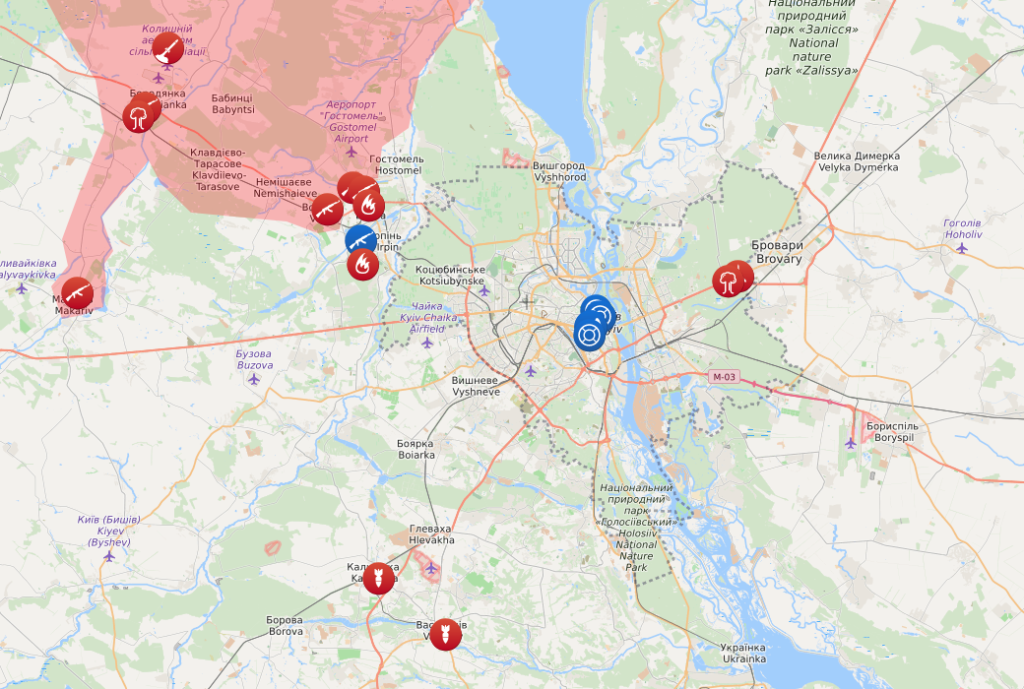
Battle For Kiev Begins

Monday, February 28th, 2022

I’ve been too busy to post earlier today, and the Texas Primary voting day is TOMORROW, so this may be brief.

Yesterday’s post noted: “Russia has failed to encircle and isolate Kyiv with the combination of mechanized and airborne attacks as it had clearly planned to do. Russian forces are now engaging in more straightforward mechanized drives into the capital along a narrow front along the west bank of the Dnipro River and toward Kyiv from a broad front to the northeast.”

That’s what you can see on the Livemap of Kiev here, with that red area being controlled by Russian forces:

If Ukrainian forces can keep them from entering Kiev proper, that will go a long way toward stopping Putin’s invasion cold.

That’s a big If.

Other links on the war:

  • Those sanctions are biting hard:

    The “swift and severe” sanctions of the U.S. and its allies took a while to arrive, not taking effect until 96 hours or so after the first steps of the Russian invasion of Ukraine.

    But to give credit where its due, once those sanctions did kick in, the consequences were indeed intense:

    • At one point, “The ruble plunged to a record low of less than one U.S. penny” — at one point 118 rubles to a dollar, before recovering to 84 rubles to a dollar.
    • The Economist noted, even with the recovery, that it was “one of the largest one-day slumps in the Russian currency’s modern history, similar in scale to the one-day declines recorded during the worst moments of the country’s financial crisis in 1998, when Russia defaulted on its debt. In mid-morning in Moscow, the Russian central bank raised its key interest rate from 9.5 percent to 20 percent in an effort to stem the ruble’s slump, and the country’s finance ministry ordered companies with foreign-currency revenues to convert 80 percent of their income into rubles.”
    • One analyst on CNBC summarized that the Russian currency has “pretty much lost all value outside of the country. . . . To me, it doesn’t really feel like we’re looking at or at least we’re going to see the bottom in the ruble here. I think there still is plenty more room for weakness to come.”
    • The Moscow stock exchange initially delayed its opening this morning, then declared it would be closed for the day.
    • Russians no longer have faith that their banks will remain solvent: “Russians waited in long queues outside ATMs on Sunday, worried that bank cards may cease to function, or that banks would limit cash withdrawals. ‘Since Thursday, everyone has been running from ATM to ATM to get cash. Some are lucky, others not so much,’ St Petersburg resident, Pyotr, who declined to give his last name, said.”
    • CNN reports that, “One early casualty was the European subsidiary of Sberbank, Russia’s biggest lender that has been sanctioned by Western allies. The European Central Bank said Sberbank Europe, including its Austrian and Croatian branches, was failing, or likely to fail, because of ‘significant deposit outflows’ triggered by the Ukraine crisis.”
  • Chuck DeVore on the fight:

    It’s now five days since Russian President Vladimir Putin sent his mostly conscript army into Ukraine to overthrow the government of President Volodymyr Zelenskyy, and it hasn’t gone as planned. In what may signal frustration, Putin has put his nuclear forces on alert in one last desperate move to beat his chest and show the world who’s in charge.

    Time has given some clarity to the operation and allows the drawing of some conclusions.

    I’m a retired Army lieutenant colonel—an intelligence officer. My training, from 1983 to 2007, was a Cold War focus on the old Soviet Union, the predecessor state to the Russian Federation. Never in my time as an intelligence officer was I able to see the worst-case scenario of a large-scale conventional Russian attack in Europe—until now.

    I’ve seen multiple reports of Russian conscripts who didn’t know they were invading Ukraine. They’re confused. They don’t know who to shoot at, as “Ukrainians look the same as us.” The Russian force appears to suffer from: Poor training; poor leadership (bad officers); and a cultural disregard for information-sharing down the chain of command, which prevents lower-ranking soldiers from making informed decisions in the chaos of war.

    The result of all this is a lack of initiative from soldiers when non-commissioned officers and officers are killed or wounded.

    It is important to note that the Russian army hasn’t fought a conventional war against a near-peer enemy since 1945. It’s out of practice, poorly trained, poorly led, and poorly motivated. It does have plenty of heavy armaments—very large thermobaric bombs. It can destroy, but it can’t fight effectively.

    Regarding the “Father of Bombs,” a large thermobaric or “vacuum” bombs capable of destroying a city block, killing 10,000 or more civilians and soldiers. Using one on Kyiv would horrify the world and likely increase calls for war crimes charges on Russian leaders. The Russians have used smaller thermobaric weapons against Ukrainian bunkers.

    This opens another question: How powerful are Russia’s reconstituted zampolit? Putin brought them back in 2018. The zampolit were political officers in the old Red Army, previously called “commissars” until 1942 when the position’s battlefield power was scaled back in response to negative military command implications.

    If a Russian field commander is ordered to use a city-busting thermobaric bomb, will he? Or will he refuse to carry out the order, like German Gen. von Choltitz when Adolf Hitler ordered him to destroy Paris—unless a zampolit is looking over his shoulder with a pistol?

    Logistics is also manifesting itself as a Russian weak spot. Logistics is hard—it’s harder in combat. It requires synchronizing the delivery of fuel, ammo, and food to frontline forces all while the enemy is shooting at your resupply trucks. At four days in, Russian forces are running out of basic supplies. This has a powerfully negative effect on morale.

    Complicating Russian resupply efforts are indications that Ukrainian light forces hunkered down during the initial Russian wave passed by, only to reemerge when the lightly armored supply columns entered Ukraine. Also of note is the increasingly effective Ukrainian use of Turkish-designed BayraktarTB2 drones. These low-cost, slow, non-stealthy drones have scored dozens of kills on Russian columns. Ukraine has about 60 of them.

    As Ukrainian resistance stiffens and tens of thousands of Ukrainian citizens rush to defend their nation, other nations in the region have been emboldened. Germany is sending 1,000 antitank missiles and 500 Stinger antiaircraft missiles. The Czech Republic and the Netherlands are sending small arms and ammunition.

  • Long thread on how Putin has reversed reforms in the Russian military. Tidbit: Russia’s military commander is Tuvan:

    He also says Russia is only using one echelon of troops:

    Is this true? Maybe. It would explain the logistics problems with out-of-gas convoys. But it might not be true of the main thrust toward Kiev.

    Food for thought.

  • Bank runs everywhere in Russia.
  • Hacker group Anonymous joins the fight against Putin:

  • Even Switzerland is abandoning its vaunted neutrality to impose the same sanctions as the EU on Russian people and entities.
  • Rambo fighting for Ukraine:

  • I cranked this out in haste and have a lot more links to go. Maybe tomorrow…

    LinkSwarm for February 25, 2022

    Friday, February 25th, 2022

    Ukraine fights back, Biden isn’t going to do jack about it, Kyle Rittenhouse is going to sue everyone, inflation soars, the Canadian “emergency” is ended, disaster looms for Democrats, and Ilhan Omar gets an unusual challenger. It’s the Friday LinkSwarm!

  • Ukraine forces have retaken Antonov International Airport, AKA Gostomel, AKA Hostomel.

    While reports of the battle are confused and preliminary, it appears that Ukrainian forces counterattacked, shot down some Russian helicopters, and have so far been able to prevent the Russians from landing reinforcements. Initial claims that the Russian force at the airfield had been “destroyed” were later clarified; it now seems that the battle at Gostomel is continuing. It’s easy to understand how crucial this battle is, simply by looking at a map. If the Russians could gain control of the Gostomel airfield, they could score a quick knock-out of the Ukrainian capital as part of what is being called their “decapitation” strategy.

    Russian news services are claiming they’ve taken the airfield, but that may be stale news or propaganda.

  • There are conflicting reports whether the the Antonov An-225 Mriya (the largest aircraft in the world) stationed there has been destroyed or not
    

  • Ukrainian forces take up positions in Kiev. Also: “Reports that the Ukrainian military has delivered a strike on a Russian airfield in Millerovo, Rostov Oblast have now been confirmed.”
  • Chuck DeVore: “Has Putin Miscalculated His Ability To Take Ukraine Swiftly?”

    The invasion of Ukraine by the armed forces of Russia at Russian President Vladimir Putin’s orders marks the first time since 1945 that Russia has engaged in a conventional war with a near-peer nation.

    Ukraine isn’t restive Warsaw Pact nations, it isn’t Afghanistan, it isn’t Chechnya, it isn’t Georgia, and it isn’t Crimea.

    The conflict launched by Putin is on a far grander scale than the invasion of Crimea in 2014, launched as Ukraine’s last pro-Russia president, Viktor Yanukovych, was driven from office in a popular uprising.

    Putin, by choosing to reach beyond the ethnic-Russian majority separatist provinces of Donetsk and Luhansk in the Donbas Basin, has decided to end the independent, Western-looking Ukrainian government of President Volodymyr Zelenskyy and install a pro-Putin quisling.

    And while the fog of war, some deliberate mis-and disinformation operations by the combatants, and the far-from-perfect filter of Western media leaves much unknown at this time, what is known is that Zelenskyy is still in power a day after the Russian offensive. Further, the Ukrainian military appears to be taking a toll on the Russians invading from three sides: south across the Pripyat Marshes from Russian satellite Belarus; west from Russia, including Donbas; and north from the Black Sea in the region of Odessa and Transnistria, a Russian client breakaway state in Moldavia.

    Modern conventional war is extremely difficult to do well. Imagine being a conductor of an orchestra, all while the audience was lobbing soccer balls at you and your musicians as you perform J.S. Bach’s Chaconne in D — that’s modern warfare. Putin is attempting a highly complicated operation over large distances in the face of a determined foe. Further, he’s doing so with an army largely composed of conscripts serving for only one year.

    Since Putin has decided to oust the Ukrainian government, this means that every day Zelenskyy remains in office is another day that adds to Ukrainian national confidence to resist — and another day that Putin looks to have miscalculated.

  • White House claims Russian forces are 20 miles outside Kiev.
  • Tweets from the war zone:

  • Both the EU and the Biden Administration offer sanctions they admit will not do Jack Squat.

  • But the UK is Freezing Putin assets…assuming he has any.
  • Holy Fark is this unbelievable incompetence and naivete:

  • Taiwan joins sanctions against Russia, including their semiconductor industry. I don’t know if any fabless Russian chip design company gets their chips fabbed at TSMC, so I’m not sure how badly this hurts their economy in the long run.
  • “You Can Thank Environmentalists for the Invasion of Ukraine.”

    It is the West’s wacko environmentalists who handed Russian President Vladimir Putin the leverage and money to invade Crimea in 2014 and Ukraine this week.

    Without these wackos, Putin would be just another gangster in charge of a crumbling country, and maybe one on the verge of a revolution to depose him.

    But the facts are the facts are the facts, and the facts are these… Thanks to the West’s environmentalists, those smug greenies who are more concerned with carbon output than world peace, this gangster controls much of the energy going to the European Union (E.U.).

    Thanks a lot, Greta…

  • A great mystery:

  • Enjoy these cringy social justice takes on Ukraine.

    (Hat tip: Stephen Green at Instapundit.)
    

  • Biden is demonstrably more hostile to American oil and gas companies than he is to Russian companies, having frozen oil and gas leases despite a court order otherwise.
  • Thanks to Biden’s inflation, the cost of everything is going up. “70 percent of Americans are living paycheck to paycheck.”
  • Due to either bad polling or raw panic among his party, Canada’s Justin Trudeau rescinded his Emergencies Act declaration.
  • Matt Taibbi on Canada’s dangerous new dystopian powers:

    Fellow former finance reporter Chrystia Freeland — someone I’ve known since we were both expat journalists in Russia in the nineties — announced last week that her native Canada would be making Sorkin’s vision a reality. Freeland arouses strong feelings among old Russia hands. Before the Yeltsin era collapsed, she had consistent, remarkable access to gangster-oligarchs like Boris Berezovsky, who appeared in her Financial Times articles described as aw-shucks humans just doing their best to make sure “big capital” maintained its “necessary role” in Russia’s political life. “Berezovsky was one of several financiers who came together in a last-ditch attempt to keep the Communists out of the Kremlin” was typical Freeland fare in, say, 1998.

    Then the Yeltsin era collapsed in corrupt ignominy and Freeland immediately wrote a book called Sale of the Century that identified Yeltsin’s embrace of her former top sources as the “original sin” of Russian capitalism, a “Faustian bargain” that crippled Russia’s chance at true progress. This is Freeland on Yeltsin’s successor in 2000. Note the “Yes, Putin has a reputation for beating the press, but his economic rep is solid!” passage at the end:

    It looks as if we’re about to fall in love with Russia all over again…

    Compared to the ailing, drink-addled figure Boris Yeltsin cut in his later years, his successor, Vladimir Putin, in the eyes of many western observers, seems refreshingly direct, decisive and energetic… Tony Blair, who has already paid Putin the compliment of a visit to Russia and received the newly installed president in Downing Street in return, has praised him as a strong leader with a reformist vision. Bill Clinton, who recently hot-footed it to Russia, offered the equally sunny appraisal that “when we look at Russia today . . . we see an economy that is growing . . . we see a Russia that has just completed a democratic transfer of power for the first time in a thousand years.”

    To be sure, some critics have lamented Putin’s support for the bloody second war in Chechnya, accused him of eroding freedom of the press…and worried aloud that his KGB background and unrepenting loyalty to the honor of that institution could jeopardize Russia’s fragile democratic institutions. But many of even Putin’s fiercest prosecutors seem inclined to give him the benefit of the doubt when it comes to the economy…

    Years later, she is somehow Canada’s Finance Minister, and what another friend from our Russia days laughingly describes as “the Nurse Ratched of the New World Order.” At the end of last week, Minister Freeland explained that in expanding its Financial Transactions and Reports Analysis Centre of Canada (FINTRAC) program, her government was “directing Canadian financial institutions to review their relationships with anyone involved in the illegal blockades.”

    The Emergencies Act contains language beyond the inventive powers of the best sci-fi writers. It defines a “designated person” — a person eligible for cutoff of financial services — as someone “directly or indirectly” participating in a “public assembly that may reasonably be expected to lead to a breach of the peace.” Directly or indirectly?

    She went on to describe the invocation of Canada’s Emergencies Act in the dripping-fake tones of someone trying to put a smile on an insurance claim rejection, with even phrases packed with bad news steered upward in the form of cheery hypotheticals. As in, The names of both individuals and entities as well as crypto wallets? Have been shared? By the RCMP with financial institutions? And accounts have been frozen? As she confirmed this monstrous news about freezing bank accounts, Freeland burst into nervous laughter, looking like Tony Perkins sharing a cheery memory with “mother.”

  • Angeleno’s tax dollars at work:

  • China is getting a good return on its investment in the Biden clan: “DOJ shuts down China-focused anti-espionage program. The China Initiative is being cast aside largely because of perceptions that it unfairly painted Chinese Americans and U.S. residents of Chinese origin as disloyal.” We can’t let national security stand in the way of political correctness…
  • The Covid-theater crazies are about to throw in the towel.

    In what may be remembered as one of the greatest miracles of all time, it seems that an upcoming American election cycle is set to put an end to the great COVID pandemic in regions that have been clinging to “mitigation” tactics despite them being proven ineffective long ago. What science couldn’t do for blue state governors, politics is about to. Meanwhile, much of the rest of the country has already adopted an “endemic” approach to COVID. In my Indiana community, for instance, school systems have been in-person and maskless for well over a year.

    A combination of experience and common sense led local officials to recognize that while COVID was a serious virus, and an often-times unpleasant condition to endure, we just weren’t experiencing the kind of mortality rates or critical hospitalizations that would require the suspension of normal life. If I was guessing, I would say that there are more counties, cities, and communities in the United States like mine than not.

    While mainstream media may be drawn like a moth to the bright lights of urban areas with all the restrictions, mandates, and panic-fueled policies enacted there, most Americans have been “living with” the virus for a long time now.

    In fact, if my community is any bellwether for the nation, most Americans are already wondering why anyone is still attempting to take a non-endemic approach at this point. The virus has proven itself to be, like all other viruses, prone to seasonal surges that are largely unaltered by our theatrical mitigation techniques. Not that anyone with their head screwed on straight ever thought there was value in wearing a porous cloth mask while standing up at a restaurant, then taking it off while sitting down, but the comical nonsense of mask histrionics is now widely appreciated as a goofy spectator sport. Behold:

    So silly. And so as opinion polls continue showing that an ever-increasing number of Americans are infuriated by this nonsense, and that they are done with all the aggressive pandemic restrictions that proved unnecessary a long time ago, a public pivot of massive proportions is underway amongst the political class.

    Whether it’s big blue state governors like California’s Gavin Newsom hilariously announcing that he will be transitioning his state to the country’s first “endemic” virus policy – meaning they’re going to start doing some things that Texas, Florida, South Dakota, Indiana, and so many others have been doing for over a year – or whether it’s blue city school boards like San Francisco’s being recalled by angry voters for their abusive and needless shutdown and masking policies, it’s clear where we’re headed.

  • Despite that, the midterm news for Democrats is not good.

    Democrats know that they should be preparing for a brutal showing in this November’s midterm elections. Glenn Youngkin’s victory in the Virginia gubernatorial race last year — and, more to the point, the substance and style of his successful campaign — were the first sign of it.

    But the hits have kept on coming. In San Francisco last week, two progressive parents succeeded in their campaign to oust three school-board members for being . . . too progressive. Irked initially at how long it was taking for area schools to reopen for in-person learning during the pandemic, these two single parents did some digging and discovered even more to be upset about: an enormous budget shortfall, an intensive campaign to rename dozens of school buildings, and the replacement of a merit-based admissions program with a diversity-minded lottery, among other issues.

    Suggesting just how central education has become to politics, San Francisco’s intensely progressive mayor, London Breed — who last fall violated her own mask mandate at a concert and defended herself by saying she was “feeling the spirit” — endorsed the school-board recall effort.

    “My take is that it was really about the frustration of the board of education doing their fundamental job,” Breed said after the results were in. “And that is to make sure that our children are getting educated, that they get back into the classroom. And that did not occur. . . . We failed our children. Parents were upset. The city as a whole was upset, and the decision to recall school-board members was a result of that.”

    San Francisco–based writer Gary Kamiya suggests in a piece for the Atlantic that the results of the recall seem to confirm the conservative narrative. Kamiya writes that conservatives have argued “that the Democratic Party is out of step not just with Republicans, but with its own constituents. . . . Progressives rejected such conclusions, insisting that the recall was simply about competence and was driven by an only-in-San-Francisco set of circumstances.” Kamiya concludes that the best way to read the outcome is “closer to the conservative view.” “At a minimum,” Kamiya writes, “the recall demonstrates that ‘woke’ racial politics have their limits, even in one of the wokest cities in the country.”

    Over in Texas, meanwhile, failed Senate candidate and failed presidential hopeful Beto O’Rourke is gearing up to become a failed gubernatorial candidate, too. Running against incumbent Republican governor Greg Abbott, O’Rourke was most recently seen trying to pretend that he isn’t a fan of radical gun-control measures.

    Asked about the promise he made during his run for president that he would “take away AR-15s and AK-47s,” O’Rourke attempted a hard about-face.

    “I’m not interested in taking anything from anyone,” he said. “What I want to make sure that we do is defend the Second Amendment. I want to make sure that we protect our fellow Texans far better than we’re doing right now. And that we listen to law enforcement, which Greg Abbott refused to do. He turned his back on them when he signed that permitless-carry bill that endangers the lives of law enforcement in a state that’s seen more cops and sheriff’s deputies gunned down than in any other.”

    As Charlie Cooke has noted, this is utter tripe. It also isn’t working. The latest poll of the race from the Dallas Moring News has Abbott up by seven points, 45 percent to 38 percent. O’Rourke himself remains underwater with voters: Only 40 percent view him favorably, while 46 percent say they have an unfavorable view of the candidate.

  • Republicans win a Jacksonville City Council race:

  • Speaking of Florida:

  • A nice guide to recent incidents of election fraud.
  • Texas sues ATF over silencers.
  • Denounce antifa violence at a leftwing think tank? You know that’s a firing!
  • Kyle Rittenhouse is finally ready to sue, including lawsuits against Whoopi Goldberg and Cenk Uygur. I hope he bankrupts anyone who called him a white supremacist.
  • Former Houston Rockets draft bust Royce White is running for Congress as a Republican against “Squad” member Ilhan Omar. Hopefully he can be on the campaign trail more than he was on the floor for the Rockets…
  • Another day, another hate crime hoax.
  • Commies gonna commie:

  • There’s a huge fight going on between Qatar Airways and Airbus over quality control issues. Boeing may be the beneficiary.
  • It takes under 20 seconds for the Lock-Picking Lawyer to defeat the mailbox lock the government requires you to use.
  • A long, detailed look at what Peter Jackson’s Get Back documentary shows us about The Beatles creative process. (Hat tip: Ed Driscoll at Instapundit.)
  • Uncomable Hair Syndrome.
  • “Massacre As Great White Shark Allowed To Compete In Women’s 500 Freestyle.”
  • The Silence of the PIIGS

    Sunday, February 6th, 2022

    Let’s talk about the European Debt Crisis.

    [The sound you hear is the countless multitudes clicking off to another blog.]

    Way back last decade, dispatches on the ongoing crisis were a regular staple of the blog. To summarize the crisis for those who weren’t paying attention back then:

  • A bunch of countries joined the Eurozone without following the requirements outlined for membership, including limiting budget deficits to 3% of less of their GDP, and overall debt-to-GDP ratio of 60% or less. How were they able to join? Simple: They lied and the Eurocrats turned a blind eye, because EU.
  • Foremost among those running into trouble were the PIIGS (Portugal, Italy, Ireland, Greece and Spain). (Cyprus and Malta also had serious issues, but their tiny size meant they presented no systematic risk for other nations, and Cyprus relieved its problems by becoming the dirty Russian money laundering capital of Europe.)
  • Ireland was probably the most incongruous of the five, since their debt only spiked when the Irish government nationalized Anglo Irish Bank to prevent it from collapsing.
  • In all other cases, the cause of of the problem was obvious: Each ran huge budget deficits to underwrite generous welfare state programs for countries with below replacement birth rates, and they were allowed to get away with it for a while because they used Germany’s credit rating in lieu of their own thanks to the Euro.
  • The problem finally came to a head after the SubPrime Meltdown in 2008 made various banks and regulatory agencies actually scrutinize balance sheets and realize just how broke the PIIGS were.
  • Greece was the worst, being the most dysfunctional, and absolutely refusing to slow down spending on their own. There followed a reoccurring farce where various Euro regulatory agencies (including the International Monetary Fund, the European Commission, and the European Central Bank, collectively known as “the Troika”) demanded Greece end their ridiculous high levels of deficit spending, Greece refused, the Troika threatened to cut off the tap entirely, Greece promised to be better, the Troika reluctantly extended them another loan, and then Greece continued to spend recklessly, setting up the next round of the farce.
  • A bunch of Eurozone countries then implemented “austerity,” which involved not cutting spending to balance their budgets, but merely reducing the deficits slightly.

    None of these “austerity” measures eliminated deficit spending, and none addressed the issue that’s driving all of Europe (and us) bankrupt, namely unwillingness to carry out structural reforms of the welfare state. The few tiny reforms that have been undertaken have been, as NRO’s Michael Tanner notes, ridiculously timid, and even those have been heavily weighted in future years. “So far, European governments haven’t even been willing to take a penknife to the welfare state, let alone an axe.” Plus a huge round of tax hikes…

    Actual austerity would mean (at a minimum) reducing spending to the amount of money actually taken in. As best I can tell, none of the PIIGS, or France, or the UK has undertaken such real austerity. That “severe” Greek austerity that just caused a change in government? It reduced Greece’s official deficit spending from 9.0% of GDP to 7.5% of GDP. They didn’t even want Greece to stop digging a hole, they just wanted them to dig more slowly.

    Austerity did not fail, it was declared difficult and left untried.

  • Eventually growth in the Eurozone picked up just enough, and the Troika managed to install enough of their own functionaries in various PIIGS positions to ensure that their half-assed, anemic austerity programs were actually followed that, along with Brexit and the Rise of Trump, it got Eurozone debt crisis off the front page and back under the rug.
  • So fast forward to today. Has the European debt crisis been solved?

    Hah! Of course not. Does the EU ever really solve anything? European debt grew during the pandemic, but this time they get to blame Flu Manchu rather than slow growth, high taxes, declining births and a bloated welfare state.

    Spain, Italy and Greece have all continued their PIIGS-ish ways. The UK, under ostensibly conservative Tory governments for the entire pandemic and constant attack for “austerity,” and they’re still piling up debt like one of the PIIGS, though the double-whammy of Brexit dislocations and idiotic lockdowns are more to blame than increased spending per se.

    Ireland, with the lowest deficit for the period, seems to have proved that their membership among the PIIGS was transitory.

    What then of Portugal? Have they improved? It turns out only slightly and relatively. Their debt increased by 13.9% for the period, making them better not only than Spain, Italy, Greece and the UK, but also France, Cyprus, Malta, Hungary and Slovenia. They evidently managed a balanced budget in 2019 (at least on paper). Their Flu Manchu deficit spending is still unsustainable, just slightly less unsustainable than many of their fellow Eurozone grave-diggers.

    Ireland seems to have escaped PIIGSdom, but the others as are still very much in trouble, with debt-to-GDP rations at or above 100%:

  • Greece: 174.15%
  • Italy: 133.43%
  • Portugal: 119.46%
  • Spain: 95.96%
  • Ireland is down at 62.42%.

    We don’t have much standing to condemn others, as the United States ratio stands at 106.70%. Donald Trump had numerous virtues as President, but he was no deficit hawk, and Biden would crank up deficits even higher if the Senate let him.

    We can see the fruits of this orgy of deficit spending in the worldwide inflation we’re seeing. (Feel free to argue whether government budget deficits or central bank quantitative easing is more at fault.) Inflation may ruin nations, but it’s the deficit-spender’s friend, letting him pay off debt on the cheap with now devalued currency. And it’s the working poor whose lives are most impoverished by it.

    Robbing Peter to pay Paul has always been a popular proposition to get Paul’s vote, but we’re now robbing Peter and Paul’s unborn grandchildren to delay financial reckonings until after the next election cycle.

    It will not end well.

    LinkSwarm for January 14, 2022

    Friday, January 14th, 2022

    Greetings, and welcome to another Friday LinkSwarm! Biden has a bad week, another high profile Democratic politician is indicted on federal charges, and a dog goes home.


  • After having his business mandate overturned by the Supreme Court, Joe Biden goes on TV to plead that they have to end the filibuster because Republican election fraud prevention laws are keeping Democrats from cheating. (I may be paraphrasing a little.) Whereupon…
  • West Virginia Democratic Senator Joe Manchin declares for the zillionth time “Nah, I’m good.” And…
  • Arizona Democratic senator Kyrsten Sinema said the same. You know, just like the last thousand times Democratic Media Complex mouthpieces asked them. “Are you sure? Are you really sure? Are you really really really sure? But we want it!”
  • But don’t let the focus on Manchin and Sinema fool you. Several other Democratic senators secretly opposed ending the filibuster as well.
  • Indeed, it sets up a no win scenario for some of them.

    If they vote with Schumer, Republicans will eat Kelly and Hassan alive this year and others later on, all for a vote that Manchin and Sinema have already insisted will go nowhere anyway. If they vote against the filibuster change, progressives will eat them alive in states where their support is critical. Even if these seats were salvageable, and that may not be the case already for Kelly and Hassan, Schumer’s move is guaranteed to lose seats for no purpose whatsoever. It’s the political equivalent of Pickett’s Charge.

  • Democrats handled Sinema’s refusal with tact and grace. Ha, just kidding! They called her a racist:

  • Baltimore Democratic State’s Attorney and Soros-tool Marilyn Mosby, “the city’s top prosecutor, was indicted on Thursday on federal charges of perjury and filing false mortgage applications related to her purchase of two Florida vacation homes.” You may remember Mosby from such previous hits as “How Soros-Backed Leftwing DAs Refuse To Enforce The Law” and “I want the FCC to investigate Tucker Carlson.”
  • Think the supply chain is screwed now? China just locked down several big ports over Flu Manchu.
  • “To staff, Kamala Harris is a clueless bully who refuses to do her homework.”

    Before she became vice president, Kamala Harris had a bad habit of ignoring prepared briefing materials.

    She does not appear to have kicked this habit, even after making it all the way to the White House.

    “Staffers who worked for Harris before she was vice president said one consistent problem was that Harris would refuse to wade into briefing materials prepared by staff members, then berate employees when she appeared unprepared,” the Washington Post reports.

    One former staffer told the paper, “It’s clear that you’re not working with somebody who is willing to do the prep and the work. With Kamala, you have to put up with a constant amount of soul-destroying criticism and also her own lack of confidence. So you’re constantly sort of propping up a bully, and it’s not really clear why.”

    (Hat tip: Stephen Green at Instapundit.)

  • “Google, Twitter employees flood Democrats with donations as companies are accused of censoring conservatives.” This is my shocked face. (Hat tip: Dr. Malone on Gettr.)
  • “J6 Hysteria Is How Media And Other Democrats Are Avoiding Accountability For Their Rigging Of The 2020 Election.”

    The 2020 presidential election was unlike any in American history.

    Hundreds of laws and processes were changed in the months leading up to the election, sometimes legally and sometimes not, creating chaos, confusion, and uncertainty. Tech oligarch Mark Zuckerberg, one of the world’s wealthiest and most powerful men, spent $419 million — nearly as much as the federal government itself — to interfere in the government’s management of the election in key states.

    Powerful tech oligarchs and corrupt propaganda press conspired to keep indisputably important news stories, such as allegations of corruption regarding the Biden family business, hidden from voters in the weeks prior to voting. Information operations were routinely manufactured about President Trump in the closing months of the campaign, including the false claim that Russians paid bounties for dead American soldiers and Trump didn’t care, and that Trump had called dead American soldiers losers. Both were disputed by dozens of on-the-record sources.

    Effective conservative voices were censored by the social media arms of the Democrat Party. And all this was done after the establishment spent years running an unprecedented “Resistance” that falsely claimed Trump was a traitor who had colluded with Russia to steal the 2016 election.

    It’s not surprising that polls show most Republicans are deeply concerned about the integrity of such an election. If anything, it’s surprising that all of them aren’t screaming from the rooftops about it. But it is interesting and telling how little the media and other Democrats are willing to talk about efforts to rig the election.

    With the exception of a single Time Magazine article admitting there was a “conspiracy” by a “a well-funded cabal of powerful people” who worked to “change rules and laws, steer media coverage and control the flow of information,” to create a “revolution in how people vote,” corporate media have largely kept silent about or downplayed how the establishment secured its victory for their man Joe Biden.

  • Why Democrats must make a mountain out of the molehill of January 6.

    The number of people killed by pro-Trump supporters at the January 6 Capitol riot is equal to the number of pro-Trump supporters who brandished guns or knives inside the Capitol. That is the same number as the total of Americans who — after a full year of a Democrat-led DOJ conducting what is heralded as “the most expansive federal law enforcement investigation in US history” — have been charged with inciting insurrection, sedition, treason or conspiracy to overthrow the government as a result of that riot one year ago. Coincidentally, it is the same number as Americans who ended up being criminally charged by the Mueller probe of conspiring with Russia over the 2016 election, and the number of wounds — grave or light — which AOC, who finally emerged at night to assure an on-edge nation that she was “okay” while waiting in an office building away from the riot at the rotunda, sustained on that solemn day.

    That number is zero. But just as these rather crucial facts do not prevent the dominant wing of the U.S. corporate media and Democratic Party leaders from continuing to insist that Donald Trump’s 2016 election victory was illegitimate due to his collusion with the Kremlin, it also does not prevent January 6 from being widely described in those same circles as an Insurrection, an attempted coup, an event as traumatizing as Pearl Harbor (2,403 dead) or the 9/11 attack (2,977 dead), and as the gravest attack on American democracy since the mid-19th Century Civil War (750,000 dead). The Huffington Post’s White House reporter S.V. Date said that it was wrong to compare 1/6 to 9/11, because the former — the three-hour riot at the Capitol — was “1,000 percent worse.”

    Indeed, when it comes to melodrama, histrionics, and exploitation of fear levels from the 1/6 riot, there has never been any apparent limit. And today — the one-year anniversary of that three-hour riot — there is no apparent end in sight. Too many political and media elites are far too vested in this maximalist narrative for them to relinquish it voluntarily.

    Snip.

    That the January 6 riot was some sort of serious attempted insurrection or “coup” was laughable from the start, and has become even more preposterous with the passage of time and the emergence of more facts. The United States is the most armed, militarized and powerful regime in the history of humanity. The idea that a thousand or so Trump supporters, largely composed of Gen X and Boomers, who had been locked in their homes during a pandemic — three of whom were so physically infirm that they dropped dead from the stress — posed anything approaching a serious threat to “overthrow” the federal government of the United States of America is such a self-evidently ludicrous assertion that any healthy political culture would instantly expel someone suggesting it with a straight face.

    Snip.

    Far too many centers of political and economic power benefit from an exaggerated and even false narrative about January 6 to expect it ever to end.

    The Democratic Party, eager to cling to their majoritarian control of the White House and both houses of Congress, knows it has no political program that is appealing and thus hopes that this concocted drama will help them win — just as they foolishly believed about Russiagate. With the threat of Al Qaeda and ISIS faded if not gone, and the attempt to scare Americans over Putin a failure, the U.S. security state, always in need of a scary enemy, has settled on the claim that right-wing “domestic extremists” are the greatest threat to U.S national security; though they claimed this before 1/6, casting 1/6 as an insurrection allows them to classify an entire domestic political movement as an insurrectionary criminal group and thus justify greater spying powers and budgetary authorities.

    CNN proudly announced that the most-watched day in the history of their network was 1/6. The dirty little secret of the liberal wing of the corporate media is that nobody benefited more from the Trump campaign, his presidency and its aftermath than they, and they are desperate to rejuvenate it and re-discover that glory. Meanwhile, coddled journalists who have never broken meaningful stories have finally found a way to claim that they stared down dangerous and risky situations — as if they spent years in the middle of an active war zone or were persecuted and prosecuted by a corrupt and authoritarian state for their intrepid reporting — and have converted Brian Stelter’s CNN show into a virtual therapists’s couch where they all get to go and talk about how they are still coping with the deep trauma of spending a few hours in the Capitol last year.

    The pettiness and absurdity of this Democrat/media narrative, laughable as it often is, does not mean it is free of danger. Asserting that the U.S. suffered an attempted coup by a still-vibrant armed faction of insurrectionists is a self-evidently inflammatory claim. It has been used to allocate billions more to the Capitol Police and to radically expand their powers; justify the increased domestic use of FBI tactics including monitoring and infiltration; and agitate for the mass imprisonment of political adversaries, including elected members of Congress. Hapless defendants who are not even accused of using violence have been held in harsh solitary confinement for close to a year, then sentenced to years in prison — while self-styled criminal justice reform advocates say nothing or, even worse, cheer. If one genuinely believes that the U.S. came close to a violent overthrow of American democracy and still faces the risk of an insurrection, then it is rational to sanction radical acts by the U.S. security state that, in more peaceful and normal times, would be unthinkable.

    (Hat tip: Director Blue.)

  • EU to exempt luxury yachts from carbon taxes because of course they are.
  • Hollywood’s new rules.

    A few years ago, the editor-in-chief of The Hollywood Reporter pitched a story to the newsroom. He had just come back from lunch with a well-known agent, who had suggested the paper take a look at the unintended consequences of Hollywood’s efforts to diversify. Those white men who had spent decades writing scripts—which had been turned into blockbuster movies and hit television shows—were no longer getting hired.

    The newsroom blew up. The reporters, especially the younger ones, mocked the idea that white men were on the outs. The editor-in-chief, normally self-assured, immediately backtracked. He looked rattled.

    Snipped.

    So, in September 2020, the Academy launched its Representation and Inclusion Standards Entry platform (or RAISE). For a movie to qualify for Best Picture, producers not only had to register detailed personal information about everyone involved in the making of that movie, but the movie had to meet two of the Academy’s four diversity standards—touching on everything from on-screen representation to creative leadership. (An Academy spokesperson said “only select staff” would have access to data collected on the platform.)

    The Academy explained that movies failing to meet these standards would not be barred from qualifying for Best Picture until 2024. But producers are already complying: In 2020, data from 366 productions were submitted to the platform.

    Meanwhile, CBS mandated that writers’ rooms be at least 40 percent black, indigenous and people of color (or BIPOC) for the 2021-2022 broadcast season and 50 percent for the 2022-2023 season. ABC Entertainment issued a detailed series of “inclusion standards.” (“I guarantee you every studio has something like that,” a longtime writer and director said.)

    Snip.

    The old-timers accustomed to being on the inside—and the (non-BIPOC) up-and-comers afraid they’d never get there—were one-part confused, one-part angry, and 10,000-parts scared.

    “Everyone has gone so underground with their true feelings about things,” said Mike White, the writer and director behind the hit HBO comedy-drama “The White Lotus.” “If you voice things in a certain way it can really have negative repercussions for you, and people can presume that you could be racist, or you could be seen as misogynist.”

    Howard Koch, who has been involved in the production of more than 60 movies, including such classics as “Chinatown” and “Marathon Man,” and is the former president of the Academy of Motion Pictures Arts & Sciences, said: “I’m all for LGBT and Native Americans, blacks, females, whatever minorities that have not been served correctly in the making of content, whether it’s television or movies or whatever, but I think it’s gone too far. I know a lot of very talented people that can’t get work because they’re not black, Native American, female or LGBTQ.”

    Another writer, who, like most of the writers we interviewed, was afraid to speak openly for fear of never working again, said: “I get so paranoid about even phone calls. It’s so scary. My close friends and my family are just like, ‘Don’t say anything.’ It is one of those things, ‘Will I be able to sleep at night if I say anything?’ Getting jobs in this town is so hard, and I’m very grateful to have a great job. If there’s any so-called ding on my record, that would just be an argument against hiring me.”

    It is, said Sam Wasson, the author of “The Big Goodbye: Chinatown and the Last Years of Hollywood,” not so different from the McCarthy era, when everyone in Hollywood professed to believe something that they thought everyone outside Hollywood—the country, their audience—believed. “Hollywood was never anti-Communist,” Wasson said. “It just pretended to be. In fact, Hollywood was never anti- or pro- anything. It was show business. There’s no morality here.”

    That amorality, coupled with a finely tuned sense of what the audience is hungry for, what’s trending, has left Hollywood more susceptible to the vagaries of the culture war.

    “Now, they’ll just say, ‘Sorry, diversity quotas. We’re just not allowed to hire you,’” said a 48-year-old white, male comedy writer who was recently dropped by his agent.

    Sounds like an opportunity to hire great talent on the cheap from someone outside the club. If only someone had the balls…

  • Steve Harvey says that wokeness has killed comedy.
  • Biden’s approval ratings hit new lows. Again.
  • Speaking of Biden, I wonder if this is what it’s like inside Biden’s head: A myriad of voices, and no independent will at the center.

  • Speaking again of Biden, remember that he backed a lot of economic turkeys other than Theranos.
  • Texas Attorney General Ken Paxton sues Planned Parenthood:

  • “Senate Democrats Block Cruz’s Effort to Sanction Russian Pipeline.”
  • Mike Rowe discusses why 4.5 million Americans quit their jobs, and the coming severe shortage in trades workers.
  • Speaking of Rowe, here he discusses why the nonstop panic porn has desensitized Americans.

  • And speaking of healthcare worker shortages:

  • For your 2024 “change” presidential candidate, would you believe none other than Grandma Death herself? If she actually gets the nomination, then we’ll know we’re living in the simulation…
  • Dwight has a good, deep dive on the course he took on how to survive a gunfight out at KR Training.
  • The Young Conservatives of Texas have their ranking of legislators out.
  • TPPF’s Joshua Trevino has a pretty swell essay about Midland-Odessa.

    What you do see are the fruits of the conquest. The admixture of confident aggression, roll-the-dice settlement, and entrepreneurial genius manifests itself with the first wells you see. The Permian is rich, a treasure-house stored up across one hundred million years, and the wells are everywhere. They appear, solitary or in pairs, and as you proceed westward they multiply. There is a particular mesa with a sharp escarpment on its south face, and every time I see it I marvel at the wells perched on its nearly vertical incline. There is new exploration and investment, too. The Permian has been exploited for nearly a century, but its yield is nowhere close to exhaustion. Yesterday, and the day before, I witnessed tremendous convoys — men, trucks, equipment — sallying forth to new wells in the creation. There is a cotton field with wells on it: acreage that produces everything America needs to keep warm. In Midland itself, there is a golf course with a well on it. There are roadside shoulders with wells on them. There are wells everywhere. Midland-Odessa works: they raise families and hell alike, and power the continent.

    All of this is set in the Llano Estacado, a region of Texas ordinarily hostile to life and settlement. Most of Texas outside the verdant east is hostile to life and settlement to some degree. The Llano Estacado, though, is nearly the hardest far place there is, exceeded only by the despoblado and desert of the trans-Pecos. The land is hard. The weather is hard. The enterprise is hard too. The oil-and-gas business makes some men rich, ruins more, and perennially frustrates still more. There are the handful of energy giants around the world — the ExxonMobils, the Shells, and the handful of other names you see on gas stations and giant tankers — but that isn’t who you see in the Permian. It isn’t who you see on the road to Midland. What you see are names and signs of firms that you don’t recognize, and wouldn’t unless this was your professional world. Some are well established. Others are just starting out. All of them are the names of dreams and gambles: ideas made real but not necessarily lasting, leaps without nets. There is something admirable to it.

    Spend time in Midland (and, if you’re raising hell, in Odessa) and you realize you’re seeing a way of life that is increasingly rare. It is a place where nearly everyone is working. I don’t mean sitting at a desk. I mean labor as it was once understood, things done with the hands, wearying the body, with the end product being something you could see, touch, feel. It is a single-industry town, yes, but that industry is in the business of real material creation. In our fathers’ time, we could say that about most of America. Now it it characterizes only a small proportion of our national life. Something is lost along with it. You see Midland, a town where the taquerias and coffee shops open at 3:30am, at 4am, at 5am to accommodate what passes for rush hour there — and you see a town that is too hard at work to ever indulge in the luxury of anxiety. Places where people hit the alarm at 6am, at 7am, spend an hour on a crawling commute, spend eight hours motionless in a cube, and then repeat: that’s where alienation and disconnect occur. That’s where the civic neuroses take root and blossom. That’s where we spawn the psychic illnesses peculiar to people who are physically safe and have in their whole lives risked nothing.

    Read the whole thing.

  • Heh:

  • Lunatic stabs police dog to death. Lunatic gets dirtnapped. (Hat tip: Dwight.)
  • Things that make you go “Hmmm.” Namely Austin police finding two submerged bodies in three days…
  • So you want to become a warlord! Here are some handy tips on ruling your patch of the post-apocalyptic wasteland! (Though sadly, there seems to be very little information on obtaining chrome face spray after the apocalypse…)
  • A list of Austin restaurants that closed in 2021.
  • Bill Burr remembers his friend Bob Saget.
  • Impressive!

  • Richard Hammond makes the case for classic cars.

    They are artifacts that have locked into them so many messages about the aspirations, hopes, needs, and restrictions of their time. They were incredibly expensive things, and they were used as opportunities to demonstrate something about yourself, to say something about yourself to the world…[The best art is] always composed within some sort of restraints. There’s always a limit to how far you can go, and it’s within those limitations that i think human ingenuity does best.

    I think this is true, and I think that the restraints and limits of various art forms are what help bring out their greatness.

  • “Supreme Court Sets Dangerous Precedent Of Letting The American People Make Medical Decisions For Themselves.”
  • “FBI Promises To Make Hoaxes Less Obvious This Year.”
  • Dog stolen from man on Christmas Day found and returned. Man, these winter allergies are real killers…
  • Supply Chain Disruption Update for October 11, 2021

    Monday, October 11th, 2021

    Supply chain problems have gotten so bad that Derek Thompson at The Atlantic deigns to notice them:

    The coronavirus pandemic has snarled global supply chains in several ways. Pandemic checks sent hundreds of billions of dollars to cabin-fevered Americans during a fallow period in the service sector. A lot of that cash has flowed to hard goods, especially home goods such as furniture and home-improvement materials. Many of these materials have to be imported from or travel through East Asia. But that region is dealing with the Delta variant, which has been considerably more deadly than previous iterations of the virus. Delta has caused several shutdowns at semiconductor factories across Asia just as demand for cars and electronics has started to pick up. As a result, these stops along the supply chain are slowing down at the very moment when Americans are demanding that they work in overdrive.

    The most dramatic expression of this snarl is the purgatory of loaded cargo containers stacked on ships bobbing off the coast of Los Angeles and Long Beach. Just as a normal traffic jam consists of too many drivers trying to use too few lanes, the traffic jam at California ports has been exacerbated by extravagant consumer demand slamming into a shortage of trucks, truckers, and port workers. Because ships can’t be unloaded, not enough empty containers are in transit to carry all of the stuff that consumers are trying to buy. So the world is getting a lesson in Econ 101: High demand plus limited supply equals prices spiraling to the moon. Before the pandemic, reserving a container that holds roughly 35,000 books cost $2,500. Now it costs $25,000.

    The container situation is even weirder than it looks. With demand surging in the United States, shipping a parcel from Shanghai to Los Angeles is currently six times more expensive than shipping one from L.A. to Shanghai. J.P. Morgan’s Michael Cembalest wrote that this has created strong incentives for container owners to ship containers to China—even if they are mostly empty—to expedite the packing and shipping of freights in Shanghai to travel east. But when containers leave Los Angeles and Long Beach empty, American-made goods that were supposed to be sent across the Pacific Ocean end up sitting around in railcars parked at West Coast ports. Since the packed railcars can’t unload their goods, they can’t go back and collect more stuff from filled warehouses in the American interior.

    And what about the truckers who are needed to drive materials between warehouses, ports, stores, and houses? They’re dealing with a multidimensional shortage too. Supply-chain woes have backed up orders for parts, such as resin for roof caps and vinyl for seats. But there’s also a crucial lack of people to actually drive the rigs. The Minnesota Trucking Association estimates that the country has a shortage of about 60,000 drivers, due to longtime recruitment issues, early retirements, and COVID-canceled driving-school classes.

    In short, supply chains depend on containers, ports, railroads, warehouses, and trucks. Every stage of this international assembly line is breaking down in its own unique way. When the global supply chain works, it’s like a beautifully invisible system of dominoes clicking forward. Today’s omnishambles is a reminder that dominoes can fall backwards too.

    However, there are two important words missing from Thompson’s analysis: “vaccine” and “mandate.”
    

  • The latest industry to suffer shortages: paints and plastics.

    Like other manufacturers, petrochemical companies have been shaken by the pandemic and by how consumers and businesses responded to it. Yet petrochemicals, which are made from oil, have also run into problems all their own, one after another: A freak winter freeze in Texas. A lightning strike in Louisiana. Hurricanes along the Gulf Coast.

    All have conspired to disrupt production and raise prices.

    “There isn’t one thing wrong,” said Jeremy Pafford, managing editor for the Americas at Independent Commodity Intelligence Services (ICIS), which analyzes energy and chemical markets. “It’s kind of whack-a-mole — something goes wrong, it gets sorted out, then something else happens. And it’s been that way since the pandemic began.’’

    The price of polyvinyl chloride or PVC, used for pipes, medical devices, credit cards, vinyl records and more, has rocketed 70%. The price of epoxy resins, used for coatings, adhesives and paints, has soared 170%. Ethylene — arguably the world’s most important chemical, used in everything from food packaging to antifreeze to polyester — has surged 43%, according to ICIS figures.

    The root of the problem has become a familiar one in the 18 months since the pandemic ignited a brief but brutal recession: As the economy sank into near-paralysis, petrochemical producers, like manufacturers of all types, slashed production. So they were caught flat-footed when the unexpected happened: The economy swiftly bounced back, and consumers, flush with cash from government relief aid and stockpiles of savings, resumed spending with astonishing speed and vigor.

    Suddenly, companies were scrambling to acquire raw materials and parts to meet surging orders. Panic buying worsened the shortages as companies rushed to stock up while they could.

  • Expecting these problems to be transitory? Dubai’s largest port operator says to expect supply chain problems to extend in 2023.
  • Adding to shipping woes: Marine fuel is at a seven year high.
  • India institutes rolling blackouts over a coal shortage.
  • Brazil is also having to import more natural gas.
  • Energy problems are only expected to get worse:

    A global energy crunch caused by weather and a resurgence in demand is getting worse, stirring alarm ahead of the winter, when more energy is needed to light and heat homes. Governments around the world are trying to limit the impact on consumers, but acknowledge they may not be able to prevent bills spiking.

    Further complicating the picture is mounting pressure on governments to accelerate the transition to cleaner energy as world leaders prepare for a critical climate summit in November.

    Translation: Green energy mandates = blackouts.

    In China, rolling blackouts for residents have already begun, while in India power stations are scrambling for coal. Consumer advocates in Europe are calling for a ban on disconnections if customers can’t promptly settle what they owe.

    “This price shock is an unexpected crisis at a critical juncture,” EU energy chief Kadri Simson said Wednesday, confirming the bloc will outline its longer-term policy response next week. “The immediate priority should be to mitigate social impacts and protect vulnerable households.”

    In Europe, natural gas is now trading at the equivalent of $230 per barrel, in oil terms — up more than 130% since the beginning of September and more than eight times higher than the same point last year, according to data from Independent Commodity Intelligence Services.

    In East Asia, the cost of natural gas is up 85% since the start of September, hitting roughly $204 per barrel in oil terms. Prices remain much lower in the United States, a net exporter of natural gas, but still have shot up to their highest levels in 13 years.

    Wait, you mean relying on Russian benevolence wasn’t an optimal strategy? Do tell.

  • There’s also panic buying to secure winter supplies, especially in China, where “the central government there has given state-owned energy companies a directive to secure winter energy supplies at any and all costs.”
  • Steel and roofing supplies are also facing shortages.

    Steel, roofing and insulation materials are some of the most difficult products to get right now, said Ken Simonson, chief economist at the Associated General Contractors of America. Bar joists, which are used to frame roofs, can have lead times of anywhere from 10 months to 14 months.

    Costs have also soared, with the index for steel mill products rising 123% YoY in August, according to the Bureau of Labor Statistics’ Producer Price Index. Copper and brass mill shapes jumped 45.3% YoY, while plastic construction products saw increases of just under 30% YoY.

  • Also in short supply: HVAC parts:

    A few weeks ago I spoke with several people intimately involved with large companies in my industry and they all agree that we have probably another year of supply chain disruptions and problems. That wasn’t exactly music to my ears as the last year and a half has been an intense marathon trying to keep my buildings full of product that my dealers need. The reasons are everything that you have heard before here and on other media outlets – labor shortages, raw material issues and now, chip problems.

    The chip problem could be a really big issue as those chips go into printed circuit boards that control furnaces – and we need furnaces now for Fall.

    My one large exception mentioned above is that my inventory levels are absolutely enormous and we are setting new records daily. This is killing my turns and as a result cash, but this is the new model. We simply can’t predict when things will come in so we have to pile in sometimes a full years worth of a widget. We are absolutely bursting at the seams and it is extremely stressful trying to keep everyone happy. We don’t dare cancel any orders as we would go to the back of the line, so it is what it is.

    Freight is a major issue right now. We get damage all the time and the LTL lines are all extremely slow and sloppy. Hardly a day goes by where we don’t have a freight problem.

    Parts don’t really seem to be an issue. Sure, there are certain things that we have problems with, but in general the parts world is OK so there is that silver lining.

  • Even oats, the lowly horse and breakfast food, is hitting all-time highs.

    This year, a devastating drought in North American oat fields has resulted in the lowest harvest for the cereal grain in years, pushing prices to record highs, a warning sign that breakfast inflation is imminent.

    Scorching heat waves in Candian oat fields slashed production to an 11-year low. Canada, the world’s biggest exporter, ships most of its oats to the US, its largest consumer.

    The result so far has been a new record high in oats futures trading on the CME. The sudden spike in prices has yet to ripple through supply chains to affect consumers, though that will be coming.

    According to Bloomberg, “the situation for North American farmers was so dire in the summer that many cut their losses and harvested damaged plants to be sold as feed for animals.”

    What this means for consumers is that dwindling supplies and record-high prices will soon affect foods like cereals, oatmeal, and granola bars, all popular breakfast items.

    Randy Strychar, president of Ag Commodity Research and Oatinformation.com, said Cheerios, the US’ most popular cereal, is made entirely of oats. He said there’s no substitute for the ingredient: “You can’t make a Cheerio out of barley.”

    General Mills, the maker of Cheerios and Nature Valley granola bars, nor Quaker Oats Company, the maker of oatmeal, among others, have yet to announce price increase of their oat products, but that could be imminent or at least create an illusion of stable prices through shrinkflation.

  • Retailers say they’re getting ready for a lot of bare shelves.

    Before retailers can make their sales, they need stuff to sell. That’s where the trouble is this year. Container ships are packed, ports are clogged, contracts with carriers are falling to the wayside. And the rush to ship goods for the holidays is only adding traffic to what was already intense congestion.

    “There aren’t enough containers. There aren’t enough ships. There aren’t enough trucks or trains. There is more volume now than any part of the supply chain pipe can adequately handle,” Burlington Stores Chief Financial Officer John Crimmins told analysts in late August. Trying to accelerate and pull forward orders “even further increased the pressure on the supply chain, helping to drive even higher rates,” the executive added.

    So not only are retailers competing with each other for sales, they are competing just to get cargo space to ship goods into the country. Freight has skyrocketed as a result, and shipments still lag or even fail to materialize. Many of the bottlenecks are tied to the unexpectedly swift surge in consumer demand in the U.S. this year, combined with capacity shortfalls at numerous points along the supply chain.

  • That’s one reason big retailers like Walmart are chartering their own vessels. (Hat tip: Director Blue.)
  • There’s even a backup for ships to unload at the Port of Houston:

  • Why does UK have a truck driver shortage? Evidently they get treated like garbage compared to European drivers.
  • LinkSwarm for August 13, 2021

    Friday, August 13th, 2021

    Happy Friday the 13th!

    This week’s LinkSwarm features Democrats behaving badly (a timeless theme).

  • Immediately after Senate Republicans caved on the pork-filled infrastructure bill, Democrats turned around and passed a highly partisan $3.5 billion budget bill. Good job, idiots.
  • Hunter Biden is the gift that keeps digging: “The Russians have videos of me doing crazy f***ing sex!’ Hunter Biden is seen in unearthed footage telling prostitute that Russian drug dealers stole ANOTHER of his laptops.” 1. Hunter has more Russian-related felonies in a single weekend than Donald Trump had in his entire lifetime. 2. I don’t lose pennies the way Hunter loses laptops…
  • “How Many Other Andrew Cuomos Are Elites Covering For?”

    The obvious fact is, however, that this corrupt corporate press and the Jennifer Rubin “conservatives” of the world are the ones who propped Cuomo up as “the gold standard,” to use Joe Biden’s words, even describing themselves as “Cuomosexuals.”

    Cuomo’s “radical transparency” made him a “terrific bureaucrat,” they said. Cuomo is “inspiring, uplifting, fascinating,” and truly “magnificent,” they insisted. He’s “honest, direct, brave,” and what “real leadership” looks like. Elites gave him an Emmy and blessed him with softball interviews and comedy-hour airtime, with left-wing activists working behind the scenes to discredit Cuomo’s accusers.

    Tuesday’s resignation signals it’s the end of the road for Cuomo — for now. But if the media can sit and twiddle its thumbs — or worse, kiss keister and perform comedy sketches with giant Q-Tips — while thousands of elderly folks die in New York nursing homes and women in the double digits tell of a gropey governor’s disgusting habits, we must ask: How many other Andrew Cuomos is the media covering for?

    Covering for elite misconduct is a perpetual problem in the media; it didn’t start with Cuomo. As Federalist Political Editor John Daniel Davidson wrote on Tuesday, the media did the same with Harvey Weinstein, Jeffrey Epstein, and Theodore McCarrick. Don’t forget Bill Clinton or Roman Polanski, either.

    “Everyone knew. No one cared. No one said anything until forced to. Then the feigned shock and outrage, the concern about the treatment of women, the hand-wringing and Me Too-ing, the performances on social media,” Davidson wrote. “As long as sexual harassment, assault, abuse, even the sex trafficking of underage girls stays quiet, then [the media] stay quiet, too.”

  • “New York’s Capital Is Crazytown

    You read all this and think: The governor is a letch, a creep, a dirty old man. But also a nut—a high-functioning one, a politically talented one, but a nut. Only a nut would do these things, and only a nut would think he wouldn’t be found out.

    No one in New York is walking around saying “I don’t believe it” or “That’s not the Andrew I know.” It’s apparently the Andrew Cuomo a lot of people knew.

  • Cuomo could still end up in prison. (Hat tip: Stephen Green at Instapundit.)
  • “Arizona state Sen. Tony Navarrete resigns seat after arrest in child sex abuse case.”
  • Old and busted: Democrats want to segregate students by race. The new hotness: Democrats want to segregate students by race.
  • How inflation is undoing the four years of wage growth and price deflation President Trump brought to the economy.

    Read the whole thing, especially the parts on the EU and Canada.

  • Devin Hogan, head of the Minneapolis Democratic Party, said that burning down a police building was “an act of pure righteousness.”
  • “Swiss Police Threaten to Stop Enforcing COVID-19 Rules. Group warns in letter that lockdown laws violate fundamental rights.”
  • Oregon has decided that it’s going to stop requiring Oregon high school graduates to prove they can read and write.
  • Baltimore professor arrested for dealing math. “Prof. Edward C. Ennels taught math at Baltimore City Community College but appears to have been offering a running lesson on supply side economic theory. Ennels reportedly was selling grades on a sliding scale depending on your worth and your ambition: $150 for a C; $250 for a B; and $500 for an A. He has now earned jail time after pleading to 11 misdemeanor charges, including bribery and misconduct in office.”
  • Speaking of Baltimore schools failing their students: Some Baltimore high school students test at grade school levels.
  • Dan Crenshaw slams Jennifer Ruben for a huge mistake:

    That’s a big mistake even by her standards. How did she make it? The Texas Tribune screwed the pooch on the original story:

    That’s a hell of a correction. “When we wrote Nolan Ryan struck out 383 batters in a single game, we meant he struck out that many in a single season…”

  • YouTube takes down another video by Rand Paul.(Hat tip: Director Blue.)
  • Dumbass: Running from the police. Extra Dumbass: In a stolen vehicle. Super Turbo Dumbass: On a stolen ATV. (Hat tip: Dwight.)
  • “Mongo ist nur Schachfigur im großen Spiel des Lebens.” (Hat tip: Dwight.)
  • “Dems Considering Another Lockdown To Wipe Out The Few Small Businesses That Survived The Last One.”
  • “Bill Gates Announces He Too Will Go To Space Once His Rocket Is Finished Installing Updates.”
  • Golden throats:

  • Bosch’s New Fab And The State of European Semiconductors

    Wednesday, June 23rd, 2021

    This is interesting for what it says about the state of European semiconductor manufacturing:

    German tech giant Bosch has opened the doors to a new semiconductor manufacturing facility in Dresden, which it hopes will plug the significant hole currently plaguing automotive supply chains.

    The site – which was estimated to cost the company in excess of €1 billion (AU$1.57 billion) to build – will reportedly begin producing much-needed chips for vehicles by early September this year. It is so far unclear how the product will be distributed, and if German manufacturers – including Volkswagen, BMW, and Mercedes-Benz – will be given priority in the queue.

    “The new [factory] is the single largest investment in the company’s history. This cannot be stressed too much. Its size and additional production capacity alone are impressive. The very latest methods of data-driven continuous improvement in production make the Dresden plant a smart factory,” said German Chancellor Angela Merkel.

    “To put it another way: in this plant, natural and artificial intelligence have joined forces with the internet of things to form a productive symbiosis.”

    Here Alte Jungfer Merkel is no doubt repeating some generic technomarketingspeak handed to her by an aide, as I suspect Merkel is as ignorant of current developments in artificial intelligence as I am of the songs she sang in the Freie Deutsche Jugend.

    Here’s a Deutsche Weil English video segment on the fab, for which the headline says “Europe aims for independence from Asia”:

    How cutting edge will the Bosch fab be?

    The 300mm fab has been under construction since June 2018 and as recently as October 2019 it was stated that the Dresden wafer fab was expected to start operations in spring 2020…

    The fab makes use of 5G communications and artificial intelligence [there’s that phrase again -LP] for extensive automation and will be used for the manufacture of power semiconductors and ASICs for automotive applications down to a minimum geometry of 65nm, according to a company spokesperson.

    (record scratch)

    300mm is industry standard, and Dresden makes sense, as Infineon, Global Foundries and X-FAB already have fabs there, so there’s a skilled labor pool to draw on. The strange thing here is spending $1.2 building a new 65nm fab, since that’s about seven process node generations behind the cutting edge. 65nm was cutting edge way back in 2005.

    You don’t need cutting edge process technology to build automotive integrated circuits, which tend to use older process nodes, but 65nm doesn’t give you much headroom for the long haul. It also doesn’t really do much to “compete with Asia,” since it’s hopelessly behind not only leaders TSMC and Samsung, but also about half the fabs run by Chinese companies SMIC and Unigroup. It’s hard to see investing $1 billion in building a older technology fab as opposed to contracting out production to foundries. (Of course, foundry capacity is highly constrained right now, and maybe Bosch leadership was able to see that coming when they broke ground in 2018.)

    Could it still turn out to be a decent investment? Possibly. In the short haul it will relieve the current capacity crunch and let Bosch gain share from competitors who can’t book foundry production. Plus semiconductor manufacturing seems like the sort of thing European governments like to subsidize. And indeed, the DW piece notes that “The German government also invested in the plant.” (It also wouldn’t surprise me to find out that various inscrutable, multi-acronym EU agencies unknown to voters in Barcelona and Gdansk are also kicking in money.) Fueled by taxpayer money, building a 65nm fab could still be a profitable proposition for Bosch.

    But fabs close all the time, even 300mm fabs. Building a fab dedicated to such an old process node makes profitability a much more challenging proposition, especially given the next (inevitable) industry downturn. You only have so many years before everything is obsolete. Bosch has given themselves a very short runway to profitability for this investment.

    Back in the 1990s, Europe was competitive with American and Japanese semiconductor companies, with fabs built in the UK, Ireland, France, Germany, the Netherlands and even Italy. Today, of those countries, only Ireland (Intel) and Germany have any 300mm fabs at all, despite having a highly educated workforce and modern technological infrastructure. (Russia evidently has one as well, owned by Crocus Nano Electronics (about which I know next to nothing), also running 65nm, that started production in 2015.) Europe’s semiconductor industry has been passed not only by Taiwan and South Korea, but also by China.

    While Europe was integrating, its semiconductor manufacturing capacity was stagnating. Highly integrated, yes, but also highly regulated and highly unionized.

    As I’ve said before, building cutting edge fabs is a very expensive game to play. Collectively, the world has decided that Europe is not a suitable location for one.

    World Finally Tired Of China’s BS?

    Wednesday, March 24th, 2021

    If by “the World” you mean “the EU,” then the answer is “maybe a little bit“:

    In a historic shift, the European Union has imposed sanctions against Communist China for the first time in more than thirty years. Brussels froze Chinese assets and sanctioned four senior Chinese officials for their role in human rights violations inside China — the first measure of its kind since the end of the Cold War.

    “The move from Brussels represents the first punitive measure against Beijing since the arms embargo that the then-twelve member states imposed in 1989 on Communist China due to the violent crackdown in Tiananmen Square,” the French TV network Euronews reported.

    The Associated Press reported the details of the EU sanctions:

    The EU targeted four senior officials in Xinjiang. The sanctions involve a freeze on the officials’ assets and a ban on them traveling in the bloc. European citizens and companies are not permitted to provide them with financial assistance.

    The 27-nation bloc also froze the assets of the Xinjiang Production and Construction Corps Public Security Bureau, which it describes as a “state-owned economic and paramilitary organization” that runs Xinjiang and controls its economy.

    British Foreign Secretary Dominic Raab said the measures were part of “intensive diplomacy” by the U.K, the United States, Canada and the 27-nation EU to force action amid mounting evidence about serious rights abuses against the Uyghur Muslim people.

    The Reuters news agency described the significance of the EU measures: “While mainly symbolic, the EU sanctions mark a significant hardening in the bloc’s policy towards China, which Brussels long regarded as a benign trading partner but now views as a systematic abuser of basic rights and freedoms.”

    Those sanctions are so anemic that they make an actual slap on the wrist look like a knockout punch from a in-his-prime Mike Tyson. Anemic though they were, the United States, the UK and Canada joined in:

    In coordination with the newly announced European Union sanctions on select Beijing officials for the alleged ongoing major crackdown on Muslim Uighurs, the Biden administration has hit Beijing with its own punitive sanctions, setting tensions further on edge just two days after the conclusion of the fiery Alaska summit.

    The US sanctions target two top Chinese officials for “serious human rights abuses” against Uighur minorities concentrated in northwest Xinjiang province. Along with the EU, the sanctions were coordinated with Canada and the United Kingdom, which rolled out with similarly targeted sanctions that included additional individuals, according to a Treasury Department statement.

    “Chinese authorities will continue to face consequences as long as atrocities occur in Xinjiang,” Treasury’s Director of the Office of Foreign Assets Control Andrea M. Gacki said…

    “Treasury is committed to promoting accountability for the Chinese government’s human rights abuses, including arbitrary detention and torture, against Uyghurs and other ethnic minorities,” she added. The statement identified the following individuals that fall under the new US action:

    The US designated Wang Junzheng, the Secretary of the Party Committee of the Xinjiang Production and Construction Corps, and Chen Mingguo, Director of the Xinjiang Public Security Bureau.

    “These individuals are designated pursuant to Executive Order (E.O.) 13818, which builds upon and implements the Global Magnitsky Human Rights Accountability Act and targets perpetrators of serious human rights abuse and corruption,” the Treasury Department added.

    The UK government meanwhile said of the coordinated actions in a statement: “Acting together sends the clearest possible signal that the international community is united in its condemnation of China’s human rights violations in Xinjiang and the need for Beijing to end its discriminatory and oppressive practices in the region.”

    Such small, targeted sanctions are basically one step up from the dreaded Strongly Worded Letter, and will not hurt China nearly as badly as the Trump Administration’s trade sanctions or the designation that Hong Kong was no longer autonomous. Nor did The Hague’s ruling against China on its South China Sea territorial claims seem to have any perceivable effect on its actions.

    But these declarations at least start to get the bureaucratic wheels rolling. The Magnitsky Act designation is treated with real ire by foreign government, so presumably some actual consequences (however slight) might result.

    But stronger medicine is required to deter China from its many criminal enterprises, and no one in the international community seems to know what might actually deter them. Or the gumption to pursue them.