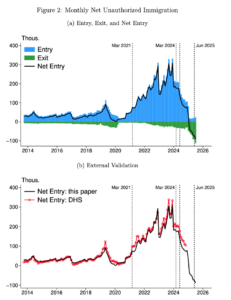
As I’ve stated before, Biden importing several million illegal aliens across the southern border raised housing prices, because increasing demand without increasing supply raises prices.
A working paper from the Federal Reserve Bank of Dallas concluded that the large influx of illegal aliens during the Biden administration drove up housing prices and rents.
According to the paper, roughly 7 million people illegally came to the United States between 2021 and 2024.
This spike of illegal immigration “raised local house prices and rents without expanding housing supply,” acting as a “demand shock to local housing markets.”
Using court records and border enforcement information alongside housing market data, the economists estimated that illegal immigration “can explain about 30% of the total growth in house prices and 20% of total growth in rents over the boom period for the average local market.”
“We’ve actually been saying this for a number of months now,” U.S. Rep. Beth Van Duyne (R–Irving) told CBS News. “I don’t think people sometimes understand the ramifications of having so many folks enter your country illegally in such a short period of time and the financial disaster that it causes.”
Although housing costs have begun to ease, prospective homeowners continue to face affordability challenges. The National Association of Home Builders calculated that in Texas, a $1,000 median price increase would price out roughly 15,000 households.
John Bonura and Selene Rodriguez from the Texas Public Policy Foundation are urging lawmakers to “ensure that scarce housing opportunities first serve the people to whom this country ultimately owes its highest obligation.”
You mean citizens rather than illegal aliens? Seems like the Democrats have those priorities reversed.
The paper can be found here, in which we find this breathtaking chart showing the effects of the Biden Administration’s deliberate attempt to leave the southern border unsecured:
Republicans need to drop direct mailers to everyone under the age of 30 this year, explaining that Biden’s illegal alien wave drove up housing prices, and that excessive regulation in blue cities and states restrict demand. Who knows, this little nugget of truth may even give some of them a clue as to why socialism doesn’t work…
Back when I was doing regular Texas vs. California updates, this is the sort of video I would feature. It covers why Texas is doing so much better than Europe, though the framing misses a few things I’ve tried to highlight below.
Caveat: I don’t know who “The Economic Matrix” is, but what they’re saying is generally right, but a bit incomplete.
“This is Texas. To most of the world, it’s just one of 50 American states. But if you pulled it off the US map and dropped it into the global rankings as its own nation, it would sit eighth in the world, sandwiched directly between France and Italy, with a staggering GDP of $2.77 trillion. But that’s just the start. In 2025, the Texas economy was bigger than the equivalent of the Netherlands, Belgium, Denmark, and Austria combined.”
“Texas and Europe are separated by more than an ocean. They’re separated by two completely different ideas of how a state should operate. And right now, one of those ideas is winning by a distance that gets harder to close every year. In 2024, the Texas economy grew by nearly 4%. The entire European Union managed 1%, and the gap is only getting wider.”
“The EU spent most of the last 15 years in crisis mode. A sovereign debt collapse left Greece, Spain, and Portugal on the edge of ruin.” I covered the European Debt Crisis (especially among the PIIGS (Portugal, Italy, Ireland, Greece, Spain)) as it was happening, and the thing to remember is that it was (and is) a deficit spending crisis. Like the federal government, European governments insist on spending more than they take in. Real austerity, i.e. cutting outlays until they match receipts, hasn’t failed, it’s been declared difficult and left untried.
“Years of near zero growth followed. The in 2022, Russia cut off the gas and sent inflation across the Euro zone spiking to 9.2%.” Here the video also avoids noting that another big inflation driver was the effects of the Flu Manchu lockdown across most EU economies.
“Through all of that, the Texas economy just kept climbing. The productivity gap tells the same story. Between late 2019 and mid 2024, labor productivity per hour in the Euro zone rose by 0.9%. In the US, it rose by 6.7%. Texas led that charge.”
“Look at the Permian Basin. Oil production nearly tripled in a decade while the rig count was cut almost in half because horizontal drilling and AI-guided extraction meant fewer rigs producing more oil. Same workforce, three times the output.” Oil industry-specific AI has very little do with the current general AI build-out bubble.
“There’s a mathematical reality that makes this trajectory almost impossible to reverse. At 1.5% annual growth, the EU takes roughly 47 years to double in size. At the 3.5% rate Texas usually averages, it takes 20. By the time the EU doubles once, Texas will have doubled twice. That gap compounds and it means every year the distance between these two economic models doesn’t just persist, it accelerates.”
“Mario Draghi, the former head of the European Central Bank, released a landmark report warning that without serious reform, the EU is heading toward what he called a slow agony. Leaders held a retreat to discuss it. Then they went back to their committees.” Future pain is abstract, while the electoral pain of trying to reform things is far more immediate.
“Since 2020, more than 200 companies have moved their headquarters to Texas. Tesla relocated to Austin in 2021. Chevron, one of the largest energy companies on Earth, announced its move to Houston in 2024. Charles Schwab, CBRE, SpaceX. More than half of these relocations came from California alone.”
“These are not satellite offices or mailbox moves. The reason they gave was simple. The regulatory environment in California made expansion too slow and too expensive. Texas made it fast, cheap, and permanent.”
“Spotify was founded in Stockholm, but listed on the New York Stock Exchange. Skype was built in Estonia and Luxembourg, then bought by Microsoft and absorbed into Redmond. ARM was designed in Cambridge, England, then acquired by a Japanese conglomerate and listed in New York. Europe keeps building the talent. America keeps cashing the check.”
“Beneath the growth stats and the corporate migrations, there’s one factor that explains this gap better than anything else: Energy. Texas produces more energy than almost any country on Earth. Not other American states, actual nations. Between 2007 and 2023, while the rest of the United States saw energy consumption drop by about 5%, Texas went in the other direction. Energy use in the state climbed by 21% and the industrial sector alone saw a 28% jump in demand. This was not a state focused on conservation or cutting back. Texas was building oil rigs, refineries, chemical plants, and massive wind installations, all at the same time.” Those wind farm installations were the result of subsidies, and they’re not really building new ones anymore.
“The reason Texas could pull this off comes down to one decision made decades ago. Texas built its own power grid, specifically to escape the slow motion gears of federal regulation. The result, solar capacity that grew 32% in just 2024, wind generation that leads every other American state, and a massive natural gas fleet running underneath it all to keep the lights on when the sun goes down, cheap, abundant, predictable, and fast to build.” Again, the solar build-out was aided by subsidies.
“For decades, the European energy models rested on one assumption. Buy cheap gas from Russia, build out renewables slowly, and keep industrial costs manageable. When Russia invaded Ukraine in 2022, that assumption collapsed overnight. Wholesale energy prices went vertical. Industrial electricity costs in Germany suddenly hit three to four times what businesses in Texas were paying for the exact same power.”
“Look at what happened to BASF, the largest chemical company in the world. For over 150 years, their home was Ludwigshafen, Germany, a sprawling industrial complex on the Rhine that employed tens of thousands. After 2022, they announced billions in cuts to that site. Plants shuttered, thousands of jobs gone. But BASF didn’t disappear. At the exact same time, they were breaking ground on new facilities in Freeport, Texas. Same company, same products, two completely different decisions driven entirely by the price of electricity.” Probably not just electricity. Union work rules in Germany are considerably less flexible than those in right-to-work Texas.
“France tried to escape this trap by leaning into nuclear power, which once covered 75% of French electricity needs. But that infrastructure is aging. New reactor projects like Flamenville have run tens of billions over budget and more than a decade behind schedule, and the political will to build more has been stuck in debate for a generation. The old Russian gas model is dead. The nuclear renaissance has not arrived. And permitting a single wind farm in the EU can take 7 to 10 years.”
“In Texas, the same process often takes a few months. Energy prices act like a hidden tax on everything from manufacturing steel to running a server farm to heating a bakery. European businesses pay that tax every single day. And Europe does not have the gas, does not have the grid independence, and does not have the permitting speed to change that.” Actually, Europe does have oil and gas reserves it refuses to develop.
“Cheap energy is a huge piece of the puzzle. But the real accelerant for the Texas economy has been something even harder for Europe to copy. And it starts with one number. The average top personal income tax rate across 35 European countries is 38.5%. In Denmark, that number hits a staggering 60.5%. In Germany, France, and Italy, high earners face rates between 45 and 50%.”
“In Texas, the state income tax rate is zero. It’s always been zero, and the Texas Constitution actually makes it illegal for the state to introduce one without a direct vote from the public. This is not a temporary policy that a new government can reverse after the next election. It’s locked into the foundation of the state.”
“Texas still has high property taxes, so the total burden on a normal resident is not as dramatic as that 0% headline suggests. But for the people these economies are competing over, the math is brutal. A senior software engineer in Munich earns roughly €75,000 and takes home about $45,000 after income tax and social contributions. The same engineer in Austin earns $140,000 and takes home over $105,000. same skills, same screen, more than double the money in their pocket at the end of the year. Between 2020 and 2024, Texas startups pulled in over $46 billion in venture capital. In Q1 2025 alone, Texas tech companies raised nearly $3 billion, the biggest single quarter the state had seen in over 2 years, with massive deals in cyber security, defense tech, and biotech.”
“Compare that to the other side of the Atlantic. The entire European Union raised about $17.5 billion for AI funding in all of 2025. The US raised nearly $70 billion for generative AI alone by midyear. Not total tech, not all venture capital, generative AI alone. These two regions are not competing in the same category.”
“The EU’s regulatory framework was designed to protect consumers and level the playing field. GDPR [General Data Protection Regulation], the AI Act, 27 different national compliance regimes stacked on top of each other. The intentions were sound, but the unintended result is that the compliance costs favor massive American companies like Google and Microsoft, who can absorb them easily over smaller European rivals who can’t.”
“None of this means Texas has it all figured out, because the truth is it hasn’t. The most visible problem is housing. In 2019, a median Texas family earned 62% more than they needed to buy a median home. By 2023, that cushion had collapsed to just 7%. Not 62%, 7%. Over a third of Texas households now spend more than 30% of their income on housing.” That’s a national problem, partially engendered by the Flu Manchu shutdowns, partially by restrictive local building codes. “Affordable housing” blather snipped, since this is just more unnecessary government subsidy and intervention.
“The workers who actually build the Texas economy, the Tesla line workers, the nurses, the warehouse staff, can’t afford to live in the cities their labor is building anymore. They commute in from further and further out, and the roads, the housing, and the services all fall behind.” Partially true, partially false. Austin housing prices exploded, but have come down dramatically. Dallas and San Antonio prices spiked, then plateaued. Houston prices have continued climbing, but gradually.
“When a place grows this fast, the infrastructure simply can’t keep up.” True of Austin, less true of Houston, though having to rebuild certain interchanges is making things a nightmare for certain commuters.
Discussion of energy grid problems and the 2021 ice storm snipped, since I think we’ve covered those enough here.
“The problems in Texas are the problems of a place growing too fast. The problems in Europe are the problems of a place that is barely growing at all. In that sense, Texas and Europe have something in common. Both are stuck. The difference is that Texas is gridlocked because too many people are trying to get to work. Europe is gridlocked because too many committees are still deciding whether to build the road. Right now, Texas has its sights set on overtaking France, a G7 nation. At current growth rates, that gap closes faster than most people realize. And France’s response, like the rest of Europe’s, has been to wait and see.”
“The real question isn’t whether Europe can change. It’s whether it actually wants to change badly enough to feel the pain that comes with it. Because while Brussels is still writing the rule book, the game is already over for the economies Texas has already passed. The ones still in its path just haven’t checked the scoreboard yet.”
Left out of this coverage: Texas has a constitutionally mandated balanced budget, while the overwhelming majority of European nations keep running budget deficits to keep their cradle-to-grave welfare states afloat.
Not to mention a government run by Republicans rather than unstable coalitions including the Greens…
It’s hard to know just what the state of the Chinese economy is, given the CCP’s constant lies, but this Joe Blogs video suggests that Chinese manufacturers are in a world of hurt, with four straight years of deflation and falling profit margins.
“Chinese businesses are continuing to suffer from margin erosion. And this is an absolute disaster from China’s perspective, because Chinese businesses have very thin margins in the first place. And if these margins are now being cut, then many businesses in China have now actually fallen into a loss-making situation.”
“More than 50% of the companies in China are now estimated to be banking losses.”
“If you’re posting losses, you don’t pay any taxes, and that will drag down GDP growth in China. The Chinese authorities have said that they’re going to hit 5% again in 2026, but I think there is a major question mark over whether or not that is realistically achievable.” My working assumption is they just lied about hitting that target last year as well. And probably meany years before that.
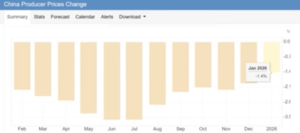
“If we have a look at this table, it shows what’s been happening with producer prices over the past 12 months. And the scale on the right hand side here starts at zero and goes down to minus 4%. And as you can see, in every single one of the past 12 months, Chinese producers have been cutting their prices. This chart is also referred to as the factory gate prices. So this is the price of products when they’re leaving Chinese factories. And the latest data for January 2026 shows that year on year prices were down by 1.4%.”
“If you put that into the context of your economy, if prices were going down by 1.4%, then you’d be very happy as a consumer, because that means that you’re paying less at the tills.”
“But as a company, this is an absolute disaster. Because the reason why we want some form of inflation in the economy is because it allows companies to pass on their cost increases.”
“But if your end price is going down by 1.4%, then clearly you can’t pass on those cost increases. You have to absorb them. And this is why Chinese businesses are seeing their profit margins being wiped out.”
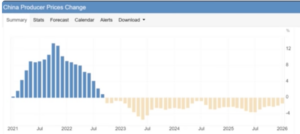
“And if we widen the scale of this chart to show the last five years, you can start to see the scale of the problem in China, because producer prices, factory gate prices have now been falling since May 2022.”
“What we’ve got here is a compounding of year-on-year falls in factory gate prices.”
“We have a look at this table I’ve put together. It shows what the impact of this has been on the sales price for a product. So if we assume that January 2022, which was the last time that we saw a price increase year-on-year in China, if we assume that a product that Chinese company was selling for $100 at that time, this shows what the impact has been on that product. So in the year to January 2023, prices fell by 8% producer prices. So that means that that $100 product would have then been selling for $99.20. In January 2024, the year-on-year fall was 2.5%. So that $100 product would then be have sold would have been been selling for $96.72. In 2025 there was a 2.3% fall in producer prices. So that product by then would have been down to $94.50. And the 1.4% that we’ve just seen posted means that that $100 product that was being sold in 2022 would now be selling for $93.17.”
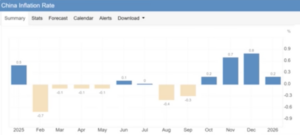
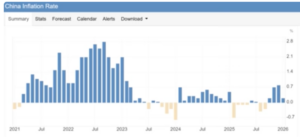
Is this deflation mirrored in Chinese consumer inflation prices? No. “It has been a bit of a mixed story. The scale on the right hand side here goes from 1% positive at the top to 1% negative at the bottom. And as you can see, in six out of the past 12 months, prices did actually fall, but they’ve been increasing over the past four months. And you can see that the latest data that we have for January 2026 shows that year on year prices are up by .2%. So that doesn’t explain the 1.4% fall in producer prices in January 2026.”
“And we widen the scale of this chart to show the past five years. You can see that whilst there has been a few months where we’ve seen deflation, it’s predominantly been inflation in China. It’s a relatively low level compared to other countries, we’re talking between 1% and 2%. So a lot less than we’ve seen in the West over the past five years. But we’ve still seen prices going up.”
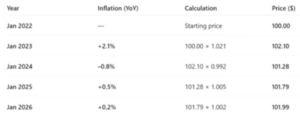
“And if we have a look at this table, it shows what’s happened to prices over the same period. So if we assume the same $100 product in January 2022 that we just looked at for producer prices, in 2023 prices actually went up by 2.1%. So that product would have been selling for $102.10 at that time. We saw deflation in January 2024, which would have brought the price back down to $101.28. In 2025, we saw a year-on-year increase of .5%. So it would have pushed that that price to $101.79. And the most recent data for January 26 of 2% increase tells us that that product would now be selling for $101.99. So an increase in the price.”
“And if we have a look at the comparison between those two tables, then you can see here the producer prices between January 22 and 26, the $100 product has gone from $100 to $93.17. That’s what the companies are receiving for that same product. At the same time, inflation has gone up by 1.99% over that period. That pushed up the price to 101.99. So the gap between those two metrics, what’s been happening with inflation? If producer prices had just been moving at the same rate as inflation, the difference between the two is $8.82 over the past five years. That represents lost profit margin for Chinese businesses over the past five years of 8.6%. So that’s how much profit has been taken out by the fall in producer prices compared to what should have been happening if they were matching inflation.”
“Now why is this happening?”
“Why are Chinese businesses constantly cutting their prices when prices in the domestic market are going up? Well, there’s a number of reasons for it, but one of the main reasons is down to overcapacity.”
“Chinese industry has been gearing up heavily over the past 20 years. So in areas where China believes that it’s strong, it’s put a lot of investment and the government has subsidized a lot of these companies in many situations to enable them to grow rapidly to take a dominant global market position. So we have got some huge businesses in sectors where China has tried to become dominant.”
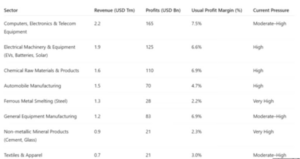
“If we have a look at this table, it shows the different industries in China that are the biggest in terms of revenue and what that should mean in terms of profitability for those businesses.”
“So the biggest sector in terms of manufacturing is computers, electronics, and telecom equipment. So I’m sure you’ve seen lots of different equipment that’s been made in China over the past 20 years. It’s estimated that that sector has revenue of around about $2.2 trillion US, and that should be equating to around about $165 billion of profits. The usual profit margin is around 7.5% for Chinese businesses in those sectors. But those sectors are currently under a lot of pressure.”
“Firstly, we’ve seen its biggest single market, the USA, applying tariffs against Chinese imports. So, that’s causing problems because it’s pushing up the price. And in order to counteract those tariff increases, some Chinese businesses have actually been cutting their cost to absorb some of those tariffs. But also, we’re seeing competition from the rest of the world.”
“So Chinese businesses are constantly slashing their prices to be the cheapest on the shelf because, realistically, that’s why a lot of consumers choose the Chinese option.”
“So that sector is under pressure at the moment. So that’s one of the reasons why those companies are cutting back on their prices.”
“Now another area which is absolutely huge for Chinese businesses is electric vehicles, batteries and solar. So this is an area that China has really specialized in. It’s cornered the market in batteries and solar panels. Most of them are made in China these days. But also electric vehicles. It decided to take a big slice of the global market and those electric vehicles are being sold at very low prices compared to local competition. So if you compare a Chinese electric vehicle the actual list price of that versus things like BMW, Volkswagen, Ford, they are a lot cheaper.”
“That’s one of the reasons why a lot of countries have been applying tariffs on the electric vehicles. So this is aside from Donald Trump’s tariffs. We’re talking about the whole industry globally is saying that it’s not fair that EVs are being subsidized. In terms of revenue, it’s around about $1.9 trillion for China and the usual profit margins around about 7% on that. But they’re under a lot of pressure because of the tariffs. Now a lot of countries are saying that China is trying to put the rest of the world out of business so that it can become completely monopolistic in these areas. So they’re under high pressure, and that’s another reason why Chinese companies are cutting their prices.”
“Jump down to some of the things that are related to property. Look at ferrous metals, which are basically steel. China has some of the biggest steel smelting plants in the world. It’s a big producer of steel. The revenue is about $1.3 trillion. Now the profit margin on steel is wafer thin. 2.2%. And the problem that China has is twofold at the moment.”
“Firstly, a lot of that steel was being sold into the Chinese market for the property market, because the property market over the past 25 years was booming the first 20 years of the 20th century. It was absolutely on fire. Lots of massive property developers like Evergrande were building whole cities all across China and they were using a huge amount of steel to do that. They building these huge tower blocks and you have to put a lot of steel in there.”
“The properties sector has absolutely crashed in China over the past few years, since the government changed the rules and made it more difficult for property developers to borrow money. There hasn’t been anywhere near as much production. So that’s caused a huge drop off in demand in China for steel itself.”
“So that’s meant that Chinese steel businesses have had to look to the export markets. But similar to what’s been happening in the electric vehicle market, a lot of countries, including the USA, have pushed back on Chinese steel imports because they are so cheap that they are killing local steel production. And in the UK, the British government had to recently take over the last virgin steel producer in the UK to make sure that it could actually produce steel that was needed for things like the defense sector. So we’ve seen a major attack globally on the whole steel industry, and lots of countries have pushed back on that.”
“So the steel industry in China is now under a lot of pressure. It’s struggling with regards to demand and those profit margins have been wiped out.”
“But we’ve got a lot of different sectors here that are under intense pressure at the moment from competition. And that’s one of the factors why Chinese businesses are cutting their prices.”
“In addition to that, Chinese businesses are also seeing weak demand at home. Chinese consumers are not buying as much stuff as they used to. So Chinese companies are cutting their prices to try to encourage consumers to keep buying.”
“And as that demand falls at home, what that means is that Chinese businesses are having to depend on the export markets more. So, Chinese companies are struggling with regards to its biggest single market, because the USA has hit all Chinese imports with additional tariffs. So, that’s led to a further cutting of prices and Chinese businesses basically across the board are geared up for high volume, low margin. And when demand starts to fall, then the only thing that you can do is cut your price.”
“Because if you’ve got a huge fixed cost business, if you’ve spent billions building up your business, maybe it’s lots of machinery, you’ve got lots of people, you’ve got huge factories, you need to hit those volume numbers just to keep the wafer thin profit margins going.”
“If demand starts falling, you can’t cut back on your costs because these are very high fixed cost businesses. So what Chinese businesses are doing instead is slashing their prices to maintain their volume of sales. But that is wiping out their profit margins. And that’s why many Chinese businesses, over 50%, are now banking losses.”
“And of course, this is an absolute disaster from the Chinese economy point of view, because it needs those companies to keep contributing to make profits to pay taxes to contribute to GDP in order to hit that 5% GDP total.”
“What we’re seeing from the data that’s just been published is that producer prices are continuing to fall.”
“Inflation is still very, very low in China. Consumer demand is very weak. So China remains dependent on the export markets. Many export markets are pushing back against Chinese imports.”
“Chinese businesses are having to cut their prices, which is further reducing their profit margins. Many have moved into losses, and this is a complete nightmare, vicious circle from many of these companies’ perspective. And I can’t see how they’re going to get out of this situation.”
China’s economy has long been smoke and mirrors all the way down. To be sure, China has made real gains, joining (and gaming) the world economic system just in time to see explosive growth thanks to global trade deals, the container ship era, rampant IP theft, and western capitalists eager to exploit cheap labor. But the rest of the world slowly caught on to China’s tricks, especially since China thought they could get away with belligerent, militarist, expansionist rule-breaking aggression against at the same time it was striving to become the world’s manufacturing hub.
Now that the world’s caught on, people are starting to realize that much of China’s “economic miracle” was an illusion. The opaque banking rules, the government subsidies, the insane “ghost cities” property boom and the regime’s strict currency controls all helped to hide the manipulations, making China’s economy look healthier than it actually is. But now the entire house of cards is tumbling down, and China has no one to blame but itself.
Happy Friday the 13th, everyone! Good job numbers drop, a court win for Trump on deportations, more California fraud, more Chinese researchers stealing secrets, and the cure for global warming is global warming.
It’s the Friday LinkSwarm!
Naturally, a week after I blog about the “no hire, no fire” economy, it comes out that the economy added 130,000 in January, the most since December 2024. “However, the report shows the U.S. only added 181,000 jobs in 2025.” And the numbers for previous months keep getting revised downwards.
As I’ve said before, I’ll believe we’re out of the Biden Recession when I have a job again…
Petitions for Habeas Corpus to release illegal aliens from detention, or at least grant them bond hearings, have overwhelmed the federal courts, with most district court judges who have ruled on the subject siding with the detained aliens. It was the practice of prior administration from both parties to grant bond hearings. But is it a legal requirement?
A ruling by the 5th Circuit Court of Appeals, which covers critical border state Texas, has rejected the argument that a bond hearing and release is required by law. To the contrary, it held that the applicable legislation passed by congress does not require such bond hearings or release. That prior administrations did not exercise their full powers of detention under the law did not mean the present Trump administration could not do so, the court ruled.
Another win for secure borders and the rule of law in the face of massive leftwing judicial resistance.
The House of Representatives on Wednesday night passed the new Republican-led Safeguard American Voter Eligibility (SAVE) America Act, which requires individuals to present proof of citizenship to register to vote and requires Americans to show ID when voting.
The House passed the legislation, which combined two bills, in a 218-213 vote. The bill saw little support from House Democrats, with Texas Rep. Henry Cuellar being the sole Democrat to join Republicans in passing the legislation.
“It’s just common sense,” House Speaker Mike Johnson told reporters of the legislation. “Americans need an ID to drive, to open a bank account, to buy cold medicine, to file government assistance. So why would voting be any different than that?”
Senate Democrats, of course, with the exception of John Fetterman, will do anything to prevent it from being passed. If they can’t cheat, they can’t win…
Stephen Green: California raked off $370M in taxpayer money to bankroll leftwing activism.
1. Californians voted to fund youth drug prevention through the Cannabis Tax. Instead, $370M in revenue is bankrolling leftwing activism.
2. The money flows through a single unelected nonprofit – The Center at Sierra Health Foundation’s Elevate Youth program.
3. The Center has gotten rich off this arrangement – growing from $11.8M in 2018 to $197M in 2024. The CEO makes over $600K.
4. The Center runs Prop 64 dollars through to a web of NGOs, including the Jakara Movement, Young Invincibles, and Asian Refugees United – for activism, organizing, and voter registration.
5. This is not drug prevention – it’s a taxpayer funded pipeline from the governor’s office to leftwing political organizing.
Snip.
“The state does not pick who gets the grants,” CAL DOGE said. “The intermediary does, bypassing the rigorous procurement processes mandated for direct government contracts under the Department of General Services and State Controller oversight.”
That’s a multimillion-dollar slush fund, in other words, in which tax dollars pass through to the well-connected for the purpose of maintaining Democrat control of the state. And, one presumes, lining pockets along the way —allegedly including Newsom’s:
According to the California Fair Political Practices Commission’s Behested Payment Transparency Report (pg.19-20), in 2020 alone, Sierra Health Foundation was the third-largest payor of behested payments statewide at $14,747,724 and the single largest payee of behested payments statewide at $30,869,901 — payments Newsom solicited from private companies.
“Newsom himself was the top behesting official in the state that year at $226.8 million total,” the report continued, “and Sierra Health Foundation ranked among his top three financial partners in the system.
Los Angeles spent about $418 million on homelessness programs in 2025, yet only a small share went toward helping people leave the streets for good, according to the New York Post. A recent City Hall report suggests most of the money supports short-term services that manage homelessness rather than resolve it.
The review, released as the city prepares major budget cuts, shows that hundreds of millions were directed to hygiene facilities, outreach teams, temporary housing, and vehicle-living programs with limited long-term success. These efforts often keep people in transitional situations instead of moving them into permanent homes.
The Post noted that councilwoman Monica Rodriguez condemned the system, saying, “We’re hemorrhaging money on a homelessness system that was never designed to succeed — and no one is being held accountable for the failure.”
She also argued that ineffective programs are protected instead of evaluated: “If we really wanted to do something about this crisis, we would be advancing real oversight, demanding results, and shutting down programs that don’t work — not protecting a system that keeps spending more while delivering less.”
It’s not designed to end homelessness, its designed to line the pockets of the Homeless Industrial Complex and leftwing activists.
Indeed, California’s entire NGO funding structure is designed to avoid scrutiny.
The money moves smoothly, the explanations pile up, and the ability to see end-to-end quietly disappears. The deeper the look went, the more consistent the pattern became. California doesn’t struggle to explain where the money goes. It has arranged things so the explanation never quite arrives.
Snip.
When the information is pulled in its entirety and organized outside the state’s presentation layer, the scope becomes impossible to miss. More than 1,100 vendors associated with humanitarian-related contracts. Roughly $8.8 billion flowing through them. Not scattered grants. Not pilot programs. An economy of vendors, operating continuously, funded at scale. The dashboard never highlights that universe. It doesn’t need to. It only needs to make seeing it difficult enough that most people never try.
At the same time, at the federal level, the Small Business Administration acknowledged what everyone working in procurement already understands. Billions of dollars under review. Tens of thousands of entities flagged for potential fraud exposure. Large systems, large sums, limited verification, delayed audits. The numbers don’t have to match perfectly to rhyme. They already do. When separate data streams begin pointing toward the same structural vulnerabilities, the story stops being about isolated actors and starts being about architecture.
Requests for clarity meet resistance long before they reach conclusions. Public records requests stall. Narrow questions expand into bureaucratic negotiations. Specific funding totals become “unavailable.” Amy Reihart’s experience in San Diego fits neatly into this rhythm. The data is said to be public, but pulling it cleanly proves elusive. The formal channels exist, but they lead nowhere quickly. What’s left is a familiar posture from the state: the information is technically available, practically unreachable, and always just one more step away.
The same rhythm shows up in how California moves money on the ground. Childcare subsidies offer a clean example. In many states, the government pays providers directly. The path is short. Attendance aligns with eligibility. Eligibility aligns with reimbursement rates. Payments can be checked against records without heroic effort. In California, that line bends. Funds are routed through intermediary NGOs charged with administering the program. The state pays the intermediary. The intermediary interfaces with providers. Documentation flows inward. Payments flow outward.
Following that path takes work. First, identify which NGO controls which geography. Then locate its audit filings, assuming they are current and complete. Then reconcile those filings with procurement records that are already difficult to interrogate. Only after that does the provider level come into view. Each step adds distance. Each handoff adds discretion. Sources describe monthly subsidy flows exceeding $1,400 per child with minimal verification. Whether every dollar is misused is unknowable from the outside. What is visible is how easily the structure absorbs misuse without producing alarms.
That same opacity shows up beyond childcare. Walk through downtown Los Angeles and the conversations repeat. Not policy debates. Observations. Barbers, bartenders, people who work late and walk home early. The homeless system comes up unprompted. Everyone knows how much money moves through it. Everyone knows how little seems to change. Deliveries arrive at storefronts with no customers. Benefits circulate with minimal identification. Stories circulate about organized applications and quiet laundering through approved channels. None of this appears on a dashboard. It doesn’t need to. It lives in the gap between official narratives and daily experience.
The system doesn’t rely on secrecy. It relies on diffusion. Money enters labeled as humanitarian assistance, housing support, community partnership. It passes through nonprofit layers that soften scrutiny and multiply explanations. By the time it reaches the ground, responsibility is spread thin enough that no single ledger tells the whole story. Each participant can point upward or downward and remain technically correct. Oversight exists everywhere in theory and nowhere in practice.
Organizations operating at the intersection of activism and public funding sit comfortably inside this environment. The Solidarity Research Center in Los Angeles, connected to broader political networks, is one example drawing attention. Not because of slogans or mission statements, but because proximity to power and insulation from scrutiny tend to travel together. When funding, politics, and moral language overlap, questions are framed as attacks and audits become optional. The structure does the work long before anyone has to defend it.
The contrast between damage and response is hard to ignore. Drive through the Palisades fire zone and the destruction remains visible. Burned properties. Long stretches untouched. The rebuild lags. The NGO signage does not. Clean placards promise recovery, resilience, and renewal, often paired with donation links. The messaging arrives faster than the materials. The branding arrives faster than the permits. Money is already being organized, even as the outcomes remain distant. It’s a familiar sight in California: urgency in fundraising, patience in results.
None of this happens by accident. The systems are too consistent. The barriers appear in the same places. Presentation layers substitute for access. Intermediaries substitute for accountability. Requests for detail meet friction rather than answers. The result is a machine that keeps moving regardless of whether anyone outside it can explain how. For the people inside, it works. For the public, it produces impressions instead of records.
The report’s overview notes the beaming confidence of Georgia Secretary of State Brad Raffensperger on the morning after the election. Appearing on the Today Show, Raffensperger said a record 4.7 million Georgia voters cast a ballot in the election. More importantly, the secretary of state said only 2 percent of the ballots remained to be counted. Trump, at that time, led Biden by nearly 104,000 votes, seemingly more than enough for a Georgia win. Raffensperger, at the time, said about 94,000 ballots had yet to be counted.
“We can see where the candidates are right now in both presidential, congressional, senatorial. When you look at how many votes are out there, even if one of the candidates got 100 percent it probably wouldn’t be enough to move it on way or another,” the elections official told the Today Show crew. He should know, the report notes. The secretary could see the numbers in real time through the state elections database.
Raffensperger added that his office would wait until everything was done.
When the dust settled, the confident secretary turned out to be very wrong. The final vote count — at least then — was an incredible 5.023 million. Between the time Fulton County’s polls closed on Election Day and the final ballot was tallied, the number of absentee ballots soared from 74,000 to more than 148,000, according to the report.
Trump went from the verge of winning a key battleground state to losing it. Just like that.
“At the time of this writing, no known explanation has been provided to justify” the surge in ballots, the report states.
Snip.
The number of absentee ballots counted doesn’t match the number of credited voters, the report notes. It draws from Fulton County and state records that show 148,318 ballots were counted in the 2020 election, although only 125,784 voters were recorded as casting an absentee ballot. That’s a difference of 22,534 votes between the absentee ballots tallied and the number of individuals given credit for voting.
“Remember: the margin between President Trump and Joe Biden was 11,779 votes…and that was the THIRD certified number and didn’t match either of the first two counts….the counties could not get their numbers to match from the first count to the second to the third…..
Ukraine also hit a GRAU arsenal in Volgograd with multiple missiles. GRAU is the umbrella organization for Russian logistics.
While Russia has continued to eek out ever smaller territorial gains at high cost, Ukraine just liberated 100 square kilometers of territory in Huliaipole, Zaporizhzhia oblast. “Ukrainian forces have liberated the towns of Dobropillia, Pryluky, Olenokostiantynivka and part of Varvarivka in an assault south on the Zaporizhzhia Frontline.”
Scientists at the University of California, Irvine have discovered that climate change is causing nitrous oxide, a potent greenhouse gas and ozone-depleting substance, to break down in the atmosphere more quickly than previously thought, introducing significant uncertainty into climate projections for the rest of the 21st century.
A recent watchdog report revealed that several top-ranked American universities have brought in Chinese academics who have links to Chinese military-linked technology firms like tech behemoth Huawei and other Chinese firms linked to the CCP’s state security endeavors.
A conservative non-profit watchdog group, the American Accountability Foundation, reported that it found nearly two dozen Chinese academics working at elite U.S. schools and labs “who, because of the dual-use threat of their research, close ties to the military research sector in China, and/or clear ties to the Chinese Communist Party” and as such “should be expelled from the United States or never be re-admitted.”
The new AAF report pointed out that multiple Chinese students working at American universities had previously collaborated on projects with researchers at Huawei, including working with researchers at the Internal Cybersecurity Lab at Huawei.
Just the News also found that at least one of the Chinese academics had also worked at iFlytek — a similarly blacklisted Chinese company which often collaborates with Huawei. The U.S. National Security Commission on Artificial Intelligence stated in 2021 that “national champion” firms such as Huawei and iFlytek help “lead development of AI technologies at home” and “advance state-directed priorities that feed military and security programs.”
Snip.
The AAF report argued that Guangyao Chen “poses a high national-security and dual-use risk due to his expertise in adversarial machine learning” and that “this risk is amplified by his training at Peking University, PRC government funding, and collaborations with PRC universities and Huawei, placing his work squarely within China’s military-civil fusion ecosystem.”
Chen currently appears to be affiliated with Cornell. The ResearchGate page for Chen says that his “top co-authors” include Lin Du, a researcher at Huawei. Chen appears to have conducted multiple research projects with the Huawei researcher. The Huawei scientist’s ResearchGate profile lists Du’s skills and expertise as being “computer vision,” “object recognition,” and “machine learning.”
Snip.
Meng Wanzhou, Huawei’s CFO and the daughter of the company’s founder, was arrested by Canadian authorities in December 2018 at the request of the U.S., indicted in the Eastern District of New York in January 2019, and charged with bank fraud and wire fraud as well as conspiracy to commit both, but was allowed to walk free by the Biden Administration in 2021 in a deferred prosecution agreement wherein she admitted violating U.S. law.
Snip.
Fengqui You, a Cornell professor, leads the Fengqui You Research Group at Cornell, which is “pushing the boundaries of systems engineering, artificial intelligence, and data science.”
Chen is listed as a member and Fengqui You is listed as the principal investigator for the lab. You attended Tsinghua University, which the House Select Committee on the CCP has warned about. You did not immediately respond to a request for comment.
Snip.
The report by AAF said that Cen Zhang’s “prior work with Chinese entities and his influential role at Georgia Tech is highly concerning given the nature of computer science’s impact on U.S. national security.”
Zhang co-authored a 2021 paper on “Practical Binary Fuzzing Framework for Programs of IoT and Mobile Devices” — related to security vulnerabilities for mobile phones and other smart devices — with co-authors Xiaoxing Luo and Miaohua Li from the Internal Cyber Security Lab at Huawei Technologies.
Zhang has also conducted research with Hongxu Chen, who now lists himself as a lead engineer at Huawei, and who also went to Nanyang Technological University.
Zhang’s personal curriculum vitae also says he was previously an algorithm and engine development engineer for iFlytek. Zhang says on his GitHub page that he won the “Best New Employee Award of Year” at iFlytek in 2017.
The firm has long received state support and recognition from China’s government. The company was named a national “AI champion” by the Chinese Ministry of Science and Technology in 2018.
The Commerce Department said in October 2019 that iFlytek was among more than two dozen Chinese entities added to a U.S. blacklist, saying they were “implicated in human rights violations and abuses in the implementation of China’s campaign of repression, mass arbitrary detention, and high-technology surveillance against Uighurs, Kazakhs, and other members of Muslim minority groups.” Liu Qingfeng, iFlytek’s founder and CEO, is also a deputy to the National People’s Congress, the CCP’s rubber-stamp national legislature.
There are problems with how this piece is organized, but I wanted to capture the names (some of which are are already familiar) to keep track of them. At this point, any organization that hires a Chinese national for scientific research should assume they’re stealing data.
The legislation raises the current $10 billion asset threshold that caps debit card fees for banks and index annually to inflation.
Sen. Cruz said, “The Durbin Amendment was not designed for the current economic and regulatory reality and subjects community banks to fee limits that the original language intended for much larger institutions. My legislation modernizes the interchange fee cap to reflect inflation, helping small banks support local economies while lowering banking costs for Americans.”
Sen. Britt said, “As we’ve seen in so many instances, countless regulations in the Dodd-Frank Act were not only onerous but set fixed thresholds that have become outdated over time, and the Durbin Amendment is no exception. The largest burden is on our smallest financial institutions who provide vital sources of credit to Main Streets that drive our local economies. This commonsense legislation would simply index, to both inflation and COLA, the outdated threshold in this provision of Dodd-Frank, ultimately providing relief for our community banks who were never intended to be burdened by this regulation.”
Companion legislation was introduced in the House by Rep. Andy Barr (R-KY-6).
Rep. Barr said, “The Durbin Amendment was sold as a win for consumers in the Dodd-Frank Act by Democrats. Instead, it’s hurt Kentucky’s community banks and credit unions that do so much for underserved communities by limiting their ability to grow and compete with larger financial institutions. I’m working with Senator Cruz to fix this — because Washington shouldn’t be picking winners and losers at the expense of our local banks and the families they serve.”
This bill is supported by Americans for Tax Reform, Independent Bankers Association of Texas, and the Texas Bankers Association.
A new political organization has launched with the stated goal of countering one of Austin’s most powerful and long-standing special interest groups.
Republicans Against Texans for Lawsuit Reform, a 501(c)(4) organization, announced its formation this week. It is positioning itself directly against Texans for Lawsuit Reform (TLR), the influential tort reform group that has played a major role in Texas politics for decades.
On its website, Republicans Against Texans for Lawsuit Reform (RATLR) accuses TLR of abandoning its original mission and becoming what it describes as a major player in the “Austin swamp.” The group argues that TLR, which began in the mid-1990s advocating civil tort reform, now prioritizes the interests of “big business, big pharma, and big insurance” over conservative policy outcomes and Texas citizens.
RATLR also points to millions of dollars in political donations—including contributions to Democrats and Republican incumbents it labels as “RINOs”—as evidence that TLR wields outsized influence at the Texas Capitol.
“Protecting big business, big pharma, and big insurance should never override protecting you, Texas’ citizens,” the group states.
RATLR says it plans to focus on grassroots education and outreach, including speaking engagements with conservative groups across the state. The executive director is James Wesolek, the former communications director for the Republican Party of Texas.
So here’s a longish essay by Hugh Hendry on gold, Bitcoin and fiat money. I don’t necessarily agree with everything, but he has a provocative argument that creation of fiat money was justified to keep the entire economic system from breaking down.
he defining monetary lesson of the twentieth century was not ideological. it was traumatic. it emerged not from debates about socialism versus capitalism, or keynes versus hayek, but from the lived experience of what happens when economic systems impose rigidity on societies already under extreme stress.
after the first world war, germany was not a failed society. it was bruised, diminished, politically unstable, and deeply resentful, but it remained functional. industry existed. labour existed. institutions existed. the system was strained, not yet broken. the collapse came later, and it was not inevitable.
versailles changed that.
the treaty was not merely punitive. it was vindictive and economically illiterate. reparations were demanded in hard terms, payable in gold, at precisely the moment germany’s productive capacity was being constrained. forgiveness was absent. flexibility was absent. economic reality was ignored.
when germany struggled to meet those obligations, the response was not renegotiation but enforcement. in 1923, french and belgian forces occupied the ruhr valley, seizing control of germany’s industrial heartland, its coal, its steel, its metal production, while still demanding gold payments to the allied victors. output was taken. gold was still required. rigidity was imposed from both ends.
this was the breaking point.
what followed was not ideological radicalisation in the abstract, but economic paralysis in practice. unemployment surged. production collapsed. a growing share of the adult population became economically useless. not inefficient. not underpaid. useless. idle. watching. waiting. that condition does not produce reflection or moderation. it produces rage. and hyper-inflation.
hard money did not cause the collapse of weimar germany. but it failed catastrophically to absorb the trauma. and when institutions fracture under mass unemployment, money fractures with them. hyperinflation wasn’t softness. it was panic. it was the monetary expression of legitimacy evaporating in real time.
that sequence mattered. and it was remembered.
a decade later, the world faced another shock that threatened to replay the same pattern at a far larger scale. the crash of 1929 produced mass unemployment, collapsing demand, and the genuine possibility that the american system would follow germany down the same path. the ingredients were familiar: idle men, shuttered factories, political stress, and a rigid monetary framework that transmitted pressure rather than absorbing it.
this time, the response changed.
gold was abandoned as the governing constraint, not because it was immoral or discredited, but because it was brittle. too rigid to cope with systemic trauma. under gold, pressure concentrates until something snaps. under fiat, pressure disperses. elasticity replaced purity. monetary doctrine abandoned to keep the system intact.
the response was ugly. it was unfair. it produced deserved anger. but it worked.
the united states survived intact. unemployment was brutal, but the political centre held. extremism remained marginal. fiat didn’t heal the trauma, but it prevented it from metastasising. that became the lesson: in moments of economic shock, hardness accelerates entropy, while monetary elasticity buys time. and time, in stressed societies, is the difference between repair and collapse.
this was not an argument against scarcity. it was an argument against rigidity in the wrong place, at the wrong time. fiat emerged not as an ideological triumph, but as an adaptive response to the catastrophic failure of hard constraints under conditions of mass unemployment.
that distinction matters, because bitcoin did not arrive to overturn this lesson. it arrived long after, in its aftermath.
fiat’s ugly success.
over the subsequent century, that logic has been tested repeatedly, and each time it has been reaffirmed under pressure.
the global financial crisis of 2008 was not a scare or a stress test. it was a system-wide cardiac arrest. the banking system was insolvent in any meaningful sense. the only open question was whether circulation could be restarted before institutional damage became permanent. the response was not elegant. rules were bent. balance sheets were expanded. losses were socialised. hard constraints were suspended to keep the system alive. it was ugly, unfair, and morally nauseating to me and many others. it also worked.
the same pattern repeated during the pandemic. supply chains froze. borders closed. hospitals filled. the phrase “human extinction” escaped the laboratory and entered the bloodstream of culture. belief alone was enough to threaten collapse. once again, fiat leaned in. too much some say. money expanded. credit expanded. time was frozen. people were paid to stay home while the system was held upright. once again, rigidity was rejected in favour of elasticity. once again, the worst tail events were avoided.
this is what fiat does well.
it absorbs shocks that hard systems transmit. it disperses pressure instead of concentrating it. it allows societies to survive periods of mass dislocation without forcing immediate liquidation of people, institutions, or legitimacy. in a world repeatedly exposed to financial crises, pandemics, and geopolitical shocks, this has proven to be a feature, not a bug.
elasticity, however, is not free.
the cost shows up as inflation. not as a temporary inconvenience, but as a ratchet. prices spike, settle, and then remain elevated. grocery bills do not return to their old levels. this is the mechanical consequence of pushing risk forward in time. fiat smooths the present by borrowing from the future.
this matters most for those without assets. for the disenfranchised, inflation is not a macroeconomic abstraction or a debate about models. it is a daily budgetary pressure. rent before wages. food before leisure. energy before dignity. when prices ratchet higher, there is no portfolio adjustment, no rebalancing, no clever hedge. there is only less room to breathe.
modern financial systems are exceptionally effective at protecting those who already participate in them. the franchise holders. equities rise with nominal growth. property absorbs inflation and then some. credit, leverage, index-linked instruments, real assets, productive ownership. the menu is broad, liquid, and proven. elasticity doesn’t destroy capital for insiders. it often enriches them. asset prices inflate faster than wages precisely because the system is designed to keep capital mobile and solvent.
the burden falls elsewhere.
what inflation punishes is not thrift in some moral sense, but exclusion. money left idle because it must be. capital that cannot move because it does not exist. patience without agency. this is not a judgment about behaviour. it is a structural outcome. fiat rewards participation and mobility, not fairness. and over long periods of sustained monetary elasticity, that distinction compounds into something corrosive. something unfair.
I had to disable the ancient Word Press Stats package that stopped working and was screwing up my dashboard. So I lost all my blog hit history, which is irksome, as I received more than five million hits. On the plus side, it seems to save drafts much more quickly, and it also seems to be recording more views than the old stats did. I also wonder if the old stat package was responsible for some of the slow load times people occasionally experienced.
This week: More Charlie Kirk assassination fallout, more Ukrainian oil infrastructure strikes, Fani Willis gets permabanned, Planned Parenthood want to trans your children, the Democrat party’s racism problem, Lina Hidalgo calls it quits, more of that voting fraud that doesn’t exist, and YouTube screws up, then refuses to admit it
Tyler Robinson, the alleged assassin of Charlie Kirk, was living with his transgender romantic partner in the leadup to the assassination, Utah Governor Spencer Cox confirmed to CNN.
The roommate was “a male transitioning to female,” Cox said, noting that “this partner has been incredibly cooperative, had no idea this was happening, and is working with investigators right now.”
Snip.
While officials have not yet released the name of the roommate, public records show that Lance Twiggs, a 22-year-old, reportedly in the process of transitioning from male to female, lives at the same address as Robinson. The Post reported that a family member of Twiggs confirmed they were living together.
Cox told the Wall Street Journal that the suspect was “deeply indoctrinated with leftist ideology.”
Robinson was also evidently a furry. So a gay tranny-loving furry killed Charlie Kirk. Some things are beyond parody…
“Anyone Who Blames ‘Both Sides’ After Charlie Kirk’s Murder Is A Liar And Coward.”
the Official Party of Wanton Assassination is busy making the case that there is extreme political violence “on both sides.” Immediately after the shooting, buffoonish Democrats like Hakeem Jeffries, Chuck Schumer, and Elizabeth Warren marched out to the microphones with convoluted messages about coming together and stopping violence on both sides.
By now, the drumbeat of bothsidesism in the aftermath of Kirk’s assassination has become a cacophony. “Bothsidesism” is what I am calling the irresistible urge for morally corrupt politicians (on both sides!) and journalists to lay half the blame for Kirk’s brutal murder at the feet of the right.
In fact, the worst Bothsiders — even worse than the sneering Democrats who can barely contain their glee that Kirk is dead, even as they scold us for not being interested in “unity” — are sniveling Republicans and so-called conservatives.
“There are monsters in your midst too,” intoned The New York Times’ David French, who persists in claiming to be conservative.
As proof, they will present their list of “right-wing violent attacks.” To give this barebones list more heft, they will go as far back as the Oklahoma City bombing, as that cretinous GOP Sen. James Lankford did on CNN. Lankford even had the gall to open his interview with Dana Bash by bringing up “white supremacy.” On Fox and Friends, Ainsley Earhardt tried to bait Trump into conceding that there are extremists on the right, too. Thank God he refused to take it.
This outrageous formulation must be crushed into dust, immediately. There is no moral equivalency. The Bothsiders are on the wrong side.
Why are Bothsiders wasting time blaming the right after a vicious murder committed by a leftist? Shouldn’t they be vociferously defending the innocent? The answer is that they’re cowards. They are too scared to call out Democrats for creating, supporting, and ignoring the evil that has taken root in their party.
Instead of courageously calling out their friends, colleagues, coworkers, and media allies, these pathetic Republican Bothsiders will spout long lists of examples of “right-wing political violence.” This allows them to avoid doing what has to be done: laying bare the left’s deep hatred of conservatives that has been allowed to fester for decade after decade.
By insisting that “both sides” are guilty of violence, they are giving the vicious left a way out. It’s a lifeline — a magical force field that immediately exonerates them. Democrats can then neatly avoid having to address the malevolent violence and hatred in so many of their voters. When it’s “both sides,” you get to escape accountability. When it’s “both sides,” the guilty get to escape a hard look in the mirror.
And just to belabor the point, here is why nearly everyone on the right is so united about political violence as a left-wing problem. First, Matt Walsh posted a short list of all the left-wing violence the right has had to endure in just the past few years:
BLM riots
Antifa
Church shootings
Trump assassination attempt [two of these!]
Pro life pregnancy center fires
Tesla vandalism
Attacks against ICE agents
Attacks against police
Attacks against federal courthouses
Allow me to add to this: multiple transgender shootings and threats by transgender activists. Plus, don’t any of these Bothsiders remember that our cities turned into a nightly warzone of fires, shootings, and Molotov cocktails from 2020-2021? It got so bad outside the White House that the president had to be moved to a secure location.
Don’t forget “Punch a Nazi” and “Punch a TERF” rhetoric either. Yes, men who identify as transgender, some of the most violent of the various Democrat shock troops, have attacked women as TERFs, or trans-exclusionary radical feminists, for years.
And we endure plenty of ancillary political violence. It was left-wing violence that forced Kyle Rittenhouse into a trial for self-defense. It was left-wing violence that forced Daniel Penny into a trial for being a hero. It was left-wing violence that wrecked countless statues, monuments, and businesses.
Just days after the assassination of Charlie Kirk, the left is working overtime to hide the truth and create fantasies about his death.
Specifically, leftists alleged that conservatives were going to “pounce” on the death to wage protests and boost radical agendas in the manner of what followed George Floyd’s death.
Here are some of the lies that such a ridiculous narrative entails.
One, Charlie Kirk is not conservatives’ George Floyd. There were no mass riots after his death of the sort that followed Floyd’s demise.
Floyd’s death was used by the left to justify five months of rioting, arson, murder, looting, and attacking police officers.
The postmortem respect for Kirk’s singular life was not characterized by $2 billion in property damage, the torching of a police precinct, a federal courthouse, and an iconic church, 35 deaths, and 1,500 injured law-enforcement officers.
Instead, thousands of people peacefully joined his Turning Point USA organization and promised to redirect their lives toward peaceful political engagement.
Two, after Kirk’s death, no prominent Republican or conservative is encouraging ongoing mass (and often violent) protests in the manner of high-profile leftists like Kamala Harris.
Snip.
Three, Charles Kirk was not George Floyd. He was a law-abiding, religiously devout, political organizer, happily married with two children. Kirk was a media figure and head of a huge 501(c)(3) nonprofit whose brand was calmly debating students who disagreed with him.
Floyd should not have died while in police custody. But Floyd’s comorbidities were many. When arrested, he was under the influence of fentanyl and methamphetamine, with a heart condition and recent Covid infection.
He was a career felon, with eight previous criminal convictions, who had in the past staged a violent home-invasion robbery and pointed a knife at the abdomen of one of the female occupants.
In contrast, when Kirk was killed, he was not on drugs. He was not resisting police officers. And he was not trying to pass counterfeit currency. Instead, he eschewed violence and tried to engage in polite dialogue with students of different views.
Four, Kirk was not, as alleged by the left, murdered by a right-wing shooter. His death was not an example of right-on-right violence. Just the opposite was true. The shooter, Tyler Robinson, was on record with his family expressing hatred for the conservative Kirk.
Robinson engraved his bullets with both Antifa-like “anti-fascist” messaging and transgender references. He lived with his transgender partner, who was a leftist. Robinson’s aim was to end Kirk’s peaceful conservative career because he hated his politics and popularity and feared his influence.
Five, the left used the death of Floyd to promote its hard-left and otherwise unpopular agenda—defunding the police, cashless bail, decriminalization of theft, and DEI mandates. It manipulated outrage, chaos, and months-long violence to ram through radical cultural and top-down legal changes that otherwise had little popular support.
“The Fake News Media, Democrats and Radical Left are Lying about Charlie Kirk. They use their lies to justify and excuse Charlie Kirk’s brutal murder and their culpability for it for winding up the radical leftist fringe with their violent rhetoric.”
Leftist political violence is on the rise with Fake News Media, Democrat politicians, activists and the far left using more and more radical, violent rhetoric. I wrote about the violent rhetoric (and leftist political violence) on this substack, several times (see also here and here). I also observed previously that the far left consider political violence a tool and that the violent rhetoric serves to “trigger” the radical leftist fringe into acting out violence. The visceral response Americans had to the brutal assassination of Charlie Kirk only days ago made the media, Democrats and their enablers “circle the wagons” and start fabricating lies and misinformation about Charlie Kirk. I debunk a couple of the nastier lies in this article.
Snip.
AT NO TIME did he say “black women” lack brain processing power. He said several prominent liberal women who admitted they were assisted by affirmative action were admitting they lacked the “brain processing power to be taken really seriously.”
The comments at issue were made on the July 13, 2023 episode of Charlie Kirk’s podcast. During the show, Charlie discusses affirmative action. Affirmative action was a particularly hotly debated topic at the time due to the United States Supreme Court’s decision in Students for Fair Admissions v. Harvard wherein SCOTUS found the use of race-based affirmative action programs at Harvard and the University of North Carolina violated the Equal Protection Clause of the 14th Amendment.
After the Supreme Court’s opinion in Harvard a number of prominent black Democrats publicly supported affirmative action and stated they were personally assisted in their careers by affirmative action. Among these were the late Sheila Jackson Lee, a Democrat Congresswoman from Texas, former First Lady Michelle Obama and former MSNBC correspondent Joy Reid.
Snip.
The Charlie Kirk Called for Stoning Gay People LIE
Literally hours after his murder, prominent leftists started circulating false claims that Charlie Kirk advocated for or supported stoning gay people to death. Chief among the purveyors of this misinformation was famous author (and radical leftist) Stephen King.
Snip.
Did Charlie Kirk “Advocate” for Stoning Gays?
No, of course not. In fact, Charlie Kirk advocated repeatedly for caring for gay people and encouraged and supported gay conservatives. (This link is to a gay conservative Charlie supported. His video is worth watching and includes video of Charlie Kirk answering questions from gay people.)
Charlie Kirk was a Christian and believed in the Bible. Based on Scripture, Charlie knew homosexuality was a sin. Naturally, this enraged the far left. To justify or excuse Charlie’s murder the far left FABRICATED the claim that Charlie Kirk “advocated” for “stoning gays.” All Charlie Kirk did was reference Scripture. Here is what happened.
Charlie Kirk and Jack Posobiec hosted a podcast called Thoughtcrime. During a Thoughtcrime episode on June 8, 2024, Jack and Charlie (along with a couple of other frequent conservative contributors to the show) discussed a social media personality named Miss Rachel and her endorsement of Pride month (gay pride). Miss Rachel’s social media and blogging content focuses largely on kids and parenting. Miss Rachel made a post about suppoting Pride month and invoked the Bible in the process, citing the admonitions on the Book of Matthew to “love your neighbor.” Miss Rachel implied, but did not expressly say, anyone who is against Pride Month, is not being a good Christian.
In response, Charlie Kirk pointed out you love someone by “. . . by telling them the truth and not by confirming or affirming their sin.” He then suggested Miss Rachel read the rest of the Scriptures and pointed out the Book of Leviticus calls for a man who lays with another man to be stoned, making the point Miss Rachel was cherry-picking Bible verses. He also pointed out the Bible says to love God, one must love his law and that the Book of Leviticus lays down God’s law about sex.
“Stephen King himself agreed his own post was untrue and apologized for the post.”
The Fake News Media, the Democrats and the left generally are in panic mode working to spread lies about Charlie Kirk in an effort to blunt public opinion against their radical, violent rhetoric and leftist violence. These two lies are the worst in my view. There are many more other lies being spread about Charlie Kirk by the left. Keep that in mind as you read any media reports.
Florida’s Commissioner of Education Anastasios Kamoutsas reminded teachers and administrators that they can be fired for violating the state’s code of ethics. “An educator who is designated with ensuring the health, safety and welfare of students in schools making comments celebrating violence at a school is very concerning.” (Hat tip: Stephen Green at Instapundit.)
More transtifa news: “The man who pleaded guilty to attempting to assassinate Supreme Court Justice Brett Kavanaugh identifies as a transgender woman, according to newly revealed court documents. In a recent court filing, Nicholas Roske’s defense attorneys call their client “Sophie” and explain in a footnote that they will use female pronouns to refer to him ‘out of respect.'”
A few years back we got really serious about studying cash transfers, and rigorous research began in cities all across America. Some programs targeted the homeless, some new mothers and some families living beneath the poverty line. The goal was to figure out whether sizable monthly payments help people lead better lives, get better educations and jobs, care more for their children and achieve better health outcomes.
Many of the studies are still ongoing, but, at this point, the results aren’t “uncertain.” They’re pretty consistent and very weird. Multiple large, high-quality randomized studies are finding that guaranteed income transfers do not appear to produce sustained improvements in mental health, stress levels, physical health, child development outcomes or employment. Treated participants do work a little less, but shockingly, this doesn’t correspond with either lower stress levels or higher overall reported life satisfaction.
Homeless people, new mothers and low-income Americans all over the country received thousands of dollars. And it’s practically invisible in the data. On so many important metrics, these people are statistically indistinguishable from those who did not receive this aid.
Read on for more detailed methodologies, but the results (or lack thereof) are consistent with all other experiments of this type, all the way back to the SIME/DIME experiments of the late 1960s. (Hat tip: Sarah Hoyt at Instapundit.)
The State Department announced Wednesday its decision to close the remnants of the Global Engagement Center, an office the Biden administration rebranded last year after it came under scrutiny for contributing to the censorship of conservatives online.
“The United States has ceased all Frameworks to Counter Foreign State Information Manipulation and any associated instruments implemented by the former administration,” principal deputy spokesperson Tommy Pigott said in a statement, referring to the Global Engagement Center’s new title.
“The Framework, initially launched by the GEC to counter so-called disinformation, devolved into tools for political censorship instead of protecting Americans from foreign adversarial propaganda,” he added.
“Through free speech, the United States will counter genuine malign propaganda from adversaries that threaten our national security, while protecting Americans’ right to exchange ideas.”
The Biden administration reshuffled the GEC into the Frameworks to Counter Foreign State Information Manipulation after congressional Republicans defunded the GEC in 2024. Republican lawmakers shut down the GEC after widespread backlash among conservatives against the agency over the pressure it put on social media companies to censor disfavored points of view.
The State Department’s move followed through on Secretary Marco Rubio’s directive earlier this year to close the unit and end the practice of government-sponsored censorship.
Disgraced Georgia DA Fani Willis permabanned from prosecuting Trump. “The denial of certiorari to Ms. Willis’s appeal of her suspension from the election interference case she brought against Mr. Trump and 18 others is a decisive victory for the 47th president. The high court’s four-to-three decision ends Ms. Willis’s time atop the case, which was terminated because of her secret romance with her special prosecutor, Nathan Wade.”
More food inflation? Except for beef, I’m not seeing price spikes the way I saw 2020-2022.
There’s a rare public spat going on between Governor Greg Abbott and Dan Patrick over THC regulation.
Lt. Gov. Dan Patrick has responded to Gov. Greg Abbott’s hemp-derived THC executive order (EO), saying that “on this issue, we disagree.”
A staunch supporter of an outright ban on THC in Texas, Patrick said in his Friday press release that via the EO, Abbott “intentionally or not, has sent a signal to the THC industry that they have a state seal of approval on the current THC market.”
Abbott’s EO, which comes after his veto of the THC ban in Senate Bill 3 at the end of the regular session and then two special sessions where the Legislature was unable to come to an agreement on regulation, directs the Texas Alcoholic Beverage Commission (TABC) and Department of State Health Services (DSHS) with prohibiting the sale of hemp-derived THC products to “minors” — but does not explicitly state a specific age.
The EO also directs DSHS to conduct a review of existing agency rules that deal with total THC content in products, labeling requirements, and record-keeping.
Abbott told The Texan in July that he wants to see a 21-year age limit on the sale of hemp-derived THC products, an age he had mentioned in his veto proclamation.
Deputy Chief of Staff for Policy and Homeland Security Advisor Stephen Miller joined Vice President JD Vance, who hosted The Charlie Kirk Show earlier, following Kirk’s assassination last Wednesday by what has been described as a “radical left, ANTIFA-adjacent creep” with a radicalized transgender partner.
Miller told Vance, “Which is that we need to have an organized strategy to go after the left-wing organizations that are promoting violence in this country.”
It appears that Miller has correctly identified the dark-money-funded NGO world as fueling this madness, and that an urgent all-of-government approach is necessary.
More on the subject from Jason Curtis Anderson of One City Rising:
It’s encouraging to see the White House focus on the violent, revolutionary arm of the radical left, but targeting small organizations alone won’t solve the problem.
We need a multi-agency coordinated effort, and it must confront the dark-money network of foundations that prop them up.
We also must begin ruthlessly regulating and enforcing the tax-exempt 501(c)(3) system, where the revolution against the West operates. To qualify for tax-exempt status, a group is supposed to serve the public good.
Yet many qualify on flimsy claims of promoting social, racial, or climate justice and then devote themselves to protests and flag-burning.
They are a cancer on society, and the longer we wait, the more it will metastasize.
It’s also alarming how closely far-left radicalization mirrors Islamist radicalization. The stages are strikingly similar: Introduction to ideology, Obsession with ideology, Belief that violence is justified, Acts of violence on behalf of the ideology.
Planned Parenthood’s online “gender affirming care” lesson for students as young as middle-schoolers suggests using “liquid filled condoms” to mimic a penis and provides instructions on how to circumvent safeguards if “you’re looking for hormones without extra gatekeeping.”
Sex Ed To-Go is an online program with free sex-education lessons in Spanish and English developed by Planned Parenthood for teachers and students, ranging from topics like sexually transmitted diseases to “handling break-ups.” The new module titled “Gender Affirming Care,” created by Planned Parenthood of the Pacific Southwest, is designed for students in eighth grade and above. The lesson plan explains gender-related terminology, explores “types of things people can do to help their body and appearance match their gender identity,” directs students on finding “resources,” and details “how to support someone who is transgender, non-binary, or transitioning.”
Conversely, University President Mark Welsh is out at Texas A&M.
Mark Welsh, president of Texas A&M University, is stepping down effective September 19. Announced by Chancellor Glenn Hegar and the Board of Regents, the news follows weeks of mounting controversy over Welsh’s leadership.
Welsh’s resignation caps a period of public uproar sparked by his handling of a children’s literature course that included instruction on introducing LGBT and gender identity material to children as young as three.
The situation came under public scrutiny after State Rep. Brian Harrison (R–Midlothian) released audio of a student objecting to the curriculum and subsequent allegations that the student was kicked out of class for expressing concerns about transgender indoctrination. Initially, Welsh defended the professor involved but later reversed himself—firing the instructor and removing the department head and dean from their posts.
Despite these actions, criticism intensified from lawmakers and activists, who accused Welsh of ambivalence and being slow to address the controversy.
Lt. Gov. Dan Patrick publicly called for further accountability, stating Welsh “did not handle the recent situation … as he should have,” while Harrison said Welsh “must be fired for forcing radical trans indoctrination on students.”
Sadly, trans indoctrination in education is something squishy Republicans dragged their heels on fighting in the past. That’s no longer the case, and I suspect that anyone in Texas who thinks its a good idea to use trans indoctrination on kids is soon going to find themseleves on the receiving end of a pink slip.
“We got too progressive, I believe,” said JoJo Burgess, the black Democratic mayor of Washington, Pennsylvania, a small city in steel country. He’s also a steelworker trying to claw back some of the steel country for Democrats.
Burgess argued that the Democrats’ problems are Sen. Bernie Sanders (I-VT) and identity politics, including gender ideology. Clairton Mayor Rich Lattanzi, also a Democrat and a former steelworker, basically agreed.
“It’s almost like the Democrats forgot the people they are representing,” Lattanzi told the Washington Examiner.
In 2000, Al Gore won Fayette, Washington, and Greene counties, all steel and coal country south of Pittsburgh, by 10 points, which was the norm. More recently, President Donald Trump carried all three counties by 30 points.
Burgess told the Washington Examiner he believes steel country Democrats were done in by a one-two punch. First, former President Barack Obama won the presidency, and Burgess said he believes white rural Democrats didn’t want to be in a party headed by a black man. He said the second blow was self-inflicted in 2016, adding “one of the biggest problems that we had with the Democratic Party — that’s Bernie Sanders.”
Burgess said he believes Sanders got so much attention that party leadership felt they had to tack left to embrace it.
“We got too progressive, I believe. And you got the progressives that picked up on that, like the AOCs [Alexandria Ocasio-Cortez] and people like that,” Burgess said. “Listen, I’m not gonna say that they’re bad, but sometimes some of the shit that some of these guys say: it’s just it’s too extreme and it don’t make sense.”
He added that one example is “gender stuff.”
“Whenever the LGBQTIA community comes out and says, ‘We’re getting treated just like black people,’ no, you’re not,” Burgess said. “As black people, we have no choice. In that community, you do have a choice, and you do know what you sign up for when you take on that role. Do I believe that you’re discriminated against? Yes. Do I believe you should be protected against it? Absolutely.”
However, Burgess totally rejected the idea that boys who identify as girls should be able to compete as girls, and he said he believes Democrats harm themselves by taking the other side.
Lattanzi said when the Democratic establishment hosts an event in steel country, it plays its identity-politics games and tries to stay away from the working-class white guy who stereotypically embodies this region.
“They’re out there looking for minorities, gays, and lesbians,” Lattanzi said.
Lots of interesting takeaways there, but this was a big one: “white rural Democrats didn’t want to be in a party headed by a black man.” Emphasis added. And that’s in 2008, which suggests racism lingered on in the rural Democratic Party much longer than in the Republican Party or America as a whole. See also: The Myth of the Southern Strategy.
Things that make you go “Hmmmm: “The EU Paid-Off €600,000 To Friendly Media Outlets Right After European Elections.”
One European politician, MEP Petr Bystron, has revealed that the EU commission has provided Financial support to the American investigative network Organized Crime and Corruption Reporting Project (OCCRP) right after the 2024 EU elections. Major German news outlets like Spiegel, Zeit, and Süddeutsche Zeitung belong to the group, which is the world’s largest network of investigative media.
These outlets are known for their hit pieces on conservative and right-wing parties, often at opportune times. Notably, Spiegel and Süddeutsche Zeitung’s reporting in 2019 on the Ibiza Affair scandal — which involved an undercover video of the Freedom Party of Austria (FPÖ) party’s leader — led to the toppling of the Austrian government at the time, which included the FPÖ. Many critics believed that due to the sophistication of the operation, which included an undercover actress, intelligence services may have played a role.
The OCCRP group was founded in 2006 and is most well known for publishing the “Panama Papers” and the “Azerbaijan Laundromat” evasion scandals.
After a massive flow of U.S. money was cut off to key European establishment outlets and NGOs, Brussels is stepping in to fill the gap. Namely, the Trump administration ended the massive levels of funding headed towards foreign organizations, particularly from USAID, which allowed them to pump out pro-EU and left-wing content to wide swathes of the population across Europe.
The OCCRP group has received an extraordinary amount of money from U.S. taxpayers and other U.S. sources. According to French outlet Mediapart, the group received nearly $50 million from U.S. sources, but these funders were not just generous donors. They also could dictate editorial agendas and veto staff appointments.
Two journalists from NDR, a German state media network, questioned just how independent the OCCRP is in a 2024 report.
The two determined that a significant portion of the money was coming from American funds, particularly from USAID. OCCRP was funneling content and material to German media outlets like Spiegel, Zeit, and Süddeutsche Zeitung.
Since the revelations, Alternative for Germany (AfD) MEP Petr Bystron has officially requested the EU Commission to provide information about whether it also provides financial support to OCCRP. The response revealed that the organization has received €600,000 since November 2024 as part of an EU project to “strengthen” journalism.
Known as the NEXT-U project, it aims to support European journalists and media organizations with training and tools for investigative journalism. The commission defends the grants, stating that the taxpayer money is transparently distributed and adheres to journalistic standards.
Bystron argues that the ample amount of money amounts to an influence operation.
“OCCRP media outlets like Der Spiegel received over 600,000 euros from the EU directly after the EU elections. These very media outlets manipulated the last EU elections through massive campaigns,” he said in an interview with Berliner Zeitung, which published the exclusive story first.
The AfD MEP stated that the aim was to discredit conservative, right-wing politicians who are critical of the EU.
I first met Charlie Kirk when he was just 18 years old, in my friend’s living room. Fresh out of high school, even then, he had a vision for Turning Point USA—a dream to energize young people, inspire them, and get them involved. He started in his parents’ garage, and that vision grew into something extraordinary.
From the beginning, Charlie stood out. He was brilliant, bold, courageous, and joyful. He was a happy warrior.
Like so many across the country, I struggled to comprehend the news of his death.
He was assassinated for speaking the truth, for sharing his heartfelt beliefs, for daring to open conversations across the political spectrum. And his absence leaves a gaping hole in our nation’s soul.
Snip.
When I think back on Charlie’s life and all that he accomplished by the age of 31, I’m struck by how profoundly he influenced our nation. He had a gift, and few have done more for America’s youth.
Yes, he encouraged young Americans to go to the polls. He engaged in open discussion. He wanted to know young people’s hearts.
But most importantly, he was good for our country because he wanted to revive the souls of Americans.
Charlie wanted people to know the Lord, and he wanted to be remembered most for his courage in faith. He was one of the most important Christian evangelists and apologists of modern times.
Charlie sought out those who disagreed with him, and he was happy to listen to their arguments—respectfully and civilly—and to engage them on substance.
And he made an unbelievable difference in the lives of young people, inspiring millions across America and across the world.
The Indiana Supreme Court on Thursday permanently banned Judge Matthew J. Elkin of Howard County from judicial service following findings of judicial misconduct.
Chief Justice Loretta Rush wrote the rare decision to oust a county judge, and the other four justices on the Indiana Supreme Court agreed.
Elkin, a Republican who served in Howard Superior Court in Kokomo, was found to have engaged in misconduct by failing to disqualify himself from cases involving former clients, making inappropriate comments to court participants, and favoring certain litigants over others.
Yeah, the failure to disqualify is a huge no-no. Never let it be said that I don’t report actual Republican corruption when it happens.
Aw, how does it feel? “Rolling Stone Hit With Layoffs Amid Ongoing Staff Reductions at Penske.”
According to [Oliver] Darcy, among the affected Rolling Stone staffers are executive digital director Lisa Tozzi, chief television critic Alan Sepinwall and copy chief Steven Pearl. As of this writing, none of them have commented publicly.
Following months of speculation about her future plans, Harris County Judge Lina Hidalgo announced this week she will not seek a third term as chief executive of Texas’ largest county.
“I am still in office until December 2026, and I’ve got the work cut out for me and that’s not even, knock on wood, counting any emergencies that might arise,” Hidalgo said during an interview with ABC 13 in Houston. “After that, I don’t know. I don’t know what I will do. I know that I’m not running for office this cycle. I can say that with confidence, and I know that I will stay in public service.”
First elected in 2018 in the down-ballot “Beto wave” of victories for Democrats, Hidalgo won with less than 50 percent of the vote against incumbent Republican Judge Ed Emmett. Prior to taking the reins as chief executive of Harris County, the 27-year-old had worked as a medical interpreter at the Texas Medical Center in Houston and volunteered for the Texas Civil Rights Project. A graduate of Stanford University, Hidalgo previously worked for international media group Internews in Indonesia.
Hidalgo’s surprise victory handed Democrats control of the commissioners court, with whom she initially worked well to usher in a slew of reforms to the county’s management of flood mitigation, infrastructure, and criminal justice systems; an administrative restructuring of county government; and the launch of new social programs. Lauded as a rising political star, the young judge drew the attention of national media for her promotion of progressive policies in a reliably Republican state.
Despite multiple controversies during her first term — including her efforts to release violent criminal suspects from the county’s jail during the COVID-19 pandemic and indictment of several staffers over an alleged vaccine outreach bid-rigging scheme — Hidalgo narrowly won a second term in 2022, but has since increasingly clashed with fellow Democratic commissioners and often exhibited erratic behavior.
During a swearing-in ceremony after the 2022 election, Hidalgo accused fellow Democratic commissioners of trying to cut her out of the program. Later that year she alleged that she had been “groped” in the commissioners court meeting room. Months later, Hidalgo took a lengthy leave of absence while she sought in-patient treatment for depression.
Since returning to her office Hidalgo has increasingly clashed publicly with Commissioners Adrian Garcia (D-Pct. 2) and Lesley Briones (D-Pct. 4), while largely maintaining her alliance with Commissioner Rodney Ellis (D-Pct. 1).
The fractures on the commissioners’ court erupted earlier this year when Garcia and Briones joined the lone Republican Commissioner Tom Ramsey (R-Pct. 3) in support of raises for law enforcement but refused to support Hidalgo’s proposal for a tax increase to continue a pilot daycare program launched with federal COVID-19 relief funds in 2022.
Good news for the exit of an unqualified leftist who did much harm while she was there.
Jimmy Kimmel yanked off the air indefinitely for Charlie Kirk comments, mainly implying the shooter was MAGA rather than a lefty and for using Kirk’s death as an excuse to segway into still more Trump bashing. Evidently affiliate stations and advertisers stated they would no longer air or advertise on the show after that. I think media companies are finally figuring out just how tired ordinary Americans are of the far left, social justice hatefest on late night TV.
Analysis: True. “The Left is angrier about Kimmel getting fired for lying about an assassination than the assassination itself.”
A woman accused of running an illegal ballot harvesting scheme during the 2022 General Election was arrested in Starr County, Attorney General Ken Paxton announced on Wednesday.
A grand jury indicted Modesta Vela of Roma after a yearlong investigation into ballot harvesting operations targeting numerous senior citizens in South Texas. She was arrested on September 4, marking her fourth arrest since 2010.
“Due to the findings of this investigation, a grand jury issued a true bill indictment against Vela for intentionally and knowingly influencing a Texan’s vote in the presence of the ballot during the voting process, which is an offense punishable as a state jail felony,” according to Paxton’s office.
Ballot harvesting—sometimes referred to as “ballot trafficking”—typically involves a third party illegally collecting and handling voters’ ballots in order to influence elections.
In South Texas, these third-party ballot harvesters are known as politiqueras.
Investigators with the Office of the Attorney General said Vela’s activities focused on Texans over the age of 65, a group often targeted in such cases due to their automatic eligibility for mail-in voting.
Paxton reiterated his longstanding position that election fraud is an ongoing threat in Texas.
“Though liberals and the left-wing media like to pretend otherwise, we know that election fraud is real and a serious threat,” said Paxton. “Criminals trying to steal our elections and rig the democratic process will be found, arrested, and prosecuted. Modesta Vela was trying to take advantage of voters and broke the law by illegally ballot harvesting and targeting a Texan seeking to engage in our elections. Now, it’s time for Vela to answer for her actions in court.”
The investigation followed a complaint filed in late 2022 by Project Red Texas, alleging Vela was involved in ballot harvesting operations in Starr County.
A popular Ohio barbecue restaurant is facing major backlash after one of its co-owners called conservative activist Charlie Kirk a “piece of s—” in a social media post after his assassination.
Shortly after Kirk, 31, was shot Wednesday while speaking at a campus event in Utah, Aaron Sharpe, co-owner of Lucius Q in Cincinnati, commented on a Facebook post from someone offering prayers for the husband and father of two.
“Good riddance,” Sharpe wrote in a post that is no longer publicly visible but has been circulated widely online in screenshots. “What a piece of s—,” he added.
On Wednesday evening, Sharpe doubled down on Facebook, posting, “Don’t you dare come at me with your hypocrisy. … If you think that threats of social media attacks on me or my business will in any way keep me silent about what I believe, you are sorely mistaken….”
On Thursday, several of Lucius Q’s business partners announced they had cut ties with the restaurant. Lucius Q later announced it had parted ways with Sharpe.
Remember how everyone swore that the idea Democrats were going to use the Pacific Palisades fire as an excuse to build public housing was just a conspiracy theory? Guess what?
A lot of Russo-Ukraine War news bubbled up last week when every other damn thing was happening, so here’s a roundup, much (but not all) from Suchomimus. Plus some bits on Russia’s economy and their continuing friction with various neighbors.
Multiple successful Storm Shadow strikes:
“Storm Shadow and Ukrainian-produced cruise missiles hit a train yard in Yasynuvyata, the officer Headquarters of the 8th Guards Combined Arms Army plus drones destroy oil depot in Luhansk. Multiple impacts are seen–at least EIGHT missiles hit the train yard. Many more targeted the office headquarters. Six drones impacted the oil depot….One of Ukraine’s biggest missile strikes of the war so far.”
“SAM System Factory Hit By Drones in Izhevsk, Russia – Over 1,300 km From Ukraine. Liutyi drones hit the Kupol Electromechanical Plant which produces Tor and Osa SAM systems for Russia as well as drones, including Shaheds.”
Follow-up satellite imagery for the Izhevsk strike:
Another Shahed drone factory strike, this one in Sergiev Posad near Moscow.
Not a super significant story, but this Russian ammo dump cookoff in Khartsyzk, Donetsk is pretty epic:
Colombian volunteers in Sumy?
Usual Reporting From Ukraine caveats apply.
Russia did manage to carry out a massive missile attack against Kiev, but as usual with Russian missile and drone attacks, it’s not clear that anything of military significance was actually hit.
There’s always talk that Russia’s economy is about to crack due to the strain from their illegal war of territorial aggression (as well western sanctions), but Putin recently announced that Russia would decrease defense spending next year. Given that there’s no way for Russia to recover material and equipment losses to its forces while continuing the war, he must imagine some sort of end to the conflict is near.
Russia economy meltdown as metal production plummets 23% and recession fears soar…
The Russian economy is on the brink of recession, with several key sectors showing dwindling productivity, according to analysis. Alexander Kolyandr from the Center for European Policy Analysis took to X to explain that the country’s manufacturing sector was “losing its mojo”, even in military production.
“The country is in a state of stagflation,” the Centre for Macroeconomic Analysis and Short-Term Forecasting (TsMAKP). “Economic dynamics are declining rapidly, and there is a risk of a technical recession in the second and third quarters, but inflation remains high.”
It’s been less than three weeks since the central bank — supposedly independent from government control — symbolically lowered interest rates: from 21% to 20%. In doing so, it fulfilled a long-standing demand from the Kremlin. It was the first rate cut since September 2022, the year of Russia’s invasion of Ukraine. This marked a break from a long cycle of interest rate hikes aimed at curbing rising prices.
The situation, however, remains dire. Official inflation still hovers around 10% year-on-year, although several independent institutes estimate the real figure to be above 15%. With military spending still running wild, “risks remain skewed towards inflation,” warned Nabiullina. “Our rate cut approach requires greater caution.”
The contradiction facing the central bank is a true reflection of the current state of the Russian economy, which has long dropped out of the world’s top 10 in terms of size. By now, even the Kremlin is beginning to acknowledge the obvious: that the economic boom driven by the war industry is coming to an end and that the savings made before the war are no longer enough.
Maxim Oreshkin, economic advisor to the all-powerful Presidential Executive Office, declared that the emperor has no clothes just before the St. Petersburg Forum: “The model that ensured growth in recent years has largely reached its limit […] We need to advance — not forward, but upward: to the next technological and organizational level.”
Despite those well documented losses, Russia is now sabre rattling about Estonia hosting nuclear-weapon capable F-35 NATO aircraft. Why this is an issue when NATO-member Finland also has F-35s on order is unclear. Also unclear is how Russia thinks it could successfully invade a NATO country when it couldn’t digest Ukraine despite previously possessing considerably higher stores of Soviet-era material and equipment which it has now squandered…
Turkey, Armenia and Azerbaijan have reportedly reached agreement on a rail line through the Zangezur Corridor, a move that would cut Russia (and Iran) out entirely.
This follows on the heels of a falling out between Azerbaijan and Russia over Azerbaijani nationals being killed in a police raid inside Russia. “All cultural events with ties to Russia were cancelled in protest. A presenter on primetime state television denounced Moscow’s “imperial behavior” toward former Soviet states. On June 30, Azerbaijani authorities arrested two Russian journalists with Russia’s state-funded news agency Sputnik Azerbaijan in Baku. According to media reports, the two were working for the Russian domestic security service, the FSB.” More Azerbaijan arrests of Russian nationals ensued.
This followed on the heels of the Russian shootdown of an Azerbaijani plane last year, and there’s evidently no love lost between Putin and Azerbaijani president Ilham Aliyev. “The Azerbaijani political scientist and member of parliament Rasim Muzabekov says Baku no longer sees Moscow as an external power in a position to dictate the rules in the Caucasus. He told DW that Azerbaijan had begun to develop its own military and energy infrastructures, and that this, in turn, had annoyed the Kremlin.” No doubt. That’s what happens when you invade much smaller nations on your periphery and get bogged down in a quagmire.
These are just the developments I thought worth highlighting. If you know of others, feel free to share them in the comments below.
I hope your taxes are finished, or at least in the home stretch. Mine are done but not mailed out yet. I made so little last year that I’m getting every cent I sent in back, pitiful though it is.
This week: The Supreme Court hands Trump two victories, more progress in the war against illegal aliens, a trade war reprieve for everyone but China, Jasmine Crockett seems to think illegal aliens pick cotton, Tim Walz proves he’s still a putz, and after 72 years, police finally arrest an infamous Mexican bandit!
The Supreme Court is allowing the Trump administration to move forward with its plans to fire thousands of probationary federal employees, overturning a lower court order preventing the terminations.
The Supreme Court lifted an injunction Tuesday from a California federal court barring the Trump administration from firing employees across six federal agencies. The lower court order came last month following a lawsuit from the American Federation of Government Employees, a powerful public sector union.
“The District Court’s injunction was based solely on the allegations of the nine non-profit-organization plaintiffs in this case. But under established law, those allegations are presently insufficient to support the organizations’ standing,” the justices said in an unsigned ruling.
Liberal justices Sonia Sotomayor and Ketanji Brown Jackson dissented from the court’s order. Sotomayor did not explain her reasoning, while Jackson said the Trump administration failed to demonstrate the urgency of the issue.
Nearly two months after a top Department of Government Efficiency (DOGE) official and support team arrived at IRS headquarters to investigate waste and fraud—aiming to streamline a bloated and corrupt federal bureaucracy—the Trump administration has begun a sizeable workforce reduction across the federal agency.
Fox News reported late Friday evening that the IRS will begin laying off about 20,000 staffers — up to 25% of the workforce — on Friday and through next week.
Most job cuts will center around the IRS Office of Civil Rights and Compliance, which protects taxpayers from discrimination, audits, and investigations.
White House spokesperson Liz Huston told Fox News, “In a stark contrast to the previous administration’s wildly unpopular plan to hire thousands of additional IRS agents, President Trump is focused on saving tax dollars, eliminating bloat, axing useless DEI offices, and increasing the agency’s efficiency.”
Here’s more from Fox:
In addition to the layoffs, the agency said in a letter to employees that it is eliminating its Office of Civil Rights and Compliance, which is responsible for protecting taxpayers from discrimination, audits and investigations.
. . .
“This action is being taken to increase the efficiency and effectiveness of the IRS in accordance with agency priorities and the Workforce Optimization Initiative outlined in a recent Executive Order,” the letter states, referring to President Donald Trump’s executive order directing the Department of Government Efficiency to get rid of wasteful spending.
The agency said it was approved to offer Voluntary Early Retirement Authority (VERA) and Voluntary Separation Incentive Payment (VSIP). Information about those programs will be shared with employees at a later date, the message said.
“This calendar year to date, approximately 5% of this office left through the Deferred Resignation Program and attrition,” the message said. “An additional 75% of the office will be reduced through a RIF (Reduction in Force).”
A Treasury Department spokesperson told Fox News, “The rollback of wasteful Biden-era hiring surges and consolidation of critical support functions are vital to improving both efficiency and quality of service. ” The spokesperson added, “The Secretary is committed to ensuring that efficiency is realized while providing the collections, privacy, and customer service the American people deserve.”
An official with the Department of Government Efficiency (DOGE) said that millions of migrants are currently receiving taxpayer-funded Medicaid benefits while thousands are on voter rolls across the country and are illegally voting in American elections.
DOGE official and equity firm CEO Antonio Gracias said that migrants have obtained Social Security cards after being released into the interior of the country with a notice to appear in immigration court, with court dates scheduled an average of six years after their release.
“So now you’re in the country with some quasi-legal status, you’re waiting for your court date … you can fill out an asylum application,” Gracias explained during a recent appearance on the “All In” podcast, which featured Daily Wire host Ben Shapiro. “Once that application is in, you can file another form, a 765 to get work authorization, once you get that, you get a 766, which is the authorization and we automatically send you a Social Security card in the mail.”
With access to Social Security cards, Gracias says, over a million migrants have been able to receive Medicaid benefits. “We mapped this through the benefit programs, we found every benefits program that is being accessed by these people, 1.3 million are on Medicaid right now, today,” Gracias said.
He went on to explain that thousands of migrants have been found on voter rolls as well, also asserting that the Democratic Party opened the border in order to import new voters.
“We looked at voter rolls and we found that thousands are registered to vote in friendly states. And we looked even further in those friendly states and found that many of those people had actually voted. It was shocking to us,” Gracias explained. “I think this was a move to import voters.”
“This doesn’t include the 7.8 million that ICE has that have come in illegally that we know are here and all the people who are here illegally who we don’t know are here,” he explained.
DOGE is uncovering illegal aliens and massive fraud. It’s easy to see why Democrats are upset…
The Supreme Court on Monday lifted a federal judge’s order that once blocked the Trump administration from using the Alien Enemies Act of 1798 to deport suspected members of a Venezuelan gang to El Salvador.
In a 5–4 majority opinion, the Supreme Court handed President Donald Trump a major victory against legal challenges regarding his mass deportation agenda. The decision allows Trump to continue invoking the Alien Enemies Act to accelerate the removal of illegal immigrants believed to be in Tren de Aragua.
The nation’s highest court, however, noted that the administration should give immigrants it seeks to deport “reasonable time” to challenge their removal from the U.S. in court. Those legal challenges must take place in Texas, where the detainees are held, and not Washington, D.C., the conservative majority ruled.
“The notice must be afforded within a reasonable time and in such a manner as will allow them to actually seek habeas relief in the proper venue before such removal occurs,” the ruling states. “The detainees subject to removal orders under the [Alien Enemies Act] are entitled to notice and an opportunity to challenge their removal.”
President Donald Trump announced Thursday that his administration is finalizing plans to withhold all federal funding for sanctuary cities and states that provide safe harbor to illegal aliens.
“No more Sanctuary Cities! They protect the Criminals, not the Victims,” Trump posted on Truth Social. “They are disgracing our Country, and are being mocked all over the World.”
On his first day in office, Trump signed the “Protecting the American People Against Invasion” executive order laying out a framework to strictly enforce the nation’s immigration laws and “prioritize the safety, security, and financial and economic well-being of Americans.”
In the E/O, Trump authorized the Attorney General and the Secretary of Homeland Security to “evaluate and undertake any lawful actions” needed to ensure sanctuary jurisdictions across the U.S. are not receiving federal funds.
Now, it appears Trump is ready to drop the hammer on these Democrat strongholds.
“Working on papers to withhold all Federal Funding for any City or State that allows these Death Traps to exist,” the president said in his post.
Sanctuary jurisdictions are states, counties, or cities that refuse to cooperate with federal law enforcement agencies seeking to deport criminal illegal aliens.
There are about a dozen states and hundreds of cities across the US that consider themselves “sanctuaries” for illegals.
The House Judiciary Subcommittee on Immigration Integrity, Security and Enforcement held a hearing Wednesday to address the issue, titled “Sanctuary Jurisdictions: Magnet for Migrants, Cover for Criminals.”
Republicans contended that sanctuary cities have been an impediment to the mass deportations the Trump administration has prioritized in its first 100 days of office.
But Democrats defended Sanctuary Cities, arguing that trust between local law enforcement and the community erodes when the police comply with Immigration and Customs Enforcement (ICE).
In his opening statement, Subcommittee Chairman Rep. Tom McClintock (R-Calif.) argued that the strong measures were necessary after Democrats deliberately trafficked over eight million unvetted illegal aliens into the country, “including some of the most dangerous, vicious criminals and cartel members in the world.”
“Congress must enact stronger laws that will prevent a future Joe Biden from ever again placing our families at risk, and that will stop today’s Democratic politicians from impeding the enforcement of our immigration and public safety laws,” said McClintock stated.
The usual talking heads said that Trump was going to trigger higher inflation (higher, that is, than the Biden inflation they’d been taking such pains to hide). Reality: Not so much. “CPI Shows 12 Month Inflation Rate at 2.4%; Lowest Core in 4 Years.”
ICE deport criminal illegal alien for the 40th time. “Julian Estrada-Garcia, 36, has four convictions for illegal entry and convictions for driving while intoxicated, possession of illicit narcotics, and fraud.” Just the sort of people Democrats are working so hard to keep us from deporting…
The U.S. House of Representatives has passed Rep. Chip Roy’s (R-TX-21) Safeguard American Voter Eligibility (SAVE) Act, which would require proof of American citizenship to register to vote in federal elections.
The SAVE Act would require states to verify U.S. citizenship and identity through documentary proof in-person when an individual registers to vote in federal elections, regardless of the registration method. Additionally, it requires states to remove “non-citizens” from voter rolls.
“The American people have spoken very clearly that they believe only American citizens should vote in American elections. There’s nothing controversial about that,” Roy said on the floor before the vote.
“This legislation is designed to restore that faith, to save our elections, to save election integrity,” he added.
The U.S. House passed the SAVE Act 220 to 208, with four Democratic members voting in favor of the legislation — one of them being Rep. Henry Cuellar (D-TX-28). No Republicans voted against the bill.
A Gallup poll from October 2024 found that 84 percent of respondents are in favor of requiring voters to provide photo identification at voting locations, and 83 percent favor requiring proof of citizenship to register to vote.
What do you know, another 80/20 issue Democrats are on the wrong side of. Of course, they’re lying about the SAVE Act, so if you see misinformation about it on facebook, ask them where in the ext of the bill itself do they see the nonsense they’re peddling.
President Donald Trump announced Wednesday that he is implementing a 90-day pause on retaliatory tariffs for countries that have come to the negotiating table, while raising tariffs on China to 125 percent following Beijing’s latest retaliatory levies.
Trump stated on Truth Social that he is lowering the retaliatory tariffs he unveiled earlier this week for the “worst offenders” to the baseline rate of 10 percent after more than 75 nations expressed a willingness to negotiate new trade deals with the U.S. He vowed not to raise rates on those countries for 90 days while negotiations proceed.
“Based on the lack of respect that China has shown to the World’s Markets, I am hereby raising the Tariff charged to China by the United States of America to 125%, effective immediately,” Trump posted.
“Conversely, and based on the fact that more than 75 Countries have called Representatives of the United States, including the Departments of Commerce, Treasury, and the USTR, to negotiate a solution to the subjects being discussed relative to Trade, Trade Barriers, Tariffs, Currency Manipulation, and Non Monetary Tariffs, and that these Countries have not, at my strong suggestion, retaliated in any way, shape, or form against the United States, I have authorized a 90 day PAUSE, and a substantially lowered Reciprocal Tariff during this period, of 10%, also effective immediately,” Trump added.
Stocks immediately surged upon Trump’s announcement with each of the three major indexes jumping by over 7 percent. The Dow Jones and S&P 500 saw their biggest gains in five years, and the tech-oriented Nasdaq jumped over 10 percent. Wall Street had been reeling since last week when Trump announced a dramatic global tariff package consisting of a 10 percent minimum tariff and much higher tariff rates for many countries worldwide.
Golly, It’s almost like Trump knew what he was doing and planned something like this all along, integrating both carrot and stick in his negotiating strategy. And it’s almost like China is on the outside looking in as Trump wins lower rates for American goods, accomplishing the decoupling of America from China and more firmly cementing other nations in America’s sphere of influence rather than China’s.
A whole lot of promising return for one week of work…
This week, President Trump instituted a 90-day pause on reciprocal tariffs for the nations that are clearly interested in coming to the negotiating table to make deals more fair to the United States. The reality is brutally simple: America holds all the cards.
“What’s the largest consumer market on Earth? The United States,” Kevin O’Leary noted this week. “Almost 40% of all goods consumed worldwide. What’s the largest GDP? 25 or 26% of the world? The United States of America. China needs the United States.”
Even our top competitor in the global market, China, needs us more than we need them.
During a recent appearance on “The Ingraham Angle,” investor Chamath Palihapitiya laid out a stark picture of China’s economic fragility, arguing that the ongoing tariff standoff gives the United States far more leverage than Beijing wants to admit.
“Even the Chinese economists are admitting that the tariffs are gonna hurt China a lot more than the United States,” Ingraham said, pointing to growing concern within China itself. She quoted one Chinese economist who conceded, “The impact on China is mainly that Chinese products have nowhere to go. These companies will be hit very hard.”
Palihapitiya agreed, saying Americans routinely underestimate just how dire China’s economic outlook has become. “Together, America and China represent almost half of world GDP,” he explained, “but underneath the covers, what we keep forgetting time and again is America is the market that matters.”
He pointed to a series of structural problems dragging China down, including its rapidly aging population, tightening restrictions on foreign investment, and unreliable intellectual property protections. “Foreign investment in China has fallen off of a cliff,” Palihapitiya noted, painting a picture of a nation increasingly isolated and economically vulnerable.
This tariff cliff is precisely what America needs to force real change.
China’s economic trajectory, he warned, is far from sustainable. “They have a very difficult economic forecast if they shrink,” he said. “When you look at the China case, they’re in a worse position than we are, which is why they have to sort of come to the negotiating table now and figure out some reasonable thing.”
Palihapitiya added that President Trump understands this imbalance well. “I think this is what President Trump was alluding to when he said, ‘They want to come to the table, and they don’t quite know how.’”
With China’s economy teetering on the brink, the United States is in a far stronger position than most so-called experts ever imagined—and President Trump is wasting no time seizing the advantage.
“Our investigation of MECA has yielded evidence suggesting it holds fiscal and personnel ties to US designated foreign terrorist organizations, chiefly the Popular Front for the Liberation of Palestine (PFLP), alongside a host of extremist anti-government actors based in the United States,” reads the report by the NCRI, released on Monday.
MECA states on its website that it has sent more than $31 million in aid to children in “Palestine,” Iraq, and Lebanon since 1988. The nonprofit further purports to provide financial and professional assistance to community organizations in the West Bank and Gaza, fund university scholarships for Palestinians, and develop educational programs about the Middle East. MECA states that its “founding advisors” include Noam Chomsky, Angela Davis, Edward Said, and Maxine Waters.
The supposedly humanitarian organization has expressed its support for violence against Israel. The day after October 7, MECA declared its support on social media for the attack: “We are witnessing the people of Gaza rising up to respond to decades of Israeli settler colonial violence. The US [government] bears responsibility for its political, economic & military support of this brutal apartheid regime. Join us to stand in solidarity with Palestine.”
The NCRI report identifies deeper relationships between MECA and the Popular Front for the Liberation of Palestine (PFLP), which has been a designated foreign terrorist organization since 1997 and participated in the October 7 attack on Israel.
MECA’s current director of Gaza projects, Dr. Mona El-Farra, previously served as the deputy director of the Union of Health Work Committees, which was recognized as the “health organization” of the PFLP in a 1993 USAID report. In 2014, El-Farra was reportedly denied an exit visa by Israel for “security reasons.” El-Farra and Barbara Lubin, MECA’s founder and current executive director, have both met with Leila Khaled, who joined the PFLP when it was founded in 1967 and became the first woman to hijack a plane.
A media advisory released by MECA in 2011 listed Leena Al-Arian as its communications coordinator. Al-Arian is the daughter of Sami Al-Arian, a Palestinian Islamic Jihad terrorist who was sentenced to 57 months in prison for “conspiring to violate a federal law that prohibits making or receiving contributions of funds, goods or services to, or for the benefit of the Palestinian Islamic Jihad (PIJ).”
I think it’s far safer to assume that every middle eastern or Islamic charity raising money for “the children” is actually buying weapons for terrorists or lining the pockets of jihadis. But I’m cynical that way…
“Journalist Matt Taibbi is suing Rep. Sydney Kamlager-Dove for libel, after the California Democrat claimed during her opening remarks in a House Foreign Affairs Subcommittee hearing on Tuesday that he’s a ‘serial sexual harasser.'” Juding from that picture, I can only assume that Kamlager-Dove has never been on the receiving end of sexual harassment…
Rep. Jasmine Crockett (D-ranged) evidently thinks that illegal aliens pick cotton. Eli Whitney died in vain. (Though it wasn’t until John Rust invented an improved picker that manual cotton picking finally died out after World War II.)
Follow-up: “Collin County Residents Reject Planned Islamic ‘City‘. County Judge Chris Hill said he ‘cannot support’ the proposed EPIC City project.” (Previously.)
Tim Walz gets a savage heckling from veterans at the Minnesota state capital. Say what you want about Hillary’s losing Veep pick Tim Kaine, but he wasn’t a weirdo who didn’t know when to get off the stage and slink back into relative obscurity.
Evidently made jealous by Amazon ruining J.R.R. Tolkien, Netflix decided to ruin C. S. Lewis. “Netflix offered Meryl Streep the role of Aslan in new ‘Chronicles of Narnia’ movie.”
Hoovie makes a six figure error calculating the capital gains costs of trading in a Lamborghini Countach for a lease-to-buy Bugatti Veyron. Offered here as a public service for all my viewers leasing a Bugatti Veyron…
The Biden economy is still sucking, the arsonist who helped set LA ablaze was (of course!) an illegal alien, a Tik-Tok triptych, Dan Patrick announces a staggering warchest, WaPo walloped, Stacey Abrams is busted, and Americans are told “no thanks” by Chinese RedNote users.
The bad news for American workers doesn’t end there. “1 in 5 postings on Greenhouse are ‘ghost jobs.'”
There were many reasons why they did it. Some did it for the same reason Biden’s administration did: To make their company look like it was doing better than it was. Some post them just in case there is a unicorn out there with magical qualifications.
But the most frustrating reason was the final one:
Some hiring managers even admitted they post fake jobs to keep their own employees on their toes, saying they want workers to feel ‘replaceable’ so they will work harder.
“LA County Arson Suspect is Illegal Immigrant Repeat Offender Protected By California’s Sanctuary State Policies.” Because of course he is. “The suspect, Juan Manuel Sierra-Leyva, is a Mexican national who has already been convicted of multiple crimes, but because California is a sanctuary state, he is unlikely to be deported, the New York Post reported.”
Just days after reports that she’d planned to can her fire chief, Kristin Crowley, after she publicly criticized the level of funding she’d received from the city, Bass is facing intense criticism yet again from a memo up on a city website, which shows that just months ago, the chief practically begged city hall to stop its budget-cutting spree on fire response.
The memo, which was dated Nov. 18, was written to the fire commissioners, according to the Washington Free Beacon. That’s a five-person board appointed by Bass.
In Crowley’s memo, she urged the commissioners to let Bass and the city council know how dire the situation was.
“In many ways, the current staffing, deployment model, and size of the LAFD have not changed since the 1960s,” Crowley wrote.
A federal judge in Texas has found that American Airlines violated both federal law and their fiduciary duty to their employees by using the company’s 401(k) plan to push ESG. Let a thousand lawsuits bloom.
Texas Republican Lt. Governor Dan Patrick is loaded for bear. “Lt. Gov. Dan Patrick posted ‘over $33.5 million’ cash-on-hand for his re-election campaign in 2026.”
Ron DeSantis continues to drive the enemy before him and hear the lamentations of their women. “United Teachers of Dade, Florida’s largest teachers union, failed to meet the requirements of a new state law that requires at least 60% of union members pay dues.” (Hat tip: Stephen Green at Instapundit.)
Keir Starmer’s Labour government has been trying to give away the Chagos Islands, despite them being the home to vital U.S. military base Diego Garcia. Fortunately, someone has slammed the breaks on the deal until Trump is in office.
Big drone attack from Ukraine against Russia, with reportedly over 200 drones used.
“WaPo’s Pulitzer-winning cartoonist, who portrays Republicans as groomers and predators, arrested for possession of child porn. Washington Post cartoonist Darrin Bell arrested for possession of child pornography.”
But it’s not all bad news for Bezos! TDS sufferer Jennifer Rubin quit.
Remember Stacey Abrams, the black female Georgian Beto? The mediocrity whose fawning media profiles never turned into actual election victories? Well, “Stacey Abrams Group Hit with Largest Fine in Georgia History for Violating Campaign Finance Law.”
A Democratic advocacy group founded by former Representative Stacey Abrams and once led by Senator Raphael Warnock were fined $300,000 on Wednesday for breaking Georgia’s campaign finance law.
Georgia’s ethics commission found that the New Georgia Project and its affiliated action fund raised $4.2 million and spent $3.2 million to support Abrams during the 2018 election cycle when she ran for governor. The groups failed to disclose those partisan contributions in violation of state campaign finance law. Abrams ultimately lost to Republican Brian Kemp, who defeated her again in 2022.
The two entities agreed to pay a $300,000 penalty, the largest fine in the commission’s 38-year history, in two $150,000 installments for 16 instances of illegal activity. The punishment is aimed at the groups, not Abrams and Warnock directly.
The New Georgia Project failed to register as an independent campaign committee and failed to file campaign finance reports of contributions and spending in 2018, showing their support for Abrams and other Democratic candidates.
In 2019, the groups committed the same offense without disclosing $646,000 in contributions and $174,000 in spending to support a voter referendum for Gwinnett County’s citizens to join the Metropolitan Atlanta Rapid Transit Authority system. Despite the nonprofit’s efforts, voters rejected the referendum.
Just like Beto…
You didn’t expect Ken Paxton to let Biden leave office without one last lawsuit. “Texas Sues Biden Administration Over ‘Unlawful’ Methane Tax. Along with 22 other states, Texas is seeking to bar the final rule from taking effect on January 17.”
Turns out Secretary of Defense Lloyd Austin didn’t bother to tell the chain of command that he was having major surgery. Or that he was hopped up on goofballs afterwards…
Not the Bee: “Asked what he’ll talk about at Mar-a-Lago, John Fetterman says, “I demand that I need to be made Pope of Greenland.” Fetterman seems to be the rare Democrat with a sense of humor…
This may count as an “old man yells at cloud” moment, but before the Flu Manchu lockdowns and the resultant supply chain breakage, HEB’s house brand of Diet Root Beer went for $2.25 a 12-pack. Now, here in early 2025, it’s going for $5.20. I calculate that as a 131% inflation rate over five years, considerably above the official 21.9% phony baloney “let’s lie for Biden” rate. So what gives?
My first thought was “Well, aluminum prices must have gone through the roof again.” Nope.
Aluminum shot way up in 2022, and then came right back down, and has been essentially flat for two years.
As one of the biggest costs in soft drinks 12-packs, you’d think prices might be stable for that, but no. The prices for name brand soft drinks have gone up as well.
Even if we can all agree that the real inflation rate is much higher than admitted, why are soft drinks up so much more than even the unofficial rate?
If you have any idea, please feel free to share in the comments below.
The past is another country, and it’s hard to understand Jimmy Carter (who died yesterday at age 100) without understanding the very weird decade that thrust him into prominence.
The cultural milieu of the 1970s usually gets squeezed down to “disco” and “cocaine,” but there was an awful lot more (both good and bad) going on then. It was one of the greatest decades for movies ever, but with a focus on unlikable antiheroes, urban decay and downer endings (Dog Day Afternoon, Taxi Driver). The reaction to that extreme brought us Rocky and Star Wars (and, speaking of cocaine, The Star Wars Holiday Special). There was a tremendous ferment in music, from progressive to punk rock, very little of which was getting played on the radio, while things like “Muskrat Love” and “Disco Duck” topped the charts.
Politically, the unpopular (though not as unpopular as depicted in the movies) Vietnam War had come to an end with America pulling out, South Vietnam collapsing, and the genocidal Khmer Rouge coming to power in Cambodia. Democrats had controlled both the House and Senate for all but four years since FDR’s election. Watergate had taken out Nixon, but not before he had carried 49 states in crushing George McGovern.
The 1976 Democratic Presidential Primary was a different kettle of fish. Scoop Jackson was considered an early favorite, but faded. Carter, seen as moderate centrist in contrast to McGovern’s far left “acid, amnesty and abortion” vibes, won a plurality at the Iowa caucuses. George Wallace, still a segregationist (don’t let Democrats get away with their “the parties switched places/southern strategy” myth), dominated the Mississippi caucuses. From then on out, Carter dominated the primaries, distancing himself from Wallace, Jackson, Arizona Rep. Mo Udall and California’s Jerry “Governor Moonbeam” Brown. Then he beat Gerald R. Ford, the first un-elected Vice President to ascend to the Oval Office, after he survived a brutal primary challenge from Ronald Reagan, who hadn’t jumped into the race until September of 1975.
Once in office, Carter, a nasty piece of work masquerading as a plaster saint, proved unequal to the multiple challenges besetting the nation. Post-Bretton Woods inflation resisted all attempts to tame it, and was soon joined by high unemployment rates, hitting ordinary Americans with a one-two punch of stagflation that Keynesian economists assured us was impossible.
In foreign policy, Carter’s supine weakness encouraged the fall of the Shah and the rise of Ayatollah Khomeini’s Islamic Republic in Iran, which led to Iranian hostage crisis, all of which encouraged the Soviet Union to invade Afghanistan.
Even beyond policy, Carter seemed snakebit. “Lust in my heart,” Billy Beer, the jogging collapse, the “malaise” speech. And, let’s not forget, the killer rabbit. Even nature seemed to have it in for Carter.
All of that combined to make Carter vulnerable enough to lose soundly to Ronald Reagan in 1980.
It must be said that late in his term, Carter would finally embrace some policies that would pave the way for Reagan’s success: Rebuilding the military, deregulating significant segments of the economy, and appointing Paul Volcker to the federal reserve.
I suppose I’m supposed to talk about his charitable work in his retirement, but Carter’s primary traits seemed to be that he got both crankier and more leftwing as time went on, and seemingly more bitter over how America had rejected him in 1980.
Carter’s longest lasting legacies will probably be the Camp David Accords (which cost the American taxpayer billions in subsidies to Egypt and Israel every year), and the USS Jimmy Carter (SSN-23), a nuclear powered fast attack/electronic warfare submarine (Carter served in a submarine prior to his political career).
100 is a good, long run, especially given that the last year was spent in hospice care. Many a wag online has suggested that God kept Carter alive long enough to see Trump win a second term.