While Florence pounds the Carolinas, enjoy a complimentary LinkSwarm:

And when Twitter encounters a beloved celebrity pic.twitter.com/bnCfOPsmyV
— Andrew Wimsatt (@ajwimsatt) September 12, 2018

While Florence pounds the Carolinas, enjoy a complimentary LinkSwarm:
And when Twitter encounters a beloved celebrity pic.twitter.com/bnCfOPsmyV
— Andrew Wimsatt (@ajwimsatt) September 12, 2018
Today’s example of Trump Derangement Syndrome harming Democratic electoral chances comes from Tennessee:
A top Tennessee Democratic Party’s communications official made disparaging comments about President Donald Trump and lashed out against a suggestion to reach out to his voters, describing them as “idiots.”
Mark Brown, a top communications official for the Tennessee Democratic Party currently working as the leading spokesperson to help Democrat Phil Bredesen win the Senate race against Republican Marsha Blackburn, has made a number over-the-top comments on social media, including calling the president “f—stik” and “Putin’s b—-,” the Washington Free Beacon revealed.
“Exactly, f— ‘reaching out’ to Trump voters. The idiots aren’t listening,” Brown wrote in one of the tweets from 2017. In other tweets he also called Trump a “f—ing moron” and “insane f—.”
Tiny little problem: “Trump won Tennessee by 26 points.”
That’s some mighty fine electioneering, Lou…
(Hat tip: Instapundit.)
In dissecting a Washington Post piece ostensibly on why people like President Donald Trump, but actually yet another “how dare those flyover country rubes pick that jackass Trump over our obviously superior magnificence?” piece, Ann Althouse hits the nail on the head:
WaPo’s Richard Cohen seems to be asking the right question, according to the headline, “Why people like Trump.”
But very little of the column even attempts to tell us why people like Trump. Nearly all of it is about all the things that seemingly should have already made everyone loathe Trump — he said “shithole countries,” he probably committed adultery, he failed to show faith in our intelligence community— and the confounding persistence of support for Trump.
A more accurate headline would be a question, “Why do people like Trump?,” not what looks like a promise to answer that question. Elite media people like Cohen should finally come around to asking the question humbly, confessing to their abject failure even to admit that they’ve needed to ask it and rejecting their imperious concentration on telling people what they should think. Look at all these reasons to loathe Trump. Come on, you idiots, you’re embarrassing yourselves by not loathing him yet. It hasn’t worked, and yet you continue to do it.
Cohen has exactly one sentence that tries to say why people like Trump, and it’s incredibly weak:
My guess is that it’s a low-boil rage against a vague and threatening liberalism — urbane, educated, affluent, secular, diverse and sexually tolerant.
Yes, yes, I know. You’re so sure you and your friends are the good people. Your unshakeable love for yourself and your friends is glaringly evident, as usual.
Our ruling elites seem unable to come to grips not only with President Trump pantsing them at every turn, but that their own smug sense of superiority and entitlement is what led to his rise in the first place. They don’t do “humble.”

Their smug sense of superiority shines through in every imperious announcement and self-satisfied Facebook post. That smug is the reason ordinary Americans love watching President Trump humiliate the media. What I said a year ago still applies:
While Trump does many things with his tweets, the latest controversy displays his masterful exploitation of the vast gulf between the borderline delusional self-regard of the media in general (and CNN in specific) and the public’s low opinion of same. It’s like watching Groucho Marx humiliate Margaret Dumont every morning. Normal people are laughing their asses off, while other stuffed shirt media pundits are aghast. “How dare he keep insulting that old rich lady!”
And here it is, a year and half or later, CNN is still declaring “Well, I never!” and wondering why everyone is laughing at them. Trump’s attacks are effective because average Americans hate the news media more, and trust them less, than they do Trump. And they feel that way because of the CNN and the media’s own self-inflicted wounds, and for obvious left-wing bias visible to pretty much any non-liberal observer.
The media keeps falling into Trump’s Twitter traps because their delusional self-love keeps leading them straight in. “Why surely fiend Trump’s latest attack on America’s sacred media outlets will finally rouse the populace to outrage!” Like Margaret Dumont’s characters, the media’s moral outrage never lets them realize they’re the butt of the joke.
Which, of course, always makes the joke that much funnier…
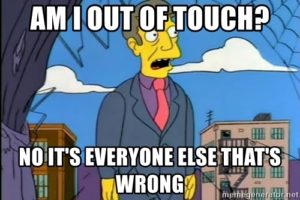
And here it is two and a half years later, and they’re still displaying the same arrogance and making the same stupid mistakes. Nothing can shake their faith in their own smug sense of superiority. And so, instead of reporting actual news, they continue to pimp Russian conspiracy theories and Stormy Daniels and wonder why we’ve tuned them out.
The same people love to conflate contempt for their biased selves into contempt for the freedom of the press and the First Amendment. This is patently false. Ordinary Americans love the First Amendment. It’s the current smug, biased, dishonest incarnation of the MSM that we hate.
Look in the mirror. We don’t hate the free press. We hate you. Personally. And our loathing for you smug pricks dates back to long before Donald Trump ever threw his hat into the ring…
It’s both puzzling and gratifying to see the American left make the same mistakes over and over again. Thinking that American voters will take kindly to their open borders and socialism platform is one. Refusing to learn just how President Donald Trump operates, despite ample opportunity to observe him, is another.
Scott Adams has already discussed Trump’s persuasion techniques at length, but here’s another approach to describing how Trump works:
I’m continually amazed at the legions of politicos, pundits and so-called ‘experts’ who don’t understand President Trump or how he conducts policy.
These elites have a mental model of how a president is supposed to behave and how the policymaking process is supposed to be carried out. Obviously, Trump does not fit their model.
Instead of trying to grasp the model that Trump does use, they continually berate and disparage Trump for not living up to their expectations. A more thoughtful group would say, “Well, he’s different, so why don’t we try to understand the differences and analyze the new model?”
Really, these people need to get out of Washington, New York and Hollywood more and get away from their screens. If they knew more everyday Americans, they would come a lot closer to understanding how Trump gets things done.
It’s not chaos; it’s just a little different and more down to earth.
This is because of Trump’s “art of the deal” style described in his best-selling book by that name. Bush 43 and Obama were totally process-driven. You could see events coming a mile away as they wound their way through the West Wing and Capitol Hill deliberative processes.
All you had to do was understand the process and you could forecast big developments in a relatively straightforward way.
With Trump, there is a process, but it does not adhere to a timeline or existing template. Trump seems to be the only process participant most of the time.
Here’s the Trump process:
- Identify a big goal (tax cuts, balanced trade, the wall, etc.).
- Identify your leverage points versus anyone who stands in your way (elections, tariffs, jobs, etc.).
- Announce some extreme threat against your opponent that uses your leverage.
- If the opponent backs down, mitigate the threat, declare victory and go home with a win.
- If the opponent fires back, double down. If Trump declares tariffs on $50 billion of good from China,and China shoots back with tariffs on $50 billion of goods from the U.S., Trump doubles down with tariffs on $100 billion of goods, etc. Trump will keep escalating until he wins.
- Eventually, the escalation process can lead to negotiations with at least the perception of a victory for Trump (North Korea) — even if the victory is more visual than real.
No one else in Washington thinks this way. Washington insiders try to avoid confrontation, avoid escalation, compromise from the beginning and finesse their way through any policy process.
Trump is in a league of his own. What amazes me is that the media still do not understand his style and keep taking the bait when he announces something crazy, as in Step 3 above.
That nicely fits the data, doesn’t it?
But why actually seek to understand what President Trump is doing and how he works when you can continue to sprawl in the comforting embrace of Trump Derangement Syndrome and shriek about how he’s insane and reckless and needs to be impeached right away?
It is said that if you know your enemies and know yourself, you will not be imperiled in a hundred battles; if you do not know your enemies but do know yourself, you will win one and lose one; if you do not know your enemies nor yourself, you will be imperiled in every single battle. – Sun Tzu, The Art of War
Trump tweet: Just had some hummus. Delicious!
Jen Rubin column: Why I no longer love hummus
Max Boot column: Why Trump's love of hummus spells disaster for the Israeli-Palestinian conflict
Krassenstein tweet: Boycott all hummus. RETWEET IF YOU AGREE!
— neontaster (@neontaster) May 23, 2018
Remember when dislike of President Donald Trump was going to propel Democrats into control of both houses of congress in an unstoppable “blue wave”?
Well, that thinking is so 2017:
After months of confidence that public discontent with President Trump would lift Democrats back to power in Congress, some party leaders are fretting that their advantages in this year’s midterms are eroding amid a shifting political landscape.
Driving their concerns are Trump’s approval rating, which has ticked upward in recent weeks, and high Republican turnout in some recent primaries, suggesting the GOP base remains energized. What’s more, Republicans stand to benefit politically from a thriving economy and are choosing formidable candidates to take on vulnerable Democratic senators.
One of their biggest sources of anxiety is the Senate race in Florida, where some Democrats fear that three-term Sen. Bill Nelson has not adequately prepared to defend his seat against Gov. Rick Scott, a well-financed former businessman handpicked for the race by Trump. Scott and Nelson are close in early polls.
“I’m concerned about the race. I think everybody is,” said Ione Townsend, the Democratic Party chair in Hillsborough County, home to Tampa. Townsend said it will “be hard to compete” with Scott’s money.
The growing alarm about Nelson, one of 10 Democratic senators running this year in a state won by Trump in 2016, prompted the Senate’s top Democrat, Charles E. Schumer (N.Y.), to sound the alarm a few months ago in a private meeting in which he pleaded with Nelson to step up his efforts and hire a campaign manager, which he did not do until March, according to people familiar with the conversation.
In West Virginia, where Trump won by about 42 points and Republicans gave the president credit last week for urging voters to reject the primary candidacy of a former coal executive who had served jail time, Democratic Sen. Joe Manchin III acknowledged that Trump’s popularity in the state is a major boon for the Republicans.
“The more he can stay out of West Virginia and direct his energies elsewhere would be helpful,” Manchin said.
Does Manchin actually think President Trump’s going to take that advice?
In another sign that Democrats’ “All Trump Derangement Syndrome, All The Time” platform isn’t winning over voters, former San Francisco Mayor Willie Brown says they need to cut it out:
It’s time for the Democrats to stop bashing President Trump.
It’s not going to be easy, given his policies and personality. It might even mean checking into a 12-step program. But setting a winning agenda is like maneuvering an aircraft carrier. It takes time to change course. And if they want to be on target for the November midterm elections, the Democrats need to start changing course now.
Like it or not, a significant number of Americans are actually happy these days. They are making money. They feel safe, and they agree with with the president’s protectionist trade policies, his call for more American jobs, even his immigration stance.
The jobs growth reports, the North Korea summit and the steady economy are beating out the Stormy Daniels scandal and the Robert Mueller investigation in Middle America, hands down.
So you are not going to win back the House by making it all about him.
Rather than stoking the base by attacking Trump, Democrats need to come up with a platform that addresses the average voters’ hopes and concerns. Not just the needs of underdogs or whatever cause happens to be the media flavor of the week.
Will Democrats heed his advice? I sincerely doubt they’re intellectually and emotionally capable of doing so. Democratic elites hate President Trump on an even more visceral level than they hated Bush43, and I doubt many are capable of dialing back the Trump Derangement Syndrome even if they wanted to…
Once again we have a case of Trump Derangement Syndrome that’s beyond parody, this time from “conservative” Max Boot:
Imagine if, after 9/11, the president saw the attack as a political embarrassment to be minimized rather than as a national security threat to be combated. That’s roughly where we stand after the 2nd-worst foreign attack on America in recent decades. Me: https://t.co/MatJYEJO9g
— Max Boot (@MaxBoot) February 19, 2018
If you find yourselves comparing a terrorist attack that killed nearly 3,000 people with thirteen trolls stirring up trouble online, maybe it’s time to step away from the Internet…
This close to Christmas it’s temping to throw in the towel and say “See you next year!” But I’m made of sterner stuff. Well, slightly sterner stuff, since this is some lazy blogging in its own right.
So here are two Charles Cooke exercises in swatting flies with howitzers.
First up: More Jennifer Rubin bashing! I know I linked another one in last week’s LinkSwarm, but this piece is delightful in its devastatingly restrained contempt:
Rubin is not the only example of this president’s remarkable talent for corrupting his detractors as well as his devotees, but she is perhaps the best one. Since Donald Trump burst onto the political scene, Rubin has become precisely what she dislikes in others: a monomaniac and a bore, whose visceral dislike of her opponents has prompted her to drop the keys to her conscience into a well. Since the summer of 2015, the many acolytes of “MAGA!” have agreed to subordinate their true views to whatever expediency is required to sustain Donald Trump’s ego. Out has gone their judgement, and in has come their fealty; where once there were thriving minds, now there are just frayed red hats. During the same period, Jennifer Rubin has done much the same thing. If Trump likes something, Rubin doesn’t. If he does something, she opposes it. If his agenda flits into alignment with hers—as anyone’s is wont to do from time to time—she either ignores it, or finds a way to downplay it. The result is farcical and sad; a comprehensive and self-inflicted airbrushing of the mind.
Snip.
If Trump is indeed a tyrant, he is a tyrant of the mind. And how potent is the control he exerts over Rubin’s. So sharp and so sudden are her reversals as to make effective parody impossible. When President Obama agreed to the Paris Climate Accord, Rubin left her readers under no illusions as to the scale of her disapproval. The deal, she proposed, was “ephemeral,” “a piece of paper,” “a group wish,” a “nonsense” that would achieve “nothing.” That the U.S. had been made a party to a covenant so “devoid of substance,” she added, illustrated the “fantasy world” in which the Obama administration lived, and was reflective of Obama’s preference for “phony accomplishments,” his tendency to distract, and his base’s craven willingness to eat up any “bill of goods” they were served. At least it did until President Trump took America out of it, at which point adhering to the position she had theretofore held became a “senseless act,” a “political act,” “a dog whistle to the far right,” and “a snub to ‘elites’” that had been calibrated to please the “climate-change denial, right-wing base that revels in scientific illiteracy” (a base that presumably enjoyed Rubin’s blog until January 20th, 2017). To abandon the “ephemeral” “piece of paper,” Rubin submitted, would “materially damage our credibility and our persuasiveness” and represent conduct unbecoming of “the leader of the free world.” One is left wondering how, exactly, any president is supposed to please her.
Read the whole thing, especially the bit about “her self-appointed tenure as the president of Mitt Romney’s fan club.” (“Cruel, but fair!”)
Next on the list: 70s leftist TV fossil Ed Asner’s ludicrous assertion in Salon (natch) that America was “founded on gun control.” It’s like a barrel of tightly-packed herring.
Having proposed that Congress, the Supreme Court, and the majority of Americans “claim the Second Amendment is not simply about state militias but guarantees the unfettered right of everyone to own, carry, trade and eventually shoot someone with a gun” — ah, yes, the right to “eventually shoot someone with a gun,” so beloved to those of us who can read — Asner and his co-author, Ed Weinberger, proceed to offer up the most comprehensively illiterate and most embarrassingly researched example within what is, alas, a growing genre. As an example of Second Amendment trutherism, this one will likely never be beaten.
We might start with the purely factual errors. Asner and Weinberger claim that “as written, the Second Amendment follows closely in meaning and in language previous state and national Constitutions — all of which explicitly refer to militias and not individuals.” This is wrong. The Second Amendment was ratified in 1791, which is 15 years after Vermont’s Bill of Rights, which held that “the people have a right to bear arms for the defence of themselves and the state”; 15 years after North Carolina’s Bill of Rights, which proposed that “the people have a right to bear arms, for the defence of the State”; and a year after Pennsylvania’s Declaration of Rights, which ensured that “the right of the citizens to bear arms in defence of themselves and the State shall not be questioned.” It is also eleven years after Massachusetts confirmed that “the people have a right to keep and to bear arms for the common defence” — a plain statement that, like the others quoted, contains no references to a “militia,” “explicit” or otherwise, but does mention “the people.”
Other spurious claims are dismantled at great length:
As for the “Framers’ intent” and the “historical context,” both of these line up squarely on the side of what is, for good reason, described as the “Standard Model.” It cannot be repeated often enough that the “odd” position in the debate over the Second Amendment is not the one taken by the Supreme Court, but the preposterous “collective right” theory that Asner, Weinberger, and a handful of other truthers have taken to peddling in the modern era. To “study the history,” as Asner commands, is to discover this immediately, and thereby to realize the absurdity of the claims that the United States was “founded on gun control”; that our “American forefathers limited any and all freedoms when they clashed with public safety”; and that, ultimately, the Constitution was written because “the Founders were afraid of guns.” It wasn’t. They didn’t. And they weren’t. Rather, they understood that they had entrenched within the federal Constitution the principle that, as St. George Tucker put it in 1803,
The right of the people to keep and bear arms shall not be infringed. Amendments to C. U. S. Art. 4, and this without any qualification as to their condition or degree, as is the case in the British government
Which meant, as William Rawle wrote in his seminal A View of the Constitution of the United States of America, that:
The prohibition is general. No clause in the Constitution could by any rule of construction be conceived to give to congress a power to disarm the people. Such a flagitious attempt could only be made under some general pretence by a state legislature.
Or, as outlined by Supreme Court Justice Joseph Story in his influential 1833 work, Commentaries on the Constitution,
The right of the citizens to keep and bear arms has justly been considered, as the palladium of the liberties of a republic; since it offers a strong moral check against the usurpations and arbitrary power of rulers; and it will generally, even if these are successful in the first instance, enable the people to resist and triumph over them.
The right of the citizens to keep and bear arms has justly been considered, as the palladium of the liberties of a republic; since it offers a strong moral check against the usurpations and arbitrary power of rulers; and it will generally, even if these are successful in the first instance, enable the people to resist and triumph over them.
Know who else wrote like this? James Madison, a man whom Asner and Weinberger inexplicably cast as a “scared’ gun-controller. A quick reading of Federalist 46 – in which Madison distinguished repeatedly between “the advantage of being armed, which the Americans possess over the people of almost every other nation” and “the existence of subordinate governments, to which the people are attached, and by which the militia officers are appointed” — should suffice to disabuse anybody of the first position. In Europe, Madison observed in the same document, “governments are afraid to trust the people with arms”; in America, those people had won independence, and they would do so again if it came to it. There is no way of squaring this document with the claim that Madison was either against the private ownership or arms per se, or that he wished it to be contingent upon militia service.
Cooke offers a testbook dismantlement of claims so transparently shoddy it would be something of a surprise liberals were still making them, save that so many seem congenitally incapable of learning from history..